


Acts 18:27
Bible text: King James Version (1769 Blayney text) · Public domain
Bible text: King James Version with Strong's numbers · Public domain
Bible text: Berean Standard Bible · Public domain
Bible text: American Standard Version (1901) · Public domain
Bible text: World English Bible, Messianic edition · Public domain
Bible text: Geneva Bible (1599) · Public domain
Bible text: Young's Literal Translation · Public domain
- βουλομένουboulomenouWhen is resolvingG1014V-PNP-GSMVerb Present Middle Or Passive Deponent Participle Genitive Singular Masculine
- δὲdethenG1161CONJConjunction
- αὐτοῦautouheG846P-GSMPersonal pronoun Genitive Singular Masculine
- διελθεῖνdieltheinto pass throughG1330V-2AANVerb 2nd Aorist Active Infinitive
- εἰςeisintoG1519PREPPreposition
- τὴνtēn<the>G3588T-ASFDefinite article Accusative Singular Feminine
- ἈχαΐανAchaianAchaiaG882N-ASF-LNoun Accusative Singular Feminine Location
- προτρεψάμενοιprotrepsamenoihaving encouraged [him]G4389V-AMP-NPMVerb Aorist Middle Participle Nominative Plural Masculine
- οἱhoitheG3588T-NPMDefinite article Nominative Plural Masculine
- ἀδελφοὶadelphoibrothersG80N-NPMNoun Nominative Plural Masculine
- ἔγραψανegrapsanwroteG1125V-2AAI-3PVerb 2nd Aorist Active Indicative 3rd Plural
- τοῖςtoisto theG3588T-DPMDefinite article Dative Plural Masculine
- μαθηταῖςmathētaisdisciplesG3101N-DPMNoun Dative Plural Masculine
- ἀποδέξασθαιapodexasthaito welcomeG588V-ADNVerb Aorist Middle Deponent Infinitive
- αὐτόν·autonhimG846P-ASMPersonal pronoun Accusative Singular Masculine
- ὃςhoswhoG3739R-NSMRelative pronoun Nominative Singular Masculine
- παραγενόμενοςparagenomenoshaving arrivedG3854V-2ADP-NSMVerb 2nd Aorist Middle Deponent Participle Nominative Singular Masculine
- συνεβάλετοsunebaletohe helpedG4820V-2AMI-3SVerb 2nd Aorist Middle Indicative 3rd Singular
- πολὺpolugreatlyG4183A-ASNAdjective Accusative Singular Neuter
- τοῖςtoisthoseG3588T-DPMDefinite article Dative Plural Masculine
- πεπιστευκόσινpepisteukosinhaving believedG4100V-RAP-DPMVerb Perfect Active Participle Dative Plural Masculine
- διὰdiathroughG1223PREPPreposition
- τῆςtēs<the>G3588T-GSFDefinite article Genitive Singular Feminine
- χάριτος·charitosgraceG5485N-GSFNoun Genitive Singular Feminine
English is a literal word-by-word gloss of the Greek, not the KJV's wording. Why?
This is the original text the KJV's translators worked from — each Greek word with its own literal English meaning in this verse, prepared by scholars at Tyndale House, Cambridge. The KJV translates whole sentences, not word by word, so its wording differs: one Greek word can become several English words, and the KJV may choose “charity” where the gloss reads “love”. Both are faithful — they answer different questions. For the KJV's own rendering, switch to the KJV text.
Details
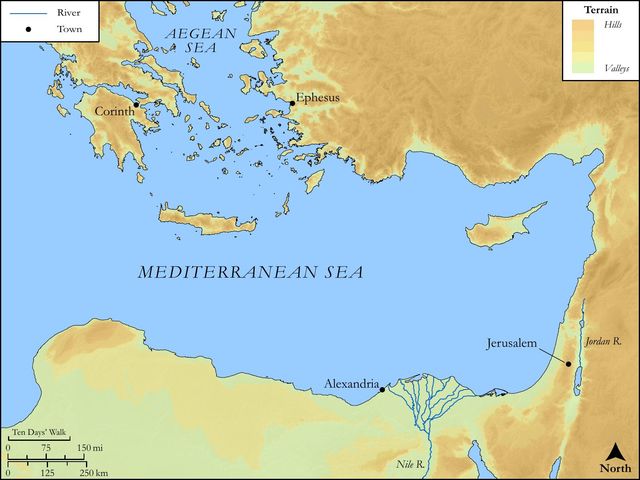
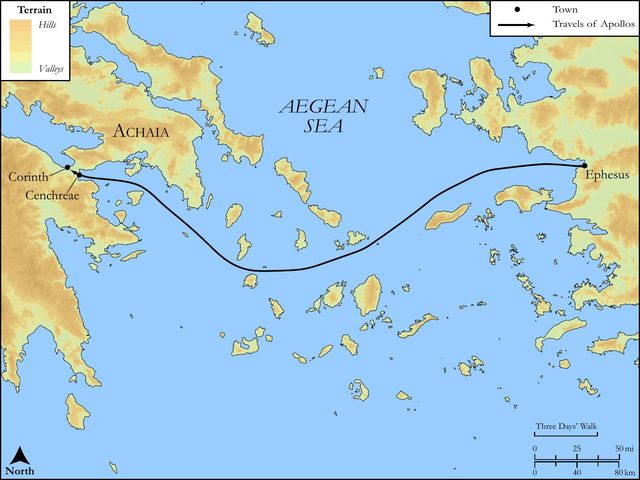
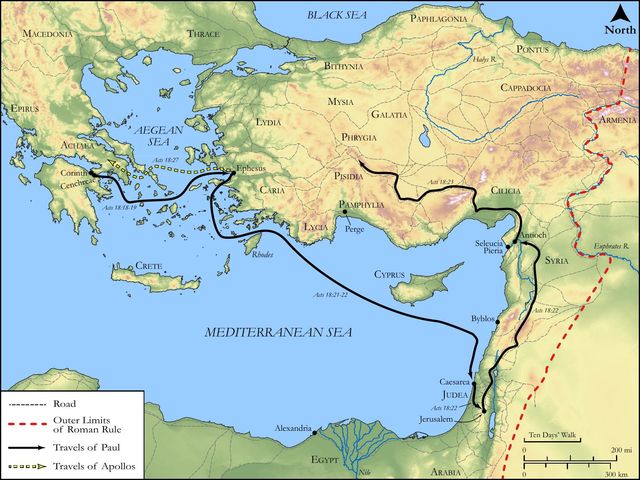
See on the biblical-era maps
Study this verse
Public-domain commentary
Matthew Henry
From his Commentary on the Whole Bible. Henry comments on passages, not single verses — this entry covers Acts 18:24–28. His four-level outline is real structure in the source text, so it is rendered as structure.
The sacred history leaves Paul upon his travels, and goes here to meet Apollos at Ephesus, and to give us some account of him, which was necessary to our understanding some passages in Paul's epistles.
I.Here is an account of his character, when he came to Ephesus.
1.He was a Jew, born at Alexandria in Egypt, but of Jewish parents; for there were abundance of Jews in that city, since the dispersion of the people, as it was foretold (Deu 28:68): The Lord shall bring thee into Egypt again. His name was not Apollo, the name of one of the heathen gods, but Apollos, some think the same with Apelles, Rom 16:10.
2.He was a man of excellent good parts, and well fitted for public service. He was an eloquent man, and mighty in the scriptures of the Old Testament, in the knowledge of which he was, as a Jew, brought up.
(1.)He had a great command of language: he was an eloquent man; he was anēr logios - a prudent man, so some; a learned man, so others; historiarum peritus - a good historian, which is an excellent qualification for the ministry: he was one that could speak well, so it properly signifies; he was an oracle of a man; he was famous for speaking pertinently and closely, fully and fluently, upon any subject.
(2.)He had a great command of scripture-language, and this was the eloquence he was remarkable for. He came to Ephesus, being mighty in the scriptures, so the words are placed; having an excellent faculty of expounding scripture, he came to Ephesus, which was a public place, to trade with that talent, for the honour of God and the good of many. He was not only ready in the scriptures, able to quote texts off-hand, and repeat them, and tell you where to find them (many of the carnal Jews were so, who were therefore said to have the form of knowledge, and the letter of the law); but he was mighty in the scriptures. He understood the sense and meaning of them, he knew how to make use of them and to apply them, how to reason out of the scriptures, and to reason strongly; a convincing, commanding, confirming power went along with all his expositions and applications of the scripture. It is probable he had given proof of his knowledge of the scriptures, and his abilities in them, in many synagogues of the Jews.
3.He was instructed in the way of the Lord; that is, he had some acquaintance with the doctrine of Christ, had obtained some general notions of the gospel and the principles of Christianity, that Jesus is the Christ, and that prophet that should come into the world; the first notice of this would be readily embraced by one that was so mighty in the scripture as Apollos was, and therefore understood the signs of the times. He was instructed, katēchēmenos - he was catechised (so the word is), either by his parents or by ministers; he was taught something of Christ and the way of salvation by him. Those that are to teach others must first be themselves taught the word of the Lord, not only to talk of it, but to walk in it. It is not enough to have our tongues tuned to the word of the Lord, but we must have our feet directed into the way of the Lord.
4.Yet he knew only the baptism of John; he was instructed in the gospel of Christ as far as John's ministry would carry him, and no further; he knew the preparing of the way of the Lord by that voice crying in the wilderness, rather than the way of the Lord itself. We cannot but think he had heard of Christ's death and resurrection, but he was not let into the mystery of them, had not had opportunity of conversing with any of the apostles since the pouring out of the Spirit; or he had himself been baptized only with the baptism of John, but was not baptized with the Holy Ghost, as the disciples were at the day of pentecost.
II.We have here the employment and improvement of his gifts at Ephesus; he came thither, seeking opportunities of doing and getting good, and he found both.
1.He there made a very good use of his gifts in public. He came, probably, recommended to the synagogue of the Jews as a fit man to be a teacher there, and according to the light he had, and the measure of the gift given to him, he was willing to be employed (Act 18:25): Being fervent in the Spirit, he spoke and taught diligently the things of the Lord. Though he had not the miraculous gifts of the Spirit, as the apostles had, he made use of the gifts he had; for the dispensation of the Spirit, whatever the measure of it is, is given to every man to profit withal. And our Savior, by a parable, designed to teach his ministers that though they had but one talent they must not bury that. We have seen how Apollos was qualified with a good head and a good tongue: he was an eloquent man, and mighty in the scriptures; he had laid in a good stock of useful knowledge, and had an excellent faculty of communicating it. Let us now see what he had further to recommend him as a preacher; and his example is recommended to the intimation of all preachers.
(1.)He was a lively affectionate preacher; as he had a good head, so he had a good heart; he was fervent in Spirit. He had in him a great deal of divine fire as well as divine light, was burning as well as shining. He was full of zeal for the glory of God, and the salvation of precious souls. This appeared both in his forwardness to preach when he was called to it by the rulers of the synagogue, and in his fervency in his preaching. He preached as one in earnest, and that had his heart in his work. What a happy composition was here! Many are fervent in spirit, but are weak in knowledge, in scripture-knowledge - have far to seek for proper words and are full of improper ones; and, on the other hand, many are eloquent enough, and mighty in the scriptures, and learned, and judicious, but they have no life or fervency. Here was a complete man of God, thoroughly furnished for his work; both eloquent and fervent, full both of divine knowledge and of divine affections.
(2.)He was an industrious laborious preacher. He spoke and taught diligently. He took pains in his preaching, what he delivered was elaborate; and he did not offer that to God, or to the synagogue, that either cost nothing or cost him nothing. He first worked it upon his own heart, and then laboured to impress it on those he preached to: he taught diligently, akribōs - accurately, exactly; every thing he said was well-weighed.
(3.)He was an evangelical preacher. Though he knew only the baptism of John, yet that was the beginning of the gospel of Christ, and to that he kept close; for he taught the things of the Lord, of the Lord Christ, the things that tended to make way for him, and to set him up. The things pertaining to the kingdom of the Messiah were the subjects he chose to insist upon; not the things of the ceremonial law, though those would be pleasing to his Jewish auditors; not the things of the Gentile philosophy, though he could have discoursed very well on those things; but the things of the Lord.
(4.)He was a courageous preacher: He began to speak boldly in the synagogue, as one who, having put confidence in God, did not fear the face of man; he spoke as one that knew the truth of what he said, and had no doubt of it, and that knew the worth of what he said and was not afraid to suffer for it; in the synagogue, where the Jews not only were present, but had power, there he preached the things of God, which he knew they were prejudiced against.
2.He there made a good increase of his gifts in private, not so much in study, as in conversation with Aquila and Priscilla. If Paul or some other apostle or evangelist had been at Ephesus, he would have instructed him; but, for want of better help, Aquila and Priscilla (who were tent-makers) expounded to him the way of God more perfectly. Observe,
(1.)Aquila and Priscilla heard him preach in the synagogue. Though in knowledge he was much inferior to them, yet, having excellent gifts for public service, they encouraged his ministry, by a diligent and constant attendance upon it. Thus young ministers, that are hopeful, should be countenanced by grown Christians, for it becomes them to fulfil all righteousness.
(2.)Finding him defective in his knowledge of Christianity, they took him to them, to lodge in the same house with them, and expounded to him the way of God, the way of salvation by Jesus Christ, more perfectly. They did not take occasion from what they observed of his deficiency either to despise him themselves, or to disparage him to others; did not call him a young raw preacher, not fit to come into a pulpit, but considered the disadvantages he had laboured under, as knowing only the baptism of John; and, having themselves got great knowledge in the truths of the gospel by their long intimate conversation with Paul, they communicated what they knew to him, and gave him a clear, distinct, and methodical account of those things which before he had but confused notions of.
[1.]See here an instance of that which Christ has promised, that to him that hath shall be given; he that has, and uses what he has, shall have more. He that diligently traded with the talent he had doubled it quickly.
[2.]See an instance of truly Christian charity in Aquila and Priscilla; they did good according to their ability. Aquila, though a man of great knowledge, yet did no undertake to speak in the synagogue, because he had not such gifts for public work as Apollos had; but he furnished Apollos with matter, and then left him to clothe it with acceptable words. Instructing young Christians and young ministers privately in conversation, who mean well, and perform well, as far as they go, is a piece of very good service, both to them and to the church.
[3.]See an instance of great humility in Apollos. He was a very bright young man, of great parts and learning, newly come from the university, a popular preacher, and one mightily cried up and followed; and yet, finding that Aquila and Priscilla were judicious serious Christians, that could speak intelligently and experimentally of the things of God, though they were but mechanics, poor tent-makers, he was glad to receive instructions from them, to be shown by them his defects and mistakes, and to have his mistakes rectified by them, and his deficiencies made up. Young scholars may gain a great deal by converse with old Christians, as young students in the law may by old practitioners. Apollos, though he was instructed in the way of the Lord, did not rest in the knowledge he had attained, nor thought he understood Christianity as well as any man (which proud conceited young men are apt to do), but was willing to have it expounded to him more perfectly. Those that know much should covet to know more, and what they know to know it better, pressing forward towards perfection.
[4.]Here is an instance of a good woman, though not permitted to speak in the church or in the synagogue, yet doing good with the knowledge God had given her in private converse. Paul will have the aged women to be teachers of good things Tit 2:3, Tit 2:4.
III.Here is his preferment to the service of the church of Corinth, which was a larger sphere of usefulness than Ephesus at present was.
Paul had set wheels a-going in Achaia and particularly at Corinth, the county-town. Many were stirred up by his preaching to receive the gospel, and they needed to be confirmed; and many were likewise irritated to oppose the gospel, and they needed to be confuted. Paul was gone, was called away to other work, and now there was a fair occasion in this vacancy for Apollos to set in, who was fitted rather to water than to plant, to build up those that were within than to bring in those that were without. Now here we have,
1.His call to this service, not by a vision, as Paul was called to Macedonia, no, nor so much as by the invitation of those he was to go to; but,
(1.)He himself inclined to go: He was disposed to pass into Achaia; having heard of the state of the churches there, he had a mind to try what good he could do among them. Though there were those there who were eminent for spiritual gifts, yet Apollos thought there might be some work for him, and God disposed his mind that way.
(2.)His friends encouraged him to go, and approved of his purpose; and, he being a perfect stranger there, they gave him a testimonial or letters of recommendation, exhorting the disciples in Achaia to entertain him and employ him. In this way, among others, the communion of churches is kept up, by the recommending of members and ministers to each other, when ministers, as Apollos here, are disposed to remove. Though those at Ephesus had a great loss of his labours, they did not grudge those in Achaia the benefit of them; but, on the contrary, used their interest in them to introduce him; for the churches of Christ, though they are many, yet they are one.
2.His success in this service, which both ways answered his intention and expectation; for,
(1.)Believers were greatly edified, and those that had received the gospel were very much confirmed: He helped those much who had believed through grace. Note,
[1.]Those who believe in Christ, it is through grace that they believe; it is not of themselves, it is God's gift to them; it is his work in them.
[2.]Those who through grace do believe, yet still have need of help; as long as they are here in this world there are remainders of unbelief, and something lacking in their faith to be perfected, and the work of faith to be fulfilled.
[3.]Faithful ministers are capable of being in many ways helpful to those who through grace do believe, and it is their business to help them, to help them much; and, when a divine power goes along with them, they will be helpful to them.
(2.)Unbelievers were greatly mortified. Their objections were fully answered, the folly and sophistry of their arguments were discovered, so that they had nothing to say in defence of the opposition they made to the gospel; their mouths were stopped, and their faces filled with shame (Act 18:28): He mightily convinced the Jews, and that publicly, before the people; he did it, eutonōs - earnestly, and with a great deal of vehemence; he took pains to do it; his heart was upon it, as one that was truly desirous both to serve the cause of Christ and to save the souls of men. He did it effectually and to universal satisfaction. He did it levi negotio - with facility. The case was so plain, and the arguments were so strong on Christ's side, that it was an easy matter to baffle all that the Jews could say against it. Though they were so fierce, yet their cause was so weak that he made nothing of their opposition. Now that which he aimed to convince them of was that Jesus is the Christ, that he is the Messiah promised to the fathers, who should come, and they were to look for not other. If the Jews were but convinced of this - that Jesus is Christ, even their own law would teach them to hear him. Note, The business of ministers is to preach Christ: We preach not ourselves, but Christ Jesus the Lord. The way he took to convince them was by the scriptures; thence he fetched his arguments; for the Jews owned the scriptures to be of divine authority, and it was easy for him, who was mighty in the scriptures, from them to show that Jesus is the Christ. Note, Ministers must be able not only to preach the truth, but to prove it and defend it, and to convince gainsayers with meekness and yet with power, instructing those that oppose themselves; and this is real service to the church.
Historical interpretation
Three Centuries of Reception
2 surviving comments on this verse. Each one is dated, so this reads as a timeline rather than a list.
Select a marker to jump to its quote. Markers stagger vertically where authors wrote within a few decades of each other.
"And when he was disposed to pass into Achaia, the brethren wrote, exhorting the disciples to receive him." He wished then also to depart into Achaia, and these also encouraged him to do so, having also given him letters. In faith, he did all by faith; "the brethren wrote," etc. Nowhere envy, nowhere an evil eye. Aquila teaches, or rather this man lets himself be taught. He was minded to depart, and they send letters.
When he came, he conferred much with those who believed. For he vigorously confuted the Jews. Another translation has: He greatly benefited the believers by grace. This is what the Apostle writes to the Achaians: "I planted, Apollos watered" (I Cor. III).
Continue studying Acts 18:27 across the web’s major study libraries — every link below opens this exact verse, chapter, or book on the destination site.
Read & Compare
 BibleGatewayThis verse in more than 200 translations and 70 languages.
 Bible.comThe YouVersion reader — hundreds of translations, reading plans, and highlights.
 ESV.orgCrossway's official English Standard Version reader.
 NET BibleThe NET translation with 60,000+ translators' notes on every rendering decision.
 STEP BibleTyndale House's free study tool — original text, vocabulary, and scholarly resources.
 BibliaLogos Bible Software's free web reader.
 USCCBThe New American Bible (Revised Edition) with the U.S. bishops' study notes.
Commentaries
 BibleHub CommentariesDozens of classic commentaries on this verse, gathered on one page.
 StudyLightMore than 100 commentary sets — the largest collection on the web.
 BibleRefPlain-English commentary on what this verse means, verse by verse.
 Enduring WordDavid Guzik's free commentary on this chapter, widely used by Bible teachers.
 Bible Study ToolsVerse commentary alongside Greek and Hebrew study aids.
Original Language & Research
- BibleHub InterlinearThe verse word by word — original language, transliteration, and English.
- BibleHub LexiconEvery word's original-language definition and Strong's entry.
 Blue Letter BibleDeep-study tools — Strong's numbers, concordance, and word studies.
 CNTR CollationThe earliest Greek manuscripts of this verse, collated letter by letter.
Sermons, Hymns & Audio


TrulyRandomVerse is not affiliated with these sites and doesn’t control their content. They’re linked because they’re genuinely useful.
Summary
Acts 18:27 describes the significant transition of Apollos from Ephesus to Achaia, highlighting the early church's practice of communal support and commendation for ministers. It underscores the divine enablement of Apollos's ministry, which profoundly strengthened believers who had come to faith through God's unmerited favor, setting the stage for his impactful work in Corinth and emphasizing the centrality of grace in Christian experience and growth.
Context
ShowHideLiterary Context
This verse immediately follows Apollos's spiritual refinement by Priscilla and Aquila in Ephesus, where they "expounded unto him the way of God more perfectly." Prior to this, Apollos is introduced as an eloquent and knowledgeable Jew from Alexandria, "mighty in the scriptures," who taught accurately about Jesus but only knew "the baptism of John" (Acts 18:24-25). Acts 18:27 thus serves as a bridge, detailing the Ephesian brethren's initiative to facilitate Apollos's ministry in Achaia, specifically preparing him for the challenges and opportunities in Corinth, a city where Paul had recently established a church and faced significant opposition (Acts 18:1-17). This transition is crucial for understanding the subsequent dynamics within the Corinthian church, particularly the factions that later emerged around Paul and Apollos, as addressed in 1 Corinthians 1-4.
Historical & Cultural Context
Achaia was a Roman senatorial province encompassing much of southern Greece, with Corinth as its capital. It was a strategic hub for trade, culture, and intellectual discourse, making it a vital center for the spread of the Gospel. The practice of writing letters of commendation, as seen here, was common in that day, both within secular and religious spheres. Such letters served as credentials, vouching for a person's character, doctrine, and mission, thereby ensuring their acceptance and support within new communities. For the early church, which lacked centralized authority structures, these letters were indispensable for maintaining unity, preventing false teachers, and facilitating the movement of evangelists and teachers. This cultural norm provided a practical means for the nascent Christian movement to expand its reach while preserving doctrinal integrity.
Key Themes
ShowHideActs 18:27 contributes to several overarching themes in the book of Acts and the broader New Testament. Firstly, it highlights the theme of Divine Providence and Guidance, as Apollos's desire to go to Achaia aligns with God's plan for the spread of the Gospel, facilitated by the Ephesian believers. Secondly, it powerfully illustrates Communal Support and Partnership in Ministry, demonstrating how believers collaborate to advance God's kingdom, recognizing and affirming one another's gifts. The "brethren" in Ephesus actively participate in Apollos's mission, not merely observing. Thirdly, the verse underscores the Centrality of Grace in the Christian life and ministry. The phrase "believed through grace" emphasizes that faith itself is a gift and an outworking of God's unmerited favor, a foundational theological truth echoed throughout the New Testament, particularly in Pauline epistles (e.g., Ephesians 2:8-9). Finally, it showcases the Effectiveness of Spirit-Empowered Teaching, as Apollos's ministry "helped them much," affirming the vital role of sound doctrine and eloquent proclamation in nurturing and strengthening believers. This sets the stage for Apollos's significant role in the Corinthian church, as later referenced by Paul in 1 Corinthians 3:6.
Exposition and Analysis
ShowHideKey Word Analysis
ShowHideThis word, derived from a primary verb, means "to will," or reflexively, "to be willing." In this context, it indicates Apollos's strong internal desire or intention to travel to Achaia. It suggests a purposeful, deliberate inclination, likely guided by the Holy Spirit, rather than a casual whim. This "willingness" is an active state of mind, signifying his readiness and resolve to engage in ministry in a new region.
This middle voice verb literally means "to turn forward for oneself," and by implication, "to encourage" or "to urge forward." The Ephesian brethren's act of "exhorting" the disciples in Achaia to receive Apollos was more than a mere suggestion; it was a strong recommendation or encouragement. It implies a persuasive appeal designed to ensure Apollos's warm reception and full integration into the local Christian community, recognizing his value and the spiritual benefit he would bring.
This rich theological term refers to "graciousness," "favor," or "divine influence upon the heart." Here, it specifically denotes God's unmerited favor as the instrumental cause of the believers' faith. Their belief was not achieved through human effort or merit, but was enabled and sustained by God's sovereign, benevolent action. This emphasizes that salvation and spiritual growth are fundamentally gifts from God, highlighting the divine initiative in the process of conversion and sanctification.
Verse Breakdown
ShowHide"And when he was disposed to pass into Achaia,"
This clause establishes Apollos's personal initiative and intention. Having been further instructed by Priscilla and Aquila in Ephesus, Apollos felt a strong inner leading or desire (disposed) to extend his ministry to the Roman province of Achaia, particularly to Corinth, where a significant church had been established. This highlights his zeal and strategic thinking for the Gospel's advance.
"the brethren wrote, exhorting the disciples to receive him:"
Recognizing Apollos's gifts and his earnest desire, the Christian community in Ephesus, referred to as "the brethren," took a proactive step. They composed a letter of commendation, a common practice in the early church, urging the believers (disciples) in Achaia to welcome Apollos. This act demonstrates communal support, mutual trust, and a shared commitment to facilitating effective ministry across geographical boundaries, ensuring Apollos's legitimacy and acceptance.
"who, when he was come, helped them much"
This part describes the immediate and significant impact of Apollos's arrival and ministry. Upon reaching Achaia, Apollos proved to be a tremendous asset, providing substantial spiritual assistance and strengthening to the local believers. The word "helped" (symbállō) implies a collaborative contribution, suggesting he engaged them in discourse, clarified understanding, and provided powerful arguments for the faith, leading to significant spiritual growth and consolidation within the community.
"which had believed through grace:"
This concluding phrase is a profound theological statement. It clarifies the nature of the faith held by those Apollos helped. Their belief was not merely an intellectual assent or a product of human will, but it was enabled and sustained "through grace"—God's unmerited favor and divine influence. This emphasizes that their salvation and spiritual vitality were ultimately a work of God, making Apollos's ministry an instrument of that divine grace, building upon a foundation already laid by God's sovereign initiative.
Literary Devices
ShowHideThe verse employs several significant literary devices. Narrative Progression is evident as Luke meticulously details the logical sequence of events: Apollos's inner disposition leads to the brethren's action, which in turn facilitates Apollos's journey and subsequent effective ministry. This creates a clear cause-and-effect chain. The use of Commendation through the written letter serves as a crucial plot device, highlighting the practical means by which the early church maintained unity and facilitated the spread of the Gospel, validating ministers and preventing false teachings. Finally, the concluding phrase "through grace" acts as a potent Theological Emphasis. By placing this phrase at the end, Luke underscores the divine enablement of faith and ministry, ensuring that the reader understands that Apollos's success, and indeed the believers' faith, is ultimately rooted in God's unmerited favor, not human effort or eloquence alone.
Theological and Thematic Connections
ShowHideActs 18:27 beautifully weaves together themes of divine calling, communal support, and the fundamental role of grace in the Christian life. Apollos's disposition to minister in Achaia reflects a Spirit-led initiative, while the Ephesian brethren's letter of commendation exemplifies the early church's understanding of mutual accountability and partnership in the Gospel. Most profoundly, the verse highlights that genuine faith is not self-generated but is a gift, a divine work enabled "through grace." This serves as a powerful reminder that all spiritual fruitfulness, both in the believer's life and in ministry, flows from God's unmerited favor, providing both the foundation for salvation and the power for effective service.
Reflection and Application
ShowHideActs 18:27 offers profound insights for contemporary believers and the church. It reminds us that God often works through the willing hearts of His servants, like Apollos, who are "disposed" to advance His kingdom. This disposition, however, is not a solitary endeavor but is often affirmed and facilitated by the body of Christ. The practice of commendation, though perhaps not always in the form of a physical letter today, translates into the vital need for churches to recognize, affirm, and send out those gifted for ministry, providing them with the necessary support and endorsement. Furthermore, the verse's emphasis on believers having "believed through grace" serves as a crucial theological anchor. It calls us to constantly remember and proclaim that salvation, spiritual growth, and the very ability to believe are sovereign acts of God's unmerited favor. This truth should cultivate humility, deepen our gratitude, and fuel our reliance on God, rather than on our own abilities or efforts. When we minister, like Apollos, our aim should be to "help much" by clearly articulating the message of grace, strengthening others in their faith, and pointing them to the divine source of all spiritual life.
Questions for Reflection
ShowHideFAQ
ShowHideWhat was the significance of the "letter of commendation" mentioned in Acts 18:27?
ShowHideThe letter of commendation was highly significant in the early church, serving as a vital credential for traveling ministers like Apollos. In a time before formal denominational structures or widespread communication, these letters provided a crucial means of authentication. They vouched for the character, doctrinal soundness, and mission of the bearer, ensuring they would be welcomed, trusted, and supported by local Christian communities. This practice helped to maintain unity within the burgeoning Christian movement, prevent the infiltration of false teachers, and facilitate the effective spread of the Gospel by validating those who ministered. Paul later refers to such letters, contrasting them with the transformed lives of believers as "letters of Christ" in 2 Corinthians 3:1-3.
How did Apollos "help them much" in Achaia?
ShowHideApollos "helped them much" primarily through his powerful and eloquent teaching, particularly his ability to demonstrate from the Scriptures that Jesus was the Christ (Acts 18:28). Having been more fully instructed by Priscilla and Aquila (Acts 18:26), Apollos was now equipped to clarify and deepen the understanding of those who had already come to faith. His ministry would have strengthened their theological foundations, provided robust apologetic arguments against Jewish opposition, and encouraged their spiritual growth. This "help" was instrumental in nurturing the nascent church in Corinth, building upon the foundation laid by Paul, as highlighted in 1 Corinthians 3:6.
Christ-Centered Fulfillment
ShowHideActs 18:27, while focusing on Apollos's ministry, ultimately points to Christ as the ultimate source and enabler of all spiritual life and effective service. Apollos's willingness to go to Achaia, the brethren's commendation, and his powerful impact are all channels through which God's grace flows. The phrase "believed through grace" is profoundly Christ-centered, for it is through Christ's redemptive work that God's unmerited favor is extended to humanity (Romans 3:24). Jesus is the embodiment of grace and truth (John 1:14), and it is His Spirit who empowers believers to have faith and ministers to serve effectively (Ephesians 4:7). Apollos, in "helping them much," was acting as an instrument of Christ, building up the body of Christ, which is the church (Ephesians 1:22-23). His ministry, empowered by grace, served to strengthen those whose faith was rooted in Christ's finished work, foreshadowing the ongoing work of Christ through His Spirit and His people to nourish and mature His church until His return (Colossians 1:28).