


Ezra 8:22
Bible text: King James Version (1769 Blayney text) · Public domain
Bible text: King James Version with Strong's numbers · Public domain
Bible text: Berean Standard Bible · Public domain
Bible text: American Standard Version (1901) · Public domain
Bible text: World English Bible, Messianic edition · Public domain
Bible text: Geneva Bible (1599) · Public domain
Bible text: Young's Literal Translation · Public domain
- כִּיkiforH3588PrtParticle Conditional
- בֹשְׁתִּיVo·she·tiI was ashamedH954V-Qal-Perf-1csVerb Qal Perfect 1st Singular common gender
- לִשְׁאוֹלlish·'olto askH7592Prep-l ¦ V-Qal-InfVerb Qal Infinitive Constructלִtoשְׁאוֹלask
- מִןminfromH4480PrepPreposition
- הַמֶּלֶךְha·Me·lekhthe kingH4428Art ¦ N-msNoun Singular Masculine Absoluteהַtheמֶּלֶךְking
- חַיִלCha·yilan escortH2428N-msNoun Singular Masculine Absolute
- וּפָרָשִׁיםu·fa·ra·Shimand horsemenH6571Conj-w ¦ N-mpNoun Plural Masculine Absoluteוּandפָרָשִׁיםhorsemen
- לְעָזְרֵנוּle·'a·ze·Re·nuto help usH5826Prep-l ¦ V-Qal-Inf ¦ 1cpVerb Qal Infinitive Constructלְtoעָזְרֵhelpנוּus
- מֵאוֹיֵבme·'o·Yevfrom an enemyH341Prep-m ¦ V-Qal-Prtcpl-msVerb Qal Participle Singular Masculine Absoluteמֵfromאוֹיֵבan enemy
- בַּדָּרֶךְba·Da·rekhon the journeyH1870Prep-b ¦ N-csNoun Singular common gender Absoluteבַּon theדָּרֶךְjourney
- כִּיkiforH3588PrtParticle Conditional
- אָמַרְנוּ'a·Mar·nuwe had saidH559V-Qal-Perf-1cpVerb Qal Perfect 1st Plural common gender
- לַמֶּלֶךְla·Me·lekhto the kingH4428Prep-l ¦ N-msNoun Singular Masculine Absoluteלַto theמֶּלֶךְking
- לֵאמֹרle·Mor<to> sayingH559Prep-l ¦ V-Qal-InfVerb Qal Infinitive Constructלֵ<to>אמֹרsaying
- יַדyad[the] hand ofH3027N-cscNoun Singular common gender Construct
- אֱלֹהֵינוּ'e·lo·Hei·nuour GodH430N-mpc ¦ 1cpNoun Plural Masculine ConstructאֱלֹהֵיGodנוּour
- עַל'al[is] onH5921PrepPreposition
- כָּלkolallH3605N-mscNoun Singular Masculine Construct
- מְבַקְשָׁיוme·vak·Shav[those who] seek himH1245V-Piel-Prtcpl-mp ¦ 3msVerb Piel Participle Plural Masculine Constructמְבַקְשָׁי[those who] seekוhim
- לְטוֹבָהle·to·Vahfor goodH2896Prep-l ¦ N-fsNoun Singular Feminine Absoluteלְforטוֹבָהgood
- וְעֻזּוֹve·'u·Zoand his strengthH5797Conj-w ¦ N-msc ¦ 3msNoun Singular Masculine Constructוְandעֻזּstrengthוֹhis
- וְאַפּוֹve·'a·Poand his angerH639Conj-w ¦ N-msc ¦ 3msNoun Singular Masculine Constructוְandאַפּangerוֹhis
- עַל'al[are] towardsH5921PrepPreposition
- כָּלkolallH3605N-mscNoun Singular Masculine Construct
- עֹזְבָיו'o·ze·Vav[those who] forsake himH5800V-Qal-Prtcpl-mp ¦ 3msVerb Qal Participle Plural Masculine Constructעֹזְבָי[those who] forsakeוhim
English is a literal word-by-word gloss of the Hebrew, not the KJV's wording. Why?
This is the original text the KJV's translators worked from — each Hebrew word with its own literal English meaning in this verse, prepared by scholars at Tyndale House, Cambridge. The KJV translates whole sentences, not word by word, so its wording differs: one Hebrew word can become several English words, and the KJV may choose “the LORD” where the gloss reads “Yahweh”. Both are faithful — they answer different questions. For the KJV's own rendering, switch to the KJV text.
Details
See on the biblical-era map
Study this verse
Public-domain commentary
Matthew Henry
From his Commentary on the Whole Bible. Henry comments on passages, not single verses — this entry covers Ezra 8:21–23. His two-level outline is real structure in the source text, so it is rendered as structure.
Ezra has procured Levites to go along with him; but what will that avail, unless he have God with him? That is therefore his chief care. In all our ways we must acknowledge God, and in those particularly wherein we are endeavouring to serve the interest of his kingdom among men. Ezra does so here. Observe,
I.The stedfast confidence he had in God and in his gracious protection.
He told the king (Ezr 8:22) what principles he went upon, that those who seek God are safe under the shadow of his wings, even in their greats dangers, but that those who forsake him are continually exposed, even when they are most secure. God's servants have his power engaged for them; his enemies have it engaged against them. This Ezra believed with his heart, and with his mouth made confession of it before the king; and therefore he was ashamed to ask of the king a convoy, lest thereby he should give occasion to the king, and those about him, to suspect either God's power to help his people or Ezra's confidence in that power. Those that trust in God, and triumph in him, will be ashamed of seeking to the creature for protection, especially of using any sorry shifts for their own safety, because thereby they contradict themselves and their own confidence. Not but that those who depend upon God must use proper means for their preservation, and they need not be ashamed to do so; but, when the honour of God is concerned, one would rather expose one's-self than do any thing to the prejudice of that, which ought to be dearer to us than our lives.
II.The solemn application he made to God in that confidence:
He proclaimed a fast, Ezr 8:21. No doubt he had himself begged of God direction in this affair from the first time he had it in his thoughts; but for public mercies public prayers must be made, that all who are to share in the comfort of them may join in the request for them. Their fasting was,
1.To express their humiliation. This he declares to be the intent and meaning of it. "that we might afflict ourselves before our God for our sins, and so be qualified for the pardon of them." When we are entering upon any new condition of life our care should be to bring none of the guilt of the sins of our former condition into it. When we are in any imminent peril let us be sure to make our peace with God, and then we are safe: nothing can do us any real hurt.
2.To excite their supplications. Prayer was always joined with religious fasting. Their errand to the throne of grace was to seek of God the right way, that is, to commit themselves to the guidance of the divine Providence, to put themselves under the divine protection, and to beg of God to guide and keep them in their journey and bring them safely to their journey's end. They were strangers in the road, were to march through their enemies' countries, and had not a pillar of cloud and fire to lead them, as their fathers had; but they believed that the power and favour of God, and the ministration of his angels, would be to them instead of that, and hoped by prayer to obtain divine assistance. Note, All our concerns about ourselves, our families, and our estates, it is our wisdom and duty by prayer to commit to God, and leave the care of with him, Phi 4:6.
III.The good success of their doing so (Ezr 8:23):
We besought our God by joint-prayer, and he was entreated of us. They had some comfortable assurance in their own minds that their prayers were answered, and the event declared it; for never any that sought God in earnest sought him in vain.
Continue studying Ezra 8:22 across the web’s major study libraries — every link below opens this exact verse, chapter, or book on the destination site.
Read & Compare
 BibleGatewayThis verse in more than 200 translations and 70 languages.
 Bible.comThe YouVersion reader — hundreds of translations, reading plans, and highlights.
 ESV.orgCrossway's official English Standard Version reader.
 NET BibleThe NET translation with 60,000+ translators' notes on every rendering decision.
 STEP BibleTyndale House's free study tool — original text, vocabulary, and scholarly resources.
 BibliaLogos Bible Software's free web reader.
 USCCBThe New American Bible (Revised Edition) with the U.S. bishops' study notes.
Commentaries
 BibleHub CommentariesDozens of classic commentaries on this verse, gathered on one page.
 StudyLightMore than 100 commentary sets — the largest collection on the web.
 BibleRefPlain-English commentary on what this verse means, verse by verse.
 Enduring WordDavid Guzik's free commentary on this chapter, widely used by Bible teachers.
 Bible Study ToolsVerse commentary alongside Greek and Hebrew study aids.
Original Language & Research
- BibleHub InterlinearThe verse word by word — original language, transliteration, and English.
- BibleHub LexiconEvery word's original-language definition and Strong's entry.
 Blue Letter BibleDeep-study tools — Strong's numbers, concordance, and word studies.
 SefariaThe Hebrew text with Rashi and centuries of Jewish commentary.
Sermons, Hymns & Audio


TrulyRandomVerse is not affiliated with these sites and doesn’t control their content. They’re linked because they’re genuinely useful.
Summary
Ezra 8:22 powerfully articulates Ezra's unwavering conviction and profound trust in God's protective power during the perilous journey from Babylon to Jerusalem. Having previously declared to King Artaxerxes that God's benevolent hand blesses those who earnestly seek Him, while His power and wrath are against those who forsake Him, Ezra found it spiritually incongruous to then request a military escort. This verse profoundly illustrates Ezra's commitment to live in integrity with his spoken testimony, prioritizing divine reliance and the honor of God's name over conventional human security in the face of very real dangers.
Context
ShowHideLiterary Context
Ezra 8:22 is strategically placed within the narrative of the second return of Jewish exiles to Jerusalem, led by Ezra. Chapter 8 meticulously details the preparations for this significant journey, including the assembly of the returning exiles at the Ahava Canal, the careful enrollment of priests and Levites, and the precise inventory and collection of valuable temple treasures. Immediately preceding this verse, Ezra recounts a solemn fast proclaimed at the Ahava Canal, as recorded in Ezra 8:21, where the entire company humbled themselves before God to seek a safe journey and divine protection from enemies along the way. Ezra's decision not to request a military escort, articulated in verse 22, directly follows and underscores this act of spiritual dependence. This choice then sets the stage for the detailed listing of the precious vessels entrusted to the priests in Ezra 8:25-27, highlighting the immense value being transported and thus the heightened risk. This sequence demonstrates Ezra's consistent and practical faith, showing that his trust in God was not merely a theological concept but the guiding principle for his leadership and actions.
Historical & Cultural Context
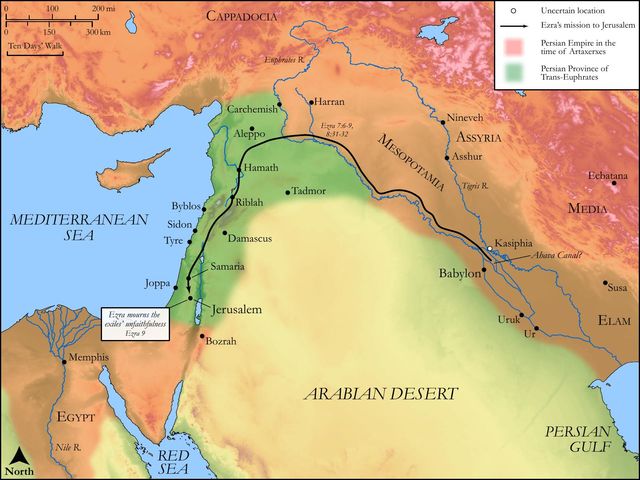
The journey from Babylon (specifically, the Ahava Canal, a tributary of the Euphrates) to Jerusalem was an arduous and perilous undertaking, spanning approximately 900 miles. This route traversed desolate wildernesses, mountainous terrain, and regions notorious for banditry and hostile nomadic tribes. For a large group of people, including women and children, carrying immense wealth in gold, silver, and valuable temple vessels, travel without a strong military escort was exceptionally risky. King Artaxerxes I, the Persian monarch, had granted Ezra significant authority and resources for this mission, and it would have been customary, expected, and even prudent for a royal envoy of such importance, transporting such valuable cargo, to be provided with a substantial military guard. Ezra's deliberate refusal of this standard protection was, therefore, a remarkable and counter-cultural act. It was a conscious decision to place the reputation and power of his God above the conventional wisdom and perceived safety offered by the mighty Persian Empire, serving as a public declaration of faith before a pagan king and a profound demonstration of God's sovereignty to both the Jewish exiles and the surrounding nations.
Key Themes
ShowHideEzra 8:22 contributes significantly to several overarching themes within the book of Ezra and broader biblical theology. Firstly, it powerfully underscores the theme of Unwavering Trust in God's Providence. Ezra's choice exemplifies a profound reliance on divine protection over human strength, echoing sentiments found in passages like Psalm 20:7, which contrasts trust in chariots and horses with trust in the name of the Lord, or Proverbs 3:5-6. Secondly, the verse highlights the critical theme of Integrity of Testimony and Witness. Ezra had boldly proclaimed God's active involvement and power to King Artaxerxes; to then seek a human escort would have fundamentally undermined his own witness and potentially dishonored God's name in the eyes of the pagan monarch. His "shame" was not a sign of weakness, but a deep spiritual conviction to maintain consistency between his words and his actions, upholding the veracity of his declaration. Finally, the verse articulates the fundamental biblical principle of Divine Retribution and Blessing, stating explicitly that "the hand of our God [is] upon all them for good that seek him; but his power and his wrath [is] against all them that forsake him." This dual aspect of God's character—His benevolent care for the faithful and His righteous judgment against the disobedient—is a recurring motif throughout Scripture, as seen in the blessings and curses outlined in Deuteronomy 28, reinforcing the covenant relationship and its inherent consequences.
Exposition and Analysis
ShowHideKey Word Analysis
ShowHideFrom the primitive root H954, meaning "to pale, i.e. by implication to be ashamed; also (by implication) to be disappointed or delayed." In this context, Ezra's "shame" is not a feeling of personal guilt or inadequacy, but rather a profound sense of spiritual propriety and embarrassment at the thought of contradicting his own bold testimony about God's power. To request a military escort after having declared God's sovereign care would, in his view, have dishonored God's name and undermined his witness before the pagan king. It was a holy shame, born out of a deep desire to uphold the truth and integrity of God's word and reputation.
From a primitive word H3027, referring to "the open one (indicating power, means, direction, etc.)," used in a great variety of applications, both literally and figuratively. When coupled with "God" (H430, ʼĕlôhîym), "hand of our God" is a powerful and frequently used biblical idiom. It symbolizes God's active power, authority, intervention, and favor. Here, it specifically conveys God's benevolent, protective, and guiding presence extended "for good" upon those who earnestly seek Him, demonstrating His active involvement in their lives.
From a primitive root H1245, meaning "to search out (by any method, specifically in worship or prayer); by implication, to strive after." To "seek Him" implies more than a casual inquiry; it denotes an earnest, diligent, and intentional pursuit of God, His will, and His presence, often involving worship, prayer, and obedience. It signifies a wholehearted devotion and reliance on God, which Ezra exemplifies by his decision to trust God for protection.
Verse Breakdown
ShowHide"For I was ashamed to require of the king a band of soldiers and horsemen to help us against the enemy in the way:"
This opening clause reveals Ezra's internal moral and spiritual dilemma. Despite the very real and well-known dangers of the journey—including bandits and hostile groups—he felt a deep-seated spiritual conviction that prevented him from asking for the customary military escort from King Artaxerxes. This "shame" was not a lack of courage but a profound commitment to theological consistency.
"because we had spoken unto the king, saying,"
This phrase provides the direct justification for Ezra's "shame." He had previously made a bold and public theological declaration to the Persian monarch, setting a high standard for his own conduct and for the reputation of the God he served. His subsequent actions needed to align perfectly with his preceding words.
"The hand of our God [is] upon all them for good that seek him;"
This is the first part of Ezra's profound testimony to the king and the core of his theological conviction. It articulates a fundamental principle of divine providence: God's active, benevolent, and protective power (His "hand") is consistently extended to those who earnestly and diligently seek Him. This statement expresses God's favor, provision, and guidance in the lives of His devoted followers.
"but his power and his wrath [is] against all them that forsake him."
This second part of Ezra's testimony presents the contrasting consequence of human response to God. It reveals the dual nature of God's interaction with humanity: while He blesses the faithful, He also justly opposes and judges those who deliberately abandon Him and His ways. This underscores God's holiness, justice, and the serious implications of disobedience and spiritual rebellion.
Literary Devices
ShowHideEzra 8:22 employs several potent literary devices to convey its profound message. Juxtaposition is central to the verse, presenting a stark contrast between God's benevolent "hand... for good" upon those who seek Him and His "power and his wrath" against those who forsake Him. This highlights the conditional nature of divine favor and the serious consequences of spiritual abandonment. The phrase "the hand of our God" is a powerful idiom, a common Hebrew expression signifying divine power, intervention, and favor, which adds depth and familiarity to the theological statement. Furthermore, the verse functions as a powerful confession or testimony, as Ezra recounts his prior declaration to the king, emphasizing the importance of verbal witness and the alignment of actions with beliefs. There is also a subtle irony in Ezra's "shame"; what might appear as a weakness (being ashamed to ask for human help) is, in fact, a profound demonstration of spiritual strength, integrity, and unwavering faith in God's sufficiency, transforming a potential human vulnerability into a powerful testament to divine power and faithfulness.
Theological and Thematic Connections
ShowHideEzra 8:22 serves as a powerful theological statement on the nature of God's relationship with humanity, particularly His covenant people. It articulates the fundamental biblical principle that God is actively involved in the affairs of His creation, dispensing both blessing and judgment based on human response to Him. Ezra's decision exemplifies a deep understanding of divine sovereignty and the call to live a life of consistent faith, where one's actions align with one's confession. It teaches that true security is found not in worldly provisions or human might, but in a wholehearted reliance on God's protective hand. This verse also underscores the importance of a credible witness; for Ezra, compromising his testimony by seeking worldly protection would have diminished the glory of God before a pagan king. It is a testament to the fact that God honors those who honor Him, and He is indeed a rewarder of those who diligently seek Him.
Reflection and Application
ShowHideEzra's radical act of faith in Ezra 8:22 presents a profound challenge and encouragement for believers today. In a world that constantly seeks tangible assurances, visible security, and relies on human ingenuity, Ezra's example calls us to examine the depth of our own trust in God. It prompts us to consider whether our actions consistently align with our verbal declarations of faith. Just as Ezra prioritized God's honor before a pagan king, we are called to live in such a way that our lives bear witness to God's power and faithfulness to those around us, especially non-believers. This does not preclude wisdom or responsible planning, but it fundamentally reorients our primary source of security and help. When faced with uncertainty, danger, or the temptation to compromise our convictions for worldly comfort, Ezra reminds us that our ultimate refuge and provision come from God alone, whose "hand is for good" upon those who genuinely seek Him. Our faith is not merely a private belief but a public testimony, best demonstrated by our practical dependence on Him.
Questions for Reflection
ShowHideFAQ
ShowHideWhy was Ezra "ashamed" to ask for a military escort from the king?
ShowHideEzra's "shame" was not a sign of personal weakness or a lack of courage, but rather a profound spiritual conviction rooted in his prior testimony to King Artaxerxes. He had boldly declared to the king that "the hand of our God [is] upon all them for good that seek him." To then immediately request a military escort for protection would have appeared to directly contradict his own words and potentially undermine the credibility of God's power in the eyes of the pagan monarch. Ezra's shame stemmed from a desire to uphold God's honor and the integrity of his witness, demonstrating that his faith was not merely theoretical but practical and absolute. It was a holy embarrassment at the thought of implying God's insufficiency.
Does Ezra 8:22 imply that believers should never seek human protection or use worldly resources for safety?
ShowHideNot necessarily as a blanket prohibition. Ezra's situation was unique in that he had just made a direct, bold theological declaration to a pagan king about God's protective power. For him to then immediately seek a human escort would have been a direct contradiction of his specific witness in that moment. The verse emphasizes prioritizing faith and God's honor above all else, especially when our actions could directly impact our testimony. It encourages radical trust and dependence on God, but it does not inherently forbid using wisdom, taking precautions, or utilizing available resources when appropriate and when they do not compromise one's faith or witness. For instance, the Apostle Paul often used his Roman citizenship for protection, as seen in Acts 22:25-29, and accepted military escorts when provided, as detailed in Acts 23:23-24. The key is the heart's posture and the ultimate source of one's trust. Ezra's example calls us to first and foremost rely on God's sovereign care and to ensure our actions consistently glorify Him.
Christ-Centered Fulfillment
ShowHideEzra 8:22, with its powerful declaration of God's benevolent hand upon those who seek Him and His wrath against those who forsake Him, finds its ultimate and most profound fulfillment in Jesus Christ. Ezra's act of faith, trusting God for protection on a perilous journey, foreshadows the perfect trust and obedience of the Son of God, who walked a path far more perilous, culminating in the cross. The "hand of our God... for good" is supremely extended to humanity through the person and work of Christ, who, by His atoning sacrifice, made a way for all who "seek Him" to find reconciliation and eternal life, as proclaimed in John 3:16. He is the ultimate seeker of God's will, perfectly embodying trust in the Father, even praying, "Nevertheless not my will, but yours, be done" in Luke 22:42. Conversely, God's "power and his wrath" against those who "forsake Him" is also fully and justly revealed in Christ—not only in His future role as Judge of the living and the dead, but also paradoxically at the cross, where the full weight of God's wrath against sin was poured out upon His own Son, allowing those who believe to escape it. Thus, Jesus Christ is both the perfect embodiment of seeking God and the ultimate provision for escaping His wrath, inviting all to come to Him and find the true and lasting protection of God's hand, as promised in John 6:37.