


Ezra 8:21
Bible text: King James Version (1769 Blayney text) · Public domain
Bible text: King James Version with Strong's numbers · Public domain
Bible text: Berean Standard Bible · Public domain
Bible text: American Standard Version (1901) · Public domain
Bible text: World English Bible, Messianic edition · Public domain
Bible text: Geneva Bible (1599) · Public domain
Bible text: Young's Literal Translation · Public domain
- וָאֶקְרָאva·'ek·Ra'and I proclaimedH7121Conj-w ¦ V-Qal-ConsecImperf-1csVerb Qal Consecutive Imperfect 1st Singular common genderוָandאֶקְרָאI proclaimed
- שָׁםshamthereH8033AdvAdverb
- צוֹםtzOma fastH6685N-msNoun Singular Masculine Absolute
- עַל'alatH5921PrepPreposition
- הַנָּהָרha·na·Harthe riverH5104Art ¦ N-msNoun Singular Masculine Absoluteהַtheנָּהָרriver
- אַהֲוָא'a·ha·Va'AhavaH163N-properNoun Proper Location
- לְהִתְעַנּוֹתle·hit·'a·Notto humble ourselvesH6031Prep-l ¦ V-Hithpael-InfVerb Hithpael Infinitive Constructלְtoהִתְעַנּוֹתhumble ourselves
- לִפְנֵיlif·Nei<to> beforeH6440Prep-l ¦ N-mpcNoun Plural Masculine Constructלִ<to>פְנֵיbefore
- אֱלֹהֵינוּ'e·lo·Hei·nuour GodH430N-mpc ¦ 1cpNoun Plural Masculine ConstructאֱלֹהֵיGodנוּour
- לְבַקֵּשׁle·va·Keshto seekH1245Prep-l ¦ V-Piel-InfVerb Piel Infinitive Constructלְtoבַקֵּשׁseek
- מִמֶּנּוּmi·Me·nufrom himH4480Prep ¦ 3msPrepositionמִמֶּfromנּוּhim
- דֶּרֶךְDe·rekha journeyH1870N-csNoun Singular common gender Absolute
- יְשָׁרָהye·sha·RahstraightH3477Adj-fsAdjective Singular Feminine Absolute
- לָנוּLa·nufor usPrep-l ¦ 1cpSuffix Personal 1st Plural common genderלָforנוּus
- וּלְטַפֵּנוּu·le·ta·Pe·nuand for our little one[s]H2945Conj-w ¦ Prep-l ¦ N-msc ¦ 1cpNoun Singular Masculine Constructוּandלְforטַפֵּlittle one[s]נוּour
- וּלְכָלu·le·kholand for allH3605Conj-w ¦ Prep-l ¦ N-mscNoun Singular Masculine Constructוּandלְforכָלall
- רְכוּשֵׁנוּre·khu·She·nuour propertyH7399N-msc ¦ 1cpNoun Singular Masculine Constructרְכוּשֵׁpropertyנוּour
English is a literal word-by-word gloss of the Hebrew, not the KJV's wording. Why?
This is the original text the KJV's translators worked from — each Hebrew word with its own literal English meaning in this verse, prepared by scholars at Tyndale House, Cambridge. The KJV translates whole sentences, not word by word, so its wording differs: one Hebrew word can become several English words, and the KJV may choose “the LORD” where the gloss reads “Yahweh”. Both are faithful — they answer different questions. For the KJV's own rendering, switch to the KJV text.
Details
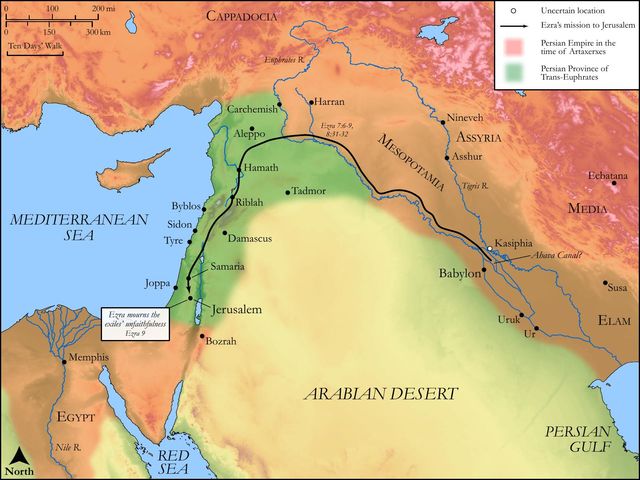
See on the biblical-era map
Study this verse
Public-domain commentary
Matthew Henry
From his Commentary on the Whole Bible. Henry comments on passages, not single verses — this entry covers Ezra 8:21–23. His two-level outline is real structure in the source text, so it is rendered as structure.
Ezra has procured Levites to go along with him; but what will that avail, unless he have God with him? That is therefore his chief care. In all our ways we must acknowledge God, and in those particularly wherein we are endeavouring to serve the interest of his kingdom among men. Ezra does so here. Observe,
I.The stedfast confidence he had in God and in his gracious protection.
He told the king (Ezr 8:22) what principles he went upon, that those who seek God are safe under the shadow of his wings, even in their greats dangers, but that those who forsake him are continually exposed, even when they are most secure. God's servants have his power engaged for them; his enemies have it engaged against them. This Ezra believed with his heart, and with his mouth made confession of it before the king; and therefore he was ashamed to ask of the king a convoy, lest thereby he should give occasion to the king, and those about him, to suspect either God's power to help his people or Ezra's confidence in that power. Those that trust in God, and triumph in him, will be ashamed of seeking to the creature for protection, especially of using any sorry shifts for their own safety, because thereby they contradict themselves and their own confidence. Not but that those who depend upon God must use proper means for their preservation, and they need not be ashamed to do so; but, when the honour of God is concerned, one would rather expose one's-self than do any thing to the prejudice of that, which ought to be dearer to us than our lives.
II.The solemn application he made to God in that confidence:
He proclaimed a fast, Ezr 8:21. No doubt he had himself begged of God direction in this affair from the first time he had it in his thoughts; but for public mercies public prayers must be made, that all who are to share in the comfort of them may join in the request for them. Their fasting was,
1.To express their humiliation. This he declares to be the intent and meaning of it. "that we might afflict ourselves before our God for our sins, and so be qualified for the pardon of them." When we are entering upon any new condition of life our care should be to bring none of the guilt of the sins of our former condition into it. When we are in any imminent peril let us be sure to make our peace with God, and then we are safe: nothing can do us any real hurt.
2.To excite their supplications. Prayer was always joined with religious fasting. Their errand to the throne of grace was to seek of God the right way, that is, to commit themselves to the guidance of the divine Providence, to put themselves under the divine protection, and to beg of God to guide and keep them in their journey and bring them safely to their journey's end. They were strangers in the road, were to march through their enemies' countries, and had not a pillar of cloud and fire to lead them, as their fathers had; but they believed that the power and favour of God, and the ministration of his angels, would be to them instead of that, and hoped by prayer to obtain divine assistance. Note, All our concerns about ourselves, our families, and our estates, it is our wisdom and duty by prayer to commit to God, and leave the care of with him, Phi 4:6.
III.The good success of their doing so (Ezr 8:23):
We besought our God by joint-prayer, and he was entreated of us. They had some comfortable assurance in their own minds that their prayers were answered, and the event declared it; for never any that sought God in earnest sought him in vain.
Historical interpretation
Ten Centuries of Reception
2 surviving comments on this verse. Each one is dated, so this reads as a timeline rather than a list.
Select a marker to jump to its quote. Markers stagger vertically where authors wrote within a few decades of each other.
And I proclaimed there a fast, etc. An example of fasting and praying, when we want to commence something of great virtue: and because the faithful hope in the Lord never fails, nor can it happen that we do not obtain what we justly seek from a pious and just helper through abstinence and prayers with faith. But we must carefully observe that fasting is prescribed first, and thus prayer is subsequently instructed. For first he says, And I proclaimed a fast, so that we might humble ourselves before the Lord. And then he adds: And we asked for a straight way for us and our children, etc., up to the conclusion of the sentence: But we fasted, and we prayed to our Lord for this, and it turned out well for us. Therefore, it is absolutely necessary that whoever enters to beseech the mercy of the Lord should first live more abstinently, to show themselves worthy to be heard; and thus, praying to the Lord, they should not doubt that what they request will turn out well for them.
I proclaimed there a fast: It is not enough to part from Babylon, that is, figuratively from sin, but we must also do works of penance; and therefore Esdras here proclaimed an extraordinary fast to those that were come from captivity. This shows that fasting was commanded and practised from the earliest times.
Continue studying Ezra 8:21 across the web’s major study libraries — every link below opens this exact verse, chapter, or book on the destination site.
Read & Compare
 BibleGatewayThis verse in more than 200 translations and 70 languages.
 Bible.comThe YouVersion reader — hundreds of translations, reading plans, and highlights.
 ESV.orgCrossway's official English Standard Version reader.
 NET BibleThe NET translation with 60,000+ translators' notes on every rendering decision.
 STEP BibleTyndale House's free study tool — original text, vocabulary, and scholarly resources.
 BibliaLogos Bible Software's free web reader.
 USCCBThe New American Bible (Revised Edition) with the U.S. bishops' study notes.
Commentaries
 BibleHub CommentariesDozens of classic commentaries on this verse, gathered on one page.
 StudyLightMore than 100 commentary sets — the largest collection on the web.
 BibleRefPlain-English commentary on what this verse means, verse by verse.
 Enduring WordDavid Guzik's free commentary on this chapter, widely used by Bible teachers.
 Bible Study ToolsVerse commentary alongside Greek and Hebrew study aids.
Original Language & Research
- BibleHub InterlinearThe verse word by word — original language, transliteration, and English.
- BibleHub LexiconEvery word's original-language definition and Strong's entry.
 Blue Letter BibleDeep-study tools — Strong's numbers, concordance, and word studies.
 SefariaThe Hebrew text with Rashi and centuries of Jewish commentary.
Sermons, Hymns & Audio


TrulyRandomVerse is not affiliated with these sites and doesn’t control their content. They’re linked because they’re genuinely useful.
Summary
Ezra 8:21 records a pivotal moment during the second return of Jewish exiles from Babylon to Jerusalem, led by Ezra. Faced with the daunting prospect of a perilous journey through bandit-infested territories while transporting immense wealth for the temple, Ezra chose not to request a military escort from King Artaxerxes, having previously testified to the king about God's protective hand. Instead, he proclaimed a communal fast at the river of Ahava, calling the entire company to humble themselves before God, earnestly seeking divine guidance and protection for themselves, their children, and all their valuable possessions on the "right way" back to Judah. This act underscored Ezra's profound dependence on God and set a powerful example of faith for the returning exiles.
Context
ShowHideLiterary Context
Ezra 8 details the second wave of exiles returning to Jerusalem, led by Ezra, approximately 80 years after the first return under Zerubbabel. Chapters 7 and 8 describe Ezra's commission by King Artaxerxes I, his meticulous preparations, and the gathering of the returning exiles. Specifically, Ezra 8:1-20 lists the heads of the families and the Levites who assembled with Ezra. Verse 21, the focus, marks a crucial spiritual turning point before the physical journey commences. It immediately precedes Ezra's account of entrusting the vast temple treasures to the priests and Levites (Ezra 8:24-30) and the subsequent successful journey and arrival in Jerusalem (Ezra 8:31-32), highlighting the direct outcome of the fast and prayer. The narrative emphasizes God's faithfulness in protecting those who trust in Him, serving as a direct fulfillment of Ezra's declaration of faith to the king.
Historical & Cultural Context
The return from Babylonian exile was a monumental undertaking, both logistically and spiritually. The journey from Babylon to Jerusalem was long, arduous, and fraught with dangers, typically taking four months for a large caravan. The route passed through desolate regions and areas known for banditry, making the transport of significant wealth (gold, silver, and temple vessels, as detailed in Ezra 8:25-27) an extremely risky endeavor. Kings often provided military escorts for such valuable shipments or important officials, and Ezra's refusal to request one, based on his prior testimony to Artaxerxes (Ezra 8:22), showcased a profound commitment to demonstrating God's sovereign protection. Fasting in ancient Israel was a common practice for expressing deep humility, repentance, mourning, and fervent supplication, especially in times of national crisis or significant personal need (e.g., Judges 20:26, 1 Samuel 7:6, Joel 2:12-17).
Key Themes
ShowHideThis verse powerfully encapsulates several key themes central to the book of Ezra and the broader post-exilic narrative. Foremost is Divine Dependence and Protection, illustrating Ezra's unwavering trust in God's ability to safeguard His people and their mission, even in the face of significant danger. This reliance on God over human strength is a recurring motif, contrasting with the temptation to seek worldly solutions, as highlighted by Ezra's decision not to ask for a military escort (Ezra 8:22). The act of "afflicting ourselves" highlights the theme of Humility and Seeking God, emphasizing that sincere repentance and self-abasement are prerequisites for divine favor and guidance, echoing principles found in passages like 2 Chronicles 7:14. The request for "a right way" underscores the theme of Divine Guidance, demonstrating a profound desire for God's specific direction and blessing in all aspects of life, from personal safety to the preservation of future generations and resources. Finally, the communal nature of the fast emphasizes the importance of Corporate Prayer and Intercession, recognizing the power of a united people seeking God's face in times of great need, a theme echoed in the broader narrative of Israel's restoration after exile.
Exposition and Analysis
ShowHideKey Word Analysis
ShowHideThis primitive root signifies "to call out to," "to address by name," or "to announce publicly." In this context, Ezra's "proclamation" of a fast was not merely a suggestion but a formal, authoritative summons to the entire community. It highlights his leadership role and the communal nature of the spiritual discipline. The act of proclaiming underscores the urgency and importance of the fast, setting a clear expectation for collective participation and a unified approach to seeking God.
This verb carries a rich semantic range, extending beyond mere physical discomfort. In biblical usage, especially when associated with fasting, it denotes humbling oneself, bringing oneself low, or denying oneself, often in a spiritual sense. It is frequently associated with repentance, self-abasement, and earnest supplication before God. It implies a conscious act of submission to God's will, a turning away from self-reliance, and an intense focus on seeking divine favor and intervention. This is not a punitive act, but a means to draw closer to God and express profound sincerity in one's petitions, acknowledging utter dependence.
This primitive root means "to search out (by any method, specifically in worship or prayer)," or "to strive after." It conveys an active, earnest, and diligent pursuit. When applied to seeking God, it implies a heartfelt and persistent effort to understand His will, gain His favor, or obtain His intervention. In Ezra 8:21, it emphasizes the intentional and fervent nature of their prayer and fasting – they were not passively waiting but actively and diligently pursuing God's guidance and protection.
The Hebrew word derek means "way," "path," or "road," often used metaphorically for a course of life or conduct. Yâshâr means "straight," "right," or "upright." Together, derek yâshâr refers to a path that is not only physically safe and direct but also morally and spiritually aligned with God's will. In this context, it encompasses both the practical need for a secure route for the journey and the deeper spiritual desire for God's approval and blessing upon their entire undertaking, ensuring their mission to restore temple worship was conducted according to His perfect plan.
Verse Breakdown
ShowHide"Then I proclaimed a fast there, at the river of Ahava"
Ezra, as the spiritual leader and divinely appointed scribe, initiates a communal spiritual discipline. The "river of Ahava" was a specific gathering point, likely a tributary of the Euphrates, where the returning exiles assembled before embarking on the arduous desert journey. This location became a spiritual crucible, a place of preparation not just physically, but primarily spiritually, before facing the dangers ahead. This public proclamation underscores the gravity of their situation and the need for unified spiritual action.
"that we might afflict ourselves before our God"
The explicit purpose of the fast is stated: to humble themselves. This was a collective act of spiritual discipline, acknowledging their complete dependence on God. It was a public and communal expression of their unworthiness and their absolute reliance on divine grace and mercy, demonstrating a posture of submission and earnest seeking. This humbling was "before our God," emphasizing that their spiritual posture was directed specifically towards the One who holds all power and authority.
"to seek of him a right way for us"
The primary objective of their humbling and fasting was to earnestly seek God's specific guidance and protection. "A right way" implies not just a safe physical route for their journey, free from the dangers of bandits and other perils, but also a divinely approved path that would ensure the success and spiritual integrity of their mission. It reflects a profound desire for God's providential care over every step of their significant undertaking.
"and for our little ones"
The scope of their concern extended beyond themselves to the most vulnerable members of their community—the children. This highlights the pastoral heart of Ezra and the collective responsibility of the community for the safety and well-being of their future generation. It underscores the profound trust placed in God to protect those who are defenseless and dependent, recognizing them as a precious heritage.
"and for all our substance"
Their concern also encompassed their valuable possessions, which included the immense gold, silver, and temple vessels (as described in Ezra 8:25-27) intended for the restoration of temple worship in Jerusalem. This demonstrates that their faith in God's protection extended to their material resources, acknowledging that even their wealth was ultimately God's and subject to His care. They understood that the success of their mission, including the safe transport of these vital resources, depended entirely on God's safeguarding hand.
Literary Devices
ShowHideEzra 8:21 employs several literary devices to convey its profound message. The most prominent is Dependence Theology, where Ezra's actions (proclaiming a fast and seeking God) directly reflect his theological conviction that God's protection is superior to human military might. This is underscored by the explicit Contrast between seeking a royal escort (which Ezra explicitly chose not to do, as mentioned in Ezra 8:22) and relying solely on divine intervention. The act of "afflicting ourselves" serves as powerful Symbolism for humility, repentance, and earnest supplication, representing an inward spiritual posture made manifest through outward discipline. Furthermore, the verse functions as Narrative Foreshadowing, as this act of fervent prayer and fasting anticipates the successful and protected journey described later in the chapter (Ezra 8:31), demonstrating God's faithfulness in answering the prayers of His dependent people. The phrase "a right way" also carries a subtle Double Meaning, referring both to a safe physical path and a divinely approved, righteous course of action for their mission of restoration.
Theological and Thematic Connections
ShowHideEzra 8:21 stands as a powerful testament to the principle of divine dependence, illustrating that true security and guidance come not from human strength or worldly resources, but from humble reliance on God. Ezra's decision to forgo a military escort, despite the immense dangers, was a deliberate act of faith, designed to magnify God's power and faithfulness. This passage teaches that when faced with overwhelming challenges, the most effective strategy is often to humble ourselves, seek God earnestly through prayer and fasting, and entrust every aspect of our lives—our safety, our families, and our resources—into His sovereign care. It underscores the biblical truth that God honors those who honor Him, and His protective hand is upon those who seek Him with all their heart. This passage serves as a timeless reminder that spiritual preparation and reliance on God supersede all human preparations when undertaking God's work.
Reflection and Application
ShowHideEzra 8:21 offers timeless principles for believers navigating the uncertainties and challenges of life today. In a world that often prioritizes self-reliance, strategic planning, and human ingenuity, Ezra's example calls us back to a foundational posture of complete dependence on God. When embarking on new ventures, facing significant transitions, or confronting daunting obstacles, our first and most crucial step should be to humble ourselves before God, seeking His "right way" for our lives, our families, and our resources. This means prioritizing prayer, potentially accompanied by fasting, as a means of earnestly seeking divine guidance and protection, rather than immediately turning to human solutions or worldly assurances. It reminds us that our security is ultimately found not in our preparations or provisions, but in the unfailing hand of our sovereign God. Ezra's actions demonstrate that true faith is not the absence of fear, but the decision to trust God in the midst of fear, knowing that His way is always the best and safest path.
Questions for Reflection
ShowHideFAQ
ShowHideWhy did Ezra choose not to ask King Artaxerxes for a military escort?
ShowHideEzra had previously testified to King Artaxerxes about the benevolent hand of God being upon all who seek Him (as recorded in Ezra 8:22). To then request a military escort, despite the very real dangers of the journey, would have contradicted his earlier declaration of faith and potentially undermined the testimony of God's power before a pagan king. Ezra's decision was a deliberate act of faith, demonstrating his absolute trust in God's ability to protect His people and their mission without human intervention, thereby bringing greater glory to God. It was a choice to live out his theology and provide a powerful witness to God's sovereignty.
What is the spiritual significance of "afflicting ourselves" in this context?
ShowHideThe phrase "afflict ourselves" (Hebrew: anah) goes beyond mere physical discomfort. In biblical usage, especially when associated with fasting, it signifies a deep act of humbling oneself, bringing oneself low, or denying oneself before God. It is a spiritual posture that expresses repentance, earnest supplication, and complete submission to God's will. For Ezra and the exiles, it was an outward manifestation of their inward spiritual state, acknowledging their unworthiness and total dependence on God for protection and guidance. It was a means to draw closer to God, make their petitions with sincerity and devotion, and prepare their hearts to receive His divine favor. This practice is seen in various Old Testament contexts, such as on the Day of Atonement (Leviticus 16:29) and in times of national crisis (1 Samuel 7:6).
Christ-Centered Fulfillment
ShowHideThe profound dependence demonstrated by Ezra and the exiles in seeking a "right way" finds its ultimate and perfect fulfillment in Jesus Christ. While Ezra sought a safe physical path and divine blessing for a temporal journey, Christ Himself declares, "I am the way, the truth, and the life. No one comes to the Father except through me" (John 14:6). The "right way" for humanity, lost in sin and estranged from God, is not a geographical path but a redemptive one, made possible only through the sacrificial work of the Lamb of God, who takes away the sin of the world!. Furthermore, Ezra's act of humbling himself and seeking divine protection foreshadows Christ's own perfect reliance on the Father, even to the point of obedient death on the cross (Philippians 2:8). The spiritual protection and guidance Ezra sought for his people is now eternally secured for believers through the indwelling Holy Spirit, who guides us into all truth (John 16:13) and empowers us to walk in God's "right way," leading us safely through the spiritual wilderness of this world to our eternal home. The ultimate "substance" preserved is not gold or silver, but the souls of humanity, redeemed by Christ's precious blood (1 Peter 1:18-19).