


Genesis 42:17
- וַיֶּאֱסֹףvai·ye·'e·Sofand he removedH622Conj-w ¦ V-Qal-ConsecImperf-3msVerb Qal Consecutive Imperfect 3rd Singular Masculineוַandיֶּאֱסֹףhe removed
- אֹתָם'o·Tam<obj.> themH853DirObjM ¦ 3mpParticle Object Indicatorאֹתָ<obj.>םthem
- אֶל'eltoH413PrepPreposition
- מִשְׁמָרmish·MarcustodyH4929N-msNoun Singular Masculine Absolute
- שְׁלֹשֶׁתshe·Lo·shetthreeH7969Adj-cscAdjective Numerical Singular common gender Construct
- יָמִיםya·MimdaysH3117N-mpNoun Plural Masculine Absolute
English is a literal word-by-word gloss of the Hebrew, not the KJV's wording. Why?
This is the original text the KJV's translators worked from — each Hebrew word with its own literal English meaning in this verse, prepared by scholars at Tyndale House, Cambridge. The KJV translates whole sentences, not word by word, so its wording differs: one Hebrew word can become several English words, and the KJV may choose “the LORD” where the gloss reads “Yahweh”. Both are faithful — they answer different questions. For the KJV's own rendering, switch to the KJV text.
Details
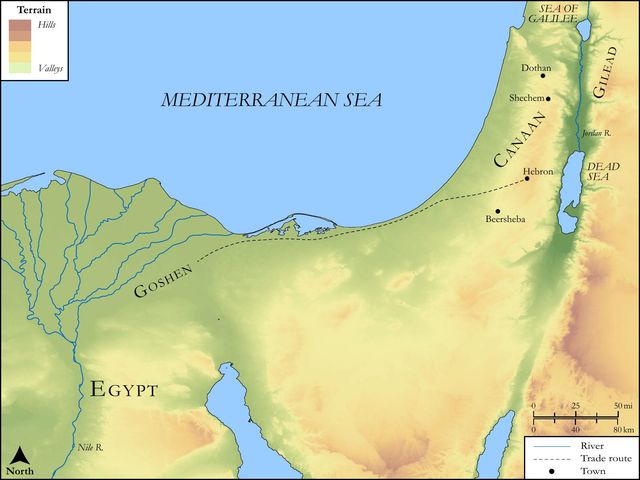
See on the biblical-era map


Study this verse
Public-domain commentary
Matthew Henry
From his Commentary on the Whole Bible. Henry comments on passages, not single verses — this entry covers Genesis 42:7–20. His two-level outline is real structure in the source text, so it is rendered as structure.
We may well wonder that Joseph, during the twenty years that he had now been in Egypt, especially during the last seven years that he had been in power there, never sent to his father to acquaint him with his circumstances; nay, it is strange that he who so often went throughout all the land of Egypt (Gen 41:45, Gen 41:46) never made an excursion to Canaan, to visit his aged father, when he was in the borders of Egypt, that lay next to Canaan. Perhaps it would not have been above three or four days' journey for him in his chariot. It is a probable conjecture that his whole management of himself in this affair was by special direction from Heaven, that the purpose of God concerning Jacob and his family might be accomplished. When Joseph's brethren came, he knew them by many a satisfactory token, but they knew not him, little thinking to find him there, Gen 42:8. He remembered the dreams (Gen 42:9), but they had forgotten them. The laying up of God's oracles in our hearts will be of excellent use to us in all our conduct. Joseph had an eye to his dreams, which he knew to be divine, in his carriage towards his brethren, and aimed at the accomplishment of them and the bringing of his brethren to repentance for their former sins; and both these points were gained.
I.He showed himself very rigorous and harsh with them.
The very manner of his speaking, considering the post he was in, was enough to frighten them; for he spoke roughly to them, Gen 42:7. He charged them with bad designs against the government (Gen 42:9), treated them as dangerous persons, saying, You are spies, and protesting by the life of Pharaoh that they were so, Gen 42:16. Some make this an oath, others make it no more than a vehement asseveration, like that, as thy soul liveth; however it was more than yea, yea, and nay, nay, and therefore came of evil. Note, Bad words are soon learned by converse with those that use them, but not so soon unlearned. Joseph, by being much at court, got the courtier's oath, By the life of Pharaoh, perhaps designing hereby to confirm his brethren in their belief that he was an Egyptian, and not an Israelite. They knew this was not the language of a son of Abraham. When Peter would prove himself no disciple of Christ, he cursed and swore. Now why was Joseph thus hard upon his brethren? We may be sure it was not from a spirit of revenge, that he might now trample upon those who had formerly trampled upon him; he was not a man of that temper. But,
1.It was to enrich his own dreams, and complete the accomplishment of them.
2.It was to bring them to repentance.
3.It was to get out of them an account of the state of their family, which he longed to know: they would have discovered him if he had asked as a friend, therefore he asks as a judge. Not seeing his brother Benjamin with them, perhaps he began to suspect that they had made away with him too, and therefore gives them occasion to speak of their father and brother. Note, God in his providence sometimes seems harsh with those he loves, and speaks roughly to those for whom yet he has great mercy in store.
II.They, hereupon, were very submissive.
They spoke to him with all the respect imaginable: Nay, my lord (Gen 42:10) - a great change since they said, Behold, this dreamer comes. They very modestly deny the charge: We are no spies. They tell him their business, that they came to buy food, a justifiable errand, and the same that many strangers came to Egypt upon at this time. They undertake to give a particular account of themselves and their family (Gen 42:13), and this was what they wanted.
III.He clapped them all up in prison for three days, Gen 42:17.
Thus God deals with the souls he designs for special comfort and honour; he first humbles them, and terrifies them, and brings them under a spirit of bondage, and then binds up their wounds by the Spirit of adoption.
IV.He concluded with them, at last, that one of them should be left as a hostage, and the rest should go home and fetch Benjamin.
It was a very encouraging word he said to them (Gen 42:18): I fear God; as if he had said, "You may assure yourselves I will do you no wrong; I dare not, for I know that, high as I am, there is one higher than I." Note, With those that fear God we have reason to expect fair dealing. The fear of God will be a check upon those that are in power, to restrain them from abusing their power to oppression and tyranny. Those that have no one else to stand in awe of ought to stand in awe of their own consciences. See Neh 5:15, So did not I, because of the fear of God.
Continue studying Genesis 42:17 across the web’s major study libraries — every link below opens this exact verse, chapter, or book on the destination site.
Read & Compare
 BibleGatewayThis verse in more than 200 translations and 70 languages.
 Bible.comThe YouVersion reader — hundreds of translations, reading plans, and highlights.
 ESV.orgCrossway's official English Standard Version reader.
 NET BibleThe NET translation with 60,000+ translators' notes on every rendering decision.
 STEP BibleTyndale House's free study tool — original text, vocabulary, and scholarly resources.
 BibliaLogos Bible Software's free web reader.
 USCCBThe New American Bible (Revised Edition) with the U.S. bishops' study notes.
Commentaries
 BibleHub CommentariesDozens of classic commentaries on this verse, gathered on one page.
 StudyLightMore than 100 commentary sets — the largest collection on the web.
 BibleRefPlain-English commentary on what this verse means, verse by verse.
 Enduring WordDavid Guzik's free commentary on this chapter, widely used by Bible teachers.
 Bible Study ToolsVerse commentary alongside Greek and Hebrew study aids.
Original Language & Research
- BibleHub InterlinearThe verse word by word — original language, transliteration, and English.
- BibleHub LexiconEvery word's original-language definition and Strong's entry.
 Blue Letter BibleDeep-study tools — Strong's numbers, concordance, and word studies.
 SefariaThe Hebrew text with Rashi and centuries of Jewish commentary.
Sermons, Hymns & Audio


TrulyRandomVerse is not affiliated with these sites and doesn’t control their content. They’re linked because they’re genuinely useful.
Summary
In a pivotal moment of the Genesis narrative, Joseph, now the powerful governor of Egypt, strategically confined his estranged brothers to "ward" for three days. This calculated act, following his accusation of espionage, served as a crucial test of their character, truthfulness, and remorse. It compelled them towards profound self-reflection, initiating a process that would ultimately facilitate the unfolding of God's sovereign plan to preserve Jacob's family and fulfill Joseph's prophetic dreams.
Context
ShowHideLiterary Context
Genesis 42:17 is situated within the dramatic reunion narrative of Joseph and his brothers. Immediately preceding this verse, Joseph has recognized his brothers, who have come to Egypt seeking grain during a severe famine, but he chooses to conceal his identity. Instead, he accuses them of being spies, a fabrication designed to test their integrity and extract information about his family. Verses 9-16 detail Joseph's accusations and the brothers' desperate attempts to prove their innocence by recounting their family situation, including the mention of their youngest brother, Benjamin, and their father, Jacob. Joseph's decision to imprison them for three days is the direct consequence of this interaction, setting the stage for the subsequent trials and revelations that will unfold in the following chapters, leading to their eventual reconciliation and the preservation of the nascent nation of Israel.
Historical & Cultural Context
The setting is ancient Egypt during a widespread famine, a common and devastating natural disaster in the ancient Near East, often interpreted as divine judgment or a test. The role of a vizier or governor, like Joseph, was one of immense power and authority, including control over food distribution and the justice system. Imprisonment, or being placed "into ward," was a common practice for those accused of crimes or held for interrogation. The three-day period, while seemingly arbitrary, often carried symbolic weight in ancient cultures, signifying a period of intense trial, transition, or preparation for a significant event. The cultural emphasis on family lineage and the preservation of the household (Jacob's concern for Benjamin and his own survival) are also critical undercurrents shaping the brothers' actions and Joseph's strategic maneuvering.
Key Themes
ShowHideThis verse contributes significantly to several overarching themes within Genesis and the broader biblical narrative. It powerfully illustrates Divine Providence and Sovereignty, showcasing how God orchestrates human actions—even those born of past sin and present deception—to achieve His ultimate purposes, as Joseph later articulates in Genesis 50:20. The imprisonment serves as a crucial moment of Testing and Revelation, forcing the brothers to confront their past sins and revealing their changed character, particularly their concern for Benjamin and their father. This period of distress also highlights the Consequences of Sin and the Call to Repentance, as their suffering in "ward" directly leads to their self-reproach regarding their treatment of Joseph (Genesis 42:21). Ultimately, it is a key step in the journey towards Reconciliation and Preservation of God's chosen family, preparing them for the move to Egypt and the fulfillment of the Abrahamic covenant.
Exposition and Analysis
ShowHideKey Word Analysis
ShowHideA primitive root meaning "to gather for any purpose." This word implies a deliberate act of collection or assembly. In this context, it signifies Joseph's intentional action of gathering his brothers and placing them under a unified confinement. It suggests a purposeful, rather than haphazard, detention, emphasizing Joseph's control over the situation and his strategic intent to keep them as a group for the duration of their imprisonment.
Meaning "a guard (the man, the post or the prison)." This term denotes a place of custody, imprisonment, or detention. It is not merely a waiting room but a secure facility where individuals are held under guard. The use of "ward" here underscores the seriousness of their situation, signifying that they were under strict surveillance and control, stripped of their freedom, and subject to Joseph's authority.
Referring to a literal day (from sunrise to sunset, or sunset to sunset) or a defined space of time. The addition of "three" (H7969, shâlôwsh) to "days" makes the duration specific. The "three days" is a significant temporal marker in biblical narratives, often preceding a major turning point, a revelation, or a deliverance. It is a period of intense waiting, testing, and often, transformation, preparing the way for a new phase or outcome.
Verse Breakdown
ShowHide"And he put them all together"
This phrase highlights Joseph's active agency and control. He is not merely reacting but deliberately orchestrating the events. The act of "putting them all together" emphasizes that they were confined as a collective unit, preventing individual escape and fostering a shared experience of their predicament. This collective confinement was crucial for their joint reflection and eventual confession.
"into ward"
This specifies the nature of their confinement—a place of custody or prison. It implies a loss of freedom, a state of vulnerability, and subjection to authority. This "ward" was a tangible manifestation of Joseph's power over them and the seriousness of the accusation he had leveled. It was designed to create an environment of pressure and introspection.
"three days"
The duration of their imprisonment is precisely stated. This period is not arbitrary; it serves multiple strategic and symbolic purposes. Practically, it allowed Joseph time to observe their reactions, assess their character, and formulate the next steps in his elaborate test. Theologically and symbolically, "three days" often signifies a period of intense trial, purification, and preparation for a significant divine act or revelation, as seen in other biblical narratives.
Literary Devices
ShowHideThe verse employs several significant literary devices. Symbolism is evident in the "three days," a recurring motif in biblical literature that often precedes a major turning point, a divine intervention, or a resurrection/deliverance (e.g., Jonah in the fish, Christ's resurrection). Here, it symbolizes a period of intense trial and preparation for the brothers' spiritual transformation and the unfolding of God's plan. There is profound Irony in Joseph, whom his brothers had imprisoned and sold into slavery, now being the one to imprison them. This reversal of fortunes underscores divine justice and the outworking of God's sovereignty. Furthermore, the entire scenario functions as Foreshadowing, hinting at the deeper truths of sin, suffering, repentance, and eventual reconciliation that will define the rest of the Joseph narrative and, ultimately, God's redemptive plan for humanity.
Theological and Thematic Connections
ShowHideJoseph's act of imprisoning his brothers for three days is a profound theological statement on God's sovereign use of difficult circumstances to bring about His purposes. This period of "ward" was a divinely orchestrated crucible, designed not for punishment alone, but for a deeper work of grace. It forced the brothers into a position of helplessness and introspection, compelling them to confront their past sin against Joseph, as evidenced by their subsequent confession in Genesis 42:21. This intense pressure served to humble them, test their integrity, and prepare their hearts for the reconciliation that God intended. It highlights that God often uses trials and discomfort to expose sin, cultivate repentance, and shape His people for His greater redemptive plans, demonstrating His faithfulness even through human suffering and sin.
Reflection and Application
ShowHideThe experience of Joseph's brothers in "ward" offers profound lessons for contemporary believers. Just as they endured a period of uncertainty, discomfort, and forced introspection, we too may encounter "ward" moments in our lives—periods of confinement, challenge, or waiting that feel restrictive. These are not necessarily punishments, but often divinely appointed opportunities for self-examination, where we can honestly assess our past actions and their impact, leading to genuine repentance and growth. Such times can cultivate patience, humility, and a deeper reliance on God, preparing us for future revelations, reconciliations, or new roles within His sovereign plan. The silence and isolation of these "ward" seasons can be fertile ground for spiritual maturity, allowing us to hear God's voice more clearly and align our hearts with His will. Ultimately, Genesis 42:17 reminds us that even in moments of apparent hardship, God's purposeful hand is at work, guiding events toward His intended outcome for those who are called according to His purpose.
Questions for Reflection
ShowHideFAQ
ShowHideWhy did Joseph imprison his brothers for three days?
ShowHideJoseph imprisoned his brothers for three days as a strategic and multi-faceted test, not out of malice, but as part of God's providential plan. First, it was to test their honesty and character after he accused them of being spies. He needed to ascertain if they had truly changed from the cruel young men who sold him into slavery. Second, this period of intense pressure and anxiety was designed to force them into deep introspection, which directly led them to reflect on and confess their past sin against him, as recorded in Genesis 42:21. Third, the three-day period allowed Joseph sufficient time to observe their reactions, assess their current family situation (particularly regarding his father Jacob and full brother Benjamin), and formulate the next steps in his elaborate plan, which included demanding that they bring Benjamin to Egypt. This entire ordeal was a crucial step in God's larger providential plan to humble them, prepare them for genuine reconciliation, and ultimately preserve the family of Jacob, leading to their eventual settlement in Egypt and the growth of the nation of Israel.
Christ-Centered Fulfillment
ShowHideThe narrative of Joseph, particularly his "three days" of testing his brothers, powerfully foreshadows the redemptive work of Christ. Joseph, though innocent of any wrongdoing against his family, suffered at the hands of his brothers, being sold into slavery and effectively "imprisoned" in a pit and then in Egypt. Yet, through his suffering and subsequent exaltation to power, he became the savior of his family, preserving them from famine and death. This mirrors Christ, the ultimate Lamb of God, who takes away the sin of the world, who, though sinless, suffered immensely at the hands of humanity. Just as the brothers' three days in "ward" led to their conviction of sin and eventual reconciliation with Joseph, Christ's three days in the grave culminated in His glorious resurrection, offering humanity the ultimate reconciliation with God. His bodily resurrection on the third day broke the power of sin and death. Through His death and resurrection, Christ, like Joseph, became the means of salvation, not just for a family, but for all who believe, leading them from spiritual famine and condemnation to abundant life and eternal reconciliation with the Father. The "ward" experience for the brothers was a necessary precursor to their freedom and restoration, just as Christ's "ward" in the tomb was the necessary precursor to our spiritual freedom and new life.