


Ezra 6:16
Bible text: King James Version (1769 Blayney text) · Public domain
Bible text: King James Version with Strong's numbers · Public domain
Bible text: Berean Standard Bible · Public domain
Bible text: American Standard Version (1901) · Public domain
Bible text: World English Bible, Messianic edition · Public domain
Bible text: Geneva Bible (1599) · Public domain
Bible text: Young's Literal Translation · Public domain
- וַעֲבַדוּva·'a·Va·duand they madeH5648Conj-w ¦ V-Peal-Perf-3mpVerb Peal Perfect 3rd Plural Masculineוַandעֲבַדוּthey made
- בְנֵיve·nei[the] people ofH1247N-mpcNoun Plural Masculine Construct
- יִשְׂרָאֵלYis·ra·'elIsraelH3479N-properNoun Proper Location
- כָּהֲנַיָּאka·ha·nai·Ya'priests theH3549N-mp ¦ ArtNoun Plural Masculine Definiteכָּהֲנַיָּpriestsאthe
- וְלֵוָיֵאve·le·va·Ye'and Levites theH3879Conj-w ¦ N-mp ¦ ArtNoun Gentilic Plural Masculine DefiniteוְandלֵוָיֵLevitesאthe
- וּשְׁאָרu·she·'Arand [the] rest ofH7606Conj-w ¦ N-cscNoun Singular common gender Constructוּandשְׁאָר[the] rest of
- בְּנֵיbe·nei[the] people ofH1247N-mpcNoun Plural Masculine Construct
- גָלוּתָאga·lu·Ta'exile theH1547N-fs ¦ ArtNoun Singular Feminine Definiteגָלוּתָexileאthe
- חֲנֻכַּתcha·nu·Kat[the] dedication ofH2597N-fscNoun Singular Feminine Construct
- בֵּיתbeit[the] house ofH1005N-cscNoun Singular common gender Construct
- אֱלָהָא'e·la·Ha'<the> GodH426N-cs ¦ ArtNoun Singular common gender Definiteאֱלָהָ<the>אGod
- דְנָהde·NahthisH1836PrtParticle Demonstrative
- בְּחֶדְוָהbe·ched·Vahwith joyH2305Prep-b ¦ N-fsNoun Singular Feminine Absoluteבְּwithחֶדְוָהjoy
English is a literal word-by-word gloss of the Hebrew, not the KJV's wording. Why?
This is the original text the KJV's translators worked from — each Hebrew word with its own literal English meaning in this verse, prepared by scholars at Tyndale House, Cambridge. The KJV translates whole sentences, not word by word, so its wording differs: one Hebrew word can become several English words, and the KJV may choose “the LORD” where the gloss reads “Yahweh”. Both are faithful — they answer different questions. For the KJV's own rendering, switch to the KJV text.
Details
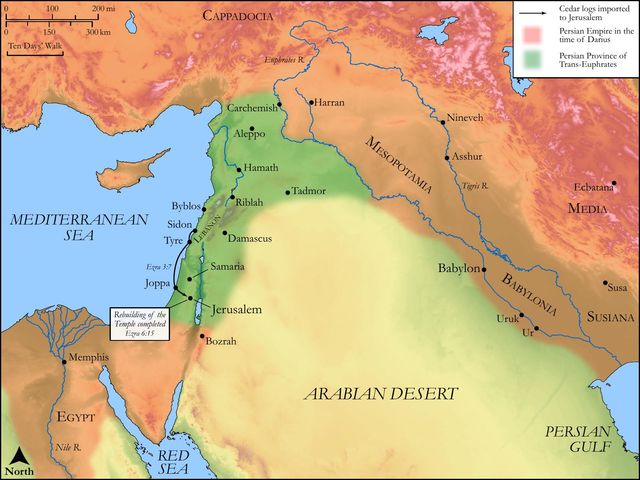
See on the biblical-era map
Study this verse
Public-domain commentary
Matthew Henry
From his Commentary on the Whole Bible. Henry comments on passages, not single verses — this entry covers Ezra 6:13–22. His two-level outline is real structure in the source text, so it is rendered as structure.
Here we have, I. The Jews' enemies made their friends. When they received this order from the king they came with as much haste to encourage and assist the work as their predecessors had done to put a stop to it, Ezr 4:23. What the king ordered they did, and, because they would not be thought to do it with reluctance, they did it speedily, Ezr 6:13. The king's moderation made them, contrary to their own inclination, moderate too.
II.The building of the temple carried on, and finished in a little time, Ezr 6:14, Ezr 6:15.
Now the elders of the Jews built with cheerfulness. For aught I know, the elders themselves laboured at it with their own hands; and, if they did, it was no disparagement to their eldership, but an encouragement to the other workmen.
1.They found themselves bound to it by the commandment of the God of Israel, who had given them power that they might use it in his service.
2.They found themselves shamed into it by the commandment of the heathen kings, Cyrus formerly, Darius now, and Artaxerxes some time after. Can the elders of the Jews be remiss in this good work when these foreign princes appear so warm in it? Shall native Israelites grudge their pains and care about this building when strangers grudge not to be at the expense of it?
3.They found themselves encouraged in it by the prophesying of Haggai and Zechariah, who, it is likely, represented to them (as bishop Patrick suggests) the wonderful goodness of God in inclining the heart of the king of Persia to favour them thus. And now the work went on so prosperously that, in four hears' time, it was brought to perfection. As for God, his work is perfect. The gospel church, that spiritual temple, is long in the building, but it will be finished at last, when the mystical body is completed. Every believer is a living temple, building up himself in his most holy faith. Much opposition is given to this work by Satan and our own corruptions. We trifle, and proceed in it with many stops and pauses; but he that has begun the good work will see it performed, and will bring forth judgment unto victory. Spirits of just men will be made perfect.
III.The dedication of the temple.
When it was built, being designed only for sacred uses, they showed by an example how it should be used, which (says bishop Patrick) is the proper sense of the word dedicate. They entered upon it with solemnity and probably with a public declaration of the separating of it from common uses and the surrender of it to the honour of God, to be employed in his worship.
1.The persons employed in this service were not only the priests and Levites who officiated, but the children of Israel, some of each of the twelve tribes, though Judah and Benjamin were the chief, and the rest of the children of the captivity or transportation, which intimates that there were many besides the children of Israel, of other nations, who transported themselves with them, and became proselytes to their religion, unless we read it, even the remnant of the children of the captivity, and then, we may suppose, notice is hereby taken of their mean and afflicted condition, because the consideration of that helped to make them devout and serious in this and other religious exercises. A sad change! The children of Israel have become children of the captivity, and there appears but a remnant of them, according to that prediction (Isa 7:3), Shear-jashub - The remnant shall return.
2.The sacrifices that were offered upon this occasion were bullocks, rams, and lambs (Ezr 6:17), for burnt-offerings and peace-offerings; not to be compared, in number, with what had been offered at the dedication of Solomon's temple, but, being according to their present ability, they were accepted, for, after a great trial of affliction, the abundance of their joy, and their deep poverty, abounded to the riches of their liberality, Co2 8:2. These hundreds were more to them than Solomon's thousands were to him. But, besides these, they offered twelve he-goats for sin-offerings, one for every tribe, to make atonement for their sins, which they looked upon as necessary in order to the acceptance of their services. Thus, by getting iniquity taken away, they would free themselves from that which had been the sting of their late troubles, and which, if not removed, would be a worm at the root of their present comforts.
3.This service was performed with joy. They were all glad to see the temple built and the concerns of it in so good a posture. Let us learn to welcome holy ordinances with joy and attend on them with pleasure. Let us serve the Lord with gladness. Whatever we dedicate to God, let it be done with joy that he will please to accept of it.
4.When they dedicated the house they settled the household. Small comfort could they have in the temple without the temple service, and therefore they set the priests in their divisions and the Levites in their courses, Ezr 6:18. Having set up the worship of God in this dedication, they took care to keep it up, and made the book of Moses their rule, to which they had an eye in this establishment. Though the temple service could not now be performed with so much pomp and plenty as formerly, because of their poverty, yet perhaps it was performed with as much purity and close adherence to the divine institution as ever, which was the true glory of it. No beauty like the beauty of holiness.
IV.The celebration of the passover in the newly-erected temple.
Now that they were newly delivered out of their bondage in Babylon it was seasonable to commemorate their deliverance out of their bondage in Egypt. Fresh mercies should put us in mind of former mercies. We may suppose that they had kept the passover, after a sort, every year since their return, for they had an altar and a tabernacle. But they were liable to frequent disturbances from their enemies, were straitened for room, and had not conveniences about them, so that they could not do it with due solemnity till the temple was built; and now they made a joyful festival of it, it falling out in the next month after the temple was finished and dedicated, Ezr 6:19. Notice is here taken,
1.Of the purity of the priests and Levites that killed the passover, Ezr 6:20. In Hezekiah's time the priests were many of them under blame for not purifying themselves. But now it is observed, to their praise, that they were purified together, as one man (so the word is); they were unanimous both in their resolutions and in their endeavours to make and keep themselves ceremonially clean for this solemnity; they joined together in their preparations, that they might help one another, so that all of them were pure, to a man. The purity of ministers adds much to the beauty of their ministrations; so does their unity.
2.Of the proselytes that communicated with them in this ordinance: All such as had separated themselves unto them, had left their country and the superstitions of it and cast in their lot with the Israel of God, and had turned from the filthiness of the heathen of the land, both their idolatries and immoralities, to seek the Lord God of Israel as their God, did eat the passover. See how the proselytes, the converts, are described. They separated themselves from the filthiness of sin and fellowship with sinners, joined themselves with the Israel of God in conformity and communion, and set themselves to seek the God of Israel; and those that do so in sincerity, though strangers and foreigners, are welcome to eat of the gospel feast, as fellow-citizens with the saints and of the household of God.
3.Of the great pleasure and satisfaction wherewith they kept the feast of unleavened bread, Ezr 6:22. The Lord had made them joyful, had given them both cause to rejoice and hearts to rejoice. It was now about twenty years since the foundation of this temple was laid, and we may suppose the old men that then wept at the remembrance of the first temple were most of them dead by this time, so that now there were no tears mingled with their joys. Those that are, upon good grounds, joyful, have therefore reason to be thankful, because it is God that makes them to rejoice. He is the fountain whence all the streams of our joy flow. God has promised to all those who take hold of his covenant that he will make them joyful in his house of prayer. The particular occasion they had for joy at this time was that God had turned the heart of the emperor to them, to strengthen their hands. If those that have been, or who we feared would have been, against us, prove to be for us, we may rejoice in it as a token for good, that our ways please the Lord (Pro 16:7), and he must have the glory of it.
Historical interpretation
Historical reception
1 surviving comment on this verse from the historical church.
Now the children of Israel, the priests, and the Levites, etc. The sons of the captivity rightly rejoice that they are worthy to both cast off the yoke of captivity and to build the house of God, which was destroyed. They offer a great number of sacrifices in the dedication of His house as devout servants to God. They also offer sacrifices for the sin of all Israel, not only for those who could be present, but also for those who were still placed in Babylon or in other provinces, living among enemies outside the promised land. They pray to God to be merciful to them as well and to protect them from evils among the enemies or to bring them back to the desired homeland. Because the rebuilding of the house after their captivity, as often said, signifies the correction of those who have strayed from the path of truth through sin after having initially started it, the well-restored temple is rightly dedicated by the priests and Levites and the other sons of the captivity in joy. For when those who have sinned are corrected, there is great joy in heaven before the angels of God (Luke XV). There is joy also for the teachers who have labored for the salvation of the erring; and for all those who have migrated from Babylon, that is, the confusion of sins, to the height of virtues—the promised land in thought and deed. Therefore, both the priests and Levites and all the people rejoice in the dedication of the restored house of the Lord because all orders of the holy Church must rejoice together in the reconciliation through penance of those who have sinned. They offer sacrifices in this dedication when they render thanks to God for the conversion of the erring, when many, seeing their devout life to God, also gird themselves to works of greater virtues, not wanting to be slothful in good works, in which they had remained more innocent, by sinning less. This can equally be understood of those who have recently come to faith, to receive the sacraments of Christ, that many who were advanced in the faith often emulate the more fervent zeal of the newcomers and follow their examples in good works. Not only do the priests, Levites, and the people offer sacrifices for the dedication of the house of the Lord which they had renovated, but also for the sin of all Israel. For just as it is fitting to favor the good deeds of those who are with us, and to make their good deeds our own by imitation, so it is necessary with diligent care to pray to the Lord for the state of the whole Church which is scattered throughout the world, according to the example of the Lord’s prayer; in which no one asks for daily bread, or for the forgiveness of sins, or to be delivered from temptation and evil, only for himself, but rather for all who have the same Father in heaven. Likewise, after the temple has been built, dedication follows when the total number of the elect shall at the end of the world reach the grace of heavenly rewards. Many acceptable sacrifices to God are offered in this dedication; those, indeed, of which the same house of God, that is, the holy Church, rebuilt through the glory of immortality after the long captivity of mortal distress, sings to its Creator and Redeemer, saying: "You have broken my bonds, I will sacrifice an offering of praise to You" (Psalm 115). And since the same sacrifice of praise is to be offered to God, not only for the gifts of virtues given, but also for the purged and removed stains of vices: correctly, after bulls, rams, and lambs were offered in the dedication of the temple, goats are also said to have been slaughtered for the sin of all Israel; for the grace of God, which confers the benefits of virtues, also removes the iniquity of sins. No Pelagian has a place in the house of God, who persuades that by the freedom of his own will he can either be freed from evils or confirmed in good. Indeed, goats for sin are offered in this life when the elect of supreme piety supplicate to be freed from sins. They are also offered in the future when the same ones give thanks because, by the grace of God, they have been freed from sins; and therefore, they will sing the mercies of the Lord forever (Psalm 100); for they will never forget that they were once miserable and have been made blessed by His gift.
Continue studying Ezra 6:16 across the web’s major study libraries — every link below opens this exact verse, chapter, or book on the destination site.
Read & Compare
 BibleGatewayThis verse in more than 200 translations and 70 languages.
 Bible.comThe YouVersion reader — hundreds of translations, reading plans, and highlights.
 ESV.orgCrossway's official English Standard Version reader.
 NET BibleThe NET translation with 60,000+ translators' notes on every rendering decision.
 STEP BibleTyndale House's free study tool — original text, vocabulary, and scholarly resources.
 BibliaLogos Bible Software's free web reader.
 USCCBThe New American Bible (Revised Edition) with the U.S. bishops' study notes.
Commentaries
 BibleHub CommentariesDozens of classic commentaries on this verse, gathered on one page.
 StudyLightMore than 100 commentary sets — the largest collection on the web.
 BibleRefPlain-English commentary on what this verse means, verse by verse.
 Enduring WordDavid Guzik's free commentary on this chapter, widely used by Bible teachers.
 Bible Study ToolsVerse commentary alongside Greek and Hebrew study aids.
Original Language & Research
- BibleHub InterlinearThe verse word by word — original language, transliteration, and English.
- BibleHub LexiconEvery word's original-language definition and Strong's entry.
 Blue Letter BibleDeep-study tools — Strong's numbers, concordance, and word studies.
 SefariaThe Hebrew text with Rashi and centuries of Jewish commentary.
Sermons, Hymns & Audio


TrulyRandomVerse is not affiliated with these sites and doesn’t control their content. They’re linked because they’re genuinely useful.
Summary
Ezra 6:16 powerfully captures the profound and joyous dedication of the rebuilt Temple in Jerusalem, a monumental occasion that marked the culmination of decades of exile, hardship, and dedicated labor. This verse highlights the communal participation of all returned exiles—encompassing the priests, Levites, and the broader community—in celebrating the completion and consecration of the "house of God," signifying the restoration of formal worship and God's tangible presence among His people after their return from Babylonian captivity.
Context
ShowHideLiterary Context
Ezra 6:16 serves as the triumphant climax to a crucial narrative arc within the book of Ezra, detailing the successful completion of the Second Temple. The preceding verses (Ezra 6:1-15) meticulously recount the discovery of King Cyrus's original decree by King Darius, Darius's subsequent reaffirmation of royal support for the Temple's rebuilding, and the diligent efforts of the Jewish elders, who were divinely stirred and encouraged by the prophets Haggai and Zechariah. The narrative emphasizes the providential timing and divine orchestration that led to the Temple's completion on the third day of the month Adar, in the sixth year of Darius's reign (Ezra 6:15). This verse thus sets the stage for the grand dedication ceremony, marking a pivotal transition from the challenges of reconstruction to the joyous restoration of worship, which then seamlessly flows into the celebration of Passover in the subsequent verses (Ezra 6:19-22). The overall narrative underscores God's unfailing providence and the fulfillment of His prophetic word, culminating in this magnificent act of communal worship and consecration.
Historical & Cultural Context
The dedication of the Second Temple, as recorded in Ezra 6:16, transpired approximately 70 years after the devastating destruction of Solomon's Temple by the Babylonians in 586 BC, and roughly two decades following the initial return of Jewish exiles under the leadership of Zerubbabel. This post-exilic period was fraught with significant challenges, including persistent opposition from local adversaries who actively sought to impede the rebuilding efforts, as vividly detailed in Ezra 4. The Persian Empire, under the successive reigns of kings like Cyrus the Great and Darius I, played an instrumental role in facilitating, permitting, and even financially supporting the reconstruction, reflecting a broader imperial policy of religious tolerance and administrative order within its vast dominion. Culturally, the Temple was unequivocally the spiritual and communal heart of Jewish life, serving as the singular, divinely appointed place for sacrifices, the observance of annual festivals, and the tangible manifestation of God's presence among His people. Its completion and subsequent dedication were therefore not merely an architectural feat but a profound theological statement, signifying God's unwavering faithfulness to His covenant promises to restore His people to their land and re-establish His dwelling place among them, precisely as prophesied by Jeremiah (Jeremiah 29:10).
Key Themes
ShowHideThe dedication of the Temple in Ezra 6:16 powerfully articulates several foundational themes pervasive throughout the books of Ezra-Nehemiah and the broader Old Testament narrative. Foremost among these is the theme of Restoration and Fulfillment, as the completion of the Temple signifies the tangible re-establishment of God's presence among His people in Jerusalem, directly fulfilling prophecies concerning their return from exile and the rebuilding of His house. This momentous act also emphatically underscores Divine Sovereignty and Faithfulness, demonstrating how God orchestrates powerful political decrees (such as those issued by Cyrus and Darius) and raises up prophetic voices (like Haggai and Zechariah) to ensure His divine purposes are accomplished, even in the face of human opposition and prolonged delays (Ezra 4:24). Another crucial theme is Communal Unity and Participation, highlighted by the inclusive enumeration of "the children of Israel, the priests, and the Levites, and the rest of the children of the captivity," all joining together in the dedication. This unity was absolutely vital for the formation of the post-exilic community's identity and its spiritual vitality. Finally, the explicit mention of "joy" points to Joy in God's Presence and Provision, emphasizing that true rejoicing stems from witnessing God's powerful hand at work and experiencing the renewal of His covenant relationship. This profound joy is a testament to the spiritual delight found in corporate worship and obedience to God's commands.
Exposition and Analysis
ShowHideKey Word Analysis
ShowHideThis Aramaic verb, corresponding to the Hebrew עָבַד (‘ābad), means "to do, make, prepare, keep, etc." In the context of Ezra 6:16, it signifies more than a mere passive observance; it implies an active, intentional, and communal participation in the dedication ceremony. It highlights the people's agency and their profound commitment to fulfilling the religious rites associated with consecrating the Temple, thereby demonstrating their obedience and deep devotion to God. This term is frequently employed for the observance of feasts or covenants, underscoring the solemn and purposeful nature of this monumental event.
This Aramaic noun, corresponding to the Hebrew חֲנֻכָּה (ḥănukkâ), is derived from a root meaning "to train, initiate." It refers to the formal act of consecrating or inaugurating something, particularly a building or an altar, by setting it apart for sacred use. It implies a formal ceremony that transitions an object or structure from common to holy, rendering it fit for divine service. This is the same root word that later gives its name to the Feast of Hanukkah, commemorating the rededication of the Temple during the Maccabean period. Here, it emphasizes the solemn and sacred setting apart of the newly built Temple exclusively for the worship of Yahweh.
This Aramaic noun, corresponding to the Hebrew חֶדְוָה (ḥeḏwâ), denotes gladness, mirth, or rejoicing. It describes a deep, often exuberant, emotional state, frequently associated with divine blessing, deliverance, and communal celebration of God's goodness. In Ezra 6:16, the phrase "with joy" is not merely a description of a pleasant emotion but a profound spiritual response to witnessing God's unwavering faithfulness in bringing the monumental task of rebuilding the Temple to glorious completion, despite immense challenges and decades of delay. It reflects the spiritual delight found in renewing their covenant relationship with God through His appointed place of worship.
Verse Breakdown
ShowHide"And the children of Israel, the priests, and the Levites, and the rest of the children of the captivity"
This comprehensive enumeration highlights the broad and inclusive participation in the dedication ceremony. "The children of Israel" refers to the entire community of returned exiles, representing the continuity of God's covenant people. The specific mention of "the priests, and the Levites" underscores their essential, divinely ordained role in Temple worship and administration, indicating the full restoration of the sacrificial system and Levitical service. "The rest of the children of the captivity" further emphasizes that this was a truly communal effort, involving every segment of the population who had endured the Babylonian exile and subsequently returned, fostering a profound sense of unity and shared purpose in their renewed identity.
"kept the dedication of this house of God"
This phrase signifies the formal, solemn, and active consecration of the newly completed Temple. "Kept" (from the Aramaic ‘ăbad') implies active observance and participation in the prescribed rituals for setting apart a sacred space, signifying their obedience to God's commands regarding His dwelling. "This house of God" explicitly identifies the structure as Yahweh's dwelling place, emphasizing its divine purpose and paramount significance as the central hub of Israelite worship and the tangible symbol of God's continuing presence among His people.
"with joy"
This concluding phrase encapsulates the overwhelming emotional and spiritual atmosphere of the occasion. The "joy" was a profound and exuberant response to God's unwavering faithfulness in overcoming decades of desolation, persistent opposition, and frustrating delays to bring about the glorious completion of His house. It was a celebration of restoration, the fulfillment of divine prophecy, and the renewed opportunity for corporate worship and intimate fellowship with God, reflecting a deep sense of gratitude, spiritual delight, and communal triumph.
Literary Devices
ShowHideEzra 6:16 masterfully employs several literary devices to convey its powerful and celebratory message. The most prominent is Enumeration, evident in the detailed listing of "the children of Israel, the priests, and the Levites, and the rest of the children of the captivity." This comprehensive list serves to emphasize the widespread and unified participation of the entire post-exilic community, underscoring the communal nature of the dedication and the restoration of a cohesive national identity centered around the newly rebuilt Temple. There is also a subtle Juxtaposition at play, as the profound "joy" of the dedication stands in stark contrast to the preceding "captivity" and the decades of desolation, struggle, and opposition that the people endured. This highlights the dramatic and divinely orchestrated shift from suffering to restoration, emphasizing the transformative power of God's faithfulness. Finally, the concluding phrase "with joy" functions as a powerful Emphasis, underscoring the profound emotional and spiritual significance of the entire event. It is not merely a factual report of a ceremony but a vibrant declaration of the deep spiritual delight experienced by a people who had witnessed God's mighty hand bringing His promises to glorious fruition.
Theological and Thematic Connections
ShowHideThe dedication of the Temple in Ezra 6:16 stands as a profound theological statement about God's unwavering faithfulness and His steadfast commitment to dwelling among His people. Despite human failure, the trauma of exile, and persistent opposition, God ensures the restoration of His presence and the re-establishment of the means of worship. This event underscores the immense importance of the "house of God" as a physical symbol of divine presence and a central place for communal worship, sacrifice, and the maintenance of the covenant relationship. The overwhelming joy expressed by the people is a deeply theological response to witnessing God's promises fulfilled and experiencing His restorative power, serving as a powerful reminder that true and lasting joy is fundamentally found in God's presence and His redemptive work.
Reflection and Application
ShowHideThe joyous dedication of the Second Temple, as described in Ezra 6:16, offers timeless and invaluable lessons for believers today. It serves as a powerful reminder that perseverance in faith, even amidst significant opposition, discouragement, and prolonged delays, ultimately leads to the glorious fulfillment of God's purposes. The Israelites faced decades of daunting challenges and periods of spiritual apathy, yet through divine enablement and their renewed commitment, they completed the Temple, demonstrating that God's work, though often arduous and demanding, is always worth the effort and yields profound spiritual fruit. This passage also powerfully underscores the irreplaceable importance of corporate worship and the communal celebration of God's faithfulness. There is a unique strength, profound encouragement, and deep spiritual delight found when God's people gather together to acknowledge His mighty work and offer Him united praise. Our joy, like theirs, should be a direct and heartfelt response to witnessing God's hand at work in our personal lives, in our families, and within the broader church community, reminding us that the "joy of the Lord" is indeed our strength and our wellspring of resilience. As New Testament believers, we understand that we are now living temples of the Holy Spirit and integral parts of a spiritual house, called to offer spiritual sacrifices of praise and service, finding our greatest and most enduring joy in the indwelling presence of God within us and among us.
Questions for Reflection
ShowHideFAQ
ShowHideWhat was the significance of the "dedication" of the Temple?
ShowHideThe dedication (Aramaic: chănukkâʼ) of the Temple was a solemn and profoundly joyous ceremony that formally consecrated the newly rebuilt structure, setting it apart as holy and fit exclusively for the worship of God. It signified the re-establishment of God's dwelling place among His people after the traumatic Babylonian exile and the restoration of the divinely ordained sacrificial system. This act was not merely an architectural milestone but a deeply theological declaration, marking the fulfillment of God's promises to bring His people back to their land and re-establish His presence among them, thereby ensuring the continuity of the covenant and providing the essential opportunity for Israel to worship Him according to His commands. It was a public and communal declaration that the Temple was now God's house, dedicated exclusively to His service and glory, a place where His presence could once again be known and His name honored.
Christ-Centered Fulfillment
ShowHideThe joyous dedication of the Second Temple in Ezra 6:16, while a significant historical and theological event for the nation of Israel, ultimately points beyond itself to the greater and more perfect reality found in Jesus Christ. The physical Temple, as the dwelling place of God among His people, was a profound type and shadow of the ultimate "house of God"—Jesus Himself. He boldly declared, "Destroy this temple, and in three days I will raise it up, speaking prophetically of the temple of His own body (John 2:21). Christ is the true and perfect Temple, the ultimate place where God fully dwells in human form and where humanity can truly encounter God in reconciliation. His life, atoning death, and glorious resurrection represent the ultimate "dedication"—a consecration of Himself as the perfect, once-for-all sacrifice, which opened the way for all people to draw near to God with confidence (Hebrews 10:10). Furthermore, through union with Christ, believers themselves become living stones, dynamically built into a spiritual house, a "temple of the Holy Spirit" (1 Corinthians 3:16 and 1 Peter 2:5). The profound joy experienced at the Temple's dedication in Ezra's day foreshadows the far greater, eternal, and indwelling joy of salvation and the abiding presence of God's Spirit in every believer, a joy that flows directly from the completed work of Christ and the glorious promise of His eternal kingdom (Philippians 4:4).