


1 Kings 9:22
- וּמִבְּנֵיu·mi·be·Neiand any of [the] people ofH1121Conj-w ¦ Prep-m ¦ N-mpcNoun Plural Masculine Constructוּandמִany ofבְּנֵי[the] people of
- יִשְׂרָאֵלYis·ra·'ElIsraelH3478N-properNoun Proper Location
- לֹאlo'notH3808NegParticle Negative
- נָתַןna·Tanhe madeH5414V-Qal-Perf-3msVerb Qal Perfect 3rd Singular Masculine
- שְׁלֹמֹהshe·lo·MohSolomonH8010N-proper-mNoun Proper Masculine
- עָבֶד'A·veda slaveH5650N-msNoun Singular Masculine Absolute
- כִּיkiforH3588PrtParticle Conditional
- הֵםhemtheyH1992Pro-3mpPronoun Personal 3rd Plural Masculine
- אַנְשֵׁי'an·Shei[were] [the] men ofH582N-mpcNoun Plural Masculine Construct
- הַמִּלְחָמָהha·mil·cha·Mah<the> warH4421Art ¦ N-fsNoun Singular Feminine Absoluteהַ<the>מִּלְחָמָהwar
- וַעֲבָדָיוva·'a·va·Davand his servantsH5650Conj-w ¦ N-mpc ¦ 3msNoun Plural Masculine Constructוַandעֲבָדָיservantsוhis
- וְשָׂרָיוve·sa·Ravand his officialsH8269Conj-w ¦ N-mpc ¦ 3msNoun Plural Masculine Constructוְandשָׂרָיofficialsוhis
- וְשָׁלִשָׁיוve·sha·li·Shavand his officersH7991Conj-w ¦ N-mpc ¦ 3msNoun Plural Masculine Constructוְandשָׁלִשָׁיofficersוhis
- וְשָׂרֵיve·sa·Reiand [the] commanders ofH8269Conj-w ¦ N-mpcNoun Plural Masculine Constructוְandשָׂרֵי[the] commanders of
- רִכְבּוֹrikh·Bohis chariotryH7393N-msc ¦ 3msNoun Singular Masculine Constructרִכְבּchariotryוֹhis
- וּפָרָשָׁיוu·fa·ra·Shavand his horsemenH6571Conj-w ¦ N-mpc ¦ 3msNoun Plural Masculine Constructוּandפָרָשָׁיhorsemenוhis
English is a literal word-by-word gloss of the Hebrew, not the KJV's wording. Why?
This is the original text the KJV's translators worked from — each Hebrew word with its own literal English meaning in this verse, prepared by scholars at Tyndale House, Cambridge. The KJV translates whole sentences, not word by word, so its wording differs: one Hebrew word can become several English words, and the KJV may choose “the LORD” where the gloss reads “Yahweh”. Both are faithful — they answer different questions. For the KJV's own rendering, switch to the KJV text.
Details
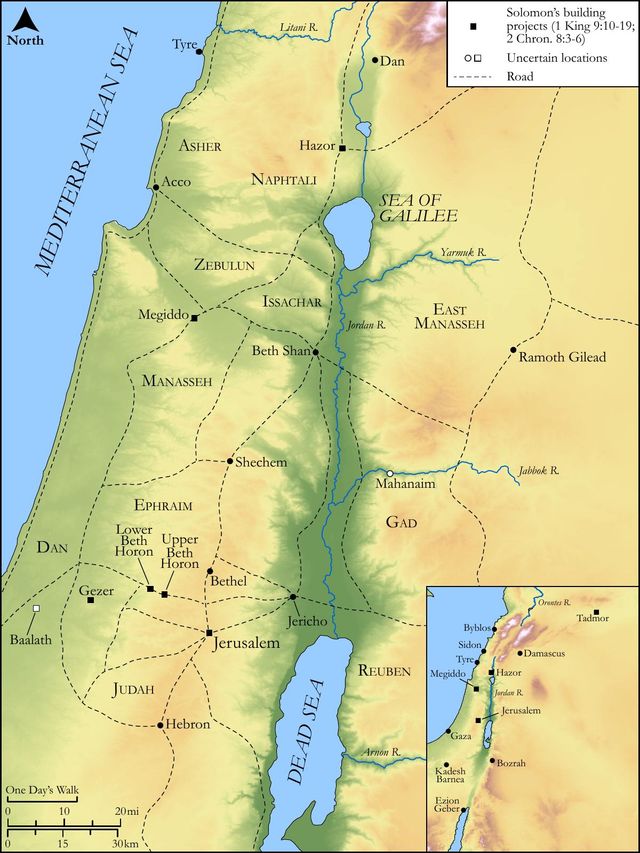
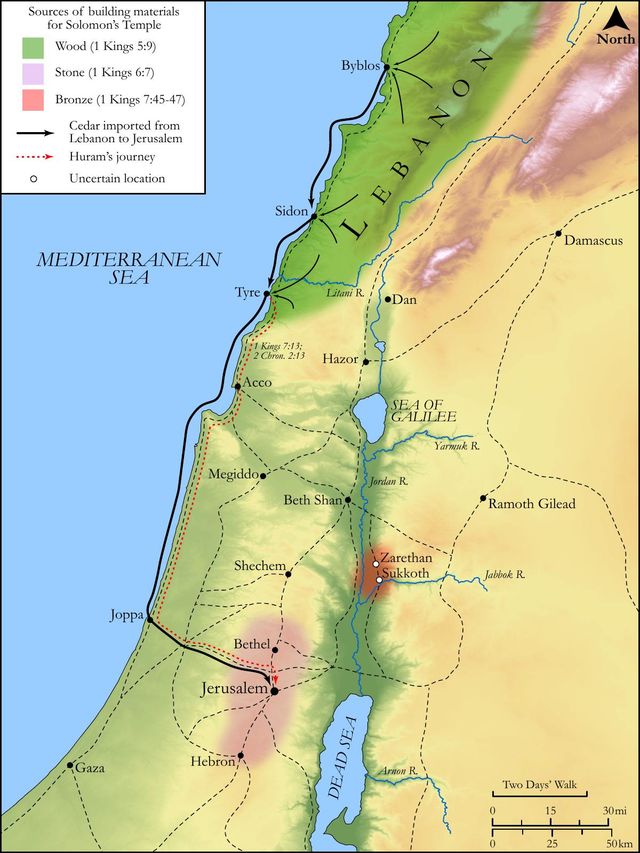
See on the biblical-era maps

Study this verse
Public-domain commentary
Matthew Henry
From his Commentary on the Whole Bible. Henry comments on passages, not single verses — this entry covers 1 Kings 9:15–28. His two-level outline is real structure in the source text, so it is rendered as structure.
We have here a further account of Solomon's greatness.
I.His buildings.
He raised a great levy both of men and money, because he projected a great deal of building, which would both employ many hands and put him to a vast expense, Kg1 9:15. And he was a wise builder, who sat down first, and counted the cost, and would not begin to build till he found himself able to finish. Perhaps there was some complaint of the heaviness of the taxes, which the historian excuses from the greatness of his undertakings. He raised it, not for war (as other princes), which would spend the blood of his subjects, but for building, which would require only their labour and purses. Perhaps David observed Solomon's genius to lie towards building, and foresaw he would have his head and hands full of it, when he penned that song of degrees for Solomon, which begins, Except the Lord build the house, those labour in vain that build it (Psa 127:1), directing him to acknowledge God in all his ways, and, by prayer and faith in his providence, to take him along with him in all his designs of this kind. And Solomon verily began his work at the right end, for he built God's house first, and finished that before he began his own; and then God blessed him, and he prospered in all his other buildings. If we begin with God, he will go on with us. Let the first-fruits be his, and the after-fruits will the more comfortably be ours, Mat 6:33. Solomon built a church first and then he was enabled to build houses, and cities, and walls. Those consult not their own interest that defer to the last what they design for pious uses. The further order in Solomon's buildings is observable. God's house first for religion, then his own for his own convenience, then a house for his wife, to which she removed as soon as it was ready for her (Kg1 9:24), then Millo, the town-house or guild-hall, then the wall of Jerusalem, the royal city, then some cities of note and strength in the country, which were decayed and unfortified, Hazor, Megiddo, etc. As he rebuilt these at his own charge, the inhabitants would be not only his subjects, but his tenants, which would increase the revenues of the crown for the benefit of his successors. Among the rest, he built Gezer, which Pharaoh took out of the hands of the Canaanites, and made a present of to his daughter, Solomon's wife, Kg1 9:16. See how God maketh the earth to help the woman. Solomon was not himself a warlike prince, but the king of Egypt, who was, took cities for him to build. Then he built cities for convenience, for store, for his chariots, and for his horsemen, Kg1 9:19. And, lastly, he built for pleasure in Lebanon, for his hunting perhaps, or other diversions there. Let piety begin, and profit proceed, and leave pleasure to the last.
II.His workmen and servants.
In doing such great works, he must needs employ abundance of workmen. The honour of great men is borrowed from their inferiors, who do that which they have the credit of.
1.Solomon employed those who remained of the conquered and devoted nations in all the slavish work, Kg1 9:20, Kg1 9:21. We may suppose that they renounced their idolatry and submitted to Solomon's government, so that he could not, in honour, utterly destroy them, and they were so poor that he could not levy money on them; therefore he served himself of their labour. Herein he observed God's law (Lev 25:44, Thy bondmen shall be of the heathen), and fulfilled Noah's curse upon Canaan, A servant of servants shall he be unto his brethren, Gen 9:25.
2.He employed Israelites in the more creditable services (Kg1 9:22, Kg1 9:23): Of them he made no bondmen, for they were God's freemen, but he made them soldiers and courtiers, and gave them offices, as he saw them qualified, among his chariots and horsemen, appointing some to support the service of the inferior labourers. Thus he preserved the dignity and liberty of Israel and honoured their relation to God as a kingdom of priests.
III.His piety and devotion (Kg1 9:25):
Three times in a year he offered burnt-offerings extraordinary (namely, at the three yearly feasts, the passover, pentecost, and feast of tabernacles) in honour of the divine institution, besides what he offered at other times, both statedly and upon special occasions. With his sacrifices he burnt incense, not himself (that was king Uzziah's crime), but the priest for him, at his charge, and for his particular use. It is said, He offered on the altar which he himself built. He took care to build it, and then,
1.He himself made use of it. Many will assist the devotions of others that neglect their own. Solomon did not think his building an altar would excuse him from sacrificing, but rather engage him the more to it.
2.He himself had the benefit and comfort of it. Whatever pains we take, for the support of religion, to the glory of God and the edification of others, we ourselves are likely to have the advantage of it.
IV.His merchandise.
He built a fleet of trading ships at Ezion-geber (Kg1 9:26), a port on the coast of the Red Sea, the furthest stage of the Israelites when they wandered in the wilderness, Num 33:35. Probably that wilderness now began to be peopled by the Edomites, which it was not then. To them this port had belonged, but, David having subdued the Edomites, it now pertained to the crown of Judah. The fleet traded to Ophir in the East Indies, supposed to be that which is now called Ceylon. Gold was the commodity traded for, substantial wealth. It should seem, Solomon had before been Hiram's partner, or put a venture into his ships, which made him a rich return of 120 talents (Kg1 9:14), which encouraged him to build a fleet of his own. The success of others in any employment should quicken our industry; for in all labour there is profit. Solomon sent his own servants as factors, and merchants, and super-cargoes, but hired Tyrians for sailors, for they had knowledge of the sea, Kg1 9:27. Thus one nation needs another, Providence so ordering it that there may be mutual commerce and assistance; for not only as Christians, but as men, we are members one of another. The fleet brought home to Solomon 420 talents of gold, Kg1 9:28. Canaan, the holy land, the glory of all lands, had no gold in it, which teaches us that that part of the wealth of this world which is for hoarding and trading is not the best part of it, but that which is more immediately for the present support and comfort of life, our own and others'; such were the productions of Canaan. Solomon got much by his merchandise, but, it should seem, David got much more by his conquests. What were Solomon's 420 talents to David's 100,000 talents of gold? Ch1 22:14; Ch1 29:4. Solomon got much by his merchandise, and yet has directed us to a better trade, within reach of the poorest, having assured us from his own experience of both that the merchandise of wisdom is better than the merchandise of silver and the gain thereof than fine gold, Pro 3:14.
Continue studying 1 Kings 9:22 across the web’s major study libraries — every link below opens this exact verse, chapter, or book on the destination site.
Read & Compare
 BibleGatewayThis verse in more than 200 translations and 70 languages.
 Bible.comThe YouVersion reader — hundreds of translations, reading plans, and highlights.
 ESV.orgCrossway's official English Standard Version reader.
 NET BibleThe NET translation with 60,000+ translators' notes on every rendering decision.
 STEP BibleTyndale House's free study tool — original text, vocabulary, and scholarly resources.
 BibliaLogos Bible Software's free web reader.
 USCCBThe New American Bible (Revised Edition) with the U.S. bishops' study notes.
Commentaries
 BibleHub CommentariesDozens of classic commentaries on this verse, gathered on one page.
 StudyLightMore than 100 commentary sets — the largest collection on the web.
 BibleRefPlain-English commentary on what this verse means, verse by verse.
 Enduring WordDavid Guzik's free commentary on this chapter, widely used by Bible teachers.
 Bible Study ToolsVerse commentary alongside Greek and Hebrew study aids.
Original Language & Research
- BibleHub InterlinearThe verse word by word — original language, transliteration, and English.
- BibleHub LexiconEvery word's original-language definition and Strong's entry.
 Blue Letter BibleDeep-study tools — Strong's numbers, concordance, and word studies.
 SefariaThe Hebrew text with Rashi and centuries of Jewish commentary.
Sermons, Hymns & Audio


TrulyRandomVerse is not affiliated with these sites and doesn’t control their content. They’re linked because they’re genuinely useful.
Summary
1 Kings 9:22 meticulously details King Solomon's administrative policy regarding the Israelite population, setting it in stark contrast to his treatment of the non-Israelite peoples in the preceding verses. This verse explicitly states that Solomon did not subject the children of Israel to forced labor or make them "bondmen." Instead, it enumerates the honorable and authoritative roles they held within his kingdom, serving as military personnel, high-ranking officials, and leaders, thereby underscoring their unique covenantal status and adherence to the principles of Mosaic Law.
Context
ShowHideLiterary Context
This verse acts as a crucial counterpoint to the preceding verses, specifically 1 Kings 9:20-21, which describe Solomon's conscription of the remaining non-Israelite populations (Amorites, Hittites, Perizzites, Hivites, and Jebusites) into forced labor, or "bondmen" (Hebrew: mas). The immediate narrative flow in 1 Kings 9 concerns Solomon's extensive and ambitious building program, encompassing the Temple, his own palace, the Millo, and various fortified cities like Hazor, Megiddo, and Gezer, as detailed in 1 Kings 9:15. The distinction drawn in verse 22 is therefore pivotal, showcasing a deliberate and religiously informed policy of differentiation in labor practices. It follows the completion of the Temple and palace construction, marking a phase of administrative organization within Solomon's flourishing kingdom, and highlights the ongoing tension and interaction between Israel and the Canaanite remnants, while simultaneously asserting Israel's unique identity under the Mosaic covenant.
Historical & Cultural Context
In the broader ancient Near East, the practice of corvée labor—forced conscription for public works—was a common and accepted aspect of imperial administration. Rulers of powerful empires, such as the pharaohs of Egypt or the kings of Mesopotamia, routinely employed such systems to construct monumental structures, maintain infrastructure, and fund military campaigns. Solomon's utilization of non-Israelite "bondmen" for his massive building projects aligns with this widespread regional practice. However, the truly unique and significant aspect highlighted in 1 Kings 9:22 is the explicit exemption of Israelites from this type of servitude. This policy directly reflects the stipulations of the Mosaic Law, particularly the prohibitions found in Leviticus 25:39-43, which strictly forbade Israelites from being made "bondservants" by their brethren, emphasizing their status as God's redeemed people. Solomon's adherence to this specific legal principle, at least in this regard, demonstrates a recognition of Israel's distinct covenantal identity and divine protection, setting them apart from the surrounding nations.
Key Themes
ShowHide1 Kings 9:22 contributes significantly to several overarching themes within the book of 1 Kings and the broader Deuteronomistic History. Firstly, it underscores the theme of Divine Distinction and Covenantal Status, emphasizing Israel's unique relationship with God, which afforded them different treatment compared to other peoples. This aligns with the concept of Israel as God's chosen people, set apart for a special purpose, as articulated in Exodus 19:5-6. Secondly, the verse highlights the theme of Adherence to Mosaic Law, demonstrating Solomon's (at least partial) obedience to the divine statutes concerning the treatment of fellow Israelites. This adherence, even if limited to specific areas, reflects a period of faithfulness in his reign. Thirdly, it speaks to the theme of Dignity in Service and Leadership, showcasing that Israelites were not subjected to menial, forced labor but rather occupied positions of honor, skill, and authority within the kingdom, including military, administrative, and strategic roles. This contrasts sharply with the subjugation of the non-Israelite populations and reflects the ideal of a just and divinely ordered society under God.
Exposition and Analysis
ShowHideKey Word Analysis
ShowHideThis term refers to a servant, slave, or bondman, often implying a condition of servitude or subjugation involving heavy, involuntary, or unpaid labor. In the context of ancient Near Eastern empires, ʻebed (when referring to state-imposed labor, often associated with mas) was a common form of forced conscription for public works, distinct from voluntary employment or compensated service. The explicit statement that Solomon made "no bondmen" of the children of Israel underscores a significant policy of exemption for the covenant people, directly contrasting their status with that of the subjugated non-Israelite populations.
Derived from the name given to Jacob, this term identifies the descendants of Jacob as the covenant people of God. Their exemption from forced labor highlights their unique theological and social status within the kingdom, distinguishing them from the non-Israelite populations who were subjected to such work. This distinction is rooted in their identity as God's chosen nation, redeemed from slavery in Egypt and set apart by divine decree.
This word denotes a head person of any rank or class, including a chief, general, governor, or ruler. In the context of Solomon's administration, "princes" signifies high-ranking officials, nobles, or military commanders who held positions of authority and leadership. Their inclusion in the list of roles held by Israelites, rather than being subjected to forced labor, emphasizes the dignity, responsibility, and compensated service that characterized the Israelite contribution to the kingdom, standing in stark contrast to the involuntary servitude of the mas.
Verse Breakdown
ShowHide"But of the children of Israel did Solomon make no bondmen"
This opening clause establishes the fundamental distinction in King Solomon's labor policy. It explicitly states that the Israelites, as God's covenant people, were exempt from the forced, conscripted labor (the mas or bond-service) that was imposed upon the non-Israelite populations. This adherence to the Mosaic Law, particularly Leviticus 25:39-43, which prohibited the enslavement of fellow Israelites, demonstrates a recognition of their unique status and the divine principles governing their society.
"but they [were] men of war, and his servants, and his princes, and his captains, and rulers of his chariots, and his horsemen"
This second clause details the various honorable and authoritative roles that Israelites occupied within Solomon's kingdom. Instead of being subjected to forced labor, they served in the military as professional "men of war," held administrative and personal advisory roles as "servants" to the king (likely high-ranking officials, not menial laborers), functioned as high-ranking "princes" and "captains" (both civil and military leaders), and commanded the elite units of "chariots" and "horsemen." This comprehensive list underscores that Israelites were integrated into the kingdom's structure at levels of dignity, skill, and trust, reflecting their privileged status as the people of God.
Literary Devices
ShowHideThe primary literary device employed in 1 Kings 9:22 is Contrast. The verse sharply juxtaposes the treatment of the "children of Israel" with the non-Israelite peoples mentioned in the preceding verses. While the latter were subjected to forced labor as "bondmen," the former were explicitly exempt and instead occupied positions of honor and authority. This contrast serves to emphasize the unique covenantal status of Israel and Solomon's (at least partial) adherence to the Mosaic Law. Additionally, the detailed Enumeration of the roles held by Israelites ("men of war, and his servants, and his princes, and his captains, and rulers of his chariots, and his horsemen") functions to underscore the dignity, variety, and importance of their service, reinforcing the distinction from forced labor. The use of the strong negative "no bondmen" creates a powerful Emphasis on this specific policy, highlighting its significance within Solomon's governance and its alignment with divine principles.
Theological and Thematic Connections
ShowHide1 Kings 9:22 profoundly illustrates the theological principle of divine distinction and the unique covenantal status of Israel. God had set Israel apart as "a kingdom of priests and a holy nation" (Exodus 19:6), and this verse reflects a societal structure that, at least in this instance, honored that distinction. The prohibition against making Israelites bondmen by their own king echoes the broader Mosaic Law, which sought to prevent the re-enslavement of a people whom God had redeemed from Egyptian bondage. This principle underscores God's valuing of human dignity, especially for those in covenant with Him. For believers today, this serves as a powerful reminder of our elevated status in Christ—we are no longer slaves to sin or the law, but adopted sons and daughters, called to willing, dignified service in God's kingdom.
Reflection and Application
ShowHide1 Kings 9:22 offers profound insights into ethical leadership, the value of human dignity, and the nature of service within a divinely ordered community. Solomon's policy of exempting Israelites from forced labor, while utilizing non-Israelite populations for such tasks, reflects a recognition of the covenantal principles that ought to govern a nation dedicated to God. For contemporary leaders, whether in government, business, or the church, this verse challenges us to consider how we treat those under our authority, emphasizing justice, respect, and the recognition of inherent worth. It calls us to foster environments where individuals can serve with dignity, purpose, and proper compensation, rather than being exploited. For believers, our identity in Christ elevates us from spiritual bondage to a place of honorable service as children of God. We are called to serve not out of compulsion or fear, but out of love and gratitude, recognizing that all righteous work, whether in the church or the world, can be a form of dignified contribution to God's purposes. This verse encourages us to value the diverse gifts and roles within the body of Christ, ensuring that all are treated with the respect due to those redeemed by God.
Questions for Reflection
ShowHideFAQ
ShowHideDid Solomon fully adhere to the Law of Moses throughout his reign?
ShowHideWhile 1 Kings 9:22 demonstrates Solomon's adherence to a specific aspect of the Mosaic Law concerning the treatment of Israelites, his reign was not characterized by complete faithfulness. Later in his life, Solomon significantly deviated from God's commands, particularly through his accumulation of many foreign wives and the subsequent introduction and worship of their gods (1 Kings 11:1-8). These actions directly violated specific prohibitions given to kings in Deuteronomy 17:17, leading to God's judgment and the eventual division of the kingdom. So, while this verse highlights a positive aspect of his early rule, it does not represent his overall trajectory of obedience.
What was the purpose of the non-Israelite bondmen mentioned in the preceding verses?
ShowHideThe non-Israelite bondmen, specifically the Amorites, Hittites, Perizzites, Hivites, and Jebusites who remained in the land, were conscripted by Solomon to provide the immense labor force required for his vast building projects. These projects included the construction of the magnificent Temple in Jerusalem, his own royal palace, the fortification of Jerusalem (including the Millo), and the building and strengthening of various cities like Hazor, Megiddo, and Gezer (1 Kings 9:15). This forced labor was essential for Solomon's ambitious infrastructure development, which marked his reign with unparalleled architectural achievements and solidified his kingdom's infrastructure.
Christ-Centered Fulfillment
ShowHide1 Kings 9:22, with its emphasis on the freedom of Israelites from physical bondage and their elevation to honorable service, finds profound Christ-centered fulfillment in the New Covenant. Just as the Israelites were set apart by God and freed from the yoke of forced labor, believers in Christ are liberated from the ultimate bondage—the slavery to sin and the condemnation of the Law (Romans 6:6). Jesus, the true and greater Solomon, does not make His people "bondmen" to a harsh taskmaster; instead, He declares that "if the Son sets you free, you will be free indeed" (John 8:36). Through His atoning sacrifice, Christ has purchased our freedom, adopting us as sons and daughters into God's family (Galatians 4:7), elevating us to a status far beyond mere servants. Our service to Him is not forced labor but a joyful, willing response of love and gratitude, empowered by the Holy Spirit. We are called to be a "royal priesthood, a holy nation" (1 Peter 2:9), fulfilling in a spiritual and universal sense the unique covenantal identity foreshadowed by Israel's privileged position in Solomon's kingdom. Our roles in Christ's kingdom, whether in leadership, teaching, or humble service, are all positions of dignity and purpose, reflecting the liberating grace of our Lord and the new creation we become in Him (2 Corinthians 5:17).