


Genesis 15:19
Bible text: King James Version (1769 Blayney text) · Public domain
Bible text: King James Version with Strong's numbers · Public domain
Bible text: Berean Standard Bible · Public domain
Bible text: American Standard Version (1901) · Public domain
Bible text: World English Bible, Messianic edition · Public domain
Bible text: Geneva Bible (1599) · Public domain
Bible text: Young's Literal Translation · Public domain
- אֶת'et<obj.>H853DirObjMParticle Object Indicator
- הַקֵּינִיha·kei·Nithe Kenite[s]H7017Art ¦ N-msNoun Gentilic Singular Masculine AbsoluteהַtheקֵּינִיKenite[s]
- וְאֶתve·'Etand <obj.>H853Conj-w ¦ DirObjMParticle Object Indicatorוְandאֶת<obj.>
- הַקְּנִזִּיha·ke·ni·Zithe Kenizzite[s]H7074Art ¦ N-msNoun Gentilic Singular Masculine AbsoluteהַtheקְּנִזִּיKenizzite[s]
- וְאֵתve·'Etand <obj.>H853Conj-w ¦ DirObjMParticle Object Indicatorוְandאֵת<obj.>
- הַקַּדְמֹנִיha·kad·mo·Nithe Kadmonite[s]H6935Art ¦ N-msNoun Gentilic Singular Masculine AbsoluteהַtheקַּדְמֹנִיKadmonite[s]
English is a literal word-by-word gloss of the Hebrew, not the KJV's wording. Why?
This is the original text the KJV's translators worked from — each Hebrew word with its own literal English meaning in this verse, prepared by scholars at Tyndale House, Cambridge. The KJV translates whole sentences, not word by word, so its wording differs: one Hebrew word can become several English words, and the KJV may choose “the LORD” where the gloss reads “Yahweh”. Both are faithful — they answer different questions. For the KJV's own rendering, switch to the KJV text.
Details
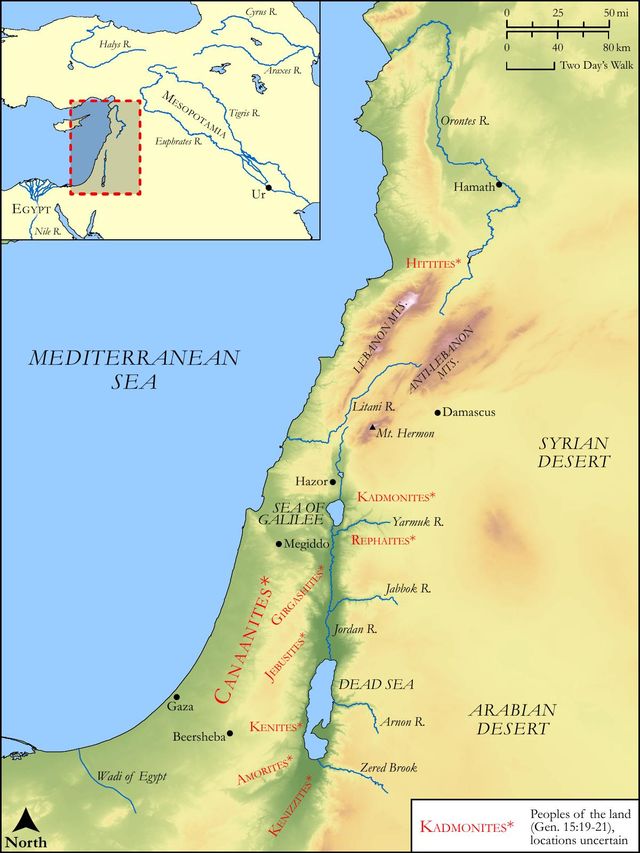
See on the biblical-era maps


Study this verse
Public-domain commentary
Matthew Henry
From his Commentary on the Whole Bible. Henry comments on passages, not single verses — this entry covers Genesis 15:17–21. His three-level outline is real structure in the source text, so it is rendered as structure.
Here is, I. The covenant ratified (Gen 15:17); the sign which Abram desired was given, at length, when the sun had gone down, so that it was dark; for that was a dark dispensation.
1.The smoking furnace signified the affliction of his seed in Egypt. They were there in the iron furnace (Deu 4:20), the furnace of affliction (Isa 48:10), labouring in the very fire. They were there in the smoke, their eyes darkened, that they could not see to the end of their troubles, and themselves at a loss to conceive what God would do with them. Clouds and darkness were round about them.
2.The burning lamp denotes comfort in this affliction; and this God showed to Abram, at the same time that he showed him the smoking furnace.
(1.)Light denotes deliverance out of the furnace; their salvation was as a lamp that burneth, Isa 62:1. When God came down to deliver them, he appeared in a bush that burned, and was not consumed, Exo 3:2.
(2.)The lamp denotes direction in the smoke. God's word was their lamp: this word to Abram was so, it was a light shining in a dark place. Perhaps this burning lamp prefigured the pillar of cloud and fire, which led them out of Egypt, in which God was.
(3.)The burning lamp denotes the destruction of their enemies who kept them so long in the furnace. See Zac 12:6. The same cloud that enlightened the Israelites troubled and burned the Egyptians.
3.The passing of these between the pieces was the confirming of the covenant God now made with him, that he might have strong consolation, being fully persuaded that what God promised he would certainly perform. It is probable that the furnace and lamp, which passed between the pieces, burnt and consumed them, and so completed the sacrifice, and testified God's acceptance of it, as of Gideon's (Jdg 6:21), Manoah's (Jdg 13:19, Jdg 13:20), and Solomon's, Ch2 7:1. So it intimates,
(1.)That God's covenants with man are made by sacrifice (Psa 50:5), by Christ, the great sacrifice: no agreement without atonement.
(2.)God's acceptance of our spiritual sacrifices is a token for good and an earnest of further favours. See Jdg 13:23. And by this we may know that he accepts our sacrifices if he kindle in our souls a holy fire of pious and devout affections in them.
II.The covenant repeated and explained:
In that same day, that day never to be forgotten, the Lord made a covenant with Abram, that is, gave a promise to Abram, saying, Unto thy seed have I given this land, Gen 15:18. Here is,
1.A rehearsal of the grant. He had said before, To thy seed will I give this land, Gen 12:7; Gen 13:15. But here he says, I have given it; that is,
(1.)I have given the promise of it, the charter is sealed and delivered, and cannot be disannulled. Note, God's promises are God's gifts, and are so to be accounted.
(2.)The possession is as sure, in due time, as if it were now actually delivered to them. What God has promised is as sure as if it were already done; hence, it is said, He that believes hath everlasting life (Joh 3:36), for he shall as surely go to heaven as if he were there already.
2.A recital of the particulars granted, such as is usual in the grants of lands. He specifies the boundaries of the land intended hereby to be granted, Gen 15:18. And then, for the greater certainty, as is usual in such cases, he mentions in whose tenure and occupation these lands now were. Ten several nations, or tribes, are here spoken of (Gen 15:19-21) that must be cast our, to make room for the seed of Abram. They were not possessed of all these countries when God brought them into Canaan. The bounds are fixed much narrower, Num 34:2, Num 34:3, etc. But,
(1.)In David's time, and Solomon's, their jurisdiction extended to the utmost of these limits, Ch2 9:26.
(2.)It was their own fault that they were not sooner and longer in possession of all these territories. They forfeited their right by their sins, and by their own sloth and cowardice kept themselves out of possession.
(3.)The land granted is here described in its utmost extent because it was to be a type of the heavenly inheritance, where there is room enough: in our father's house are many mansions. The present occupants are named, because their number, and strength, and long prescription, should be no hindrance to the accomplishment of this promise in its season, and to magnify God's love to Abram and his seed, in giving to that one nation the possessions of many nations, so precious were they in his sight, and so honourable, Isa 43:4.
Historical interpretation
Historical reception
3 surviving comments on this verse. Each one is dated, so this reads as a timeline rather than a list.
Select a marker to jump to its quote. Markers stagger vertically where authors wrote within a few decades of each other.
Foreign peoples are given to Abraham as though for education and so that the most scrupulous mind of the just person might cut away their vices and correct their errors. But what is most evident here is rather the mystery of the church. Through its apostles, “who are Israelites, to whom belong the patriarchs,” and from whose patriarchs “Christ was born according to the flesh” under the law, the church was to be constituted from the gathering of pagan peoples who would believe. And it is not by accident that these are indicated by the number ten but rather to show that these, at first unbelievers, when they had completed the measure of impiety, would certainly obtain the crown of faith.
When the torches had passed over the divided animals, the covenant was made. God said to Abraham, “To your descendants I will give this land,” and he described in detail how far the land extended in each direction. But, through an anagogical [mystical] transposition consistent with our above remarks, we must understand that this land is given to the holy man’s spiritual posterity. The Savior too promises it to those who practice gentleness. This is a promise that applies to the true children and not to all who descend from Abraham, for “it is not the children of the flesh who are the children of God, but the children of the promise are reckoned as descendants.” It is “the one who does the works of Abraham” who is in fact his child.The phrase “from the river to the river” is also well put, for the promise that belongs to the posterity of the holy man is virtue, which is placed between flowing things. Flowing things, of course, do not make up virtue but are its very borders, in the sense that if one departs from virtue, one encounters them immediately. But it is possible too that the rivers represent the trials that come to virtuous persons, since they are placed among people who oppress them, and yet the virtuous triumph over them.
What is clearly stated in the text can be expounded as follows. When the sun was already near setting, a flame emerged, and there appeared a smoking oven and fiery torches “that passed between the two parts of the divided animals,” burning and lighting up the place, to allow the patriarch to see what was happening and to reveal in a more divine manner the mysteries to be searched out. It should be noted that a fire did not appear only after the covenant had been made, but the gift of the law through Moses took place itself in the midst of a fire. Fire could be seen, and, without being able to see the one who was speaking, the giving of the commandments could be heard. What is suggested here is perhaps something like this. As the law contains rewards and punishments, it was given in the midst of fire to indicate that it brings burning to some and illumination to others. In fact, fire has a twofold power: it illuminates, and at the same time it burns. The gift of the law, then, burns those who abandon it and enlightens those who observe it. So too here, torches and smoke appeared; now smoke is the result and as it were the consequence of a fire that has been lit. Moreover, a flame had appeared first. We conclude, then, that one who is defining what is to be done and what is not to be done in a matter this difficult requires the light of God and also fear, symbolized by the furnace, so as to accomplish everything in accordance with right reason.
Continue studying Genesis 15:19 across the web’s major study libraries — every link below opens this exact verse, chapter, or book on the destination site.
Read & Compare
 BibleGatewayThis verse in more than 200 translations and 70 languages.
 Bible.comThe YouVersion reader — hundreds of translations, reading plans, and highlights.
 ESV.orgCrossway's official English Standard Version reader.
 NET BibleThe NET translation with 60,000+ translators' notes on every rendering decision.
 STEP BibleTyndale House's free study tool — original text, vocabulary, and scholarly resources.
 BibliaLogos Bible Software's free web reader.
 USCCBThe New American Bible (Revised Edition) with the U.S. bishops' study notes.
Commentaries
 BibleHub CommentariesDozens of classic commentaries on this verse, gathered on one page.
 StudyLightMore than 100 commentary sets — the largest collection on the web.
 BibleRefPlain-English commentary on what this verse means, verse by verse.
 Enduring WordDavid Guzik's free commentary on this chapter, widely used by Bible teachers.
 Bible Study ToolsVerse commentary alongside Greek and Hebrew study aids.
Original Language & Research
- BibleHub InterlinearThe verse word by word — original language, transliteration, and English.
- BibleHub LexiconEvery word's original-language definition and Strong's entry.
 Blue Letter BibleDeep-study tools — Strong's numbers, concordance, and word studies.
 SefariaThe Hebrew text with Rashi and centuries of Jewish commentary.
Sermons, Hymns & Audio


TrulyRandomVerse is not affiliated with these sites and doesn’t control their content. They’re linked because they’re genuinely useful.
Summary
Genesis 15:19 precisely enumerates three of the ten nations whose territories God solemnly promised to Abram's descendants as part of the Abrahamic Covenant. This verse provides specific detail within the momentous divine pledge, outlining the exact boundaries of the inherited land and underscoring the divine precision and expansive scope of God's unwavering promise to Abraham's lineage, affirming the certainty of the covenant's fulfillment.
Context
ShowHideLiterary Context
This verse is situated within Genesis chapter 15, a pivotal passage detailing the "Covenant of the Pieces" between God and Abram. The narrative unfolds after Abram expresses concern about having no heir, prompting God's magnificent promise of countless descendants and a vast land. This divine oath is sealed through a solemn covenant ceremony involving split animals, a ritual signifying the grave consequences of breaking such an agreement (Genesis 15:9-11). Following God's declaration of the overall geographical extent of the promised land "from the river of Egypt unto the great river, the river Euphrates" in Genesis 15:18, verses 19-21 then itemize the specific peoples inhabiting this vast territory. This meticulous listing serves to underscore God's sovereign right to grant this land to Abram's lineage, a promise first introduced in Genesis 12:7.
Historical & Cultural Context
The "Covenant of the Pieces" ritual described in Genesis 15 reflects the practice of cutting a covenant, where parties would walk between divided animal halves, implicitly invoking a curse upon themselves if they broke the covenant. God alone passed through the pieces, signifying His unilateral and unconditional commitment to the covenant. The nations listed, including the Kenites, Kenizzites, and Kadmonites, represent various tribal groups inhabiting the broader Syro-Palestinian region. Their inclusion highlights the vastness of the territory promised, extending beyond the immediate Canaanite heartland. The mention of these specific groups also implies a future displacement, a concept understood among the nations, where divine favor could grant one people dominion over another's land, often through conquest. This context sets the stage for the later narratives of the Exodus and the Israelite conquest of Canaan.
Key Themes
ShowHideGenesis 15:19 contributes significantly to several overarching themes within the book of Genesis and the broader biblical narrative. Firstly, it powerfully reiterates the theme of God's Covenant Faithfulness, demonstrating His meticulous planning and unwavering commitment to His promises, particularly the Abrahamic Covenant. Secondly, it underscores Divine Sovereignty over Territory and Nations, asserting God's ultimate authority as the true owner of all land and the one who determines the destinies of peoples. By declaring His intention to "give" the land of these established peoples to Abram's lineage, God asserts His supreme prerogative. Thirdly, the verse highlights the Scope of God's Promises, revealing that His blessings are not limited but are expansive and comprehensive, often exceeding human imagination, stretching from the "river of Egypt" to the "Euphrates" as mentioned in Genesis 15:18.
Exposition and Analysis
ShowHideKey Word Analysis
ShowHideThis term (H7017) refers to a member of the tribe of Kajin. The name is often associated with "smith" or "metalworker," suggesting a nomadic group possibly known for their craft. Interestingly, some Kenites, such as Jethro, Moses' father-in-law, later maintained peaceful relations with Israel, demonstrating a complex relationship with the Israelite nation throughout their history (Judges 1:16).
This (H7074) is a patronymic, meaning "descendant of Kenaz." While less clearly identified historically than the Kenites, they are thought to be related to the Edomites or a clan within Judah, possibly connected to Kenaz, a grandson of Esau or a forefather of Caleb (Numbers 32:12).
This term (H6935) means "ancient" or "easterner," deriving from a root meaning "east" or "ancient." This suggests a people residing to the east of the primary Canaanite territories, further emphasizing the vast eastern reach of the promised land and its inclusion of peoples beyond the immediate central Canaanite groups.
Verse Breakdown
ShowHide"The Kenites,"
This clause introduces the first of the three specific tribes listed in this verse. Their inclusion immediately signals the divine precision of the land promise, moving beyond the broad geographical description of the previous verse to name the specific inhabitants whose territories are encompassed by God's covenant.
"and the Kenizzites,"
The second tribe named further elaborates the scope of the promised land. The sequential naming of distinct ethnic groups underscores the comprehensive nature of God's pledge, indicating that the inheritance would involve a diverse array of peoples and regions, not merely a single, homogenous territory.
"and the Kadmonites,"
The final tribe in this verse completes the initial enumeration of peoples. Their mention, particularly given their name's connotation of "easterners," highlights the expansive geographical reach of the covenant, stretching far beyond the immediate vicinity of Canaan and emphasizing God's intention to grant a vast and diverse inheritance to Abram's descendants.
Literary Devices
ShowHideThe primary literary device at play in Genesis 15:19 is Enumeration or Listing. By specifically naming the Kenites, Kenizzites, and Kadmonites (and continuing in subsequent verses with seven more tribes), the text employs a detailed cataloging technique. This serves to emphasize the Specificity and concrete nature of God's covenant promise to Abram. Rather than a vague generality, God provides an exact inventory of the peoples whose lands will be given. This specificity also functions as a form of Foreshadowing, hinting at the future conquest narratives where Israel would indeed dispossess various peoples to inherit the land, as recounted in books like Joshua. The act of naming these distinct groups also highlights the Scope and vastness of the promised territory, stretching beyond the well-known Canaanite heartland.
Theological and Thematic Connections
ShowHideThe detailed enumeration of tribes in Genesis 15:19, alongside the broader list in the subsequent verses, serves as a powerful testament to the meticulousness and certainty of God's covenant promises. It underscores that God's word is not vague or abstract but concrete and precisely defined, demonstrating His unwavering commitment to His declared intentions. This specificity also highlights God's absolute sovereignty over all creation, including the destinies of nations and the boundaries of their territories, affirming His right to dispossess one people and establish another according to His divine purpose. The very act of naming these distinct groups also reveals the expansive nature of God's blessings, which often exceed human expectations in their scope and detail.
Reflection and Application
ShowHideGenesis 15:19, embedded within the profound context of God's covenant with Abram, offers deep assurance to believers today. Just as God meticulously detailed the land for Abraham, naming specific tribes and defining precise boundaries, we can trust in the certainty and precision of His promises for our lives and for the broader scope of redemptive history. This passage encourages unwavering faith and patient endurance, reminding us that the full realization of God's promises, much like the inheritance of the land for Israel, often unfolds over time according to His perfect timing and sovereign plan. Furthermore, it reinforces our trust in God's overarching control and ultimate sovereignty over all earthly matters, including geopolitical landscapes and personal circumstances, knowing that what He promises, He will surely deliver, regardless of apparent obstacles or delays. This divine faithfulness calls us to rest in His word and await His perfect fulfillment.
Questions for Reflection
ShowHideFAQ
ShowHideWhy does Genesis 15:19 list only three tribes when God promised ten?
ShowHideGenesis 15:19 begins the enumeration of the tribes whose land God promised to Abram's descendants. It lists the Kenites, Kenizzites, and Kadmonites as the first three of a total of ten nations. The remaining seven tribes (the Hittites, Perizzites, Rephaims, Amorites, Canaanites, Girgashites, and Jebusites) are explicitly named in the subsequent verses, Genesis 15:20-21. This detailed list emphasizes the comprehensive and specific nature of God's land promise to Abram, demonstrating the vast scope of the inheritance.
Were the Kenites, Kenizzites, and Kadmonites completely dispossessed by Israel?
ShowHideWhile God promised their land to Abram's descendants, the historical fulfillment was complex and multifaceted. The Kenites, for instance, maintained a unique and often peaceful relationship with Israel, with some even accompanying Judah into the wilderness during the conquest (Judges 1:16). The Kenizzites may have been absorbed into or were related to certain clans within Judah, suggesting a degree of integration rather than total expulsion. The Kadmonites, being "easterners," might have resided outside the primary area of Israelite conquest in the central highlands of Canaan. The full extent of the promised land, "from the river of Egypt unto the great river, the river Euphrates" (Genesis 15:18), was only fully realized during the reigns of David and Solomon, who exercised dominion over this vast territory (1 Kings 4:21). This historical reality highlights that the fulfillment of God's promises can be progressive, involve complex interactions, and sometimes allow for the continued presence of certain groups within or alongside the covenant people.
Christ-Centered Fulfillment
ShowHideWhile Genesis 15:19 meticulously details a specific earthly land promise to Abraham's physical descendants, its ultimate and spiritual fulfillment points profoundly to Christ and the boundless inheritance of all believers. The earthly land of promise, with its defined boundaries and dispossessed inhabitants, serves as a powerful type and shadow of the eternal dwelling of God's redeemed people in the new heavens and new earth, a spiritual and everlasting inheritance secured not by conquest but by Christ's finished redemptive work (Revelation 21:1-4). As the true seed of Abraham, Jesus Christ inherits all things, and in Him, all who believe—whether Jew or Gentile—become spiritual heirs, receiving a "better country," a heavenly one, and an "inheritance incorruptible, and undefiled, and that fadeth not away" (Hebrews 11:16; 1 Peter 1:3-4). Thus, the specificity of the land promise in Genesis finds its eschatological and universal culmination in the boundless spiritual kingdom established by Jesus Christ, where believers are co-heirs with Him (Romans 8:17) and dwell eternally in the presence of God.