


Genesis 15:20
Bible text: King James Version (1769 Blayney text) · Public domain
Bible text: King James Version with Strong's numbers · Public domain
Bible text: Berean Standard Bible · Public domain
Bible text: American Standard Version (1901) · Public domain
Bible text: World English Bible, Messianic edition · Public domain
Bible text: Geneva Bible (1599) · Public domain
Bible text: Young's Literal Translation · Public domain
- וְאֶתve·'Etand <obj.>H853Conj-w ¦ DirObjMParticle Object Indicatorוְandאֶת<obj.>
- הַחִתִּיha·chi·Tithe Hittite[s]H2850Art ¦ N-msNoun Gentilic Singular Masculine AbsoluteהַtheחִתִּיHittite[s]
- וְאֶתve·'Etand <obj.>H853Conj-w ¦ DirObjMParticle Object Indicatorוְandאֶת<obj.>
- הַפְּרִזִּיha·pe·ri·Zithe Perizzite[s]H6522Art ¦ N-msNoun Gentilic Singular Masculine AbsoluteהַtheפְּרִזִּיPerizzite[s]
- וְאֶתve·'Etand <obj.>H853Conj-w ¦ DirObjMParticle Object Indicatorוְandאֶת<obj.>
- הָרְפָאִיםha·re·fa·'Imthe RephaitesH7497Art ¦ N-mpNoun Gentilic Plural Masculine AbsoluteהָtheרְפָאִיםRephaites
English is a literal word-by-word gloss of the Hebrew, not the KJV's wording. Why?
This is the original text the KJV's translators worked from — each Hebrew word with its own literal English meaning in this verse, prepared by scholars at Tyndale House, Cambridge. The KJV translates whole sentences, not word by word, so its wording differs: one Hebrew word can become several English words, and the KJV may choose “the LORD” where the gloss reads “Yahweh”. Both are faithful — they answer different questions. For the KJV's own rendering, switch to the KJV text.
Details
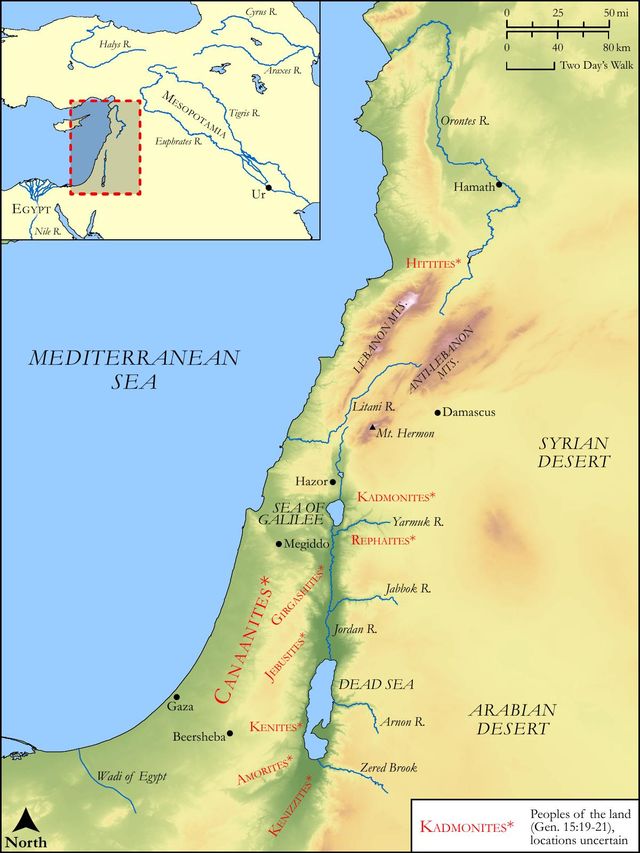
See on the biblical-era maps


Study this verse
Public-domain commentary
Matthew Henry
From his Commentary on the Whole Bible. Henry comments on passages, not single verses — this entry covers Genesis 15:17–21. His three-level outline is real structure in the source text, so it is rendered as structure.
Here is, I. The covenant ratified (Gen 15:17); the sign which Abram desired was given, at length, when the sun had gone down, so that it was dark; for that was a dark dispensation.
1.The smoking furnace signified the affliction of his seed in Egypt. They were there in the iron furnace (Deu 4:20), the furnace of affliction (Isa 48:10), labouring in the very fire. They were there in the smoke, their eyes darkened, that they could not see to the end of their troubles, and themselves at a loss to conceive what God would do with them. Clouds and darkness were round about them.
2.The burning lamp denotes comfort in this affliction; and this God showed to Abram, at the same time that he showed him the smoking furnace.
(1.)Light denotes deliverance out of the furnace; their salvation was as a lamp that burneth, Isa 62:1. When God came down to deliver them, he appeared in a bush that burned, and was not consumed, Exo 3:2.
(2.)The lamp denotes direction in the smoke. God's word was their lamp: this word to Abram was so, it was a light shining in a dark place. Perhaps this burning lamp prefigured the pillar of cloud and fire, which led them out of Egypt, in which God was.
(3.)The burning lamp denotes the destruction of their enemies who kept them so long in the furnace. See Zac 12:6. The same cloud that enlightened the Israelites troubled and burned the Egyptians.
3.The passing of these between the pieces was the confirming of the covenant God now made with him, that he might have strong consolation, being fully persuaded that what God promised he would certainly perform. It is probable that the furnace and lamp, which passed between the pieces, burnt and consumed them, and so completed the sacrifice, and testified God's acceptance of it, as of Gideon's (Jdg 6:21), Manoah's (Jdg 13:19, Jdg 13:20), and Solomon's, Ch2 7:1. So it intimates,
(1.)That God's covenants with man are made by sacrifice (Psa 50:5), by Christ, the great sacrifice: no agreement without atonement.
(2.)God's acceptance of our spiritual sacrifices is a token for good and an earnest of further favours. See Jdg 13:23. And by this we may know that he accepts our sacrifices if he kindle in our souls a holy fire of pious and devout affections in them.
II.The covenant repeated and explained:
In that same day, that day never to be forgotten, the Lord made a covenant with Abram, that is, gave a promise to Abram, saying, Unto thy seed have I given this land, Gen 15:18. Here is,
1.A rehearsal of the grant. He had said before, To thy seed will I give this land, Gen 12:7; Gen 13:15. But here he says, I have given it; that is,
(1.)I have given the promise of it, the charter is sealed and delivered, and cannot be disannulled. Note, God's promises are God's gifts, and are so to be accounted.
(2.)The possession is as sure, in due time, as if it were now actually delivered to them. What God has promised is as sure as if it were already done; hence, it is said, He that believes hath everlasting life (Joh 3:36), for he shall as surely go to heaven as if he were there already.
2.A recital of the particulars granted, such as is usual in the grants of lands. He specifies the boundaries of the land intended hereby to be granted, Gen 15:18. And then, for the greater certainty, as is usual in such cases, he mentions in whose tenure and occupation these lands now were. Ten several nations, or tribes, are here spoken of (Gen 15:19-21) that must be cast our, to make room for the seed of Abram. They were not possessed of all these countries when God brought them into Canaan. The bounds are fixed much narrower, Num 34:2, Num 34:3, etc. But,
(1.)In David's time, and Solomon's, their jurisdiction extended to the utmost of these limits, Ch2 9:26.
(2.)It was their own fault that they were not sooner and longer in possession of all these territories. They forfeited their right by their sins, and by their own sloth and cowardice kept themselves out of possession.
(3.)The land granted is here described in its utmost extent because it was to be a type of the heavenly inheritance, where there is room enough: in our father's house are many mansions. The present occupants are named, because their number, and strength, and long prescription, should be no hindrance to the accomplishment of this promise in its season, and to magnify God's love to Abram and his seed, in giving to that one nation the possessions of many nations, so precious were they in his sight, and so honourable, Isa 43:4.
Historical interpretation
Historical reception
1 surviving comment on this verse from the historical church.
What is clearly stated in the text can be expounded as follows. When the sun was already near setting, a flame emerged, and there appeared a smoking oven and fiery torches “that passed between the two parts of the divided animals,” burning and lighting up the place, to allow the patriarch to see what was happening and to reveal in a more divine manner the mysteries to be searched out. It should be noted that a fire did not appear only after the covenant had been made, but the gift of the law through Moses took place itself in the midst of a fire. Fire could be seen, and, without being able to see the one who was speaking, the giving of the commandments could be heard. What is suggested here is perhaps something like this. As the law contains rewards and punishments, it was given in the midst of fire to indicate that it brings burning to some and illumination to others. In fact, fire has a twofold power: it illuminates, and at the same time it burns. The gift of the law, then, burns those who abandon it and enlightens those who observe it. So too here, torches and smoke appeared; now smoke is the result and as it were the consequence of a fire that has been lit. Moreover, a flame had appeared first. We conclude, then, that one who is defining what is to be done and what is not to be done in a matter this difficult requires the light of God and also fear, symbolized by the furnace, so as to accomplish everything in accordance with right reason.
Continue studying Genesis 15:20 across the web’s major study libraries — every link below opens this exact verse, chapter, or book on the destination site.
Read & Compare
 BibleGatewayThis verse in more than 200 translations and 70 languages.
 Bible.comThe YouVersion reader — hundreds of translations, reading plans, and highlights.
 ESV.orgCrossway's official English Standard Version reader.
 NET BibleThe NET translation with 60,000+ translators' notes on every rendering decision.
 STEP BibleTyndale House's free study tool — original text, vocabulary, and scholarly resources.
 BibliaLogos Bible Software's free web reader.
 USCCBThe New American Bible (Revised Edition) with the U.S. bishops' study notes.
Commentaries
 BibleHub CommentariesDozens of classic commentaries on this verse, gathered on one page.
 StudyLightMore than 100 commentary sets — the largest collection on the web.
 BibleRefPlain-English commentary on what this verse means, verse by verse.
 Enduring WordDavid Guzik's free commentary on this chapter, widely used by Bible teachers.
 Bible Study ToolsVerse commentary alongside Greek and Hebrew study aids.
Original Language & Research
- BibleHub InterlinearThe verse word by word — original language, transliteration, and English.
- BibleHub LexiconEvery word's original-language definition and Strong's entry.
 Blue Letter BibleDeep-study tools — Strong's numbers, concordance, and word studies.
 SefariaThe Hebrew text with Rashi and centuries of Jewish commentary.
Sermons, Hymns & Audio


TrulyRandomVerse is not affiliated with these sites and doesn’t control their content. They’re linked because they’re genuinely useful.
Summary
Genesis 15:20 meticulously continues God's profound covenant promise to Abram, enumerating three more of the ten distinct nations whose territories would one day constitute the promised inheritance for Israel. This specific listing of the Hittites, Perizzites, and Rephaim underscores the divine precision and comprehensive scope of the land God solemnly pledged to Abram's descendants, long before the nation of Israel was even formed, highlighting God's sovereign foresight and the unshakeable nature of His word.
Context
ShowHideLiterary Context
This verse is an integral part of a pivotal passage in Genesis chapter 15, where God formally establishes and confirms His covenant with Abram. Following Abram's expression of concern about having no heir and questioning the fulfillment of God's earlier promises, God reassures him that his descendants will be as numerous as the stars of heaven (Genesis 15:5). The covenant ceremony, a solemn act of divine commitment, culminates in God explicitly defining the extent of the land promised, listing the peoples currently dwelling there. Genesis 15:18-21 provides a comprehensive enumeration of these nations, with Genesis 15:20 specifically mentioning the Hittites, Perizzites, and Rephaim as part of this future inheritance, emphasizing the detailed nature of God's prophetic promise.
Historical & Cultural Context
At the time of Abram, the land of Canaan was a patchwork of city-states and tribal territories, inhabited by various peoples with distinct cultural practices and political structures. The region served as a crucial land bridge between the great powers of Egypt and Mesopotamia, making it strategically significant. Covenant-making ceremonies often involved solemn rituals, such as the cutting of animals (as seen in Genesis 15:9-17), symbolizing the dire consequences for breaking the agreement. God's act of walking through the divided pieces alone underscored His unilateral commitment and the unconditional nature of His promise to Abram. The specific naming of tribes like the Hittites, Perizzites, and Rephaim, some of whom were powerful or formidable, grounds the divine promise in the tangible reality of the land and its existing inhabitants, setting the stage for future historical interactions and conquests.
Key Themes
ShowHideGenesis 15:20 contributes significantly to several overarching themes within the book of Genesis and the broader Pentateuch. Foremost among these is the theme of Divine Promise and Covenant Faithfulness, as God reiterates and expands upon His commitment to Abram, solidifying the Abrahamic Covenant. The detailed listing of nations also emphasizes God's Sovereignty over Nations and Land, demonstrating His absolute authority to dispossess existing inhabitants and bestow territory upon His chosen people. Furthermore, the inclusion of formidable groups like the Rephaim subtly introduces the theme of Future Conquest and Inheritance, foreshadowing the challenges and triumphs Israel would face in claiming their promised land, as later detailed in books like Joshua. This verse thus serves as a foundational piece in understanding God's long-term plan for Israel's national identity and destiny.
Exposition and Analysis
ShowHideKey Word Analysis
ShowHideDerived patronymically from "Cheth," this term refers to a descendant of Cheth, indicating a member of the Hittite people. Historically, the Hittites were a major power in Anatolia, but their influence and settlements extended into northern Syria and parts of Canaan. Their inclusion in this list signifies God's comprehensive claim over the land, encompassing territories inhabited or controlled by even significant regional powers.
This term denotes an "inhabitant of the open country." The Perizzites were one of the Canaanitish tribes, often mentioned in conjunction with other groups occupying the land of Canaan. Their designation suggests a less centralized, possibly rural population, highlighting that God's promise extended to all inhabitants of the land, regardless of their political structure or settlement patterns.
This word, derived from a root meaning "to invigorate," refers to a "giant" or powerful, ancient people. The Rephaim are often associated with formidable stature or strength in biblical texts (e.g., Deuteronomy 2:10-11). Their inclusion in this list emphasizes the challenging nature of the future conquest for Israel, yet simultaneously underscores God's absolute power to overcome even the most daunting adversaries in fulfilling His divine decree.
Verse Breakdown
ShowHide"And the Hittites,"
This clause introduces the first of three additional nations whose territory is explicitly named as part of the promised inheritance. The Hittites represent a significant, established people group within or adjacent to the land of Canaan, whose eventual dispossession would demonstrate God's sovereign power over historical and geopolitical realities.
"and the Perizzites,"
Following the Hittites, the inclusion of the Perizzites further delineates the scope of the promised land. As inhabitants of the "open country," their presence signifies that God's claim was not limited to major cities or kingdoms but encompassed all settled and unsettled areas within the designated territory, ensuring a complete and thorough inheritance for Abram's descendants.
"and the Rephaims,"
The final nation listed in this verse, the Rephaim, often associated with formidable stature or strength, adds a dimension of challenge and divine might to the promise. Their mention highlights that no human obstacle, however imposing, would stand in the way of God's covenant fulfillment, reinforcing the omnipotence of the God who makes and keeps such promises.
Literary Devices
ShowHideGenesis 15:20 primarily employs Enumeration and Listing, meticulously detailing specific tribal groups. This precise naming serves to underscore the concrete and tangible nature of God's promise, moving beyond general assurances to specific geographical and demographic realities. The act of listing these nations, particularly formidable ones like the Rephaim, also functions as a form of Foreshadowing, hinting at the future conflicts and conquests that Israel would undertake to possess the land. Furthermore, the divine authority behind this declaration imbues the list with the weight of a Divine Decree, a prophetic statement that guarantees the future dispossession of these peoples, thereby emphasizing God's absolute Sovereignty over nations and history. The repetition of "and the..." creates a rhythmic, almost litany-like quality, reinforcing the comprehensive scope of the promised inheritance.
Theological and Thematic Connections
ShowHideGenesis 15:20, by precisely naming these nations, profoundly illustrates the Divine Specificity and Unwavering Nature of God's Promises. It reveals a God who is not vague in His declarations but meticulously details the very territories and peoples involved in His covenant plan. This specificity builds confidence in the absolute certainty of God's word, demonstrating His omniscience and meticulous preparation for the future of His people. The inclusion of these particular groups, some of whom were powerful or formidable, also underscores God's Absolute Sovereignty over All Peoples and Lands. He is the ultimate dispossessor and granter of territory, acting according to His divine will and purpose. This verse serves as a foundational prophecy for the Future Inheritance of the Promised Land by Israel, a promise that would shape their national identity and destiny for centuries to come, affirming God's faithfulness to His covenant despite any human obstacles.
Reflection and Application
ShowHideFor believers today, Genesis 15:20 offers profound and enduring lessons about the character of God and the nature of our faith journey. Just as God was meticulously specific and utterly faithful in His promise to Abraham, detailing the very nations to be dispossessed, so too is He faithful to His promises to us. This passage encourages us to trust in God's detailed plan, even when the obstacles seem insurmountable or the timeline extends beyond our immediate comprehension. The centuries-long wait for the fulfillment of this promise, culminating in the conquest under Joshua (Joshua 11:23), reminds us of the critical importance of patience, perseverance, and unwavering faith in God's divine timetable. It reassures us that God is actively involved in the unfolding of history, orchestrating events and nations to bring about His ultimate purposes. Therefore, we can rest in the assurance that what God has promised, He will surely bring to pass, regardless of the apparent strength of any adversary or the length of the waiting period.
Questions for Reflection
ShowHideFAQ
ShowHideWho were the Rephaim, and what is their significance in this list?
ShowHideThe Rephaim were an ancient, often formidable group of people, frequently associated with unusual size or strength, sometimes referred to as "giants" in biblical texts (e.g., Deuteronomy 2:10-11). Their inclusion in this specific list of nations to be dispossessed is highly significant. It highlights the challenging and formidable nature of the inhabitants of Canaan that Abraham's descendants would eventually face. By naming the Rephaim, God underscores that even the most powerful, intimidating, or seemingly unconquerable groups would not prevent the ultimate fulfillment of His promise to Abraham. This demonstrates God's absolute power and sovereignty, assuring that no obstacle is too great for Him to overcome in bringing His divine word to pass. Their mention serves as both a prophetic warning of future conflict and a powerful assurance of God's omnipotence.
Christ-Centered Fulfillment
ShowHideThe promise of a physical land to Abraham's descendants, secured by God's unilateral covenant and involving the future dispossession of existing nations like the Hittites, Perizzites, and Rephaim, finds its ultimate and most profound fulfillment in Jesus Christ. The earthly inheritance of Canaan, a land of rest and blessing, serves as a powerful type and shadow of the spiritual inheritance and eternal rest that believers receive through Christ. Just as Israel was promised a land free from enemies and filled with God's presence, so too are believers promised a spiritual kingdom and complete freedom from the dominion of sin, death, and the spiritual adversaries of this world through Christ's decisive victory. Christ is the true heir of all things, the ultimate Seed of Abraham through whom all nations are blessed (Galatians 3:16). Through union with Him, believers become co-heirs of God's promises, receiving an imperishable inheritance that is not bound by earthly borders but encompasses eternal life, reconciliation with God, and participation in His glorious, everlasting kingdom (1 Peter 1:3-5). The prophetic dispossessing of the nations in Canaan points forward to Christ's ultimate triumph over all spiritual adversaries—sin, Satan, and death—establishing His eternal reign and securing a spiritual dwelling place for His redeemed people, where God's presence fully abides (Revelation 21:1-4).