


1 Chronicles 22:2
Bible text: King James Version (1769 Blayney text) · Public domain
Bible text: King James Version with Strong's numbers · Public domain
Bible text: Berean Standard Bible · Public domain
Bible text: American Standard Version (1901) · Public domain
Bible text: World English Bible, Messianic edition · Public domain
Bible text: Geneva Bible (1599) · Public domain
Bible text: Young's Literal Translation · Public domain
- וַיֹּאמֶרvai·Yo·merand he saidH559Conj-w ¦ V-Qal-ConsecImperf-3msVerb Qal Consecutive Imperfect 3rd Singular Masculineוַandיֹּאמֶרhe said
- דָּוִידda·VidDavidH1732N-proper-mNoun Proper Masculine
- לִכְנוֹסlikh·nOsto gatherH3664Prep-l ¦ V-Qal-InfVerb Qal Infinitive Constructלִtoכְנוֹסgather
- אֶת'et<obj.>H853DirObjMParticle Object Indicator
- הַגֵּרִיםha·ge·Rimthe sojournersH1616Art ¦ N-mpNoun Plural Masculine Absoluteהַtheגֵּרִיםsojourners
- אֲשֶׁר'a·SherwhoH834RelParticle Relative
- בְּאֶרֶץbe·'E·retz[were] in [the] land ofH776Prep-b ¦ N-fscNoun Singular Feminine Constructבְּ[were] inאֶרֶץ[the] land of
- יִשְׂרָאֵלYis·ra·'ElIsraelH3478N-properNoun Proper Location
- וַיַּעֲמֵדvai·ya·'a·Medand he appointedH5975Conj-w ¦ V-Hiphil-ConsecImperf-3msVerb Hiphil Consecutive Imperfect 3rd Singular Masculineוַandיַּעֲמֵדhe appointed
- חֹצְבִיםcho·tze·Vimstone cuttersH2672V-Qal-Prtcpl-mpVerb Qal Participle Plural Masculine Absolute
- לַחְצוֹבlach·tzOvto cutH2672Prep-l ¦ V-Qal-InfVerb Qal Infinitive Constructלַtoחְצוֹבcut
- אַבְנֵי'av·Neistones ofH68N-fpcNoun Plural Feminine Construct
- גָזִיתga·Zithewn [stone]H1496N-fsNoun Singular Feminine Absolute
- לִבְנוֹתliv·Notto buildH1129Prep-l ¦ V-Qal-InfVerb Qal Infinitive Constructלִtoבְנוֹתbuild
- בֵּיתbeit[the] house ofH1004N-mscNoun Singular Masculine Construct
- הָאֱלֹהִיםha·'E·lo·Him<the> GodH430Art ¦ N-mpNoun Plural Masculine Absoluteהָ<the>אֱלֹהִיםGod
English is a literal word-by-word gloss of the Hebrew, not the KJV's wording. Why?
This is the original text the KJV's translators worked from — each Hebrew word with its own literal English meaning in this verse, prepared by scholars at Tyndale House, Cambridge. The KJV translates whole sentences, not word by word, so its wording differs: one Hebrew word can become several English words, and the KJV may choose “the LORD” where the gloss reads “Yahweh”. Both are faithful — they answer different questions. For the KJV's own rendering, switch to the KJV text.
Details
See on the biblical-era map
Study this verse
Public-domain commentary
Matthew Henry
From his Commentary on the Whole Bible. Henry comments on passages, not single verses — this entry covers 1 Chronicles 22:1–5. His two-level outline is real structure in the source text, so it is rendered as structure.
Here is, I. The place fixed for the building of the temple (Ch1 22:1): Then David said, by inspiration of God, and as a declaration of his mind, This is the house of the Lord God. If a temple must be built for God, it is fit that it be left to him to choose the ground, for all the earth is his; and this is the ground he makes choice of - ground that pertained to a Jebusite, and perhaps there was not a spot of ground besides, in or about Jerusalem, that did so - a happy presage of the setting up of the gospel temple among the Gentiles. See Act 15:16, Act 15:17. The ground was a threshing-floor; for the church of the living God is his floor, his threshing, and the corn of his floor, Isa 21:10. Christ's fan is in his hand, thoroughly to purge his floor. This is to be the house because this is the altar. The temple was built for the sake of the altar. There were altars long before there were temples.
II.Preparation made for that building.
David must not build it, but he would do all he could towards it: He prepared abundantly before his death, Ch1 22:5. This intimates that the consideration of his age and growing infirmities, which showed him his death approaching, quickened him, towards his latter end, to be very diligent in making this preparation. What our hands find to do for God, and our souls, and our generation, let us do it with all our might before our death, because, after death, there is no device nor working. Now we are here told,
1.What induced him to make such preparation. Two things he considered: - (1.) That Solomon was young and tender, and not likely to apply with any great vigour to this business at first; so that, unless he found the wheels set a-going, he would be in danger of losing a great deal of time at first, the rather because, being young, he would be tempted to put it off; whereas, if he found the materials got ready to his hand, the most difficult part of the work would be over, and this would excite and encourage him to go about it in the beginnings of his reign. Note, Those that are aged and experienced should consider those that are young and tender, and provide them what help they can, that they may make the work of God as easy to them as possible. (2.) That the house must be exceedingly magnificent, very stately and sumptuous, strong and beautiful, every thing about it the best in its kind, and for a good reason, since it was intended for the honour of the great God, the Lord of the whole earth, and was to be a type of Christ, in whom all fulness dwells and in whom are hid all treasures. Men were then to be taught by sensible methods. The grandeur of the house would help to affect the worshippers with a holy awe and reverence of God, and would invite strangers to come to see it, and the wonder of the world, who thereby would be brought acquainted with the true God. Therefore it is here designed to be of fame and glory throughout all countries. David foretold this good effect of its being magnificent, Psa 68:29 Because of thy temple at Jerusalem shall kings bring presents unto thee.
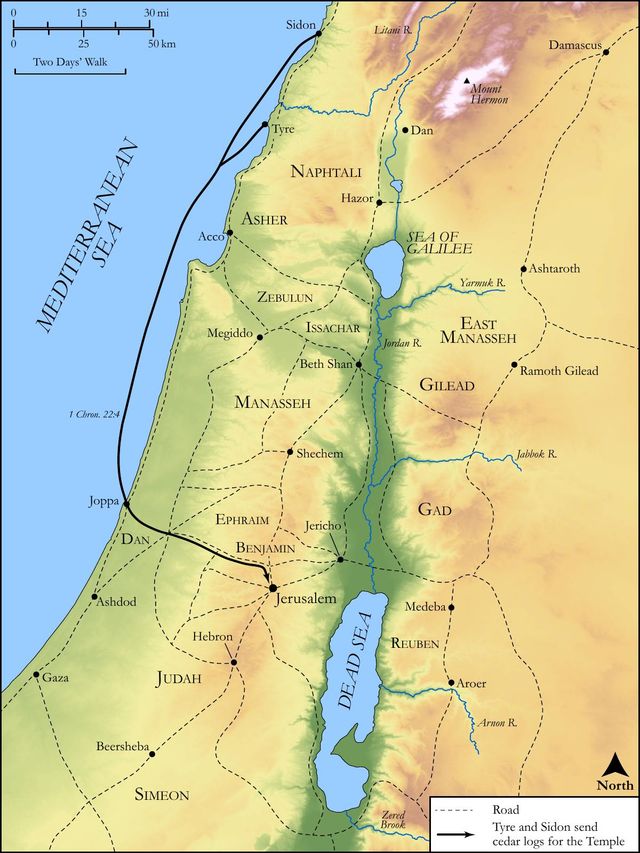
2.What preparation he made. In general, he prepared abundantly, as we shall find afterwards; cedar and stones, iron and brass, are here specified, Ch1 22:2-4. Cedar he had from the Tyrians and the Zidonians. The daughter of Tyre shall be there with a gift, Psa 45:12. He also got workmen together, the strangers that were in the land of Israel. Some think that he employed them because they were generally better artists, and more ingenious in manual operations, than the Israelites; or, rather, because he would not employ the free-born Israelites in any thing that looked mean and servile. They were delivered from the bondage of making bricks in Egypt, and must not return to hew stone. These strangers were proselytes to the Jewish religion, but, though not enslaved, they were not of equal dignity with Israelites.
Continue studying 1 Chronicles 22:2 across the web’s major study libraries — every link below opens this exact verse, chapter, or book on the destination site.
Read & Compare
 BibleGatewayThis verse in more than 200 translations and 70 languages.
 Bible.comThe YouVersion reader — hundreds of translations, reading plans, and highlights.
 ESV.orgCrossway's official English Standard Version reader.
 NET BibleThe NET translation with 60,000+ translators' notes on every rendering decision.
 STEP BibleTyndale House's free study tool — original text, vocabulary, and scholarly resources.
 BibliaLogos Bible Software's free web reader.
 USCCBThe New American Bible (Revised Edition) with the U.S. bishops' study notes.
Commentaries
 BibleHub CommentariesDozens of classic commentaries on this verse, gathered on one page.
 StudyLightMore than 100 commentary sets — the largest collection on the web.
 BibleRefPlain-English commentary on what this verse means, verse by verse.
 Enduring WordDavid Guzik's free commentary on this chapter, widely used by Bible teachers.
 Bible Study ToolsVerse commentary alongside Greek and Hebrew study aids.
Original Language & Research
- BibleHub InterlinearThe verse word by word — original language, transliteration, and English.
- BibleHub LexiconEvery word's original-language definition and Strong's entry.
 Blue Letter BibleDeep-study tools — Strong's numbers, concordance, and word studies.
 SefariaThe Hebrew text with Rashi and centuries of Jewish commentary.
Sermons, Hymns & Audio


TrulyRandomVerse is not affiliated with these sites and doesn’t control their content. They’re linked because they’re genuinely useful.
Summary
King David, though divinely prevented from personally constructing the Temple due to his involvement in warfare, displayed profound devotion and strategic foresight by meticulously preparing for its eventual erection. This verse highlights his proactive initiative in mobilizing essential resources and organizing skilled labor, specifically commanding the gathering of "strangers" (resident aliens) within Israel and appointing masons to meticulously hew and prepare high-quality stones. David's actions underscore a deep, selfless commitment to God's future dwelling place, ensuring that his son and successor, Solomon, would inherit a project exceptionally well-resourced and ready for immediate commencement, reflecting a dedication to divine purposes that transcended his own lifetime.
Context
ShowHideLiterary Context
This verse immediately follows God's revelation to David, conveyed through the prophet Nathan, that not David, but his son Solomon, would build the Temple because David had shed much blood in warfare, a detail explicitly stated in 1 Chronicles 22:8. Despite this personal disappointment and the deferral of his cherished desire, David immediately pivots from his ambition to a fervent commitment to preparation. Chapter 22 of 1 Chronicles meticulously details David's extensive and organized efforts, including his charge to Solomon and the leaders of Israel, making this verse a foundational statement of his preparatory endeavors. It sets the stage for the immense scale of the Temple project, which would later be described in detail in 1 Kings 5-8 and 2 Chronicles 2-7. David's actions here demonstrate his unwavering obedience, humility, and exemplary stewardship, ensuring the divine plan would proceed seamlessly through his successor.
Historical & Cultural Context
Monumental building projects like the house of God, whose pattern David gave to Solomon, required immense resources, vast labor forces, and highly specialized skills. Kings often conscripted both native populations and foreign residents or captives for such endeavors, viewing it as a royal prerogative and a means to consolidate power and demonstrate piety. The "strangers" mentioned in this verse, translated from the Hebrew gerim, refer to resident aliens who lived among the Israelites, often having certain legal protections and responsibilities, as outlined in Mosaic law (e.g., Deuteronomy 10:19). Their inclusion in this sacred building project was not unusual for the time, as foreign skilled laborers were highly valued (e.g., Hiram of Tyre's contribution to Solomon's Temple, as seen in 1 Kings 5:1-18). The emphasis on "wrought stones" highlights the advanced masonry techniques of the era, where stones were not merely rough-hewn but meticulously cut, shaped, and dressed at the quarry before being transported to the building site, ensuring a precise and aesthetically superior construction. This practice also minimized noise at the actual construction site, as later noted in 1 Kings 6:7.
Key Themes
ShowHideThis verse encapsulates several significant themes central to the Chronicler's narrative. First, it underscores the theme of diligent preparation for God's work, demonstrating that even when one is not the ultimate executor of a divine task, thorough foresight, meticulous planning, and resourceful provision are paramount. David's proactive gathering of materials and organization of labor exemplifies excellent stewardship and a commitment to God's long-term purposes. Second, the inclusion of "strangers" highlights the theme of universal reach in divine service, showing God's capacity to use diverse individuals, regardless of their ethnic or national origin, for His sacred purposes. This subtly foreshadows a broader, more inclusive community of faith that transcends national boundaries. Third, the command to "hew wrought stones" emphasizes the theme of excellence and quality in serving God. The "house of God" demanded the finest materials and craftsmanship, setting a high standard for all contributions to His kingdom work, reflecting the reverence and honor due to the Almighty. Finally, David's actions embody the theme of legacy and succession, as he selflessly prepares the way for the next generation to fulfill God's plan, prioritizing the divine mission over personal glory or the gratification of completing the project himself.
Exposition and Analysis
ShowHideKey Word Analysis
ShowHideThis term refers to a "guest" or, by implication, a "foreigner," "alien," or "sojourner." In the context of Israel, gerim were resident aliens who lived within the land but were not native-born Israelites. Unlike transient visitors, these individuals often had established residences and were subject to certain Israelite laws and protections, particularly those related to justice and charity. Their inclusion in the monumental task of building the Temple signifies David's comprehensive mobilization of all available manpower, regardless of national origin, for this sacred project. It also subtly hints at the universal scope of God's redemptive plan, which would eventually extend beyond Israel to include all nations.
This primitive root means "to cut or carve (wood, stone or other material)." By implication, it means "to hew, split, square, quarry, engrave." In this context, it emphasizes the active, skilled work of shaping raw stone into usable building material. David's command to "hew" indicates that the stones were not merely to be collected but meticulously prepared, underscoring the demand for precision and craftsmanship in the Temple's construction.
This phrase combines H1496 (gâzîyth), meaning "something cut, i.e., dressed stone," and H68 ('eben), meaning "a stone." Together, they describe stones that have been carefully quarried, shaped, and dressed by skilled masons, rather than being rough, unworked rocks. The emphasis on "wrought" signifies a commitment to quality, precision, and excellence in the materials designated for the "house of God." This meticulous preparation ensured that the stones would fit together perfectly, contributing to the structural integrity and aesthetic beauty of the Temple, reflecting the reverence and honor due to God's dwelling place.
Verse Breakdown
ShowHide"And David commanded to gather together the strangers that [were] in the land of Israel"
This clause reveals King David's decisive leadership and administrative prowess. Despite being denied the privilege of building the Temple himself, he immediately takes charge of the preparatory phase. His command to gather "strangers" (resident aliens) underscores his comprehensive approach to resource management, utilizing all available human capital, including non-Israelite residents, for this divinely ordained project. This highlights the practical necessity of a large, diverse workforce for such a massive undertaking and David's authority to mobilize it efficiently.
"and he set masons to hew wrought stones"
This part of the verse details the specific type of skilled labor employed and the quality of materials sought. David not only gathered the workforce but also organized them, assigning "masons" (skilled stonecutters) to the task. The instruction to "hew wrought stones" indicates a demand for high-quality, pre-finished building blocks. This meticulous preparation of materials off-site was crucial for the sanctity and quietness of the Temple construction itself, signifying that the Temple was to be built with the utmost care and precision, reflecting the sanctity and importance of God's dwelling.
"to build the house of God"
This final phrase states the ultimate, sacred purpose of all David's preparations: the construction of the Temple, the central sanctuary where God's presence would dwell among His people, and where the Ark of the Covenant would finally rest. This highlights the profound theological significance of David's efforts. His personal ambition was subsumed by his desire to honor God and facilitate the establishment of a permanent, magnificent place for worship, sacrifice, and communion, central to Israel's national and spiritual identity.
Literary Devices
ShowHideThe verse employs several literary devices to convey its meaning and significance. Foreshadowing is evident as David's meticulous preparations anticipate the grand scale and successful completion of the Temple by Solomon. The very act of gathering immense resources and skilled labor sets the stage for future events, hinting at the immense undertaking to come. Symbolism is powerfully present in the "wrought stones," which symbolize not only the physical excellence required for God's house but also the spiritual truth that God's work demands our best, our most refined and prepared contributions. The "house of God" itself is a profound symbol of God's presence, His covenant faithfulness, and the epicenter of Israelite worship and national identity. Furthermore, the inclusion of "strangers" (resident aliens) can be seen as a subtle foreshadowing of the future inclusion of Gentiles into God's covenant community, a theme that becomes much more explicit and central in the New Testament. This early act of universal reach within a sacred project hints at God's universal redemptive plan.
Theological and Thematic Connections
ShowHide1 Chronicles 22:2 powerfully illustrates the principle that God's grand purposes often require extensive human preparation, even when the ultimate fulfillment rests with another. David's diligent efforts, despite his personal disappointment, exemplify selfless devotion, humble obedience, and exemplary stewardship. This commitment to excellence and comprehensive resource mobilization for the "house of God" underscores the biblical emphasis on giving our very best to the Lord, recognizing that His work deserves our highest quality and most thoughtful contributions. Furthermore, the inclusion of "strangers" in this sacred work highlights God's inclusive nature, demonstrating His ability and willingness to use diverse individuals from all backgrounds to accomplish His divine will, laying a foundational groundwork for the universal scope of His kingdom.
Reflection and Application
ShowHideDavid's example in 1 Chronicles 22:2 offers profound and enduring lessons for believers today. His willingness to diligently prepare for a monumental task he would not personally complete challenges us to consider our own contributions to God's kingdom. Are we willing to lay foundations, gather resources, or train and equip others for future work, even if we don't see the final outcome or receive the credit? This verse calls us to embrace a long-term vision, prioritizing God's glory and the success of His mission over personal recognition or immediate gratification. It also reminds us that God can and does use all people—regardless of their background, status, or perceived "outsider" identity—to advance His purposes. Just as David sought "wrought stones," we are called to offer our best to God, striving for excellence in our service, our relationships, and our character. This means our contributions should be carefully considered, thoughtfully prepared, and executed with integrity, ensuring that our efforts build a spiritual house worthy of His presence and honor.
Questions for Reflection
ShowHideFAQ
ShowHideWhy was David not allowed to build the Temple, and why did he still prepare for it?
ShowHideDavid was not permitted to build the Temple because, as God revealed through the prophet Nathan, he had shed much blood in warfare (1 Chronicles 22:8). The Temple was to be a house of peace, built by a man of peace, Solomon. Despite this divine prohibition, David's heart was entirely devoted to God and the establishment of a permanent dwelling place for the Ark of the Covenant. His immediate and extensive preparations demonstrate his unwavering obedience, humility, and profound desire to honor God's will, even when it differed from his personal ambition. He understood that while the builder was to be his son, the vision and provision for the project were his responsibility, ensuring that Solomon would have all the necessary resources and organization to commence the work swiftly and successfully.
Who were these "strangers" David gathered, and what does their involvement signify?
ShowHideThe "strangers" (Hebrew: gerim) were resident aliens or sojourners living within the land of Israel. These were not merely transient visitors but individuals who had settled among the Israelites, often integrated into the society, and subject to certain laws and protections (e.g., Deuteronomy 10:19). Their involvement in the Temple construction signifies several important aspects: David's pragmatic mobilization of all available manpower for a project of immense scale; the practice, seen again under Solomon, of utilizing diverse populations for large public works; and, more profoundly, a theological hint towards the universal reach of God's purposes. Even in the Old Testament, God's plan extended beyond ethnic Israel, foreshadowing the future inclusion of Gentiles into the covenant community through Christ.
What is the significance of "wrought stones" for the Temple's construction?
ShowHide"Wrought stones" refers to stones that were meticulously quarried, cut, shaped, and dressed by skilled masons, rather than being rough, unhewn rocks. This emphasis on "wrought" or "hewn" materials signifies a commitment to the highest quality, precision, and excellence in the construction of the "house of God." It implies that the stones were prepared off-site, ensuring a quiet and efficient assembly at the Temple mount (as later described in 1 Kings 6:7). The use of such refined materials underscored the sanctity and majesty of the Temple, reflecting the reverence and honor due to God's dwelling place, and setting a standard of giving one's very best for divine service.
Christ-Centered Fulfillment
ShowHideDavid's diligent preparation for the physical Temple, a task he was forbidden to complete but selflessly facilitated for his son, profoundly foreshadows the ultimate work of Christ. Just as David laid the groundwork for a dwelling place for God's presence among His people, Jesus Christ is the true and ultimate builder of God's spiritual house, the Church. He declared, "Destroy this temple, and in three days I will raise it up," speaking of the temple of His body (John 2:19). Through His perfect life, atoning death, and glorious resurrection, Christ provided the complete and flawless "wrought stones"—His own righteousness and sacrifice—upon which the new spiritual Temple is built. The inclusion of "strangers" (gentiles) in David's workforce finds its glorious fulfillment in Christ, who broke down the dividing wall of hostility, making Jews and Gentiles "fellow citizens with the saints and members of the household of God, built on the foundation of the apostles and prophets, Christ Jesus himself being the cornerstone" (Ephesians 2:19-20). We, as believers, are now "living stones" being built up into a spiritual house, a holy priesthood, to offer spiritual sacrifices acceptable to God through Jesus Christ (1 Peter 2:5). David's preparatory acts, marked by excellence and selfless devotion, point to the perfect, complete, and eternally sufficient work of Christ, who, unlike David, was not merely a preparer but the very foundation and builder of His eternal Church (Matthew 16:18), a house far greater than Solomon's Temple, for He is the Son who built the house and is worthy of greater glory than Moses (Hebrews 3:3-6).