


1 Kings 5:17
Bible text: King James Version (1769 Blayney text) · Public domain
Bible text: Berean Standard Bible · Public domain
Bible text: American Standard Version (1901) · Public domain
Bible text: World English Bible, Messianic edition · Public domain
Bible text: Geneva Bible (1599) · Public domain
Bible text: Young's Literal Translation · Public domain
- וַיְצַוvay·Tzavand he commandedH6680Conj-w ¦ V-Piel-ConsecImperf-3msVerb Piel Consecutive Imperfect 3rd Singular Masculineוַandיְצַוhe commanded
- הַמֶּלֶךְha·Me·lekhthe kingH4428Art ¦ N-msNoun Singular Masculine Absoluteהַtheמֶּלֶךְking
- וַיַּסִּעוּvai·ya·si·'Uand they quarriedH5265Conj-w ¦ V-Hiphil-ConsecImperf-3mpVerb Hiphil Consecutive Imperfect 3rd Plural Masculineוַandיַּסִּעוּthey quarried
- אֲבָנִים'a·va·NimstonesH68N-mpNoun Plural Masculine Absolute
- גְּדֹלוֹתge·do·LotlargeH1419Adj-fpAdjective Plural Feminine Absolute
- אֲבָנִים'a·va·NimstonesH68N-mpNoun Plural Masculine Absolute
- יְקָרוֹתye·ka·RotcostlyH3368Adj-fpAdjective Plural Feminine Absolute
- לְיַסֵּדle·ya·Sedto foundH3245Prep-l ¦ V-Piel-InfVerb Piel Infinitive Constructלְtoיַסֵּדfound
- הַבָּיִתha·Ba·yitthe houseH1004Art ¦ N-msNoun Singular Masculine Absoluteהַtheבָּיִתhouse
- אַבְנֵי'av·Neistones ofH68N-mpcNoun Plural Masculine Construct
- גָזִיתga·Zithewn [stone]H1496N-fsNoun Singular Feminine Absolute
English is a literal word-by-word gloss of the Hebrew, not the KJV's wording. Why?
This is the original text the KJV's translators worked from — each Hebrew word with its own literal English meaning in this verse, prepared by scholars at Tyndale House, Cambridge. The KJV translates whole sentences, not word by word, so its wording differs: one Hebrew word can become several English words, and the KJV may choose “the LORD” where the gloss reads “Yahweh”. Both are faithful — they answer different questions. For the KJV's own rendering, switch to the KJV text.
Details
See on the biblical-era maps

Study this verse
Public-domain commentary
Matthew Henry
From his Commentary on the Whole Bible. Henry comments on passages, not single verses — this entry covers 1 Kings 5:10–18. His two-level outline is real structure in the source text, so it is rendered as structure.
Here is, I. The performance of the agreement between Solomon and Hiram. Each of the parties made good his engagement. 1. Hiram delivered Solomon the timber, according to his bargain, Kg1 5:10. The trees were Solomon's, but perhaps - Materiam superabat opus - The workmanship was of more value than the article. Hiram is therefore said to deliver the trees. 2. Solomon conveyed to Hiram the corn which he had promised him, Kg1 5:11. Thus let justice be followed (as the expression is, Deu 16:20), justice on both sides, in every bargain.
II.The confirmation of the friendship that was between them hereby.
God gave Solomon wisdom (Kg1 5:12), which was more and better than any thing Hiram did or could give him; but this made Hiram love him, and enabled Solomon to improve his kindness, so that they were both willing to ripen their mutual love into a mutual league, that it might be lasting. It is wisdom to strengthen our friendship with those whom we find to be honest and fair, lest new friends prove not so firm and so kind as old ones.
III.The labourers whom Solomon employed in preparing materials for the temple.
1.Some were Israelites, who were employed in the more easy and honourable part of the work, felling trees and helping to square them, in conjunction with Hiram's servants; for this he appointed 30,000, but employed only 10,000 at a time, so that for one month's work they had two months' vacation, both for rest and for the despatch of their own affairs at home, Kg1 5:13, Kg1 5:14. It was temple service, yet Solomon takes care that they shall not be over-worked. Great men ought to consider that their servants must rest as well as they.
2.Others were captives of other nations, who were to bear burdens and to hew stone (Kg1 5:15), and we read not that these had their resting times as the other had, for they were doomed to servitude.
3.There were some employed as directors and overseers (Kg1 5:16), 3300 that ruled over the people, and they were as necessary and useful in their place as the labourers in theirs; here were many hands and many eyes employed, for preparation was now to be made, not only for the temple, but for all the rest of Solomon's buildings, at Jerusalem, and here in the forest of Lebanon, and in other places of his dominion, of which see Kg1 9:17-19. He speaks of the vastness of his undertakings (Ecc 2:4, I made me great works), which required this vast number of workmen.
IV.The laying of the foundation of the temple; for that is the building his heart is chiefly upon, and therefore he begins with that, Kg1 5:17, Kg1 5:18. It should seem, Solomon was himself present, and president, at the founding of the temple, and that the first stone (as has been usual in famous buildings) was laid with some solemnity. Solomon commanded and they brought costly stones for the foundation; he would do every thing like himself, generously, and therefore would have some of the costliest stones laid, or buried rather, in the foundation, though, being out of sight, worse might have served. Christ, who is laid for a foundation, is an elect and precious stone (Isa 28:16), and the foundations of the church are said to be laid with sapphires, Isa 54:11, compare Rev 21:19. That sincerity which is our gospel perfection obliges us to lay our foundation firm and to bestow most pains on that part of our religion which lies out of the sight of men.
Historical interpretation
Historical reception
1 surviving comment on this verse from the historical church.
But it seems to be in accord with the solemn celebration that we are observing to recall something about the building of the temple and to search out how appropriately its adornment suits the significance of the church. Scripture tells how Solomon ordered that “they should take very great costly stones for the foundation of the temple and should square them off.” These great and costly stones that were laid as a foundation and that supported the entire bulk of the temple built on them suggest the extraordinary teachers of the holy church: “great” because of the outstanding quality of their merits; “costly” because of the splendor of the signs that those who heard the word from the Lord himself produced by their preaching as the fabric of the growing church.
Continue studying 1 Kings 5:17 across the web’s major study libraries — every link below opens this exact verse, chapter, or book on the destination site.
Read & Compare
 BibleGatewayThis verse in more than 200 translations and 70 languages.
 Bible.comThe YouVersion reader — hundreds of translations, reading plans, and highlights.
 ESV.orgCrossway's official English Standard Version reader.
 NET BibleThe NET translation with 60,000+ translators' notes on every rendering decision.
 STEP BibleTyndale House's free study tool — original text, vocabulary, and scholarly resources.
 BibliaLogos Bible Software's free web reader.
 USCCBThe New American Bible (Revised Edition) with the U.S. bishops' study notes.
Commentaries
 BibleHub CommentariesDozens of classic commentaries on this verse, gathered on one page.
 StudyLightMore than 100 commentary sets — the largest collection on the web.
 BibleRefPlain-English commentary on what this verse means, verse by verse.
 Enduring WordDavid Guzik's free commentary on this chapter, widely used by Bible teachers.
 Bible Study ToolsVerse commentary alongside Greek and Hebrew study aids.
Original Language & Research
- BibleHub InterlinearThe verse word by word — original language, transliteration, and English.
- BibleHub LexiconEvery word's original-language definition and Strong's entry.
 Blue Letter BibleDeep-study tools — Strong's numbers, concordance, and word studies.
 SefariaThe Hebrew text with Rashi and centuries of Jewish commentary.
Sermons, Hymns & Audio


TrulyRandomVerse is not affiliated with these sites and doesn’t control their content. They’re linked because they’re genuinely useful.
Summary
This verse encapsulates a critical phase in the monumental construction of the First Temple in Jerusalem, initiated by King Solomon. It meticulously details the royal decree for the procurement and precise preparation of foundational materials—specifically, immense, valuable, and expertly cut stones—underscoring the unparalleled quality, deliberate craftsmanship, and profound reverence dedicated to establishing the sacred dwelling place for the Lord.
Context
ShowHideLiterary Context
1 Kings 5:17 is strategically placed within the narrative of King Solomon's extensive preparations for building the Temple, immediately following the establishment of a vital alliance with King Hiram of Tyre. The preceding verses (1 Kings 5:1-12) detail the diplomatic exchange, Hiram's commitment to supply cedar and fir timber, and Solomon's provision of food for Hiram's household. Subsequently, 1 Kings 5:13-16 describes the immense labor force Solomon conscripted, comprising both Israelite and foreign workers, numbering in the hundreds of thousands, all meticulously organized for this colossal undertaking. This verse, therefore, marks the pivotal transition from the logistical planning and labor mobilization to the actual commencement of the physical construction, focusing specifically on the critical first stage: laying the foundation. It highlights the meticulousness and grand scale of the project from its very inception, setting the stage for the detailed building account that follows in 1 Kings 6.
Historical & Cultural Context
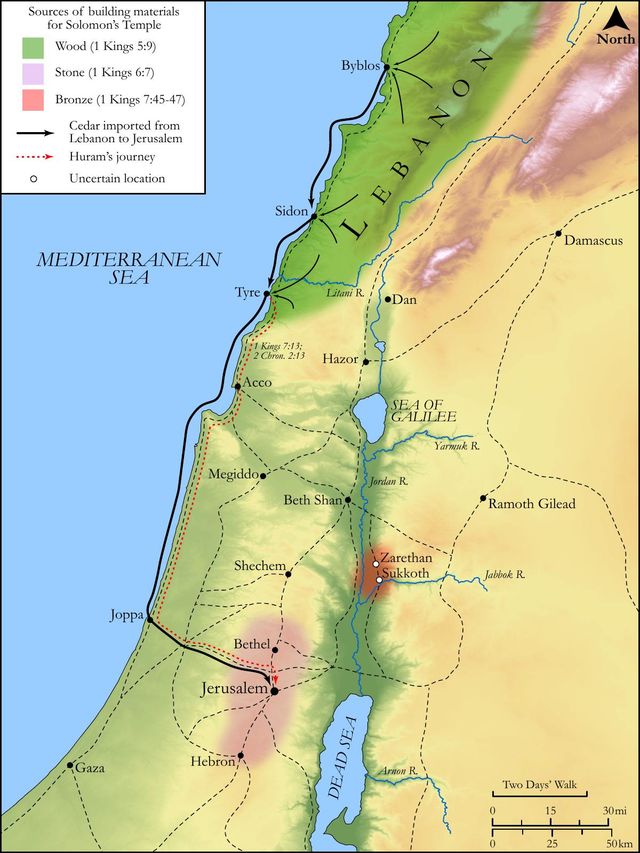
The building of the Temple was the crowning work of Solomon's reign, following the pattern that his father David had given him, and it served not only as a religious epicenter but also as a potent symbol of national prestige, divine favor, and royal authority. Solomon's Temple held a unique distinction as the designated dwelling place for the God of Israel, Yahweh, a concept rooted in the Tabernacle's design as outlined in Exodus 25:8-9. The use of "great stones, costly stones, and hewed stones" reflects the immense wealth and vast resources available to Solomon's kingdom at its zenith, as well as the advanced architectural and engineering capabilities of the era. The strategic alliance with Tyre, a renowned maritime and mercantile power, was indispensable, as the Tyrians were celebrated for their unparalleled expertise in quarrying, timber work, and skilled craftsmanship—specialized areas where Israel, though agriculturally rich, may have lacked such sophisticated techniques. The practice of using massive, precisely cut stones for foundations was common for significant structures, ensuring their longevity and stability, a testament to the enduring nature intended for God's sacred house.
Key Themes
ShowHideThis verse powerfully contributes to several overarching themes within 1 Kings and the broader biblical narrative. Firstly, it underscores the theme of Excellence and Dedication in Worship. The command for "great stones, costly stones, and hewed stones" signifies that only the absolute best materials and craftsmanship were deemed worthy for the Lord's dwelling, reflecting a profound commitment to honor God with unparalleled quality. This principle of offering one's best to God is a recurring motif in Scripture, as seen in the warnings against offering blemished sacrifices in Malachi 1:8. Secondly, it highlights the Intersection of Divine Mandate and Human Responsibility. While the Temple's construction was God's explicit will, first revealed to David in 2 Samuel 7:13, its realization required immense human effort, meticulous planning, and vast resources, as detailed throughout 1 Kings 5. Finally, the emphasis on laying the "foundation of the house" points to the Critical Importance of a Firm Foundation. Both physically and spiritually, a stable and durable base is paramount for any enduring structure or endeavor, a concept later profoundly expounded upon by Jesus in the parable of the wise and foolish builders in Matthew 7:24-27.
Exposition and Analysis
ShowHideKey Word Analysis
ShowHideThis word signifies magnitude in any sense—size, importance, or intensity. In the context of "great stones," it emphasizes the immense physical dimensions and weight of the quarried blocks, indicating that these were not ordinary building materials but colossal pieces requiring significant effort and engineering to quarry, transport, and position. Their grandeur was intended to convey the magnificence and enduring nature of the structure, fitting for the dwelling place of the Almighty.
This term describes something valuable, precious, or honorable. Applied to the "costly stones," it refers to their high intrinsic value, which could stem from rarity, exceptional beauty (e.g., specific colors, veins, or luminescence), or the sheer difficulty and expense involved in their acquisition and preparation. It signifies that no expense was spared in honoring God, reflecting the ultimate commitment to quality, reverence, and the offering of one's most prized possessions for His service.
This word denotes something cut, specifically dressed or wrought stone. This term indicates that the stones were not left in their rough, natural state but were meticulously cut, shaped, and dressed with precision. This careful preparation ensured that each stone would fit perfectly with its counterparts, creating a seamless, stable, and aesthetically pleasing foundation. It speaks to the skilled craftsmanship involved and the desire for perfection in every detail of the Temple's construction, ensuring both structural integrity and a refined appearance.
Verse Breakdown
ShowHide"And the king commanded"
This opening clause immediately establishes King Solomon's direct authority and active involvement in the Temple's construction. It underscores that this massive undertaking was not a casual project but a royal mandate, demonstrating Solomon's unwavering commitment to fulfilling his father David's vision and God's divine promise. His command initiated the complex logistical and labor efforts required for such a monumental task.
"and they brought great stones, costly stones, [and] hewed stones"
This phrase details the specific types and qualities of materials procured for the foundation. The progression from "great" (emphasizing size and scale) to "costly" (highlighting value and preciousness) to "hewed" (denoting precision and craftsmanship) collectively emphasizes the unparalleled quality and meticulous preparation of every element. This careful selection and shaping ensured both structural integrity and aesthetic grandeur, reflecting the sacred nature of the building.
"to lay the foundation of the house"
This final clause explicitly states the ultimate purpose of these extraordinary stones. The foundation is the most critical and fundamental part of any structure, bearing the entire weight and ensuring its stability, longevity, and resistance to external forces. By emphasizing the superior quality of the foundation stones, the text implicitly stresses the enduring nature and profound divine significance of the Temple as God's designated dwelling place on earth.
Literary Devices
ShowHideThe verse employs several impactful literary devices to convey its message. The most prominent is the tricolon ("great stones, costly stones, [and] hewed stones"), which uses a series of three parallel words or phrases to emphasize the comprehensive and exceptional nature of the materials. This repetition with variation creates a rhythmic and memorable description, building a sense of increasing specificity and quality from sheer size to inherent value to precise craftsmanship. The phrase "the house" serves as a synecdoche, where a part (the foundation of the house) represents the whole (the entire Temple complex), focusing the reader's attention on the crucial initial stage of construction while implying the grandeur of the completed structure. Furthermore, the meticulous description of the stones functions as symbolism, where the physical quality of the foundation stones symbolizes the spiritual and theological importance of the Temple itself—a structure built with utmost care and value, reflecting the reverence due to God and the enduring nature of His covenant. The emphasis on "great" and "costly" stones also subtly employs hyperbole to suggest the immense scale and unparalleled expense involved, reinforcing the idea of a project beyond ordinary human endeavor, truly fit for the Divine.
Theological and Thematic Connections
ShowHideThe meticulous preparation of the Temple's foundation in 1 Kings 5:17 carries profound theological weight, illustrating enduring principles for God's people. It powerfully demonstrates that anything dedicated to God, especially His dwelling place or His work, demands the highest standard of excellence, sacrifice, and intentionality. This commitment to unparalleled quality reflects a deep reverence for God's holiness, majesty, and worthiness, emphasizing that true worship is not merely ritualistic but involves the offering of our very best—our resources, talents, and diligent effort. Furthermore, the emphasis on a strong, carefully laid foundation speaks to the enduring nature of God's covenant promises and the steadfast stability of His presence among His people. Just as the physical Temple required an unshakeable base to withstand the test of time, so too is the spiritual life of an individual believer and the collective community of faith built upon enduring truths, a steadfast commitment to God's revealed will, and the unyielding faithfulness of God Himself.
Reflection and Application
ShowHide1 Kings 5:17 offers timeless principles for contemporary believers, challenging us to deeply consider the quality of our own "foundations" and the excellence we bring to all aspects of our lives, particularly those dedicated to God. Just as Solomon spared no expense and demanded meticulous craftsmanship in preparing the Temple's base, we are called to build our spiritual lives, our relationships, our ministries, and our daily work on a bedrock of unwavering faith, uncompromised truth, and genuine commitment. This means investing our best time, our unique talents, and our available resources not just in grand, visible projects, but especially in the seemingly mundane, foundational aspects of discipleship—consistent prayer, diligent study of God's Word, and unwavering obedience to His commands. The precision of the "hewed stones" reminds us that God values not only our effort but also our diligence, integrity, and attention to detail in every endeavor. As we reflect, we must ask ourselves: What kind of foundation are we laying for our personal faith, our families, our communities, and our work for the Kingdom of God? Are we content with convenience, expediency, or minimal effort, or are we striving for excellence, reflecting the costly grace and immeasurable value of the salvation we have so freely received?
Questions for Reflection
ShowHideFAQ
ShowHideWhy was so much emphasis placed on the foundation of the Temple?
ShowHideThe foundation of any large structure is its most critical component, bearing the entire weight and ensuring its stability and longevity. For the Temple, this emphasis was amplified by its divine purpose. It was to be a permanent dwelling place for the name of the Lord, a central hub for Israelite worship for generations to come. Using "great stones, costly stones, and hewed stones" for the foundation underscored the Temple's immense significance, its intended permanence, and the unparalleled reverence due to God. It also symbolically represented the enduring nature of God's covenant with Israel and the steadfastness of His presence among His people. This meticulousness in the foundation ensured that the physical structure would stand as a lasting testament to God's glory, much like a wise builder ensures a strong foundation to withstand storms, as taught by Jesus in Matthew 7:24-27.
Christ-Centered Fulfillment
ShowHideWhile 1 Kings 5:17 vividly describes the physical foundation of Solomon's magnificent Temple, it profoundly foreshadows the ultimate spiritual foundation laid in Jesus Christ. The "great stones, costly stones, and hewed stones" meticulously prepared for God's earthly dwelling find their supreme and eternal fulfillment in Christ, who is Himself described as the "chief cornerstone" and the very foundation upon which the spiritual temple, the Church, is built. As Ephesians 2:20 powerfully declares, believers are "built on the foundation of the apostles and prophets, Christ Jesus himself being the cornerstone." Unlike the temporary nature of any physical structure, even one as magnificent as Solomon's Temple, Christ provides an eternal, unshakeable foundation for salvation and spiritual life. His sacrificial death on the cross was the "costly stone" of infinite value, purchased by His precious blood, as noted in 1 Peter 1:18-19. His perfect life, sinless obedience, and victorious resurrection are the "hewed stone" of divine precision, upon which all who believe can securely build their faith, finding redemption and new life. Thus, the diligent work of laying the Temple's foundation points forward to God's ultimate and perfect provision for His people's spiritual dwelling place, not in a building made with hands, but in the person and finished work of Jesus, the Lamb of God who takes away the sin of the world.