


Joshua 19:48
Bible text: King James Version (1769 Blayney text) · Public domain
Bible text: Berean Standard Bible · Public domain
Bible text: American Standard Version (1901) · Public domain
Bible text: World English Bible, Messianic edition · Public domain
Bible text: Geneva Bible (1599) · Public domain
Bible text: Young's Literal Translation · Public domain
- זֹאתZotthisH2063PrtParticle Demonstrative
- נַחֲלַתna·cha·Lat[was] [the] inheritance ofH5159N-fscNoun Singular Feminine Construct
- מַטֵּהma·Teh[the] tribe ofH4294N-mscNoun Singular Masculine Construct
- בְנֵיve·nei[the] descendants ofH1121N-mpcNoun Plural Masculine Construct
- דָןdanDanH1835N-properNoun Proper Location
- לְמִשְׁפְּחֹתָםle·mish·pe·cho·Tamto their clansH4940Prep-l ¦ N-fpc ¦ 3mpNoun Plural Feminine Constructלְtoמִשְׁפְּחֹתָclansםtheir
- הֶעָרִיםhe·'a·Rimthe citiesH5892Art ¦ N-mpNoun Plural Masculine Absoluteהֶtheעָרִיםcities
- הָאֵלֶּהha·'E·leh<the> theseH428Art ¦ PrtParticle Demonstrativeהָ<the>אֵלֶּהthese
- וְחַצְרֵיהֶןve·chatz·rei·Henand their villagesH2691Conj-w ¦ N-mpc ¦ 3fpNoun Plural Masculine Constructוְandחַצְרֵיvillagesהֶןtheir
English is a literal word-by-word gloss of the Hebrew, not the KJV's wording. Why?
This is the original text the KJV's translators worked from — each Hebrew word with its own literal English meaning in this verse, prepared by scholars at Tyndale House, Cambridge. The KJV translates whole sentences, not word by word, so its wording differs: one Hebrew word can become several English words, and the KJV may choose “the LORD” where the gloss reads “Yahweh”. Both are faithful — they answer different questions. For the KJV's own rendering, switch to the KJV text.
Details
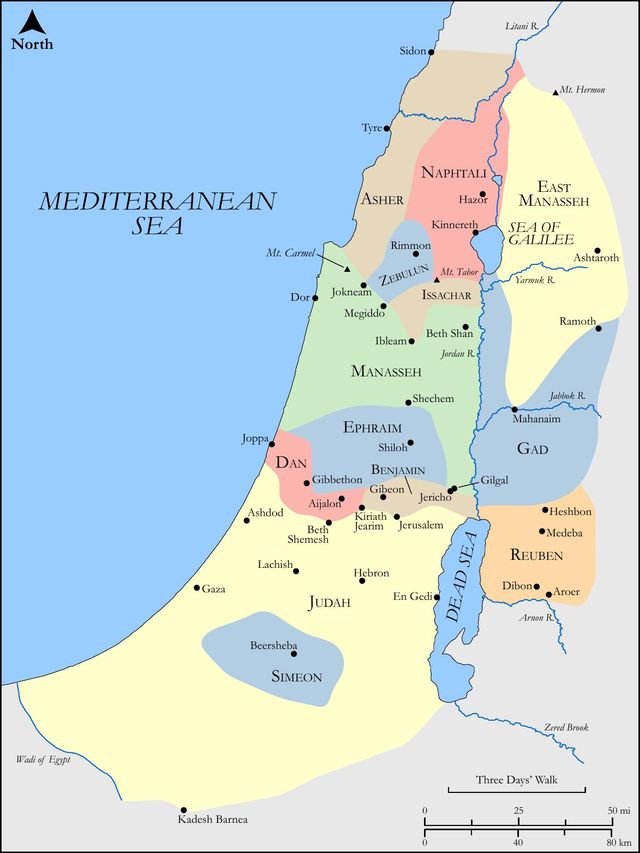
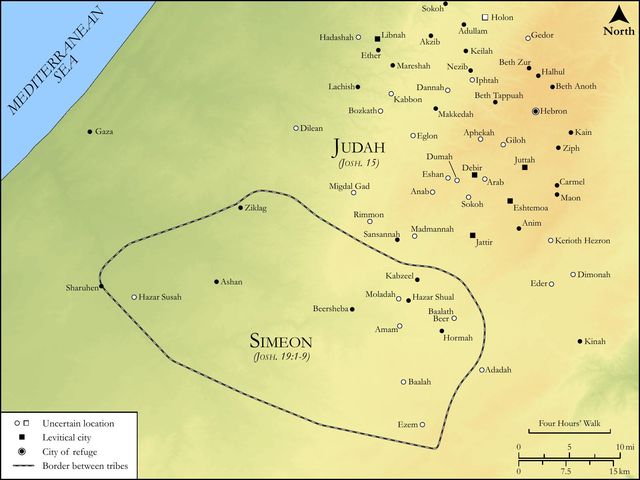
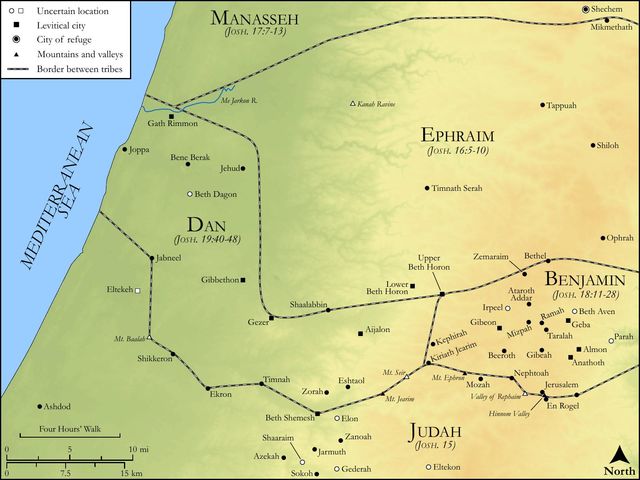
See on the biblical-era maps
Study this verse
Public-domain commentary
Matthew Henry
From his Commentary on the Whole Bible. Henry comments on passages, not single verses — this entry covers Joshua 19:40–48.
Dan, though commander of one of the four squadrons of the camp of Israel, in the wilderness, that which brought up the rear, yet was last provided for in Canaan, and his lot fell in the southern part of Canaan, between Judah on the east and the land of the Philistines on the west, Ephraim on the north and Simeon on the south. Providence ordered this numerous and powerful tribe into a post of danger, as best able to deal with those vexatious neighbours the Philistines, and so it was found in Samson. Here is an account, 1. Of what fell to this tribe by lot, Zorah, and Eshtaol, and the camp of Dan thereabouts, of which we read in the story of Samson. And near there was the valley of Eshcol, whence the spies brought the famous bunch of grapes. Japho, or Joppa was in this lot. 2. Of what they got by their own industry and valour, which is mentioned here (Jos 19:47), but related at large, Jdg 18:7, etc.
Continue studying Joshua 19:48 across the web’s major study libraries — every link below opens this exact verse, chapter, or book on the destination site.
Read & Compare
 BibleGatewayThis verse in more than 200 translations and 70 languages.
 Bible.comThe YouVersion reader — hundreds of translations, reading plans, and highlights.
 ESV.orgCrossway's official English Standard Version reader.
 NET BibleThe NET translation with 60,000+ translators' notes on every rendering decision.
 STEP BibleTyndale House's free study tool — original text, vocabulary, and scholarly resources.
 BibliaLogos Bible Software's free web reader.
 USCCBThe New American Bible (Revised Edition) with the U.S. bishops' study notes.
Commentaries
 BibleHub CommentariesDozens of classic commentaries on this verse, gathered on one page.
 StudyLightMore than 100 commentary sets — the largest collection on the web.
 BibleRefPlain-English commentary on what this verse means, verse by verse.
 Enduring WordDavid Guzik's free commentary on this chapter, widely used by Bible teachers.
 Bible Study ToolsVerse commentary alongside Greek and Hebrew study aids.
Original Language & Research
- BibleHub InterlinearThe verse word by word — original language, transliteration, and English.
- BibleHub LexiconEvery word's original-language definition and Strong's entry.
 Blue Letter BibleDeep-study tools — Strong's numbers, concordance, and word studies.
 SefariaThe Hebrew text with Rashi and centuries of Jewish commentary.
Sermons, Hymns & Audio


TrulyRandomVerse is not affiliated with these sites and doesn’t control their content. They’re linked because they’re genuinely useful.
Summary
Joshua 19:48 serves as the definitive concluding statement regarding the territorial allotment for the tribe of Dan. This verse meticulously confirms that the specific cities and their surrounding villages, previously enumerated in detail, constitute the divinely appointed and permanent inheritance for Dan's families. It marks the formal completion of the land distribution process for this tribe, underscoring the fulfillment of God's covenant promises and the orderly execution of the division overseen by Joshua and Eleazar.
Context
ShowHideLiterary Context
Joshua 19:48 functions as the concluding summary for the detailed description of Dan's tribal inheritance, which begins in Joshua 19:40. This verse is situated within the broader narrative of the land distribution (Joshua chapters 13-19), a lengthy and meticulous section that systematically records how the Promised Land was divided among the twelve tribes of Israel after the initial conquest of Canaan. Each tribal inheritance account typically follows a pattern: an introductory statement, a list of boundaries and specific cities, and a concluding summary verse that affirms the completeness and divine legitimacy of the allotment. The precision of this final statement, like others in this section, emphasizes the divine order and the fulfillment of God's covenant with His people. The Book of Joshua, as a whole, highlights God's faithfulness in bringing His people into the land He promised, culminating in the declaration of rest and inheritance (e.g., Joshua 21:43-45).
Historical & Cultural Context
The allocation of land described in Joshua occurred at a pivotal moment in Israelite history, transitioning them from a nomadic people to a settled nation in Canaan. Land was not merely property but the foundation of Israelite national identity, economic stability, and social structure. Its inheritance was paramount for a family's survival, status, and continuity. The phrase "according to their families" reflects the patriarchal and kinship-based societal structure, where land was passed down through generations to preserve tribal and familial integrity. The distribution process, often involving lots (as detailed in Joshua 14:2), underscored divine sovereignty and prevented disputes, ensuring each tribe's portion was recognized as divinely appointed and legitimate. The mention of "cities with their villages" signifies the comprehensive nature of the inheritance, encompassing not only fortified urban centers but also the surrounding agricultural lands, pastures, and smaller settlements essential for sustenance and communal life.
Key Themes
ShowHideThis verse, as part of the extensive land distribution narrative, contributes significantly to several overarching themes in the Book of Joshua and the broader biblical canon. It powerfully demonstrates Divine Fulfillment and Faithfulness, showcasing God's unwavering commitment to His ancient covenant promises made to Abraham regarding the land (e.g., Genesis 12:7). It highlights Divine Provision, illustrating God's meticulous care in providing a specific, defined, and secure inheritance for each family within each tribe. The theme of Tribal Identity and Inheritance is central, as the land allocation was not merely a geographical division but was integral to the unique identity, economic viability, and social cohesion of each tribe, establishing their permanent place within the nascent nation of Israel. Furthermore, the systematic process emphasizes Sovereignty in Distribution, signifying that each tribe's portion was a direct gift from God, divinely appointed rather than a result of human strategy or power, as explicitly stated in Joshua 14:1).
Exposition and Analysis
ShowHideKey Word Analysis
ShowHideThis term (H5159) is fundamental to the land distribution narrative in Joshua. It signifies an allotted portion, a possession, or an inheritance, specifically referring to the land given by God as a permanent possession to the tribes and their families. It carries the strong connotation of a divine gift and a lasting legacy, emphasizing that the land was not earned but bestowed by God's grace and covenant faithfulness. The concept of naḥălāh is deeply theological, linking the physical land to God's promise and provision for His people, as seen in Numbers 26:53.
The phrase "according to their families" (H4940) is crucial. It highlights that the land was not merely distributed to the tribe as a collective but was meticulously apportioned down to the familial units within each tribe. This ensured the long-term stability and identity of each lineage, providing a secure place for each household to dwell, cultivate, and perpetuate their heritage. It underscores the personal and communal nature of God's provision and the importance of preserving the tribal structure.
This word (H2691) refers to a yard or an enclosed space, but in the context of land distribution, it denotes a hamlet or smaller settlement, often surrounded by walls or fences, and connected to a larger city. The inclusion of "villages" alongside "cities" (H5892) emphasizes the comprehensive nature of the inheritance, encompassing not just urban centers but also the surrounding agricultural lands and dependent communities vital for the economy and sustenance of the tribe.
Verse Breakdown
ShowHide"This [is] the inheritance"
This opening phrase functions as a definitive summary statement. "This" refers back to the detailed list of cities and their associated villages just enumerated in the preceding verses (Joshua 19:41-47), confirming that the entire described territory constitutes the designated portion. The implied "is" in the Hebrew affirms the established reality and finality of the allocation.
"of the tribe of the children of Dan"
This clause precisely identifies the recipient of the inheritance. It specifies that the land described belongs to the tribal descendants of Dan, affirming their unique claim and place within the confederation of Israelite tribes, descended from Dan, one of the sons of Jacob.
"according to their families"
This vital phrase emphasizes the systematic and familial basis of the land division. It indicates that the allocation was not arbitrary but was structured to ensure that each family unit within the tribe of Dan received its designated share, reinforcing the importance of lineage, continuity, and the preservation of the patriarchal structure in Israelite society.
"these cities with their villages"
This concluding phrase provides a concise and comprehensive description of the inheritance's physical scope. "Cities" refers to the more significant population centers, while "villages" (or "dependent settlements") indicates the surrounding agricultural lands, smaller hamlets, and unfortified communities that were economically and administratively linked to the main cities. Together, they represent the entirety of the settled and usable territory allotted to Dan, highlighting the completeness of God's provision.
Literary Devices
ShowHideJoshua 19:48 primarily employs Summary and Legal/Administrative Language. As a concluding statement for the description of Dan's inheritance, it functions as a concise summary, bringing formal closure to a detailed list of geographical locations. The precise and formulaic phrasing—"This is the inheritance... according to their families, these cities with their villages"—is characteristic of the Legal/Administrative Language found throughout the land distribution chapters. This formal language lends authority and finality to the divine decree, emphasizing the binding and permanent nature of the land allocation. The phrase "cities with their villages" can also be seen as a form of Merism, a literary device where two contrasting or complementary parts are used to represent a whole, signifying the entire settled territory, encompassing both urban centers and their rural dependencies.
Theological and Thematic Connections
ShowHideJoshua 19:48, though seemingly an administrative detail, is profoundly theological. It stands as a testament to God's meticulous faithfulness in fulfilling His covenant promises to Abraham and his descendants, specifically concerning the land of Canaan. The precise allocation to each tribe and family underscores God's sovereignty, His orderly nature, and His desire to provide a secure dwelling place for His people. This physical inheritance was not merely a geographical possession but a tangible expression of God's presence and blessing among Israel, foundational to their identity as a holy nation. It reminds us that God is a God who keeps His word, providing for His people in concrete and specific ways, demonstrating His unwavering commitment to His covenant.
Reflection and Application
ShowHideJoshua 19:48, while concluding a specific historical land allotment, offers profound insights for contemporary believers. It reminds us of God's unwavering faithfulness to His promises. Just as He meticulously provided a physical inheritance for each family in Israel, He has promised and provided an eternal spiritual inheritance for those who are in Christ. This verse prompts us to consider the security and specificity of God's provision in our own lives, whether it be spiritual blessings, unique gifts, or the specific callings He places upon us. It also subtly foreshadows the reality that while God's promises are certain, their full possession often requires active faith, perseverance, and sometimes, spiritual warfare, as evidenced by Dan's later struggles to fully occupy their territory and their eventual migration (recorded in Judges 18). We are called to steward the inheritance God has given us, both physical and spiritual, with gratitude and diligence, trusting in His sovereign plan and actively pursuing the full measure of His blessings in our lives.
Questions for Reflection
ShowHideFAQ
ShowHideWhat was the significance of "inheritance" in ancient Israelite society, and how does Joshua 19:48 relate to it?
ShowHideIn ancient Israel, "inheritance" (Hebrew: naḥălāh) was profoundly significant, representing a permanent, inalienable possession of land passed down through families. It was the primary source of economic stability, tribal identity, and social standing. Unlike modern concepts of property, this land was seen as a divine gift, not merely a commodity to be bought and sold freely; it was God's provision for His covenant people. Joshua 19:48 concludes the description of Dan's inheritance, affirming that the specified cities and villages were their divinely allotted and permanent possession. This detail underscores God's faithfulness in fulfilling His covenant promise to provide a secure dwelling for each Israelite family, ensuring their place within the nation and their connection to the land God had sworn to give them, as seen in passages like Numbers 26:52-56.
Christ-Centered Fulfillment
ShowHideWhile Joshua 19:48 describes a physical inheritance of land, it points forward to the ultimate, spiritual inheritance found in Jesus Christ. The meticulous division of Canaan among the tribes foreshadows God's perfect and eternal provision for His people in the new covenant. Just as Israel received a promised land, believers in Christ receive a spiritual inheritance that is "imperishable, undefiled, and unfading, kept in heaven for you" (1 Peter 1:4). Jesus, as the true and greater Joshua, leads His people not merely into an earthly Canaan, but into the heavenly kingdom and eternal rest. He is the ultimate "inheritance" (e.g., Colossians 1:12), the one through whom all spiritual blessings are bestowed (Ephesians 1:3). The stability and security of Dan's allotted territory, though later challenged by their failure to fully possess it, prefigure the unshakeable and eternal security of the believer's inheritance in Christ, secured by His atoning work and resurrection (Hebrews 9:15). Ultimately, the physical land of promise points to the new heavens and new earth, where God's people will dwell eternally with Him, fulfilling the deepest longings for a permanent home and complete provision found in the person of Jesus Christ (Revelation 21:1-7).