


Joshua 19:49
Bible text: King James Version (1769 Blayney text) · Public domain
Bible text: King James Version with Strong's numbers · Public domain
Bible text: Berean Standard Bible · Public domain
Bible text: American Standard Version (1901) · Public domain
Bible text: World English Bible, Messianic edition · Public domain
Bible text: Geneva Bible (1599) · Public domain
Bible text: Young's Literal Translation · Public domain
- וַיְכַלּוּvay·kha·Luand they finishedH3615Conj-w ¦ V-Piel-ConsecImperf-3mpVerb Piel Consecutive Imperfect 3rd Plural Masculineוַandיְכַלּוּthey finished
- לִנְחֹלlin·cholto divide for possessionH5157Prep-l ¦ V-Qal-InfVerb Qal Infinitive Constructלִtoנְחֹלdivide for possession
- אֶת'et<obj.>H853DirObjMParticle Object Indicator
- הָאָרֶץha·'A·retzthe landH776Art ¦ N-fsNoun Singular Feminine Absoluteהָtheאָרֶץland
- לִגְבוּלֹתֶיהָlig·vu·lo·Tei·hato its bordersH1367Prep-l ¦ N-fpc ¦ 3fsNoun Plural Feminine Constructלִtoגְבוּלֹתֶיbordersהָits
- וַיִּתְּנוּvai·yi·te·Nuand they gaveH5414Conj-w ¦ V-Qal-ConsecImperf-3mpVerb Qal Consecutive Imperfect 3rd Plural Masculineוַandיִּתְּנוּthey gave
- בְנֵיve·nei[the] people ofH1121N-mpcNoun Plural Masculine Construct
- יִשְׂרָאֵלYis·ra·'ElIsraelH3478N-properNoun Proper Location
- נַחֲלָהna·cha·Lahan inheritanceH5159N-fsNoun Singular Feminine Absolute
- לִיהוֹשֻׁעַli·ho·Shu·a'to JoshuaH3091Prep-l ¦ N-proper-mNoun Proper MasculineלִtoיהוֹשֻׁעַJoshua
- בִּןbin[the] son ofH1121N-mscNoun Singular Masculine Construct
- נוּןnunNunH5126N-proper-mNoun Proper Masculine
- בְּתוֹכָםbe·to·Khamin midst of themH8432Prep-b ¦ N-msc ¦ 3mpNoun Singular Masculine Constructבְּinתוֹכָmidst ofםthem
English is a literal word-by-word gloss of the Hebrew, not the KJV's wording. Why?
This is the original text the KJV's translators worked from — each Hebrew word with its own literal English meaning in this verse, prepared by scholars at Tyndale House, Cambridge. The KJV translates whole sentences, not word by word, so its wording differs: one Hebrew word can become several English words, and the KJV may choose “the LORD” where the gloss reads “Yahweh”. Both are faithful — they answer different questions. For the KJV's own rendering, switch to the KJV text.
Details
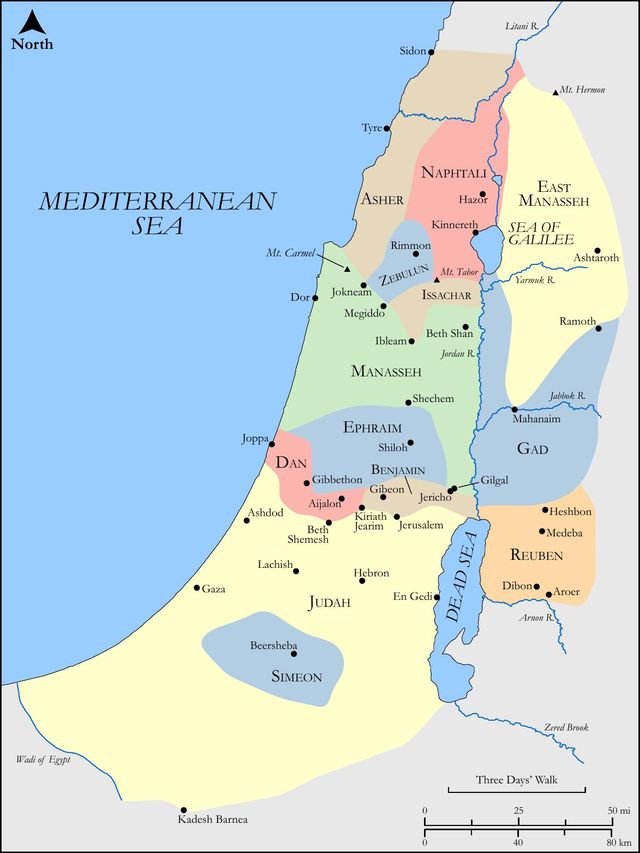
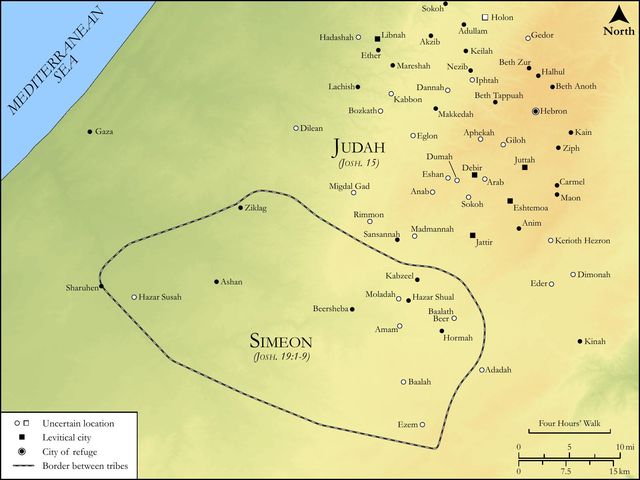
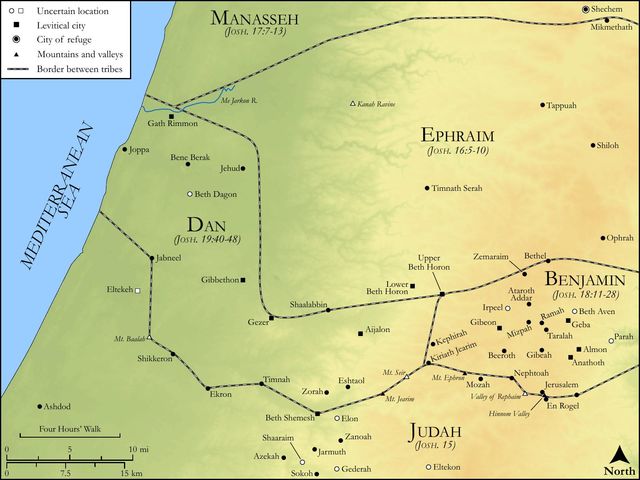
See on the biblical-era maps
Study this verse
Public-domain commentary
Matthew Henry
From his Commentary on the Whole Bible. Henry comments on passages, not single verses — this entry covers Joshua 19:49–51.
Before this account of the dividing of the land is solemnly closed up, in the last verse, which intimates that the thing was done to the satisfaction of all, here is an account of the particular inheritance assigned to Joshua. 1. He was last served, though the eldest and greatest man of all Israel, and who, having commanded in the conquest of Canaan, might have demanded the first settlement in it for himself and his family. But he would make it to appear that in all he did he sought the good of his country, and not any private interest of his own. He was content to be unfixed till he saw them all settled; and herein is a great example to all in public places to prefer the common welfare before their particular satisfaction. Let the public be first served. 2. He had his lot according to the word of the Lord. It is probable that, when God by Moses told Caleb what inheritance he should have (Jos 14:9), he gave the like promise to Joshua, which he had an eye to in making his election: this made his portion doubly pleasant, that he had it, not as the rest by common providence, but by special promise. 3. He chose it in Mount Ephraim, which belonged to his own tribe, with which he thereby put himself in common, when he might by prerogative have chosen his inheritance in some other tribe, as suppose that of Judah, and thereby have distinguished himself from them. Let no man's preferment or honour make him ashamed of his family or country, or estrange him from it. The tabernacle was set up in the lot of Ephraim, and Joshua would forecast not to be far from that. 4. The children of Israel are said to give it to him (Jos 19:49), which bespeaks his humility, that he would not take it to himself without the people's consent and approbation, as if he would thereby own himself, though major singulis - greater than any one, yet minor universis - less than the whole assemblage, and would hold even the estate of his family, under God, by the grant of the people. 5. It was a city that must be built before it was fit to be dwelt in. While others dwelt in houses which they built not, Joshua must erect for himself (that he might be a pattern of industry and contentment with mean things) such buildings as he could hastily run up, without curiosity or magnificence. Our Lord Jesus thus came and dwelt among us, not in pomp but poverty, providing rest for us, yet himself not having where to lay his head. Even Christ pleased not himself.
Continue studying Joshua 19:49 across the web’s major study libraries — every link below opens this exact verse, chapter, or book on the destination site.
Read & Compare
 BibleGatewayThis verse in more than 200 translations and 70 languages.
 Bible.comThe YouVersion reader — hundreds of translations, reading plans, and highlights.
 ESV.orgCrossway's official English Standard Version reader.
 NET BibleThe NET translation with 60,000+ translators' notes on every rendering decision.
 STEP BibleTyndale House's free study tool — original text, vocabulary, and scholarly resources.
 BibliaLogos Bible Software's free web reader.
 USCCBThe New American Bible (Revised Edition) with the U.S. bishops' study notes.
Commentaries
 BibleHub CommentariesDozens of classic commentaries on this verse, gathered on one page.
 StudyLightMore than 100 commentary sets — the largest collection on the web.
 BibleRefPlain-English commentary on what this verse means, verse by verse.
 Enduring WordDavid Guzik's free commentary on this chapter, widely used by Bible teachers.
 Bible Study ToolsVerse commentary alongside Greek and Hebrew study aids.
Original Language & Research
- BibleHub InterlinearThe verse word by word — original language, transliteration, and English.
- BibleHub LexiconEvery word's original-language definition and Strong's entry.
 Blue Letter BibleDeep-study tools — Strong's numbers, concordance, and word studies.
 SefariaThe Hebrew text with Rashi and centuries of Jewish commentary.
Sermons, Hymns & Audio


TrulyRandomVerse is not affiliated with these sites and doesn’t control their content. They’re linked because they’re genuinely useful.
Summary
Joshua 19:49 serves as the climactic conclusion to the meticulous and divinely orchestrated division of the Promised Land among the Israelite tribes, marking the fulfillment of God's ancient covenant promises. This pivotal verse uniquely records the communal act of the children of Israel bestowing a special inheritance upon their faithful leader, Joshua the son of Nun, only after every other tribe had received its allotted portion, thereby underscoring his selfless dedication and the people's grateful recognition of his exemplary service.
Context
ShowHideLiterary Context
This verse provides a definitive concluding statement to the extensive and detailed section of the book of Joshua (chapters 13-19) that meticulously chronicles the distribution of the Promised Land among the twelve tribes of Israel. Its placement immediately follows the exhaustive listing of tribal boundaries and cities, signaling the successful completion of a monumental task—the transition from nomadic conquest to settled inheritance. By explicitly stating that "they had made an end of dividing the land," the narrative emphasizes the thoroughness and divine orchestration of the settlement process, underscoring God's faithfulness in bringing His people into their promised rest. The strategic positioning of Joshua's personal inheritance at the very end of this long and detailed account serves to highlight his selfless leadership, demonstrating his prioritization of the people's needs before his own, and provides a fitting capstone before the subsequent chapters delve into the establishment of cities of refuge, Levitical cities, and finally, Joshua's farewell address and death.
Historical & Cultural Context
The division of the land was far more than a mere administrative or logistical undertaking; it was a profound theological act, deeply rooted in God's covenant promises to Abraham, Isaac, and Jacob that their descendants would inherit the land of Canaan. The method of allocation, involving the casting of lots, was understood not as a random process but as a divine means of distribution, ensuring impartiality and affirming God's sovereign hand in the precise allotment of territory to each tribe, as explicitly commanded in Numbers 26:55. The concept of "inheritance" (Hebrew: נַחֲלָה, nachalah) was foundational to Israelite identity, signifying not merely a piece of property but a permanent, divinely-given possession that inextricably linked them to their covenant God and their ancestral heritage. The collective act of the "children of Israel" giving an inheritance to Joshua reflects a deeply ingrained cultural practice of honoring exemplary leaders, particularly those who had faithfully executed God's will and successfully brought the people into their promised "rest" within the land, as celebrated in Joshua 21:44.
Key Themes
ShowHideJoshua 19:49 powerfully encapsulates several overarching and interconnected themes that permeate the entire book of Joshua. Foremost among these is the Fulfillment of Divine Promise, as the verse stands as a tangible testament to God's unwavering faithfulness to His covenant word, demonstrating that He meticulously brought Israel into the very land He swore to their patriarchs, beginning with Abraham in Genesis 12:7. It also profoundly highlights Joshua's Exemplary Leadership, portraying him as a selfless, humble, and obedient servant who, in stark contrast to many ancient rulers, consistently prioritized the welfare and secure settlement of his people over any personal gain or immediate gratification. His patient waiting for his own portion until all others were satisfied sets a profound and enduring example of godly, servant-hearted leadership. Finally, the verse speaks directly to the theme of Divine Provision and Rest, as the completed division of the land signifies the culmination of the conquest and the ushering in of a settled existence, a tangible manifestation of the "rest" God promised to His people, as beautifully summarized in Joshua 21:43-45.
Exposition and Analysis
ShowHideKey Word Analysis
ShowHideThis primitive root signifies "to end, whether intransitive (to cease, be finished, perish) or transitived (to complete, prepare, consume)." In Joshua 19:49, its use emphasizes the exhaustive and definitive nature of the land division. It highlights that the monumental task of surveying, allocating, and demarcating tribal territories was fully accomplished, marking a significant and divinely ordained milestone in Israel's history and the comprehensive fulfillment of God's command. This word conveys a sense of finality and completion, signifying that a major phase of God's redemptive plan for Israel had been brought to its successful conclusion.
This term refers to "properly, something inherited, i.e. (abstractly) occupancy, or (concretely) an heirloom; generally an estate, patrimony or portion." Far more than a mere piece of land, nachălâh denotes a permanent, divinely-given possession or heritage. It carries immense theological weight, linking the land directly to God's covenant promises to the patriarchs. In this context, it applies both to the tribal portions and to Joshua's personal allotment, underscoring that all land in Israel was ultimately a sacred gift from God, a tangible manifestation of His covenant faithfulness and provision for His people.
This word denotes "a boundary, region; border, bound, coast, landmark." Its inclusion in the verse emphasizes the meticulous detail and precision with which the land was divided. The establishment of clear "coasts" or borders was crucial for defining each tribe's unique territory, preventing future disputes, and ensuring the orderly settlement of the nation. This precision reflects the orderly nature of God's provision and the legalistic framework within which the land was distributed, securing each tribe's distinct identity and portion as part of the larger divine plan.
Verse Breakdown
ShowHide"When they had made an end of dividing the land for inheritance by their coasts,"
This opening clause establishes the crucial temporal and thematic context for the verse. It signifies the successful and complete culmination of the massive undertaking of land distribution, which involved intricate surveying, the casting of lots, and the meticulous definition of precise borders ("coasts") for each of the Israelite tribes. This completion is a profound testament to God's unwavering faithfulness in bringing His people into the promised land and enabling them to possess it fully, thereby bringing to fruition the ancient covenant promises. The phrase "for inheritance" underscores the permanent, divinely-sanctioned, and deeply significant nature of these territorial allotments, linking them to Israel's identity as God's chosen people.
"the children of Israel gave an inheritance to Joshua the son of Nun among them:"
This second clause reveals a deeply significant act of communal honor, gratitude, and recognition. It highlights that only after all the other tribes had received and settled into their respective portions did the entire community of Israel collectively bestow an inheritance upon their faithful leader, Joshua. This was not a demand or a pre-allocated prime portion for Joshua; rather, it was a spontaneous and heartfelt gift from a grateful nation, acknowledging his tireless, selfless, and faithful service in leading them through decades of wilderness wandering, conquest, and into their promised rest. The phrase "among them" further emphasizes that Joshua, despite his unique and elevated leadership role, remained fully integrated within the community of Israel, receiving his portion like any other Israelite, yet notably, as the very last recipient.
Literary Devices
ShowHideJoshua 19:49 employs several potent literary devices to convey its profound message and emotional weight. The most prominent is Narrative Closure, as the verse effectively brings to a definitive end the lengthy and detailed section on land distribution (chapters 13-19). This sense of finality emphasizes the completion of a major, divinely ordained phase in Israel's history, powerfully highlighting God's unwavering faithfulness in fulfilling His promises. The deliberate and strategic placement of Joshua's inheritance after all the tribes had received theirs serves as a powerful form of Emphasis on his selfless leadership, underscoring his profound humility, servant heart, and unwavering commitment to the welfare of his people above his own. This delayed gratification for the leader creates a striking Contrast with the manner of the kings of the nations, who would invariably claim the most desirable portions for themselves first, as Samuel warned that a king would take the best of their fields. Furthermore, the verse functions as a concise yet comprehensive Summary Statement, encapsulating the meticulous, divinely guided process of settlement and providing a crucial transitional point to the final chapters of the book, which focus on Joshua's enduring legacy, his farewell addresses, and the future trajectory of the Israelite nation.
Theological and Thematic Connections
ShowHideJoshua 19:49 stands as a powerful and enduring testament to the unwavering faithfulness of God in meticulously fulfilling His ancient covenant promises. The comprehensive division of the land, culminating in this verse, is the tangible and undeniable realization of the oath sworn to Abraham, Isaac, and Jacob that their descendants would indeed inherit the land of Canaan. This act demonstrates God's meticulous care for His people, providing not only for their physical needs but also establishing their identity as a sovereign nation dwelling securely in His promised rest. Furthermore, the verse highlights the profound divine principle of honoring faithful service, as Joshua, who tirelessly led Israel in unwavering obedience to God, receives his deserved inheritance not as a right claimed, but as a gracious gift spontaneously bestowed by a grateful people, thereby reflecting God's own disposition to reward those who serve Him diligently and selflessly.
Reflection and Application
ShowHideJoshua 19:49 offers profound and enduring lessons for contemporary believers, inviting us to reflect deeply on God's steadfast faithfulness and the true nature of exemplary leadership. Just as God meticulously fulfilled His ancient promises to the nation of Israel, providing them with a secure and abundant inheritance, so too can we trust implicitly in His unwavering commitment to His word and His promises in our own lives. This verse powerfully encourages us to cultivate a spirit of patient, selfless, and humble service, mirroring Joshua's remarkable example of consistently prioritizing the community's well-being over any personal gain or recognition. In a world often driven by ambition, self-promotion, and immediate gratification, Joshua's profound humility in patiently waiting for his own portion until all others were fully satisfied challenges us to critically examine our own motives and consider how we can better serve others and the broader body of Christ without seeking immediate reward or the spotlight. It serves as a potent reminder that faithful, diligent service, often unseen and unheralded by human eyes, is ultimately honored and rewarded by God, and can inspire deep gratitude and recognition within the community. Our ultimate inheritance is not a physical plot of land, but eternal life and a secure place in God's glorious kingdom, irrevocably secured by the finished work of Christ, and our faithful service now contributes to the building and manifestation of that eternal reality.
Questions for Reflection
ShowHideFAQ
ShowHideWhy was Joshua's inheritance given to him last, after all the other tribes?
ShowHideJoshua's inheritance was given to him last primarily to highlight his exemplary character as a selfless and servant leader. Throughout the arduous conquest and the meticulous land distribution, Joshua consistently prioritized the welfare of the entire Israelite nation, faithfully executing God's commands and ensuring that each tribe received its allotted portion before considering his own. By receiving his inheritance only after all others were settled, Joshua profoundly demonstrated humility and a deep commitment to his people, putting their needs and the fulfillment of God's promise to them before his personal gain. This act underscores his role as a true shepherd, contrasting sharply with the kings of the nations, who would often claim the choicest lands first, as Samuel warned that a king would take the best of their fields. It was a communal act of honor and profound gratitude from the children of Israel, recognizing his tireless service and faithful obedience in bringing them into their promised rest, as mentioned in Joshua 21:44.
What was the significance of "dividing the land for inheritance by their coasts"?
ShowHideThe phrase "dividing the land for inheritance by their coasts" emphasizes the meticulous, precise, and divinely guided nature of the land distribution. "Inheritance" (Hebrew: nachalah) signifies a permanent, divinely-given possession, thereby tying the land directly to God's ancient covenant promises to Abraham, Isaac, and Jacob. The explicit mention of "coasts" (borders) highlights the precise and detailed demarcation of each tribal territory. This meticulousness was crucial for several profound reasons: it ensured that God's promise was fulfilled with absolute exactitude, it provided clear and unambiguous boundaries to prevent future disputes and conflicts among the tribes, and it firmly established the distinct identity and specific responsibilities of each tribal unit within the larger nation of Israel. This methodical process, often involving the casting of lots (Numbers 26:55), powerfully affirmed God's sovereign hand in the allocation and His unwavering faithfulness in providing a secure and permanent dwelling place for His beloved people.
Does this verse imply that Joshua was poor or without land until this point?
ShowHideNot necessarily. While Joshua 19:49 states that his inheritance was given to him last, it does not imply that he was impoverished or entirely landless throughout the entire period of conquest and settlement. As the supreme leader of Israel, it is highly probable that he would have been provided for in terms of sustenance and temporary dwelling. The profound significance of this verse lies in the formal, permanent inheritance of land (his nachalah), which was a critical and foundational aspect of Israelite identity and God's covenant promise for permanent settlement. His patient waiting for his own permanent allotment until all others were settled is a powerful statement about his character, his selfless leadership style, and his unwavering commitment to God's plan for the entire nation, rather than an indication of his immediate economic status. It underscores that his personal gain was secondary to the fulfillment of God's will for the entire nation and the well-being of every single tribe.
Christ-Centered Fulfillment
ShowHideJoshua 19:49, with its profound emphasis on the completion of the land division and the giving of an inheritance, richly foreshadows the ultimate redemptive work and glorious provision of Jesus Christ. Joshua, whose very name (Hebrew: Yeshua) is the same as Jesus, serves as a powerful and compelling type of Christ. Just as Joshua faithfully led the nation of Israel into their promised earthly inheritance and a measure of rest from their enemies, so Jesus, the greater Joshua, leads His people into a far superior, eternal inheritance and perfect spiritual rest. Through His perfect obedience, atoning sacrifice on the cross, and victorious resurrection, Christ has "made an end" of the power of sin and death, securing for all believers an imperishable inheritance that is "kept in heaven for you, unstained, unfading, and undefiled" (1 Peter 1:4). While Joshua distributed an earthly land, Christ bestows the Holy Spirit as a divine "guarantee of our inheritance until we acquire possession of it, to the praise of his glory" (Ephesians 1:13-14). Furthermore, Joshua's selfless leadership, patiently waiting until all others received their portion before claiming his own, profoundly mirrors Christ's ultimate act of self-sacrifice and humility, who "did not come to be served, but to serve, and to give his life as a ransom for many" (Mark 10:45). Jesus, the faithful Son, has secured our eternal dwelling place, preparing a "place for you" in His Father's house (John 14:2-3), ensuring that all who believe in Him receive the ultimate, unfading inheritance of salvation, eternal life, and unending fellowship with God Himself.