


2 Chronicles 32:30
Bible text: King James Version (1769 Blayney text) · Public domain
Bible text: King James Version with Strong's numbers · Public domain
Bible text: Berean Standard Bible · Public domain
Bible text: American Standard Version (1901) · Public domain
Bible text: World English Bible, Messianic edition · Public domain
Bible text: Geneva Bible (1599) · Public domain
Bible text: Young's Literal Translation · Public domain
- וְהוּאve·Hu'and heH1931Conj-w ¦ Pro-3msPronoun Personal 3rd Singular Masculineוְandהוּאhe
- יְחִזְקִיָּהוּye·chiz·ki·Ya·huHezekiahH2396N-proper-mNoun Proper Masculine
- סָתַםsa·Tamhe stopped upH5640V-Qal-Perf-3msVerb Qal Perfect 3rd Singular Masculine
- אֶת'et<obj.>H853DirObjMParticle Object Indicator
- מוֹצָאmo·Tza'[the] outlet ofH4161N-mscNoun Singular Masculine Construct
- מֵימֵיmei·Mei[the] waters ofH4325N-mpcNoun Plural Masculine Construct
- גִיחוֹןgi·chOnGihonH1521N-properNoun Proper Location
- הָעֶלְיוֹןha·'el·Yon<the> upperH5945Art ¦ Adj-msAdjective Singular Masculine Absoluteהָ<the>עֶלְיוֹןupper
- וַיַּישְּׁרֵםvai·yaishsh·Remand he directed themH3474Conj-w ¦ V-Piel-ConsecImperf-3ms ¦ 3mpVerb Piel Consecutive Imperfect 3rd Singular Masculineוַandיַּישְּׁרֵhe directedםthem
- לְמַטָּהle·ma·tah<to> downwardsH4295Prep-l ¦ Adj-msAdjective Numerical Singular Masculine Absoluteלְ<to>מַטָּהdownwards
- מַּעְרָבָהma'·Ra·vahwest -wardH4628N-ms ¦ SfxNoun Singular Masculine Absoluteמַּעְרָבָwestה-ward
- לְעִירle·'Irof [the] city ofH5892Prep-l ¦ N-fscNoun Singular Feminine Constructלְofעִיר[the] city of
- דָּוִידda·VidDavidH1732N-proper-mNoun Proper Masculine
- וַיַּצְלַחvai·yatz·Lachand he prosperedH6743Conj-w ¦ V-Hiphil-ConsecImperf-3msVerb Hiphil Consecutive Imperfect 3rd Singular Masculineוַandיַּצְלַחhe prospered
- יְחִזְקִיָּהוּye·chiz·ki·Ya·huHezekiahH2396N-proper-mNoun Proper Masculine
- בְּכָלbe·kholin everyH3605Prep-b ¦ N-mscNoun Singular Masculine Constructבְּinכָלevery
- מַעֲשֵׂהוּma·'a·Se·huhis deedH4639N-msc ¦ 3msNoun Singular Masculine Constructמַעֲשֵׂdeedהוּhis
English is a literal word-by-word gloss of the Hebrew, not the KJV's wording. Why?
This is the original text the KJV's translators worked from — each Hebrew word with its own literal English meaning in this verse, prepared by scholars at Tyndale House, Cambridge. The KJV translates whole sentences, not word by word, so its wording differs: one Hebrew word can become several English words, and the KJV may choose “the LORD” where the gloss reads “Yahweh”. Both are faithful — they answer different questions. For the KJV's own rendering, switch to the KJV text.
Details
See on the biblical-era maps
Study this verse
Public-domain commentary
Matthew Henry
From his Commentary on the Whole Bible. Henry comments on passages, not single verses — this entry covers 2 Chronicles 32:24–33. His three-level outline is real structure in the source text, so it is rendered as structure.
Here we conclude the story of Hezekiah with an account of three things concerning him: -
I.His sickness and his recovery from it, Ch2 32:24.
The account of his sickness is but briefly mentioned here; we had a large narrative of it, 2 Kings 20. His disease seemed likely to be mortal. In the extremity of it he prayed. God answered him, and gave him a sign that he should recover, the going back of the sun ten degrees.
II.His sin and his repentance for it, which were also more largely related, Kg2 20:12, etc. Yet several things are here observed concerning his sin which we had not there.
1.The occasion of it was the king of Babylon's sending an honourable embassy to him to congratulate him on his recovery. But here it is added that they came to enquire of the wonder that was done in the land (Ch2 32:31), either the destruction of the Assyrian army or the going back of the sun. The Assyrians were their enemies; they came to enquire concerning their fall, that they might triumph in it. The sun was their god; they came to enquire concerning the favour he had shown to Hezekiah, that they might honour him whom their god honoured, Ch2 32:31. These miracles were wrought to alarm and awaken a stupid careless world, and turn them from dumb and lame idols to the living God; and men were startled by them, but not converted till a greater wonder was done in that land, in the appearing of Jesus Christ, Mat 2:1, Mat 2:2.
2.God left him to himself in it, to try him, Ch2 32:31. God, by the power of his almighty grace, could have prevented the sin; but he permitted it for wise and holy ends, that, by this trial and his weakness in it, he might know, that is, it might be known (a usual Hebraism), what was in his heart, that he was not so perfect in grace as he thought he was, but had his follies and infirmities as other men. God left him to himself to be proud of his wealth, to keep him from being proud of his holiness. It is good for us to know ourselves, and our own weakness and sinfulness, that we may not be conceited or self-confident, but may always think meanly of ourselves and live in a dependence upon divine grace. We know not the corruption of our own hearts, nor what we shall do if God leave us to ourselves. Lord, lead us not into temptation.
3.His sin was the his heart was lifted up, Ch2 32:25. He was proud of the honour God had put upon him in so many instances, the honour his neighbours did him in bringing him presents, and now that the king of Babylon should send an embassy to him to caress and court him: this exalted him above measure. When Hezekiah had destroyed other idolatries he began to idolize himself. O what need have great men, and good men, and useful men, to study their own infirmities and follies, and their obligations to free grace, that they may never think highly of themselves, and to beg earnestly of God that he will hide pride from them and always keep them humble!
4.The aggravation of his sin was the he made so bad a return to God for his favours to him, making even those favours the food and fuel of his pride (Ch2 32:25): He rendered not again according to the benefit done unto him. Note, It is justly expected that those who have received mercy from God should study to make some suitable returns for the mercies they have received; and, if they do not, their ingratitude will certainly be charged upon them. Though we cannot render an equivalent, or the payment of a debt, we must render the acknowledgment of a favour. What shall I render that may be so accepted? Psa 116:12.
5.The divine displeasure he was under for this sin; though it was but a heart-sin, and the overt-act seemed not only innocent but civil (the showing of his treasures to a friend), yet wrath came upon him and his kingdom for it, Ch2 32:25. Note, Pride is a sin that God hates as much as any, and particularly in his own people. Those that exalt themselves must expect to be abased, and put under humbling providences. Wrath came on David for his pride in numbering the people.
6.His repentance for this sin: He humbled himself for the pride of his heart. Note,
(1.)Though God may, for wise and holy ends, suffer his people to fall into sin, yet he will not suffer them to lie still in it; they shall not be utterly cast down.
(2.)Heart-sins are to be repented of, though they go no further.
(3.)Self-humiliation is a necessary branch of repentance.
(4.)Pride of heart, by which we have lifted up ourselves, is a sin for which we ought in a special manner to humble ourselves.
(5.)People ought to mourn for the sins of their rulers. The inhabitants of Jerusalem humbled themselves with Hezekiah, because they either knew that they also had been guilty of the same sin, or at least feared that they might share in the punishment. When David, in his pride, numbered the people, they all smarted for his sin.
7.The reprieve granted thereupon. The wrath came not in his days. While he lived the country had peace and truth prevailed; so much does repentance avail to put by, or at least to put off, the tokens of God's anger.
III.Here is the honour done to Hezekiah,
1.By the providence of God while he lived. He had exceeding much riches and honour (Ch2 32:27), replenished his stores, victualled his campus, fortified his city, and did all he wished to do; for God had given him very much substance, Ch2 32:29. Among his great performances, his turning the water-course of Gihon is mentioned (Ch2 32:30), which was done upon occasion of Sennacherib's invasion, Ch2 32:3, Ch2 32:4. The water had come into that which is called the old pool (Isa 22:11) and the upper pool (Isa 7:3); but he gathered the waters into a new place, for the greater convenience of the city, called the lower pool, Isa 22:9. And, in general, he prospered in all his works, for they were good works.
2.By the respect paid to his memory when he was dead.
(1.)The prophet Isaiah wrote his life and reign (Ch2 32:32), his acts and his goodness or piety, or which it is part of the honour to be recorded and remembered, for examples to others.
(2.)The people did him honour at his death (Ch2 32:33), buried him in the chief of the sepulchres, made as great a burning for him as for Asa, or, which is a much greater honour, made great lamentation for him, as for Josiah. See how the honour of serious godliness is manifested in the consciences of men. Though it is to be feared that the generality of the people did not heartily comply with the reforming kings, yet they could not but praise their endeavours for reformation, and the memory of those kings was blessed among them. It is a debt we owe to those who have been eminently useful in their day to do them honour at their death, when they are out of the reach of flattery and we have seen the end of their conversation. The due payment of this debt will be an encouragement to others to do likewise.
Continue studying 2 Chronicles 32:30 across the web’s major study libraries — every link below opens this exact verse, chapter, or book on the destination site.
Read & Compare
 BibleGatewayThis verse in more than 200 translations and 70 languages.
 Bible.comThe YouVersion reader — hundreds of translations, reading plans, and highlights.
 ESV.orgCrossway's official English Standard Version reader.
 NET BibleThe NET translation with 60,000+ translators' notes on every rendering decision.
 STEP BibleTyndale House's free study tool — original text, vocabulary, and scholarly resources.
 BibliaLogos Bible Software's free web reader.
 USCCBThe New American Bible (Revised Edition) with the U.S. bishops' study notes.
Commentaries
 BibleHub CommentariesDozens of classic commentaries on this verse, gathered on one page.
 StudyLightMore than 100 commentary sets — the largest collection on the web.
 BibleRefPlain-English commentary on what this verse means, verse by verse.
 Enduring WordDavid Guzik's free commentary on this chapter, widely used by Bible teachers.
 Bible Study ToolsVerse commentary alongside Greek and Hebrew study aids.
Original Language & Research
- BibleHub InterlinearThe verse word by word — original language, transliteration, and English.
- BibleHub LexiconEvery word's original-language definition and Strong's entry.
 Blue Letter BibleDeep-study tools — Strong's numbers, concordance, and word studies.
 SefariaThe Hebrew text with Rashi and centuries of Jewish commentary.
Sermons, Hymns & Audio


TrulyRandomVerse is not affiliated with these sites and doesn’t control their content. They’re linked because they’re genuinely useful.
Summary
Second Chronicles 32:30 encapsulates the remarkable reign of King Hezekiah, particularly highlighting his strategic genius and the divine favor that undergirded his actions. This verse specifically commends his monumental engineering feat of diverting the Gihon Spring's water supply into Jerusalem, a critical defensive measure undertaken in anticipation of the Assyrian siege. This act of prudent foresight, combined with his diligent and faithful leadership throughout his reign, culminated in the declaration that Hezekiah "prospered in all his works," serving as a powerful testament to God's blessing upon obedient and wise human endeavor.
Context
ShowHideLiterary Context
This verse serves as a climactic summary statement following the detailed narrative of Sennacherib's formidable invasion of Judah and Jerusalem's miraculous deliverance, as recounted in 2 Chronicles 32. The preceding chapters (29-31) meticulously document Hezekiah's extensive religious reforms, his zealous re-establishment of proper temple worship, and the subsequent spiritual revival among the people. Chapter 32 then pivots to the external threat posed by the expansionist Assyrian Empire. The Chronicler emphasizes Hezekiah's balanced approach: fervent prayer and unwavering trust in God (2 Chronicles 32:20-21) alongside pragmatic, strategic preparations. Therefore, verse 30 acts as a concluding theological and historical assessment, highlighting Hezekiah's practical wisdom and the divine blessing that validated his reign, echoing earlier affirmations of his faithfulness and success, such as in 2 Chronicles 31:20-21.
Historical & Cultural Context
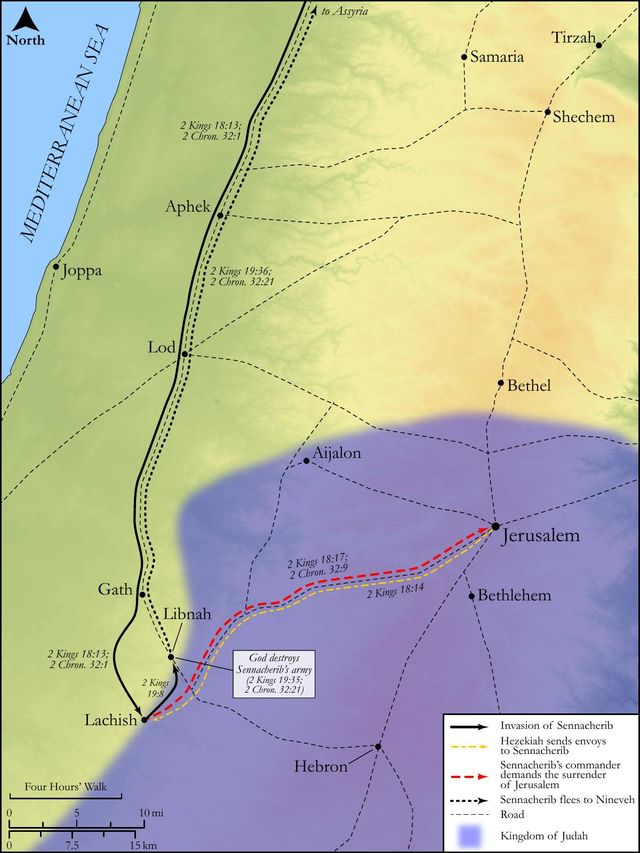
The late 8th century BCE was a tumultuous era dominated by the relentless expansion of the Neo-Assyrian Empire. King Sennacherib's campaign against Judah in 701 BCE, vividly described in parallel accounts in 2 Kings 18-19 and Isaiah 36-37, posed an existential threat to Jerusalem. In ancient siege warfare, control over water supply was paramount for survival. The Gihon Spring, Jerusalem's primary natural water source, was located outside the vulnerable city walls. Hezekiah's engineering project, famously known as "Hezekiah's Tunnel" or the Siloam Tunnel, was an extraordinary undertaking. It involved carving a winding, subterranean conduit approximately 1,750 feet (533 meters) through solid rock to bring the Gihon's waters safely inside the city walls to the Pool of Siloam. This monumental feat not only secured the city's vital water supply but also strategically deprived the besieging Assyrians of a crucial resource, demonstrating remarkable foresight and ingenuity in a time of profound crisis.
Key Themes
ShowHideThe verse masterfully encapsulates several core themes central to the Chronicler's theological perspective. Firstly, it underscores prudent leadership and resourceful preparation, showcasing Hezekiah's practical wisdom in anticipating and preparing for the Assyrian threat. His actions were not a passive reliance on God but active, strategic measures that complemented his faith. Secondly, it highlights the consistent Chronicler theme of divine blessing and prosperity as a direct consequence of faithfulness. The Chronicler repeatedly links the success and flourishing of kings to their obedience and diligent service to God, a principle clearly articulated in 2 Chronicles 31:21. The concluding phrase, "Hezekiah prospered in all his works," is not merely a statement of material or military success but a profound theological affirmation of God's favor upon his righteous endeavors. Thirdly, the verse exemplifies the crucial synergy between human effort and divine providence. Hezekiah diligently prepared and courageously encouraged his people to trust in the Lord, asserting that "with us is the Lord our God to help us and to fight our battles" (2 Chronicles 32:7-8). His prosperity, therefore, was a dual testament to both his wise and diligent actions and God's enabling and sustaining blessing.
Exposition and Analysis
ShowHideKey Word Analysis
ShowHideThis verb (H5640) means "to stop up; by implication, to repair; figuratively, to keep secret; closed up, hidden, secret, shut out (up), stop." In the context of 2 Chronicles 32:30, it refers to Hezekiah's strategic action of sealing off or diverting the natural flow of the Gihon Spring. The intent was twofold: to prevent the formidable Assyrian army from accessing this vital water source during their siege of Jerusalem and to ensure that the water was channeled exclusively into the city for the inhabitants' survival. This act was a critical and ingenious military tactic in ancient siege warfare, demonstrating Hezekiah's foresight and resourcefulness.
This significant verb (H6743) means "to push forward, in various senses (literal or figurative, transitive or intransitive); break out, come (mightily), go over, be good, be meet, be profitable, (cause to, effect, make to, send) prosper(-ity, -ous, -ously)." In the Old Testament, especially in the Chronicler's theology, tsâlach often implies success that is divinely enabled or blessed. It signifies more than mere human achievement; it denotes a positive outcome that God facilitates or grants. When applied to a king like Hezekiah, it powerfully conveys God's approval and favor on his reign and all his undertakings, indicating that his efforts were fruitful and successful because the Lord was actively with him, honoring his faithfulness and diligence.
Verse Breakdown
ShowHide"This same Hezekiah also stopped the upper watercourse of Gihon,"
This clause immediately identifies King Hezekiah (H3169, Yᵉchizqîyâh'), emphasizing his personal agency in this significant engineering project. The "upper watercourse" (H4161, môwtsâʼ' and H4325, mayim' with H5945, ʻelyôwn') of Gihon (H1521, Gîychôwn') refers to the natural, visible outflow of the Gihon Spring, situated in the Kidron Valley on the eastern side of Jerusalem. By "stopping" (H5640, çâtham') it, Hezekiah effectively sealed off its external flow, preventing the Assyrian forces from utilizing it as a water source during their impending siege. This action was a crucial defensive measure, showcasing his strategic acumen and proactive leadership.
"and brought it straight down to the west side of the city of David."
This describes the remarkable result of Hezekiah's engineering feat: the diversion of the Gihon's waters through a subterranean tunnel. The phrase "brought it straight down" (H3474, yâshar' and H4295, maṭṭâh') is somewhat descriptive of the directness of its purpose, even though the tunnel itself is famously winding. Its aim was to efficiently bring the water from its vulnerable source outside the walls to a secure location inside the city. The "west side" (H4628, maʻărâb') of the "city of David" (H5892, ʻîyr' and H1732, Dâvid') refers specifically to the Pool of Siloam, which was located within the fortified walls, providing a protected and accessible water supply for Jerusalem's inhabitants during the siege. This tunnel remains an archaeological marvel, a testament to ancient engineering capabilities and the urgency of the crisis.
"And Hezekiah prospered in all his works."
This concluding statement offers a profound divine assessment of Hezekiah's reign and actions. The "prosperity" (H6743, tsâlach') mentioned here is not limited to the success of the water project but extends comprehensively to "all his works" (H4639, maʻăseh'), encompassing his sweeping religious reforms, his courageous leadership during the Assyrian crisis, and his overall administration of the kingdom. This prosperity is unequivocally attributed to God's favor, indicating that Hezekiah's diligent, faithful, and wise efforts were met with divine blessing and success, powerfully reinforcing the Chronicler's theological perspective that obedience, trust, and righteous action lead to flourishing and divine approval.
Literary Devices
ShowHideThe verse employs several potent literary devices to convey its multifaceted message. Juxtaposition is prominently featured, as the Chronicler immediately places Hezekiah's human ingenuity and diligent effort ("stopped the upper watercourse... brought it straight down") alongside the divine affirmation of his success ("prospered in all his works"). This highlights the Chronicler's consistent theological theme that human endeavor, when undertaken in faithfulness and reliance upon God, is met with divine blessing and enablement. The phrase "all his works" functions as a Merism or Totality, signifying the comprehensive nature of Hezekiah's success. It extends beyond the singular engineering feat to encompass the entirety of his righteous reign, his reforms, and his leadership. Finally, the verse serves as a powerful Narrative Summary, providing a concise and impactful conclusion to the detailed account of Hezekiah's preparations and God's miraculous deliverance, reinforcing the overarching message of God's faithfulness to His obedient servants.
Theological and Thematic Connections
ShowHideThis verse powerfully illustrates a foundational biblical principle: divine sovereignty does not negate human responsibility; rather, God often chooses to bless, enable, and prosper the diligent and faithful efforts of His servants. Hezekiah's actions demonstrate a profound understanding that while God is ultimately the deliverer and provider, human wisdom, foresight, and hard work are essential components of faithful living. His strategic engineering of the Gihon Tunnel was not an act of self-reliance but an act of faith, trusting that God would honor his prudent preparations. The "prosperity" he experienced was not merely material gain or military victory, but the successful outcome of his righteous endeavors, a clear testament to God's active involvement in the affairs of those who honor Him. This passage profoundly encourages believers to integrate fervent prayer and unwavering trust in God with practical wisdom, diligent effort, and responsible stewardship in all areas of life, recognizing that true and lasting success ultimately comes from God's sovereign hand.
Reflection and Application
ShowHideHezekiah's inspiring story in 2 Chronicles 32:30 offers profound and practical lessons for contemporary believers. It challenges us to critically examine how we integrate faith and action in our daily lives. While we are unequivocally called to trust God implicitly for our deliverance, provision, and guidance, this passage powerfully reminds us that such trust often manifests in diligent preparation, wise stewardship of the resources God has entrusted to us, and proactive problem-solving. Hezekiah did not passively wait for divine intervention; he prayed fervently, and he also meticulously planned and executed the digging of a life-saving tunnel. Our "works"—whether in our families, professional careers, ministries, or personal development—are not merely tasks but sacred opportunities to exercise both our God-given wisdom and our unwavering faith. When we prayerfully commit our plans to the Lord and work diligently with integrity, we can confidently anticipate His divine guidance, enabling power, and abundant blessing, understanding that true prosperity and flourishing are found in aligning our efforts with His perfect will. This verse encourages us to be resourceful, responsible, and utterly reliant on God, recognizing that our ultimate success and impact are rooted in His favor and empowering presence.
Questions for Reflection
ShowHideFAQ
ShowHideWhat was the significance of Hezekiah's Tunnel, and why is it mentioned in this verse?
ShowHideHezekiah's Tunnel was a critical engineering marvel designed to secure Jerusalem's vital water supply during the impending Assyrian siege led by King Sennacherib in 701 BCE. The Gihon Spring, Jerusalem's primary natural water source, was located outside the city walls, making it dangerously vulnerable to an attacking army. Hezekiah shrewdly ordered the construction of a subterranean tunnel to divert the spring's water directly into the fortified city, specifically to the Pool of Siloam on the west side of the City of David. This strategic move served two crucial purposes: it ensured a continuous and protected water supply for Jerusalem's inhabitants throughout the siege, and it simultaneously deprived the Assyrians of access to water, significantly weakening their position. The mention of this tunnel in 2 Chronicles 32:30 highlights Hezekiah's remarkable foresight, practical wisdom, and the divine blessing that accompanied his efforts to protect his people, ultimately contributing to the city's miraculous survival against the formidable Assyrian threat, as detailed in 2 Chronicles 32:21-22.
How did Hezekiah's actions, particularly building the tunnel, demonstrate faith?
ShowHideHezekiah's actions, including the monumental undertaking of building the tunnel, profoundly demonstrated faith by seamlessly combining human ingenuity and diligent effort with an unwavering trust in God. While the tunnel was a purely practical and defensive measure, it was undertaken within a broader context of Hezekiah's profound reliance on the Lord. Prior to the siege, Hezekiah had courageously encouraged his people not to fear Sennacherib, declaring, "With him is an arm of flesh, but with us is the Lord our God to help us and to fight our battles" (2 Chronicles 32:7-8). His meticulous preparations, including the tunnel, were not a sign of a lack of faith, but rather a tangible expression of responsible stewardship and a deep-seated belief that God often works through human means and diligent obedience. The Chronicler emphasizes that Hezekiah "prospered in all his works" because his actions were rooted in righteousness, a commitment to God's ways, and a heart devoted to the Lord (2 Chronicles 31:20-21), illustrating that true faith often involves active obedience, wise planning, and diligent preparation.
Christ-Centered Fulfillment
ShowHideHezekiah's diligent provision of physical water for Jerusalem, securing its very life during a devastating siege, serves as a profound and beautiful foreshadowing of the ultimate provision of spiritual "living water" found exclusively in Jesus Christ. Just as Hezekiah's ingenious tunnel brought life-sustaining water into a city under siege, Christ is the singular source of eternal life, offering spiritual sustenance, cleansing, and refreshment to a world under siege by sin, death, and spiritual thirst. Jesus Himself declared, "If anyone thirsts, let him come to me and drink. Whoever believes in me, as the Scripture has said, 'Out of his heart will flow rivers of living water'" (John 7:37-38). Furthermore, Hezekiah's "prosperity in all his works" due to divine favor powerfully points to Christ, in whom all true spiritual prosperity, success, and fruitfulness are found. Through Christ, believers are not only redeemed but also enabled by the Holy Spirit to perform good works that are truly "prospered" by God (Ephesians 2:10), not by human merit or strength, but by divine grace and empowering presence. The physical security Hezekiah sought for Jerusalem through his engineering marvel finds its ultimate and eternal fulfillment in the spiritual security, abundant life, and eternal dwelling offered through Christ, who, as the Lamb, will ultimately guide His redeemed people to the "springs of living water" in the New Jerusalem, where God Himself will wipe away every tear (Revelation 7:17 and Revelation 22:1-2).