


1 Kings 1:33
Bible text: King James Version (1769 Blayney text) · Public domain
Bible text: King James Version with Strong's numbers · Public domain
Bible text: Berean Standard Bible · Public domain
Bible text: American Standard Version (1901) · Public domain
Bible text: World English Bible, Messianic edition · Public domain
Bible text: Geneva Bible (1599) · Public domain
Bible text: Young's Literal Translation · Public domain
- וַיֹּאמֶרvai·Yo·merand he saidH559Conj-w ¦ V-Qal-ConsecImperf-3msVerb Qal Consecutive Imperfect 3rd Singular Masculineוַandיֹּאמֶרhe said
- הַמֶּלֶךְha·Me·lekhthe kingH4428Art ¦ N-msNoun Singular Masculine Absoluteהַtheמֶּלֶךְking
- לָהֶםla·Hemto themPrep-l ¦ 3mpSuffix Personal 3rd Plural Masculineלָtoהֶםthem
- קְחוּke·ChutakeH3947V-Qal-Imp-2mpVerb Qal Imperative 2nd Plural Masculine
- עִמָּכֶם'i·ma·Khemwith youH5973Prep ¦ 2mpPrepositionעִמָּwithכֶםyou
- אֶת'et<obj.>H853DirObjMParticle Object Indicator
- עַבְדֵי'av·Dei[the] servants ofH5650N-mpcNoun Plural Masculine Construct
- אֲדֹנֵיכֶם'a·do·nei·Khemyour lord<s>H113N-mpc ¦ 2mpNoun Plural Masculine Constructאֲדֹנֵיlord<s>כֶםyour
- וְהִרְכַּבְתֶּםve·hir·kav·Temand you will cause to rideH7392Conj-w ¦ V-Hiphil-ConsecPerf-2mpVerb Hiphil Consecutive Perfect 2nd Plural Masculineוְandהִרְכַּבְתֶּםyou will cause to ride
- אֶת'et<obj.>H853DirObjMParticle Object Indicator
- שְׁלֹמֹהshe·lo·MohSolomonH8010N-proper-mNoun Proper Masculine
- בְנִיve·Nimy sonH1121N-msc ¦ 1csNoun Singular Masculine Constructבְנִsonיmy
- עַל'alonH5921PrepPreposition
- הַפִּרְדָּהha·pir·Dahthe muleH6506Art ¦ N-fsNoun Singular Feminine Absoluteהַtheפִּרְדָּהmule
- אֲשֶׁר'a·SherwhichH834RelParticle Relative
- לִיLi[belongs] to mePrep-l ¦ 1csSuffix Personal 1st Singular common genderלִ[belongs] toיme
- וְהוֹרַדְתֶּםve·ho·rad·Temand you will take downH3381Conj-w ¦ V-Hiphil-ConsecPerf-2mpVerb Hiphil Consecutive Perfect 2nd Plural Masculineוְandהוֹרַדְתֶּםyou will take down
- אֹתוֹ'o·To<obj.> himH853DirObjM ¦ 3msParticle Object Indicatorאֹת<obj.>וֹhim
- אֶל'eltoH413PrepPreposition
- גִּחוֹןgi·ChonGihonH1521N-properNoun Proper Location
English is a literal word-by-word gloss of the Hebrew, not the KJV's wording. Why?
This is the original text the KJV's translators worked from — each Hebrew word with its own literal English meaning in this verse, prepared by scholars at Tyndale House, Cambridge. The KJV translates whole sentences, not word by word, so its wording differs: one Hebrew word can become several English words, and the KJV may choose “the LORD” where the gloss reads “Yahweh”. Both are faithful — they answer different questions. For the KJV's own rendering, switch to the KJV text.
Details
See on the biblical-era maps
Study this verse
Public-domain commentary
Matthew Henry
From his Commentary on the Whole Bible. Henry comments on passages, not single verses — this entry covers 1 Kings 1:32–40. His two-level outline is real structure in the source text, so it is rendered as structure.
We have here the effectual care David took both to secure Solomon's right and to preserve the public peace, by crushing Adonijah's project in the bud. Observe,
I.The express orders he gave for the proclaiming of Solomon.
The persons he entrusted with this great affair were Zadok, Nathan, and Benaiah, men of power and interest whom David had always reposed a confidence in and found faithful to him, and whom Adonijah had passed by in his invitation, Kg1 1:10. David orders them forthwith, with all possible solemnity, to proclaim Solomon. They must take with them the servants of their lord, the lifeguards, and all the servants of the household. They must set Solomon on the mule the king used to ride, for he kept not such stables of horses as his son afterwards did. He appoints them whither to go (Kg1 1:33 and Kg1 1:34, Kg1 1:35), and what to do.
1.Zadok and Nathan, the two ecclesiastical persons, must, in God's name, anoint him king; for though he was not the first of his family, as Saul and David were, yet he was a younger son, was made king by divine appointment, and his title was contested, which made it necessary that hereby it should be settled. This unction was typical of the designation and qualification of the Messiah, or Christ, the anointed one, on whom the Spirit, that oil of gladness, was poured without measure, Heb 1:9, Psa 89:20. And all Christians, being heirs of the kingdom (Jam 2:5), do from him receive the anointing, Jo1 2:27.
2.The great officers, civil and military, are ordered to give public notice of this, and to express the public joy upon this occasion by sound of trumpet, by which the law of Moses directed the gracing of great solemnities; to this must be added the acclamations of the people: "Let king Solomon live, let him prosper, let his kingdom be established and perpetuated, and let him long continue in the enjoyment of it;" so it had been promised concerning him. Psa 72:15, He shall live.
3.They must then bring him in state to the city of David, and he must sit upon the throne of his father, as his substitute now, or viceroy, to despatch public business during his weakness and be his successor after his death: He shall be king in my stead. It would be a great satisfaction to David himself, and to all parties concerned, to have this done immediately, that upon the demise of the king there might be no dispute, or agitation, in the public affairs. David was far from grudging his successor the honour of appearing such in his life-time, and yet perhaps was so taken up with his devotions on his sick-bed that, if he had not been put in mind of it by others, this great good work, which was so necessary to the public repose, would have been left undone.
II.The great satisfaction which Benaiah, in the name of the rest, professed in these orders.
The king said, "Solomon shall reign for me, and reign after me." "Amen" (says Benaiah heartily); "as the king says, so say we; we are entirely satisfied in the nomination, and concur in the choice, we give our vote for Solomon, nemine contradicente - unanimously, and since we can bring nothing to pass, much less establish it, without the concurrence of a propitious providence, The Lord God of my lord the king say so too!" Kg1 1:36. This is the language of his faith in that promise of God on which Solomon's government was founded. If we say as God says in his word, we may hope that he will say as we say by his providence. To this he adds a prayer for Solomon (Kg1 1:37), that God would be with him as he had been with David, and make his throne greater. He knew David was not one of those that envy their children's greatness, and that therefore he would not be disquieted at this prayer, nor take it as an affront, but would heartily say Amen to it. The wisest and best man in the world desires his children may be wiser and better than he, for he himself desires to be wiser and better than he is; and wisdom and goodness are true greatness.
III.The immediate execution of these orders, Kg1 1:38-40.
No time was lost, but Solomon was brought in state to the place appointed, and there Zadok (who, though he was not as yet high priest, was, we may suppose, the suffragan, the Jews called him the sagan, or second priest) anointed him by the direction of Nathan the prophet and David the king, Kg1 1:39. In the tabernacle, where the ark was now lodged, was kept among other sacred things, the holy oil for many religious services thence Zadok took a horn of oil, which denotes both power and plenty, and therewith anointed Solomon. We do not find that Abiathar pretended to anoint Adonijah: he was made king by a feast, not by an unction. Whom God calls, he will qualify, which was signified by the anointing; usurpers had it not. Christ signifies anointed, and he is the king whom God hath set upon his holy hill of Sion, according to decree, Psa 2:6, Psa 2:7. Christians also are made to our God (and by him) kings, and they have an unction from the Holy One, Jo1 2:20. The people, hereupon, express their great joy and satisfaction in the elevation of Solomon, surround him with their Hosannas - God save king Solomon, and attend him with their music and shouts of joy, Kg1 1:40. Hereby they declared their concurrence in the choice, and that he was not forced upon them, but cheerfully accepted by them. The power of a prince can be little satisfaction to himself, unless he knows it to be a satisfaction to his people. Every Israelite indeed rejoices in the exaltation of the Son of David.
Historical interpretation
Historical reception
2 surviving comments on this verse. Each one is dated, so this reads as a timeline rather than a list.
[David] orders [Zadok, Nathan and Benaiah] to make “Solomon ride [his] mule,” because this animal was highly valued among the Hebrews, just like the white donkey among the Romans. The Jews, in fact, did not possess mules, since they were not allowed to “breed their animals with another kind,” but mules were bought at very high prices from the Gentiles.
[David] orders them to bring [Solomon] down to Šiloha, where the tabernacle was, not far from the spring of water, which is called Šiloha. Šiloha is a Hebrew name, which is given because the water of the spring gushes out straight up and on and off; indeed, it does not gush out regularly and all the time. And the same can be said about the Nile: since, at different intervals, it suddenly becomes full and then overflows, it is called Gihon, because its waters spread out.
Continue studying 1 Kings 1:33 across the web’s major study libraries — every link below opens this exact verse, chapter, or book on the destination site.
Read & Compare
 BibleGatewayThis verse in more than 200 translations and 70 languages.
 Bible.comThe YouVersion reader — hundreds of translations, reading plans, and highlights.
 ESV.orgCrossway's official English Standard Version reader.
 NET BibleThe NET translation with 60,000+ translators' notes on every rendering decision.
 STEP BibleTyndale House's free study tool — original text, vocabulary, and scholarly resources.
 BibliaLogos Bible Software's free web reader.
 USCCBThe New American Bible (Revised Edition) with the U.S. bishops' study notes.
Commentaries
 BibleHub CommentariesDozens of classic commentaries on this verse, gathered on one page.
 StudyLightMore than 100 commentary sets — the largest collection on the web.
 BibleRefPlain-English commentary on what this verse means, verse by verse.
 Enduring WordDavid Guzik's free commentary on this chapter, widely used by Bible teachers.
 Bible Study ToolsVerse commentary alongside Greek and Hebrew study aids.
Original Language & Research
- BibleHub InterlinearThe verse word by word — original language, transliteration, and English.
- BibleHub LexiconEvery word's original-language definition and Strong's entry.
 Blue Letter BibleDeep-study tools — Strong's numbers, concordance, and word studies.
 SefariaThe Hebrew text with Rashi and centuries of Jewish commentary.
Sermons, Hymns & Audio


TrulyRandomVerse is not affiliated with these sites and doesn’t control their content. They’re linked because they’re genuinely useful.
Summary
1 Kings 1:33 records King David's urgent and authoritative command to his loyal officials, initiating the public procession and anointing of Solomon as his chosen successor. This decisive action, taken amidst the crisis of Adonijah's attempted usurpation, was crucial for publicly affirming Solomon's legitimate claim to the throne, ensuring a peaceful and divinely sanctioned transfer of royal authority, and securing the stability of the kingdom of Israel.
Context
ShowHideLiterary Context
This verse is a direct and forceful command from King David, serving as the climax of an intense narrative sequence. It immediately follows the urgent appeals of Bathsheba and Nathan the prophet, who have just informed the aging and frail king of Adonijah's audacious attempt to seize the throne, gathering prominent military and religious figures to his side (1 Kings 1:5-9). David's response in 1 Kings 1:32-35 is a rapid and strategic counter-measure, demonstrating his resolve to uphold God's promise regarding Solomon's succession. This command sets the immediate stage for the public anointing and enthronement of Solomon, which swiftly follows in 1 Kings 1:38-40, effectively quashing Adonijah's rebellion.
Historical & Cultural Context
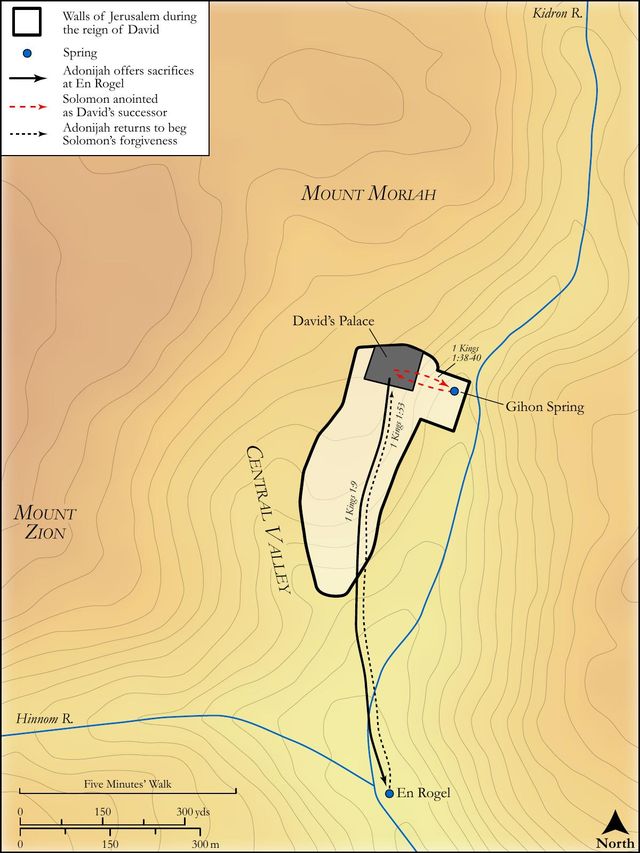
Among the kings of that day, the period of royal succession was inherently volatile, often marked by political intrigue, power struggles, and even civil war. The incapacitation or death of a king frequently triggered immediate attempts by various contenders to seize power, as vividly illustrated by Adonijah's actions. Within this context, the act of riding the king's personal mule was a highly symbolic and universally understood gesture, signifying the transfer of royal authority and status, akin to wearing the king's crown or sitting on his throne. Furthermore, anointing with oil was a sacred ritual in Israel, signifying divine appointment and empowerment for leadership, a practice deeply rooted in tradition for both priests (e.g., Exodus 29:7) and kings (e.g., 1 Samuel 10:1; 1 Samuel 16:13). Gihon, a vital spring outside Jerusalem's walls, was a natural, public, and historically significant location, providing an ideal site for such a momentous and visible ceremony.
Key Themes
ShowHideThis verse powerfully contributes to several overarching themes within the book of 1 Kings and the broader narrative of Israel's monarchy. Firstly, it underscores the theme of Divine Sovereignty and Chosen Succession, demonstrating that despite human machinations and attempts at usurpation, God's divinely appointed plan for the Davidic line will ultimately prevail, as promised to David in 2 Samuel 7:12-16. Secondly, it highlights the Importance of Orderly Transition and Legitimate Authority, as David's decisive action prevents potential civil strife and establishes Solomon's reign on a firm, divinely sanctioned foundation. The public nature of the procession and anointing serves to legitimize Solomon's rule in the eyes of the entire populace. Lastly, the specific details—the use of the king's mule and the destination of Gihon—emphasize Symbolism and Ritual in Kingship, where specific actions, objects, and locations carry profound meaning in conveying power, status, and divine blessing.
Exposition and Analysis
ShowHideKey Word Analysis
ShowHideThis term, derived from a root meaning "to rule," denotes a sovereign ruler. In this context, it refers specifically to David, whose authority, despite his advanced age and physical frailty, is unequivocally asserted in this command. The use of "the king" emphasizes that this is not a suggestion but a royal decree, carrying the full weight of his supreme power and ensuring the legitimacy of Solomon's succession against any rival claims.
This word, meaning "a son" or "builder of the family name," is crucial here. David explicitly refers to Solomon as "my son," affirming their familial relationship and, more importantly, Solomon's direct lineage and rightful place as heir. This designation is a public affirmation of Solomon's status as the legitimate successor, contrasting sharply with Adonijah's self-proclamation and underscoring the divinely ordained continuity of the Davidic line through Solomon.
Specifically a "she-mule," this term refers to a hybrid animal, highly valued for its strength, endurance, and sure-footedness. In ancient Israel, mules were often associated with royalty and nobility, symbolizing status, wealth, and power. David himself rode a mule (2 Samuel 18:9). The command for Solomon to ride David's own mule was a clear, visual, and public declaration of the immediate transfer of David's personal royal dignity, authority, and endorsement to Solomon, leaving no ambiguity about the chosen heir.
Meaning "gushing forth" or "bursting forth," Gihon was the primary natural spring supplying water to ancient Jerusalem, located in the Kidron Valley. Its vital, life-giving waters made it a sacred and essential location. Anointing a king at such a life-giving spring symbolized a fresh, divinely blessed beginning for the new reign, connecting the king's authority to the source of life and blessing, and echoing the imagery of a king as a source of justice and prosperity for his people. It also provided a public and accessible venue for the momentous ceremony.
Verse Breakdown
ShowHide"The king also said unto them"
This opening phrase immediately establishes David's direct, personal, and authoritative involvement. Despite his physical weakness, his mental acuity and royal prerogative remain fully intact, enabling him to issue a decisive command that will shape the future of the kingdom. "Them" refers to Zadok the priest, Nathan the prophet, and Benaiah son of Jehoiada, the loyal and trusted officials whom David had summoned.
"Take with you the servants of your lord"
This instruction refers to David's personal retinue, including his elite bodyguard, the Cherethites and Pelethites, along with other loyal royal officials. Their presence was crucial for lending official authority, providing protection, and ensuring that Solomon's public appearance was recognized as a legitimate royal act, not merely a private family arrangement. It signified the full backing of the royal court.
"and cause Solomon my son to ride upon mine own mule"
This is the most symbolically charged element of the command. By explicitly stating that Solomon should ride his (David's) personal royal mule, David publicly designates Solomon as his chosen heir and successor. This act was a clear, unmistakable visual signal to all observers that Solomon was the legitimate, divinely chosen recipient of David's authority, effectively countering Adonijah's usurpation attempt and demonstrating a direct transfer of royal prerogative in plain sight.
"and bring him down to Gihon"
This specifies the sacred and public destination for the anointing ceremony. Gihon, as Jerusalem's vital water source, was a prominent and accessible location. The act of "bringing him down" suggests a deliberate procession from the royal palace on Mount Zion to the valley where the spring was located, a public movement for a sacred ritual that would be witnessed by many and serve as an undeniable declaration of Solomon's kingship.
Literary Devices
ShowHideThe passage employs several potent literary devices to convey its profound significance. Symbolism is paramount, with "mine own mule" serving as a powerful symbol of the direct transfer of royal authority, personal endorsement, and legitimate succession from David to Solomon. The action of Solomon riding this specific animal functions as a performative utterance, where the very act itself publicly declares and enacts the new reality of Solomon's kingship, making it a visible and undeniable truth. The choice of "Gihon" as the anointing site also carries significant symbolic weight, representing life, blessing, and divine provision, thereby underscoring the sacred and divinely sanctioned nature of the kingship. Furthermore, the entire command operates with a strong sense of dramatic irony, as the audience is fully aware of Adonijah's attempted coup, making David's swift, public, and decisive counter-action all the more impactful and demonstrating the ultimate futility of human schemes against divine decree.
Theological and Thematic Connections
ShowHideThis pivotal moment in 1 Kings 1:33 powerfully illustrates the intersection of divine decree and human agency in the establishment of God's kingdom. David's decisive action is not merely a political maneuver but a direct fulfillment of God's covenant promise that Solomon would succeed him and build the Temple (2 Samuel 7:12-13; 1 Chronicles 22:9-10). It underscores that legitimate authority, especially in leadership divinely appointed, must be established with clarity and public affirmation to prevent chaos and ensure stability. The anointing at Gihon, a life-giving spring, further links the king's reign to God's life-sustaining power and blessing, emphasizing that true kingship is rooted in divine favor and purpose, not merely human ambition or popular acclaim.
Reflection and Application
ShowHideThe scene of David's decisive action in 1 Kings 1:33 offers profound insights into leadership, divine purpose, and the nature of transitions. It reminds us that even in moments of weakness or vulnerability, faithful leaders are called to act with clarity, courage, and integrity to uphold what is right and what aligns with God's revealed will. David's immediate and public response to the threat of usurpation, ensuring Solomon's legitimate succession, highlights the importance of orderly processes and public affirmation in establishing authority, preventing chaos, and ensuring the continuity of God's work. For us, this translates into understanding the value of clear communication, decisive action, and humble submission to God's appointed order in our families, churches, and communities. It encourages us to pray for and support those in leadership, recognizing that their authority, when exercised justly and in accordance with God's principles, serves to maintain peace, facilitate divine purposes, and bless the people they lead.
Questions for Reflection
ShowHideFAQ
ShowHideWhy was it so important for Solomon to ride "David's own mule"?
ShowHideThe act of Solomon riding David's personal mule was an extraordinarily significant symbolic gesture in Israel, particularly in royal succession. It was a public and unmistakable declaration that King David was personally endorsing Solomon as his successor and transferring his royal authority directly to him. In a society where visual cues and public rituals were paramount for conveying legitimacy, this action served as a powerful counter-narrative to Adonijah's self-proclamation. It left no doubt in the minds of the people about the legitimate heir, signifying a direct, personal, and official transfer of power and royal prerogative. It was akin to a modern-day monarch handing over their crown or scepter in a public ceremony, making the succession undeniable.
What was the significance of Gihon as the location for Solomon's anointing?
ShowHideGihon was Jerusalem's primary and most vital natural spring, providing life-sustaining water to the city. Anointing a king at such a location carried profound symbolic meaning. It connected Solomon's reign to the source of life, blessing, and divine provision. Just as Gihon brought life to Jerusalem, so the king was expected to bring prosperity, justice, and blessing to his people. Furthermore, its public location outside the city walls allowed for a large gathering, ensuring that the anointing was witnessed by many and thus widely recognized as a legitimate and divinely sanctioned event. The imagery of "gushing forth" from the spring could also symbolize the outpouring of God's Spirit and blessing upon the new king. The anointing itself is detailed in 1 Kings 1:39.
Christ-Centered Fulfillment
ShowHideWhile 1 Kings 1:33 details the establishment of an earthly king, it profoundly foreshadows the ultimate, eternal King, Jesus Christ. Solomon's anointing on David's mule, leading to his reign of peace and wisdom, points to the coming of the true Son of David. Jesus rides not merely a mule but a humble donkey into Jerusalem, fulfilling prophecy and presenting Himself as the humble yet sovereign King (Zechariah 9:9; Matthew 21:4-5). Just as Solomon's reign was divinely appointed to build the first Temple, Jesus, the greater Solomon, builds the spiritual Temple, His Church, with Himself as the cornerstone (Ephesians 2:20-22). The anointing at Gihon, a life-giving spring, anticipates Christ's own anointing by the Holy Spirit at His baptism, marking Him as the Messiah, the "Anointed One," the ultimate source of living water for all who believe (John 7:37-38). Ultimately, Solomon's peaceful and divinely secured succession, initiated by David's decisive action, prefigures the eternal and unshakable kingdom of Christ, established not by human decree but by God's eternal covenant, a kingdom that will have no end (Luke 1:32-33).