


1 Kings 1:32
Bible text: King James Version (1769 Blayney text) · Public domain
Bible text: King James Version with Strong's numbers · Public domain
Bible text: Berean Standard Bible · Public domain
Bible text: American Standard Version (1901) · Public domain
Bible text: World English Bible, Messianic edition · Public domain
Bible text: Geneva Bible (1599) · Public domain
Bible text: Young's Literal Translation · Public domain
- וַיֹּאמֶרvai·Yo·merand he saidH559Conj-w ¦ V-Qal-ConsecImperf-3msVerb Qal Consecutive Imperfect 3rd Singular Masculineוַandיֹּאמֶרhe said
- הַמֶּלֶךְha·Me·lekhthe kingH4428Art ¦ N-msNoun Singular Masculine Absoluteהַtheמֶּלֶךְking
- דָּוִדda·VidDavidH1732N-proper-mNoun Proper Masculine
- קִרְאוּkir·'usummonH7121V-Qal-Imp-2mpVerb Qal Imperative 2nd Plural Masculine
- לִיlifor mePrep-l ¦ 1csSuffix Personal 1st Singular common genderלִforיme
- לְצָדוֹקle·tza·Dok<to> ZadokH6659Prep-l ¦ N-proper-mNoun Proper Masculineלְ<to>צָדוֹקZadok
- הַכֹּהֵןha·ko·Henthe priestH3548Art ¦ N-msNoun Singular Masculine Absoluteהַtheכֹּהֵןpriest
- וּלְנָתָןu·le·na·Tanand <to> NathanH5416Conj-w ¦ Prep-l ¦ N-proper-mNoun Proper Masculineוּandלְ<to>נָתָןNathan
- הַנָּבִיאha·na·Vi'the prophetH5030Art ¦ N-msNoun Singular Masculine Absoluteהַtheנָּבִיאprophet
- וְלִבְנָיָהוּve·liv·na·Ya·huand <to> BenaiahH1141Conj-w ¦ Prep-l ¦ N-proper-mNoun Proper Masculineוְandלִ<to>בְנָיָהוּBenaiah
- בֶּןben[the] son ofH1121N-mscNoun Singular Masculine Construct
- יְהוֹיָדָעye·ho·ya·Da'JehoiadaH3077N-proper-mNoun Proper Masculine
- וַיָּבֹאוּvai·ya·Vo·'uand they cameH935Conj-w ¦ V-Qal-ConsecImperf-3mpVerb Qal Consecutive Imperfect 3rd Plural Masculineוַandיָּבֹאוּthey came
- לִפְנֵיlif·Nei<to> beforeH6440Prep-l ¦ N-mpcNoun Plural Masculine Constructלִ<to>פְנֵיbefore
- הַמֶּלֶךְha·Me·lekhthe kingH4428Art ¦ N-msNoun Singular Masculine Absoluteהַtheמֶּלֶךְking
English is a literal word-by-word gloss of the Hebrew, not the KJV's wording. Why?
This is the original text the KJV's translators worked from — each Hebrew word with its own literal English meaning in this verse, prepared by scholars at Tyndale House, Cambridge. The KJV translates whole sentences, not word by word, so its wording differs: one Hebrew word can become several English words, and the KJV may choose “the LORD” where the gloss reads “Yahweh”. Both are faithful — they answer different questions. For the KJV's own rendering, switch to the KJV text.
Details
See on the biblical-era maps
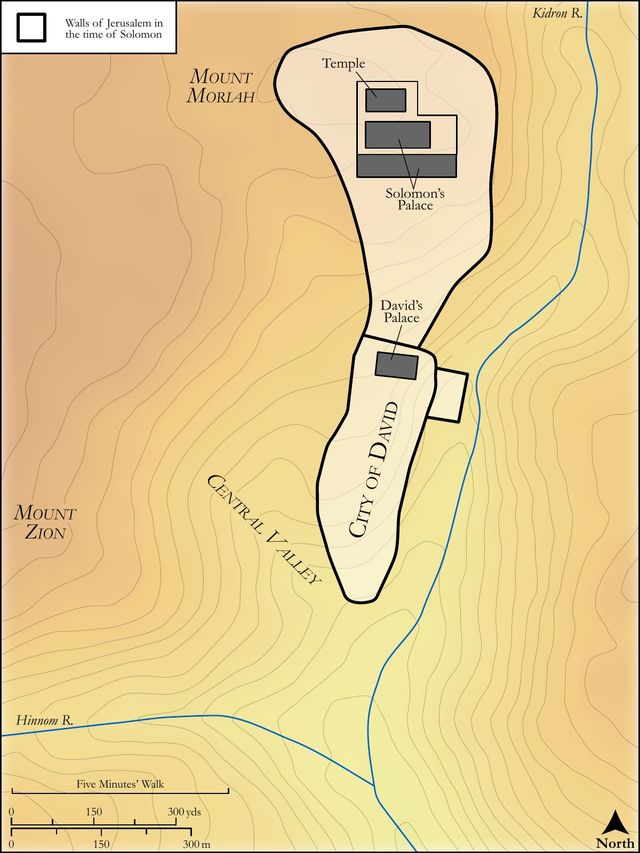
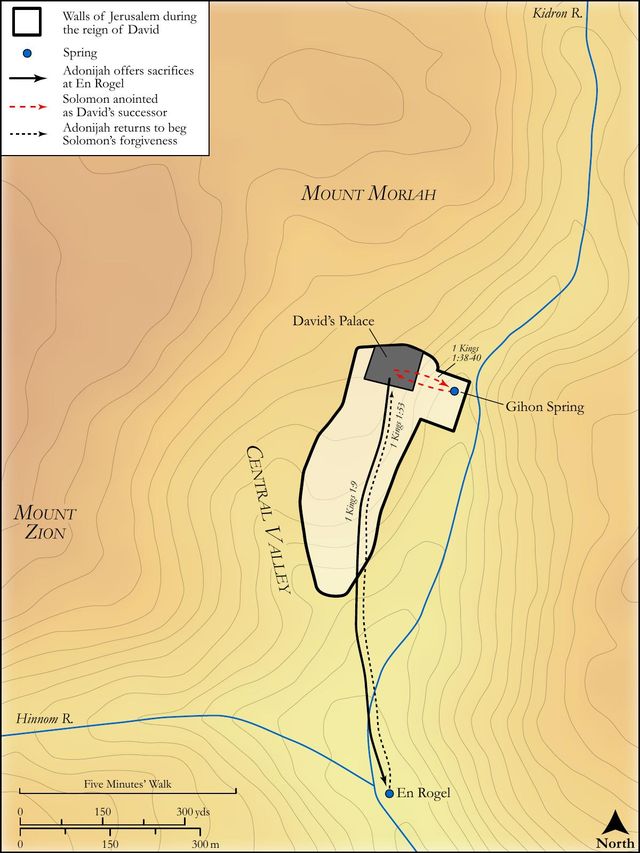
Study this verse
Public-domain commentary
Matthew Henry
From his Commentary on the Whole Bible. Henry comments on passages, not single verses — this entry covers 1 Kings 1:32–40. His two-level outline is real structure in the source text, so it is rendered as structure.
We have here the effectual care David took both to secure Solomon's right and to preserve the public peace, by crushing Adonijah's project in the bud. Observe,
I.The express orders he gave for the proclaiming of Solomon.
The persons he entrusted with this great affair were Zadok, Nathan, and Benaiah, men of power and interest whom David had always reposed a confidence in and found faithful to him, and whom Adonijah had passed by in his invitation, Kg1 1:10. David orders them forthwith, with all possible solemnity, to proclaim Solomon. They must take with them the servants of their lord, the lifeguards, and all the servants of the household. They must set Solomon on the mule the king used to ride, for he kept not such stables of horses as his son afterwards did. He appoints them whither to go (Kg1 1:33 and Kg1 1:34, Kg1 1:35), and what to do.
1.Zadok and Nathan, the two ecclesiastical persons, must, in God's name, anoint him king; for though he was not the first of his family, as Saul and David were, yet he was a younger son, was made king by divine appointment, and his title was contested, which made it necessary that hereby it should be settled. This unction was typical of the designation and qualification of the Messiah, or Christ, the anointed one, on whom the Spirit, that oil of gladness, was poured without measure, Heb 1:9, Psa 89:20. And all Christians, being heirs of the kingdom (Jam 2:5), do from him receive the anointing, Jo1 2:27.
2.The great officers, civil and military, are ordered to give public notice of this, and to express the public joy upon this occasion by sound of trumpet, by which the law of Moses directed the gracing of great solemnities; to this must be added the acclamations of the people: "Let king Solomon live, let him prosper, let his kingdom be established and perpetuated, and let him long continue in the enjoyment of it;" so it had been promised concerning him. Psa 72:15, He shall live.
3.They must then bring him in state to the city of David, and he must sit upon the throne of his father, as his substitute now, or viceroy, to despatch public business during his weakness and be his successor after his death: He shall be king in my stead. It would be a great satisfaction to David himself, and to all parties concerned, to have this done immediately, that upon the demise of the king there might be no dispute, or agitation, in the public affairs. David was far from grudging his successor the honour of appearing such in his life-time, and yet perhaps was so taken up with his devotions on his sick-bed that, if he had not been put in mind of it by others, this great good work, which was so necessary to the public repose, would have been left undone.
II.The great satisfaction which Benaiah, in the name of the rest, professed in these orders.
The king said, "Solomon shall reign for me, and reign after me." "Amen" (says Benaiah heartily); "as the king says, so say we; we are entirely satisfied in the nomination, and concur in the choice, we give our vote for Solomon, nemine contradicente - unanimously, and since we can bring nothing to pass, much less establish it, without the concurrence of a propitious providence, The Lord God of my lord the king say so too!" Kg1 1:36. This is the language of his faith in that promise of God on which Solomon's government was founded. If we say as God says in his word, we may hope that he will say as we say by his providence. To this he adds a prayer for Solomon (Kg1 1:37), that God would be with him as he had been with David, and make his throne greater. He knew David was not one of those that envy their children's greatness, and that therefore he would not be disquieted at this prayer, nor take it as an affront, but would heartily say Amen to it. The wisest and best man in the world desires his children may be wiser and better than he, for he himself desires to be wiser and better than he is; and wisdom and goodness are true greatness.
III.The immediate execution of these orders, Kg1 1:38-40.
No time was lost, but Solomon was brought in state to the place appointed, and there Zadok (who, though he was not as yet high priest, was, we may suppose, the suffragan, the Jews called him the sagan, or second priest) anointed him by the direction of Nathan the prophet and David the king, Kg1 1:39. In the tabernacle, where the ark was now lodged, was kept among other sacred things, the holy oil for many religious services thence Zadok took a horn of oil, which denotes both power and plenty, and therewith anointed Solomon. We do not find that Abiathar pretended to anoint Adonijah: he was made king by a feast, not by an unction. Whom God calls, he will qualify, which was signified by the anointing; usurpers had it not. Christ signifies anointed, and he is the king whom God hath set upon his holy hill of Sion, according to decree, Psa 2:6, Psa 2:7. Christians also are made to our God (and by him) kings, and they have an unction from the Holy One, Jo1 2:20. The people, hereupon, express their great joy and satisfaction in the elevation of Solomon, surround him with their Hosannas - God save king Solomon, and attend him with their music and shouts of joy, Kg1 1:40. Hereby they declared their concurrence in the choice, and that he was not forced upon them, but cheerfully accepted by them. The power of a prince can be little satisfaction to himself, unless he knows it to be a satisfaction to his people. Every Israelite indeed rejoices in the exaltation of the Son of David.
Continue studying 1 Kings 1:32 across the web’s major study libraries — every link below opens this exact verse, chapter, or book on the destination site.
Read & Compare
 BibleGatewayThis verse in more than 200 translations and 70 languages.
 Bible.comThe YouVersion reader — hundreds of translations, reading plans, and highlights.
 ESV.orgCrossway's official English Standard Version reader.
 NET BibleThe NET translation with 60,000+ translators' notes on every rendering decision.
 STEP BibleTyndale House's free study tool — original text, vocabulary, and scholarly resources.
 BibliaLogos Bible Software's free web reader.
 USCCBThe New American Bible (Revised Edition) with the U.S. bishops' study notes.
Commentaries
 BibleHub CommentariesDozens of classic commentaries on this verse, gathered on one page.
 StudyLightMore than 100 commentary sets — the largest collection on the web.
 BibleRefPlain-English commentary on what this verse means, verse by verse.
 Enduring WordDavid Guzik's free commentary on this chapter, widely used by Bible teachers.
 Bible Study ToolsVerse commentary alongside Greek and Hebrew study aids.
Original Language & Research
- BibleHub InterlinearThe verse word by word — original language, transliteration, and English.
- BibleHub LexiconEvery word's original-language definition and Strong's entry.
 Blue Letter BibleDeep-study tools — Strong's numbers, concordance, and word studies.
 SefariaThe Hebrew text with Rashi and centuries of Jewish commentary.
Sermons, Hymns & Audio


TrulyRandomVerse is not affiliated with these sites and doesn’t control their content. They’re linked because they’re genuinely useful.
Summary
1 Kings 1:32 records the pivotal moment when King David, despite his advanced age and physical frailty, decisively reasserts his royal authority by summoning his most trusted and influential advisors: Zadok the priest, Nathan the prophet, and Benaiah the son of Jehoiada. This urgent command marks a critical turning point in the succession crisis, as David moves to counteract Adonijah's premature and illegitimate attempt to seize the throne, thereby ensuring the divinely ordained transfer of power to Solomon.
Context
ShowHideLiterary Context
This verse is situated at a crucial juncture in 1 Kings 1, immediately following a period of intense political maneuvering and personal distress for the aging King David. Adonijah, David's fourth son, had presumptuously declared himself king, gathering support from prominent figures such as Joab, the seasoned army commander, and Abiathar, a high priest (1 Kings 1:5-7). The gravity of this usurpation is brought to David's attention by Nathan the prophet and Bathsheba, Solomon's mother, who skillfully appeal to David's past oath and the immediate threat to Solomon's life (1 Kings 1:11-27). David, roused from his infirmity by their pleas and reminded of his divine promise regarding Solomon's succession (1 Kings 1:17), issues the command in verse 32, setting in motion the legitimate anointing of Solomon. This moment profoundly underscores David's enduring authority and his unwavering commitment to God's plan for the Davidic dynasty, even amidst personal weakness.
Historical & Cultural Context
The succession of kings in ancient Israel was a complex affair, not always strictly adhering to primogeniture, especially when divine promises or a reigning king's decree were involved. David's kingdom, still relatively nascent, was particularly vulnerable during transitions of power, which often led to instability, civil unrest, or even civil war. The presence and active involvement of a prophet like Nathan and a priest like Zadok were paramount, as their participation conferred divine legitimacy and religious sanction upon the chosen successor, crucial for public acceptance. Benaiah, as the commander of the Cherethites and Pelethites (David's elite personal guard), represented the indispensable military authority required to enforce the king's will and maintain order. Adonijah's actions were typical of ambitious princes in royal courts, who frequently attempted to seize power during a monarch's old age or perceived weakness. David's advanced age and apparent infirmity likely emboldened Adonijah, making David's decisive and authoritative command in this verse all the more impactful and surprising to his opponents.
Key Themes
ShowHideThis verse powerfully highlights the theme of Legitimate Succession versus usurpation. David's immediate and authoritative action to summon these key figures demonstrates his unwavering commitment to the divinely ordained path for the throne, standing in stark contrast to Adonijah's self-proclamation. This also underscores David's Enduring Authority; despite his physical frailty and advanced age, he remains the ultimate decision-maker, capable of wielding significant power to shape the kingdom's future according to God's will. The involvement of Nathan the prophet and Zadok the priest emphasizes Divine Orchestration and the necessity of God's sanction for true leadership, reinforcing the importance of the Davidic covenant first revealed in 2 Samuel 7:12-16. Finally, David's reliance on a diverse council comprising spiritual, prophetic, and military leaders illustrates the timeless principle of Wise Counsel and collaborative leadership in critical moments of national importance.
Exposition and Analysis
ShowHideKey Word Analysis
ShowHideThis verb (H559) is a primitive root meaning "to say," but used with great latitude, encompassing declarations, commands, appointments, and even promises. In this context, David's "saying" is not a mere utterance but a forceful, authoritative command from the reigning monarch. It signifies a deliberate and decisive act, signaling his re-engagement with the affairs of the kingdom and his intent to counter Adonijah's rebellion with royal decree. The urgency and weight of his words are paramount, indicating a direct intervention to restore order and implement God's predetermined plan for the succession.
This primitive root (H7121) means "to call out to," "address by name," or "summon." Here, it carries the full weight of a royal summons, not merely an invitation. David is not requesting their presence; he is commanding it. The imperative nature of "Call me" underscores the critical and immediate need for these specific individuals, highlighting the urgency of the situation and David's intent to act swiftly and decisively to establish Solomon's legitimate claim to the throne. It implies a direct activation of his most trusted and powerful agents.
This active participle (H3548) literally means "one officiating," a "priest," and by courtesy, an "acting priest." Zadok's designation as "the priest" highlights his critical role as a legitimate religious authority figure within Israel. Priests served as mediators between God and the people, responsible for temple rituals, sacrifices, and upholding the Mosaic Law. Zadok's unwavering loyalty to David and his subsequent anointing of Solomon signify divine approval and the legitimate transfer of religious authority, standing in stark contrast to Abiathar's defection to Adonijah's faction and setting the stage for a legitimate priestly line under Solomon.
Verse Breakdown
ShowHide"And king David said,"
This opening clause immediately re-establishes the authority of David. Despite his advanced age, physical infirmity, and the perception of his weakness, he is still "king," and his word carries ultimate, decisive weight. This declaration is a direct, authoritative response to the unfolding crisis, signaling a crucial shift from passive infirmity to active, sovereign intervention.
"Call me Zadok the priest,"
Zadok represents the legitimate religious authority and the spiritual sanction necessary for a divinely approved kingship. His inclusion is vital for the spiritual and ceremonial legitimization of Solomon's rule, ensuring that the succession is recognized as blessed by God. His loyalty to David stands in stark contrast to Abiathar's support for Adonijah, setting the stage for the establishment of a legitimate priestly line under Solomon.
"and Nathan the prophet,"
Nathan's presence is crucial for divine validation and prophetic endorsement. As the one who delivered the Davidic covenant to David and later prompted David to remember his oath to Bathsheba regarding Solomon, his involvement ensures that Solomon's anointing is understood not merely as a political maneuver but as the direct fulfillment of God's sovereign will and promise for the Davidic dynasty.
"and Benaiah the son of Jehoiada."
Benaiah embodies the military and executive power of the kingdom. As the commander of David's elite personal guard, his presence signifies the king's ability to enforce his decrees and maintain order through force if necessary. His unwavering loyalty ensures that the transition will be secured by the practical and immediate means of military might, providing a crucial counter to any potential resistance from Adonijah's faction.
"And they came before the king."
This concluding phrase powerfully demonstrates the immediate and unquestioning obedience of these three powerful and influential figures. Their prompt appearance before David affirms his continuing, undisputed authority and their loyalty to him, thereby setting the stage for the swift execution of his command and the legitimate anointing of Solomon, effectively resolving the succession crisis.
Literary Devices
ShowHideThe passage employs several key literary devices to underscore the significance of David's command. Synecdoche is prominently featured, as David's summoning of Zadok, Nathan, and Benaiah is not merely a call to individuals but a strategic appeal to the three fundamental pillars of power and legitimacy within the Israelite kingdom: the religious establishment (represented by the priest), the divine will and prophetic guidance (represented by the prophet), and the military and executive enforcement (represented by the commander). By calling these specific men, David is effectively mobilizing the full authority and support of the kingdom's most critical institutions. There is also a strong element of Dramatic Irony, as the reader is privy to the full extent of Adonijah's presumptuous rebellion and David's perceived physical decline, yet David's sudden, decisive action in this verse dramatically reasserts his power in a way that undoubtedly surprised and thwarted Adonijah's faction. Furthermore, the verse serves as significant Foreshadowing, as the immediate summoning of these very individuals directly precedes their pivotal roles in anointing Solomon as the rightful king, thereby signaling the imminent resolution of the succession crisis and the divinely sanctioned establishment of the new monarch.
Theological and Thematic Connections
ShowHideThis verse powerfully illustrates God's unwavering faithfulness to His covenant promises, particularly the Davidic covenant, which guaranteed an enduring dynasty for David's lineage. Despite human frailties, political machinations, and the apparent chaos of a succession crisis, God's sovereign plan prevails through David's decisive action. The summoning of Zadok, Nathan, and Benaiah underscores the divine necessity of legitimate authority, established not by human ambition or popular acclaim but by divine appointment and sanctioned through both spiritual and practical means. It highlights the importance of discerning and upholding God's chosen path, even when faced with significant opposition or internal strife. This moment of crisis becomes a profound opportunity for God's faithfulness to be demonstrated through the obedient actions of His anointed king and His loyal servants, ensuring the continuity of His redemptive purposes.
Reflection and Application
ShowHide1 Kings 1:32 offers profound insights into the nature of leadership, the unwavering sovereignty of God, and the critical importance of wise counsel, even in the twilight of one's influence. David, though aged and seemingly weak, demonstrates that true leadership involves decisive action rooted in divine promises and supported by trusted advisors. For us today, this passage encourages a proactive stance in addressing challenges, especially when core values, God-given responsibilities, or the integrity of a community are threatened. It reminds us that even when we feel physically or emotionally diminished, our spiritual authority and commitment to God's will can still yield powerful and transformative results. Furthermore, the diverse composition of David's summoned council—a priest, a prophet, and a military commander—serves as a timeless model for seeking comprehensive counsel from various perspectives: spiritual guidance, prophetic discernment, and practical wisdom. In our own lives, whether in personal decisions, family matters, or leadership roles within the church or community, we are called to seek out and value the input of trusted individuals who can offer different facets of wisdom, ensuring that our choices are well-informed, spiritually aligned, and practically sound. This passage ultimately calls us to trust in God's overarching plan, even amidst human turmoil, and to faithfully play our part in its unfolding.
Questions for Reflection
ShowHideFAQ
ShowHideWhy did David summon these three specific individuals: Zadok, Nathan, and Benaiah?
ShowHideDavid specifically summoned Zadok the priest, Nathan the prophet, and Benaiah the son of Jehoiada because, together, they represented the three essential pillars of legitimate authority and power in the kingdom, crucial for ensuring a divinely sanctioned and practically enforceable succession. Zadok represented the religious authority and the legitimate priestly line, ensuring the anointing would have divine blessing and ceremonial legitimacy. Nathan represented the prophetic voice of God, confirming that Solomon's kingship was God's chosen will, fulfilling the Davidic covenant. Benaiah, as the commander of David's elite guard (the Cherethites and Pelethites), represented the military power and the king's ability to execute his decrees and maintain order, countering any physical resistance from Adonijah's faction. Their combined presence ensured that Solomon's anointing was recognized as legitimate by God, by the people, and by the military, solidifying his claim to the throne.
What was the urgency of the situation that prompted David's immediate action?
ShowHideThe urgency stemmed from Adonijah's premature and illegitimate self-proclamation as king, which threatened to destabilize the kingdom and usurp God's chosen successor. Adonijah had already gathered significant support from key figures like Joab, the army commander, and Abiathar, the priest, and was holding a coronation feast, effectively attempting to seize the throne while David was still alive but perceived as incapacitated (1 Kings 1:5-9). If David did not act swiftly and decisively, Adonijah's claim could have solidified, leading to civil war, permanent division, or the deviation from God's plan for the Davidic dynasty. Nathan and Bathsheba's urgent intervention highlighted the immediate danger and reminded David of his oath to make Solomon king (1 Kings 1:11-27), prompting his rapid and authoritative response to prevent a catastrophic power vacuum and ensure a smooth, legitimate transition of power.
Christ-Centered Fulfillment
ShowHideThe narrative of 1 Kings 1:32, with King David's decisive action to secure Solomon's legitimate succession, powerfully foreshadows the ultimate, divinely appointed King, Jesus Christ. Just as David, though frail and nearing the end of his earthly reign, acted to establish his chosen heir, God the Father, in His perfect wisdom and sovereignty, established His Son as the eternal King, fulfilling the Davidic covenant not merely through a human lineage but through a divine one. David's summoning of the priest, prophet, and military commander to validate Solomon's reign points to Christ who perfectly embodies and transcends all these roles: He is our great High Priest, interceding for us eternally and offering the perfect, once-for-all sacrifice for sin (Hebrews 4:14-16, Hebrews 7:24-27); He is the ultimate Prophet, the very Word made flesh, who perfectly reveals God's truth and will to humanity (John 1:14, John 1:45); and He is the conquering King and Commander of the Lord's armies, whose authority is absolute, whose reign is everlasting, and who will ultimately bring all things under His dominion (Revelation 19:11-16, Luke 1:32-33). The temporary crisis of succession in David's kingdom finds its ultimate and eternal resolution in the unshakeable, glorious reign of Christ, who inherited His throne not by human decree or ambition, but by divine right and an eternal covenant, securing a kingdom that will never end.