


1 Kings 9:13
Bible text: King James Version (1769 Blayney text) · Public domain
Bible text: Berean Standard Bible · Public domain
Bible text: American Standard Version (1901) · Public domain
Bible text: World English Bible, Messianic edition · Public domain
Bible text: Geneva Bible (1599) · Public domain
Bible text: Young's Literal Translation · Public domain
- וַיֹּאמֶרvai·Yo·merand he saidH559Conj-w ¦ V-Qal-ConsecImperf-3msVerb Qal Consecutive Imperfect 3rd Singular Masculineוַandיֹּאמֶרhe said
- מָהmahwhat?H4100InterrogPronoun Interrogative
- הֶעָרִיםhe·'a·Rim[are] the citiesH5892Art ¦ N-mpNoun Plural Masculine Absoluteהֶ[are] theעָרִיםcities
- הָאֵלֶּהha·'E·leh<the> theseH428Art ¦ PrtParticle Demonstrativeהָ<the>אֵלֶּהthese
- אֲשֶׁר'a·SherwhichH834RelParticle Relative
- נָתַתָּהna·Ta·tahyou have givenH5414V-Qal-Perf-2msVerb Qal Perfect 2nd Singular Masculine
- לִּיlito mePrep-l ¦ 1csSuffix Personal 1st Singular common genderלִּtoיme
- אָחִי'a·Chimy O brotherH251N-msc ¦ 1csNoun Singular Masculine ConstructאָחִO brotherיmy
- וַיִּקְרָאvai·yik·Ra'and someone calledH7121Conj-w ¦ V-Qal-ConsecImperf-3msVerb Qal Consecutive Imperfect 3rd Singular Masculineוַandיִּקְרָאsomeone called
- לָהֶםla·Hem<to> themPrep-l ¦ 3mpSuffix Personal 3rd Plural Masculineלָ<to>הֶםthem
- אֶרֶץ'E·retz[the] land ofH776N-fscNoun Singular Feminine Construct
- כָּבוּלka·VulCabulH3521N-properNoun Proper Location
- עַד'aduntilH5704PrepPreposition
- הַיּוֹםhai·Yomthe dayH3117Art ¦ N-msNoun Singular Masculine Absoluteהַtheיּוֹםday
- הַזֶּהha·Zeh<the> thisH2088Art ¦ PrtParticle Demonstrativeהַ<the>זֶּהthis
English is a literal word-by-word gloss of the Hebrew, not the KJV's wording. Why?
This is the original text the KJV's translators worked from — each Hebrew word with its own literal English meaning in this verse, prepared by scholars at Tyndale House, Cambridge. The KJV translates whole sentences, not word by word, so its wording differs: one Hebrew word can become several English words, and the KJV may choose “the LORD” where the gloss reads “Yahweh”. Both are faithful — they answer different questions. For the KJV's own rendering, switch to the KJV text.
Details
See on the biblical-era maps
Study this verse
Public-domain commentary
Matthew Henry
From his Commentary on the Whole Bible. Henry comments on passages, not single verses — this entry covers 1 Kings 9:10–14.
What agreement was made between Solomon and Hiram, when the building-work was to be begun, we read before, ch. 5. Here we have an account of their fair and friendly parting when the work was done. 1. Hiram made good his bargain to the utmost. He had furnished Solomon with materials for his buildings, according to all his desire (Kg1 9:11), and with gold, Kg1 9:15. So far was he from envying Solomon's growing greatness and reputation, and being jealous of him, that he helped to magnify him. Solomon's power, with Solomon's wisdom, needs not be dreaded by any of his neighbours. God honours him; therefore Hiram will. 2. Solomon, no doubt, made good his bargain, and gave Hiram food for his household, as was agreed, Kg1 5:9. But here we are told that, over and above that, he gave him twenty cities (small ones we may suppose, like those mentioned here, Kg1 9:19) in the land of Galilee, Kg1 9:11. It should seem, these were not allotted to any of the tribes of Israel (for the border of Asher came up to them, Jos 19:27, which intimates that it did not include them), but continued in the hands of the natives till Solomon made himself master of them, and then made a present of them to Hiram. It becomes those that are great and good to be generous. Hiram came to see these cities, and did not like them (Kg1 9:12): They pleased him not. He called the country the land of Cabul, a Phoenician word (says Josephus) which signifies displeasing, Kg1 9:13. He therefore returned them to Solomon (as we find, Ch2 8:2), who repaired them, and then caused the children of Israel to inhabit them, which intimates that before they did not; but, when Solomon received back what he had given, no doubt he honourably gave Hiram an equivalent in something else. But what shall we think of this? Did Solomon act meanly in giving Hiram what was not worth his acceptance? Or was Hiram humoursome and hard to please? I am willing to believe it was neither the one nor the other. The country was truly valuable, and so were the cities in it, but not agreeable to Hiram's genius. The Tyrians were merchants, trading men, that lived in fine houses, and became rich by navigation, but knew not how to value a country that was fit for corn and pasture (that was business that lay out of their way); and therefore Hiram desired Solomon to take them again, he knew not what to do with them, and, if he would please to gratify him, let it be in his own element, by becoming his partner in trade, as we find he did, Kg1 9:27. Hiram, who was used to the clean streets of Tyre, could by no means agree with the miry lanes in the land of Cabul, whereas the best lands have commonly the worst roads through them. See how the providence of God suits both the accommodation of this earth to the various dispositions of men and the dispositions of men to the various accommodations of the earth, and all for the good of mankind in general. Some take delight in husbandry, and wonder what pleasure sailors can take on a rough sea; others take as much delight in navigation, and wonder what pleasure husbandmen can take in a dirty country, like the land of Cabul. It is so in many other instances, in which we may observe the wisdom of him whose all souls are and all lands.
Historical interpretation
Historical reception
1 surviving comment on this verse from the historical church.
Chabul: That is, dirty or displeasing.
Continue studying 1 Kings 9:13 across the web’s major study libraries — every link below opens this exact verse, chapter, or book on the destination site.
Read & Compare
 BibleGatewayThis verse in more than 200 translations and 70 languages.
 Bible.comThe YouVersion reader — hundreds of translations, reading plans, and highlights.
 ESV.orgCrossway's official English Standard Version reader.
 NET BibleThe NET translation with 60,000+ translators' notes on every rendering decision.
 STEP BibleTyndale House's free study tool — original text, vocabulary, and scholarly resources.
 BibliaLogos Bible Software's free web reader.
 USCCBThe New American Bible (Revised Edition) with the U.S. bishops' study notes.
Commentaries
 BibleHub CommentariesDozens of classic commentaries on this verse, gathered on one page.
 StudyLightMore than 100 commentary sets — the largest collection on the web.
 BibleRefPlain-English commentary on what this verse means, verse by verse.
 Enduring WordDavid Guzik's free commentary on this chapter, widely used by Bible teachers.
 Bible Study ToolsVerse commentary alongside Greek and Hebrew study aids.
Original Language & Research
- BibleHub InterlinearThe verse word by word — original language, transliteration, and English.
- BibleHub LexiconEvery word's original-language definition and Strong's entry.
 Blue Letter BibleDeep-study tools — Strong's numbers, concordance, and word studies.
 SefariaThe Hebrew text with Rashi and centuries of Jewish commentary.
Sermons, Hymns & Audio


TrulyRandomVerse is not affiliated with these sites and doesn’t control their content. They’re linked because they’re genuinely useful.
Summary
1 Kings 9:13 records King Hiram of Tyre's profound disappointment upon inspecting the twenty cities King Solomon had given him as payment for his extensive and costly assistance in the construction of the Temple and Solomon's royal palace. Hiram's rhetorical question, "What cities are these which thou hast given me, my brother?" clearly conveys his dissatisfaction, leading him to derisively name the region "the land of Cabul unto this day," signifying its perceived worthlessness and the lasting memory of his poor impression.
Context
ShowHideLiterary Context
This verse is situated immediately after the completion of Solomon's monumental building projects, which spanned twenty years (1 Kings 9:10). The preceding verses detail Solomon's payment to Hiram for the vast quantities of cedar, fir, and gold supplied from Tyre (1 Kings 9:11-12). The narrative flow highlights Solomon's immense wealth and power, but also begins to subtly introduce potential cracks in his reign, particularly in his dealings and alliances. This specific incident follows God's renewed covenant with Solomon, emphasizing obedience and faithfulness (compare 1 Kings 9:1-9), making Solomon's subsequent misjudgment of Hiram's expectations a poignant detail in the unfolding story of his kingship. The mention of "unto this day" connects the ancient event to the time of the narrative's compilation, underscoring its lasting significance and serving as a historical marker for the readers.
Historical & Cultural Context
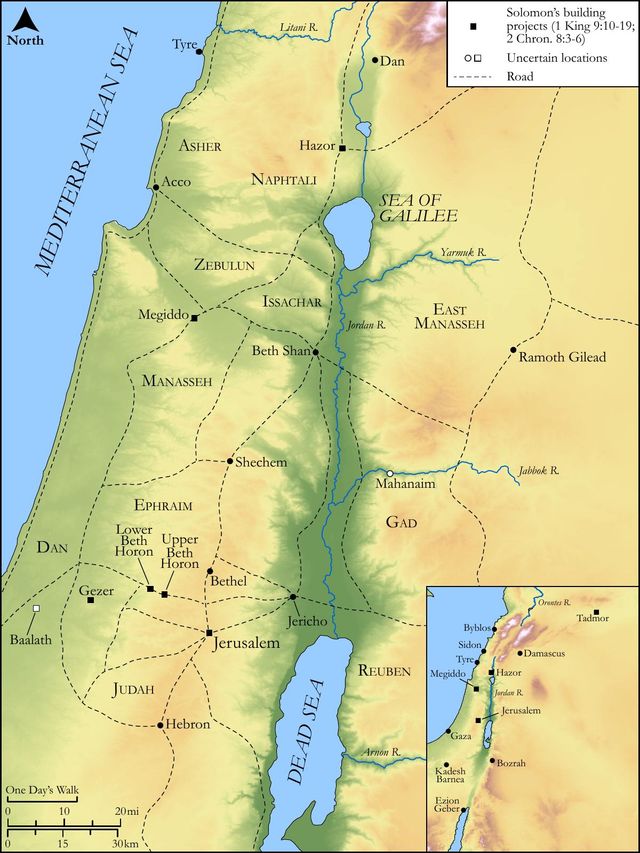
The alliance between King Solomon of Israel and King Hiram of Tyre was a cornerstone of Solomon's reign, facilitating the acquisition of crucial resources and skilled labor for his ambitious building programs (see 1 Kings 5). Tyre was a powerful maritime and mercantile kingdom, valuing trade routes, strategic ports, and precious commodities. Land, particularly agricultural land in the Galilean hill country, might not have held the same strategic or economic value for Hiram as it did for an agrarian kingdom like Israel. The exchange of land for services was a significant diplomatic act, and Hiram's reaction reveals a cultural clash in perceived value. The cities given were likely in the northern part of Galilee, a region that may have been less fertile or strategically important for a sea-faring nation, contributing to Hiram's disappointment. This incident underscores the complexities of ancient international diplomacy and the importance of understanding differing cultural and economic priorities.
Key Themes
ShowHideThis verse powerfully illustrates the theme of unfulfilled expectations and the subjectivity of value. What Solomon considered a substantial payment, Hiram deemed "nothing." It highlights the importance of clear communication and understanding the needs and priorities of all parties in any transaction, whether personal or diplomatic. Furthermore, it touches upon the theme of inter-kingdom relations, showing that even strong alliances, like that between Solomon and Hiram, could be strained by perceived inequities or misjudgments. The incident also subtly foreshadows the decline of Solomon's reign, where his renowned wisdom was not always perfectly applied, leading to various forms of dissatisfaction and eventual division (compare with 1 Kings 11, which details the consequences of his later missteps).
Exposition and Analysis
ShowHideKey Word Analysis
ShowHideThis word, derived from a root suggesting "limitation" or "sterility," is understood as a pun meaning "as nothing," "good for nothing," or "displeasing." Hiram's choice of this name for the region powerfully conveys his disdain and the perceived worthlessness of the cities in his eyes, especially when contrasted with the immense value of the resources he had supplied for Solomon's grand projects. It signifies a land that was unproductive or of little use to him.
This term, used by Hiram to address Solomon, emphasizes the close, treaty-bound relationship and personal friendship that existed between the two kings. As a primitive word meaning "brother" in the widest sense of literal relationship or metaphorical affinity, its use in the context of a rhetorical question expressing profound dissatisfaction makes Hiram's disappointment particularly pointed, highlighting the personal nature of the perceived slight rather than just a formal diplomatic complaint.
This word, from a root meaning "to be hot," refers to a day, either literal or figurative, or a space of time. In the phrase "unto this day," it signifies that the derogatory name "Cabul" for the region persisted long after the initial incident, serving as a lasting testament to Hiram's poor impression of the land. It underscores the enduring impact of the event and the memory of Hiram's judgment within the historical consciousness of the time the book was written.
Verse Breakdown
ShowHide"And he said, What cities [are] these which thou hast given me, my brother?"
This clause captures Hiram's immediate, direct, and rhetorical question upon inspecting the cities. The interrogative "What cities are these?" is not a request for information but an expression of profound dismay, surprise, and dissatisfaction. It conveys a sense of incredulity that Solomon, his esteemed ally and "brother," would offer such a seemingly inadequate payment. The inclusion of "my brother" underscores the personal nature of the disappointment within the context of their strong alliance, indicating a breach of expectation from a trusted friend and partner.
"And he called them the land of Cabul unto this day."
This clause describes Hiram's decisive action of naming the region. In Scripture, naming was an act of power and definition, as when Adam gave names to all cattle and to the fowl of the air, often reflecting character or destiny. By calling the land "Cabul" (meaning "as nothing" or "displeasing"), Hiram publicly and permanently registered his negative judgment of the gift. This act of naming served as a lasting, derogatory label for the region. The phrase "unto this day" signifies that this name stuck and was still in use at the time the biblical account was compiled, serving as a historical marker of Hiram's lasting dissatisfaction and the perceived poor quality of Solomon's payment.
Literary Devices
ShowHideThe verse employs several potent literary devices to convey Hiram's reaction and the historical impact of the event. The most prominent is the rhetorical question, "What cities are these which thou hast given me, my brother?", which effectively communicates Hiram's dismay and incredulity without requiring a direct answer. This question serves to highlight the perceived disparity between the value of his contributions and the worth of Solomon's payment. Furthermore, the passage features a significant pun or wordplay in the naming of "Cabul," which sounds like a Hebrew phrase meaning "as nothing" or "good for nothing." This linguistic device powerfully encapsulates Hiram's disdain and provides a memorable, albeit derogatory, label for the region. Finally, the phrase "unto this day" functions as an etiology, explaining the origin of a place name and emphasizing the enduring historical legacy of this diplomatic misstep. The underlying irony is also present, as Solomon, renowned for his wisdom and wealth, is depicted as offering a gift that is deemed worthless by his closest ally, revealing a surprising miscalculation.
Theological and Thematic Connections
ShowHideThe incident of Cabul serves as a profound theological lesson on the nature of earthly value and human expectations. While Solomon's intentions may have been to fulfill his obligation, his gift was perceived as insufficient and disappointing by Hiram. This highlights that true value is often subjective and can lead to relational strain when expectations are mismanaged or when one party's understanding of worth differs significantly from another's. It cautions against assuming that what we consider valuable will be equally esteemed by others, urging a deeper consideration of another's perspective and needs. Theologically, it reminds us that earthly riches and transactions, even those between powerful kings, are ultimately fleeting and prone to human imperfection and dissatisfaction, contrasting sharply with the perfect, immeasurable gifts of God, which are always sufficient and eternally satisfying.
Reflection and Application
ShowHideThe story of Cabul offers a timeless lesson for navigating relationships and transactions in our own lives. It underscores the critical importance of clear communication and managing expectations. What we perceive as valuable or a generous offering might be seen as "Cabul"—worthless or disappointing—by another, if we haven't truly understood their needs, priorities, or perspective. This applies not only to financial dealings but also to our time, efforts, and emotional investments in personal, professional, and even spiritual relationships. Are we giving what we think is valuable, or are we giving what is truly valued by the recipient? This narrative challenges us to move beyond our own assumptions and to genuinely seek to understand the other person's frame of reference, ensuring that our contributions are truly received as a blessing and not as a source of disappointment. It calls us to cultivate generosity that is discerning and empathetic, fostering genuine connection and avoiding the relational friction that can arise from misaligned expectations, ultimately promoting healthier and more fruitful interactions.
Questions for Reflection
ShowHideFAQ
ShowHideWhy did Solomon give land instead of gold or other goods?
ShowHideWhile Solomon was immensely wealthy (see 1 Kings 10:23), the text doesn't explicitly state his reasoning for offering land. Several factors may have contributed: he might have preferred to preserve his vast treasury of precious metals and goods; land, particularly in a less developed or strategically vital area of Galilee, might have been seen as a convenient and substantial asset to offer without depleting his more liquid wealth; or it could simply have been a miscalculation on Solomon's part regarding Hiram's priorities and the specific value he placed on such territory. For an agrarian society like Israel, land was the primary source of wealth and inheritance, making it a significant gift, even if its specific location or quality proved disappointing to a maritime king like Hiram.
Did this incident damage the relationship between Solomon and Hiram?
ShowHideThe text does not indicate a permanent rupture in their alliance. Despite Hiram's clear dissatisfaction, their cooperation continued on other projects, such as Solomon's fleet at Ezion-geber (see 1 Kings 9:26-28). This suggests that while the "Cabul" incident introduced a strain and revealed a significant misjudgment on Solomon's part, it did not entirely sever their diplomatic and economic ties. It highlights that even strong international alliances, built on mutual benefit, could experience friction and require ongoing negotiation and understanding to endure.
What was the significance of "Cabul" meaning "good for nothing"?
ShowHideThe significance lies in its powerful linguistic jab. By naming the region "Cabul," which is understood as a pun meaning "as nothing" or "good for nothing," Hiram delivered a clear and lasting public indictment of the quality of Solomon's payment. This derogatory naming underscored the perceived disparity between the immense value of the resources Hiram had provided (cedar, gold, skilled labor) for two decades of monumental construction, and the seemingly worthless land he received in return. It served as a permanent, derisive memorial to his disappointment, reflecting a profound sense of being short-changed in a major international transaction.
Christ-Centered Fulfillment
ShowHideThe narrative of Solomon's "Cabul" transaction, marked by human imperfection and earthly disappointment, stands in stark contrast to the perfect and infinitely valuable exchange offered through Jesus Christ. Solomon, in his flawed wisdom, offered a gift deemed "worthless" by his closest ally, revealing the limitations of even the most powerful human kings and their earthly treasures. Yet, in Christ, we encounter a divine exchange where the seemingly "worthless" is transformed into the infinitely precious. The world often deemed Christ's life and sacrifice as "nothing"—a stumbling block to some and foolishness to others (as described in 1 Corinthians 1:23). However, what the world rejected as "Cabul" is, in God's economy, the "pearl of great price" (as seen in Matthew 13:45-46), the very means of salvation and eternal life. Unlike Solomon's gift, which left Hiram disappointed, God's gift of His Son is perfect, complete, and eternally satisfying, never failing to meet our deepest needs or disappoint our truest hopes. Through Christ, we receive not a "land of Cabul" but an inheritance incorruptible, undefiled, and unfading, reserved in heaven for us (as promised in 1 Peter 1:4). The ultimate fulfillment is found in Jesus, who gave Himself, the most valuable gift imaginable, for us, transforming our "nothingness" into eternal worth and abundant life in God's eyes (as affirmed in John 10:10).