


2 Chronicles 28:17
Bible text: King James Version (1769 Blayney text) · Public domain
Bible text: Berean Standard Bible · Public domain
Bible text: American Standard Version (1901) · Public domain
Bible text: World English Bible, Messianic edition · Public domain
Bible text: Geneva Bible (1599) · Public domain
Bible text: Young's Literal Translation · Public domain
- וְעוֹדve·'odand againH5750Conj-w ¦ Adj-msAdjective Numerical Singular Masculine Absoluteוְandעוֹדagain
- אֲדוֹמִים'a·do·Mim[the] EdomitesH130N-mpNoun Gentilic Plural Masculine Absolute
- בָּאוּBa·'uthey had comeH935V-Qal-Perf-3cpVerb Qal Perfect 3rd Plural common gender
- וַיַּכּוּvai·ya·Kuand they had defeatedH5221Conj-w ¦ V-Hiphil-ConsecImperf-3mpVerb Hiphil Consecutive Imperfect 3rd Plural Masculineוַandיַּכּוּthey had defeated
- בִיהוּדָהvi·hu·Dah<in> JudahH3063Prep-b ¦ N-properNoun Proper Locationבִ<in>יהוּדָהJudah
- וַיִּשְׁבּוּvai·yish·buand they had taken captiveH7617Conj-w ¦ V-Qal-ConsecImperf-3mpVerb Qal Consecutive Imperfect 3rd Plural Masculineוַandיִּשְׁבּוּthey had taken captive
- שֶׁבִיShe·vicaptive[s]H7628N-msNoun Singular Masculine Absolute
English is a literal word-by-word gloss of the Hebrew, not the KJV's wording. Why?
This is the original text the KJV's translators worked from — each Hebrew word with its own literal English meaning in this verse, prepared by scholars at Tyndale House, Cambridge. The KJV translates whole sentences, not word by word, so its wording differs: one Hebrew word can become several English words, and the KJV may choose “the LORD” where the gloss reads “Yahweh”. Both are faithful — they answer different questions. For the KJV's own rendering, switch to the KJV text.
Details
See on the biblical-era maps
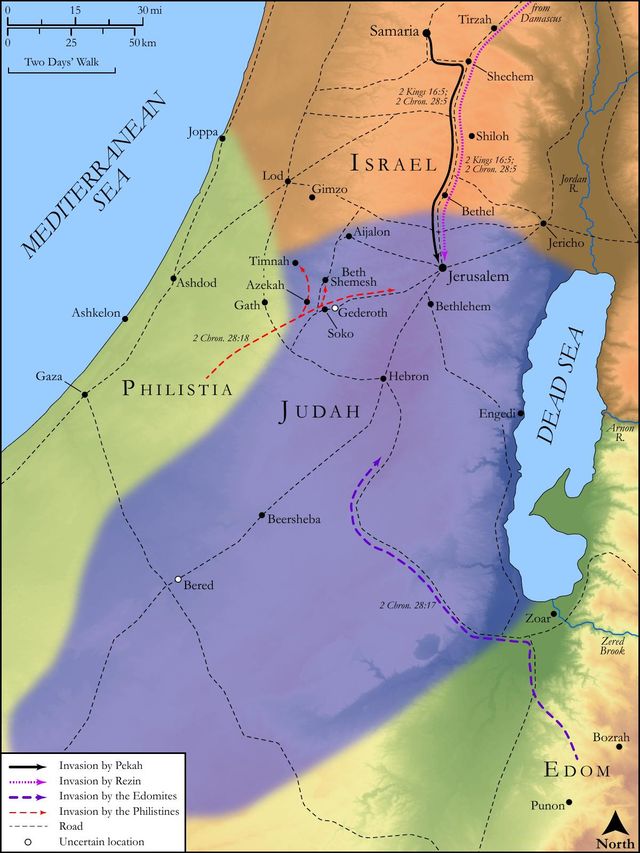
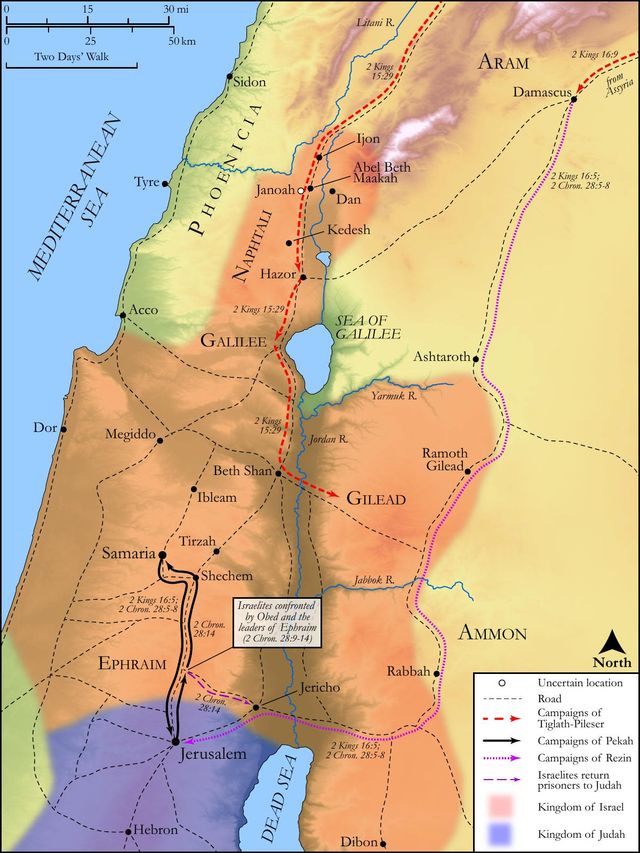
Study this verse
Public-domain commentary
Matthew Henry
From his Commentary on the Whole Bible. Henry comments on passages, not single verses — this entry covers 2 Chronicles 28:16–27. His three-level outline is real structure in the source text, so it is rendered as structure.
Here is, I. The great distress which the kingdom of Ahaz was reduced to for his sin. In general, 1. The Lord brought Judah low, Ch2 28:19. They had lately been very high in wealth and power; but God found means to bring them down, and make them as despicable as they had been formidable. Those that will not humble themselves under the word of God will justly be humbled by his judgments. Iniquity brings men low, Psa 106:43. 2. Ahaz made Judah naked. As his sin debased them, so it exposed them. It made them naked to their shame; for it exposed them to contempt, as a man unclothed. It made them naked to their danger; for it exposed them to assaults, as a man unarmed, Exo 32:25. Sin strips men. In particular, the Edomites, to be revenged for Amaziah's cruel treatment of them (Ch2 25:12), smote Judah, and carried off many captives, Ch2 28:17. The Philistines also insulted them, took and kept possession of several cities and villages that lay near them (Ch2 28:18), and so they were revenged for the incursions which Uzziah had made upon them, Ch2 26:6. And, to show that it was purely the sin of Ahaz that brought the Philistines upon his country, in the very year that he died the prophet Isaiah foretold the destruction of the Philistines by his son, Isa 14:28, Isa 14:29.
II.The addition which Ahaz made both to the national distress and the national guilt.
1.He added to the distress, by making court to strange kings, in hopes they would relieve him. When the Edomites and Philistines were vexatious to him, he sent to the kings of Assyria to help him (Ch2 28:16); for he found his own kingdom weakened and made naked, and he could not put any confidence in God, and therefore was at a vast expense to get an interest in the king of Assyria. He pillaged the house of God, and the king's house, and squeezed the princes for money to hire these foreign forces into his service, Ch2 28:21. Though he had conformed to the idolatry of the heathen nations, his neighbours, they did not value him for that, nor love him the better, nor did his compliance, by which he lost God, gain them, nor could he make any interest in them, but with his money. It is often found that wicked men themselves have no real affection for those that revolt to them, nor do they care to do them a kindness. A degenerate branch is looked upon, on all sides, as an abominable branch, Isa 14:19. But what did Ahaz get by the king of Assyria? Why, he came to him, but he distressed him, and strengthened him not (Ch2 28:20), helped him not, Ch2 28:21. The forces of the Assyrian quartered upon his country, and so impoverished and weakened it; they grew insolent and imperious, and created him a great deal of vexation, like a broken reed, which not only fails, but pierces the hand.
2.He added to the guilt, by making court to strange gods, in hopes they would relieve him. In his distress, instead of repenting of his idolatry, which he had reason enough to see the folly of, he trespassed yet more (Ch2 28:22), was more mad than ever upon his idols. A brand of infamy is here set upon him for it: This is that king Ahaz, that wretched man, who was the scandal of the house of David and the curse and plague of his generation. Note, Those are wicked and vile indeed that are made worse by their afflictions, instead of being made better by them, who in their distress trespass yet more, have their corruptions exasperated by that which should mollify them, and their hearts more fully set in them to do evil. Let us see what his trespass was.
(1.)He abused the house of God; for he cut in pieces the vessels of it, that the priests might not perform the service of the temple, or not as it should be performed, for want of vessels; and, at length, he shut up the doors, that the people might not attend it, Ch2 28:24. This was worse than the worst of the kings before him had done.
(2.)He confronted the altar of God, for he made himself altars in every corner of Jerusalem; so that, as the prophet speaks, they were like heaps in the furrows of the fields, Hos 12:11. And in the cities of Judah, either by his power or by his purse, perhaps by both, he erected high places for the people to burn incense to what idols they pleased, as if on purpose to provoke the God of his fathers, Ch2 28:25.
(3.)He cast off God himself; for he sacrificed to the gods of Damascus (Ch2 28:23), not because he loved them, for he thought they smote him; but because he feared them, thinking that they helped his enemies, and that, if he could bring them into his interest, they would help him. Foolish man! It was his own God that smote him and strengthened the Syrians against him, not the gods of Damascus; had he sacrificed to him, and to him only, he would have helped him. But no marvel that men's affections and devotions are misplaced when they mistake the author of their trouble and their help. And what comes of it? The gods of Syria befriend Ahaz no more than the kings of Assyria did; they were the ruin of him and of all Israel. This sin provoked God to bring judgments upon them, to cut him off in the midst of his days, when he was but thirty-six years old; and it debauched the people so that the reformation of the next reign could not prevail to cure them of their inclination to idolatry, but they retained that root of bitterness till the captivity in Babylon plucked it up.
The chapter concludes with the conclusion of the reign of Ahaz, Ch2 28:26, Ch2 28:27. For aught that appears, he died impenitent, and therefore died inglorious; for he was not buried in the sepulchres of the kings. Justly was he thought unworthy to be laid among them who was so unlike them - to be buried with kings who had used his kingly power for the destruction of the church and not for its protection or edification.
Continue studying 2 Chronicles 28:17 across the web’s major study libraries — every link below opens this exact verse, chapter, or book on the destination site.
Read & Compare
 BibleGatewayThis verse in more than 200 translations and 70 languages.
 Bible.comThe YouVersion reader — hundreds of translations, reading plans, and highlights.
 ESV.orgCrossway's official English Standard Version reader.
 NET BibleThe NET translation with 60,000+ translators' notes on every rendering decision.
 STEP BibleTyndale House's free study tool — original text, vocabulary, and scholarly resources.
 BibliaLogos Bible Software's free web reader.
 USCCBThe New American Bible (Revised Edition) with the U.S. bishops' study notes.
Commentaries
 BibleHub CommentariesDozens of classic commentaries on this verse, gathered on one page.
 StudyLightMore than 100 commentary sets — the largest collection on the web.
 BibleRefPlain-English commentary on what this verse means, verse by verse.
 Enduring WordDavid Guzik's free commentary on this chapter, widely used by Bible teachers.
 Bible Study ToolsVerse commentary alongside Greek and Hebrew study aids.
Original Language & Research
- BibleHub InterlinearThe verse word by word — original language, transliteration, and English.
- BibleHub LexiconEvery word's original-language definition and Strong's entry.
 Blue Letter BibleDeep-study tools — Strong's numbers, concordance, and word studies.
 SefariaThe Hebrew text with Rashi and centuries of Jewish commentary.
Sermons, Hymns & Audio


TrulyRandomVerse is not affiliated with these sites and doesn’t control their content. They’re linked because they’re genuinely useful.
Summary
This verse records a devastating renewed assault by the Edomites against the Kingdom of Judah during the unfaithful reign of King Ahaz, highlighting the nation's severe vulnerability and the escalating divine judgment against its widespread idolatry and rejection of the Lord. This attack, which resulted in the capture and deportation of Judahite citizens, underscores the dire consequences of abandoning the covenant relationship with God and seeking human alliances instead of divine protection.
Context
ShowHideLiterary Context
The immediate literary context of 2 Chronicles 28:17 places it squarely within the grim narrative of King Ahaz's reign over Judah, specifically 2 Chronicles 28. This chapter meticulously chronicles Ahaz's profound apostasy, including his adoption of foreign idolatry and even child sacrifice (2 Chronicles 28:2-4). The preceding verses have already detailed severe judgments against Judah, including devastating defeats by the Arameans and the Northern Kingdom of Israel, resulting in massive casualties and the capture of many Judahites, though many captives were later returned due to prophetic intervention (2 Chronicles 28:5-15). Verse 17 marks a further escalation of Judah's distress, indicating that despite previous calamities, Ahaz remained unrepentant, leading to continued divine chastisement. This verse sets the stage for Ahaz's desperate, yet ultimately futile, appeal to the king of Assyria for help (2 Chronicles 28:16), a decision that only compounded Judah's troubles and deepened its spiritual decline.
Historical & Cultural Context
Historically, King Ahaz's reign (c. 735-715 BC) coincided with a period of intense geopolitical upheaval, dominated by the rising power of the Neo-Assyrian Empire. Judah found itself caught between powerful regional forces, including Aram (Syria) and Israel (the Northern Kingdom), who formed an anti-Assyrian coalition that Ahaz refused to join, leading to the Syro-Ephraimitic War. The Edomites, traditional adversaries of Judah and descendants of Esau (Genesis 25:30), inhabited the mountainous region south-east of the Dead Sea. Their history with Israel was marked by intermittent conflict and deep-seated animosity, often exploiting Judah's weaknesses, as seen in earlier periods (2 Chronicles 21:8-10). The practice of "carrying away captives" was a standard, brutal military tactic of the era, used to depopulate conquered territories, break national identity, and provide slave labor or tribute to the victorious power. This act was not merely a military success but a profound humiliation and economic blow, reflecting the complete subjugation of the defeated.
Key Themes
ShowHideSeveral key themes converge in 2 Chronicles 28:17. Foremost is the theme of Divine Judgment, where the repeated invasions and defeats, including this Edomite assault, are presented as direct consequences of King Ahaz's and Judah's widespread idolatry and covenant unfaithfulness. The Chronicler consistently links national suffering to spiritual apostasy, emphasizing God's active involvement in the nation's history as both judge and disciplinarian. This verse also highlights the Historical Enmity between Judah and Edom, a rivalry rooted in the sibling conflict of Jacob and Esau, which frequently manifested in Edomite aggression whenever Judah was vulnerable. The phrase "again" underscores the recurring nature of this threat, emphasizing a pattern of hostility that intensified during Judah's spiritual decline. Finally, the narrative powerfully illustrates Judah's profound Vulnerability Without God's Protection. When Ahaz abandoned the Lord and sought alliances with human powers like Assyria (2 Chronicles 28:16), the divine hedge of protection was removed, leaving Judah exposed to its enemies and demonstrating the futility of relying on anything other than the Lord for true security and peace.
Exposition and Analysis
ShowHideKey Word Analysis
ShowHideThis term refers to the inhabitants of Edom, a kingdom located southeast of the Dead Sea, whose people were descendants of Esau, Jacob's brother. Their name is often associated with the Hebrew word for "red" ('ādōm), possibly alluding to the reddish sandstone cliffs characteristic of their territory or to Esau's "red" stew (Genesis 25:30). Their history with Israel and Judah was consistently marked by animosity and conflict, often serving as instruments of divine judgment against an unfaithful Judah.
Derived from the primitive root נָכָה (nâkâh), meaning "to strike (lightly or severely), beat, kill, slay." The form used in the verse (wayyakkū) is the Hiphil imperfect consecutive, indicating a decisive and forceful action. This signifies not merely an attack, but a successful, crushing blow inflicted upon Judah, resulting in significant casualties and subjugation. It conveys the severity and effectiveness of the Edomite military action.
This phrase employs a cognate accusative construction, combining the verb שָׁבָה (shâbâh), "to transport into captivity," with the noun שְׁבִי (shᵉbîy), meaning "exiled, captured," or "captives/booty." This grammatical structure emphasizes the act and its outcome, highlighting the complete subjugation of the defeated population. It vividly portrays the brutal reality of ancient warfare, where human beings were treated as spoils of war and forcibly deported, signifying a profound loss of freedom and national dignity.
Verse Breakdown
ShowHide"For again the Edomites had come"
The introductory "For" (כִּי, kî) links this event directly to the preceding narrative of Judah's escalating distress and Ahaz's persistent unfaithfulness. The crucial word "again" (עוֹד, ʿôd) signifies a repeated occurrence, indicating that this was not the first time the Edomites had attacked Judah, nor was it an isolated incident of Judah's suffering. It underscores a pattern of divine judgment and the persistent vulnerability of a nation that had turned away from its covenant God. This repetition heightens the sense of relentless pressure and the cumulative nature of divine discipline.
"and smitten Judah"
This clause describes the direct military action and its devastating effect. The Edomites did not merely raid; they "smote" Judah, implying a decisive victory that inflicted significant damage, casualties, and weakened the kingdom's defenses. This was a severe blow to Judah's military and national security, further eroding its strength and morale during Ahaz's disastrous reign. The verb choice emphasizes the force and success of the Edomite assault.
"and carried away captives"
This final clause details one of the most brutal and humiliating consequences of the Edomite victory. The taking of captives (שְׁבִי, shevi) was a common practice in ancient warfare, serving to humiliate the defeated, deplete their population, and provide labor or tribute for the victors. For Judah, this meant the loss of its people, the breaking of families, and a profound sense of national shame and vulnerability, serving as a tangible sign of God's judgment and the removal of His protective hand from a disobedient nation.
Literary Devices
ShowHide2 Chronicles 28:17 employs several potent literary devices that amplify its theological message. The most prominent is Repetition, specifically through the adverb "again" (עוֹד, ʿôd). This word emphasizes the recurring nature of Judah's suffering and the relentless pressure from external enemies, reinforcing the Chronicler's theological message that Ahaz's persistent unfaithfulness led to continuous divine judgment. This repetition also highlights the escalating crisis and the cumulative effect of Judah's apostasy. There is also a strong element of Irony in the broader narrative: Ahaz's desperate attempts to secure his kingdom through human alliances, particularly with Assyria (2 Chronicles 28:16), paradoxically lead to more attacks and deeper distress, as seen with the Edomites and later the Philistines (2 Chronicles 28:18). This underscores the futility of relying on human strength over divine protection. Furthermore, the act of "carrying away captives" serves as a subtle Foreshadowing of the much larger and more devastating exiles that would befall both the Northern Kingdom (Assyrian exile) and Judah (Babylonian exile), reinforcing the theme of covenant consequences for national apostasy.
Theological and Thematic Connections
ShowHide2 Chronicles 28:17 profoundly illustrates the biblical principle that covenant unfaithfulness leads to severe consequences. For Judah, abandoning the Lord's covenant, particularly through Ahaz's idolatry and reliance on foreign powers, resulted in the removal of divine protection, leaving the nation vulnerable to its historical enemies. This verse underscores God's sovereignty over nations, using even hostile peoples like the Edomites as instruments of His righteous judgment and discipline. It serves as a stark reminder that true security and prosperity for God's people are found not in human alliances or military strength, but in faithful obedience and trust in the Lord alone. The repeated attacks signify God's persistent call for repentance, a call tragically ignored by Ahaz, leading to further devastation.
Reflection and Application
ShowHideThe account of Judah's distress under Ahaz, culminating in the Edomite attack of 2 Chronicles 28:17, serves as a timeless cautionary tale for believers today. It powerfully illustrates that spiritual compromise and reliance on worldly solutions, rather than divine wisdom and strength, inevitably lead to vulnerability and distress. Just as Judah faced escalating external threats when it turned from God, so too can individuals and communities experience spiritual and practical consequences when they drift from their covenant relationship with the Lord. This passage challenges us to examine where our ultimate trust lies—in human strategies, financial security, or political power, or in the unfailing sovereignty and provision of God. It calls us to a posture of humble dependence and faithful obedience, reminding us that true peace and security are found only under the protective hand of the Almighty, who is our refuge and strength in every time of trouble. We are invited to learn from Judah's mistakes, turning from self-reliance and idolatry to wholehearted trust in God, who alone can provide ultimate security and deliverance.
Questions for Reflection
ShowHideFAQ
ShowHideWhy did the Edomites attack Judah "again"?
ShowHideThe word "again" in 2 Chronicles 28:17 highlights the long-standing animosity between Edom and Judah, rooted in the sibling rivalry of Jacob and Esau (Genesis 25:30). Historically, Edom often exploited Judah's weaknesses, as seen during King Jehoram's reign when they successfully revolted (2 Chronicles 21:8-10). In Ahaz's time, Judah was severely weakened by divine judgment due to its widespread idolatry and unfaithfulness. The Edomites, likely seeing an opportune moment in Judah's distress and perhaps encouraged by Judah's other enemies (like Aram and Israel), launched another assault to expand their territory or exact tribute. This repetition underscores the Chronicler's theological point that Judah's ongoing suffering was a direct consequence of its persistent rebellion against God, demonstrating that divine discipline often comes through familiar adversaries.
What was King Ahaz's main problem that led to these attacks?
ShowHideKing Ahaz's primary problem was his profound unfaithfulness and blatant idolatry, which directly violated God's covenant with Judah. 2 Chronicles 28:2-4 explicitly states that he "walked in the ways of the kings of Israel" (referring to the idolatrous Northern Kingdom) and even "made molten images for Baalim" and "burnt his children in the fire in the valley of the son of Hinnom." Instead of repenting and trusting in the Lord for deliverance from foreign threats, Ahaz sought help from the king of Assyria (2 Chronicles 28:16), further demonstrating his lack of faith and reliance on human power over divine sovereignty. This spiritual apostasy removed God's protective hand from Judah, making the nation vulnerable to the very enemies it feared, including the Edomites, as a direct consequence of its covenant breaking.
Christ-Centered Fulfillment
ShowHideThe plight of Judah under Ahaz, marked by relentless attacks and the carrying away of captives as seen in 2 Chronicles 28:17, powerfully foreshadows humanity's deeper spiritual captivity and the ultimate deliverance found in Christ. Judah's vulnerability stemmed from its unfaithfulness, a reflection of humanity's inherent sinfulness that separates us from God and leaves us exposed to the destructive forces of sin and death (Romans 6:23). Just as Judah desperately needed a deliverer beyond human alliances, so too did humanity need a Savior who could break the chains of spiritual bondage. Jesus Christ, the true King of Judah and the Son of David, did not seek worldly alliances or military might, but instead offered Himself as the ultimate sacrifice, becoming the Lamb of God who takes away the sin of the world. Through His death and resurrection, He conquered sin, death, and the powers that held humanity captive (Colossians 2:15). In Christ, believers find true freedom and security, not through human strength or alliances, but through faith in His finished work, becoming part of His eternal kingdom where no enemy can ultimately prevail (Hebrews 2:14-15). He is the faithful King who provides the ultimate protection and delivers His people from all forms of captivity, fulfilling the deepest longings for security and peace that Judah desperately sought.