


Obadiah 1:13
Bible text: King James Version (1769 Blayney text) · Public domain
Bible text: King James Version with Strong's numbers · Public domain
Bible text: Berean Standard Bible · Public domain
Bible text: American Standard Version (1901) · Public domain
Bible text: World English Bible, Messianic edition · Public domain
Bible text: Geneva Bible (1599) · Public domain
Bible text: Young's Literal Translation · Public domain
- אַל'almay notH408NegParticle Negative
- תָּבוֹאta·Vo'you goH935V-Qal-Imperf-2msVerb Qal Imperfect 2nd Singular Masculine
- בְשַׁעַרve·sha·'arin [the] gate ofH8179Prep-b ¦ N-mscNoun Singular Masculine Constructבְinשַׁעַר[the] gate of
- עַמִּי'a·Mimy peopleH5971N-msc ¦ 1csNoun Singular Masculine Constructעַמִּpeopleיmy
- בְּיוֹםbe·Yomon [the] day ofH3117Prep-b ¦ N-mscNoun Singular Masculine Constructבְּonיוֹם[the] day of
- אֵידָם'ei·Damtheir disasterH343N-msc ¦ 3mpNoun Singular Masculine Constructאֵידָdisasterםtheir
- אַל'almay notH408NegParticle Negative
- תֵּרֶאTe·re'you lookH7200V-Qal-Imperf-2msVerb Qal Imperfect 2nd Singular Masculine
- גַםgamalsoH1571AdvAdverb
- אַתָּה'a·TahyouH859Pro-2msPronoun Personal 2nd Singular Masculine
- בְּרָעָתוֹbe·ra·'a·Toon his calamityH7451Prep-b ¦ N-fsc ¦ 3msNoun Singular Feminine Constructבְּonרָעָתcalamityוֹhis
- בְּיוֹםbe·Yomon [the] day ofH3117Prep-b ¦ N-mscNoun Singular Masculine Constructבְּonיוֹם[the] day of
- אֵידוֹ'ei·Dohis disasterH343N-msc ¦ 3msNoun Singular Masculine Constructאֵידdisasterוֹhis
- וְאַלve·'aland may notH408Conj-w ¦ NegParticle Negativeוְandאַלmay not
- תִּשְׁלַחְנָהtish·Lach·nahyou stretch outH7971V-Qal-Imperf-2fpVerb Qal Imperfect 2nd Plural Feminine
- בְחֵילוֹve·chei·Loon his wealthH2428Prep-b ¦ N-msc ¦ 3msNoun Singular Masculine Constructבְonחֵילwealthוֹhis
- בְּיוֹםbe·Yomon [the] day ofH3117Prep-b ¦ N-mscNoun Singular Masculine Constructבְּonיוֹם[the] day of
- אֵידוֹ'ei·Dohis disasterH343N-msc ¦ 3msNoun Singular Masculine Constructאֵידdisasterוֹhis
English is a literal word-by-word gloss of the Hebrew, not the KJV's wording. Why?
This is the original text the KJV's translators worked from — each Hebrew word with its own literal English meaning in this verse, prepared by scholars at Tyndale House, Cambridge. The KJV translates whole sentences, not word by word, so its wording differs: one Hebrew word can become several English words, and the KJV may choose “the LORD” where the gloss reads “Yahweh”. Both are faithful — they answer different questions. For the KJV's own rendering, switch to the KJV text.
Details
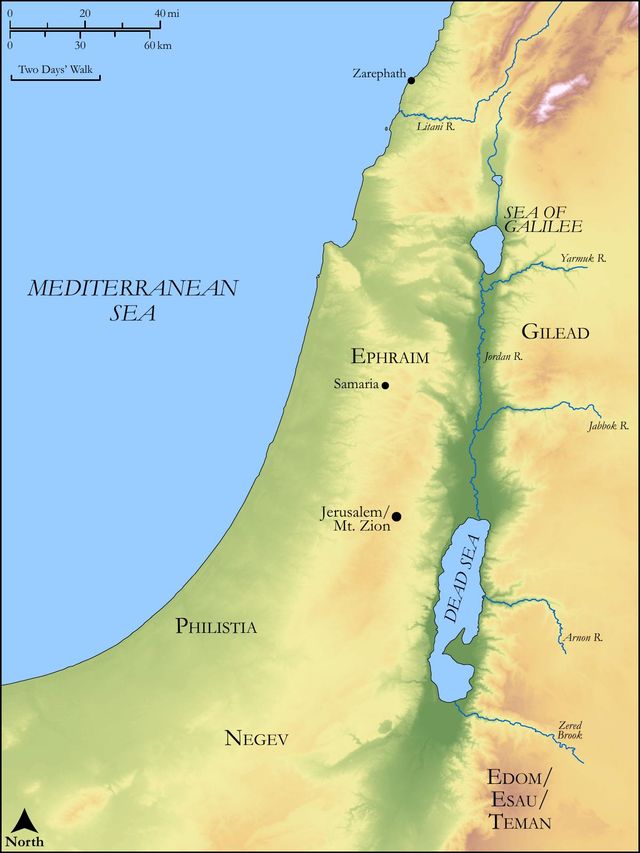
See on the biblical-era map
Study this verse
Public-domain commentary
Matthew Henry
From his Commentary on the Whole Bible. Henry comments on passages, not single verses — this entry covers Obadiah 1:10–16. His three-level outline is real structure in the source text, so it is rendered as structure.
When we have read Edom's doom, no less than utter ruin, it is natural to ask, Why, what evil has he done? What is the ground of God's controversy with him? Many things, no doubt, were amiss in Edom; they were a sinful people, and a people laden with iniquity. But that one single crime which is laid to their charge, as filling their measure and bringing this ruin upon them, that for which they here stand indicted, of which they are convicted, and for which they are condemned, is the injury they had done to the people of God (Oba 1:10): "It is for thy violence against thy brother Jacob, that ancient and hereditary grudge which thou hast borne to the people of Israel, that all this shame shall cover thee and thou shalt be cut off for ever." Note, Injuries to men are affronts to God, the righteous God, that loveth righteousness and hateth wickedness; and, as the Judge of all the earth, he will give redress to those that suffer wrong and take vengeance on those that do wrong. All violence, all unrighteousness, is sin; but it is a great aggravation of the violence if it be done either, 1. Against any of our own people; it is violence against thy brother, thy near relation, to whom thou shouldst be a goel - a redeemer, whom it is thy duty to right if others wronged him; how wicked is it then for thee thyself to wrong him! Thou slanderest and abusest thy own mother's son; this makes the sin exceedingly sinful, Psa 50:20. Or, 2. Much more if it be done against any of God's people; "it is thy brother Jacob that is in covenant with God, and dear to him. Thou hatest him whom God has loved, and because God espouses and will plead with jealousy, and in whose interests God is pleased so far to interest himself that he takes the violence done to him as done to himself. Whoso touches Jacob touches the apple of the eye of Jacob's God." So that it is crimen laesae majestatis - high treason, for which, as for high treason, let Edom expect an ignominious punishment: Shame shall cover thee, and a ruining one; thou shalt be cut off for ever.
In the following verses we are told more particularly,
I.What the violence was which Edom did against his brother Jacob, and what are the proofs of this charge.
It does not appear that the Edomites did themselves invade Israel, but that was more for want of power than will; they had malice enough to do it, but were not a match for them. But that which is laid to their charge is their barbarous conduct towards Judah and Jerusalem when they were in distress, and ready to be destroyed, probably by the Chaldeans, or upon occasion of some other of the calamities of the Jews; for this seems to have been always their temper towards them. See this charged upon the Edomites (Psa 137:7), that in the day of Jerusalem they said, Rase it, rase it, and Eze 25:12. They are here told particularly what they did, by being told what they should not have done (Oba 1:12-14): "Thou shouldst not have looked, thou shouldst not have entered; but thou didst so." Note, In reflecting upon ourselves it is good to compare what we have done with what we should have done, our practice with the rule, that we may discover wherein we have done amiss, have done those things which we ought not to have done. We should not have been where we were at such a time, should not have been in such and such company, should not have said what we said, nor have taken the liberty that we took. Sin thus looked upon, in the glass of the commandment, will appear exceedingly sinful. Let us see,
1.What was the case of Judah and Jerusalem when the Edomites behaved themselves thus basely and insulted over them.
(1.)It was a day of distress with them (Oba 1:12): It was the day of their calamity, so it is called three times, Oba 1:13. With the Edomites it was a day of prosperity and peace when with the Israelites it was a day of distress and calamity, for judgment commonly begins at the house of God. Children are corrected when strangers are let alone.
(2.)It was the day of their destruction (Oba 1:12), when both city and country were laid waste, were laid in ruins.
(3.)It was a day when foreigners entered into the gates of Jerusalem, when the city, after a long siege, was broken up, and the great officers of the king of Babylon's army came, and sat in the gates, as judges of the land; when they cast lots upon the spoils of Jerusalem, as the soldiers on Christ's garments, what shares each of the conquerors shall have, what shares of the lands, what shares of the goods; or they cast lots to determine when and where they should attack it.
(4.)It was a day when the strangers carried away captive his forces (Oba 1:11), took the men of war prisoners of war, and carried them off, in poverty and shame, to their own country, or such a multitude of captives that they were as an army. (5.) "It was a day when thy brother himself, that had long been at home, at rest in his own land, became a stranger, an exile in a strange land." Now, when this was the woeful case of the Jews, the Edomites, their neighbours and brethren, should have pitied them and helped them, condoled with them and comforted them, and should have trembled to think that their own turn would come next; for, if this was done in the green tree, what shall be done in the dry? But,
2.See what was the conduct of the Edomites towards them when they were in this distress, for which they are here condemned.
(1.)They looked with pleasure upon the affliction of God's people; they stood on the other side (Oba 1:11), afar off, when they should have come in to the relief of their distressed neighbours, and looked upon them, and their day, looked on their affliction (Oba 1:12, Oba 1:13), with a careless unconcerned eye, as the priest and Levite looked upon the wounded man, and passed by on the other side. Those have a great deal to answer for that are idle spectators of the troubles and afflictions of their neighbours, when they are capable of being their active helpers. But this was not all; they looked upon it with a scornful eye, with an eye of complacency and satisfaction; they looked and laughed to see Israel in distress, saying, Aha! so we would have it. They fed their eyes with the rueful spectacle of Jerusalem's ruin, and looked at it as those that had long looked for it and often wished to see it. Note, We must take heed with what eye we look upon the afflictions of our brethren; and, if we cannot look upon them with a gracious eye of sympathy and tenderness, it is better not to look upon them at all: Thou shouldst not have looked as thou didst upon the day of thy brother.
(2.)They triumphed and insulted over them, upbraided their brethren with their sorrows, and made themselves and their companions merry with them. They rejoiced over the children of Judah in the day of their destruction. They had not the good manners to conceal the pleasure they took in Judah's destruction and to dissemble it, but openly declared it, and rudely and insolently declared it to them; they rejoiced over them, crowed, and hectored, and trampled upon them. Those have the spirit of Edomites that can rejoice over any, especially over Israelites, in the day of their calamity.
(3.)They spoke proudly-magnified the mouth (so the word is), against Israel, talked with a great disdain of the suffering Israelites, and with an air of haughtiness of the present safety and prosperity of Edom, as it if might be inferred from their present different state that the tables were turned, and now Esau was beloved, and the favourite of heaven, and Jacob hated and rejected. Note, Those must expect to be in some way or other effectually humbled and mortified themselves that are puffed up and made proud by the humiliations and mortifications of others.
(4.)They went further yet, for they entered into the gate of God's people in the day of their calamity, and laid hands on their substance. Though they did not help to conquer them, they helped to plunder them, and put in for a share in the prey, Oba 1:13. Jerusalem was thrown open, and then they entered in; its wealth was thrown about, and they seized it for themselves, excusing it with this, that they might as well take it as let it be lost; whereas it was taking what was not their own. Babylon lays Jerusalem waste, but Edom, by meddling with the spoil, becomes particeps criminis - partaker of the crime, and shall be reckoned with as an accessary ex post facto - after the fact. Note, Those do but impoverish themselves that think to enrich themselves by the ruins of the people of God; and those deceive themselves who think they may call all that substance their own which they can lay their hands on in a day of calamity.
(5.)They did yet worse things; they not only robbed their brethren, but murdered them, in the day of their calamity; laid hands not only on their substance, but on their persons, Oba 1:14. When the victorious sword of the Chaldeans was making bloody work among the Jews many made their escape, and were in a fair way to save themselves by flight; but the Edomites basely intercepted them, stood in the cross-way where several roads met, by each of which the trembling Israelites were making the best of their way from the fury of the pursuers, and there they stopped them: some they barbarously and cowardlike cut off themselves; others they took prisoners, and delivered up to the pursuers, only to ingratiate themselves with them, because they were now the conquerors. They should not have been thus cruel to those that lay at their mercy, and never had done, nor were every likely to do, them any hurt; they should not have betrayed those whom they had such a fair opportunity to protect; but such are the tender mercies of the wicked. One cannot read this without a high degree of compassion towards those who were thus basely abused, who when they fled from the sword of an open enemy, and thought they had got out of the reach of it, fell upon and fell by the sword of a treacherous neighbour, whom they were not apprehensive of any danger from. Nor can one read this without a high degree of indignation towards those who were so perfectly lost to all humanity as to exercise such cruelty upon such proper objects of compassion.
(6.)In all this they joined with the open enemies and persecutors of Israel: Even thou wast as one of them, an accessary equally guilty with the principals. He that joins in with the evil doers, and is aiding and abetting in their evil deeds, shall be reckoned, and shall be reckoned with, as one of them.
II.What the shame is that shall cover them for this violence of theirs.
1.They shall soon find that the cup is going round, even the cup of trembling; and, when they come to be in the same calamitous condition that the Israel of God is now in, they will be ashamed to remember how they triumphed over them (Oba 1:15): The day of the Lord is near upon all the heathen, when God will recompense tribulation to the troublers of his church. Though judgment begin at the house of God, it shall not end there. This should effectually restrain us from triumphing over others in their misery, that we know not how soon it may be our own case.
2.Their enmity to the people of God, and the injuries they had done them, shall be recompensed into their own bosoms: As thou hast done, it shall be done unto thee. The righteous God will render both to nations and to particular persons according to their works; and the punishment is often made exactly to answer to the sin, and those that have abused others come to be themselves abused in like manner. The just and jealous God will find out a time and way to avenge the wrongs done to his people on those that have been injurious to them. As you have drunk upon my holy mountain (Oba 1:16), that is, as God's professing people, who inhabit his holy mountain, have drunk deeply of the cup of affliction (and their being of the holy mountain would not excuse them), so shall all the heathen drink, in their turn, of the same bitter cup; for, if God bring evil on the city that is called by his name, shall those be unpunished that never knew his name? See Jer 25:29. And it is part of the burden of Edom (Jer 49:12), Those whose judgment was not to drink of the cup (who had reason to promise themselves an exemption from it) have assuredly drunken, and shall Edom that is the generation of God's wrath go unpunished? No, thou shalt surely drink of it; the cup of trembling shall be taken out of the hand of God's people, and put into the hand of those that afflict them, Isa 51:22, Isa 51:23. Nay, they may expect their case to be worse in the day of their distress than that of Israel was in their day; for,
(1.)The afflictions of God's people were but for a moment, and soon had an end, but their enemies shall drink continually the wine of God's wrath, Rev 14:10.
(2.)The dregs of the cup are reserved for the wicked of the earth (Psa 75:8); they shall drink and swallow down, or sup up (as the margin reads it), shall drink it to the bottom.
(3.)The people of God, though they may be made to drink of the wine of astonishment for a while (Psa 60:3), shall yet recover, and come to themselves again; but the heathen shall drink and be as though they had not been; there shall be neither any remains nor any remembrance of them, but they shall be wholly extirpated and rooted out. So let all thy enemies perish, O Lord! so they shall perish, if the turn not.
Historical interpretation
Historical reception
1 surviving comment on this verse from the historical church.
(Verse 13, 14.) And you shall not despise them in their adversities on the day of their destruction, and you shall not send forth your army against them on the day of their destruction. And you shall not stand at the exits to kill those who flee, and you shall not capture the survivors on the day of their distress. LXX: And you shall not despise even their assembly on the day of their ruin, and you shall not put your strength against them on the day of their ruin. And you shall not stand at their retreats to kill those who have been saved from them, and you shall not capture their fugitives on the day of their trouble. When you yourself have been captured and destroyed by the Babylonian, among the other things that you have done, do not do the following: Do not despise or scorn your brother Jacob on the day of his devastation; do not join the army of the Babylonians or fail to send against the army of Judah when it has been defeated by the enemy and turns its back. And when they start fleeing along their familiar paths, detours, and roads leading to the wilderness, do not stand at the crossroads or wait for them at the intersections to kill those who have been set free and to release the others who have been captured; and either you yourself will be captured or you will keep watch over the captives of the enemy. We have said these things according to history: for we must briefly grasp the clearer things, and proceed to those which are obscure. Who despises the ecclesiastics of heretics? Who does not rejoice in their misfortunes, if at any time they are handed over to persecution due to the sins of the people, and many, either weak in faith or sown on stony ground, fall into denial? You may see them rejoicing, finding pleasure, considering our downfall as their own victory: to such an extent that they join with the nations, and a more furious persecution arises, either from the Jews or from those who pretend to be our brothers and are considered by the same name. And when someone, whether by flight or by repentance, has escaped, they stand in the byways and propose sophisms and testimonies, as if they were presenting them from the Scriptures: so that, worn out and exhausted, they offer stitched pillows and place them under every elbow. And thus it happens that those who perhaps have overcome persecution either by strength or by fear, deceived by false teachings, are held again in the prison of errors, and this tribulation becomes much worse than that which was from the Gentiles; for it is easier to free someone captured by pagans than one entrapped by the tricks of heretics.
Continue studying Obadiah 1:13 across the web’s major study libraries — every link below opens this exact verse, chapter, or book on the destination site.
Read & Compare
 BibleGatewayThis verse in more than 200 translations and 70 languages.
 Bible.comThe YouVersion reader — hundreds of translations, reading plans, and highlights.
 ESV.orgCrossway's official English Standard Version reader.
 NET BibleThe NET translation with 60,000+ translators' notes on every rendering decision.
 STEP BibleTyndale House's free study tool — original text, vocabulary, and scholarly resources.
 BibliaLogos Bible Software's free web reader.
 USCCBThe New American Bible (Revised Edition) with the U.S. bishops' study notes.
Commentaries
 BibleHub CommentariesDozens of classic commentaries on this verse, gathered on one page.
 StudyLightMore than 100 commentary sets — the largest collection on the web.
 BibleRefPlain-English commentary on what this verse means, verse by verse.
 Enduring WordDavid Guzik's free commentary on this chapter, widely used by Bible teachers.
 Bible Study ToolsVerse commentary alongside Greek and Hebrew study aids.
Original Language & Research
- BibleHub InterlinearThe verse word by word — original language, transliteration, and English.
- BibleHub LexiconEvery word's original-language definition and Strong's entry.
 Blue Letter BibleDeep-study tools — Strong's numbers, concordance, and word studies.
 SefariaThe Hebrew text with Rashi and centuries of Jewish commentary.
Sermons, Hymns & Audio


TrulyRandomVerse is not affiliated with these sites and doesn’t control their content. They’re linked because they’re genuinely useful.
Summary
Obadiah 1:13 delivers a scathing divine indictment against Edom, the descendants of Esau, for their egregious actions during Judah's profound suffering. The verse specifically condemns Edom for three distinct transgressions: entering Jerusalem's gate during its fall, gloating over Judah's affliction, and plundering their possessions. These acts of opportunistic cruelty and betrayal, committed in Judah's "day of calamity," highlight Edom's utter lack of compassion and brotherly solidarity, directly provoking God's righteous judgment.
Context
ShowHideLiterary Context
Obadiah is the shortest book in the Old Testament, a prophetic oracle entirely dedicated to pronouncing God's judgment against the nation of Edom. This verse, Obadiah 1:13, is part of a series of "thou shouldest not" statements (Obadiah 1:12-14) that detail Edom's specific offenses against Judah. These condemnations follow an initial declaration of Edom's impending downfall (Obadiah 1:1-9) and precede the broader principle of divine retribution (Obadiah 1:15-21), emphasizing that Edom's actions during Judah's distress were a direct cause for their own destruction. The repetitive structure underscores the severity and repeated nature of Edom's sin.
Historical & Cultural Context
The "day of their calamity" most reliably refers to the Babylonian conquest of Jerusalem in 586 BC, a catastrophic event that led to the destruction of the Temple, the city walls, and the exile of the Judahite people. Edom, sharing a common ancestry with Israel through Jacob and Esau, was considered a "brother" nation, yet their history was often marked by animosity. Instead of offering aid or even maintaining neutrality, Edom actively participated in Judah's downfall. Culturally, the "gate" was a vital point of a city, serving as a place for legal proceedings, commerce, and public assembly, symbolizing the city's strength and autonomy. To enter it during a siege was an act of invasion and conquest, a profound violation of any expected familial or neighborly solidarity.
Key Themes
ShowHideObadiah 1:13 contributes significantly to several key themes within the book and broader biblical narrative. Central among these is the theme of Divine Justice and Retribution, where God holds nations accountable for their actions, particularly their treatment of His covenant people. Edom's exploitation of Judah's weakness directly leads to the pronouncement of the "day of the Lord" upon all nations, where "as thou hast done, it shall be done unto thee" (see Obadiah 1:15). Another crucial theme is Brotherly Betrayal and Lack of Compassion. Despite their shared lineage, Edom's actions demonstrate a profound absence of empathy and a willingness to capitalize on a sibling's distress, a stark contrast to the divine command to love one's neighbor. This betrayal is a severe moral failing that underscores the depth of their sin, echoing the ancient animosity between Jacob and Esau that began in Genesis 27. The verse also highlights the theme of Active Exploitation, moving beyond passive observation to direct participation in the suffering and plunder of the vulnerable.
Exposition and Analysis
ShowHideKey Word Analysis
ShowHideThis word, derived from a root meaning "to bend down," signifies oppression, misfortune, or ruin. Its repeated use in Obadiah 1:13 emphasizes the profound and devastating nature of Judah's suffering, a state of utter distress and vulnerability that Edom chose to exploit rather than alleviate. It highlights the severity of the circumstances in which Edom's transgressions occurred.
While meaning "to see" generally, in this context, râʼâh implies more than mere observation. It carries the connotation of a malicious gaze, a gloating satisfaction, or even taking pleasure in another's misfortune. This is not passive witnessing but an active, internal participation in the affliction, revealing a hardened heart devoid of empathy.
This term is rich in meaning, referring to a force, whether of men, means, or other resources. It encompasses wealth, valor, strength, and goods. In the context of "laying hands on their substance," it refers to the plundering of Judah's material possessions, their resources, and perhaps even their people (as in taking captives), representing a complete stripping away of their means and dignity during their weakest moment.
Verse Breakdown
ShowHide"Thou shouldest not have entered into the gate of my people"
This clause condemns Edom's physical invasion of Jerusalem during its fall. The "gate" (Hebrew shaʻar) was the strategic, judicial, and commercial heart of the city. To enter it during a siege was an act of conquest, signifying hostile intent and active participation in the city's overthrow, rather than offering refuge or aid to their "brother" nation.
"in the day of their calamity; yea, thou shouldest not have looked on their affliction"
The repetition of "in the day of their calamity" underscores the specific, dire circumstances of Judah's suffering. Edom's sin was not just entering, but also the malicious "looking" (Hebrew râʼâh) upon Judah's "affliction" (Hebrew raʻ - evil, distress). This implies a gloating, a deriving of satisfaction from Judah's pain, highlighting a profound lack of compassion and a morally depraved heart.
"in the day of their calamity, nor have laid [hands] on their substance"
This final condemnation reiterates the timing of the offense and specifies the act of plunder. To "lay hands on their substance" (Hebrew chayil) means to seize and loot their wealth, goods, and resources. This was an act of extreme opportunism and exploitation, adding economic devastation to the physical and emotional trauma already inflicted upon Judah.
Literary Devices
ShowHideThe most prominent literary device in Obadiah 1:13 is Repetition, specifically the phrase "in the day of their calamity." This triple repetition serves as a powerful rhetorical device, emphasizing the crucial timing and the severity of Judah's distress during which Edom committed its transgressions. It underscores that Edom's actions were not incidental but deliberate and opportunistic, taking advantage of Judah's most vulnerable moment. This Anaphora (repetition at the beginning of successive clauses) creates a rhythmic emphasis, driving home the point that Edom's sin was compounded by the context of Judah's extreme suffering. Furthermore, the use of Apostrophe is evident, as the prophet directly addresses Edom ("Thou shouldest not have entered..."), making the indictment personal and direct. The cumulative effect of these devices is to heighten the sense of Edom's guilt and the egregious nature of their betrayal.
Theological and Thematic Connections
ShowHideObadiah 1:13 profoundly illustrates the biblical principle that God observes and judges how nations and individuals treat one another, especially the vulnerable. Edom's actions—invasion, gloating, and plunder—were not merely political or economic opportunism; they were a direct affront to God's heart, who identifies with His suffering people. Theologically, this verse reinforces the concept of divine justice, where those who sow malice and exploitation will reap judgment. It highlights the moral obligation of compassion and solidarity, particularly among those with a shared heritage, and underscores that a lack of empathy in times of crisis is a grave sin in God's eyes.
Reflection and Application
ShowHideObadiah 1:13 stands as a timeless warning against the insidious dangers of apathy, malicious pleasure (schadenfreude), and exploitation, particularly towards those in distress. It compels us to examine our own hearts and actions when others face hardship. Do we stand by idly, or worse, secretly rejoice or seek to profit from their pain? The prophet's condemnation of Edom reminds us that God takes note of our responses to the suffering of others, especially those we are called to love or support. Our faith calls us to active compassion, to mourn with those who mourn, and to extend help rather than harm. This verse challenges us to cultivate a heart that is quick to empathize, eager to assist, and resolute in resisting the temptation to capitalize on another's vulnerability, recognizing that such actions are not merely social missteps but spiritual failings that grieve the heart of God.
Questions for Reflection
ShowHideFAQ
ShowHideWhat was the relationship between Edom and Judah, and why was Edom's behavior so offensive to God?
ShowHideEdom and Judah shared a common ancestry, being descendants of Esau and Jacob, respectively, who were twin brothers (see Genesis 25). This familial relationship meant that a certain level of solidarity and support was expected. However, their history was often marked by conflict and animosity. Edom's behavior during Judah's "day of calamity" (likely the Babylonian destruction of Jerusalem in 586 BC) was particularly offensive because, instead of offering aid or even remaining neutral, they actively participated in Judah's downfall. They entered the city as invaders, gloated over their "brother's" suffering, and plundered their possessions. This was a profound betrayal of familial ties and a direct violation of the moral and ethical standards God expects, demonstrating a hardened heart and a lack of basic human (and brotherly) compassion.
Christ-Centered Fulfillment
ShowHideWhile Obadiah 1:13 condemns Edom's lack of compassion and exploitation, its ultimate fulfillment points to the perfect compassion and redemptive action found in Jesus Christ. Edom's sin was to take advantage of Judah's weakness; Christ, by contrast, entered into humanity's greatest calamity—the bondage of sin and death—not to exploit, but to deliver. He did not "look on our affliction" with malicious glee, but with profound empathy, taking our suffering upon Himself (see Isaiah 53:4-5). Instead of laying hands on our substance for His gain, Jesus "laid down his life for us" (as in 1 John 3:16), becoming poor so that we might become rich (see 2 Corinthians 8:9). He is the ultimate Good Samaritan, who, unlike Edom, did not pass by on the other side but came to our aid in our deepest distress (see Luke 10:30-37). Thus, Obadiah's indictment of Edom serves as a stark contrast, highlighting the boundless love, sacrificial service, and ultimate redemption offered through the compassionate heart of our Savior, Jesus Christ.