


Psalms 60:3
- הִרְאִיתָהhir·'I·tahyou have made seeH7200V-Hiphil-Perf-2msVerb Hiphil Perfect 2nd Singular Masculine
- עַמְּךָ'a·me·Khayour peopleH5971N-msc ¦ 2msNoun Singular Masculine Constructעַמְּpeopleךָyour
- קָשָׁהka·Shaha hard [thing]H7186Adj-fsAdjective Singular Feminine Absolute
- הִשְׁקִיתָנוּhish·ki·Ta·nuyou have made drink usH8248V-Hiphil-Perf-2ms ¦ 1cpVerb Hiphil Perfect 2nd Singular Masculineהִשְׁקִיתָyou have made drinkנוּus
- יַיִןYa·yinwine ofH3196N-mscNoun Singular Masculine Construct
- תַּרְעֵלָהtar·'e·LahstaggeringH8653N-fsNoun Singular Feminine Absolute
English is a literal word-by-word gloss of the Hebrew, not the KJV's wording. Why?
This is the original text the KJV's translators worked from — each Hebrew word with its own literal English meaning in this verse, prepared by scholars at Tyndale House, Cambridge. The KJV translates whole sentences, not word by word, so its wording differs: one Hebrew word can become several English words, and the KJV may choose “the LORD” where the gloss reads “Yahweh”. Both are faithful — they answer different questions. For the KJV's own rendering, switch to the KJV text.
Details
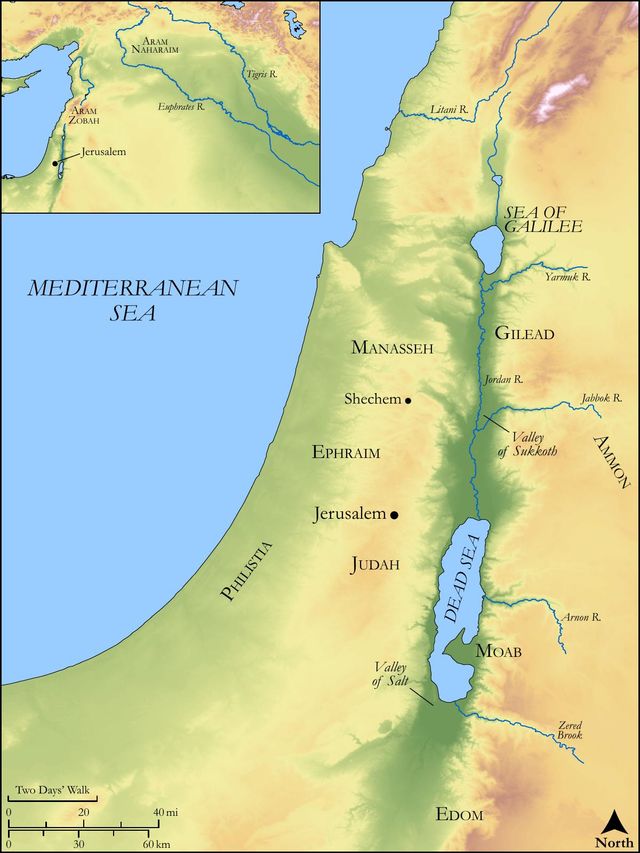
See on the biblical-era map
Study this verse
Public-domain commentary
Matthew Henry
From his Commentary on the Whole Bible. Henry comments on passages, not single verses — this entry covers Psalms 60:1–5. His three-level outline is real structure in the source text, so it is rendered as structure.
The title gives us an account, 1. Of the general design of the psalm. It is Michtam - David's jewel, and it is to teach. The Levites must teach it to the people, and by it teach them both to trust in God and to triumph in him; we must, in it, teach ourselves and one another. In a day of public rejoicing we have need to be taught to direct our joy to God and to terminate it in him, to give none of that praise to the instruments of our deliverance which is due to him only, and to encourage our hopes with our joys. 2. Of the particular occasion of it. It was at a time, (1.) When he was at war with the Syrians, and still had a conflict with them, both those of Mesopotamia and those of Zobah. (2.) When he had gained a great victory over the Edomites, by his forces, under the command of Joab, who had left 12,000 of the enemy dead upon the spot. David has an eye to both these concerns in this psalm: he is in care about his strife with the Assyrians, and in reference to that he prays; he is rejoicing in his success against the Edomites, and in reference to that he triumphs with a holy confidence in God that he would complete the victory. We have our cares at the same time that we have our joys, and they may serve for a balance to each other, that neither may exceed. They may likewise furnish us with matter both for prayer and praise, for both must be laid before God with suitable affections and emotions. If one point be gained, yet in another we are still striving: the Edomites are vanquished, but the Syrians are not; therefore let not him that girds on the harness boast as if he had put it off.
In these verses, which begin the psalm, we have,
I.A melancholy memorial of the many disgraces and disappointments which God had, for some years past, put the people under.
During the reign of Saul, especially in the latter end of it, and during David's struggle with the house of Saul, while he reigned over Judah only, the affairs of the kingdom were much perplexed, and the neighbouring nations were vexatious to them.
1.He complains of hard things which they had seen (that is, which they had suffered), while the Philistines and other ill-disposed neighbours took all advantages against them, Psa 60:3. God sometimes shows even his own people hard things in this world, that they may not take up their rest in it, but may dwell at ease in him only.
2.He owns God's displeasure to be the cause of all the hardships they had undergone: "Thou hast been displeased by us, displeased against us (Psa 60:1), and in thy displeasure hast cast us off and scattered us, hast put us out of thy protection, else our enemies could not have prevailed thus against us. They would never have picked us up and made a prey of us if thou hadst not broken the staff of bands (Zac 11:14) by which we were united, and so scattered us." Whatever our trouble is, and whoever are the instruments of it, we must own the hand of God, his righteous hand, in it.
3.He laments the ill effects and consequences of the miscarriages of the late years. The whole nation was in a convulsion: Thou hast made the earth (or the land) to tremble, Psa 60:2. The generality of the people had dreadful apprehensions of the issue of these things. The good people themselves were in a consternation: "Thou hast made us to drink the wine of astonishment (Psa 60:3); we were like men intoxicated, and at our wits' end, not knowing how to reconcile these dispensations with God's promises and his relation to his people; we are amazed, can do nothing, nor know we what to do." Now this is mentioned here to teach, that is, for the instruction of the people. When God is turning his hand in our favour, it is good to remember our former calamities,
(1.)That we may retain the good impressions they made upon us, and may have them revived. Our souls must still have the affliction and the misery in remembrance, that they may be humbled within us, Lam 3:19, Lam 3:20.
(2.)That God's goodness to us, in relieving us and raising us up, may be more magnified; for it is as life from the dead, so strange, so refreshing. Our calamities serve as foils to our joys.
(3.)That we may not be secure, but may always rejoice with trembling, as those that know not how soon we may be returned into the furnace again, which we were lately taken out of as the silver is when it is not thoroughly refined.
II.A thankful notice of the encouragement God had given them to hope that, though things had been long bad, they would now begin to mend (Psa 60:4): "Thou hast given a banner to those that fear thee (for, as bad as the times are, there is a remnant among us that desire to fear thy name, for whom thou hast a tender concern), that it may be displayed by thee, because of the truth of thy promise which thou wilt perform, and to be displayed by them, in defense of truth and equity," Psa 45:4. This banner was David's government, the establishment and enlargement of it over all Israel. The pious Israelites, who feared God and had a regard to the divine designation of David to the throne, took his elevation as a token for good, and like the lifting up of a banner to them,
1.It united them, as soldiers are gathered together to their colours. Those that were scattered (Psa 60:1), divided among themselves, and so weakened and exposed, coalesced in him when he was fixed upon the throne.
2.It animated them, and put life and courage into them, as the soldiers are animated by the sight of their banner.
3.It struck a terror upon their enemies, to whom they could now hang out a flag of defiance. Christ, the Son of David, is given for an ensign of the people (Isa 11:10), for a banner to those that fear God; in him, as the centre of their unity, they are gathered together in one; to him they seek, in him they glory and take courage. His love is the banner over them; in his name and strength they wage war with the powers of darkness, and under him the church becomes terrible as an army with banners.
III.A humble petition for seasonable mercy.
1.That God would be reconciled to them, though he had been displeased with them. In his displeasure their calamities began, and therefore in his favour their prosperity must begin: O turn thyself to us again! (Psa 60:1) smile upon us, and take part with us; be at peace with us, and in that peace we shall have peace. Tranquillus Deus tranquillat omnia - A God at peace with us spreads peace over all the scene.
2.That they might be reconciled to one another, though they had been broken and wretchedly divided among themselves: "Heal the breaches of our land (Psa 60:2), not only the breaches made upon us by our enemies, but the breaches made among ourselves by our unhappy divisions." Those are breaches which the folly and corruption of man makes, and which nothing but the wisdom and grace of God can make up and repair, by pouring out a spirit of love and peace, by which only a shaken shattered kingdom is set to rights and saved from ruin.
3.That thus they might be preserved out of the hands of their enemies (Psa 60:5): "That thy beloved may be delivered, and not made a prey of, save with thy right hand, with thy own power and by such instruments as thou art pleased to make the men of thy right hand, and hear me." Those that fear God are his beloved; they are dear to him as the apple of his eye. They are often in distress, but they shall be delivered. God's own right hand shall save them; for those that have his heart have his hand. Save them, and hear me. Note, God's praying people may take the general deliverances of the church as answers to their payers in particular. If we improve what interest we have at the throne of grace for blessings for the public, and those blessings be bestowed, besides the share we have with others in the benefit of them we may each of us say, with peculiar satisfaction, "God has therein heard me, and answered me."
Historical interpretation
Two Centuries of Reception
5 surviving comments on this verse. Each one is dated, so this reads as a timeline rather than a list.
Select a marker to jump to its quote. Markers stagger vertically where authors wrote within a few decades of each other.
“Gilead is mine, and Manasseh is mine.” Gilead is a grandson of Manasseh; this is said in order that he may show that the succession of the patriarchs, from whom is descended Christ according to the flesh, comes down from God. “And Ephraim is the support of my head. Judah is my king.” He will join together by agreement the parts that are severed. “Moab is the washbasin of my hope.” Or “a pot for washing,” another of the interpreters says; or “a pot of security”; that is to say, the excommunicated person, who has been forbidden with threats to enter the church of the Lord. For the Moabite and the Ammonite will not enter until the third and until the tenth generation and until everlasting time. Nevertheless, since baptism possesses remission for sins and produces security for the debtors, he, showing the deliverance through baptism and the affection for God, says, “Moab is a pot for washing” or “a pot of security.” Therefore, all “foreigners are made subject,” bowing down under the yoke of Christ; for this reason he will set his shoe in Edom. The shoe of the divinity is the God-bearing flesh, through which he approaches humans. In this hope, pronouncing blessed the time of the coming of the Lord, the prophet says, “Who will bring me into the fortified city.” Perhaps he means the church, a city, indeed, because it is a community governed conformably to laws; and fortified, because of the faith encompassing it. Whence one of the interpreters produced a very clear translation: “Into a city fortified all around.” Who, then, will permit me to see this great spectacle, God living among people? These are the words of the Lord: “Many prophets and just people have longed to see what you see, and they have not seen it.”
Therefore, “O God, you have cast us off.” You have cast off those who in proportion to their sins removed themselves a distance from you. You have destroyed the accumulations of our wickedness, doing good to us because of our weakness. You were angry, since “we were by nature children of wrath,” having no hope and being without God in the world. You had mercy on us when “you sent forth your only-begotten Son as a propitiation for our sins,” in order that in his blood we might find redemption. We would not know that we were having these kindnesses done to us, unless “you have made us drink the wine of sorrow.” By wine he means the words that lead the hardened heart to conscious perception.
The first labour is, that you should be displeasing to yourself, that sins you should battle out, that you should be changed into something better: the second labour, in return for your having been changed, is to bear the tribulations and temptations of this world, and amid them to hold on even unto the end. Of these things therefore when he was speaking, while pointing out such things, he adds what? "You have shown to Your people hard things" [Psalm 60:3]: to Your people now, made tributary after the victory of David. "You have shown to Your people hard things." Wherein? In persecutions which the Church of Christ has endured, when so much blood of martyrs was spilled. "You have given us to drink of the wine of goading." "Of goading" is what? Not of killing. For it was not a killing that destroys, but a medicine that smarts. "You have given us to drink of the wine of goading."
All strangers have stooped and been put under the yoke of Christ, wherefore also “over Edom” does he “cast out” his “shoe.” Now the shoe of the Godhead is the flesh that bore God whereby he came among humankind.
When a person lays aside his past sinfulness, he is suddenly endowed with new dignity, with that cup of divine love of which it is said, “And your cup which inebriated me, how it overflows!” Inebriated with that cup, I repeat, hearts taste the sweetness of heavenly things through the strength of spiritual wisdom. Then they may merit to hear, “Taste and see how good the Lord is.” Now he said “taste,” because love of God can refresh the soul but cannot satisfy the desire, regardless of the amount of faith or longing with which it is sought. More and more, it arouses thirst when it is, as it were, tasted beforehand with the edge of the lips, and for this reason he says of himself, “He who eats of me will hunger still, he who drinks of me will thirst for more.” Because of its sweetness, it arouses an appetite for itself, but it does not cause disgust from satiety. Just as people who are experienced in drinking wine are likely to thirst all the more when they have become drunk, so it is with the devout and chaste soul that is prudent and contrite and that can, therefore, say with the psalmist, “You have given us stupefying wine,” when it has begun to think about hope in a future life and to imbibe a thirst for heavenly goods. It knows how to be filled but not how to be satisfied, so that the more it consumes according to its capacity, the more it lacks in its eagerness, and it can join with the prophet in that word of longing: “My soul pines for your salvation”;4 and again: “My flesh and my heart waste away, O God of my heart”; moreover, “My soul yearns and pines for the courts of the Lord.”
Continue studying Psalms 60:3 across the web’s major study libraries — every link below opens this exact verse, chapter, or book on the destination site.
Read & Compare
 BibleGatewayThis verse in more than 200 translations and 70 languages.
 Bible.comThe YouVersion reader — hundreds of translations, reading plans, and highlights.
 ESV.orgCrossway's official English Standard Version reader.
 NET BibleThe NET translation with 60,000+ translators' notes on every rendering decision.
 STEP BibleTyndale House's free study tool — original text, vocabulary, and scholarly resources.
 BibliaLogos Bible Software's free web reader.
 USCCBThe New American Bible (Revised Edition) with the U.S. bishops' study notes.
Commentaries
 BibleHub CommentariesDozens of classic commentaries on this verse, gathered on one page.
 StudyLightMore than 100 commentary sets — the largest collection on the web.
 BibleRefPlain-English commentary on what this verse means, verse by verse.
 Enduring WordDavid Guzik's free commentary on this chapter, widely used by Bible teachers.
 Bible Study ToolsVerse commentary alongside Greek and Hebrew study aids.
Original Language & Research
- BibleHub InterlinearThe verse word by word — original language, transliteration, and English.
- BibleHub LexiconEvery word's original-language definition and Strong's entry.
 Blue Letter BibleDeep-study tools — Strong's numbers, concordance, and word studies.
 SefariaThe Hebrew text with Rashi and centuries of Jewish commentary.
Sermons, Hymns & Audio


TrulyRandomVerse is not affiliated with these sites and doesn’t control their content. They’re linked because they’re genuinely useful.
Summary
Psalms 60:3 is a poignant lament from the people of Israel, expressing a profound sense of national defeat and divine disfavor. The psalmist attributes the severe hardships and overwhelming disorientation experienced by the nation directly to God's action, portraying their suffering as a bitter, intoxicating drink that leaves them reeling in confusion and despair. This verse vividly captures the raw anguish of a people who perceive themselves as having been abandoned or disciplined by their God, setting the stage for a plea for restoration and renewed divine intervention.
Context
ShowHideLiterary Context
Psalms 60 is a communal lament, traditionally attributed to David, marked by a dramatic shift from expressions of deep distress to a renewed declaration of trust in God's power and promises. The preceding verses (60:1-2) establish the nation's broken state, describing how God has "broken" and "rent" the land, causing it to "tremble." Verse 3 intensifies this imagery by depicting the people's internal experience of this calamity. The "hard things" and "wine of astonishment" are direct consequences of God's perceived rejection, leading into a plea for God to "give a banner to them that fear thee" (60:4) and a subsequent shift towards confidence in God's future deliverance (60:6-12). This structure is characteristic of many Psalms of lament, moving from complaint to petition and ultimately to a renewed posture of faith, as seen in the progression of Psalm 13.
Historical & Cultural Context
The superscription of Psalms 60 provides crucial historical context, linking its composition to a specific period of military conflict: "when he strove with Aram-naharaim and with Aram-zobah, when Joab returned, and smote of Edom in the valley of salt twelve thousand." This refers to David's campaigns against the Arameans and Edomites, as documented in 2 Samuel 8:3-14 and 1 Chronicles 18:3-13. While the superscription mentions a victory over Edom, the psalm itself reflects an initial setback or a period of severe struggle that preceded the ultimate triumph. In ancient Near Eastern cultures, military defeat was often interpreted as a sign of divine disfavor or abandonment. The "wine of astonishment" imagery resonates with the concept of a "cup of wrath" or "cup of staggering" found in prophetic literature, where nations are made to drink from God's judgment, leading to their utter disorientation and ruin, as powerfully depicted in Isaiah 51:17.
Key Themes
ShowHideThis verse powerfully contributes to several key themes within Psalms 60 and the broader Psalter. Firstly, it underscores the theme of Divine Sovereignty in Suffering. The psalmist explicitly states, "Thou hast shewed thy people hard things: thou hast made us to drink the wine of astonishment," directly attributing their distress to God's action. This reflects a deep theological conviction that nothing, not even national calamity, falls outside God's ultimate control, a theme echoed in Job 1:21. Secondly, it highlights the theme of Overwhelming Calamity and Despair. The imagery of "wine of astonishment" vividly conveys a state of utter bewilderment, disorientation, and reeling from the severity of trials, a profound sense of being overwhelmed by adversity. Finally, it exemplifies the Legitimacy of Lament and Honest Expression of Pain. The psalmist does not shy away from expressing the raw pain, confusion, and perceived abandonment, demonstrating that it is permissible and even necessary for God's people to voice their deepest struggles to Him, even when struggling to understand His ways, as also seen in Psalms 44:9-16.
Exposition and Analysis
ShowHideKey Word Analysis
ShowHideA primitive root meaning "to see," but also "to cause to see," "to show," or "to experience." In this context, it implies that God has caused His people to experience or undergo these "hard things." It denotes a direct, albeit perhaps disciplinary, divine action that brings about severe circumstances.
From a root meaning "to be hard, difficult, severe." This adjective describes experiences that are not merely challenging but intensely burdensome, oppressive, and painful. It signifies a state of grievous adversity or harsh treatment, implying a deliberate, though perhaps redemptive, action on God's part that brings about extreme difficulty.
Derived from a root meaning "to reel," "to stagger," or "to tremble." This noun describes a state of profound bewilderment, stupefaction, or giddiness, often induced by a powerful, disorienting force. When paired with "wine," it evokes the image of someone intoxicated to the point of losing their balance, judgment, and comprehension. It signifies a complete loss of composure and understanding in the face of overwhelming, shocking circumstances.
Verse Breakdown
ShowHide"Thou hast shewed thy people hard things:"
This clause immediately establishes God as the active agent behind the nation's suffering. The verb "shewed" (from râʼâh) implies that God has caused or allowed His people to experience these "hard things" directly. It is not an accidental misfortune but a divinely ordained or permitted trial. The "hard things" refer to the severe military defeat and national distress, which are perceived as harsh treatment from God, potentially as a form of discipline or judgment for their sins.
"thou hast made us to drink the wine of astonishment."
This is a powerful metaphorical statement. God is again the active subject, "making" His people drink. The "wine" here is not a symbol of joy or celebration but of a bitter, intoxicating draught of sorrow, confusion, and disorientation. The "wine of astonishment" means they are so overwhelmed by the calamity and its implications that they are left reeling, dazed, and utterly bewildered, unable to comprehend or respond effectively to their situation, much like someone drunk and staggering. This imagery emphasizes the depth of their despair and the shattering impact of their trials.
Literary Devices
ShowHideThe verse employs several potent Literary Devices to convey its message of profound suffering. The most prominent is Metaphor, particularly in the phrase "the wine of astonishment." Here, the abstract concept of overwhelming disorientation and despair is concretely represented as a bitter, intoxicating drink, allowing the reader to viscerally grasp the depth of the nation's dazed and reeling state. This is a specific type of Cup Imagery, prevalent in biblical literature, where a cup often symbolizes a portion or destiny, frequently of divine judgment or wrath. Furthermore, the psalmist uses Anthropomorphism by attributing human actions to God – "Thou hast shewed" and "thou hast made us to drink." While God does not literally "show" or "make one drink" in a human sense, these phrases convey His direct and sovereign involvement in the nation's experience of hardship. The intense language also hints at Hyperbole or Intensification, emphasizing the extreme nature of the suffering and the profound impact it has had on the people, leaving them utterly staggered.
Theological and Thematic Connections
ShowHidePsalms 60:3 presents a stark theological reality: God's people can and do experience profound suffering, and sometimes, this suffering is directly attributed to God's sovereign hand. This does not necessarily imply divine malice but rather God's ultimate control over all circumstances, including those that serve His purposes of discipline, purification, or drawing His people closer to Him. The "wine of astonishment" speaks to the bewildering nature of such trials, where human understanding fails, and the very foundations of security seem to crumble. Yet, within the context of lament, this honest expression of pain is a legitimate form of prayer, acknowledging God's power even in His perceived absence or judgment, and ultimately laying the groundwork for a renewed plea for His intervention and restoration.
Reflection and Application
ShowHidePsalms 60:3 offers a profound space for reflection on the nature of suffering in the life of faith. It reminds us that even for God's chosen people, life is not immune to "hard things" and moments where we feel utterly overwhelmed, as if drinking a bitter, disorienting draught. This verse validates the human experience of confusion and despair in the face of adversity, assuring us that it is not unspiritual to acknowledge our pain and even our bewilderment to God. Rather, it invites us into a deeper trust that even when God seems to be the one "showing" us hard things or "making us drink" bitter wine, His ultimate purposes are always redemptive. It encourages us to bring our raw, honest lament before Him, confident that He hears and cares, and that even from the depths of astonishment, hope for His restoration can emerge, as it does later in Psalm 60.
Questions for Reflection
ShowHideFAQ
ShowHideDoes God cause suffering, as implied by "Thou hast shewed thy people hard things"?
ShowHideThe biblical perspective on God's relationship to suffering is complex. While God is sovereign over all things, including the permission of suffering, the Bible distinguishes between direct causation, allowing, and using suffering for His purposes. In Psalms 60:3, the language "Thou hast shewed" and "thou hast made us to drink" emphasizes God's ultimate control and agency, reflecting the ancient Israelite understanding that nothing happened outside of God's purview. This doesn't necessarily mean God directly inflicts every pain, but that He is ultimately in control and can use even difficult circumstances for His redemptive purposes, such as discipline, refinement, or to draw His people back to Himself (Hebrews 12:5-11). It highlights His sovereignty rather than His malevolence.
What is the significance of the "wine of astonishment" imagery?
ShowHideThe "wine of astonishment" is a powerful metaphor for a state of profound disorientation, confusion, and despair. It signifies being so overwhelmed by calamity or divine judgment that one is left reeling, staggering, and unable to comprehend or effectively respond to their circumstances, much like someone intoxicated to the point of losing their balance and senses. This imagery is found elsewhere in scripture, often in prophetic contexts, to describe a "cup of wrath" or "cup of staggering" that nations are made to drink as a consequence of their sin or God's judgment (e.g., Jeremiah 25:15-16 and Revelation 14:10). It vividly conveys the shattering impact of severe adversity.
Christ-Centered Fulfillment
ShowHideThe "wine of astonishment" and the "hard things" described in Psalms 60:3 find their ultimate and most profound fulfillment in the person and work of Jesus Christ. While the psalmist laments a cup of national calamity and bewilderment, the New Testament reveals that Jesus Himself drank the ultimate "cup" – the cup of God's righteous wrath against sin. In the Garden of Gethsemane, Jesus prayed, "O my Father, if it be possible, let this cup pass from me: nevertheless not as I will, but as thou wilt" (Matthew 26:39). This "cup" was not merely physical suffering, but the agonizing experience of bearing the full weight of humanity's sin and enduring the divine judgment that we deserved. He was "made... to drink the wine of astonishment" as He became sin for us (2 Corinthians 5:21), experiencing the ultimate spiritual abandonment on the cross when He cried out, "My God, my God, why hast thou forsaken me?" (Matthew 27:46). By drinking this bitter cup, Jesus transformed its meaning for His people. Through His suffering, death, and resurrection, He offers us a new cup – the cup of salvation and the new covenant in His blood (Luke 22:20), ensuring that those who trust in Him will never have to drink the "wine of astonishment" that is God's wrath, but instead receive the "Spirit of adoption, whereby we cry, Abba, Father" (Romans 8:15).