


2 Chronicles 28:18
Bible text: King James Version (1769 Blayney text) · Public domain
Bible text: King James Version with Strong's numbers · Public domain
Bible text: Berean Standard Bible · Public domain
Bible text: American Standard Version (1901) · Public domain
Bible text: World English Bible, Messianic edition · Public domain
Bible text: Geneva Bible (1599) · Public domain
Bible text: Young's Literal Translation · Public domain
- וּפְלִשְׁתִּיםu·fe·lish·Timand [the] PhilistinesH6430Conj-w ¦ N-mpNoun Gentilic Plural Masculine Absoluteוּandפְלִשְׁתִּים[the] Philistines
- פָּשְׁטוּpa·she·Tuthey had made a raidH6584V-Qal-Perf-3cpVerb Qal Perfect 3rd Plural common gender
- בְּעָרֵיbe·'a·Reion [the] cities ofH5892Prep-b ¦ N-mpcNoun Plural Masculine Constructבְּonעָרֵי[the] cities of
- הַשְּׁפֵלָהha·she·fe·Lahthe ShephelahH8219Art ¦ N-fsNoun Singular Feminine AbsoluteהַtheשְּׁפֵלָהShephelah
- וְהַנֶּגֶבve·ha·ne·Gevand the NegevH5045Conj-w ¦ Art ¦ N-properNoun Proper LocationוְandהַtheנֶּגֶבNegev
- לִיהוּדָהli·hu·Dahof JudahH3063Prep-l ¦ N-properNoun Proper LocationלִofיהוּדָהJudah
- וַיִּלְכְּדוּVai·yil·ke·duand they had capturedH3920Conj-w ¦ V-Qal-ConsecImperf-3mpVerb Qal Consecutive Imperfect 3rd Plural Masculineוַandיִּלְכְּדוּthey had captured
- אֶת'et<obj.>H853DirObjMParticle Object Indicator
- בֵּיתbeitBethH1053N-properNoun Proper Location
- שֶׁמֶשׁShe·meshShemeshH1053N-properNoun Proper Location
- וְאֶתve·'Etand <obj.>H853Conj-w ¦ DirObjMParticle Object Indicatorוְandאֶת<obj.>
- אַיָּלוֹן'ai·ya·LonAijalonH357N-properNoun Proper Location
- וְאֶתve·'Etand <obj.>H853Conj-w ¦ DirObjMParticle Object Indicatorוְandאֶת<obj.>
- הַגְּדֵרוֹתha·ge·de·Rot<the> GederothH1450Art ¦ N-properNoun Proper Locationהַ<the>גְּדֵרוֹתGederoth
- וְאֶתve·'Etand <obj.>H853Conj-w ¦ DirObjMParticle Object Indicatorוְandאֶת<obj.>
- שׂוֹכוֹso·KhoSocohH7755N-properNoun Proper Location
- וּבְנוֹתֶיהָu·ve·no·Tei·haand its daughtersH1323Conj-w ¦ N-fpc ¦ 3fsNoun Plural Feminine Constructוּandבְנוֹתֶיdaughtersהָits
- וְאֶתve·'Etand <obj.>H853Conj-w ¦ DirObjMParticle Object Indicatorוְandאֶת<obj.>
- תִּמְנָהtim·NahTimnahH8553N-properNoun Proper Location
- וּבְנוֹתֶיהָu·ve·no·Tei·haand its daughtersH1323Conj-w ¦ N-fpc ¦ 3fsNoun Plural Feminine Constructוּandבְנוֹתֶיdaughtersהָits
- וְאֶתve·'Etand <obj.>H853Conj-w ¦ DirObjMParticle Object Indicatorוְandאֶת<obj.>
- גִּמְזוֹgim·ZoGimzoH1579N-properNoun Proper Location
- וְאֶתve·'Etand <obj.>H853Conj-w ¦ DirObjMParticle Object Indicatorוְandאֶת<obj.>
- בְּנֹתֶיהָbe·no·Tei·haits daughtersH1323N-fpc ¦ 3fsNoun Plural Feminine Constructבְּנֹתֶיdaughtersהָits
- וַיֵּשְׁבוּvai·ye·she·Vuand they dweltH3427Conj-w ¦ V-Qal-ConsecImperf-3mpVerb Qal Consecutive Imperfect 3rd Plural Masculineוַandיֵּשְׁבוּthey dwelt
- שָׁםShamthereH8033AdvAdverb
English is a literal word-by-word gloss of the Hebrew, not the KJV's wording. Why?
This is the original text the KJV's translators worked from — each Hebrew word with its own literal English meaning in this verse, prepared by scholars at Tyndale House, Cambridge. The KJV translates whole sentences, not word by word, so its wording differs: one Hebrew word can become several English words, and the KJV may choose “the LORD” where the gloss reads “Yahweh”. Both are faithful — they answer different questions. For the KJV's own rendering, switch to the KJV text.
Details
See on the biblical-era maps
Study this verse
Public-domain commentary
Matthew Henry
From his Commentary on the Whole Bible. Henry comments on passages, not single verses — this entry covers 2 Chronicles 28:16–27. His three-level outline is real structure in the source text, so it is rendered as structure.
Here is, I. The great distress which the kingdom of Ahaz was reduced to for his sin. In general, 1. The Lord brought Judah low, Ch2 28:19. They had lately been very high in wealth and power; but God found means to bring them down, and make them as despicable as they had been formidable. Those that will not humble themselves under the word of God will justly be humbled by his judgments. Iniquity brings men low, Psa 106:43. 2. Ahaz made Judah naked. As his sin debased them, so it exposed them. It made them naked to their shame; for it exposed them to contempt, as a man unclothed. It made them naked to their danger; for it exposed them to assaults, as a man unarmed, Exo 32:25. Sin strips men. In particular, the Edomites, to be revenged for Amaziah's cruel treatment of them (Ch2 25:12), smote Judah, and carried off many captives, Ch2 28:17. The Philistines also insulted them, took and kept possession of several cities and villages that lay near them (Ch2 28:18), and so they were revenged for the incursions which Uzziah had made upon them, Ch2 26:6. And, to show that it was purely the sin of Ahaz that brought the Philistines upon his country, in the very year that he died the prophet Isaiah foretold the destruction of the Philistines by his son, Isa 14:28, Isa 14:29.
II.The addition which Ahaz made both to the national distress and the national guilt.
1.He added to the distress, by making court to strange kings, in hopes they would relieve him. When the Edomites and Philistines were vexatious to him, he sent to the kings of Assyria to help him (Ch2 28:16); for he found his own kingdom weakened and made naked, and he could not put any confidence in God, and therefore was at a vast expense to get an interest in the king of Assyria. He pillaged the house of God, and the king's house, and squeezed the princes for money to hire these foreign forces into his service, Ch2 28:21. Though he had conformed to the idolatry of the heathen nations, his neighbours, they did not value him for that, nor love him the better, nor did his compliance, by which he lost God, gain them, nor could he make any interest in them, but with his money. It is often found that wicked men themselves have no real affection for those that revolt to them, nor do they care to do them a kindness. A degenerate branch is looked upon, on all sides, as an abominable branch, Isa 14:19. But what did Ahaz get by the king of Assyria? Why, he came to him, but he distressed him, and strengthened him not (Ch2 28:20), helped him not, Ch2 28:21. The forces of the Assyrian quartered upon his country, and so impoverished and weakened it; they grew insolent and imperious, and created him a great deal of vexation, like a broken reed, which not only fails, but pierces the hand.
2.He added to the guilt, by making court to strange gods, in hopes they would relieve him. In his distress, instead of repenting of his idolatry, which he had reason enough to see the folly of, he trespassed yet more (Ch2 28:22), was more mad than ever upon his idols. A brand of infamy is here set upon him for it: This is that king Ahaz, that wretched man, who was the scandal of the house of David and the curse and plague of his generation. Note, Those are wicked and vile indeed that are made worse by their afflictions, instead of being made better by them, who in their distress trespass yet more, have their corruptions exasperated by that which should mollify them, and their hearts more fully set in them to do evil. Let us see what his trespass was.
(1.)He abused the house of God; for he cut in pieces the vessels of it, that the priests might not perform the service of the temple, or not as it should be performed, for want of vessels; and, at length, he shut up the doors, that the people might not attend it, Ch2 28:24. This was worse than the worst of the kings before him had done.
(2.)He confronted the altar of God, for he made himself altars in every corner of Jerusalem; so that, as the prophet speaks, they were like heaps in the furrows of the fields, Hos 12:11. And in the cities of Judah, either by his power or by his purse, perhaps by both, he erected high places for the people to burn incense to what idols they pleased, as if on purpose to provoke the God of his fathers, Ch2 28:25.
(3.)He cast off God himself; for he sacrificed to the gods of Damascus (Ch2 28:23), not because he loved them, for he thought they smote him; but because he feared them, thinking that they helped his enemies, and that, if he could bring them into his interest, they would help him. Foolish man! It was his own God that smote him and strengthened the Syrians against him, not the gods of Damascus; had he sacrificed to him, and to him only, he would have helped him. But no marvel that men's affections and devotions are misplaced when they mistake the author of their trouble and their help. And what comes of it? The gods of Syria befriend Ahaz no more than the kings of Assyria did; they were the ruin of him and of all Israel. This sin provoked God to bring judgments upon them, to cut him off in the midst of his days, when he was but thirty-six years old; and it debauched the people so that the reformation of the next reign could not prevail to cure them of their inclination to idolatry, but they retained that root of bitterness till the captivity in Babylon plucked it up.
The chapter concludes with the conclusion of the reign of Ahaz, Ch2 28:26, Ch2 28:27. For aught that appears, he died impenitent, and therefore died inglorious; for he was not buried in the sepulchres of the kings. Justly was he thought unworthy to be laid among them who was so unlike them - to be buried with kings who had used his kingly power for the destruction of the church and not for its protection or edification.
Continue studying 2 Chronicles 28:18 across the web’s major study libraries — every link below opens this exact verse, chapter, or book on the destination site.
Read & Compare
 BibleGatewayThis verse in more than 200 translations and 70 languages.
 Bible.comThe YouVersion reader — hundreds of translations, reading plans, and highlights.
 ESV.orgCrossway's official English Standard Version reader.
 NET BibleThe NET translation with 60,000+ translators' notes on every rendering decision.
 STEP BibleTyndale House's free study tool — original text, vocabulary, and scholarly resources.
 BibliaLogos Bible Software's free web reader.
 USCCBThe New American Bible (Revised Edition) with the U.S. bishops' study notes.
Commentaries
 BibleHub CommentariesDozens of classic commentaries on this verse, gathered on one page.
 StudyLightMore than 100 commentary sets — the largest collection on the web.
 BibleRefPlain-English commentary on what this verse means, verse by verse.
 Enduring WordDavid Guzik's free commentary on this chapter, widely used by Bible teachers.
 Bible Study ToolsVerse commentary alongside Greek and Hebrew study aids.
Original Language & Research
- BibleHub InterlinearThe verse word by word — original language, transliteration, and English.
- BibleHub LexiconEvery word's original-language definition and Strong's entry.
 Blue Letter BibleDeep-study tools — Strong's numbers, concordance, and word studies.
 SefariaThe Hebrew text with Rashi and centuries of Jewish commentary.
Sermons, Hymns & Audio


TrulyRandomVerse is not affiliated with these sites and doesn’t control their content. They’re linked because they’re genuinely useful.
Summary
Second Chronicles 28:18 powerfully depicts the dire consequences of King Ahaz's profound apostasy and Judah's widespread unfaithfulness, detailing a devastating Philistine invasion. This incursion seized numerous strategically vital cities and their surrounding villages in the low country and southern regions of Judah, underscoring the comprehensive divine judgment against a kingdom that had forsaken its covenant with the Lord, leaving it profoundly vulnerable and diminished.
Context
ShowHideLiterary Context
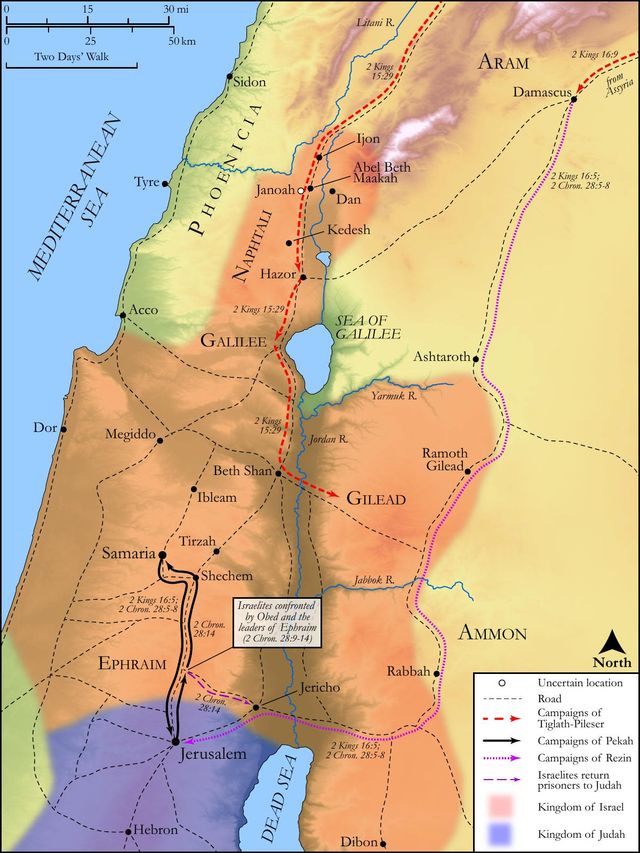
This verse is intricately woven into the grim narrative of King Ahaz's reign in 2 Chronicles 28, a period characterized by deep spiritual decline and escalating divine judgment. The chapter opens by establishing Ahaz's egregious wickedness, highlighting his adoption of detestable pagan practices, including the horrific act of child sacrifice, which profoundly provoked the Lord's wrath (2 Chronicles 28:1-4). As a direct and immediate consequence of this covenant infidelity, God delivered Judah into the hands of its enemies. Prior to the Philistine invasion described in verse 18, Judah had already suffered a crushing defeat by the Arameans (Syrians), who carried away many captives to Damascus (2 Chronicles 28:5). Immediately following this, the northern kingdom of Israel, under Pekah, inflicted an even more devastating blow, killing 120,000 Judean soldiers in a single day and taking 200,000 women, sons, and daughters captive to Samaria, though these captives were later released due to prophetic intervention (2 Chronicles 28:6-15). The Philistine invasion in verse 18 thus represents a third, concurrent wave of judgment, demonstrating the comprehensive and relentless nature of God's discipline and Judah's utter vulnerability when divine protection was withdrawn.
Historical & Cultural Context
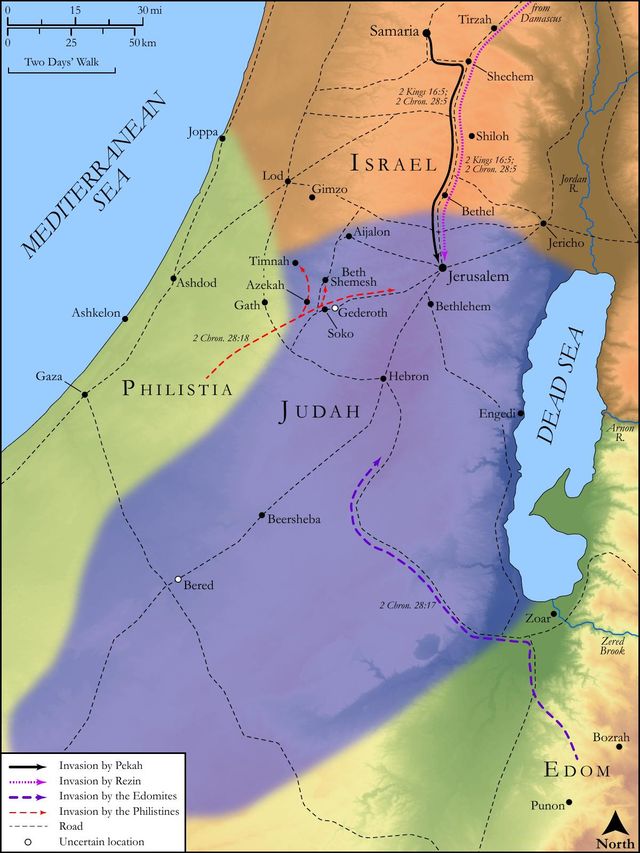
The "low country" (Hebrew: Shephelah) referenced in the verse denotes a distinct geographical region of rolling hills and fertile valleys, strategically positioned between the central Judean mountains and the Mediterranean coastal plain. This area was historically vital, functioning as a natural buffer zone and a frequent battleground between Judah and its western neighbors, the Philistines. The Philistines were a formidable and enduring adversary of Israel, originating from the Aegean Sea region and settling in the southwestern coastal plain of Canaan. Their military prowess and persistent presence had been a constant source of conflict since the era of the Judges and the early monarchy (Judges 3:3; 1 Samuel 4). The specific cities enumerated—Bethshemesh, Ajalon, Gederoth, Shocho, Timnah, and Gimzo—were all situated within or bordering the Shephelah and the southern territories of Judah. Their capture signifies a deep and alarming penetration into Judean heartland, far beyond mere border skirmishes. Culturally, the loss of these ancestral cities would have been a profound humiliation and a severe blow to Judah's economy, national pride, and sense of security. The phrase "they dwelt there" is particularly significant, indicating a sustained occupation rather than a fleeting raid, thereby emphasizing Judah's diminished sovereignty and the profound depth of its national crisis.
Key Themes
ShowHideThe Philistine invasion described in 2 Chronicles 28:18 powerfully illustrates several foundational themes prevalent throughout the book of Chronicles and the broader Old Testament narrative. Foremost is the theme of Divine Judgment, where God actively intervenes in human history to discipline His people for their unfaithfulness. Ahaz's persistent idolatry and deliberate rejection of the Lord's covenant directly led to this widespread suffering, demonstrating that God's covenant promises included both blessings for obedience and severe curses for disobedience (Deuteronomy 28:15-68). This episode also highlights the Vulnerability of Unfaithfulness; when Judah abandoned God, they forfeited His divine protection, becoming susceptible to their traditional and formidable enemies. The Philistines, who had been decisively subdued by earlier righteous kings like David (2 Samuel 8:1), now reasserted their dominance, underscoring that true security stemmed from a right relationship with God, not from military strength or political maneuvering alone. Furthermore, the Loss of Territory and Sovereignty is a prominent theme, as the capture of these strategic cities symbolized Judah's diminishing control and prestige. The very land promised by God was being taken away due to their sin, a stark reversal of the covenant blessings. Finally, the Persistence of Enemies is evident, as the Philistines, a recurring antagonist throughout Israel's history, remained ever-present and ready to exploit any sign of weakness or spiritual compromise in God's people.
Exposition and Analysis
ShowHideKey Word Analysis
ShowHideThis primitive root signifies "to spread out" in a hostile array, implying a forceful, aggressive incursion. It goes beyond a mere entry, denoting a military deployment with the intent to conquer, plunder, and occupy. In this context, it vividly portrays the violent and unwelcome nature of the Philistine advance, emphasizing that their presence was an act of war designed to seize territory and resources.
This term refers to the geographical region known as the Shephelah, a distinct lowland area comprising the maritime slope of Palestine. Its strategic significance lies in its position as a transitional zone between the coastal plain (Philistine territory) and the Judean highlands. The Philistines frequently contested control of the Shephelah, and its capture here signifies a deep penetration into Judah's heartland, indicating a severe and critical loss of vital territory.
This root word, meaning "to sit down" or "to remain," carries the strong implication of establishing a permanent presence or occupation. It indicates that the Philistines did not merely raid and withdraw, but settled in the captured cities. This signifies a lasting occupation and a profound, sustained loss of sovereignty for Judah over these territories, highlighting the long-term and devastating consequences of Ahaz's unfaithfulness.
Verse Breakdown
ShowHide"The Philistines also had invaded the cities of the low country, and of the south of Judah"
This initial clause clearly identifies the aggressors as the Philistines and their action as a hostile invasion. It specifies the broad geographical scope of their conquest, targeting the "low country" (Shephelah) and the "south of Judah." These were not peripheral areas but strategically vital regions for defense, agriculture, and trade, signaling a significant and damaging blow to Judah's territorial integrity and national security.
"and had taken Bethshemesh, and Ajalon, and Gederoth, and Shocho with the villages thereof, and Timnah with the villages thereof, Gimzo also and the villages thereof"
This detailed enumeration provides concrete evidence of the depth and breadth of the Philistine incursion. The listed cities—Bethshemesh, Ajalon, Gederoth, Shocho, Timnah, and Gimzo—were not minor outposts but historically significant locations, some with deep biblical connections. Their capture underscores the severe loss of control and the extensive nature of Judah's vulnerability. The repeated phrase "with the villages thereof" further emphasizes the comprehensive nature of the conquest, indicating that not only the urban centers but also their surrounding agricultural lands and rural populations were subjugated.
"and they dwelt there"
This concluding clause confirms the lasting impact and severity of the invasion. It signifies that the Philistines did not merely conduct a temporary raid for plunder but established a permanent presence in these captured territories. This denotes a sustained occupation, a profound loss of sovereignty for Judah, and a tangible manifestation of divine judgment, as the very land that God had graciously given to His people was now under the enduring control of their traditional enemies.
Literary Devices
ShowHideThe verse primarily employs Geographical Specificity and Enumeration to powerfully convey the overwhelming extent of Judah's calamity. By explicitly listing numerous cities such as Bethshemesh, Ajalon, Gederoth, Shocho, Timnah, and Gimzo, the Chronicler provides concrete, verifiable evidence of the deep Philistine penetration into Judean territory. This detailed geographical data is not merely informative but serves to underscore the profound loss of territory and sovereignty for Judah. The repeated phrase "with the villages thereof" further amplifies the comprehensive nature of the conquest, highlighting that not only the urban centers but also their surrounding agricultural and rural areas were lost. This precise detailing intensifies the sense of devastation and the dire state of King Ahaz's kingdom, serving as a stark and undeniable illustration of the devastating consequences of unfaithfulness to God.
Theological and Thematic Connections
ShowHide2 Chronicles 28:18 serves as a profound theological statement regarding the direct correlation between national righteousness and divine protection, and conversely, between apostasy and vulnerability. The Philistine invasion is not presented as a random geopolitical event but as a deliberate act of divine judgment, a direct consequence of King Ahaz's profound idolatry and Judah's widespread unfaithfulness to the covenant. This passage powerfully reinforces the Old Testament principle that God holds His people accountable for their actions, and that turning away from Him inevitably results in the withdrawal of His protective hand, leaving them exposed to their enemies and suffering the consequences. It underscores the timeless truth that true security, prosperity, and national flourishing are rooted in obedience and steadfast faithfulness to the Lord, not in human strength, political alliances, or geographical advantage.
Reflection and Application
ShowHideThis historical account from 2 Chronicles 28:18 offers a sobering mirror for contemporary reflection, reminding us that spiritual unfaithfulness has tangible and often devastating consequences. Just as Judah's abandonment of God led to external pressures, military defeats, and the loss of precious territory, so too can individuals and communities today experience various forms of "invasion" or vulnerability when they neglect their covenant relationship with God. This might manifest as a loss of inner peace, moral clarity, relational harmony, spiritual vitality, or even physical well-being. The passage calls us to a deep and honest self-examination: where have we, individually or corporately, allowed idols—whether material possessions, worldly ambitions, self-reliance, or even good things elevated to ultimate things—to creep into our lives, displacing God from His rightful, supreme place? Are we relying on our own strength, wisdom, or resources rather than placing our trust firmly and solely in the Lord? The security, flourishing, and true freedom we deeply desire are found not in external circumstances or human defenses, but in a steadfast, obedient, and intimate walk with God. This verse compels us to humbly return to Him, to repent of our unfaithfulness, and to consciously re-establish Him as the supreme authority and unfailing protector of our lives.
Questions for Reflection
ShowHideFAQ
ShowHideWhat was the significance of the Philistine invasion in the context of King Ahaz's reign?
ShowHideThe Philistine invasion described in 2 Chronicles 28:18 was profoundly significant as it represented a direct and severe consequence of King Ahaz's profound unfaithfulness and Judah's widespread idolatry. Ahaz had deliberately turned away from the Lord, introducing pagan altars, engaging in detestable practices, and even sacrificing his own children (2 Chronicles 28:3). In response to this egregious sin, God withdrew His protective hand, allowing Judah to be attacked and severely weakened by multiple enemies. The Philistine incursion was not an isolated event but followed devastating defeats by the Arameans and the northern kingdom of Israel (2 Chronicles 28:5-8). The loss of strategic cities in the Shephelah (low country) and southern Judah to the Philistines further compounded Judah's misery and humiliation, demonstrating the comprehensive nature of God's judgment and the kingdom's utter vulnerability when it abandoned its covenant with Him. It underscored the crucial theological principle that true security, prosperity, and national integrity for God's people are contingent upon their faithfulness and obedience to Him.
Christ-Centered Fulfillment
ShowHideWhile 2 Chronicles 28:18 vividly portrays the devastating consequences of unfaithfulness and the vulnerability of a people without divine protection, it also subtly points forward to the ultimate fulfillment found in Christ. The lost territory and the oppressive presence of enemies in Judah under Ahaz foreshadow the greater spiritual bondage of all humanity to sin and death, and the dominion of unseen spiritual adversaries (Ephesians 6:12). Just as Judah desperately needed a deliverer from its physical enemies and internal corruption, humanity in its fallen state desperately needed rescue from the pervasive "invasion" of sin that holds all captive. Jesus Christ, the true King and ultimate Son of David, does not merely regain lost physical territory but decisively conquers the spiritual enemies that hold humanity captive—Satan, sin, and death (Colossians 2:15; Hebrews 2:14-15). He establishes a kingdom that is not of this world, a spiritual dominion where His followers find true security, eternal peace, and freedom, no longer vulnerable to the schemes of the enemy if they remain faithful to Him (John 18:36; Romans 8:37-39). In Christ, the judgment for unfaithfulness is borne by the Lamb of God, and the promise of ultimate restoration, eternal dwelling in God's presence, and a new heaven and new earth is secured, far surpassing any earthly territorial loss or gain (Revelation 21:3-4).