


2 Chronicles 28:21
Bible text: King James Version (1769 Blayney text) · Public domain
Bible text: King James Version with Strong's numbers · Public domain
Bible text: Berean Standard Bible · Public domain
Bible text: American Standard Version (1901) · Public domain
Bible text: World English Bible, Messianic edition · Public domain
Bible text: Geneva Bible (1599) · Public domain
Bible text: Young's Literal Translation · Public domain
- כִּיkiforH3588PrtParticle Conditional
- חָלַקcha·Lakhe had plunderedH2505V-Qal-Perf-3msVerb Qal Perfect 3rd Singular Masculine
- אָחָז'a·ChazAhazH271N-proper-mNoun Proper Masculine
- אֶת'et<obj.>H853DirObjMParticle Object Indicator
- בֵּיתbeit[the] house ofH1004N-mscNoun Singular Masculine Construct
- יְהוָהYah·wehYahwehH3068N-properNoun Proper Title
- וְאֶתve·'Etand <obj.>H853Conj-w ¦ DirObjMParticle Object Indicatorוְandאֶת<obj.>
- בֵּיתbeit[the] house ofH1004N-mscNoun Singular Masculine Construct
- הַמֶּלֶךְha·Me·lekhthe kingH4428Art ¦ N-msNoun Singular Masculine Absoluteהַtheמֶּלֶךְking
- וְהַשָּׂרִיםve·ha·sa·Rimand the officialsH8269Conj-w ¦ Art ¦ N-mpNoun Plural Masculine Absoluteוְandהַtheשָּׂרִיםofficials
- וַיִּתֵּןvai·yi·Tenand he had givenH5414Conj-w ¦ V-Qal-ConsecImperf-3msVerb Qal Consecutive Imperfect 3rd Singular Masculineוַandיִּתֵּןhe had given
- לְמֶלֶךְle·Me·lekhto [the] king ofH4428Prep-l ¦ N-mscNoun Singular Masculine Constructלְtoמֶלֶךְ[the] king of
- אַשּׁוּר'a·ShurAssyriaH804N-properNoun Proper Location
- וְלֹאve·Lo'and notH3808Conj-w ¦ NegParticle Negativeוְandלֹאnot
- לְעֶזְרָהle·'ez·Rahfor helpH5833Prep-l ¦ N-fsNoun Singular Feminine Absoluteלְforעֶזְרָהhelp
- לוֹlofor himPrep-l ¦ 3msSuffix Personal 3rd Singular Masculineלforוֹhim
English is a literal word-by-word gloss of the Hebrew, not the KJV's wording. Why?
This is the original text the KJV's translators worked from — each Hebrew word with its own literal English meaning in this verse, prepared by scholars at Tyndale House, Cambridge. The KJV translates whole sentences, not word by word, so its wording differs: one Hebrew word can become several English words, and the KJV may choose “the LORD” where the gloss reads “Yahweh”. Both are faithful — they answer different questions. For the KJV's own rendering, switch to the KJV text.
Details
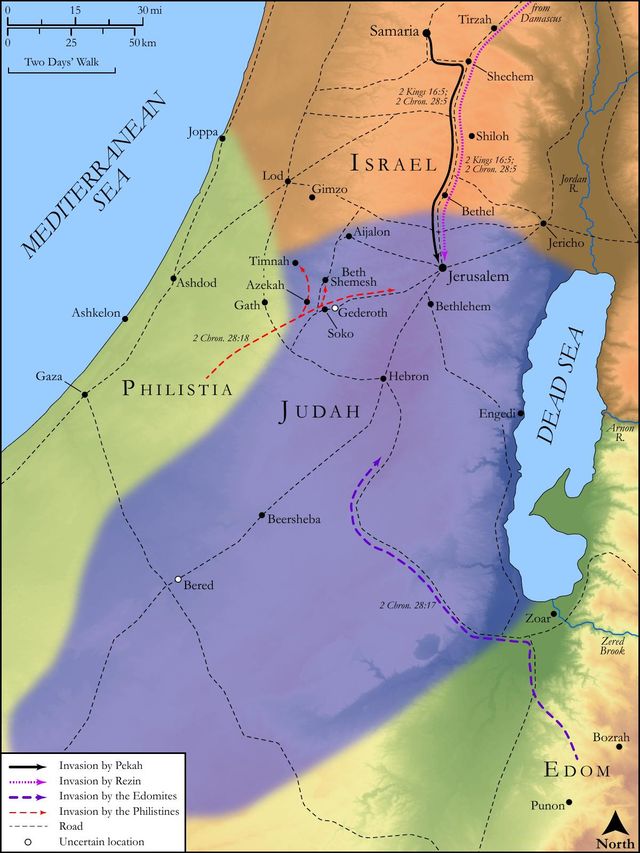
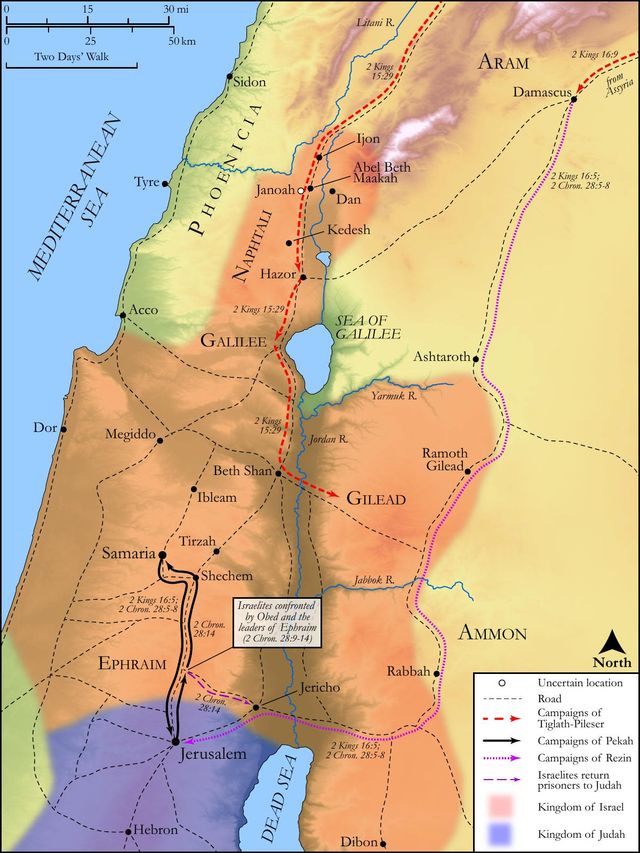
See on the biblical-era maps
Study this verse
Public-domain commentary
Matthew Henry
From his Commentary on the Whole Bible. Henry comments on passages, not single verses — this entry covers 2 Chronicles 28:16–27. His three-level outline is real structure in the source text, so it is rendered as structure.
Here is, I. The great distress which the kingdom of Ahaz was reduced to for his sin. In general, 1. The Lord brought Judah low, Ch2 28:19. They had lately been very high in wealth and power; but God found means to bring them down, and make them as despicable as they had been formidable. Those that will not humble themselves under the word of God will justly be humbled by his judgments. Iniquity brings men low, Psa 106:43. 2. Ahaz made Judah naked. As his sin debased them, so it exposed them. It made them naked to their shame; for it exposed them to contempt, as a man unclothed. It made them naked to their danger; for it exposed them to assaults, as a man unarmed, Exo 32:25. Sin strips men. In particular, the Edomites, to be revenged for Amaziah's cruel treatment of them (Ch2 25:12), smote Judah, and carried off many captives, Ch2 28:17. The Philistines also insulted them, took and kept possession of several cities and villages that lay near them (Ch2 28:18), and so they were revenged for the incursions which Uzziah had made upon them, Ch2 26:6. And, to show that it was purely the sin of Ahaz that brought the Philistines upon his country, in the very year that he died the prophet Isaiah foretold the destruction of the Philistines by his son, Isa 14:28, Isa 14:29.
II.The addition which Ahaz made both to the national distress and the national guilt.
1.He added to the distress, by making court to strange kings, in hopes they would relieve him. When the Edomites and Philistines were vexatious to him, he sent to the kings of Assyria to help him (Ch2 28:16); for he found his own kingdom weakened and made naked, and he could not put any confidence in God, and therefore was at a vast expense to get an interest in the king of Assyria. He pillaged the house of God, and the king's house, and squeezed the princes for money to hire these foreign forces into his service, Ch2 28:21. Though he had conformed to the idolatry of the heathen nations, his neighbours, they did not value him for that, nor love him the better, nor did his compliance, by which he lost God, gain them, nor could he make any interest in them, but with his money. It is often found that wicked men themselves have no real affection for those that revolt to them, nor do they care to do them a kindness. A degenerate branch is looked upon, on all sides, as an abominable branch, Isa 14:19. But what did Ahaz get by the king of Assyria? Why, he came to him, but he distressed him, and strengthened him not (Ch2 28:20), helped him not, Ch2 28:21. The forces of the Assyrian quartered upon his country, and so impoverished and weakened it; they grew insolent and imperious, and created him a great deal of vexation, like a broken reed, which not only fails, but pierces the hand.
2.He added to the guilt, by making court to strange gods, in hopes they would relieve him. In his distress, instead of repenting of his idolatry, which he had reason enough to see the folly of, he trespassed yet more (Ch2 28:22), was more mad than ever upon his idols. A brand of infamy is here set upon him for it: This is that king Ahaz, that wretched man, who was the scandal of the house of David and the curse and plague of his generation. Note, Those are wicked and vile indeed that are made worse by their afflictions, instead of being made better by them, who in their distress trespass yet more, have their corruptions exasperated by that which should mollify them, and their hearts more fully set in them to do evil. Let us see what his trespass was.
(1.)He abused the house of God; for he cut in pieces the vessels of it, that the priests might not perform the service of the temple, or not as it should be performed, for want of vessels; and, at length, he shut up the doors, that the people might not attend it, Ch2 28:24. This was worse than the worst of the kings before him had done.
(2.)He confronted the altar of God, for he made himself altars in every corner of Jerusalem; so that, as the prophet speaks, they were like heaps in the furrows of the fields, Hos 12:11. And in the cities of Judah, either by his power or by his purse, perhaps by both, he erected high places for the people to burn incense to what idols they pleased, as if on purpose to provoke the God of his fathers, Ch2 28:25.
(3.)He cast off God himself; for he sacrificed to the gods of Damascus (Ch2 28:23), not because he loved them, for he thought they smote him; but because he feared them, thinking that they helped his enemies, and that, if he could bring them into his interest, they would help him. Foolish man! It was his own God that smote him and strengthened the Syrians against him, not the gods of Damascus; had he sacrificed to him, and to him only, he would have helped him. But no marvel that men's affections and devotions are misplaced when they mistake the author of their trouble and their help. And what comes of it? The gods of Syria befriend Ahaz no more than the kings of Assyria did; they were the ruin of him and of all Israel. This sin provoked God to bring judgments upon them, to cut him off in the midst of his days, when he was but thirty-six years old; and it debauched the people so that the reformation of the next reign could not prevail to cure them of their inclination to idolatry, but they retained that root of bitterness till the captivity in Babylon plucked it up.
The chapter concludes with the conclusion of the reign of Ahaz, Ch2 28:26, Ch2 28:27. For aught that appears, he died impenitent, and therefore died inglorious; for he was not buried in the sepulchres of the kings. Justly was he thought unworthy to be laid among them who was so unlike them - to be buried with kings who had used his kingly power for the destruction of the church and not for its protection or edification.
Continue studying 2 Chronicles 28:21 across the web’s major study libraries — every link below opens this exact verse, chapter, or book on the destination site.
Read & Compare
 BibleGatewayThis verse in more than 200 translations and 70 languages.
 Bible.comThe YouVersion reader — hundreds of translations, reading plans, and highlights.
 ESV.orgCrossway's official English Standard Version reader.
 NET BibleThe NET translation with 60,000+ translators' notes on every rendering decision.
 STEP BibleTyndale House's free study tool — original text, vocabulary, and scholarly resources.
 BibliaLogos Bible Software's free web reader.
 USCCBThe New American Bible (Revised Edition) with the U.S. bishops' study notes.
Commentaries
 BibleHub CommentariesDozens of classic commentaries on this verse, gathered on one page.
 StudyLightMore than 100 commentary sets — the largest collection on the web.
 BibleRefPlain-English commentary on what this verse means, verse by verse.
 Enduring WordDavid Guzik's free commentary on this chapter, widely used by Bible teachers.
 Bible Study ToolsVerse commentary alongside Greek and Hebrew study aids.
Original Language & Research
- BibleHub InterlinearThe verse word by word — original language, transliteration, and English.
- BibleHub LexiconEvery word's original-language definition and Strong's entry.
 Blue Letter BibleDeep-study tools — Strong's numbers, concordance, and word studies.
 SefariaThe Hebrew text with Rashi and centuries of Jewish commentary.
Sermons, Hymns & Audio


TrulyRandomVerse is not affiliated with these sites and doesn’t control their content. They’re linked because they’re genuinely useful.
Summary
Second Chronicles 28:21 vividly recounts King Ahaz's desperate and sacrilegious act of plundering the sacred Temple, the royal palace, and the treasuries of his princes to offer a substantial tribute to the king of Assyria. This misguided attempt was a desperate plea for military intervention and protection against the encroaching Syro-Ephraimite coalition, a strategy born of profound faithlessness. The verse starkly concludes with the pronouncement that the Assyrian king provided no effective assistance, thereby underscoring the futility of Ahaz's misplaced trust in human power and foreign alliances over divine faithfulness during a profound national crisis.
Context
ShowHideLiterary Context
This verse is deeply embedded within the broader narrative of King Ahaz's reign (2 Chronicles 28), which is consistently portrayed as a period of profound apostasy and unfaithfulness to Yahweh. Immediately preceding this verse, the text details the devastating attacks from the Syro-Ephraimite coalition (Aram and Israel), which inflicted heavy casualties upon Judah and took many captives (2 Chronicles 28:5-8). Ahaz's response to this severe crisis, rather than seeking the Lord's counsel or deliverance, was to turn to Assyria, a recurring theme in the Deuteronomistic history where the faithfulness of kings is the primary criterion for divine judgment. The subsequent verses (2 Chronicles 28:22-25) further elaborate on Ahaz's descent into deeper idolatry and his continued defiance of God, even after Assyria proved unhelpful. Thus, this verse serves as a pivotal moment, illustrating the practical outworking of his faithlessness and setting the stage for the escalating spiritual decline of Judah under his disastrous rule.
Historical & Cultural Context
King Ahaz reigned in Judah from approximately 735-715 BC, a highly tumultuous period dominated by the burgeoning power of the Neo-Assyrian Empire. The "Syro-Ephraimite War" (circa 734-732 BC) saw King Rezin of Aram (Syria) and King Pekah of Israel form an anti-Assyrian coalition, attempting to coerce Judah into joining them. When Ahaz refused, they attacked Judah, aiming to depose him and install a more compliant ruler. Among the nations of that day, it was a common, albeit desperate, practice for smaller nations under existential threat to seek alliances with larger, more powerful empires by offering substantial tribute, often in the form of gold, silver, and valuable commodities. The plundering of temple treasuries for such purposes, while considered sacrilegious from a Yahwistic perspective, was not unheard of as a desperate measure to secure political and military aid. Ahaz's appeal to Tiglath-Pileser III, the formidable Assyrian monarch, was a calculated political move, yet one that entirely bypassed reliance on the covenant God of Israel, demonstrating his profound spiritual blindness and misplaced trust.
Key Themes
ShowHideThis verse powerfully contributes to several overarching themes in 2 Chronicles. Firstly, it highlights the theme of Misplaced Trust, showcasing Ahaz's profound failure to trust in the Lord, despite prophetic counsel (as seen in Isaiah 7:1-17). Instead, he placed his hope and resources in human strength and foreign alliances, directly contrasting the biblical call to rely on God alone (e.g., Psalm 20:7). Secondly, it underscores the Consequences of Unfaithfulness, demonstrating how Ahaz's pervasive idolatry and spiritual rebellion (detailed in 2 Chronicles 28:2-4) led to desperate and ultimately futile actions. His sacrilegious act of stripping the Temple further illustrates his spiritual bankruptcy and the depth of his apostasy. Finally, the verse emphasizes Divine Sovereignty and the Futility of Human Schemes apart from God. Despite Ahaz's significant payment, Assyria offered no lasting help, and indeed, later became a burden to Judah (2 Chronicles 28:20). This outcome powerfully illustrates that human efforts, however grand or desperate, are ultimately ineffective when they contradict or bypass God's will and covenant faithfulness.
Exposition and Analysis
ShowHideKey Word Analysis
ShowHideH271 is derived from the root meaning "to possess." As the name of the Jewish king, "Ahaz" (ʼÂchâz) ironically means "possessor." This is deeply ironic given his actions in this verse, where he is not possessing or securing his kingdom through faithful reliance on God, but rather dispossessing Judah of its sacred and national treasures in a desperate, futile attempt to secure foreign aid. His name stands in stark contrast to his reign, which was characterized by loss, spiritual poverty, and a forfeiture of divine favor.
H2505 is a primitive root meaning "to apportion or separate." In this context, it refers to the act of Ahaz "taking away a portion" or "dividing out" a part of the wealth from the Temple, the royal house, and the princes. This word emphasizes the deliberate act of extraction and allocation of sacred and national resources for an unholy purpose. It highlights the sacrilege involved, as Ahaz was not merely taking from a general treasury, but specifically "apportioning" or "separating" what was dedicated to the Lord or held in trust for the nation, to give it to a pagan king.
H5833 is a feminine noun meaning "aid" or "help." While the KJV renders it as the verb "helped," the underlying Hebrew word here refers to the assistance or succor that Ahaz desperately sought. The stark declaration "but he helped him not" signifies the complete absence of the anticipated aid or support from the Assyrian king. This word, in its negated form, underscores the ultimate failure and futility of Ahaz's strategy, demonstrating that the human "help" he paid so dearly for was ultimately withheld or proved ineffective, highlighting divine judgment or the absence of divine blessing.
Verse Breakdown
ShowHide"For Ahaz took away a portion [out] of the house of the LORD"
This clause reveals Ahaz's profound sacrilege and desperate measures. The "house of the LORD" refers to the Temple in Jerusalem, the sacred dwelling place of God's presence and the center of Israelite worship. Taking a "portion" from its treasury, likely gold, silver, and valuable vessels, was an act of extreme desperation and a blatant disregard for the sanctity of God's sanctuary. It signifies Ahaz's willingness to compromise divine principles for perceived political expediency, demonstrating his spiritual bankruptcy and lack of faith in Yahweh.
"and [out] of the house of the king, and of the princes"
In addition to the Temple, Ahaz also plundered the royal treasury and the personal wealth of the leading officials and nobles of Judah. This indicates the massive scale of the tribute he sought to gather, highlighting the immense pressure he felt and the extent of the resources he was willing to sacrifice. It also shows a complete consolidation of power and resources under Ahaz's desperate command, stripping the nation's wealth from all levels of its leadership, indicating a comprehensive national depletion for a foreign alliance.
"and gave [it] unto the king of Assyria"
This clause explicitly states the recipient of the tribute: Tiglath-Pileser III, the powerful ruler of the Assyrian Empire. Ahaz's intention was to "buy" military aid and protection from Assyria against the Syro-Ephraimite threat. This act was a formal submission, acknowledging Assyria as lord and seeking its intervention as its servant, rather than trusting in the covenant God of Israel for deliverance. It represents a strategic pivot away from divine reliance towards geopolitical maneuvering.
"but he helped him not"
This concluding phrase delivers the crushing verdict on Ahaz's strategy. Despite the enormous cost and sacrilegious nature of the tribute, the king of Assyria provided no effective or lasting help. While Assyria did eventually intervene against Aram and Israel, this intervention did not ultimately alleviate Judah's troubles, and in fact, led to Assyria becoming a burden and a source of further oppression (as noted in 2 Chronicles 28:20). This outcome serves as a powerful theological statement, demonstrating the futility of human alliances when trust in God is abandoned, and implicitly, God's judgment on Ahaz's unfaithfulness.
Literary Devices
ShowHideThe Chronicler employs several potent literary devices in 2 Chronicles 28:21 to underscore the theological message. The most prominent is Irony: Ahaz sacrifices the sacred and the substantial, hoping for salvation from a powerful human king, only to find that "he helped him not." This creates a sharp contrast between Ahaz's desperate efforts and their utterly fruitless outcome, highlighting the foolishness of his choices. There is also a strong element of Contrast between Ahaz's actions and the expected behavior of a faithful king who would rely on the Lord; his plundering of the Temple directly contrasts with the actions of faithful kings who enriched or restored it. The phrase "but he helped him not" functions as a concise Climax and Anti-climax, building up to the expectation of aid, only to deliver a stark negation. This succinct declaration also serves as a form of Divine Commentary, subtly revealing God's hand in withholding the very help Ahaz so desperately sought from an ungodly source, thereby validating the consequences of his profound unfaithfulness.
Theological and Thematic Connections
ShowHideSecond Chronicles 28:21 stands as a profound theological statement on the nature of divine sovereignty and the devastating consequences of misplaced trust. Ahaz's desperate act of stripping the Temple and national treasuries to appease a foreign power is a stark illustration of human futility when operating outside of God's will and covenant. It underscores the biblical principle that true security and deliverance come from God alone, not from the might of nations or the accumulation of wealth. The failure of the Assyrian king to provide effective help serves as a divine commentary, demonstrating that God is not obligated to bless or validate human schemes that disregard His authority and faithfulness. This episode reinforces the Chronicler's consistent message: faithfulness to God leads to blessing and security, while unfaithfulness leads to disaster and disappointment, even when human efforts seem strategically sound and politically expedient.
Reflection and Application
ShowHideThe narrative of Ahaz in 2 Chronicles 28:21 offers a powerful and timeless lesson for believers navigating their own crises. In moments of overwhelming pressure, when circumstances seem dire and human solutions appear most expedient, where do we instinctively turn? Do we, like Ahaz, compromise our spiritual convictions, sacrifice what is sacred, or forge alliances that contradict our faith, hoping for a worldly rescue? Or do we, even when the path is unclear and the odds seem stacked against us, turn wholeheartedly to the Lord, trusting in His sovereign power and unfailing faithfulness? This verse challenges us to examine our priorities, reminding us that true security is found not in accumulating resources or currying favor with powerful entities, but in steadfast reliance on God's promises. It calls us to cultivate a radical trust in God, even when it means resisting the seemingly logical or easier path, knowing that His help is the only help that truly delivers and endures, and that His ways are higher than our ways.
Questions for Reflection
ShowHideFAQ
ShowHideWhy did Ahaz turn to Assyria instead of God, especially given Judah's history?
ShowHideAhaz's decision to turn to Assyria, despite Judah's rich history of divine deliverance and prophetic warnings against foreign alliances, stemmed from a profound lack of faith and deep-seated apostasy. His reign was marked by widespread idolatry and a deliberate turning away from the Lord, as detailed in 2 Chronicles 28:2-4. Prophets like Isaiah explicitly urged him to trust the Lord and remain quiet (e.g., Isaiah 7:4), even offering a sign (e.g., Isaiah 7:11). However, Ahaz refused, demonstrating his hardened heart and preference for tangible, human solutions over the unseen, yet omnipotent, hand of God. His actions reflect a common human tendency to rely on visible power and alliances rather than the covenant faithfulness of the Lord.
Christ-Centered Fulfillment
ShowHideThe tragic account of King Ahaz in 2 Chronicles 28:21, marked by his desperate and futile reliance on Assyria, powerfully foreshadows the ultimate and perfect King who would indeed provide true deliverance. Ahaz's sacrilegious plundering of the Temple to buy human aid contrasts sharply with Christ, who did not take from the Temple but became the Temple, offering Himself as the ultimate sacrifice to secure eternal salvation. Where Ahaz's "portion" was a futile human tribute, Christ's sacrifice on the cross was the perfect, once-for-all offering that truly "helped" humanity, reconciling us to God (Hebrews 9:11-14). Ahaz sought a temporary, earthly king for military protection that ultimately failed and became a burden; in stark contrast, Jesus is the King of kings and Lord of lords, whose kingdom is eternal and whose help is always sufficient, providing true and lasting peace and security (Philippians 4:19). The futility of Ahaz's human alliance points to the absolute necessity and glorious sufficiency of Christ as our deliverer, the one who truly takes away the sin of the world and offers eternal life (John 1:29).