


Isaiah 7:11
- שְׁאַלshe·'alaskH7592V-Qal-Imp-2msVerb Qal Imperative 2nd Singular Masculine
- לְךָle·Khafor yourselfPrep-l ¦ 2msSuffix Personal 2nd Singular Masculineלְforךָyourself
- אוֹת'ota signH226N-fsNoun Singular Feminine Absolute
- מֵעִםme·'Imfrom withH5973Prep-m ¦ PrepPrepositionמֵfromעִםwith
- יְהוָהYah·wehYahwehH3068N-properNoun Proper Title
- אֱלֹהֶיךָ'e·lo·Hei·khayour GodH430N-mpc ¦ 2msNoun Plural Masculine ConstructאֱלֹהֶיGodךָyour
- הַעְמֵקha'·Mekmake deepH6009V-Hiphil-InfAbsVerb Hiphil Infinitive Absolute
- שְׁאָלָהshe·'A·lah[as] SheolH7585N-csNoun Singular common gender Absolute
- אוֹ'oorH176ConjConjunction
- הַגְבֵּהַּhag·Be·ahmake highH1361V-Hiphil-InfAbsVerb Hiphil Infinitive Absolute
- לְמָעְלָהle·Ma·'e·lah<to> upwards <towards>H4605Prep-l ¦ Adj-cs ¦ SfxAdjective Numerical Singular common gender Absoluteלְ<to>מָעְלָupwardsה<towards>
English is a literal word-by-word gloss of the Hebrew, not the KJV's wording. Why?
This is the original text the KJV's translators worked from — each Hebrew word with its own literal English meaning in this verse, prepared by scholars at Tyndale House, Cambridge. The KJV translates whole sentences, not word by word, so its wording differs: one Hebrew word can become several English words, and the KJV may choose “the LORD” where the gloss reads “Yahweh”. Both are faithful — they answer different questions. For the KJV's own rendering, switch to the KJV text.
Details
See on the biblical-era map
Study this verse
Public-domain commentary
Matthew Henry
From his Commentary on the Whole Bible. Henry comments on passages, not single verses — this entry covers Isaiah 7:10–16. His two-level outline is real structure in the source text, so it is rendered as structure.
Here, I. God, by the prophet, makes a gracious offer to Ahaz, to confirm the foregoing predictions, and his faith in them, by such sign or miracle as he should choose (Isa 7:10, Isa 7:11): Ask thee a sign of the Lord thy God; See here the divine faithfulness and veracity. God tells us nothing but what he is able and ready to prove. See his wonderful condescension to the children of men, in that he is so willing to show to the heirs of promise the immutability of his counsel, Heb 6:17. He considers our frame, and that, living in a world of sense, we are apt to require sensible proofs, which therefore he has favoured us with in sacramental signs and seals. Ahaz was a bad man, yet God is called the Lord his God, because he was a child of Abraham and David, and of the covenants made with them. See how gracious God is even to the evil and unthankful; Ahaz is bidden to choose his sign, as Gideon about the fleece (Jdg 6:37); let him ask for a sign in the air, or earth, or water, for God's power is the same in all.
II.Ahaz rudely refuses this gracious offer, and (which is not mannerly towards any superior) kicks at the courtesy, and puts a slight upon it (Isa 7:12): I will not ask. The true reason why he would not ask for a sign was because, having a dependence upon the Assyrians, their forces, and their gods, for help, he would not thus far be beholden to the God of Israel, or lay himself under obligations to him. He would not ask a sign for the confirming of his faith because he resolved to persist in his unbelief, and would indulge his doubts and distrusts; yet he pretends a pious reason: I will not tempt the Lord; as if it would be a tempting of God to do that which God himself invited and directed him to do. Note, A secret disaffection to God is often disguised with the specious colours of respect to him; and those who are resolved that they will not trust God yet pretend that they will not tempt him.
III.The prophet reproves him and his court, him and the house of David, the whole royal family, for their contempt of prophecy, and the little value they had for divine revelation (Isa 7:13) "Is it a small thing for you to weary men by your oppression and tyranny, with which you make yourselves burdensome and odious to all mankind? But will you weary my God also with the affronts you put upon him?" As the unjust judge that neither feared God nor regarded man, Luk 18:2. You have wearied the Lord with your words, Mal 2:17. Nothing is more grievous to the God of heaven than to be distrusted. "Will you weary my God? Will you suppose him to be tired and unable to help you, or to be weary of doing you good? Whereas the youths may faint and be weary, you may have tired all your friends, the Creator of the ends of the earth faints not, neither is weary." Isa 40:28-31. Or this: "In affronting the prophets, you think you put a slight only upon men like yourselves, and consider not that you affront God himself, whose messengers they are, and put a slight upon him, who will resent it accordingly." The prophet here calls God his God with a great deal of pleasure: Ahaz would not say, He is my God, though the prophet had invited him to say so (Isa 7:11): The Lord thy God; but Isaiah will say, "He is mine." Note, Whatever others do, we must avouch the Lord for ours and abide by him.
IV.The prophet, in God's name, gives them a sign:
"You will not ask a sign, but the unbelief of man shall not make the promise of God of no effect: The Lord himself shall give you a sign (Isa 7:14), a double sign."
1."A sign in general of his good-will to Israel and to the house of David. You may conclude it that he has mercy in store for you, and that you are not forsaken of your God, how great soever your present distress and danger are; for of your nation, of your family, the Messiah is to be born, and you cannot be destroyed while that blessing is in you, which shall be introduced," (1.) "In a glorious manner; for, whereas you have been often told that he should be born among you, I am now further to tell you that he shall be born of a virgin, which will signify both the divine power and the divine purity with which he shall be brought into the world, - that he shall be a extraordinary person, for he shall not be born by ordinary generation, - and that he shall be a holy thing, not stained with the common pollutions of the human nature, therefore incontestably fit to have the throne of his father David given him." Now this, though it was to be accomplished above 500 years after, was a most encouraging sign to the house of David (and to them, under that title, this prophecy is directed, Isa 7:13) and an assurance that God would not cast them off. Ephraim did indeed envy Judah (Isa 11:13) and sought the ruin of that kingdom, but could not prevail; for the sceptre should never depart from Judah till the coming of Shiloh, Gen 49:10. Those whom God designs for the great salvation may take that for a sign to them that they shall not be swallowed up by any trouble they meet with in the way. (2.) The Messiah shall be introduced on a glorious errand, wrapped up in his glorious name: They shall call his name Immanuel - God with us, God in our nature, God at peace with us, in covenant with us. This was fulfilled in their calling him Jesus - a Saviour (Mat 1:21-25), for, if he had not been Immanuel - God with us, he could not have been Jesus - a Saviour. Now this was a further sign of God's favour to the house of David and the tribe of Judah; for he that intended to work this great salvation among them no doubt would work out for them all those other salvations which were to be the types and figures of this, and as it were preludes to this. "Here is a sign for you, not in the depth nor in the height, but in the prophecy, in the promise, in the covenant made with David, which you are no strangers to. The promised seed shall be Immanuel, God with us; let that word comfort you (Isa 8:10), that God is with us, and (v. 8) that your land is Immanuel's land. Let not the heart of the house of David be moved thus (Isa 7:2), nor let Judah fear the setting up of the son of Tabeal (Isa 7:6), for nothing can cut off the entail on the Son of David that shall be Immanuel." Note, The strongest consolations, in time of trouble, are those which are borrowed from Christ, our relation to him, our interest in him, and our expectations of him and from him. Of this child it is further foretold (Isa 7:15) that though he shall not be born like other children, but of a virgin, yet he shall be really and truly man, and shall be nursed and brought up like other children: Butter and honey shall he eat, as other children do, particularly the children of that land which flowed with milk and honey. Though he be conceived by the power of the Holy Ghost, yet he shall not therefore be fed with angels' food, but, as it becomes him, shall be in all things made like unto his brethren, Heb 2:17. Nor shall he, though born thus by extraordinary generation, be a man immediately, but, as other children, shall advance gradually through the several states of infancy, childhood, and youth, to that of manhood, and growing in wisdom and stature, shall at length wax strong in spirit, and come to maturity, so as to know how to refuse the evil and choose the good. See Luk 2:40, Luk 2:52. Note, Children are fed when they are little that they may be taught and instructed when they have grown up; they have their maintenance in order to their education.
2.Here is another sign in particular of the speedy destruction of these potent princes that were now a terror to Judah, Isa 7:16. "Before this child (so it should be read), this child which I have now in my arms" (he means not Immanuel, but Shear-jashub his own son, whom he was ordered to take with him for a sign, Isa 7:3), "before this child shall know how to refuse the evil and choose the good" (and those who saw what his present stature and forwardness were would easily conjecture how long that would be), "before this child be three or four years older, the land that thou abhorrest, these confederate forces of Israelites and Syrians, which thou hast such an enmity to and standest in such dread of, shall be forsaken of both their kings, both Pekah and Rezin," who were in so close an alliance that they seemed as if they were the kings of but one kingdom. This was fully accomplished; for within two or three years after this, Hoshea conspired against Pekah, and slew him (Kg2 15:30), and, before that, the king of Assyria took Damascus, and slew Rezin, Kg2 16:9. Nay, there was a present event, which happened immediately, and when this child carried the prediction of in his name, which was a pledge and earnest of this future event. Shear-jashub signifies The remnant shall return, which doubtless points at the wonderful return of those 200,000 captives whom Pekah and Rezin had carried away, who were brought back, not by might or power, but by the Spirit of the Lord of hosts. Read the story, Ch2 28:8-15. The prophetical naming of this child having thus had its accomplishment, no doubt this, which was further added concerning him, should have its accomplishment likewise, that Syria and Israel should be deprived of both their kings. One mercy from God encourages us to hope for another, if it engages us to prepare for another.
Historical interpretation
Two Centuries of Reception
3 surviving comments on this verse. Each one is dated, so this reads as a timeline rather than a list.
Select a marker to jump to its quote. Markers stagger vertically where authors wrote within a few decades of each other.
For the one and the same Spirit of God, who proclaimed by the prophets what and of what sort the advent of the Lord should be, did by these elders give a just interpretation of what had been truly prophesied; and He did Himself, by the apostles, announce that the fullness of the times of the adoption had arrived, that the kingdom of heaven had drawn near, and that He was dwelling within those that believe in Him who was born Emmanuel of the Virgin. To this effect they testify, [saying,] that before Joseph had come together with Mary, while she therefore remained in virginity, "she was found with child of the Holy Ghost;" [Matthew 1:18] and that the angel Gabriel said to her, "The Holy Ghost shall come upon you, and the power of the Highest shall overshadow you; therefore also that holy thing which shall be born of you shall be called the Son of God;" [Luke 1:35] and that the angel said to Joseph in a dream, "Now this was done, that it might be fulfilled which was spoken by Isaiah the prophet, Behold, a virgin shall be with child." [Matthew 1:23] But the elders have thus interpreted what Esaias said: "And the Lord, moreover, said to Ahaz, Ask for yourself a sign from the Lord your God out of the depth below, or from the height above. And Ahaz said, I will not ask, and I will not tempt the Lord. And he said, It is not a small thing for you to weary men; and how does the Lord weary them? Therefore the Lord himself shall give you a sign; Behold, a virgin shall conceive, and bear a son; and you shall call His name Emmanuel. Butter and honey shall He eat: before He knows or chooses out things that are evil, He shall exchange them for what is good; for before the child knows good or evil, He shall not consent to evil, that He may choose that which is good." [Isaiah 7:10-17] Carefully, then, has the Holy Ghost pointed out, by what has been said, His birth from a virgin, and His essence, that He is God (for the name Emmanuel indicates this). And He shows that He is a man, when He says, "Butter and honey shall He eat;" and in that He terms Him a child also, [in saying,] "before He knows good and evil;" for these are all the tokens of a human infant. But that He "will not consent to evil, that He may choose that which is good,"— this is proper to God; that by the fact, that He shall eat butter and honey, we should not understand that He is a mere man only, nor, on the other hand, from the name Emmanuel, should suspect Him to be God without flesh.
But what Isaiah said, "From the height above, or from the depth beneath," [Isaiah 7:11] was meant to indicate, that "He who descended was the same also who ascended." [Ephesians 4:10]
(Verse 10, 11.) And the Lord added, speaking to Achaz, saying: Ask for yourself a sign from the Lord your God in the depths of hell, or in the highest above. He had previously spoken to Achaz through the prophet, saying: Behold, be silent, do not fear, and so on. Since Achaz did not believe, and therefore did not understand, the Lord himself speaks to Achaz, so that at least, frightened by the authority of the Lord, he may accept what is said. For, he says to him, it seems difficult to you that the most powerful kingdoms are to be ended in a short time, and that you will be delivered from great danger along with your people; ask for yourself a sign, not from idols, by whose error you are held captive, but from the Lord your God who promises you help, and that sign is the basis of your request, whether from the depths or from on high. But while only the Seventy interpreted it as 'from the depth of hell,' the others translated it more significantly according to the Hebrew, 'from the depth of the underworld.' Therefore, just as 'the depths of hell' signifies a profound abyss, so we should understand 'the heights above the heavens' as an exalted state. So when you hear a sign about either the underworld or the exalted, believe in the future things that I have mentioned. Do you want, he says, the earth to be split open and the great chasms of the underworld to be revealed, which are said to exist in the heart of the earth, or for the heavens to be opened? Both pertain to the mystery of the death and ascension of the Lord: For he who descended is the one who also ascended (Ephesians 4:10). And in the Apostle we read: 'Don't say in your heart, "Who will ascend into heaven?" (that is, to bring Christ down)' or 'Who will descend into the abyss?' (that is, to bring Christ up from the dead)' (Romans 10:6-7). And in another place, speaking about Christ, it says: 'That you may have strength to comprehend with all the saints what is the breadth and length and height and depth, and to know the love of Christ that surpasses knowledge' (Ephesians 3:18). As far as mystical understanding is concerned, Moses also received signs from the earth, which we read about in the Psalms: He sent signs and wonders among you, O Egypt (Ps. CXXXIV, 9), such as frogs, locusts, gnats, and flies; from heaven, he sent hail, fire, and three days of darkness. We also have the example of Hezekiah, when the sun went back ten lines, receiving a sign from heaven (IV Kings XX); and Joshua, the son of Nun, in Gibeon and Aijalon, when the sun and moon stood still (Joshua X). Most people think that Saul received a sign from the earth and the depths of hell when he saw Samuel raised through enchantments and magic arts (1 Samuel 28). But even the prophet Jonah, who was liberated from the abyss, the depths, and the jaws of death, gave and received a sign of the underworld (Jonah 2). I have read in a certain Commentary that this passage is interpreted allegorically, understanding the deep and high as perceptible and intelligible things, which we can call sensible and intelligible, with the former referring to the senses and the latter to the mind and reason. Also, the virgin is interpreted as the soul, which is not corrupted by any consciousness of sin, and can give birth to Emmanuel, God with us, that is, the present word of God. But we do not eat the flesh of the lamb, but roast it, and we must dry up all the humors of pleasures in us, so that we do not neglect the sacrament of our faith, while we understand more than it is necessary to understand.
Continue studying Isaiah 7:11 across the web’s major study libraries — every link below opens this exact verse, chapter, or book on the destination site.
Read & Compare
 BibleGatewayThis verse in more than 200 translations and 70 languages.
 Bible.comThe YouVersion reader — hundreds of translations, reading plans, and highlights.
 ESV.orgCrossway's official English Standard Version reader.
 NET BibleThe NET translation with 60,000+ translators' notes on every rendering decision.
 STEP BibleTyndale House's free study tool — original text, vocabulary, and scholarly resources.
 BibliaLogos Bible Software's free web reader.
 USCCBThe New American Bible (Revised Edition) with the U.S. bishops' study notes.
Commentaries
 BibleHub CommentariesDozens of classic commentaries on this verse, gathered on one page.
 StudyLightMore than 100 commentary sets — the largest collection on the web.
 BibleRefPlain-English commentary on what this verse means, verse by verse.
 Enduring WordDavid Guzik's free commentary on this chapter, widely used by Bible teachers.
 Bible Study ToolsVerse commentary alongside Greek and Hebrew study aids.
Original Language & Research
- BibleHub InterlinearThe verse word by word — original language, transliteration, and English.
- BibleHub LexiconEvery word's original-language definition and Strong's entry.
 Blue Letter BibleDeep-study tools — Strong's numbers, concordance, and word studies.
 SefariaThe Hebrew text with Rashi and centuries of Jewish commentary.
Sermons, Hymns & Audio


TrulyRandomVerse is not affiliated with these sites and doesn’t control their content. They’re linked because they’re genuinely useful.
Summary
Isaiah 7:11 captures a pivotal and extraordinary moment where the sovereign Lord, through the prophet Isaiah, extends an unprecedented invitation to King Ahaz of Judah. Amidst the looming threat of the Syro-Ephraimite War, God proactively offers Ahaz the opportunity to request any sign imaginable, whether from the deepest recesses of the earth or the highest reaches of the heavens, as a tangible and undeniable confirmation of His divine promise to protect Judah. This remarkable offer underscores God's boundless power, His profound grace, and His earnest desire to cultivate faith and trust in His people, even when they are paralyzed by fear and doubt.
Context
ShowHideLiterary Context
This verse is intricately woven into the narrative of the Syro-Ephraimite War, detailed in Isaiah 7 through Isaiah 12. Immediately preceding Isaiah 7:11, the prophet Isaiah has been divinely commissioned to confront King Ahaz, who is consumed by fear over the impending invasion by King Rezin of Aram and King Pekah of Israel, an alliance formed to depose him and install a puppet ruler (as described in Isaiah 7:1-6). God's initial message to Ahaz, delivered in Isaiah 7:7-9, is one of unwavering assurance: "It shall not stand, neither shall it come to pass." The divine counsel urges Ahaz to "believe" (or "be firm") in order to "be established." Isaiah 7:10 then explicitly states that the Lord spoke again to Ahaz, directly leading to the open-ended offer of a sign in verse 11. Ahaz's subsequent refusal in Isaiah 7:12, cloaked in a guise of piety, ironically sets the stage for God's sovereign and unsolicited provision of the profound Immanuel sign in Isaiah 7:14.
Historical & Cultural Context
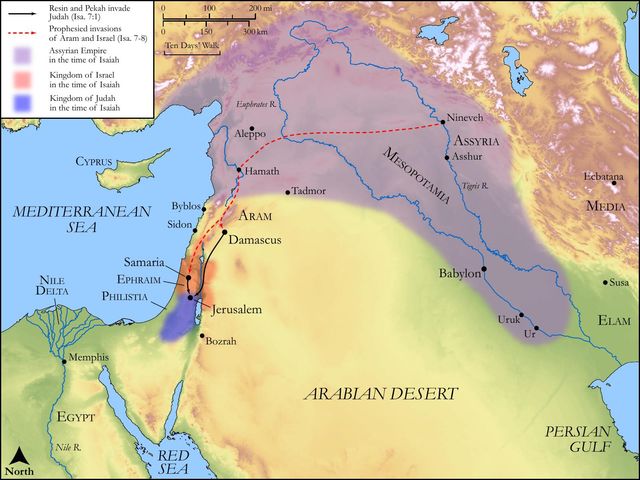
The historical setting for Isaiah 7:11 is the tumultuous period of the Syro-Ephraimite War, approximately 734 BC. The Northern Kingdom of Israel (Ephraim) and Aram (Syria) had forged an alliance, primarily as a defensive measure against the burgeoning power of the Neo-Assyrian Empire. Their strategy involved coercing Judah into joining their anti-Assyrian coalition. When King Ahaz of Judah resisted, they launched a military campaign to overthrow him and install a more compliant ruler on the Davidic throne. This era was characterized by intense geopolitical instability, with smaller nations constantly navigating alliances and threats from regional superpowers. Within this context, the concept of "signs" (Hebrew: ʼôwth) was culturally significant, often encompassing everything from natural phenomena and omens to miraculous events that served as divine confirmations, prophetic indicators, or validations of a message. God's direct, open-ended, and proactive offer of a sign to Ahaz was exceptionally unusual, transcending typical human requests for omens and powerfully demonstrating His personal involvement and deep concern for His covenant people amidst their crisis.
Key Themes
ShowHideIsaiah 7:11 profoundly articulates several foundational theological themes. Firstly, it underscores Divine Initiative and Abundant Grace: God does not wait for Ahaz to plead for help; instead, He proactively extends an unmerited and open-ended offer of a sign. This demonstrates God's boundless grace and His earnest desire to bolster Ahaz's faith, despite the king's evident fear and lack of trust, as vividly depicted in Isaiah 7:2. Secondly, the verse highlights the Boundless Sovereignty and Omnipotence of God: The invitation to ask for a sign "in the depth, or in the height above" unequivocally declares that God's power is utterly unconstrained by human imagination, physical limitations, or the laws of nature. He is capable of any miracle, anywhere, asserting His absolute dominion over all creation and the unfolding of history. Finally, the passage sets up the critical theme of Faith Versus Unbelief: God's extraordinary offer serves as a profound test of Ahaz's trust. Ahaz's subsequent refusal, under the pretense of piety (as recorded in Isaiah 7:12), tragically reveals his underlying unbelief and his preference for relying on human political alliances and strategies rather than on divine intervention. This contrasts sharply with the example of Gideon, who, despite initial hesitations, humbly sought and received multiple signs from God to confirm His word and strengthen his resolve (see Judges 6:36-40).
Exposition and Analysis
ShowHideKey Word Analysis
ShowHideThis primitive root (H7592) signifies "to inquire," "to request," "to demand," or "to beg." In this context, it is a direct, open-ended, and earnest invitation from God, not a command or a test of God by Ahaz. The repetition of "ask" in the verse (KJV: "Ask thee... ask it...") emphasizes the genuine nature and the extraordinary freedom of God's offer, implying a divine desire for Ahaz to engage with Him and seek tangible proof of His word.
Probably from a root meaning "to appear," ʼôwth (H226) refers to a signal, mark, token, or miraculous proof. It is something visible, perceptible, or extraordinary that serves to confirm a message, validate a promise, or indicate a divine presence or intervention. In Isaiah 7:11, the sign would serve as undeniable evidence of God's power and faithfulness to protect Judah, specifically designed to bolster Ahaz's wavering faith and provide assurance amidst his fear.
This primitive root (H6009) means "to be deep" or "to make deep." In this context, it refers to the lowest possible extreme, often metaphorically associated with Sheol (the underworld) or the deepest parts of the earth. When paired with "height above," it forms a comprehensive scope, indicating that God's power extends to the absolute extremes of existence, from the lowest, hidden depths to the highest, visible heavens. It implies a sign that could involve a profound, perhaps even unsettling, disruption of the natural order or a revelation from beyond the ordinary realm of human experience.
Verse Breakdown
ShowHide"Ask thee a sign of the LORD thy God;"
This opening clause presents a direct, personal, and extraordinary invitation from God Himself, conveyed through His prophet Isaiah, to King Ahaz. The phrase "the LORD thy God" is significant, emphasizing God's covenant relationship with Judah and with Ahaz as the Davidic king. It serves as a powerful reminder of the divine faithfulness that has been extended to his lineage and nation throughout history. The invitation to "ask for a sign" is an act of profound divine condescension and grace, offering Ahaz a tangible, undeniable demonstration of God's commitment to His word and His people in their moment of crisis.
"ask it either in the depth,"
This phrase specifies the first extreme of the sign's potential manifestation. "In the depth" (Hebrew: ʻâmaq) refers to the lowest conceivable place, often associated with the underworld, the grave, or the deepest, most hidden parts of the earth. This suggests a sign that might involve a profound, perhaps even unsettling, disruption of the natural order, a revelation from beneath the ground, or an intervention from a realm beyond typical human experience. It underscores God's absolute dominion over all hidden, unseen, and seemingly impossible realms.
"or in the height above."
This completes the comprehensive scope of God's limitless power. "In the height" (Hebrew: gâbahh) refers to the highest heavens, the celestial realm, while "above" (Hebrew: maʻal) reinforces the upward direction and transcendence. This suggests a sign that might involve celestial phenomena, a miraculous intervention from the heavens, or a visible display of divine power in the sky. Together, "in the depth, or in the height above" form a powerful merism, signifying the entirety of creation and implying that God is capable of performing any sign, anywhere, demonstrating His absolute and unchallengeable sovereignty over all things, from the lowest abyss to the highest firmament.
Literary Devices
ShowHideIsaiah 7:11 masterfully employs several potent literary devices to convey its profound message. The most prominent is Merism, vividly demonstrated in the phrase "in the depth, or in the height above." This rhetorical technique utilizes two contrasting or opposing parts to represent a complete totality or an entire range. Here, "depth" (alluding to the underworld or the deepest parts of the earth) and "height above" (referring to the highest heavens) collectively encompass all possible realms of existence. This merism powerfully emphasizes God's omnipotence and His boundless ability to perform a sign of any magnitude, whether hidden and profound or visible and celestial, thereby highlighting the limitless scope of His power and the unrestricted nature of the sign Ahaz could request. There is also a subtle yet significant Irony at play; God, in His infinite grace, extends an unprecedented, open-ended invitation for a miraculous sign, yet Ahaz, under the guise of piety and a false humility, refuses it. This refusal tragically exposes Ahaz's underlying lack of faith and his preference for human strategies over divine intervention. This initial irony then sets up a greater, divine irony: God, despite Ahaz's unbelief, sovereignly proceeds to provide a sign (Immanuel) that Ahaz did not ask for and likely did not desire, further underscoring God's unwavering will and faithfulness despite human unbelief.
Theological and Thematic Connections
ShowHideIsaiah 7:11 stands as a profound testament to God's active, personal involvement in human history and His unwavering commitment to His covenant promises. It reveals a God who is neither distant nor passive, but intimately concerned with the fears, doubts, and faith of His people. The divine invitation to "ask for a sign" demonstrates God's gracious condescension and His desire to meet humanity at the point of their doubt, offering tangible, undeniable evidence of His power and faithfulness. While King Ahaz's subsequent refusal tragically highlights the human propensity for unbelief, even in the face of such extraordinary divine grace, the verse ultimately magnifies God's absolute sovereignty. He proceeds to give a sign (the Immanuel prophecy) regardless of Ahaz's response, underscoring that God's redemptive plans are not contingent on human faith, though He graciously invites and abundantly rewards it. This passage affirms that God's power knows no bounds, encompassing all dimensions of existence.
Reflection and Application
ShowHideIsaiah 7:11 serves as a profound and challenging reminder of God's incredible grace and His earnest desire for us to trust Him fully, especially when circumstances appear overwhelming or impossible. While we may not receive a direct, open-ended invitation to ask for a miraculous sign in the same manner as Ahaz, the underlying principle remains eternally true: God is eager to demonstrate His faithfulness to those who genuinely seek Him and humbly rely on His unfailing promises. This verse compels us to honestly examine the hidden roots of our own fears and to critically assess where we truly place our trust when confronted with daunting challenges or seemingly insurmountable obstacles. Do we, like Ahaz, subtly reject God's gracious invitation to faith by prioritizing our own limited strength, human wisdom, or worldly solutions, or do we humbly lean into His boundless power and perfect provision? Our ultimate and most profound "sign" is found not in a fleeting miracle, but in God's eternally revealed Word and, supremely, in the person of Jesus Christ, who is the very embodiment of God's faithfulness, power, and redemptive plan. This passage calls us to cultivate a posture of expectant, unwavering faith, believing that God is not only able but willing to act in ways far beyond our comprehension, from addressing the "depth" of our deepest needs and fears to manifesting His glorious power from "the height" of His divine throne.
Questions for Reflection
ShowHideFAQ
ShowHideWas Ahaz wrong to refuse the sign?
ShowHideYes, Ahaz was unequivocally wrong to refuse the sign. While he attempted to cloak his refusal in a guise of piety, stating, "I will not ask, neither will I tempt the LORD" (Isaiah 7:12), God had explicitly and graciously invited him to ask. This was not an attempt by Ahaz to test God, but rather a divine offer intended to strengthen Ahaz's faith and provide tangible assurance in a time of severe national crisis. Ahaz's refusal tragically demonstrated his profound lack of faith and his preference for relying on his own flawed political strategies—such as seeking an alliance with Assyria—over the miraculous intervention and steadfast protection of God. To reject God's gracious provision was to reject His very invitation to trust Him.
What does "in the depth, or in the height above" mean?
ShowHideThis phrase is a powerful merism, a literary device where two contrasting parts are used to represent a complete whole or an entire range. "In the depth" refers to the lowest conceivable place, often associated with the underworld (Sheol), the grave, or the deepest, most hidden parts of the earth. "In the height above" refers to the highest heavens, the celestial realm, or the very dwelling place of God. Together, they signify that God's power is absolutely limitless and extends over all creation, from the lowest abyss to the highest firmament. It means Ahaz could have asked for any sign imaginable, no matter how impossible, grand, or hidden it seemed, thereby demonstrating God's absolute sovereignty and His infinite ability to perform any miracle, anywhere.
Christ-Centered Fulfillment
ShowHideWhile King Ahaz, in his unbelief, tragically refused the extraordinary sign offered in Isaiah 7:11, God, in His sovereign and unwavering grace, still provided a sign—the ultimate sign—through the prophecy of Immanuel in Isaiah 7:14. This profound prophecy, "Behold, a virgin shall conceive, and bear a son, and shall call his name Immanuel," finds its complete and glorious fulfillment not in Ahaz's immediate historical context, but centuries later in the miraculous virgin birth of Jesus Christ, as unequivocally affirmed in Matthew 1:23. Jesus is the true "God with us," the definitive and eternal sign of God's tangible presence, omnipotent power, and redemptive salvation. He is the one who, in His incarnation, descended to the "depth" of humanity's sin and brokenness, experiencing death and even the grave, only to be raised to the "height above," ascending triumphantly to the right hand of the Father (Ephesians 4:9-10). Thus, Jesus Himself embodies the very scope of boundless power and divine intervention offered in Isaiah 7:11, demonstrating God's ability to act from the lowest depths of human despair to the highest heights of divine glory, bringing salvation and hope to all who believe. He is the ultimate demonstration of God's faithfulness, the Lamb of God who takes away the sin of the world, and the One through whom all of God's promises are eternally secured, far surpassing any temporary sign Ahaz might have requested.