


Judges 6:37
Bible text: King James Version (1769 Blayney text) · Public domain
Bible text: King James Version with Strong's numbers · Public domain
Bible text: Berean Standard Bible · Public domain
Bible text: American Standard Version (1901) · Public domain
Bible text: World English Bible, Messianic edition · Public domain
Bible text: Geneva Bible (1599) · Public domain
Bible text: Young's Literal Translation · Public domain
- הִנֵּהhi·Nehhere!H2009PrtParticle Interjection
- אָנֹכִי'a·no·KhiIH595Pro-1csPronoun Personal 1st Singular common gender
- מַצִּיגma·Tzig[am] placingH3322V-Hiphil-Prtcpl-msVerb Hiphil Participle Singular Masculine Absolute
- אֶת'et<obj.>H853DirObjMParticle Object Indicator
- גִּזַּתgi·Zat[the] fleece ofH1492N-fscNoun Singular Feminine Construct
- הַצֶּמֶרha·Tze·mer<the> woolH6785Art ¦ N-msNoun Singular Masculine Absoluteהַ<the>צֶּמֶרwool
- בַּגֹּרֶןba·Go·renon the threshing floorH1637Prep-b ¦ N-fsNoun Singular Feminine Absoluteבַּon theגֹּרֶןthreshing floor
- אִם'imifH518PrtParticle Conditional
- טַלtaldewH2919N-msNoun Singular Masculine Absolute
- יִהְיֶהyih·Yehit will beH1961V-Qal-Imperf-3msVerb Qal Imperfect 3rd Singular Masculine
- עַל'alonH5921PrepPreposition
- הַגִּזָּהha·gi·Zahthe fleeceH1492Art ¦ N-fsNoun Singular Feminine Absoluteהַtheגִּזָּהfleece
- לְבַדָּהּle·va·Dahto alone itH905Prep-l ¦ N-msc ¦ 3fsNoun Singular Masculine Constructלְtoבַדָּaloneהּit
- וְעַלve·'aland [will be] onH5921Conj-w ¦ PrepPrepositionוְandעַל[will be] on
- כָּלkolallH3605N-mscNoun Singular Masculine Construct
- הָאָרֶץha·'A·retzthe groundH776Art ¦ N-fsNoun Singular Feminine Absoluteהָtheאָרֶץground
- חֹרֶבCho·revdrynessH2721N-msNoun Singular Masculine Absolute
- וְיָדַעְתִּיve·ya·da'·Tiand I will knowH3045Conj-w ¦ V-Qal-ConsecPerf-1csVerb Qal Consecutive Perfect 1st Singular common genderוְandיָדַעְתִּיI will know
- כִּיkithatH3588PrtParticle Conditional
- תוֹשִׁיעַto·Shi·a'you will deliverH3467V-Hiphil-Imperf-2msVerb Hiphil Imperfect 2nd Singular Masculine
- בְּיָדִיbe·ya·Diby my handH3027Prep-b ¦ N-csc ¦ 1csNoun Singular common gender Constructבְּbyיָדִhandיmy
- אֶת'et<obj.>H853DirObjMParticle Object Indicator
- יִשְׂרָאֵלYis·ra·'ElIsraelH3478N-properNoun Proper Location
- כַּאֲשֶׁרka·'a·Sherjust asH834Prep-k ¦ RelParticle Relativeכַּjustאֲשֶׁרas
- דִּבַּרְתָּdi·Bar·tayou have spokenH1696V-Piel-Perf-2msVerb Piel Perfect 2nd Singular Masculine
English is a literal word-by-word gloss of the Hebrew, not the KJV's wording. Why?
This is the original text the KJV's translators worked from — each Hebrew word with its own literal English meaning in this verse, prepared by scholars at Tyndale House, Cambridge. The KJV translates whole sentences, not word by word, so its wording differs: one Hebrew word can become several English words, and the KJV may choose “the LORD” where the gloss reads “Yahweh”. Both are faithful — they answer different questions. For the KJV's own rendering, switch to the KJV text.
Details
See on the biblical-era maps
Study this verse
Public-domain commentary
Matthew Henry
From his Commentary on the Whole Bible. Henry comments on passages, not single verses — this entry covers Judges 6:33–40. His three-level outline is real structure in the source text, so it is rendered as structure.
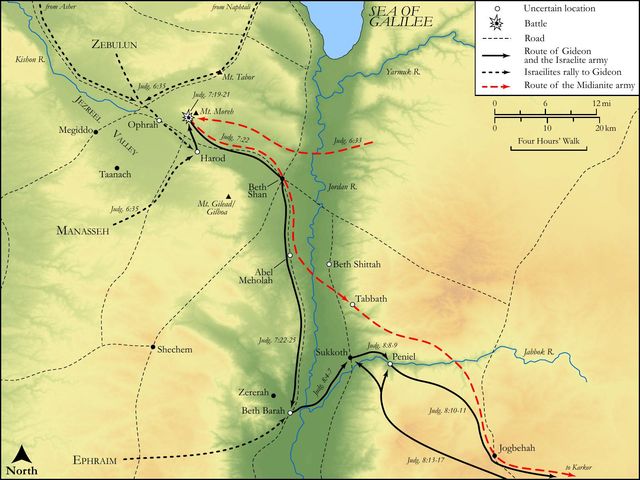
Here we have, I. The descent which the enemies of Israel made upon them, Jdg 6:33. A vast number of Midianites, Amalekites, and Arabians, got together, and came over Jordan, none either caring or daring to guard that important and advantageous pass against them, and they made their headquarters in the valley of Jezreel, in the heart of Manasseh's tribe, not far from Gideon's city. Some think that the notice they had of Gideon's destroying Baal's altar brought them over, and that they came to plead for Baal and to make that a pretence for quarrelling with Israel; but it is more likely that it was now harvest-time, when they had been wont each year to make such a visit as this (Jdg 6:3), and that they were expected when Gideon was threshing, Jdg 6:11. God raised up Gideon to be ready against this terrible blow came. Their success so many years in these incursions, the little opposition they had met with and the great booty they had carried off, made them now both very eager and very confident. But it proved that the measure of their iniquity was full and the year of recompence had come; they must now make an end to spoil and must be spoiled, and they are gathered as sheaves to the floor (Mic 4:12, Mic 4:13), for Gideon to thresh.
II.The preparation which Gideon makes to attack them in their camp, Jdg 6:34, Jdg 6:35.
1.God by his Spirit put life into Gideon: The Spirit of the Lord clothes Gideon (so the word is), clothed him as a robe, to put honour upon him, clothed him as a coat of mail, to put defence upon him. Those are well clad that are thus clothed. A spirit of fortitude from before the Lord clothed Gideon; so the Chaldee. He was of himself a mighty man of valour; yet personal strength and courage, though vigorously exerted, would not suffice for this great action; he must have the armour of God upon him, and this is what he must depend upon: The Spirit of the Lord clothed him in an extraordinary manner. Whom God calls to his work he will qualify and animate for it.
2.Gideon with his trumpet put life into his neighbours, God working with him; he blew a trumpet, to call in volunteers, and more came in than perhaps he expected.
(1.)The men of Abiezer, though lately enraged against him for throwing down the altar of Baal, and though they had condemned him to death as a criminal, were now convinced of their error, bravely came in to his assistance, and submitted to him as their general: Abiezer was gathered after him, Jdg 6:34. So suddenly can God turn the hearts even of idolaters and persecutors.
(2.)Distant tribes, even Asher and Naphtali, which lay most remote, though strangers to him, obeyed his summons, and sent him in the best of their forces, Jdg 6:35. Though they lay furthest from the danger, yet, considering that if their neighbours were over-run by the Midianites their own turn would be next, they were forward to join against a common enemy.
III.The signs which God gratified him with, for the confirming both of his own faith and that of his followers; and perhaps it was more for their sakes than for his own that he desired them. Or, perhaps, he desired by these to be satisfied whether this was the time of his conquering the Midianites, or whether he was to wait for some other opportunity. Observe,
1.His request for a sign (Jdg 6:36, Jdg 6:37): "Let me by this know that thou wilt save Israel by my hand, let a fleece of wool, spread in the open air, be wet with the dew, and let the ground about it be dry." The purport of this is, Lord, I believe, help thou my unbelief. He found his own faith weak and wavering, and therefore begged of God by this sign to perfect what was lacking in it. We may suppose that God, who intended to give him these signs, for the glorifying of his own power and goodness, put it into his heart to ask them. Yet, when he repeated his request for a second sign, the reverse of the former, he did it with a very humble apology, deprecating God's displeasure, because it looked so like a peevish humoursome distrust of God and dissatisfaction with the many assurances he had already given him (Jdg 6:39): Let not thy anger be hot against me. Though he took the boldness to ask another sign, yet he did it with such fear and trembling as showed that the familiarity God had graciously admitted him to did not breed any contempt of God's glory, nor presumption on God's goodness. Abraham had given him an example of this, when God gave him leave to be very free with him (Gen 18:30, Gen 18:32), O let not the Lord be angry, and I will speak. God's favour must be sought with great reverence, a due sense of our distance, and a religious fear of his wrath.
2.God's gracious grant of his request. See how tender God is of true believers though they be weak, and how ready to condescend to their infirmities, that the bruised reed may not be broken nor the smoking flax quenched. Gideon would have the fleece wet and the ground dry; but then, lest any should object, "It is natural for wool, if ever so little moisture fall, to drink it in and retain it, and therefore there was nothing extraordinary in this," though the quantity wrung out was sufficient to obviate such an objection, yet he desires that next night the ground might be wet and the fleece dry, and it is done, so willing is God to give to the heirs of promise strong consolation (Heb 6:17, Heb 6:18), even by two immutable things. He suffers himself, not only to be prevailed with by their importunities, but even to be prescribed to by their doubts and dissatisfactions. These signs were,
(1.)Truly miraculous, and therefore abundantly serving to confirm his commission. It is said of the dew that it is from the Lord, and tarrieth not for man, nor waiteth for the sons of men (Mic 5:7); and yet God here in this matter hearkened to the voice of a man; as to Joshua, in directing the course of the sun, so to Gideon in directing that of the dew, by which it appears that it falls not by chance, but by providence. The latter sign inverted the former, and, to please Gideon, it was wrought backward and forward, whence Dr. Fuller observes that heaven's real miracles will endure turning, being inside and outside both alike.
(2.)Very significant. He and his men were going to engage the Midianites; could God distinguish between a small fleece of Israel and the vast floor of Midian? Yes, by this he is made to know that he can. Is Gideon desirous that the dew of divine grace might descend upon himself in particular? He sees the fleece wet with dew to assure him of it. Does he desire that God will be as the dew to all Israel? Behold, all the ground is wet. Some make this fleece an emblem of the Jewish nation, which, when time was, was wet with the dew of God's word and ordinances, while the rest of the world was dry; but since the rejection of Christ and his gospel they are dry as the heath in the wilderness, while the nations about are as a watered garden.
Historical interpretation
Three Centuries of Reception
12 surviving comments on this verse. Each one is dated, so this reads as a timeline rather than a list.
Select a marker to jump to its quote. Markers stagger vertically where authors wrote within a few decades of each other.
But now let’s see why, in the first sign, “dew fell upon the fleece, whereas the ground was dry,” and in the second sign, “dew fell upon the ground, while the fleece remained dry,” an indication which Gideon accepted as a pledge that the Lord would save Israel through his hand. The rationale for this mystery is to be seen in what I remember from one of our preceding books, which characterized the people of Israel as a “fleece,” with the surrounding ground being the Gentiles, while the dew that fell “upon the fleece” was the word of God written for this people alone. For only to Israel did the dew of the divine law arrive, whereas all the surrounding nations remained dry, none of them being infused with the moisture of divine locution. In the second sign, however, where he asked that the dew fall on the ground and that the fleece remain dry, a completely different rationale can be observed. We should see this entire people, who were gathered together from nations around the world, now having within themselves the divine dew; see them infused with the dew of Moses, irrigated by the word of the prophets; see them green from evangelical and apostolic water. The fleece, however, that is, the Jewish people, suffers aridity and dryness in the word of God, according to which it is written: “The children of Israel will be for a long time without king, without prince, without prophet; they will have no altar, no victim, no sacrifice.” You can see how they remain arid, how they are stricken with drought of the word of God.… Even the seventy-first psalm, as I have often discussed with them, moves me to this conclusion because, when it describes the advent of Christ, it foretells his coming as rain on a fleece and as showers on the earth. Here in Judges a fleece is mentioned and in the psalm, also, “fleece” is the word chosen. For he will “descend like rain,” it says, “on a fleece.” He descends, therefore, on that fleece of the people of circumcision and “like showers upon the earth,” meaning that our Lord Jesus Christ descends on the remainder of the earth, dripping upon us and bringing the “dew of heaven” to us Gentiles also, that we too may drink who were on the previously arid surrounding land.
Nor was it without a reason that he put the fleece neither in a field nor in a meadow, but in a threshing-floor, where is the harvest of the wheat: "For the harvest is plenteous, but the labourers are few;" because that, through faith in the Lord, there was about to be a harvest fruitful in virtues.
Some one perhaps will enquire whether he does not seem to have been wanting in faith, seeing that after being instructed by many signs he asked still more. But how can he seem to have asked as if doubting or wanting in faith, who was speaking in mysteries? He was not then doubtful, but careful that we should not doubt. For how could he be doubtful whose prayer was effectual? And how could he have begun the battle without fear, unless he had understood the message of God? for the dew on the fleece signified the faith among the Jews, because the words of God come down like the dew.
Nor, again, was it without a reason that he dried the fleece of the Jews, and put the dew from it into a basin, so that it was filled with water, yet he did not himself wash his feet in that dew. The prerogative of so great a mystery was to be given to another. He was being waited for Who alone could wash away the filth of all. Gideon was not great enough to claim this mystery for himself, but "the Son of Man came not to be ministered unto, but to minister." Let us, then, recognize in Whom these mysteries are seen to be accomplished. Not in holy Gideon, for they were still at their commencement. Therefore the Gentiles were surpassed, for dryness was still upon the Gentiles, and therefore did Israel surpass them, for then did the dew remain on the fleece.
Let us come now to the Gospel of God. I find the Lord stripping Himself of His garments, and girding Himself with a towel, pouring water into a basin, and washing the disciples' feet. That heavenly dew was this water, this was foretold, namely, that the Lord Jesus Christ would wash the feet of His disciples in that heavenly dew.
But what does this mean: "Until the day on which the Lord shall send rain on the earth"? except that he, too, "shall come down like rain upon a fleece, and like the drops that water the earth." In this passage the mystery of the old history is disclosed where Gideon, the warrior of the mystic conflict, receiving the pledge of future victory, recognized the spiritual sacrament in the vision of his mind, that that rain was the dew of the divine Word, which first came down on the fleece, when all the earth was parched with continual drought, and by a second true sign, moistened the floor of all the earth with a shower, while dryness was upon the fleece.
The truth of the Lord reaches even to the clouds. The clouds are the apostles and prophets; to them he gave the command not to rain upon Israel. This is in agreement with history as recorded in the book of Judges, where it speaks of the fleece that was dry while rain fell upon the rest of the world. It means that Israel is dry and the rain is pouring down over the whole world.
“And he shall come down like rain into a fleece, and like drops distilling upon the earth.” He has reminded and admonished us that what was done by Gideon the judge has its end in Christ. He asked the Lord for a sign, that a fleece laid on the floor should alone be rained upon and the floor should be dry; and again, that the fleece alone should be dry and the floor should be rained upon; and so it happened. This dry fleece, which lay upon a floor in the midst of the whole round world, signified the former people Israel. Therefore, Christ came down like rain upon the fleece while the floor remained dry; concerning this he said, “I was sent only to the lost sheep of the house of Israel.” There [in Israel] he selected a mother through whom he would receive the [bodily] form of a servant in order to appear to humanity: there he gave this command to the disciples, saying, “Don’t go in the direction of the nations or enter into the cities of the Samaritans: go first to the lost sheep of the house of Israel.” When he said, go “first” to them, he also showed that afterward, when the floor was to be rained upon, they would also go to other sheep who were not of the former people of Israel. Concerning these he says, “I have other sheep which are not of this fold; I need to bring in them also, that there may be one flock and one Shepherd.” For this reason the apostle also says, “For I say that Christ was a minister of the circumcision for the truth of God, to confirm the promises of the patriarchs.” Thus rain came down upon the fleece, while the floor remained dry. Regarding this he continues, “so that the nations should glorify God for his mercy,” and, when the time arrived, that what he says by the prophet should be fulfilled, “a people whom I have not known has served me, in listening attentively it has obeyed me.” We now understand that the nation of the Jews has remained dry of Christ’s grace, and all the nations throughout the whole round world are being rained upon by clouds full of Christian grace. He has indicated this rain with another phrase, as he says that “drops [are] distilling” no longer upon the fleece but “upon the earth.” For what else is rain but drops distilling? I think that the above [Jewish] nation is signified as a fleece either because they were to be stripped of the authority of teaching—just as a sheep is stripped of its skin—or because he was hiding that same rain in a secret place and did not desire that it should be preached to those who were not circumcised, that is, to be revealed to uncircumcised nations.
But some, like the Jews in former times, both wish to be called Christians, and—still ignorant of God’s righteousness—desire to establish their own, even in our own times of open grace, of the full revelation of grace that was previously hidden, that is, in the times of grace now manifested in the floor, which had before lay hidden in the fleece.… Gideon, one of the righteous men of old, asked for a sign from the Lord, and said, “I pray, Lord, that this fleece which I put on the floor would be wet with dew, and that the floor would be dry.” And it was so. The fleece was wet with dew while the whole floor was dry. In the morning he wrung out the fleece in a basin—since grace is given to the humble—and you know what the Lord did to his disciples [with water] in a basin. He asked for yet another sign: “O Lord, I [pray] that the fleece would be dry, and the floor wet with dew.” And it was so. Consider how, in the time of the Old Testament, grace was hidden in a cloud, as the rain in the fleece. Note also the time of the New Testament: if you consider the nation of the Jews, you will find it like the dry fleece, whereas the whole world, like that floor, is full of grace, not hidden but manifested. Therefore we are greatly compelled to grieve for our brothers who strive against openly manifested, rather than hidden, grace. There is allowance for the Jews, but what shall we say of Christians? For what reason are you enemies of Christ’s grace? Why do you rely on yourselves? Why are you unthankful? Why did Christ come? Wasn’t [human] nature here before, which you only deceive by your excessive praise? Wasn’t the law here? But the apostle says, “If righteousness comes through the law, then Christ died in vain.” What the apostle says of the law, we say regarding nature concerning these people. “If righteousness comes through [human] nature, then Christ died in vain.”
Again on this subject it is written: “For through the law comes the knowledge of sin. But now, apart from the law, the justice of God is made manifest, being witnessed by the law and the prophets.” When he says “made manifest” he shows that it had existed but was like the dew for which Gideon asked; then it was not visible on the fleece, but now it is made manifest on the ground around. Therefore, since law without grace could only strengthen rather than kill sin—as it is written: “The sting of death is sin and the strength of sin is the law”—and as many flee to grace for refuge from the face of sin which had been so enthroned, to grace lying manifest, as it were, on the ground, so at that time few fled to it [grace] for refuge, invisible as it were, on the fleece. Indeed, this division of times belongs to the depth of the riches of the wisdom and of the knowledge of God, of which it is said: “How incomprehensible are his judgments and how unsearchable his ways!”
What did Gideon’s fleece signify? It is like the nation of the Jews in the midst of the world, which had the grace of sacraments, not indeed openly manifested, but hidden in a cloud or in a veil, like the dew in the fleece. The time came when the dew was to be manifested in the floor; it was manifested, no longer hidden. Christ alone is the sweetness of dew: him alone you do not recognize in Scripture, for whom Scripture was written. But yet, “they have heard all the words of your mouth.”
Rightly, then, do we compare Mary with fleece—she who conceived the Lord in such a way that she absorbed him with her whole body; nor did she undergo a rending of that same body, but she was tender in submission and firm in chastity. Rightly, I say, is Mary compared with fleece—she from whose offspring saving garments are woven for the people. Clearly Mary is fleece since from her tender womb came forth the Lamb who himself, bearing his mother’s wool (that is, flesh), covers the wounds of all peoples with a soft fleece. For every wound of sin is covered with the wool of Christ, tended by the blood of Christ, and, so that it may receive health, clothed in the garment of Christ.
Now, although Gideon was brave and confident, still he sought fuller proofs of victory from the Lord, saying, “If indeed you are going to save Israel through me, as you promised, O Lord, I am putting this woolen fleece on the threshing floor. If dew comes on the fleece, while all the ground is dry, I shall know that you will save the people through me, as you promised.” That is what took place. Afterwards, he added that the second time dew should pour over all the ground and only the fleece be dry; and so it happened. The dew on the fleece was faith in Judea, for the words of God descend as dew; for this reason Moses says, “May my discourse be awaited like the rain, and my words descend like the dew.” Thus, when the whole world was dried up from the unproductive heat of Gentile superstition, then there was the dew of a heavenly visitation upon the fleece, that is, in Judea. However, after “the lost sheep of the house of Israel” (foreshadowing, I think, the figure of the fleece of the Jews) refused the fountain of living water, the dew of faith dried up in the hearts of the Jews, and that divine stream turned its path to the hearts of the Gentiles. For this reason, the whole world is now moist with the dew of faith, but the Jews destroyed their prophets and advisers. It is no wonder that they submit to the dryness of faithlessness, since the Lord God deprived them of the fruitful rains of the prophets, saying, “I will command the clouds not to send rain upon that vineyard.” Salutary is the rain of the prophetic cloud, as David said: “He shall be like rain coming down on the meadow, like showers watering the earth.” The sacred writings of the whole world promised us this rain which watered the world at the advent of our Lord and Savior with the dew of the divine spirit. Thus, the dew has already come, and also the rain; the Lord came and brought with him heavenly showers. For this reason, we who thirsted before now drink, and by an interior drinking [we] absorb that divine spirit. Therefore, holy Gideon foresaw that by perceiving faith, even tribes and nations would drink the true heavenly dew.
Continue studying Judges 6:37 across the web’s major study libraries — every link below opens this exact verse, chapter, or book on the destination site.
Read & Compare
 BibleGatewayThis verse in more than 200 translations and 70 languages.
 Bible.comThe YouVersion reader — hundreds of translations, reading plans, and highlights.
 ESV.orgCrossway's official English Standard Version reader.
 NET BibleThe NET translation with 60,000+ translators' notes on every rendering decision.
 STEP BibleTyndale House's free study tool — original text, vocabulary, and scholarly resources.
 BibliaLogos Bible Software's free web reader.
 USCCBThe New American Bible (Revised Edition) with the U.S. bishops' study notes.
Commentaries
 BibleHub CommentariesDozens of classic commentaries on this verse, gathered on one page.
 StudyLightMore than 100 commentary sets — the largest collection on the web.
 BibleRefPlain-English commentary on what this verse means, verse by verse.
 Enduring WordDavid Guzik's free commentary on this chapter, widely used by Bible teachers.
 Bible Study ToolsVerse commentary alongside Greek and Hebrew study aids.
Original Language & Research
- BibleHub InterlinearThe verse word by word — original language, transliteration, and English.
- BibleHub LexiconEvery word's original-language definition and Strong's entry.
 Blue Letter BibleDeep-study tools — Strong's numbers, concordance, and word studies.
 SefariaThe Hebrew text with Rashi and centuries of Jewish commentary.
Sermons, Hymns & Audio


TrulyRandomVerse is not affiliated with these sites and doesn’t control their content. They’re linked because they’re genuinely useful.
Summary
Judges 6:37 details Gideon's second request for a divine sign—the specific "fleece test"—to unequivocally confirm God's promise to deliver Israel through his hand. Despite having previously received a direct divine commission and a miraculous sign of acceptance, Gideon, burdened by the immense and daunting task of liberating Israel from severe Midianite oppression, sought further, tangible proof of God's unwavering commitment. This verse precisely outlines his proposed test: that dew would fall exclusively on a wool fleece placed on the threshing floor, while the surrounding ground remained entirely dry, serving as an unmistakable and undeniable confirmation of God's spoken word.
Context
ShowHideLiterary Context
Judges 6:37 is situated within the pivotal narrative of Gideon's call and preparation for leadership, detailed in Judges 6. The chapter opens with Israel's seven-year subjugation by the Midianites, a direct consequence of their disobedience and apostasy (Judges 6:1-6). Following a prophetic rebuke of Israel's sin (Judges 6:7-10), the Angel of the Lord appears to Gideon, commissioning him to be Israel's deliverer (Judges 6:11-16). Gideon's initial skepticism and questioning of God's presence are evident (Judges 6:13). God responds by consuming Gideon's offering with fire, a powerful sign of divine acceptance (Judges 6:21), leading Gideon to build an altar to Yahweh Shalom (Judges 6:24). Gideon then demonstrates nascent obedience by tearing down his father's Baal altar and Asherah pole (Judges 6:25-32). The Spirit of the Lord subsequently empowers Gideon, enabling him to gather an army (Judges 6:34-35). Despite these profound confirmations and the mobilization of troops, Gideon's human apprehension and uncertainty resurface, prompting him to seek further, highly specific, and undeniable signs from God, which are meticulously detailed in Judges 6:36-40.
Historical & Cultural Context
The era of the Judges was marked by a recurring cycle of Israelite apostasy, divine judgment through foreign oppression, their cries for deliverance, and God raising up a judge to save them. During this period, Israel's spiritual unfaithfulness often left them vulnerable to external aggressors. The Midianites, depicted as swift, destructive nomadic raiders, had severely impoverished Israel by systematically destroying their crops and livestock, forcing the Israelites to seek refuge in caves and mountain strongholds (Judges 6:3-6). This dire context highlights the immense pressure, fear, and perceived impossibility of the task confronting Gideon. The "threshing floor" (Hebrew: gôren) was a common, open-air, elevated area, typically a flat, hard-packed surface, used for threshing and winnowing grain. Its exposed nature made it an ideal location for a dew test, as it would normally be subject to uniform atmospheric conditions. "Dew" (Hebrew: ṭal) was a critical source of moisture in ancient Israel, particularly during the dry summer months when rainfall was scarce. Its presence or absence was frequently interpreted as a direct sign of divine blessing or curse (Deuteronomy 33:28, Haggai 1:10). Gideon's request for a highly specific, localized, and counter-natural dew pattern was thus a profound appeal for an unmistakable supernatural intervention, designed to leave no room for natural explanation.
Key Themes
ShowHideThis verse powerfully illustrates several significant themes within the book of Judges and broader biblical theology. Firstly, it underscores Divine Patience and Accommodation, revealing God's extraordinary grace in engaging with human weakness and doubt. Rather than rebuking Gideon for his lack of immediate, unwavering faith, God condescends to provide the requested signs, thereby demonstrating His steadfast commitment to His promises and to His chosen, albeit fearful, servant. This theme resonates deeply with God's long-suffering character, exemplified throughout Scripture in His patient dealings with Israel's repeated rebellion, as seen in Numbers 14:18. Secondly, the narrative explores the complex tension between Faith and Doubt. Gideon, despite being divinely called and empowered by the Spirit, still grapples with the overwhelming magnitude of his mission. This reveals that faith is often a dynamic journey marked by wrestling, seeking assurance, and overcoming apprehension, rather than a static, unyielding state. His actions are not presented as a prescriptive model for habitually "testing God" in a demanding or manipulative manner, but rather as a sincere, albeit anxious, plea for clarity in the face of seemingly insurmountable odds. Finally, the passage highlights God's Sovereignty and His Choice of the Weak. God deliberately selects a timid and seemingly insignificant man from the smallest clan of Manasseh (Judges 6:15) to lead His people. This choice powerfully emphasizes that God's power and ability to save are not contingent upon human strength, confidence, or social standing. This principle aligns with the theological truth articulated in 1 Corinthians 1:27-29, where God intentionally chooses the foolish and weak things of the world to shame the wise and strong, ensuring that no human can boast in their own strength before Him.
Exposition and Analysis
ShowHideKey Word Analysis
ShowHideThis feminine noun, derived from a root meaning "to shear," specifically denotes a shorn piece of wool. In this context, it represents a common, natural object that Gideon intentionally uses as the medium for a supernatural test. The choice of a fleece emphasizes the tangible, observable, and easily verifiable nature of the sign Gideon sought, making any miraculous intervention by God undeniably clear and leaving no room for alternative explanations.
This term refers to the moisture that condenses on cool surfaces, typically at night, forming small water droplets. In the often-arid climate of ancient Israel, dew was a vital source of moisture for vegetation, particularly during the dry summer months when rain was scarce. Its presence was often seen as a sign of divine blessing and life, while its absence indicated drought and curse. The miraculous nature of Gideon's test lay not simply in the presence of dew itself, but in its selective and contrary-to-nature distribution—either exclusively on the fleece or exclusively on the ground—which defied natural meteorological patterns and pointed directly to a supernatural intervention.
This primitive root, meaning "to speak" or "to arrange," is used figuratively of words, implying a declaration, command, or promise. In this verse, it refers to God's prior declaration to Gideon that He would save Israel by Gideon's hand. Gideon's request for the fleece test is explicitly tied to this divine promise, indicating his desire for a tangible confirmation that God's spoken word (dâbar) would indeed come to pass through his actions. His need for a sign underscores the human struggle to fully grasp and trust the spoken word of God without additional physical evidence.
Verse Breakdown
ShowHide"Behold, I will put a fleece of wool in the floor;"
Gideon initiates his direct proposal to God, clearly specifying both the object of the test—a fleece of wool, a common and easily obtainable item—and its precise location—the threshing floor, an open, exposed area. This opening demonstrates Gideon's proactive, though still fearful, engagement with God's call. He is not passively waiting for another sign but actively formulating a specific, verifiable scenario to seek definitive confirmation, indicating his earnest desire for clarity, even if born out of lingering doubt.
"and if the dew be on the fleece only, and it be dry upon all the earth beside,"
This clause details the first, highly precise condition of Gideon's test. He requests a supernatural reversal of natural meteorological patterns: the fleece, which is highly absorbent, should be saturated with dew, while the surrounding ground, which would typically also be covered in dew, should remain completely dry. This extreme particularity is crucial to the sign's validity, as it eliminates any possibility of natural occurrence or coincidence, pointing directly and unmistakably to God's miraculous power and intervention.
"then shall I know that thou wilt save Israel by mine hand, as thou hast said."
This concluding clause articulates Gideon's ultimate purpose for conducting the test: to gain absolute, undeniable certainty that God will indeed fulfill His promise of salvation for Israel through Gideon's leadership. It highlights Gideon's desperate need for reassurance and his profound desire to align his actions perfectly with God's will. His longing to move from "I believe" to "I know" based on tangible, miraculous evidence reveals the depth of his human apprehension in the face of such a monumental divine commission.
Literary Devices
ShowHideThe passage employs several literary devices to enhance its meaning and emotional impact. Symbolism is prominent, with the fleece representing Gideon's vulnerability, his human need for tangible assurance, and his limited faith in the face of an overwhelming task. The dew, conversely, symbolizes God's life-giving power, His miraculous intervention, and His ability to control creation down to the smallest detail. The selective presence of dew on the fleece, contrary to natural expectation, functions as a powerful Miracle, underscoring God's absolute sovereignty over the natural world and His willingness to suspend its laws to confirm His word to His servant. The narrative also uses Contrast effectively by pitting the wet fleece against the dry ground (and vice-versa in Judges 6:39-40), creating a clear, unmistakable scenario that leaves no room for ambiguity regarding the divine intervention. Furthermore, there is an element of Irony in God's patient accommodation of Gideon's persistent doubt, as the omnipotent God who commissions Gideon with such power and promise must repeatedly prove Himself to His chosen, timid servant, thereby highlighting the vast disparity between human weakness and divine omnipotence and faithfulness.
Theological and Thematic Connections
ShowHideGideon's fleece test offers a profound illustration of God's patience and condescension towards human weakness, yet it also serves as a subtle lesson regarding the nature of mature faith. While God graciously responds to Gideon's sincere desire for confirmation, the narrative implicitly contrasts this with a more developed faith that trusts God's revealed word without demanding repeated signs. The passage underscores that God is merciful and empathetic to our doubts, especially when they stem from a genuine, though fearful, desire to obey His will in overwhelming circumstances. However, it also reminds us that true, mature faith ultimately rests on the unchanging character and infallible promises of God, rather than on a continuous stream of supernatural proofs. God's willingness to engage with Gideon's apprehension demonstrates His intimate knowledge of His servants and His unwavering commitment to equipping them for His purposes, even when they falter in their initial trust.
Reflection and Application
ShowHideGideon's story, particularly the incident of the fleece, provides a deeply human and relatable portrayal of the journey of faith—a journey often fraught with doubt, fear, and uncertainty, yet ultimately met by God's unwavering faithfulness. For believers today, it serves as a powerful and comforting reminder that God is incredibly gracious, compassionate, and empathetic to our fears and anxieties, especially when we are called to tasks that seem utterly insurmountable or beyond our capacity. We are not condemned for moments of doubt or apprehension, but rather invited to bring our honest struggles, our deepest fears, and our need for clarity directly before God, seeking His assurance and guidance. However, the narrative also subtly guides us towards cultivating a more mature and resilient faith that gradually moves beyond a constant need for external, tangible signs. While God may, in His sovereign wisdom and unique circumstances, choose to provide specific confirmations, our primary reliance should be on His revealed Word, His unchanging character, and the consistent witness of the Holy Spirit. The ultimate goal is to cultivate a trust so profound that we can step out in courageous obedience, even when the path ahead isn't perfectly illuminated, knowing with certainty that God's promises are true, His power is sufficient, and His faithfulness endures forever.
Questions for Reflection
ShowHideFAQ
ShowHideIs it wrong to "test" God like Gideon did with the fleece?
ShowHideGideon's fleece test is a nuanced passage that often invites debate among believers. On one hand, the Bible generally discourages "testing the Lord your God" (Deuteronomy 6:16), which typically refers to demanding signs out of a spirit of unbelief, rebellion, or to manipulate God into proving Himself. Such testing implies a lack of trust in God's revealed character or His previous demonstrations of power. On the other hand, God graciously and patiently responded to Gideon's specific and repeated requests, suggesting that His patience extended to Gideon's sincere, albeit fearful, desire for confirmation in the face of an overwhelming and seemingly impossible task. Gideon had already received a direct divine call and a powerful miraculous sign (the consuming fire of the offering in Judges 6:21), but his human weakness and the enormity of the mission led him to seek further, undeniable proof. The key often lies in the heart's posture: Gideon was not demanding out of rebellion or a desire to trap God, but seeking clarity and courage out of genuine trepidation and a profound desire to obey God's specific, unique call for his life. While we should primarily walk by faith in God's revealed Word and His unchanging character, this passage illustrates God's incredible grace, compassion, and understanding of our human frailty. It is not presented as a model for habitually demanding signs, but rather as a unique example of God's condescending compassion for a struggling servant in a moment of profound need.
Christ-Centered Fulfillment
ShowHideGideon's fleece test, born out of human doubt and a profound need for tangible assurance, finds its ultimate fulfillment and resolution not in another sign, but in the person of Jesus Christ Himself. While Gideon sought external, temporary signs to confirm God's word and presence, Christ is the ultimate and perfect sign, the very embodiment of God's promise, presence, and saving power among humanity. Unlike Gideon, who wrestled with fear and required repeated, specific proofs of God's faithfulness, Jesus perfectly trusted the Father, demonstrating a flawless faith that needed no external validation, even unto the agony of the cross. His entire life, His perfect obedience, His sacrificial death, and His glorious resurrection are the definitive, undeniable, and eternal proof of God's saving power and unwavering faithfulness, far surpassing any localized miracle of dew. Where Gideon's uncertainty highlighted the profound weakness and limitations of human faith, Christ's unwavering obedience, divine authority, and completed work reveal God's perfect and eternal plan of salvation. For those who, like Gideon, struggle with doubt and seek assurance, Jesus offers not a temporary sign, but Himself as the sympathetic High Priest who understands our weaknesses and temptations (Hebrews 4:15), and as the one who perfectly fulfilled all of God's promises. Through Christ, we are called to a higher form of faith—a faith that believes without seeing (John 20:29), resting not on miraculous interventions for our personal assurance, but on the finished work of the Lamb of God, who takes away the sin of the world (John 1:29). He is the ultimate "yes" and "amen" to all of God's promises (2 Corinthians 1:20), providing a certainty that transcends any physical sign and grounds our hope in an eternal reality.