


Judges 6:40
Bible text: King James Version (1769 Blayney text) · Public domain
Bible text: Berean Standard Bible · Public domain
Bible text: American Standard Version (1901) · Public domain
Bible text: World English Bible, Messianic edition · Public domain
Bible text: Geneva Bible (1599) · Public domain
Bible text: Young's Literal Translation · Public domain
- וַיַּעַשׂvai·Ya·'asand he didH6213Conj-w ¦ V-Qal-ConsecImperf-3msVerb Qal Consecutive Imperfect 3rd Singular Masculineוַandיַּעַשׂhe did
- אֱלֹהִים'E·lo·HimGodH430N-mpNoun Plural Masculine Absolute
- כֵּןkensoH3651AdvAdverb
- בַּלַּיְלָהba·Lay·lahin the nightH3915Prep-b ¦ N-msNoun Singular Masculine Absoluteבַּin theלַּיְלָהnight
- הַהוּאha·Hu'<the> thatH1931Art ¦ Pro-3msPronoun Personal 3rd Singular Masculineהַ<the>הוּאthat
- וַיְהִיvay·hiand it wasH1961Conj-w ¦ V-Qal-ConsecImperf-3msVerb Qal Consecutive Imperfect 3rd Singular Masculineוַandיְהִיit was
- חֹרֶבCho·revdrynessH2721N-msNoun Singular Masculine Absolute
- אֶל'eltoH413PrepPreposition
- הַגִּזָּהha·gi·Zahthe fleeceH1492Art ¦ N-fsNoun Singular Feminine Absoluteהַtheגִּזָּהfleece
- לְבַדָּהּle·va·Dahto alone itH905Prep-l ¦ N-msc ¦ 3fsNoun Singular Masculine Constructלְtoבַדָּaloneהּit
- וְעַלve·'aland onH5921Conj-w ¦ PrepPrepositionוְandעַלon
- כָּלkolallH3605N-mscNoun Singular Masculine Construct
- הָאָרֶץha·'A·retzthe groundH776Art ¦ N-fsNoun Singular Feminine Absoluteהָtheאָרֶץground
- הָיָהHa·yahit wasH1961V-Qal-Perf-3msVerb Qal Perfect 3rd Singular Masculine
- טָלTaldewH2919N-msNoun Singular Masculine Absolute
English is a literal word-by-word gloss of the Hebrew, not the KJV's wording. Why?
This is the original text the KJV's translators worked from — each Hebrew word with its own literal English meaning in this verse, prepared by scholars at Tyndale House, Cambridge. The KJV translates whole sentences, not word by word, so its wording differs: one Hebrew word can become several English words, and the KJV may choose “the LORD” where the gloss reads “Yahweh”. Both are faithful — they answer different questions. For the KJV's own rendering, switch to the KJV text.
Details
See on the biblical-era maps
Study this verse
Public-domain commentary
Matthew Henry
From his Commentary on the Whole Bible. Henry comments on passages, not single verses — this entry covers Judges 6:33–40. His three-level outline is real structure in the source text, so it is rendered as structure.
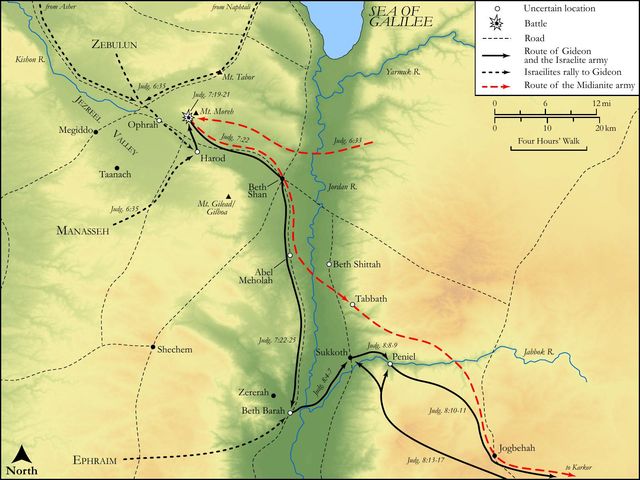
Here we have, I. The descent which the enemies of Israel made upon them, Jdg 6:33. A vast number of Midianites, Amalekites, and Arabians, got together, and came over Jordan, none either caring or daring to guard that important and advantageous pass against them, and they made their headquarters in the valley of Jezreel, in the heart of Manasseh's tribe, not far from Gideon's city. Some think that the notice they had of Gideon's destroying Baal's altar brought them over, and that they came to plead for Baal and to make that a pretence for quarrelling with Israel; but it is more likely that it was now harvest-time, when they had been wont each year to make such a visit as this (Jdg 6:3), and that they were expected when Gideon was threshing, Jdg 6:11. God raised up Gideon to be ready against this terrible blow came. Their success so many years in these incursions, the little opposition they had met with and the great booty they had carried off, made them now both very eager and very confident. But it proved that the measure of their iniquity was full and the year of recompence had come; they must now make an end to spoil and must be spoiled, and they are gathered as sheaves to the floor (Mic 4:12, Mic 4:13), for Gideon to thresh.
II.The preparation which Gideon makes to attack them in their camp, Jdg 6:34, Jdg 6:35.
1.God by his Spirit put life into Gideon: The Spirit of the Lord clothes Gideon (so the word is), clothed him as a robe, to put honour upon him, clothed him as a coat of mail, to put defence upon him. Those are well clad that are thus clothed. A spirit of fortitude from before the Lord clothed Gideon; so the Chaldee. He was of himself a mighty man of valour; yet personal strength and courage, though vigorously exerted, would not suffice for this great action; he must have the armour of God upon him, and this is what he must depend upon: The Spirit of the Lord clothed him in an extraordinary manner. Whom God calls to his work he will qualify and animate for it.
2.Gideon with his trumpet put life into his neighbours, God working with him; he blew a trumpet, to call in volunteers, and more came in than perhaps he expected.
(1.)The men of Abiezer, though lately enraged against him for throwing down the altar of Baal, and though they had condemned him to death as a criminal, were now convinced of their error, bravely came in to his assistance, and submitted to him as their general: Abiezer was gathered after him, Jdg 6:34. So suddenly can God turn the hearts even of idolaters and persecutors.
(2.)Distant tribes, even Asher and Naphtali, which lay most remote, though strangers to him, obeyed his summons, and sent him in the best of their forces, Jdg 6:35. Though they lay furthest from the danger, yet, considering that if their neighbours were over-run by the Midianites their own turn would be next, they were forward to join against a common enemy.
III.The signs which God gratified him with, for the confirming both of his own faith and that of his followers; and perhaps it was more for their sakes than for his own that he desired them. Or, perhaps, he desired by these to be satisfied whether this was the time of his conquering the Midianites, or whether he was to wait for some other opportunity. Observe,
1.His request for a sign (Jdg 6:36, Jdg 6:37): "Let me by this know that thou wilt save Israel by my hand, let a fleece of wool, spread in the open air, be wet with the dew, and let the ground about it be dry." The purport of this is, Lord, I believe, help thou my unbelief. He found his own faith weak and wavering, and therefore begged of God by this sign to perfect what was lacking in it. We may suppose that God, who intended to give him these signs, for the glorifying of his own power and goodness, put it into his heart to ask them. Yet, when he repeated his request for a second sign, the reverse of the former, he did it with a very humble apology, deprecating God's displeasure, because it looked so like a peevish humoursome distrust of God and dissatisfaction with the many assurances he had already given him (Jdg 6:39): Let not thy anger be hot against me. Though he took the boldness to ask another sign, yet he did it with such fear and trembling as showed that the familiarity God had graciously admitted him to did not breed any contempt of God's glory, nor presumption on God's goodness. Abraham had given him an example of this, when God gave him leave to be very free with him (Gen 18:30, Gen 18:32), O let not the Lord be angry, and I will speak. God's favour must be sought with great reverence, a due sense of our distance, and a religious fear of his wrath.
2.God's gracious grant of his request. See how tender God is of true believers though they be weak, and how ready to condescend to their infirmities, that the bruised reed may not be broken nor the smoking flax quenched. Gideon would have the fleece wet and the ground dry; but then, lest any should object, "It is natural for wool, if ever so little moisture fall, to drink it in and retain it, and therefore there was nothing extraordinary in this," though the quantity wrung out was sufficient to obviate such an objection, yet he desires that next night the ground might be wet and the fleece dry, and it is done, so willing is God to give to the heirs of promise strong consolation (Heb 6:17, Heb 6:18), even by two immutable things. He suffers himself, not only to be prevailed with by their importunities, but even to be prescribed to by their doubts and dissatisfactions. These signs were,
(1.)Truly miraculous, and therefore abundantly serving to confirm his commission. It is said of the dew that it is from the Lord, and tarrieth not for man, nor waiteth for the sons of men (Mic 5:7); and yet God here in this matter hearkened to the voice of a man; as to Joshua, in directing the course of the sun, so to Gideon in directing that of the dew, by which it appears that it falls not by chance, but by providence. The latter sign inverted the former, and, to please Gideon, it was wrought backward and forward, whence Dr. Fuller observes that heaven's real miracles will endure turning, being inside and outside both alike.
(2.)Very significant. He and his men were going to engage the Midianites; could God distinguish between a small fleece of Israel and the vast floor of Midian? Yes, by this he is made to know that he can. Is Gideon desirous that the dew of divine grace might descend upon himself in particular? He sees the fleece wet with dew to assure him of it. Does he desire that God will be as the dew to all Israel? Behold, all the ground is wet. Some make this fleece an emblem of the Jewish nation, which, when time was, was wet with the dew of God's word and ordinances, while the rest of the world was dry; but since the rejection of Christ and his gospel they are dry as the heath in the wilderness, while the nations about are as a watered garden.
Historical interpretation
Three Centuries of Reception
12 surviving comments on this verse. Each one is dated, so this reads as a timeline rather than a list.
Select a marker to jump to its quote. Markers stagger vertically where authors wrote within a few decades of each other.
But now let’s see why, in the first sign, “dew fell upon the fleece, whereas the ground was dry,” and in the second sign, “dew fell upon the ground, while the fleece remained dry,” an indication which Gideon accepted as a pledge that the Lord would save Israel through his hand. The rationale for this mystery is to be seen in what I remember from one of our preceding books, which characterized the people of Israel as a “fleece,” with the surrounding ground being the Gentiles, while the dew that fell “upon the fleece” was the word of God written for this people alone. For only to Israel did the dew of the divine law arrive, whereas all the surrounding nations remained dry, none of them being infused with the moisture of divine locution. In the second sign, however, where he asked that the dew fall on the ground and that the fleece remain dry, a completely different rationale can be observed. We should see this entire people, who were gathered together from nations around the world, now having within themselves the divine dew; see them infused with the dew of Moses, irrigated by the word of the prophets; see them green from evangelical and apostolic water. The fleece, however, that is, the Jewish people, suffers aridity and dryness in the word of God, according to which it is written: “The children of Israel will be for a long time without king, without prince, without prophet; they will have no altar, no victim, no sacrifice.” You can see how they remain arid, how they are stricken with drought of the word of God.… Even the seventy-first psalm, as I have often discussed with them, moves me to this conclusion because, when it describes the advent of Christ, it foretells his coming as rain on a fleece and as showers on the earth. Here in Judges a fleece is mentioned and in the psalm, also, “fleece” is the word chosen. For he will “descend like rain,” it says, “on a fleece.” He descends, therefore, on that fleece of the people of circumcision and “like showers upon the earth,” meaning that our Lord Jesus Christ descends on the remainder of the earth, dripping upon us and bringing the “dew of heaven” to us Gentiles also, that we too may drink who were on the previously arid surrounding land.
Nor was it without a reason that he put the fleece neither in a field nor in a meadow, but in a threshing-floor, where is the harvest of the wheat: "For the harvest is plenteous, but the labourers are few;" because that, through faith in the Lord, there was about to be a harvest fruitful in virtues.
Some one perhaps will enquire whether he does not seem to have been wanting in faith, seeing that after being instructed by many signs he asked still more. But how can he seem to have asked as if doubting or wanting in faith, who was speaking in mysteries? He was not then doubtful, but careful that we should not doubt. For how could he be doubtful whose prayer was effectual? And how could he have begun the battle without fear, unless he had understood the message of God? for the dew on the fleece signified the faith among the Jews, because the words of God come down like the dew.
Nor, again, was it without a reason that he dried the fleece of the Jews, and put the dew from it into a basin, so that it was filled with water, yet he did not himself wash his feet in that dew. The prerogative of so great a mystery was to be given to another. He was being waited for Who alone could wash away the filth of all. Gideon was not great enough to claim this mystery for himself, but "the Son of Man came not to be ministered unto, but to minister." Let us, then, recognize in Whom these mysteries are seen to be accomplished. Not in holy Gideon, for they were still at their commencement. Therefore the Gentiles were surpassed, for dryness was still upon the Gentiles, and therefore did Israel surpass them, for then did the dew remain on the fleece.
Let us come now to the Gospel of God. I find the Lord stripping Himself of His garments, and girding Himself with a towel, pouring water into a basin, and washing the disciples' feet. That heavenly dew was this water, this was foretold, namely, that the Lord Jesus Christ would wash the feet of His disciples in that heavenly dew.
But what does this mean: "Until the day on which the Lord shall send rain on the earth"? except that he, too, "shall come down like rain upon a fleece, and like the drops that water the earth." In this passage the mystery of the old history is disclosed where Gideon, the warrior of the mystic conflict, receiving the pledge of future victory, recognized the spiritual sacrament in the vision of his mind, that that rain was the dew of the divine Word, which first came down on the fleece, when all the earth was parched with continual drought, and by a second true sign, moistened the floor of all the earth with a shower, while dryness was upon the fleece.
The truth of the Lord reaches even to the clouds. The clouds are the apostles and prophets; to them he gave the command not to rain upon Israel. This is in agreement with history as recorded in the book of Judges, where it speaks of the fleece that was dry while rain fell upon the rest of the world. It means that Israel is dry and the rain is pouring down over the whole world.
“And he shall come down like rain into a fleece, and like drops distilling upon the earth.” He has reminded and admonished us that what was done by Gideon the judge has its end in Christ. He asked the Lord for a sign, that a fleece laid on the floor should alone be rained upon and the floor should be dry; and again, that the fleece alone should be dry and the floor should be rained upon; and so it happened. This dry fleece, which lay upon a floor in the midst of the whole round world, signified the former people Israel. Therefore, Christ came down like rain upon the fleece while the floor remained dry; concerning this he said, “I was sent only to the lost sheep of the house of Israel.” There [in Israel] he selected a mother through whom he would receive the [bodily] form of a servant in order to appear to humanity: there he gave this command to the disciples, saying, “Don’t go in the direction of the nations or enter into the cities of the Samaritans: go first to the lost sheep of the house of Israel.” When he said, go “first” to them, he also showed that afterward, when the floor was to be rained upon, they would also go to other sheep who were not of the former people of Israel. Concerning these he says, “I have other sheep which are not of this fold; I need to bring in them also, that there may be one flock and one Shepherd.” For this reason the apostle also says, “For I say that Christ was a minister of the circumcision for the truth of God, to confirm the promises of the patriarchs.” Thus rain came down upon the fleece, while the floor remained dry. Regarding this he continues, “so that the nations should glorify God for his mercy,” and, when the time arrived, that what he says by the prophet should be fulfilled, “a people whom I have not known has served me, in listening attentively it has obeyed me.” We now understand that the nation of the Jews has remained dry of Christ’s grace, and all the nations throughout the whole round world are being rained upon by clouds full of Christian grace. He has indicated this rain with another phrase, as he says that “drops [are] distilling” no longer upon the fleece but “upon the earth.” For what else is rain but drops distilling? I think that the above [Jewish] nation is signified as a fleece either because they were to be stripped of the authority of teaching—just as a sheep is stripped of its skin—or because he was hiding that same rain in a secret place and did not desire that it should be preached to those who were not circumcised, that is, to be revealed to uncircumcised nations.
But some, like the Jews in former times, both wish to be called Christians, and—still ignorant of God’s righteousness—desire to establish their own, even in our own times of open grace, of the full revelation of grace that was previously hidden, that is, in the times of grace now manifested in the floor, which had before lay hidden in the fleece.… Gideon, one of the righteous men of old, asked for a sign from the Lord, and said, “I pray, Lord, that this fleece which I put on the floor would be wet with dew, and that the floor would be dry.” And it was so. The fleece was wet with dew while the whole floor was dry. In the morning he wrung out the fleece in a basin—since grace is given to the humble—and you know what the Lord did to his disciples [with water] in a basin. He asked for yet another sign: “O Lord, I [pray] that the fleece would be dry, and the floor wet with dew.” And it was so. Consider how, in the time of the Old Testament, grace was hidden in a cloud, as the rain in the fleece. Note also the time of the New Testament: if you consider the nation of the Jews, you will find it like the dry fleece, whereas the whole world, like that floor, is full of grace, not hidden but manifested. Therefore we are greatly compelled to grieve for our brothers who strive against openly manifested, rather than hidden, grace. There is allowance for the Jews, but what shall we say of Christians? For what reason are you enemies of Christ’s grace? Why do you rely on yourselves? Why are you unthankful? Why did Christ come? Wasn’t [human] nature here before, which you only deceive by your excessive praise? Wasn’t the law here? But the apostle says, “If righteousness comes through the law, then Christ died in vain.” What the apostle says of the law, we say regarding nature concerning these people. “If righteousness comes through [human] nature, then Christ died in vain.”
Again on this subject it is written: “For through the law comes the knowledge of sin. But now, apart from the law, the justice of God is made manifest, being witnessed by the law and the prophets.” When he says “made manifest” he shows that it had existed but was like the dew for which Gideon asked; then it was not visible on the fleece, but now it is made manifest on the ground around. Therefore, since law without grace could only strengthen rather than kill sin—as it is written: “The sting of death is sin and the strength of sin is the law”—and as many flee to grace for refuge from the face of sin which had been so enthroned, to grace lying manifest, as it were, on the ground, so at that time few fled to it [grace] for refuge, invisible as it were, on the fleece. Indeed, this division of times belongs to the depth of the riches of the wisdom and of the knowledge of God, of which it is said: “How incomprehensible are his judgments and how unsearchable his ways!”
What did Gideon’s fleece signify? It is like the nation of the Jews in the midst of the world, which had the grace of sacraments, not indeed openly manifested, but hidden in a cloud or in a veil, like the dew in the fleece. The time came when the dew was to be manifested in the floor; it was manifested, no longer hidden. Christ alone is the sweetness of dew: him alone you do not recognize in Scripture, for whom Scripture was written. But yet, “they have heard all the words of your mouth.”
Rightly, then, do we compare Mary with fleece—she who conceived the Lord in such a way that she absorbed him with her whole body; nor did she undergo a rending of that same body, but she was tender in submission and firm in chastity. Rightly, I say, is Mary compared with fleece—she from whose offspring saving garments are woven for the people. Clearly Mary is fleece since from her tender womb came forth the Lamb who himself, bearing his mother’s wool (that is, flesh), covers the wounds of all peoples with a soft fleece. For every wound of sin is covered with the wool of Christ, tended by the blood of Christ, and, so that it may receive health, clothed in the garment of Christ.
Now, although Gideon was brave and confident, still he sought fuller proofs of victory from the Lord, saying, “If indeed you are going to save Israel through me, as you promised, O Lord, I am putting this woolen fleece on the threshing floor. If dew comes on the fleece, while all the ground is dry, I shall know that you will save the people through me, as you promised.” That is what took place. Afterwards, he added that the second time dew should pour over all the ground and only the fleece be dry; and so it happened. The dew on the fleece was faith in Judea, for the words of God descend as dew; for this reason Moses says, “May my discourse be awaited like the rain, and my words descend like the dew.” Thus, when the whole world was dried up from the unproductive heat of Gentile superstition, then there was the dew of a heavenly visitation upon the fleece, that is, in Judea. However, after “the lost sheep of the house of Israel” (foreshadowing, I think, the figure of the fleece of the Jews) refused the fountain of living water, the dew of faith dried up in the hearts of the Jews, and that divine stream turned its path to the hearts of the Gentiles. For this reason, the whole world is now moist with the dew of faith, but the Jews destroyed their prophets and advisers. It is no wonder that they submit to the dryness of faithlessness, since the Lord God deprived them of the fruitful rains of the prophets, saying, “I will command the clouds not to send rain upon that vineyard.” Salutary is the rain of the prophetic cloud, as David said: “He shall be like rain coming down on the meadow, like showers watering the earth.” The sacred writings of the whole world promised us this rain which watered the world at the advent of our Lord and Savior with the dew of the divine spirit. Thus, the dew has already come, and also the rain; the Lord came and brought with him heavenly showers. For this reason, we who thirsted before now drink, and by an interior drinking [we] absorb that divine spirit. Therefore, holy Gideon foresaw that by perceiving faith, even tribes and nations would drink the true heavenly dew.
Continue studying Judges 6:40 across the web’s major study libraries — every link below opens this exact verse, chapter, or book on the destination site.
Read & Compare
 BibleGatewayThis verse in more than 200 translations and 70 languages.
 Bible.comThe YouVersion reader — hundreds of translations, reading plans, and highlights.
 ESV.orgCrossway's official English Standard Version reader.
 NET BibleThe NET translation with 60,000+ translators' notes on every rendering decision.
 STEP BibleTyndale House's free study tool — original text, vocabulary, and scholarly resources.
 BibliaLogos Bible Software's free web reader.
 USCCBThe New American Bible (Revised Edition) with the U.S. bishops' study notes.
Commentaries
 BibleHub CommentariesDozens of classic commentaries on this verse, gathered on one page.
 StudyLightMore than 100 commentary sets — the largest collection on the web.
 BibleRefPlain-English commentary on what this verse means, verse by verse.
 Enduring WordDavid Guzik's free commentary on this chapter, widely used by Bible teachers.
 Bible Study ToolsVerse commentary alongside Greek and Hebrew study aids.
Original Language & Research
- BibleHub InterlinearThe verse word by word — original language, transliteration, and English.
- BibleHub LexiconEvery word's original-language definition and Strong's entry.
 Blue Letter BibleDeep-study tools — Strong's numbers, concordance, and word studies.
 SefariaThe Hebrew text with Rashi and centuries of Jewish commentary.
Sermons, Hymns & Audio


TrulyRandomVerse is not affiliated with these sites and doesn’t control their content. They’re linked because they’re genuinely useful.
Summary
Judges 6:40 records the final, conclusive sign granted by God to Gideon, reversing the conditions of his previous test. Despite Gideon's lingering doubt and repeated requests for divine assurance regarding his call to deliver Israel, God, in His profound patience and condescension, miraculously caused a wool fleece to remain completely dry while the surrounding ground was saturated with dew. This undeniable supernatural intervention served as the ultimate confirmation Gideon needed, solidifying his faith and empowering him to step forward in obedience to God's formidable commission against the Midianites.
Context
ShowHideLiterary Context
Judges 6:40 concludes the remarkable narrative of Gideon's call and his two-part test of God's will, immediately following the first fleece test described in Judges 6:37-38. The preceding verses detail Gideon's initial encounter with the Angel of the Lord, his commission to deliver Israel from Midianite oppression, and his initial hesitant steps, including tearing down his father's altar to Baal and Asherah (Judges 6:25-32). The narrative then shifts to Gideon gathering an army, but his faith, though growing, still requires tangible reassurance. The two fleece tests, culminating in this verse, serve as a crucial bridge from Gideon's initial trepidation to his eventual courageous leadership in Judges 7. This specific act of divine confirmation prepares Gideon for the seemingly impossible task ahead, highlighting God's faithfulness to His chosen instruments.
Historical & Cultural Context
The book of Judges chronicles a cyclical pattern of Israel's apostasy, oppression by foreign powers, their cry for deliverance, and God raising up a "judge" to save them. At this point, Israel was under severe oppression from the Midianites, Amalekites, and "people of the East" for seven years (Judges 6:1-6). This oppression was so severe that Israelites hid in caves and strongholds, and their crops and livestock were plundered, leading to national impoverishment and despair. In this context of fear and national weakness, Gideon, from the weakest clan of Manasseh and the least in his family (Judges 6:15), was called by God. The manipulation of dew was particularly significant in an agrarian society dependent on natural elements for survival, making God's control over it a powerful demonstration of His sovereignty and His direct intervention in the natural order to confirm His word.
Key Themes
ShowHideThis verse powerfully contributes to several key themes within Judges and the broader biblical narrative. It highlights God's extraordinary patience and condescension towards His chosen instruments, even in their moments of doubt and insecurity, providing repeated assurance rather than rebuke. It underscores the theme of divine confirmation and miraculous intervention, demonstrating God's absolute sovereignty over creation and His direct involvement in human affairs to fulfill His purposes, as seen in His control over the natural elements. Furthermore, it sets the stage for the theme of preparation for obedience, as Gideon's faith, bolstered by this undeniable sign, enables him to proceed with the daunting task of leading a small, divinely chosen army against overwhelming odds. This emphasizes that victory comes through God's power, not human strength, a central message of Judges 7. The narrative also subtly touches on the theme of human weakness and God's strength, showcasing how God chooses and empowers the unlikely.
Exposition and Analysis
ShowHideKey Word Analysis
ShowHideThis term (H430), a plural noun used with a singular verb, emphasizes the majestic and sovereign nature of the one true God. In this context, it underscores that the miraculous event was not a coincidence or a natural phenomenon, but a direct, intentional act of the all-powerful Creator, the supreme God, responding personally to Gideon's plea. It signifies the divine agency behind the impossible.
This primitive root (H6213) signifies "to do or make, in the broadest sense and widest application." Here, it highlights God's prompt, precise, and deliberate action in fulfilling Gideon's specific and audacious request. It conveys a sense of divine agency and control, leaving no doubt that the reversal of the dew's presence was a purposeful act of God's will, demonstrating His ability to accomplish His purposes.
Referring specifically to a shorn piece of wool (H1492), this ordinary object becomes the focal point of an extraordinary divine sign. Its selection by Gideon, and God's willingness to use it in such a specific and contradictory manner, emphasizes God's ability to work through the mundane to reveal His miraculous power and His attentiveness to individual human requests, even those born of doubt.
Verse Breakdown
ShowHide"And God did so that night:"
This opening clause immediately establishes the divine agency behind the miraculous event. It confirms that the outcome was not by chance but by the direct, intentional, and immediate intervention of God, fulfilling Gideon's second, reversed request. The phrase "that night" emphasizes the swiftness of God's response, occurring within the very timeframe Gideon specified, demonstrating God's attentiveness and faithfulness to His promise.
"for it was dry upon the fleece only,"
This part describes the first, counter-intuitive aspect of the miracle. Against all natural expectation, the wool fleece, which Gideon had laid out, remained completely devoid of dew. This precision demonstrates God's absolute control over the elements, isolating the effect specifically to the fleece, making the sign undeniable and eliminating any possibility of a natural explanation.
"and there was dew on all the ground."
This contrasting clause highlights the miraculous nature of the sign by juxtaposing the dry fleece with the wet ground. While the ground around the fleece was saturated with dew, as would be expected in the cool night air, the fleece itself was dry. This stark difference eliminates any possibility of a natural explanation, serving as a powerful and unambiguous confirmation of God's presence, power, and promise to Gideon, solidifying his faith for the daunting task ahead.
Literary Devices
ShowHideThe passage in Judges 6:40 employs several potent literary devices to convey its message. Most prominently, Juxtaposition and Contrast are central, setting the dry fleece directly against the dew-soaked ground. This stark difference serves to amplify the miraculous nature of God's intervention, making it clear that the event defied natural explanation and could only be attributed to divine power. The narrative also utilizes Repetition across the two fleece tests (Judges 6:37-38 and Judges 6:39-40), creating a powerful rhetorical effect. By reversing the conditions of the first sign, God provides an even more emphatic and undeniable confirmation, showcasing His patience, thoroughness, and willingness to meet Gideon's specific request. Finally, the narrative demonstrates Divine Intervention, where God is presented as the active agent, directly manipulating the natural world to communicate His will and bolster the faith of His chosen servant, ensuring Gideon's readiness for his formidable mission.
Theological and Thematic Connections
ShowHideJudges 6:40 profoundly illustrates God's incredible patience, condescension, and faithfulness towards His servants, even when their faith is weak or wavering. God does not rebuke Gideon for his repeated, audacious requests for signs, but rather graciously accommodates his need for assurance, demonstrating His desire to equip and empower those He calls. This miraculous manipulation of nature underscores God's absolute sovereignty over creation and His willingness to intervene directly in human affairs to fulfill His redemptive purposes. The passage serves as a powerful reminder that God's promises are reliable and His power is limitless, providing the necessary confirmation for Gideon to move from doubt to courageous obedience, ultimately demonstrating that God's power is made perfect in human weakness.
Reflection and Application
ShowHideThe account of Gideon's fleece, culminating in God's precise fulfillment in Judges 6:40, offers profound lessons for believers navigating their own journeys of faith and obedience. While we are called to walk by faith and not by sight, this narrative beautifully illustrates God's compassionate understanding of human weakness and doubt. It reminds us that God is not distant or uncaring but actively involved in our lives, willing to provide the specific reassurances we need to step out in His calling. It encourages us to bring our honest doubts and insecurities before Him, trusting in His patience and His power to confirm His will. This story is not an invitation to "test" God frivolously, but a testament to His grace in equipping us for His purposes, demonstrating that when He calls, He also enables, often through means that defy natural explanation, building our trust in His limitless power and unwavering faithfulness. It calls us to consider how God might be confirming His path for us, even in subtle ways, and to respond with courageous obedience.
Questions for Reflection
ShowHideFAQ
ShowHideWas Gideon wrong to ask for signs from God?
ShowHideWhile the Bible generally encourages walking by faith and warns against "testing" God in a demanding or unbelieving way (e.g., Deuteronomy 6:16), Gideon's requests appear to stem from genuine humility, a sense of inadequacy for the monumental task ahead, and a sincere desire for divine confirmation. God's gracious response, providing not one but two precise and undeniable signs, indicates that He understood Gideon's heart and patiently accommodated his need for assurance. It highlights God's condescension to meet His servants where they are, rather than rebuking them for their weakness, especially when they are stepping into a challenging divine commission where human strength is clearly insufficient.
What is the significance of the "dew" in this miracle?
ShowHideIn biblical contexts, dew (Hebrew: tal) is often associated with divine blessing, refreshment, and God's provision (e.g., Deuteronomy 33:28). Its manipulation in Gideon's tests demonstrates God's absolute sovereignty over natural phenomena. The first test (fleece wet, ground dry) was remarkable, but the second (fleece dry, ground wet) was even more counter-intuitive and miraculous, leaving no room for natural explanation. This specific control over a common, life-sustaining element underscored God's power and His direct, personal intervention to confirm His word to Gideon, proving His omnipotence over creation.
Does this story encourage believers to seek "fleeces" today for guidance?
ShowHideWhile God certainly can and does provide confirmation and guidance in various ways, the "fleece" method should be approached with caution. Gideon's situation was unique: he was called to an extraordinary, life-threatening mission, and God explicitly provided these signs in response to his humble, though hesitant, requests. For believers today, God primarily guides through His Word (Psalm 119:105), the Holy Spirit's leading (Romans 8:14), and wise counsel (Proverbs 11:14). While God may occasionally provide specific, undeniable confirmations, the "fleece" should not be a routine method for decision-making, as it can sometimes reflect a lack of trust or an attempt to manipulate God rather than humbly seek His will through established means. The emphasis should always be on obedience to what God has already revealed and a reliance on the Spirit's ongoing guidance.
Christ-Centered Fulfillment
ShowHideJudges 6:40, with its depiction of God's patience and provision of a definitive sign, finds its ultimate fulfillment in Jesus Christ. Gideon's need for tangible assurance foreshadows humanity's deeper need for an undeniable revelation of God's will and presence. In Christ, God provides not a temporary sign like a fleece, but the ultimate, living confirmation of His promises and His redemptive plan. Jesus Himself is the "sign" – the very embodiment of God's condescension and faithfulness, who came to meet humanity in its doubt and sin (John 1:14). His miraculous control over nature, from calming storms (Mark 4:39) to walking on water (Matthew 14:25), demonstrates a sovereignty far exceeding the manipulation of dew, confirming His divine authority and identity as God incarnate. Furthermore, just as the fleece prepared Gideon for his mission, Christ's death and resurrection provide the ultimate assurance and empowerment for believers, sending the Holy Spirit as our permanent seal and guarantee (Ephesians 1:13-14), enabling us to walk by faith, not by sight, in the completed work of the Lamb of God who takes away the sin of the world. He is the ultimate "yes" and "amen" to all of God's promises (2 Corinthians 1:20), making further "fleeces" unnecessary for those who trust in Him, for we have received the Spirit of truth who guides us into all truth (John 16:13).