


Exodus 17:2
- וַיָּרֶבvai·Ya·revand it quarreledH7378Conj-w ¦ V-Qal-ConsecImperf-3msVerb Qal Consecutive Imperfect 3rd Singular Masculineוַandיָּרֶבit quarreled
- הָעָםha·'Amthe peopleH5971Art ¦ N-msNoun Singular Masculine Absoluteהָtheעָםpeople
- עִם'imwithH5973PrepPreposition
- מֹשֶׁהmo·ShehMosesH4872N-proper-mNoun Proper Masculine
- וַיֹּאמְרוּvai·Yo·me·Ruand they saidH559Conj-w ¦ V-Qal-ConsecImperf-3mpVerb Qal Consecutive Imperfect 3rd Plural Masculineוַandיֹּאמְרוּthey said
- תְּנוּte·nugiveH5414V-Qal-Imp-2mpVerb Qal Imperative 2nd Plural Masculine
- לָנוּLa·nuto <the> usPrep-l ¦ 1cpSuffix Personal 1st Plural common genderלָto <the>נוּus
- מַיִםMa·yimwaterH4325N-mpNoun Plural Masculine Absolute
- וְנִשְׁתֶּהve·nish·Tehso we may drinkH8354Conj-w ¦ V-Qal-ConjImperf-1cpVerb Qal Conjunction+Imperfect 1st Plural common genderוְsoנִשְׁתֶּהwe may drink
- וַיֹּאמֶרvai·Yo·merand he saidH559Conj-w ¦ V-Qal-ConsecImperf-3msVerb Qal Consecutive Imperfect 3rd Singular Masculineוַandיֹּאמֶרhe said
- לָהֶםla·Hemto <the> themPrep-l ¦ 3mpSuffix Personal 3rd Plural Masculineלָto <the>הֶםthem
- מֹשֶׁהmo·ShehMosesH4872N-proper-mNoun Proper Masculine
- מַהmahwhy?H4100InterrogPronoun Interrogative
- תְּרִיבוּןte·ri·Vunare you quarreling !H7378V-Qal-Imperf-2mp ¦ SfxVerb Qal Imperfect 2nd Plural Masculineתְּרִיבוּare you quarrelingן!
- עִמָּדִי'i·ma·Diwith meH5978Prep ¦ 1csPrepositionעִמָּדִwithיme
- מַהmahwhy?H4100InterrogPronoun Interrogative
- תְּנַסּוּןte·na·Sunare you putting to [the] test !H5254V-Piel-Imperf-2mp ¦ SfxVerb Piel Imperfect 2nd Plural Masculineתְּנַסּוּare you putting to [the] testן!
- אֶת'et<obj.>H853DirObjMParticle Object Indicator
- יְהוָהYah·wehYahwehH3068N-properNoun Proper Title
English is a literal word-by-word gloss of the Hebrew, not the KJV's wording. Why?
This is the original text the KJV's translators worked from — each Hebrew word with its own literal English meaning in this verse, prepared by scholars at Tyndale House, Cambridge. The KJV translates whole sentences, not word by word, so its wording differs: one Hebrew word can become several English words, and the KJV may choose “the LORD” where the gloss reads “Yahweh”. Both are faithful — they answer different questions. For the KJV's own rendering, switch to the KJV text.
Details
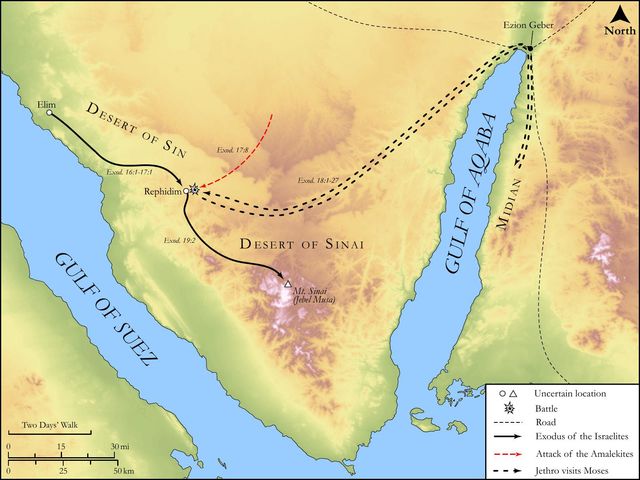
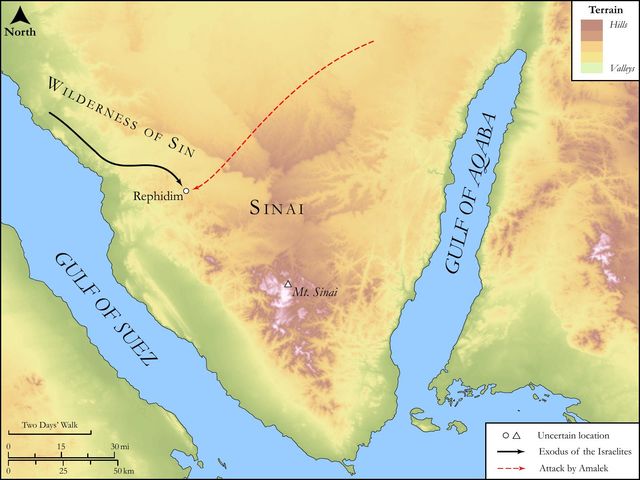
See on the biblical-era maps

Study this verse
Public-domain commentary
Matthew Henry
From his Commentary on the Whole Bible. Henry comments on passages, not single verses — this entry covers Exodus 17:1–7. His two-level outline is real structure in the source text, so it is rendered as structure.
Here is, I. The strait that the children of Israel were in for want of water; once before the were in the like distress, and now, a second time, Exo 17:1. They journeyed according to the commandment of the Lord, led by the pillar of cloud and fire, and yet they came to a place where there was no water for them to drink. Note, We may be in the way of our duty, and yet may meet with troubles, which Providence brings us into for the trial of our faith, and that God may be glorified in our relief.
II.Their discontent and distrust in this strait.
It is said (Exo 17:3), They thirsted there for water. If they had no water to drink, they must needs thirst; but this intimates, not only that they wanted water and felt the inconvenience of that want, but that their passion sharpened their appetites and they were violent and impatient in their desire; their thirst made them outrageous. Natural desires, and those that are most craving, have need to be kept under the check and control of religion and reason. See what was the language of this inordinate desire.
1.They challenged Moses to supply them (Exo 17:2): Give us water, that we may drink, demanding it as a debt, and strongly suspecting that he was not able to discharge it. Because they were supplied with bread, they insist upon it that they must be supplied with water too; and indeed to those that by faith and prayer live a life of dependence upon God one favour is an earnest of another, and may be humbly pleaded; but the unthankful and unbelieving have reason to think that the abuse of former favours is the forfeiture of further favours: Let not them think that they shall receive any thing (Jam 1:7), yet they are ready to demand every thing.
2.They quarrelled with him for bringing them out of Egypt, as if, instead of delivering them, he designed to murder them, than which nothing could be more base and invidious, Exo 17:3. Many that have not only designed well, but done well, for their generation, have had their best services thus misconstrued, and their patience thereby tried, by unthinking unthankful people. To such a degree their malice against Moses rose that they were almost ready to stone him, Exo 17:4. Many good works he had shown them; and for which of these would they stone him? Joh 10:32. Ungoverned passions, provoked by the crossing of unbridled appetites, sometimes make men guilty of the greatest absurdities, and act like madmen, that cast firebrands, arrows, and death, among their best friends.
3.They began to question whether God were with them or not: They tempted the Lord, saying, "Is the Lord among us or not? Exo 17:7. Is Jehovah among us by that name by which he made himself known to us in Egypt?" They question his essential presence - whether there was a God or not; his common providence - whether that God governed the world; and his special promise - whether he would be as good as his word to them. This is called their tempting God, which signifies, not only a distrust of God in general, but a distrust of him after they had received such proofs of his power and goodness, for the confirmation of his promise. They do, in effect, suppose that Moses was an impostor, Aaron a deceiver, the pillar of cloud and fire a mere sham and illusion, which imposed upon their senses, that long series of miracles which had rescued them, served them, and fed them, a chain of cheats, and the promise of Canaan a banter upon them; it was all so, if the Lord was not among them. Note, It is a great provocation to God for us to question his presence, providence, or promise, especially for his Israel to do it, who are so peculiarly bound to trust him.
III.The course that Moses took, when he was thus set upon, and insulted.
1. He reproved the murmurers (Exo 17:2): Why chide you with me? Observe how mildly he answered them; it was well that he was a man of extraordinary meekness, else their tumultuous conduct would have made him lose the possession of himself: it is folly to answer passion with passion, for that makes bad worse; but soft answers turn away wrath. He showed them whom their murmurings reflected upon, and that the reproaches they cast on him fell on God himself: You tempt the Lord; that is, "By distrusting his power, you try his patience, and so provoke his wrath." 2. He made his complaint to God (Exo 17:4): Moses cried unto the Lord. This servant came, and showed his Lord all these things, Luk 14:21. When men unjustly censure us and quarrel with us, it will be a great relief to us to go to God, and by prayer lay the case before him and leave it with him: if men will not hear us, God will; if their bad conduct towards us ruffle our spirits, God's consolations will compose them. Moses begs of God to direct him what he should do, for he was utterly at a loss; he could not of himself either supply their want or pacify their tumult; God only could do it. He pleads his own peril: "They are almost ready to stone me; Lord, if thou hast any regard to the life of thy poor servant, interpose now."
IV.God's gracious appearance for their relief, Luk 14:5, Luk 14:6.
He orders Moses to go on before the people, and venture himself in his post, though they spoke of stoning him. He must take his rod with him, not (as God might justly have ordered) to summon some plague or other to chastise them for their distrust and murmuring, but to fetch water for their supply. O the wonderful patience and forbearance of God towards provoking sinners! He loads those with benefits that make him to serve with their sins, maintains those that are at war with him, and reaches out the hand of his bounty to those that lift up the heel against him. Thus he teaches us, if our enemy hunger, to feed him, and if he thirst, as Israel did now, to give him drink, Rom 12:20; Mat 5:44, Mat 5:45. Will he fail those that trust him, when he was so liberal even to those that tempted him? If God had only shown Moses a fountain of water in the wilderness, as he did Hagar not far hence (Gen 21:19), that would have been a great favour; but that he might show his power as well as his pity, and make it a miracle of mercy, he gave them water out of a rock. He directed Moses whither to go, and appointed him to take some of the elders of Israel with him, to be witnesses of what was done, that they might themselves be satisfied, and might satisfy others, of the certainty of God's presence with them. He promised to meet him there in the cloud of glory (to encourage him), and ordered him to smite the rock; Moses obeyed, and immediately water came out of the rock in great abundance, which ran throughout the camp in streams and rivers (Psa 78:15, Psa 78:16), and followed them wherever they went in that wilderness: it is called a fountain of waters, Psa 114:8. God showed the care he took of his people in giving them water when they wanted it; he showed his power in fetching the water out of a rock; and he put an honour upon Moses in appointing the water to flow out upon his smiting the rock. This fair water, that came out of the rock, is called honey and oil (Deu 32:13), because the people's thirst made it doubly pleasant; coming when they were in extreme want, it was like honey and oil to them. It is probable that the people digged canals for the conveyance of it, and pools for the reception of it, in like manner as, long afterwards, passing through the valley of Baca, they made it a well, Psa 84:6; Num 21:18. Let this direct us to live in a dependence, 1. Upon God's providence, even in the greatest straits and difficulties. God can open fountains for our supply where we least expect them, waters in the wilderness (Isa 43:20), because he makes a way in the wilderness, v. 19. Those who, in this wilderness, keep to God's way, may trust him to provide for them. While we follow the pillar of cloud and fire, surely goodness and mercy shall follow us, like the water out of the rock. 2. Upon Christ's grace: That rock was Christ, Co1 10:4. The graces and comforts of the Spirit are compared to rivers of living water, Joh 7:38, Joh 7:39; Joh 4:14. These flow from Christ, who is the rock smitten by the law of Moses, for he was made under the law. Nothing will supply the needs, and satisfy the desires, of a soul, but water out of this rock, this fountain opened. The pleasures of sense are puddle-water; spiritual delights are rock-water, so pure, so clear, so refreshing - rivers of pleasure.
V.A new name was, upon this occasion, given to the place, preserving the remembrance, not of the mercy of their supply (the water that followed them was sufficient to do that), but of the sin of their murmuring - Massah, temptation, because they tempted God; Meribah, strife, because they chid with Moses, Exo 17:7. There was thus a remembrance kept of sin, both for the disgrace of the sinners themselves (sin leaves a blot upon the name) and for warning to their seed to take heed of sinning after the similitude of their transgression.
Continue studying Exodus 17:2 across the web’s major study libraries — every link below opens this exact verse, chapter, or book on the destination site.
Read & Compare
 BibleGatewayThis verse in more than 200 translations and 70 languages.
 Bible.comThe YouVersion reader — hundreds of translations, reading plans, and highlights.
 ESV.orgCrossway's official English Standard Version reader.
 NET BibleThe NET translation with 60,000+ translators' notes on every rendering decision.
 STEP BibleTyndale House's free study tool — original text, vocabulary, and scholarly resources.
 BibliaLogos Bible Software's free web reader.
 USCCBThe New American Bible (Revised Edition) with the U.S. bishops' study notes.
Commentaries
 BibleHub CommentariesDozens of classic commentaries on this verse, gathered on one page.
 StudyLightMore than 100 commentary sets — the largest collection on the web.
 BibleRefPlain-English commentary on what this verse means, verse by verse.
 Enduring WordDavid Guzik's free commentary on this chapter, widely used by Bible teachers.
 Bible Study ToolsVerse commentary alongside Greek and Hebrew study aids.
Original Language & Research
- BibleHub InterlinearThe verse word by word — original language, transliteration, and English.
- BibleHub LexiconEvery word's original-language definition and Strong's entry.
 Blue Letter BibleDeep-study tools — Strong's numbers, concordance, and word studies.
 SefariaThe Hebrew text with Rashi and centuries of Jewish commentary.
Sermons, Hymns & Audio


TrulyRandomVerse is not affiliated with these sites and doesn’t control their content. They’re linked because they’re genuinely useful.
Summary
Exodus 17:2 vividly portrays a critical moment in the Israelites' wilderness journey where, despite recent divine provision, they vehemently confront Moses at Rephidim, demanding water. Moses, discerning the spiritual root of their complaint, identifies their actions not merely as an accusation against him, but as a profound act of "tempting the LORD," challenging God's presence and faithfulness amidst their desperate circumstances. This verse encapsulates the recurring theme of human impatience and lack of trust in the face of hardship, contrasting sharply with God's unwavering commitment to His covenant people.
Context
ShowHideLiterary Context
This verse is situated within a series of wilderness narratives in Exodus that highlight the Israelites' journey from slavery to nationhood, marked by repeated tests of faith and divine provision. Immediately preceding Exodus 17, the Israelites had experienced God's miraculous provision of manna and quail in Exodus 16, demonstrating His ability to sustain them in a barren land. This episode of demanding water at Rephidim (also known as Massah and Meribah in Exodus 17:7) follows quickly on the heels of that provision, underscoring the people's short memory and persistent lack of faith. The narrative then proceeds to God's command for Moses to strike the rock, providing water, and the subsequent battle with Amalek, further illustrating God's active presence and protection over His people.
Historical & Cultural Context
The setting of Rephidim was a desolate and arid region in the Sinai wilderness, where water was a critical necessity for the vast Israelite multitude, including their livestock. For an ancient nomadic people, the absence of water meant certain death. In this context, the people's desperation was understandable, but their reaction—"chiding" with Moses—was a significant cultural and spiritual act. In ancient Near Eastern societies, a leader was expected to provide for his people, and failure to do so could lead to open rebellion or a challenge to his authority. However, Moses correctly interprets their complaint as more than just an attack on his leadership; it was a challenge to God Himself. Their demand for water was a test of God's presence and power, questioning whether the God who had delivered them from Egypt (as seen in Exodus 14) was truly with them and capable of sustaining them in their present crisis.
Key Themes
ShowHideThis pivotal moment in Exodus 17 encapsulates several overarching themes central to the wilderness narrative and the broader book of Exodus. Firstly, it highlights the recurring theme of Divine Provision in the face of human need, demonstrating God's unwavering commitment to sustain His people even in the most desolate circumstances, as seen with the manna and quail in Exodus 16. Secondly, it starkly illustrates the theme of Human Faithlessness and Rebellion, as the Israelites repeatedly doubt God's presence and power, choosing to "test the LORD" rather than trust Him, a pattern that recurs throughout their wilderness journey (e.g., Numbers 14:22). Thirdly, the passage underscores the crucial role of Moses' Leadership and Intercession, as he stands between the complaining people and God, discerning the spiritual nature of their sin and appealing to God for intervention. Finally, it reinforces the theme of God's Enduring Presence and Patience, as He continues to provide for His rebellious people, revealing His covenant faithfulness despite their provocations, culminating in the miraculous provision of water from the rock (as detailed in Exodus 17:6).
Exposition and Analysis
ShowHideKey Word Analysis
ShowHideThis verb denotes a strong, often aggressive, contention or dispute, stemming from a root meaning "to grapple" or "to wrangle." It frequently carries legal or judicial overtones, implying a formal complaint or quarrel. The people were not merely grumbling but were entering into a serious confrontation with Moses, challenging his authority and, by extension, God's. It signifies a readiness to engage in litigation or a formal grievance.
This word means to test, try, prove, or put to the test. When directed towards God, it implies a doubting of His power, presence, or faithfulness, demanding that He demonstrate His capabilities. It is an act stemming from unbelief, rather than a humble seeking of divine intervention, and essentially challenges God's character and promises. Here, the people are putting God on trial, demanding proof of His existence or care.
This is the sacred, covenantal name of God, often translated as "Yahweh" or "Jehovah." Derived from the Hebrew verb "to be" (הָיָה, hayah), it signifies God's self-existence, eternal nature, and unchanging faithfulness. When the people "tempt the LORD," they are not merely testing a generic deity, but challenging the very character and covenant promises of the God who revealed Himself to Moses and delivered them from Egypt.
Verse Breakdown
ShowHide"Wherefore the people did chide with Moses"
This opening clause immediately establishes the confrontational nature of the people's response to their thirst. Instead of seeking God, they direct their anger and frustration at Moses, holding him personally responsible for their dire situation.
"and said, Give us water that we may drink"
This is a direct, imperative demand, not a humble request. It highlights their desperation and impatience, but also their expectation that Moses should instantly resolve their problem, betraying a lack of trust in God's ultimate sovereignty and provision.
"And Moses said unto them, Why chide ye with me?"
Moses' response reveals his understanding that he is merely God's instrument. He recognizes that their complaint, though directed at him, is fundamentally misdirected. By challenging him, they are challenging the divine authority that appointed him.
"wherefore do ye tempt the LORD?"
This is Moses' profound theological insight. He identifies the true spiritual nature of their rebellion: their demand for water is an act of "tempting" or "testing" God. This reveals their doubt about God's presence ("Is the LORD among us or not?" - Exodus 17:7) and His ability to provide, despite the overwhelming evidence of His power and faithfulness they had already witnessed. This accusation elevates their complaint from a logistical issue to a grave spiritual offense.
Literary Devices
ShowHideThe passage powerfully employs Dialogue to convey the raw tension and escalating conflict between the people and Moses. Moses' questions function as a Rhetorical Device, forcing the people to confront the true, spiritual implications of their actions. There is a strong element of Irony in the narrative: despite having recently experienced miraculous deliverance and sustenance, the people quickly revert to doubt and complaint, demonstrating a profound spiritual amnesia. The entire episode serves as a Cautionary Tale, illustrating the dangers of impatience, a lack of faith, and the temptation to test God's faithfulness, even when faced with seemingly insurmountable hardships.
Theological and Thematic Connections
ShowHideExodus 17:2 serves as a pivotal narrative for understanding the theological tension between human faithlessness and divine faithfulness. It underscores the profound spiritual danger of "testing the Lord," an act rooted in doubt and a short-sighted memory of God's past deliverances. Despite God's consistent demonstration of His power and care, the people's immediate response to hardship is complaint and accusation, revealing a deep-seated distrust. This episode highlights the recurring theme of God's patience and enduring commitment to His covenant people, even when they repeatedly fail to trust Him. It also sets the stage for the revelation of God's character as both provider and judge.
Reflection and Application
ShowHideExodus 17:2 offers a profound and sobering reflection on the human heart's propensity to doubt and complain, even in the face of overwhelming evidence of God's faithfulness. In our own lives, "wilderness" experiences – periods of scarcity, uncertainty, or intense pressure – often reveal the true measure of our faith. Do we, like the Israelites, quickly resort to grumbling, blaming, or demanding, implicitly questioning God's presence and power in our circumstances? Or do we, grounded in the remembrance of His past provisions and the certainty of His promises, turn to Him in prayer, patiently waiting and trusting that He is indeed "God with us" and able to provide? This passage challenges us to cultivate a robust, resilient faith that is not dependent on immediate gratification or the absence of difficulty, but is deeply rooted in the unchanging character and sovereign care of God. It calls us to resist the temptation to "test" God, choosing instead to rest in His unfailing love and wisdom, even when the path ahead seems dry and barren.
Questions for Reflection
ShowHideFAQ
ShowHideWhy did the people "chide" with Moses instead of praying to God?
ShowHideThe people's immediate reaction to "chide" with Moses, rather than turning to God in prayer, stems from a combination of desperation, short-sightedness, and a fundamental lack of faith. While their thirst was real and life-threatening, they had recently witnessed God's miraculous provision of manna and quail in Exodus 16, yet their memory of His faithfulness was quickly overshadowed by the immediate crisis. Their complaint to Moses was an attempt to hold their visible leader accountable for their suffering, rather than recognizing that their ultimate reliance should be on the invisible God who had led them out of Egypt (see Exodus 14:11-12). Moses rightly perceived this as a deeper spiritual issue – a "testing" of God's presence and power among them.
What does it mean to "tempt the LORD"?
ShowHideTo "tempt the LORD" (Hebrew: nâçâh) means to put God to the test, to challenge His power, faithfulness, or presence, often out of doubt or unbelief. It's not a sincere seeking of God's will, but rather a demand for Him to prove Himself on human terms. In Exodus 17:2, the Israelites were essentially saying, "If God is truly with us, let Him give us water." This act of testing implied a skepticism about God's ability or willingness to provide, despite His recent, overwhelming demonstrations of power in delivering them from Egypt and sustaining them in the wilderness. This act of testing is explicitly forbidden in the Law (see Deuteronomy 6:16) and is contrasted with a humble, expectant faith.
Christ-Centered Fulfillment
ShowHideExodus 17:2, with its stark depiction of the Israelites' thirst and their testing of the Lord, finds its profound Christ-centered fulfillment in the person and work of Jesus. The water that the Israelites demanded and subsequently received from the rock (as described in the verses immediately following Exodus 17:2) is explicitly identified by the Apostle Paul as a type of Christ, for "they drank from the spiritual rock that followed them, and the rock was Christ" (1 Corinthians 10:4). Just as the physical rock provided life-sustaining water in the barren wilderness, Jesus is the ultimate source of spiritual life and satisfaction, offering "living water" that eternally quenches the deepest thirst of the human soul (John 4:10-14 and John 7:37-38). Furthermore, the Israelites' sin of "testing the Lord" is directly addressed in the New Testament, as Jesus Himself, when tempted by Satan in the wilderness, quotes Deuteronomy 6:16 by declaring, "You shall not put the Lord your God to the test" (Matthew 4:7). Thus, Christ not only fulfills the prophetic type of the life-giving rock but also perfectly embodies the obedient faith that the Israelites lacked, never testing God but always trusting the Father's provision and will, even to the point of crying "I thirst" (John 19:28) on the cross, thereby providing the ultimate spiritual drink for all who believe.