


Exodus 17:3
- וַיִּצְמָאvai·yitz·Ma'and it was thirstyH6770Conj-w ¦ V-Qal-ConsecImperf-3msVerb Qal Consecutive Imperfect 3rd Singular Masculineוַandיִּצְמָאit was thirsty
- שָׁםshamthereH8033AdvAdverb
- הָעָםha·'Amthe peopleH5971Art ¦ N-msNoun Singular Masculine Absoluteהָtheעָםpeople
- לַמַּיִםla·Ma·yimfor <the> waterH4325Prep-l ¦ N-mpNoun Plural Masculine Absoluteלַfor <the>מַּיִםwater
- וַיָּלֶןvai·Ya·lenand it grumbledH3885Conj-w ¦ V-Hiphil-ConsecImperf-3msVerb Hiphil Consecutive Imperfect 3rd Singular Masculineוַandיָּלֶןit grumbled
- הָעָםha·'Amthe peopleH5971Art ¦ N-msNoun Singular Masculine Absoluteהָtheעָםpeople
- עַל'alonH5921PrepPreposition
- מֹשֶׁהmo·ShehMosesH4872N-proper-mNoun Proper Masculine
- וַיֹּאמֶרvai·Yo·merand it saidH559Conj-w ¦ V-Qal-ConsecImperf-3msVerb Qal Consecutive Imperfect 3rd Singular Masculineוַandיֹּאמֶרit said
- לָמָּהLa·mah<to> why?H4100Prep-l ¦ InterrogPronoun Interrogativeלָ<to>מָּהwhy?
- זֶּהzehthisH2088PrtParticle Demonstrative
- הֶעֱלִיתָנוּhe·'e·li·Ta·nudid you bring up usH5927V-Hiphil-Perf-2ms ¦ 1cpVerb Hiphil Perfect 2nd Singular Masculineהֶעֱלִיתָdid you bring upנוּus
- מִמִּצְרַיִםmi·mitz·Ra·yimfrom EgyptH4714Prep-m ¦ N-properNoun Proper LocationמִfromמִּצְרַיִםEgypt
- לְהָמִיתle·ha·Mitto put to deathH4191Prep-l ¦ V-Hiphil-InfVerb Hiphil Infinitive Constructלְtoהָמִיתput to death
- אֹתִי'o·Ti<obj.> meH853DirObjM ¦ 1csParticle Object Indicatorאֹתִ<obj.>יme
- וְאֶתve·'Etand <obj.>H853Conj-w ¦ DirObjMParticle Object Indicatorוְandאֶת<obj.>
- בָּנַיba·Naimy childrenH1121N-mpc ¦ 1csNoun Plural Masculine Constructבָּנַchildrenיmy
- וְאֶתve·'Etand <obj.>H853Conj-w ¦ DirObjMParticle Object Indicatorוְandאֶת<obj.>
- מִקְנַיmik·Naimy livestockH4735N-msc ¦ 1csNoun Singular Masculine Constructמִקְנַlivestockיmy
- בַּצָּמָאba·tza·Ma'by <the> thirstH6772Prep-b ¦ N-msNoun Singular Masculine Absoluteבַּby <the>צָּמָאthirst
English is a literal word-by-word gloss of the Hebrew, not the KJV's wording. Why?
This is the original text the KJV's translators worked from — each Hebrew word with its own literal English meaning in this verse, prepared by scholars at Tyndale House, Cambridge. The KJV translates whole sentences, not word by word, so its wording differs: one Hebrew word can become several English words, and the KJV may choose “the LORD” where the gloss reads “Yahweh”. Both are faithful — they answer different questions. For the KJV's own rendering, switch to the KJV text.
Details
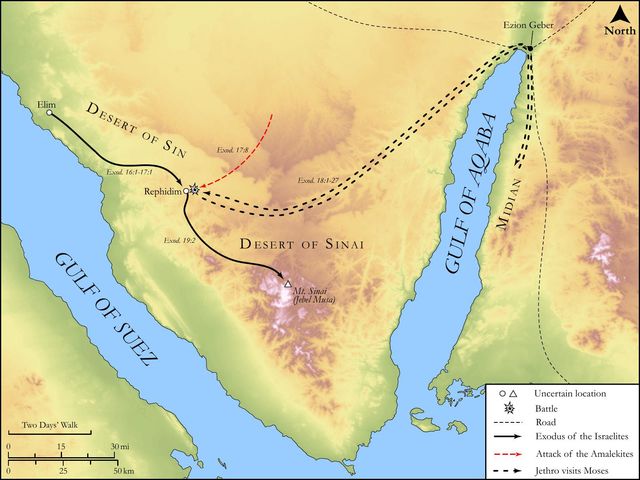
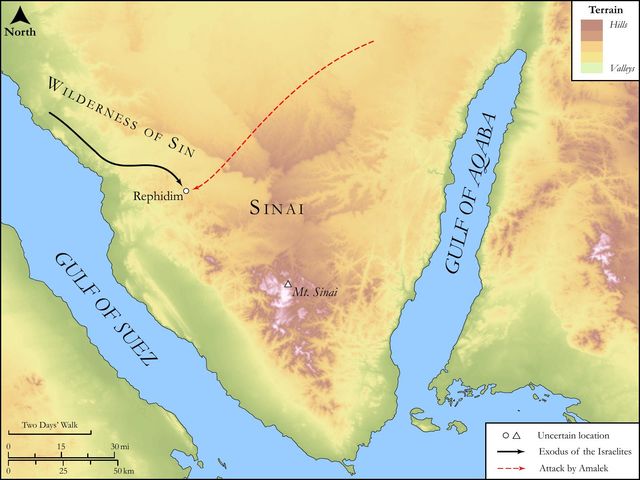
See on the biblical-era map

Study this verse
Public-domain commentary
Matthew Henry
From his Commentary on the Whole Bible. Henry comments on passages, not single verses — this entry covers Exodus 17:1–7. His two-level outline is real structure in the source text, so it is rendered as structure.
Here is, I. The strait that the children of Israel were in for want of water; once before the were in the like distress, and now, a second time, Exo 17:1. They journeyed according to the commandment of the Lord, led by the pillar of cloud and fire, and yet they came to a place where there was no water for them to drink. Note, We may be in the way of our duty, and yet may meet with troubles, which Providence brings us into for the trial of our faith, and that God may be glorified in our relief.
II.Their discontent and distrust in this strait.
It is said (Exo 17:3), They thirsted there for water. If they had no water to drink, they must needs thirst; but this intimates, not only that they wanted water and felt the inconvenience of that want, but that their passion sharpened their appetites and they were violent and impatient in their desire; their thirst made them outrageous. Natural desires, and those that are most craving, have need to be kept under the check and control of religion and reason. See what was the language of this inordinate desire.
1.They challenged Moses to supply them (Exo 17:2): Give us water, that we may drink, demanding it as a debt, and strongly suspecting that he was not able to discharge it. Because they were supplied with bread, they insist upon it that they must be supplied with water too; and indeed to those that by faith and prayer live a life of dependence upon God one favour is an earnest of another, and may be humbly pleaded; but the unthankful and unbelieving have reason to think that the abuse of former favours is the forfeiture of further favours: Let not them think that they shall receive any thing (Jam 1:7), yet they are ready to demand every thing.
2.They quarrelled with him for bringing them out of Egypt, as if, instead of delivering them, he designed to murder them, than which nothing could be more base and invidious, Exo 17:3. Many that have not only designed well, but done well, for their generation, have had their best services thus misconstrued, and their patience thereby tried, by unthinking unthankful people. To such a degree their malice against Moses rose that they were almost ready to stone him, Exo 17:4. Many good works he had shown them; and for which of these would they stone him? Joh 10:32. Ungoverned passions, provoked by the crossing of unbridled appetites, sometimes make men guilty of the greatest absurdities, and act like madmen, that cast firebrands, arrows, and death, among their best friends.
3.They began to question whether God were with them or not: They tempted the Lord, saying, "Is the Lord among us or not? Exo 17:7. Is Jehovah among us by that name by which he made himself known to us in Egypt?" They question his essential presence - whether there was a God or not; his common providence - whether that God governed the world; and his special promise - whether he would be as good as his word to them. This is called their tempting God, which signifies, not only a distrust of God in general, but a distrust of him after they had received such proofs of his power and goodness, for the confirmation of his promise. They do, in effect, suppose that Moses was an impostor, Aaron a deceiver, the pillar of cloud and fire a mere sham and illusion, which imposed upon their senses, that long series of miracles which had rescued them, served them, and fed them, a chain of cheats, and the promise of Canaan a banter upon them; it was all so, if the Lord was not among them. Note, It is a great provocation to God for us to question his presence, providence, or promise, especially for his Israel to do it, who are so peculiarly bound to trust him.
III.The course that Moses took, when he was thus set upon, and insulted.
1. He reproved the murmurers (Exo 17:2): Why chide you with me? Observe how mildly he answered them; it was well that he was a man of extraordinary meekness, else their tumultuous conduct would have made him lose the possession of himself: it is folly to answer passion with passion, for that makes bad worse; but soft answers turn away wrath. He showed them whom their murmurings reflected upon, and that the reproaches they cast on him fell on God himself: You tempt the Lord; that is, "By distrusting his power, you try his patience, and so provoke his wrath." 2. He made his complaint to God (Exo 17:4): Moses cried unto the Lord. This servant came, and showed his Lord all these things, Luk 14:21. When men unjustly censure us and quarrel with us, it will be a great relief to us to go to God, and by prayer lay the case before him and leave it with him: if men will not hear us, God will; if their bad conduct towards us ruffle our spirits, God's consolations will compose them. Moses begs of God to direct him what he should do, for he was utterly at a loss; he could not of himself either supply their want or pacify their tumult; God only could do it. He pleads his own peril: "They are almost ready to stone me; Lord, if thou hast any regard to the life of thy poor servant, interpose now."
IV.God's gracious appearance for their relief, Luk 14:5, Luk 14:6.
He orders Moses to go on before the people, and venture himself in his post, though they spoke of stoning him. He must take his rod with him, not (as God might justly have ordered) to summon some plague or other to chastise them for their distrust and murmuring, but to fetch water for their supply. O the wonderful patience and forbearance of God towards provoking sinners! He loads those with benefits that make him to serve with their sins, maintains those that are at war with him, and reaches out the hand of his bounty to those that lift up the heel against him. Thus he teaches us, if our enemy hunger, to feed him, and if he thirst, as Israel did now, to give him drink, Rom 12:20; Mat 5:44, Mat 5:45. Will he fail those that trust him, when he was so liberal even to those that tempted him? If God had only shown Moses a fountain of water in the wilderness, as he did Hagar not far hence (Gen 21:19), that would have been a great favour; but that he might show his power as well as his pity, and make it a miracle of mercy, he gave them water out of a rock. He directed Moses whither to go, and appointed him to take some of the elders of Israel with him, to be witnesses of what was done, that they might themselves be satisfied, and might satisfy others, of the certainty of God's presence with them. He promised to meet him there in the cloud of glory (to encourage him), and ordered him to smite the rock; Moses obeyed, and immediately water came out of the rock in great abundance, which ran throughout the camp in streams and rivers (Psa 78:15, Psa 78:16), and followed them wherever they went in that wilderness: it is called a fountain of waters, Psa 114:8. God showed the care he took of his people in giving them water when they wanted it; he showed his power in fetching the water out of a rock; and he put an honour upon Moses in appointing the water to flow out upon his smiting the rock. This fair water, that came out of the rock, is called honey and oil (Deu 32:13), because the people's thirst made it doubly pleasant; coming when they were in extreme want, it was like honey and oil to them. It is probable that the people digged canals for the conveyance of it, and pools for the reception of it, in like manner as, long afterwards, passing through the valley of Baca, they made it a well, Psa 84:6; Num 21:18. Let this direct us to live in a dependence, 1. Upon God's providence, even in the greatest straits and difficulties. God can open fountains for our supply where we least expect them, waters in the wilderness (Isa 43:20), because he makes a way in the wilderness, v. 19. Those who, in this wilderness, keep to God's way, may trust him to provide for them. While we follow the pillar of cloud and fire, surely goodness and mercy shall follow us, like the water out of the rock. 2. Upon Christ's grace: That rock was Christ, Co1 10:4. The graces and comforts of the Spirit are compared to rivers of living water, Joh 7:38, Joh 7:39; Joh 4:14. These flow from Christ, who is the rock smitten by the law of Moses, for he was made under the law. Nothing will supply the needs, and satisfy the desires, of a soul, but water out of this rock, this fountain opened. The pleasures of sense are puddle-water; spiritual delights are rock-water, so pure, so clear, so refreshing - rivers of pleasure.
V.A new name was, upon this occasion, given to the place, preserving the remembrance, not of the mercy of their supply (the water that followed them was sufficient to do that), but of the sin of their murmuring - Massah, temptation, because they tempted God; Meribah, strife, because they chid with Moses, Exo 17:7. There was thus a remembrance kept of sin, both for the disgrace of the sinners themselves (sin leaves a blot upon the name) and for warning to their seed to take heed of sinning after the similitude of their transgression.
Historical interpretation
Historical reception
1 surviving comment on this verse from the historical church.
What then does Scripture mention in what follows? “In their thirst for water, the people grumbled against Moses.” Perhaps this word that he said may seem superfluous, that the people thirsted for water. For since he said, “In their thirst,” what need was there to add “for water”? Thus indeed the ancient translation has it. Why did he add this, except because they thirsted for water when they should have thirsted for justice? “Blessed are they who hunger and thirst for justice”; and again, “thirst is my soul for the living God.” Many people are thirsty, both the just and sinners; the former thirst after justice, the latter after dissipation. The just are thirsty for God; sinners for gold. For this reason the people thirsted after water when they should have thirsted after justice.
Continue studying Exodus 17:3 across the web’s major study libraries — every link below opens this exact verse, chapter, or book on the destination site.
Read & Compare
 BibleGatewayThis verse in more than 200 translations and 70 languages.
 Bible.comThe YouVersion reader — hundreds of translations, reading plans, and highlights.
 ESV.orgCrossway's official English Standard Version reader.
 NET BibleThe NET translation with 60,000+ translators' notes on every rendering decision.
 STEP BibleTyndale House's free study tool — original text, vocabulary, and scholarly resources.
 BibliaLogos Bible Software's free web reader.
 USCCBThe New American Bible (Revised Edition) with the U.S. bishops' study notes.
Commentaries
 BibleHub CommentariesDozens of classic commentaries on this verse, gathered on one page.
 StudyLightMore than 100 commentary sets — the largest collection on the web.
 BibleRefPlain-English commentary on what this verse means, verse by verse.
 Enduring WordDavid Guzik's free commentary on this chapter, widely used by Bible teachers.
 Bible Study ToolsVerse commentary alongside Greek and Hebrew study aids.
Original Language & Research
- BibleHub InterlinearThe verse word by word — original language, transliteration, and English.
- BibleHub LexiconEvery word's original-language definition and Strong's entry.
 Blue Letter BibleDeep-study tools — Strong's numbers, concordance, and word studies.
 SefariaThe Hebrew text with Rashi and centuries of Jewish commentary.
Sermons, Hymns & Audio


TrulyRandomVerse is not affiliated with these sites and doesn’t control their content. They’re linked because they’re genuinely useful.
Summary
Exodus 17:3 powerfully encapsulates the Israelites' profound desperation in the arid wilderness of Rephidim, where an acute lack of water ignited a fervent outburst of complaint and accusation against Moses. This pivotal moment reveals the people's overwhelming fear for their lives, the lives of their children, and their precious livestock, leading them to question God's very purpose in delivering them from Egypt, perceiving His divine intention as one of destruction rather than faithful provision and guidance.
Context
ShowHideLiterary Context
This verse is deeply embedded within the broader narrative of the Israelites' challenging journey through the wilderness following their miraculous exodus from Egypt and the awe-inspiring crossing of the Red Sea. Immediately preceding this account, Exodus 17:1-2 recounts their arrival at Rephidim, where the critical absence of water prompted their immediate and intense contention with Moses, demanding, "Give us water that we may drink." This instance of murmuring is not isolated but is part of a recurring pattern of discontent that began with the bitter waters at Marah (Exodus 15:24) and the lack of food in the Wilderness of Sin (Exodus 16:2-3). The accusation in Exodus 17:3 escalates their discontent from mere complaint to a direct challenge of Moses's, and by extension, God's, intentions, setting the dramatic stage for God's miraculous provision of water from the rock at Horeb, detailed in Exodus 17:4-7.
Historical & Cultural Context
The journey of the Israelites through the vast and unforgiving Sinai wilderness was inherently fraught with extreme environmental challenges. The arid desert landscape, characterized by expansive stretches of rock, sand, and scarce vegetation, offered minimal natural resources, especially water. For a multitude estimated to be as large as two million people, alongside their immense herds of livestock, the daily need for water was staggering and absolutely critical for survival. In the ancient Near East, leaders were fundamentally expected to provide for their people, and any perceived failure to do so could swiftly lead to rebellion, mutiny, or abandonment. The Israelites' recent experience as slaves in Egypt, where their basic needs, though met under harsh conditions, were consistently provided, likely contributed to their expectation of immediate provision and their quick descent into fear and accusation when faced with deprivation. Their desperate question, "Wherefore [is] this [that] thou hast brought us up out of Egypt, to kill us and our children and our cattle with thirst?" vividly reflects a deeply ingrained survival instinct and a cultural understanding of leadership responsibility, but also a profound spiritual amnesia regarding God's recent, powerful acts of deliverance, such as the plagues on Egypt and the miraculous crossing of the Red Sea.
Key Themes
ShowHideExodus 17:3 contributes significantly to several overarching theological and narrative themes woven throughout the book of Exodus and the Pentateuch. Firstly, it powerfully illustrates the theme of Divine Testing and Human Faithlessness. God repeatedly leads Israel into situations that test their trust in His provision and promises, and repeatedly, the people fail these tests, revealing their spiritual fragility and tendency towards doubt. Secondly, it underscores the theme of God's Unfailing Provision Amidst Rebellion. Despite the Israelites' murmuring and accusations, God consistently demonstrates His faithfulness by providing for their needs, whether it be food (Exodus 16) or water (Exodus 15:25; Exodus 17:6). This highlights God's patience and His commitment to His covenant people, even when they are undeserving. Finally, the narrative solidifies the theme of Moses's Mediatorial Role and Burden. Moses stands between God and the people, bearing the brunt of their complaints and interceding on their behalf, a role that foreshadows the ultimate mediator. The people's repeated challenges to Moses's leadership are implicitly challenges to God's authority, as Moses is God's chosen representative.
Exposition and Analysis
ShowHideKey Word Analysis
ShowHideThis verb denotes a deep, urgent, and often agonizing physical craving for water, indicating a life-threatening condition. It profoundly underscores the severity of the people's predicament and the immediacy of their physiological need. This intense physical desperation serves as the direct catalyst for their subsequent spiritual and relational failure, moving them from need to accusation.
This word is frequently and significantly used throughout the Pentateuch to describe the Israelites' persistent grumbling, complaining, and often obstinate challenging of Moses and Aaron. Crucially, this murmuring is consistently interpreted by the divine narrative as being directed ultimately against God Himself. It signifies a deep-seated discontent, a profound lack of trust in divine leadership and provision, and a challenge to established authority that borders on open rebellion rather than a simple, humble expression of need.
This primitive root, used here in its causative form ("to kill" or "to put to death"), reveals the extreme and hyperbolic accusation leveled against Moses and, by direct implication, against God. It expresses the people's conviction that their miraculous deliverance from Egyptian bondage was not intended for life and freedom, but rather for a slow, agonizing death by thirst in the wilderness. This dramatic and unfounded accusation powerfully demonstrates their overwhelming fear, their profound lack of faith, and their complete misinterpretation of God's redemptive purposes for them.
Verse Breakdown
ShowHide"And the people thirsted there for water;"
This initial clause establishes the dire and immediate physical reality confronting the Israelites. The complete absence of water in the arid wilderness of Rephidim was not merely an inconvenience but an existential threat to life, impacting every individual, including their vulnerable children and valuable livestock. This critical physical need serves as the undeniable trigger for their subsequent emotional and spiritual reactions.
"and the people murmured against Moses, and said, Wherefore [is] this [that] thou hast brought us up out of Egypt, to kill us and our children and our cattle with thirst?"
This extended and highly charged clause reveals the people's desperate and rebellious response to their thirst. Their "murmuring" signifies a deep, grumbling discontent and a direct challenge to Moses's leadership, which, within the biblical narrative, is consistently understood as a challenge to God's divine plan and authority. Their rhetorical question, "Wherefore [is] this [that] thou hast brought us up out of Egypt," is not a genuine inquiry but a bitter, accusatory statement, implying that Moses's (and God's) intention was malicious—to lead them out of slavery only to perish miserably in the desert. The explicit inclusion of "our children and our cattle" emphasizes the perceived totality of their impending doom and their desperate fear for all that they held dear, powerfully highlighting the severity of their distrust and their complete loss of perspective.
Literary Devices
ShowHideExodus 17:3 masterfully employs several potent literary devices to convey the depth of the Israelites' despair and faithlessness. Hyperbole is strikingly evident in the people's accusation that Moses brought them out of Egypt "to kill us and our children and our cattle with thirst." While their situation was undeniably dire, this statement grossly exaggerates Moses's (and God's) intent, framing their miraculous deliverance as a premeditated death sentence rather than a liberation. This extreme language vividly underscores their panic, their profound lack of faith, and their short-sightedness. There is also a strong element of Irony in their complaint. They accuse Moses of leading them out to their demise, completely overlooking the countless instances where God had miraculously preserved their lives and provided for them, including their very escape from the formidable bondage of Egypt. This ironic accusation starkly reveals their spiritual blindness and their astonishingly short-term memory. Furthermore, the act of murmuring against Moses functions as a practical form of Anthropomorphism in the narrative; although their words are ostensibly directed at Moses, the biblical text consistently portrays such complaints as ultimately being directed against God Himself, as seen clearly in Exodus 16:8.
Theological and Thematic Connections
ShowHideExodus 17:3 serves as a profound theological statement about the persistent nature of human faithlessness in the face of unwavering divine faithfulness. It powerfully highlights the recurring biblical theme of "testing God," where the people's complaints and accusations are not merely understandable expressions of physical need, but rather a deep-seated distrust in God's character, His redemptive purposes, and His providential care. Despite having recently witnessed God's mighty acts of deliverance, judgment, and provision—from the plagues on Egypt to the parting of the Red Sea and the provision of manna—their faith falters dramatically under the immediate pressure of thirst. This episode starkly reveals the human propensity to quickly forget divine goodness and revert to doubt, rebellion, and a self-centered perspective. It serves as a potent reminder that true, mature faith is not simply believing in God's existence, but actively trusting in His good intentions, His sovereign control, and His unfailing provision, even when circumstances appear overwhelming or contrary to expectation.
Reflection and Application
ShowHideExodus 17:3 serves as a powerful and timeless mirror for contemporary believers, revealing the enduring struggle between human fear and divine faithfulness. When confronted with overwhelming challenges, persistent unmet needs, or prolonged periods of waiting and uncertainty, it is all too easy for us to succumb to the same destructive pattern of murmuring, complaint, and even accusation against God or His appointed leaders. This verse challenges us to deeply examine our hearts: do we truly trust God's good intentions and His perfect plan even when His path leads us through our own personal "wilderness moments"? Do we diligently remember His past faithfulness, His countless acts of provision and deliverance, when our present circumstances seem dire, confusing, or threatening? The Israelites' profound failure reminds us that true, resilient faith is not the absence of fear, difficulty, or doubt, but rather the unwavering conviction that God, who has already delivered us from the ultimate bondage of sin through Christ, will surely provide for our present needs and faithfully guide us to His ultimate, promised destination. Our authentic response to hardship, whether it be with trust or complaint, reveals the true depth of our reliance on the One who holds all things securely in His sovereign hands.
Questions for Reflection
ShowHideFAQ
ShowHideWhy did the Israelites murmur so quickly and severely after witnessing so many miracles?
ShowHideThe rapid and severe murmuring of the Israelites, despite having recently witnessed awe-inspiring miracles such as the crossing of the Red Sea and the daily provision of manna and quail, highlights a profound and recurring human tendency towards spiritual amnesia and a lack of sustained, deep-seated faith. Their faith was often circumstantial and superficial, heavily dependent on immediate gratification and visible, tangible provision rather than a robust, enduring trust in God's unchanging character and His long-term redemptive plan. Life in the wilderness was inherently harsh, unfamiliar, and stripped away all their former securities, forcing them into a state of complete and utter dependence on God. When that critical dependence felt immediately threatened by a lack of water, their primal fear for survival quickly overshadowed their memory of God's past faithfulness and power, leading them to revert to a mindset of complaint, accusation, and even a desire to return to their former bondage (Numbers 14:3-4). This pattern of testing God and murmuring is a recurring and lamentable theme throughout the wilderness narrative, powerfully demonstrating the ongoing struggle to walk by faith and not by sight (2 Corinthians 5:7).
Christ-Centered Fulfillment
ShowHideExodus 17:3, with its poignant depiction of a thirsty and murmuring people, finds its profound Christ-centered fulfillment in multiple layers. The desperate physical need for water in the barren wilderness powerfully foreshadows humanity's deeper, spiritual thirst—a profound longing for meaning, forgiveness, and eternal life that only Christ can truly satisfy. Just as God miraculously provided life-giving water from the rock for the physical sustenance of Israel, so too does Jesus present Himself as the "living water" that eternally quenches the soul's deepest spiritual thirst (John 4:10-14 and John 7:37-38). The Apostle Paul explicitly identifies Christ as the spiritual Rock that supernaturally accompanied Israel in the wilderness, from whom they drank, thus revealing His pre-incarnate presence and provision (1 Corinthians 10:4). Furthermore, the Israelites' recurring pattern of murmuring, testing God, and accusing His chosen leader serves as a stark and sobering contrast to Christ's perfect obedience, unwavering trust, and steadfast faithfulness to the Father, even in the face of extreme temptation and profound suffering during His own wilderness experience (Matthew 4:1-11). Where Israel repeatedly failed to trust and accused their divine deliverer, Jesus perfectly fulfilled the Father's will, becoming the ultimate provision and the true Lamb of God who takes away the sin of the world, offering eternal life and spiritual satisfaction to all who believe (John 1:29 and John 3:16). He is the true and greater Moses, leading His people not merely out of physical bondage, but out of the spiritual slavery of sin and death into the promised land of eternal life and fellowship with God.