


Isaiah 7:15
Bible text: King James Version (1769 Blayney text) · Public domain
Bible text: Berean Standard Bible · Public domain
Bible text: American Standard Version (1901) · Public domain
Bible text: World English Bible, Messianic edition · Public domain
Bible text: Geneva Bible (1599) · Public domain
Bible text: Young's Literal Translation · Public domain
- חֶמְאָהchem·'Ahcurd<s>H2529N-fsNoun Singular Feminine Absolute
- וּדְבַשׁu·de·Vashand honeyH1706Conj-w ¦ N-msNoun Singular Masculine Absoluteוּandדְבַשׁhoney
- יֹאכֵלyo·Khelhe will eatH398V-Qal-Imperf-3msVerb Qal Imperfect 3rd Singular Masculine
- לְדַעְתּוֹle·da'·Toto knowing hisH3045Prep-l ¦ V-Qal-Inf ¦ 3msVerb Qal Infinitive Constructלְtoדַעְתּknowingוֹhis
- מָאוֹסma·'osto rejectH3988V-Qal-InfAbsVerb Qal Infinitive Absolute
- בָּרָעba·Ra'<in> the evilH7451Prep-b ¦ Adj-msAdjective Singular Masculine Absoluteבָּ<in> theרָעevil
- וּבָחוֹרu·va·Chorand to chooseH977Conj-w ¦ V-Qal-InfAbsVerb Qal Infinitive Absoluteוּandבָחוֹרto choose
- בַּטּוֹבba·Tov<in> the goodH2896Prep-b ¦ Adj-msAdjective Singular Masculine Absoluteבַּ<in> theטּוֹבgood
English is a literal word-by-word gloss of the Hebrew, not the KJV's wording. Why?
This is the original text the KJV's translators worked from — each Hebrew word with its own literal English meaning in this verse, prepared by scholars at Tyndale House, Cambridge. The KJV translates whole sentences, not word by word, so its wording differs: one Hebrew word can become several English words, and the KJV may choose “the LORD” where the gloss reads “Yahweh”. Both are faithful — they answer different questions. For the KJV's own rendering, switch to the KJV text.
Details
See on the biblical-era map
Study this verse
Public-domain commentary
Matthew Henry
From his Commentary on the Whole Bible. Henry comments on passages, not single verses — this entry covers Isaiah 7:10–16. His two-level outline is real structure in the source text, so it is rendered as structure.
Here, I. God, by the prophet, makes a gracious offer to Ahaz, to confirm the foregoing predictions, and his faith in them, by such sign or miracle as he should choose (Isa 7:10, Isa 7:11): Ask thee a sign of the Lord thy God; See here the divine faithfulness and veracity. God tells us nothing but what he is able and ready to prove. See his wonderful condescension to the children of men, in that he is so willing to show to the heirs of promise the immutability of his counsel, Heb 6:17. He considers our frame, and that, living in a world of sense, we are apt to require sensible proofs, which therefore he has favoured us with in sacramental signs and seals. Ahaz was a bad man, yet God is called the Lord his God, because he was a child of Abraham and David, and of the covenants made with them. See how gracious God is even to the evil and unthankful; Ahaz is bidden to choose his sign, as Gideon about the fleece (Jdg 6:37); let him ask for a sign in the air, or earth, or water, for God's power is the same in all.
II.Ahaz rudely refuses this gracious offer, and (which is not mannerly towards any superior) kicks at the courtesy, and puts a slight upon it (Isa 7:12): I will not ask. The true reason why he would not ask for a sign was because, having a dependence upon the Assyrians, their forces, and their gods, for help, he would not thus far be beholden to the God of Israel, or lay himself under obligations to him. He would not ask a sign for the confirming of his faith because he resolved to persist in his unbelief, and would indulge his doubts and distrusts; yet he pretends a pious reason: I will not tempt the Lord; as if it would be a tempting of God to do that which God himself invited and directed him to do. Note, A secret disaffection to God is often disguised with the specious colours of respect to him; and those who are resolved that they will not trust God yet pretend that they will not tempt him.
III.The prophet reproves him and his court, him and the house of David, the whole royal family, for their contempt of prophecy, and the little value they had for divine revelation (Isa 7:13) "Is it a small thing for you to weary men by your oppression and tyranny, with which you make yourselves burdensome and odious to all mankind? But will you weary my God also with the affronts you put upon him?" As the unjust judge that neither feared God nor regarded man, Luk 18:2. You have wearied the Lord with your words, Mal 2:17. Nothing is more grievous to the God of heaven than to be distrusted. "Will you weary my God? Will you suppose him to be tired and unable to help you, or to be weary of doing you good? Whereas the youths may faint and be weary, you may have tired all your friends, the Creator of the ends of the earth faints not, neither is weary." Isa 40:28-31. Or this: "In affronting the prophets, you think you put a slight only upon men like yourselves, and consider not that you affront God himself, whose messengers they are, and put a slight upon him, who will resent it accordingly." The prophet here calls God his God with a great deal of pleasure: Ahaz would not say, He is my God, though the prophet had invited him to say so (Isa 7:11): The Lord thy God; but Isaiah will say, "He is mine." Note, Whatever others do, we must avouch the Lord for ours and abide by him.
IV.The prophet, in God's name, gives them a sign:
"You will not ask a sign, but the unbelief of man shall not make the promise of God of no effect: The Lord himself shall give you a sign (Isa 7:14), a double sign."
1."A sign in general of his good-will to Israel and to the house of David. You may conclude it that he has mercy in store for you, and that you are not forsaken of your God, how great soever your present distress and danger are; for of your nation, of your family, the Messiah is to be born, and you cannot be destroyed while that blessing is in you, which shall be introduced," (1.) "In a glorious manner; for, whereas you have been often told that he should be born among you, I am now further to tell you that he shall be born of a virgin, which will signify both the divine power and the divine purity with which he shall be brought into the world, - that he shall be a extraordinary person, for he shall not be born by ordinary generation, - and that he shall be a holy thing, not stained with the common pollutions of the human nature, therefore incontestably fit to have the throne of his father David given him." Now this, though it was to be accomplished above 500 years after, was a most encouraging sign to the house of David (and to them, under that title, this prophecy is directed, Isa 7:13) and an assurance that God would not cast them off. Ephraim did indeed envy Judah (Isa 11:13) and sought the ruin of that kingdom, but could not prevail; for the sceptre should never depart from Judah till the coming of Shiloh, Gen 49:10. Those whom God designs for the great salvation may take that for a sign to them that they shall not be swallowed up by any trouble they meet with in the way. (2.) The Messiah shall be introduced on a glorious errand, wrapped up in his glorious name: They shall call his name Immanuel - God with us, God in our nature, God at peace with us, in covenant with us. This was fulfilled in their calling him Jesus - a Saviour (Mat 1:21-25), for, if he had not been Immanuel - God with us, he could not have been Jesus - a Saviour. Now this was a further sign of God's favour to the house of David and the tribe of Judah; for he that intended to work this great salvation among them no doubt would work out for them all those other salvations which were to be the types and figures of this, and as it were preludes to this. "Here is a sign for you, not in the depth nor in the height, but in the prophecy, in the promise, in the covenant made with David, which you are no strangers to. The promised seed shall be Immanuel, God with us; let that word comfort you (Isa 8:10), that God is with us, and (v. 8) that your land is Immanuel's land. Let not the heart of the house of David be moved thus (Isa 7:2), nor let Judah fear the setting up of the son of Tabeal (Isa 7:6), for nothing can cut off the entail on the Son of David that shall be Immanuel." Note, The strongest consolations, in time of trouble, are those which are borrowed from Christ, our relation to him, our interest in him, and our expectations of him and from him. Of this child it is further foretold (Isa 7:15) that though he shall not be born like other children, but of a virgin, yet he shall be really and truly man, and shall be nursed and brought up like other children: Butter and honey shall he eat, as other children do, particularly the children of that land which flowed with milk and honey. Though he be conceived by the power of the Holy Ghost, yet he shall not therefore be fed with angels' food, but, as it becomes him, shall be in all things made like unto his brethren, Heb 2:17. Nor shall he, though born thus by extraordinary generation, be a man immediately, but, as other children, shall advance gradually through the several states of infancy, childhood, and youth, to that of manhood, and growing in wisdom and stature, shall at length wax strong in spirit, and come to maturity, so as to know how to refuse the evil and choose the good. See Luk 2:40, Luk 2:52. Note, Children are fed when they are little that they may be taught and instructed when they have grown up; they have their maintenance in order to their education.
2.Here is another sign in particular of the speedy destruction of these potent princes that were now a terror to Judah, Isa 7:16. "Before this child (so it should be read), this child which I have now in my arms" (he means not Immanuel, but Shear-jashub his own son, whom he was ordered to take with him for a sign, Isa 7:3), "before this child shall know how to refuse the evil and choose the good" (and those who saw what his present stature and forwardness were would easily conjecture how long that would be), "before this child be three or four years older, the land that thou abhorrest, these confederate forces of Israelites and Syrians, which thou hast such an enmity to and standest in such dread of, shall be forsaken of both their kings, both Pekah and Rezin," who were in so close an alliance that they seemed as if they were the kings of but one kingdom. This was fully accomplished; for within two or three years after this, Hoshea conspired against Pekah, and slew him (Kg2 15:30), and, before that, the king of Assyria took Damascus, and slew Rezin, Kg2 16:9. Nay, there was a present event, which happened immediately, and when this child carried the prediction of in his name, which was a pledge and earnest of this future event. Shear-jashub signifies The remnant shall return, which doubtless points at the wonderful return of those 200,000 captives whom Pekah and Rezin had carried away, who were brought back, not by might or power, but by the Spirit of the Lord of hosts. Read the story, Ch2 28:8-15. The prophetical naming of this child having thus had its accomplishment, no doubt this, which was further added concerning him, should have its accomplishment likewise, that Syria and Israel should be deprived of both their kings. One mercy from God encourages us to hope for another, if it engages us to prepare for another.
Historical interpretation
Five Centuries of Reception
4 surviving comments on this verse. Each one is dated, so this reads as a timeline rather than a list.
Select a marker to jump to its quote. Markers stagger vertically where authors wrote within a few decades of each other.
For the one and the same Spirit of God, who proclaimed by the prophets what and of what sort the advent of the Lord should be, did by these elders give a just interpretation of what had been truly prophesied; and He did Himself, by the apostles, announce that the fullness of the times of the adoption had arrived, that the kingdom of heaven had drawn near, and that He was dwelling within those that believe in Him who was born Emmanuel of the Virgin. To this effect they testify, [saying,] that before Joseph had come together with Mary, while she therefore remained in virginity, "she was found with child of the Holy Ghost;" [Matthew 1:18] and that the angel Gabriel said to her, "The Holy Ghost shall come upon you, and the power of the Highest shall overshadow you; therefore also that holy thing which shall be born of you shall be called the Son of God;" [Luke 1:35] and that the angel said to Joseph in a dream, "Now this was done, that it might be fulfilled which was spoken by Isaiah the prophet, Behold, a virgin shall be with child." [Matthew 1:23] But the elders have thus interpreted what Esaias said: "And the Lord, moreover, said to Ahaz, Ask for yourself a sign from the Lord your God out of the depth below, or from the height above. And Ahaz said, I will not ask, and I will not tempt the Lord. And he said, It is not a small thing for you to weary men; and how does the Lord weary them? Therefore the Lord himself shall give you a sign; Behold, a virgin shall conceive, and bear a son; and you shall call His name Emmanuel. Butter and honey shall He eat: before He knows or chooses out things that are evil, He shall exchange them for what is good; for before the child knows good or evil, He shall not consent to evil, that He may choose that which is good." [Isaiah 7:10-17] Carefully, then, has the Holy Ghost pointed out, by what has been said, His birth from a virgin, and His essence, that He is God (for the name Emmanuel indicates this). And He shows that He is a man, when He says, "Butter and honey shall He eat;" and in that He terms Him a child also, [in saying,] "before He knows good and evil;" for these are all the tokens of a human infant. But that He "will not consent to evil, that He may choose that which is good,"— this is proper to God; that by the fact, that He shall eat butter and honey, we should not understand that He is a mere man only, nor, on the other hand, from the name Emmanuel, should suspect Him to be God without flesh.
This is said [“The child grew in wisdom and in age before God and men”] in order to establish the truth of his human body. Nevertheless, wrapped in swaddling clothes and fed with curds and honey, he will have the judgment to distinguish between good and evil, that rejecting evil he might choose the good. It does not say that he will in fact reject and choose but that he would learn to reject and to choose, so that we might know through such words that this pertains to the infant’s human body, not to divine wisdom. Finally, it must be believed that the angels who announced to shepherds the news of the infant lying in a manger and the magi who came from the east to worship him were chosen. Herod, the scribes and the Pharisees, on the other hand, were condemned because they slaughtered thousands of children for the sake of one infant.
(Verse 15) He shall eat butter and honey, so that he may know how to refuse the evil and choose the good. For before he knows to refuse the evil and choose the good, the land that you dread will be forsaken by both her kings. The Lord will bring the king of Assyria upon you and your people and your father's house—days that have not come since the day that Ephraim departed from Judah. And it shall come to pass in that day, that the Lord shall hiss for the fly that is in the uttermost part of the rivers of Egypt, and for the bee that is in the land of Assyria. And they shall come, and shall rest all of them in the desolate valleys, and in the holes of the rocks, and upon all thorns, and upon all bushes. I will say something even more amazing, so that you do not think that he is born in a fantasy, he will use foods of infancy, he will eat butter and milk. And although many centuries later the Evangelist testifies about him: But the child grew in wisdom and age and grace before God and men (Luke 2:52): and this is said to confirm the truth of the human body: yet still wrapped in swaddling clothes, and fed with butter and honey, he will have the ability to judge between good and evil, so that he may reject evil and choose good. Not because he did or disapproved or chose this, but because he knew how to disapprove and choose, so that through these words we may know that the infancy of the human body did not hinder divine wisdom. Lastly, the Angels announce to the shepherds the laying in the manger: The Magi adore coming from the East, whom it is to be believed were certainly chosen. And on the other hand, Herod, the scribes, and the Pharisees are disapproved, (Matthew 2), because they killed many thousands of infants for the sake of one child.
Now, since the Lord was not a mere man but was also God and knew all things, he stood in no need of reflection, inquiry, counsel or judgment. He also had a natural affinity for good and antipathy for evil. Thus it is in this sense that the prophet Isaiah, too, says, “Before the child shall know to refuse the evil, he will choose the good. For before the child knows to refuse the evil and to choose the good, he will reject the evil by choosing the good.” The “before” shows that he made no inquiry or investigation in a human manner but that since he was God and divinely subsisted in the flesh—that is to say, was personally united to the flesh—by the fact of his very being and his knowing all things he naturally possessed the good.
Continue studying Isaiah 7:15 across the web’s major study libraries — every link below opens this exact verse, chapter, or book on the destination site.
Read & Compare
 BibleGatewayThis verse in more than 200 translations and 70 languages.
 Bible.comThe YouVersion reader — hundreds of translations, reading plans, and highlights.
 ESV.orgCrossway's official English Standard Version reader.
 NET BibleThe NET translation with 60,000+ translators' notes on every rendering decision.
 STEP BibleTyndale House's free study tool — original text, vocabulary, and scholarly resources.
 BibliaLogos Bible Software's free web reader.
 USCCBThe New American Bible (Revised Edition) with the U.S. bishops' study notes.
Commentaries
 BibleHub CommentariesDozens of classic commentaries on this verse, gathered on one page.
 StudyLightMore than 100 commentary sets — the largest collection on the web.
 BibleRefPlain-English commentary on what this verse means, verse by verse.
 Enduring WordDavid Guzik's free commentary on this chapter, widely used by Bible teachers.
 Bible Study ToolsVerse commentary alongside Greek and Hebrew study aids.
Original Language & Research
- BibleHub InterlinearThe verse word by word — original language, transliteration, and English.
- BibleHub LexiconEvery word's original-language definition and Strong's entry.
 Blue Letter BibleDeep-study tools — Strong's numbers, concordance, and word studies.
 SefariaThe Hebrew text with Rashi and centuries of Jewish commentary.
Sermons, Hymns & Audio


TrulyRandomVerse is not affiliated with these sites and doesn’t control their content. They’re linked because they’re genuinely useful.
Summary
Isaiah 7:15, an integral part of the Immanuel prophecy, describes the early life and moral development of the child promised as a divine sign to King Ahaz. The verse, "Butter and honey shall he eat, that he may know to refuse the evil, and choose the good," not only details the sustenance available during a period of national upheaval but also signifies the essential process of moral maturation. This detail serves as a critical timeframe for the fulfillment of God's judgment and deliverance, underscoring the natural progression of human discernment and the divine purpose woven into the child's growth amidst challenging circumstances.
Context
ShowHideLiterary Context
Isaiah 7:15 is deeply embedded within the "Immanuel prophecy," which spans Isaiah 7:1-17. It immediately follows the pivotal declaration in Isaiah 7:14 that a virgin will conceive and bear a son named Immanuel, meaning "God With Us." Verse 15 then elaborates on this child's early life, specifically his diet and, more significantly, his moral development. This detail is crucial for establishing a timeframe for the prophecy's fulfillment: before this child reaches an age of moral discernment, the lands of the two kings Ahaz fears—Rezin of Aram (Syria) and Pekah of Israel—will be laid waste by Assyria. The subsequent verses in Isaiah 7 further detail the extensive desolation that will come upon Judah itself, indicating a return to a more primitive, pastoral existence, which the diet of "butter and honey" foreshadows. Thus, the verse functions as both a sign of God's immediate intervention and a marker of future judgment.
Historical & Cultural Context
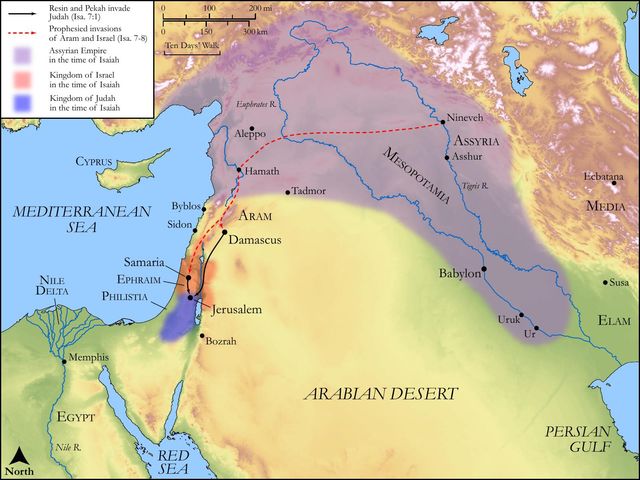
The historical setting for Isaiah 7 is the Syro-Ephraimite War, circa 735-734 BC. King Ahaz of Judah faced an existential threat from a coalition of Aram (Syria) and the northern kingdom of Israel, who aimed to depose him and install a pro-Syrian ruler. Despite God's direct offer of a sign through the prophet Isaiah, Ahaz refused to trust in the Lord, instead opting to seek a perilous alliance with the powerful Assyrian Empire. It is within this climate of fear, political intrigue, and a profound crisis of faith that Isaiah delivers God's message of assurance and judgment. The diet of "butter and honey" (often interpreted as curds/thickened milk and wild honey) carries a dual cultural significance. While "a land flowing with milk and honey" (Exodus 3:8) typically symbolizes abundance and blessing, in this specific context, it points to a return to a basic, pastoral existence. It suggests that the land, ravaged by war and the subsequent Assyrian invasion, would be so devastated that cultivated agriculture would cease, forcing the populace to rely on the simpler sustenance provided by livestock and wild foraging. This diet, therefore, signifies survival in a desolated land rather than prosperity.
Key Themes
ShowHideIsaiah 7:15 significantly contributes to several overarching themes within the book of Isaiah and the broader biblical narrative. Firstly, it powerfully illustrates Divine Providence Amidst Crisis. Even as King Ahaz demonstrates a profound lack of faith and seeks human alliances, God's sovereign plan unfolds, providing a sign and ensuring sustenance, demonstrating His control over history. Secondly, the verse highlights the theme of Moral Maturity and Discernment. The child's growth to an age where he can "refuse the evil, and choose the good" underscores the natural human progression from infancy to moral accountability. This concept of discerning good from evil is a foundational aspect of wisdom and ethical living throughout Scripture, echoed in passages like Deuteronomy 1:39 where children are described as not yet knowing good or evil. Thirdly, the verse functions as a crucial piece of Prophetic Symbolism and a Timeframe for Judgment. The child's development serves as a temporal marker for the defeat of Judah's immediate enemies and the subsequent transformation of the land. Finally, and most profoundly, the entire context of the Immanuel prophecy reinforces the powerful truth of God With Us (Immanuel), signifying God's active presence and unwavering intervention in human history, even in times of national crisis and human faithlessness.
Exposition and Analysis
ShowHideKey Word Analysis
ShowHideDerived from a root suggesting something thick or curdled, this term specifically refers to curdled milk or cheese, and by extension, butter. In the context of the verse, it denotes a basic, readily available pastoral food source, suggesting a reliance on livestock products. This points to a simple, yet nourishing, form of sustenance that would be accessible even if agricultural cultivation were disrupted.
From an unused root meaning "to be gummy," this word refers to honey, typically wild honey gathered from natural sources, or by analogy, syrup. Paired with "butter," it completes the picture of a diet derived from natural, uncultivated sources. It symbolizes the availability of fundamental provisions in a land affected by war, implying a return to a more primitive, self-sufficient way of life.
A primitive root meaning "to know," fundamentally implying "to ascertain by seeing." This versatile verb encompasses a broad spectrum of meanings, including observation, care, recognition, and, in a causative sense, instruction or designation. In Isaiah 7:15, it signifies the development of cognitive and moral discernment, reaching an age where one gains the practical, experiential understanding necessary to distinguish between moral qualities and make conscious choices.
Verse Breakdown
ShowHide"Butter and honey shall he eat"
This initial clause describes the sustenance of the promised child, Immanuel. The specific diet of curds/thickened milk and wild honey conveys a significant message about the conditions in the land. It suggests a shift to a pastoral economy, implying that while the land might be ravaged by war and invasion, basic necessities derived from livestock and wild foraging would still be available. This paints a picture of survival and a simpler way of life, rather than agricultural abundance, thus setting the stage for the circumstances under which the prophecy's timeframe would unfold.
"that he may know to refuse the evil, and choose the good"
This is the crucial purpose clause of the verse, articulating the primary reason for detailing the child's diet and growth. It indicates that the child will mature to an age of moral accountability and discernment. The phrase "to know to refuse the evil, and choose the good" functions as a Hebrew idiom, signifying the attainment of an age where one is capable of making deliberate, responsible ethical choices. This timeframe is profoundly significant for King Ahaz, as it means that before this child reaches such an age of moral understanding, the immediate threats from Syria and Israel will be neutralized. However, it also implies that Judah itself will undergo substantial changes, leading to the simpler, pastoral way of life described.
Literary Devices
ShowHideIsaiah 7:15 masterfully employs several significant literary devices to convey its multifaceted message. Symbolism is prominently featured in the phrase "butter and honey," which carries a dual meaning: while it can symbolize a land of abundance, in this specific context, it primarily represents a return to basic, even primitive, sustenance amidst desolation caused by war. This dual symbolism adds layers of depth to the prophetic message. The phrase "know to refuse the evil, and choose the good" functions as a powerful Idiom, conveying the concept of moral discernment and the attainment of an age of reason and accountability. This is not a literal instruction for the child but a prophetic marker of maturity. Furthermore, the entire verse serves as a form of Foreshadowing and Prophecy, not only predicting the immediate future outcome of the Syro-Ephraimite War but also hinting at the broader implications for Judah's future and, ultimately, the coming of the Messiah.
Theological and Thematic Connections
ShowHideIsaiah 7:15, though rooted in a specific historical crisis, offers profound theological insights that resonate across time. It powerfully speaks to God's sovereign control over history, demonstrating that His divine plans unfold according to His perfect timetable, often through seemingly ordinary processes such as a child's natural development. The emphasis on discerning good from evil underscores the enduring biblical theme of moral maturity and ethical responsibility, a core aspect of human flourishing and spiritual growth. It reminds believers that true spiritual development involves not merely intellectual understanding of truth, but the practical, experiential ability to make righteous choices in a fallen and complex world. This verse encourages a deep reliance on God's unwavering provision and His profound wisdom, even when circumstances are challenging or unclear, reaffirming His active presence ("Immanuel") amidst human frailty and geopolitical turmoil.
Reflection and Application
ShowHideIsaiah 7:15 serves as a profound reminder that God's purposes are continuously unfolding, often through processes that are both natural and divinely ordained. For believers today, this verse underscores the critical importance of moral discernment and the continuous journey of spiritual maturation. Just as the promised child would grow to distinguish good from evil, so too are we called to cultivate a keen spiritual sensitivity, allowing the Holy Spirit and the transformative power of God's Word to sharpen our ability to make righteous choices in a morally complex and often ambiguous world. This involves not merely intellectual assent to biblical truth, but the practical application of wisdom in our daily decisions, actively refusing what is evil and intentionally choosing what is good, even when such choices are difficult or counter-cultural. Furthermore, this passage encourages us to trust implicitly in God's faithful provision, knowing that He sustains us through all circumstances, equipping us for the moral and spiritual battles we inevitably face.
Questions for Reflection
ShowHideFAQ
ShowHideWas Isaiah 7:15 fulfilled by a child born in Isaiah's time, or does it refer exclusively to Jesus?
ShowHideThe immediate fulfillment of Isaiah 7:15 likely referred to a child born in Isaiah's time, possibly his own son Maher-Shalal-Hash-Baz, whose birth and symbolic name are detailed in Isaiah 8:3-4. This child's development to the age of discernment served as a specific, tangible timeframe for King Ahaz, indicating that before this child could distinguish good from evil, the Syro-Ephraimite threat would be neutralized. However, the broader prophecy of Immanuel in Isaiah 7:14 has a dual and ultimate fulfillment in Jesus Christ, as explicitly affirmed in Matthew 1:23. Thus, Isaiah 7:15, while having an immediate historical context and application, also foreshadows the true humanity and perfect moral development of the ultimate Immanuel, Jesus.
What is the significance of the diet of "butter and honey"?
ShowHideThe diet of "butter and honey" (curds/thickened milk and wild honey) carries a profound dual significance within the biblical narrative. In the immediate context of Isaiah 7, it primarily symbolizes the conditions in Judah after the Syro-Ephraimite War and the subsequent Assyrian invasion. The disruption caused by warfare would lead to a decline in cultivated agriculture, forcing the populace to rely on more basic, pastoral products and wild foraging. Thus, it signifies a return to simple, self-sufficient sustenance in a land that has been desolated. However, it also subtly echoes the biblical idiom of "a land flowing with milk and honey," which typically represents abundance and blessing, as seen in Exodus 3:8. This tension highlights the complex nature of God's judgment and grace: even in desolation, there is provision, and a future hope of restoration and blessing.
Christ-Centered Fulfillment
ShowHideIsaiah 7:15, while having a historical fulfillment in the context of Isaiah's time, finds its ultimate and most profound Christ-centered fulfillment in Jesus, the true Immanuel. The "butter and honey" can be seen as symbolic of Jesus' humble beginnings and His complete reliance on God's provision. Born into a world under Roman occupation, His early life was marked by simplicity and dependence, as powerfully conveyed by His birth in a manger (Luke 2:7). More significantly, the phrase "that he may know to refuse the evil, and choose the good" perfectly encapsulates the sinless humanity of Christ. Unlike any other human, Jesus never had to "learn" to refuse evil because He was inherently without sin (Hebrews 4:15). Yet, as a true human being, He grew in wisdom and stature (Luke 2:52), perfectly embodying the ability to choose righteousness in every circumstance. His entire earthly life was a living demonstration of choosing the good, culminating in His ultimate act of obedience on the cross, where He chose the Father's will over His own immense suffering (Matthew 26:39). Thus, Jesus is the perfect Immanuel, God with us, who fully knows and flawlessly chooses the good, offering Himself as the Lamb of God who takes away the sin of the world (John 1:29), thereby enabling us, through His grace and power, to truly refuse evil and choose good.