


Isaiah 8:5
Bible text: King James Version (1769 Blayney text) · Public domain
Bible text: Berean Standard Bible · Public domain
Bible text: American Standard Version (1901) · Public domain
Bible text: World English Bible, Messianic edition · Public domain
Bible text: Geneva Bible (1599) · Public domain
Bible text: Young's Literal Translation · Public domain
- וַיֹּסֶףvai·Yo·sefand he repeatedH3254Conj-w ¦ V-Hiphil-ConsecImperf-3msVerb Hiphil Consecutive Imperfect 3rd Singular Masculineוַandיֹּסֶףhe repeated
- יְהוָהYah·wehYahwehH3068N-properNoun Proper Title
- דַּבֵּרda·Berto speakH1696V-Piel-InfVerb Piel Infinitive Construct
- אֵלַי'e·Laito meH413Prep ¦ 1csPrepositionאֵלַtoיme
- עוֹדodagainH5750Adj-msAdjective Numerical Singular Masculine Absolute
- לֵאמֹרle·Mor<to> sayingH559Prep-l ¦ V-Qal-InfVerb Qal Infinitive Constructלֵ<to>אמֹרsaying
English is a literal word-by-word gloss of the Hebrew, not the KJV's wording. Why?
This is the original text the KJV's translators worked from — each Hebrew word with its own literal English meaning in this verse, prepared by scholars at Tyndale House, Cambridge. The KJV translates whole sentences, not word by word, so its wording differs: one Hebrew word can become several English words, and the KJV may choose “the LORD” where the gloss reads “Yahweh”. Both are faithful — they answer different questions. For the KJV's own rendering, switch to the KJV text.
Details
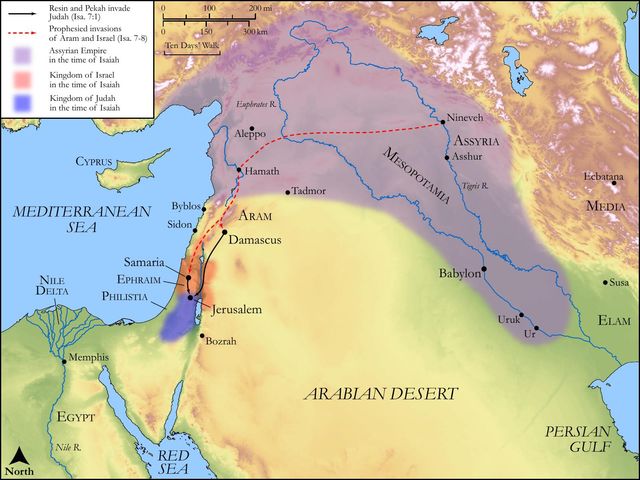
See on the biblical-era map
Study this verse
Public-domain commentary
Matthew Henry
From his Commentary on the Whole Bible. Henry comments on passages, not single verses — this entry covers Isaiah 8:1–8. His three-level outline is real structure in the source text, so it is rendered as structure.
In these verses we have a prophecy of the successes of the king of Assyria against Damascus, Samaria, and Judah, that the two former should be laid waste by him, and the last greatly frightened. Here we have,
I.Orders given to the prophet to write this prophecy, and publish it to be seen and read of all men, and to leave it upon record, that when the thing came to pass they might know that God had sent him; for that was one end of prophecy, Joh 14:29. He must take a great roll, which would contain those five chapters fairly written in words at length; and he must write in it all that he had foretold concerning the king of Assyria's invading the country; he must write it with a man's pen, in the usual way and style of writing, so as that it might be legible and intelligible by all. See Hab 2:2, Write the vision, and make it plain. Those that speak and write of the things of God should avoid obscurity, and study to speak and write so as to be understood, Co1 14:19. Those that write for men should write with a man's pen, and not covet the pen or tongue of angels. And forasmuch as it is usual to put some short, but significant comprehensive title before books that are published, the prophet is directed to call his book Maher-shalal-hash-baz - Make speed to the spoil, hasten to the prey, intimating that the Assyrian army should come upon them with great speed and make great spoil. By this title the substance and meaning of the book would be enquired after by those that heard of it, and remembered by those that had read it or heard it read. It is sometimes a good help to memory to put much matter in few words, which serve as handles by which we take hold of more.
II.The care of the prophet to get this record well attested (Isa 8:2):
I took unto me faithful witnesses to record; he wrote the prophecy in their sight and presence, and made them subscribe their names to it, that they might be ready, if afterwards there should be occasion, to make oath of it, that the prophet had so long before foretold the descent which the Assyrians made upon that country. He names his witnesses for the greater certainty, that they might be appealed to by any. They were two in number (for out of the mouth of two witnesses shall every word be established); one was Uriah the priest; he is mentioned in the story of Ahaz, but for none of his good deeds, for he humoured Ahaz with an idolatrous altar (Kg2 16:10, Kg2 16:11); however, at this time, no exception lay against him, being a faithful witness. See what full satisfaction the prophets took care to give to all persons concerned of the sincerity of their intentions, that we might know with a full assurance the certainty of the things wherein we have been instructed, and that we have not followed cunningly-devised fables.
III.The making of the title of his book the name of his child, that it might be the more taken notice of and the more effectually perpetuated, Isa 8:3. His wife (because the wife of a prophet) is called the prophetess; she conceived and bore a son, another son, who must carry a sermon in his name, as the former had done (Isa 7:3), but with this difference, that spoke mercy, Shear-jashub - The remnant shall return; but, that being slighted, this speaks judgment, Maher-shalal-hash-baz - In making speed to the spoil he shall hasten, or he has hastened, to the prey. The prophecy is doubled, even in this one name, for the thing was certain. I will hasten my word, Jer 1:12. Every time the child was called by his name, or any part of it, it would serve as a memorandum of the judgments approaching. Note, It is good for us often to put ourselves in mind of the changes and troubles we are liable to in this world, and which perhaps are at the door. When we look with pleasure on our children it should be with the allay of this thought, We know not what they are yet reserved for.
IV.The prophecy itself, which explains this mystical name.
1.That Syria and Israel, who were now in confederacy against Judah, should in a very little time become an easy prey to the king of Assyria and his victorious army (Isa 8:4): "Before the child, now newly born and named, shall have knowledge to cry, My father, and My mother" (which are usually some of the first things that children know and some of the first words that children speak), that is, "in about a year or two, the riches of Damascus, and the spoil of Samaria, those cities that are now so secure themselves and so formidable to their neighbours, shall be taken away before the king of Assyria, who shall plunder both city and country, and send the best effects of both into his own land, to enrich that, and as trophies of his victory." Note, Those that spoil others must expect to be themselves spoiled (Isa 33:1); for the Lord is righteous, and those that are troublesome shall be troubled.
2.That forasmuch as there were many in Judah that were secretly in the interests of Syria and Israel, and were disaffected to the house of David, God would chastise them also by the king of Assyria, who should create a great deal of vexation to Judah, as was foretold, Isa 7:17. Observe,
(1.)What was the sin of the discontented party in Judah (Isa 8:6): This people, whom the prophet here speaks to, refuse the waters of Shiloah that go softly, despise their own country and the government of it, and love to run it down, because it does not make so great a figure, and so great a noise, in the world, as some other kings and kingdoms do. They refuse the comforts which God's prophets offer them from the word of God, speaking to them in a still small voice, and make nothing of them; but they rejoice in Rezin and Remaliah's son, who were the enemies of their country, and were now actually invading it; they cried them up as brave men, magnified their policies and strength, applauded their conduct, were well pleased with their successes, and were hearty well-wishers to their designs, and resolved to desert and go over to them. Such vipers does many a state foster in its bosom, that eat its bread, and yet adhere to its enemies, and are ready to quit its interests if they but seem to totter.
(2.)The judgment which God would bring upon them for this sin. The same king of Assyria that should lay Ephraim and Syria waste should be a scourge and terror to those of their party in Judah, Isa 8:7, Isa 8:8. Because they refuse the waters of Shiloah, and will not accommodate themselves to the government God has set over them, but are uneasy under it, therefore the Lord brings upon them the waters of the river, strong and many, the river Euphrates. They slighted the land of Judah, because it had no river to boast of comparable to that; the river at Jerusalem was a very inconsiderable one. "Well," says God, "if you be such admirers of Euphrates, you shall have enough of it; the king of Assyria, whose country lies upon that river, shall come with his glory, with his great army, which you cry up as his glory, despising your own king because he cannot bring such an army as that into the field; God shall bring that army upon you." If we value men, if we over-value them, for their worldly wealth and power, it is just with God to make them thereby a scourge to us. It is used as an argument against magnifying rich men that rich men oppress us, Jam 2:3, Jam 2:5. Let us be best pleased with the waters of Shiloah, that go softly, for rapid streams are dangerous. It is threatened that the Assyrian army should break in upon them like a deluge, or inundation of waters, bearing down all before it, should come up over all his channels, and overflow all his banks. It would be to no purpose to oppose or withstand them. Sennacherib and his army should pass through Judah, and meet with so little resistance that it should look more like a march through the country than a descent upon it. He shall reach even to the neck, that is, he shall advance so far as to lay siege to Jerusalem, the head of the kingdom, and nothing but that shall be kept out of his hands; for that was the holy city. Note, In the greatest deluge of trouble God can and will keep the head of his people above water, and so preserve their comforts and spiritual lives; the waters that come into their souls may reach to the neck (Psa 69:1), but there shall their proud waves be stayed. And here is another comfortable intimation that though the stretching out of the wings of the Assyrian, that bird of prey, though the right and left wing of his army, should fill the breadth of the land of Judah, yet still it was Immanuel's land. It is thy land, O Immanuel! It was to be Christ's land; for there he was to be born, and live, and preach, and work miracles. He was Zion's King, and therefore had a peculiar interest in and concern for that land. Note, The lands that Immanuel owns for his, as he does all those lands that own him, though they may be deluged, shall not be destroyed; for, when the enemy shall come in like a flood, Immanuel shall secure his own, and shall lift up a standard against him, Isa 59:19.
Historical interpretation
Two Centuries of Reception
3 surviving comments on this verse. Each one is dated, so this reads as a timeline rather than a list.
Select a marker to jump to its quote. Markers stagger vertically where authors wrote within a few decades of each other.
[Isaiah] uses the “king of Assyria” as a symbol for the Antichrist.
Obviously the only way to preserve the understanding of this passage is to explain its spiritual meaning. By the softly proceeding water of Siloam it means the gospel teaching of the word of salvation, because Siloam means “sent with a message.” This would be God the Word, who was sent by the Father, of whom Moses says, “A ruler will not fail from Judah, nor a prince from his loins, until the one for whom it is stored up comes, and he is the expectation of the nations.” For rather than “for whom it is stored up” the Hebrew has “Siloam.” The same word, Siloam, is used the same way in this passage for Isaiah, that is to say, “the one who is sent.”
(Verse 5, et seq.) And the Lord added, speaking to me again, saying: Because this people has rejected the waters of Siloam that flow gently, and has preferred Rezin and the son of Remaliah, therefore behold, the Lord will bring upon them the mighty and abundant waters of the river, the king of Assyria and all his glory. And it will rise above all its channels, and overflow over all its banks. And it will pass through Judah, flooding and reaching up to the neck. And the spreading of its wings will fill the breadth of your land, O Emmanuel. He had said before that the strength of Damascus should be taken away, and the spoils of Samaria should be seen by the king of the Assyrians, and that two kings should be captured while the Assyrian was fighting: now God speaks to the Prophet in the usual style of the Scriptures, through the translation of the Siloam spring in Jerusalem, and the very violent river of the Assyrians, that the whole land of Israel will be flooded by its waters, and it will overflow its riverbanks with such force that after it has occupied the land of the ten tribes, it will reach Judah and, passing through, it will reach the neck: by which it signifies the nearby captivity. For Judas was not captured at that time, but after all the cities of the two tribes were conquered, only Jerusalem remained, which was liberated by the incredible mercy of God. Therefore, the power of the Assyrians and their countless army, which he had described as being under the flood of the river, now shows through another translation, namely, that he has covered the land of Emmanuel, that is, the land defended by God, with his other wings, that is, his leaders, and an infinite multitude. However, he did not possess it, although Emmanuel is connected in the following chapter to the seventy, not by his own name as he is called among the Hebrews, but by an interpretation, that is, "God with us. But we cannot doubt that Silo is a fountain at the foot of Mount Zion, which does not flow continuously, but only at certain times and days, and comes through the underground caves and dens of the hardest rock with a great noise. Especially we who dwell in this province. The meaning is that the people of the ten tribes preferred to be subject to Rezin and the son of Romelia, that is, the kings of Damascus and Samaria, rather than to the lineage of David, who began to reign by my judgment. I will make him not serve these kings whom he took, but serve the Assyrian king, whose power is compared to the flooding of the river that covers the land of Samaria. And an apostrophe is made to Emmanuel, that is, to the present God, that the Assyrian has exalted himself to such an extent that he has even tried to possess his own land, Judah. According to the spiritual sense, every heretic who joins his secular wisdom and desires to attack Jerusalem, that is, the Church, abandoning the waters of the Siloam fountain (John 9), which is interpreted as 'sent', and who ascends to eternal life, will be handed over to the prince of Assyria (which sense we will read later), and by the power of the one to whom he is handed over, he will come into the depth of sins. Such is the arrogance, that he dared to show to the Savior all the kingdoms of the earth and say: 'All these have been given to me' (Matthew and Luke IV). He will also try to enter into Judah, that is, the house of confession, and he will often come up to the neck through those who are negligent in the Church, wishing to suffocate those who believe in Christ, and he will spread his wings, filling the whole region of Emmanuel; but he will not be able to prevail, because Judas has the presence of God. We read in the Gospel according to John (John 9) that a blind man from birth, whose eyes the Lord had anointed with clay made from his own saliva, was sent to the pool of Siloam, and when the blind man washed the clay away, his blindness was removed and he received clear vision. This miracle signifies that the blindness of the Jews and all unbelievers can only be healed by the teachings of Christ's waters, which flow gently without noise or clamor, dispelling the darkness of previous error. What is read in the Septuagint: And he shall walk over all your walls, and he shall take away from Judah the man who can lift up his head, or perhaps do anything: in Hebrew it is not found, and in the Greek manuscripts ÷ it is cut off by the true killer.
Continue studying Isaiah 8:5 across the web’s major study libraries — every link below opens this exact verse, chapter, or book on the destination site.
Read & Compare
 BibleGatewayThis verse in more than 200 translations and 70 languages.
 Bible.comThe YouVersion reader — hundreds of translations, reading plans, and highlights.
 ESV.orgCrossway's official English Standard Version reader.
 NET BibleThe NET translation with 60,000+ translators' notes on every rendering decision.
 STEP BibleTyndale House's free study tool — original text, vocabulary, and scholarly resources.
 BibliaLogos Bible Software's free web reader.
 USCCBThe New American Bible (Revised Edition) with the U.S. bishops' study notes.
Commentaries
 BibleHub CommentariesDozens of classic commentaries on this verse, gathered on one page.
 StudyLightMore than 100 commentary sets — the largest collection on the web.
 BibleRefPlain-English commentary on what this verse means, verse by verse.
 Enduring WordDavid Guzik's free commentary on this chapter, widely used by Bible teachers.
 Bible Study ToolsVerse commentary alongside Greek and Hebrew study aids.
Original Language & Research
- BibleHub InterlinearThe verse word by word — original language, transliteration, and English.
- BibleHub LexiconEvery word's original-language definition and Strong's entry.
 Blue Letter BibleDeep-study tools — Strong's numbers, concordance, and word studies.
 SefariaThe Hebrew text with Rashi and centuries of Jewish commentary.
Sermons, Hymns & Audio


TrulyRandomVerse is not affiliated with these sites and doesn’t control their content. They’re linked because they’re genuinely useful.
Summary
Isaiah 8:5 serves as a pivotal transitional statement within the prophet's ongoing dialogue with God, signaling a renewed and distinct divine communication. This brief verse underscores the continuous nature of God's revelation to His chosen messenger, Isaiah, reaffirming the divine origin and authority of the subsequent prophecies. It sets the stage for further pronouncements concerning Judah's immediate future and the unfolding geopolitical landscape, emphasizing God's active involvement and sovereign control over human affairs even amidst national crisis.
Context
ShowHideLiterary Context
This verse immediately follows a series of prophetic actions and declarations by Isaiah concerning the impending invasion of Judah. The preceding verses in Isaiah 8:1-4 detail the symbolic prophecy of Maher-shalal-hash-baz ("swift to the spoil, speedy to the prey"), a sign against Syria (Aram) and Israel (Ephraim), foretelling their swift destruction by Assyria. Isaiah 8:5 acts as a divine interjection, indicating that the previous message, while significant, is not the final word. It signals a new phase of revelation, shifting the focus from the immediate fate of Judah's northern adversaries to Judah's own choices and the implications of their reliance on foreign powers rather than on the LORD. The phrase "spake also unto me again" explicitly marks a continuation and deepening of the prophetic discourse, preparing the audience for the weighty pronouncements that follow regarding the "waters of Shiloah" and the "waters of the River" (Assyria) in Isaiah 8:6-8.
Historical & Cultural Context
The historical backdrop for Isaiah 8:5 is the tumultuous period of the Syro-Ephraimite War (circa 735-734 BC). During this time, the northern kingdom of Israel (Ephraim) and Aram (Syria) formed an alliance against Judah, attempting to depose King Ahaz and install a puppet king. Ahaz, despite Isaiah's counsel to trust in the LORD (as seen in Isaiah 7:1-9), chose to seek an alliance with the mighty Assyrian Empire. In this climate of fear, political maneuvering, and spiritual apostasy, God's direct communication through Isaiah was crucial. Prophets served as God's primary spokespersons, delivering divine guidance, warnings, and promises to the nation. The repetition of God's speaking underscored His persistent engagement with His people, even when they were disobedient, and affirmed Isaiah's legitimate role as a divine messenger, whose words carried ultimate authority in a culture that valued direct revelation from the divine.
Key Themes
ShowHideIsaiah 8:5 powerfully contributes to several overarching themes in the book of Isaiah. Firstly, it highlights Divine Revelation, emphasizing God's active initiative in communicating His will and plans to humanity. The LORD is not a distant deity but one who continually engages with His creation, particularly through His chosen prophets. Secondly, it reinforces Prophetic Authority, validating Isaiah's role as a true and legitimate prophet whose words are not his own, but the very word of the LORD. This was crucial for a people who needed to discern true prophets from false ones. Thirdly, the phrase "again" underscores the Continuity and Progression of God's Word. God's communication is not a series of isolated pronouncements but an ongoing, unfolding dialogue that builds upon previous messages, providing deeper understanding as circumstances evolve. This reflects a broader biblical truth that God speaks in various ways and at different times, progressively revealing His plan, as beautifully articulated in Hebrews 1:1.
Exposition and Analysis
ShowHideKey Word Analysis
ShowHideFrom the root meaning "to be," this is the sacred personal name of God, often rendered as Yahweh, emphasizing His self-existent, eternal nature and His covenant relationship with Israel. Its use here underscores that the message originates from the sovereign, faithful God who is intimately involved in the affairs of His people and the world. It is not merely a generic deity speaking, but the specific, covenant-keeping God of Israel, the "self-Existent or Eternal."
A primitive root, perhaps properly meaning "to arrange," but used figuratively (of words) "to speak." This verb signifies more than just uttering words; it implies an orderly, purposeful, and authoritative communication, a declaration or pronouncement that carries weight and intent. In this context, it highlights the deliberate and powerful nature of God's communication to Isaiah, a divine command or declaration.
A primitive root meaning "to add or augment," used adverbially here to signify continuation or repetition. It conveys the idea of "to continue to do a thing," "to add more," or "henceforth." Its inclusion here is crucial, indicating that this is not a new, unrelated message, but a further, additional revelation that builds upon or follows previous divine words, signifying an ongoing process of communication from God to His prophet.
Verse Breakdown
ShowHide"The LORD spake"
This opening phrase establishes the divine origin and absolute authority of the message. It is God Himself, YHWH, the sovereign covenant Lord, who is initiating communication. This immediately lends ultimate weight and truthfulness to the words that follow, indicating that they are not human conjecture but divine truth.
"also unto me again"
The inclusion of "also" and "again" emphasizes the continuity and renewed nature of God's revelation specifically to Isaiah. It indicates that the prophet has received previous messages, and this is a fresh, perhaps urgent, installment in the ongoing divine discourse. It highlights God's persistence in communicating with His chosen messenger, even as the political and spiritual climate in Judah deteriorates, showing His unwavering engagement.
"saying"
This participle indicates that what follows is the direct content of the divine speech. It functions as a direct introduction to the subsequent prophetic oracle, signaling to the audience that they are about to hear the very words of God through Isaiah, making the following pronouncements direct divine utterances.
Literary Devices
ShowHideIsaiah 8:5, though brief, employs several subtle but significant literary devices. The most prominent is the Prophetic Formula, "The LORD spake... saying," which is a common introductory phrase in prophetic literature, immediately establishing the divine authority and origin of the message. This formula functions as a stamp of authenticity, assuring the audience that the words are not human invention but divine revelation. The word "again" serves as a form of Repetition or Continuity Marker, signaling that this is not an isolated incident but part of an ongoing dialogue between God and His prophet. It creates a sense of unfolding narrative and continuous divine engagement. Furthermore, the direct address "unto me" emphasizes the Personal Nature of Revelation, highlighting the intimate relationship between God and His prophet, and underscoring Isaiah's role as a direct recipient of divine truth.
Theological and Thematic Connections
ShowHideIsaiah 8:5 is a profound theological statement on the nature of God's communication. It portrays God as an actively engaged deity who is not silent but consistently speaks to His people, particularly through His chosen messengers. This continuous divine speech underscores God's sovereignty, His unwavering commitment to His covenant, and His desire to guide and warn humanity. The "again" signifies God's patience and persistence, reiterating His message or adding new dimensions as circumstances unfold, ensuring His people are never without His word, even in times of crisis or spiritual wandering. This verse reinforces the foundational biblical truth that all true prophecy originates from God and is delivered through His Spirit-empowered servants, emphasizing divine initiative and authority in revelation.
Reflection and Application
ShowHideIsaiah 8:5, though a simple transitional verse, offers profound insights for contemporary believers. It reminds us that God is a speaking God, and His desire to communicate with humanity remains constant. Just as He spoke "again" to Isaiah, He continues to speak to us today, primarily through His inspired written Word, the Bible, and through the Holy Spirit's illumination of that Word. This verse calls us to cultivate a posture of attentiveness and receptivity, eager to hear and obey God's voice in our lives. In an age filled with noise and competing voices, recognizing and prioritizing God's ongoing revelation is paramount. It encourages us to trust in the continuity and faithfulness of His word, knowing that His guidance is always timely and sufficient, even when circumstances are uncertain or challenging. Our spiritual growth and discernment are directly tied to our willingness to listen for and respond to what the LORD is "saying" to us, personally and corporately, through His enduring truth.
Questions for Reflection
ShowHideFAQ
ShowHideWhy does the Bible emphasize God speaking "again" to His prophets?
ShowHideThe emphasis on God speaking "again" (Hebrew: yâçaph) to His prophets, as seen in Isaiah 8:5, highlights several crucial aspects of divine revelation. Firstly, it underscores God's persistent and patient engagement with humanity. He doesn't just speak once and then withdraw; He continues to communicate, often reiterating or expanding upon previous messages to ensure His people understand His will. Secondly, it signifies the unfolding nature of God's plan. Revelation is often progressive, with God adding new layers of understanding or specific instructions as circumstances evolve. This "again" implies a dynamic, ongoing relationship between God and His chosen messengers, ensuring that His people receive timely guidance and warnings in the midst of changing historical and spiritual landscapes. It also reinforces the prophet's legitimacy, demonstrating that their ministry is not a one-time event but a continuous conduit for God's living word.
What is the significance of the LORD speaking directly to Isaiah?
ShowHideThe direct address of "The LORD spake unto me" (as in Isaiah 8:5) is profoundly significant. It establishes Isaiah's unquestionable prophetic authority and authenticity. In ancient Israel, true prophets were those who received direct, unmediated communication from God, distinguishing them from false prophets who spoke from their own imaginations or other sources. This direct speech underscores that Isaiah's words are not his opinions or political analyses, but the very words of the sovereign God (YHWH). It conveys the gravity and truthfulness of the message, demanding attention and obedience from the audience. For the people of Judah, knowing that God Himself was speaking through Isaiah provided both comfort in His presence and a stern warning against disobedience, especially during the tumultuous period of the Syro-Ephraimite War.
How does God speak to us today, given that direct prophetic communication like Isaiah's is rare?
ShowHideWhile direct, audible prophetic communication as experienced by Isaiah in Isaiah 8:5 is not the primary mode of God's communication for most believers today, God continues to speak powerfully and consistently. His primary voice for us is His inspired, inerrant Word, the Bible. Through careful study and meditation on Scripture, illuminated by the Holy Spirit, we hear God's unchanging truth, His commands, His promises, and His character revealed. The Holy Spirit also speaks to us through our consciences, through wise counsel from other believers, through circumstances (providence), and sometimes through a "still, small voice" (as in 1 Kings 19:12). The ultimate and complete revelation of God is found in His Son, Jesus Christ, as Hebrews 1:1-2 declares, "God... has in these last days spoken to us by His Son." Therefore, understanding and obeying the teachings of Christ and the apostles, recorded in the New Testament, is central to hearing God's voice today.
Christ-Centered Fulfillment
ShowHideIsaiah 8:5, with its emphasis on God speaking "again" to His prophet, finds its ultimate and most profound fulfillment in the person and work of Jesus Christ. While God consistently spoke through prophets in the Old Testament, these were partial and progressive revelations, pointing forward to a greater unveiling. Hebrews 1:1-2 declares that "God, who at sundry times and in divers manners spake in time past unto the fathers by the prophets, hath in these last days spoken unto us by his Son." Jesus is the living Word of God, the ultimate and complete revelation of the Father, embodying all that God desired to communicate to humanity. He is not merely a messenger but the message itself, the very embodiment of God's truth, grace, and salvation. The continuous "speaking" of God to Isaiah foreshadows the Incarnation, where the divine Word became flesh (John 1:14) and dwelt among us, making God fully known (John 1:18). Therefore, when God spoke "again" to Isaiah, He was preparing the way for the climactic, final, and all-sufficient Word who would come to redeem His people and establish His eternal kingdom, the Lamb of God who takes away the sin of the world.