


Isaiah 8:4
- כִּיKiforH3588PrtParticle Conditional
- בְּטֶרֶםbe·Te·rem<in> beforeH2962Prep-b ¦ Adj-csAdjective Numerical Singular common gender Absoluteבְּ<in>טֶרֶםbefore
- יֵדַעye·Da'he will knowH3045V-Qal-Imperf-3msVerb Qal Imperfect 3rd Singular Masculine
- הַנַּעַרha·Na·'arthe ladH5288Art ¦ N-msNoun Singular Masculine Absoluteהַtheנַּעַרlad
- קְרֹאke·Ro'to call outH7121V-Qal-InfVerb Qal Infinitive Construct
- אָבִי'a·Vimy O fatherH1N-msc ¦ 1csNoun Singular Masculine ConstructאָבִO fatherיmy
- וְאִמִּיve·'i·Miand my O motherH517Conj-w ¦ N-fsc ¦ 1csNoun Singular Feminine ConstructוְandאִמִּO motherיmy
- יִשָּׂאyi·Sa'someone will carry offH5375V-Qal-Imperf-3msVerb Qal Imperfect 3rd Singular Masculine
- אֶת'et<obj.>H853DirObjMParticle Object Indicator
- חֵילcheil[the] wealth ofH2428N-mscNoun Singular Masculine Construct
- דַּמֶּשֶׂקda·Me·sekDamascusH1834N-properNoun Proper Location
- וְאֵתve·'Etand <obj.>H853Conj-w ¦ DirObjMParticle Object Indicatorוְandאֵת<obj.>
- שְׁלַלshe·Lal[the] plunder ofH7998N-mscNoun Singular Masculine Construct
- שֹׁמְרוֹןsho·me·RonSamariaH8111N-properNoun Proper Location
- לִפְנֵיlif·Nei<to> beforeH6440Prep-l ¦ N-mpcNoun Plural Masculine Constructלִ<to>פְנֵיbefore
- מֶלֶךְMe·lekh[the] king ofH4428N-mscNoun Singular Masculine Construct
- אַשּׁוּר'a·ShurAssyriaH804N-properNoun Proper Location
English is a literal word-by-word gloss of the Hebrew, not the KJV's wording. Why?
This is the original text the KJV's translators worked from — each Hebrew word with its own literal English meaning in this verse, prepared by scholars at Tyndale House, Cambridge. The KJV translates whole sentences, not word by word, so its wording differs: one Hebrew word can become several English words, and the KJV may choose “the LORD” where the gloss reads “Yahweh”. Both are faithful — they answer different questions. For the KJV's own rendering, switch to the KJV text.
Details
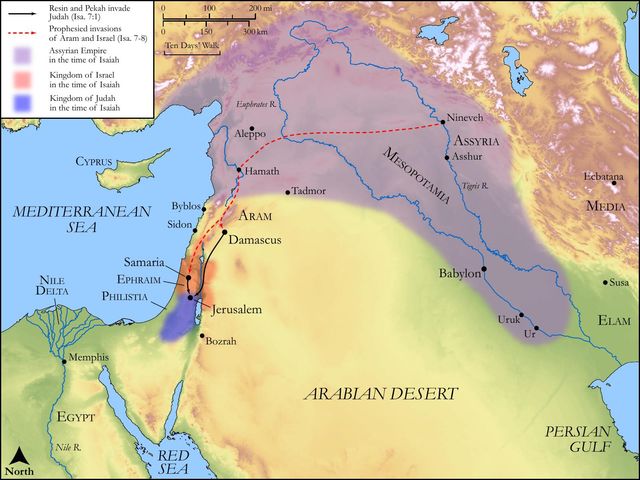
See on the biblical-era map
Study this verse
Public-domain commentary
Matthew Henry
From his Commentary on the Whole Bible. Henry comments on passages, not single verses — this entry covers Isaiah 8:1–8. His three-level outline is real structure in the source text, so it is rendered as structure.
In these verses we have a prophecy of the successes of the king of Assyria against Damascus, Samaria, and Judah, that the two former should be laid waste by him, and the last greatly frightened. Here we have,
I.Orders given to the prophet to write this prophecy, and publish it to be seen and read of all men, and to leave it upon record, that when the thing came to pass they might know that God had sent him; for that was one end of prophecy, Joh 14:29. He must take a great roll, which would contain those five chapters fairly written in words at length; and he must write in it all that he had foretold concerning the king of Assyria's invading the country; he must write it with a man's pen, in the usual way and style of writing, so as that it might be legible and intelligible by all. See Hab 2:2, Write the vision, and make it plain. Those that speak and write of the things of God should avoid obscurity, and study to speak and write so as to be understood, Co1 14:19. Those that write for men should write with a man's pen, and not covet the pen or tongue of angels. And forasmuch as it is usual to put some short, but significant comprehensive title before books that are published, the prophet is directed to call his book Maher-shalal-hash-baz - Make speed to the spoil, hasten to the prey, intimating that the Assyrian army should come upon them with great speed and make great spoil. By this title the substance and meaning of the book would be enquired after by those that heard of it, and remembered by those that had read it or heard it read. It is sometimes a good help to memory to put much matter in few words, which serve as handles by which we take hold of more.
II.The care of the prophet to get this record well attested (Isa 8:2):
I took unto me faithful witnesses to record; he wrote the prophecy in their sight and presence, and made them subscribe their names to it, that they might be ready, if afterwards there should be occasion, to make oath of it, that the prophet had so long before foretold the descent which the Assyrians made upon that country. He names his witnesses for the greater certainty, that they might be appealed to by any. They were two in number (for out of the mouth of two witnesses shall every word be established); one was Uriah the priest; he is mentioned in the story of Ahaz, but for none of his good deeds, for he humoured Ahaz with an idolatrous altar (Kg2 16:10, Kg2 16:11); however, at this time, no exception lay against him, being a faithful witness. See what full satisfaction the prophets took care to give to all persons concerned of the sincerity of their intentions, that we might know with a full assurance the certainty of the things wherein we have been instructed, and that we have not followed cunningly-devised fables.
III.The making of the title of his book the name of his child, that it might be the more taken notice of and the more effectually perpetuated, Isa 8:3. His wife (because the wife of a prophet) is called the prophetess; she conceived and bore a son, another son, who must carry a sermon in his name, as the former had done (Isa 7:3), but with this difference, that spoke mercy, Shear-jashub - The remnant shall return; but, that being slighted, this speaks judgment, Maher-shalal-hash-baz - In making speed to the spoil he shall hasten, or he has hastened, to the prey. The prophecy is doubled, even in this one name, for the thing was certain. I will hasten my word, Jer 1:12. Every time the child was called by his name, or any part of it, it would serve as a memorandum of the judgments approaching. Note, It is good for us often to put ourselves in mind of the changes and troubles we are liable to in this world, and which perhaps are at the door. When we look with pleasure on our children it should be with the allay of this thought, We know not what they are yet reserved for.
IV.The prophecy itself, which explains this mystical name.
1.That Syria and Israel, who were now in confederacy against Judah, should in a very little time become an easy prey to the king of Assyria and his victorious army (Isa 8:4): "Before the child, now newly born and named, shall have knowledge to cry, My father, and My mother" (which are usually some of the first things that children know and some of the first words that children speak), that is, "in about a year or two, the riches of Damascus, and the spoil of Samaria, those cities that are now so secure themselves and so formidable to their neighbours, shall be taken away before the king of Assyria, who shall plunder both city and country, and send the best effects of both into his own land, to enrich that, and as trophies of his victory." Note, Those that spoil others must expect to be themselves spoiled (Isa 33:1); for the Lord is righteous, and those that are troublesome shall be troubled.
2.That forasmuch as there were many in Judah that were secretly in the interests of Syria and Israel, and were disaffected to the house of David, God would chastise them also by the king of Assyria, who should create a great deal of vexation to Judah, as was foretold, Isa 7:17. Observe,
(1.)What was the sin of the discontented party in Judah (Isa 8:6): This people, whom the prophet here speaks to, refuse the waters of Shiloah that go softly, despise their own country and the government of it, and love to run it down, because it does not make so great a figure, and so great a noise, in the world, as some other kings and kingdoms do. They refuse the comforts which God's prophets offer them from the word of God, speaking to them in a still small voice, and make nothing of them; but they rejoice in Rezin and Remaliah's son, who were the enemies of their country, and were now actually invading it; they cried them up as brave men, magnified their policies and strength, applauded their conduct, were well pleased with their successes, and were hearty well-wishers to their designs, and resolved to desert and go over to them. Such vipers does many a state foster in its bosom, that eat its bread, and yet adhere to its enemies, and are ready to quit its interests if they but seem to totter.
(2.)The judgment which God would bring upon them for this sin. The same king of Assyria that should lay Ephraim and Syria waste should be a scourge and terror to those of their party in Judah, Isa 8:7, Isa 8:8. Because they refuse the waters of Shiloah, and will not accommodate themselves to the government God has set over them, but are uneasy under it, therefore the Lord brings upon them the waters of the river, strong and many, the river Euphrates. They slighted the land of Judah, because it had no river to boast of comparable to that; the river at Jerusalem was a very inconsiderable one. "Well," says God, "if you be such admirers of Euphrates, you shall have enough of it; the king of Assyria, whose country lies upon that river, shall come with his glory, with his great army, which you cry up as his glory, despising your own king because he cannot bring such an army as that into the field; God shall bring that army upon you." If we value men, if we over-value them, for their worldly wealth and power, it is just with God to make them thereby a scourge to us. It is used as an argument against magnifying rich men that rich men oppress us, Jam 2:3, Jam 2:5. Let us be best pleased with the waters of Shiloah, that go softly, for rapid streams are dangerous. It is threatened that the Assyrian army should break in upon them like a deluge, or inundation of waters, bearing down all before it, should come up over all his channels, and overflow all his banks. It would be to no purpose to oppose or withstand them. Sennacherib and his army should pass through Judah, and meet with so little resistance that it should look more like a march through the country than a descent upon it. He shall reach even to the neck, that is, he shall advance so far as to lay siege to Jerusalem, the head of the kingdom, and nothing but that shall be kept out of his hands; for that was the holy city. Note, In the greatest deluge of trouble God can and will keep the head of his people above water, and so preserve their comforts and spiritual lives; the waters that come into their souls may reach to the neck (Psa 69:1), but there shall their proud waves be stayed. And here is another comfortable intimation that though the stretching out of the wings of the Assyrian, that bird of prey, though the right and left wing of his army, should fill the breadth of the land of Judah, yet still it was Immanuel's land. It is thy land, O Immanuel! It was to be Christ's land; for there he was to be born, and live, and preach, and work miracles. He was Zion's King, and therefore had a peculiar interest in and concern for that land. Note, The lands that Immanuel owns for his, as he does all those lands that own him, though they may be deluged, shall not be destroyed; for, when the enemy shall come in like a flood, Immanuel shall secure his own, and shall lift up a standard against him, Isa 59:19.
Historical interpretation
Three Centuries of Reception
4 surviving comments on this verse. Each one is dated, so this reads as a timeline rather than a list.
Select a marker to jump to its quote. Markers stagger vertically where authors wrote within a few decades of each other.
For that expression of Isaiah 'He shall take the power of Damascus and spoils of Samaria,' foretold that the power of the evil demon that dwelt in Damascus should be overcome by Christ as soon as He was born; and this is proved to have happened. For the Magi, who were held in bondage for the commission of all evil deeds through the power of that demon, by coming to worship Christ, shows that they have revolted from that dominion which held them captive; and this [dominion] the Scripture has showed us to reside in Damascus. Moreover, that sinful and unjust power is termed well in parable, Samaria. And none of you can deny that Damascus was, and is, in the region of Arabia, although now it belongs to what is called Syrophoenicia. Hence it would be becoming for you, sirs, to learn what you have not perceived, from those who have received grace from God, namely, from us Christians; and not to strive in every way to maintain your own doctrines, dishonouring those of God.
I, on my part, now wish to engage with you in a discussion on the allegorical expressions of the apostle. What figures of speech could the novel god have found in the prophets (fit for himself)? "He led captivity captive," [Ephesians 4:8] says the apostle. With what arms? In what conflicts? From the devastation of what country? From the overthrow of what city? What women, what children, what princes did the Conqueror throw into chains? For when by David Christ is sung as "girded with His sword upon His thigh," [Psalm 45:3] or by Isaiah as "taking away the spoils of Samaria and the power of Damascus," [Isaiah 8:4] you make Him out to be really and truly a warrior confest to the eye. Learn then now, that His is a spiritual armour and warfare
Chapter 8 — Verses 1-4. And the Lord said to me: Take for yourself a large book, and write in it with the pen of a man, quickly seize the spoils, swiftly plunder. And I appointed faithful witnesses for myself, Uriah the priest, and Zechariah the son of Barachiah, and I approached the prophetess, and she conceived and gave birth to a son. And the Lord said to me: Call his name, hasten, seize the spoils, hurry to plunder; for before the child knows how to call his father and his mother, the strength of Damascus will be taken away, and the spoils of Samaria will be carried off before the king of Assyria. Seventy interpreters were employed for the large book, they translated it into a new and large book. And because it is found in Hebrew, I called upon faithful witnesses who said: 'It is present indeed, and let faithful men be my witnesses.' And concerning Uriah the Priest, only Uriah, the rest likewise. The first prophet was sent to Ahaz (Isaiah 7), to foretell to him what the Scripture mentions: but since he was unwilling to listen, the Lord himself speaks to Ahaz and commands him to ask for a sign either in the depth or in the height. In response to this, I will not ask, and I will not test the Lord. After the wicked king is dismissed, the words of God are turned to the house of David, and a Virgin is promised to give birth to a son, whose name shall be Emmanuel, which means, God is with us. If he is frequently invoked, Samaria shall be overthrown and Syria: and shall be overthrown by the king of Assyria, who shall later capture Judah itself; so that all the land of Judah shall be turned into a wilderness. Again, therefore, under another figure, a virgin birth is described. And the Lord said to the Prophet, that he should not reveal the secret of the new birth to the people, but write it in this great volume that we now read. And to make it more wondrous, let it be written in human words and in the style that men are accustomed to write, so that it may contain the sacraments of God. But what is this that is written in human style? That a child born swiftly may take away spoils and quickly plunder, that is, that he may no longer suffer the devil to reign. And let him not send Angels or Prophets, but he himself descend to save his creatures. Therefore, the Prophet does what he was commanded and summons two faithful witnesses for himself, Uriah the priest, who is a teacher of the law, as Malachi says: The lips of the priest shall guard knowledge, and they shall seek instruction from his mouth, for he is the messenger of the Lord of hosts (Malachi 2:7); and Zechariah son of Berekiah, whom there is no doubt was a prophet. We read that during the reign of Ahaz, Uriah was a priest of the Temple of the Lord (2 Kings 4), to whom Ahaz commanded to make an altar like the altar in Damascus. And the book of Days (2 Chronicles 29) narrates that Hezekiah, the son of Ahaz, sought the Lord in the days of Zechariah, who was learned in the fear of God. Isaiah presented himself as worthy of the prophetic spirit and offered the prophetess, that is, the Holy Spirit, who is called Rua in the Hebrew language. According to what is written: Come to the Lord and be illumined (Psalm 33:6). Therefore, the Lord was conceived by the Holy Spirit. And although human speech cannot explain the mysteries of his nativity, nevertheless Gabriel speaks to the Virgin who conceived him: The Holy Spirit will come upon you, and the power of the Most High will overshadow you; therefore the child to be born will be holy; he will be called Son of God (Luke 1:35). Some interpret the holy prophetess Mary, whom there is no doubt was a prophetess, for she herself speaks in the Gospel: For behold, from now on all generations will call me blessed; for he who is mighty has done great things for me (Luke 1:48-49), and the rest. And it is commanded by Isaiah, that the very child who was formerly called Emmanuel, should now be called, hasten, strip away the spoils, hasten to plunder. For ascending on high, he led captivity captive; he received gifts for men (Ps. 67; Eph. 4:8) . And before assuming a human body, and calling God his father in his infancy, and calling Mary his mother, the strength of Damascus will be taken away, and the spoils of Samaria by the king of Assyrians: so that even before he is born, he will save his people, the house of David, by his mere invocation. Uriah means the light of the Lord; Zacharias, the memory of the Lord; and Barachias, the blessing of the Lord: by these witnesses, the birth of Christ is confirmed. For he, in the Gospel of Luke, explained to two men going to Emmaus that Moses and the Prophets had prophesied about him. According to typology, in the virgin soul, untouched by any stain, conceived by the Holy Spirit, he quickly takes spoils from opposing powers and makes all things serve him. And now, as he sees in part and prophesies in part (1 Corinthians 13), before he can be made perfect and rightfully call God his heavenly Father and Mother, he, still in infancy and in progress, will conquer the strength of Damascus, namely the doctrine of secular wisdom. And he will take the spoils of Samaria that the heretics have taken from the Church, saying, 'We have no share in David, nor inheritance in the son of Jesse' (1 Kings 12:16), with the very king of the Assyrians present, the devil, who will not be able to come to their aid. But these holy women do not only bear sons to the prophets, Maria the eternal Virgin, but also to the patriarchs. Sara, which is interpreted as 'ruler' or 'prince', that is, chief: and Rebecca, which in our language means 'patience'.
For, before the child knew how to call his father and mother, as Isaiah had prophesied of him, he took the strength of Damascus and the spoils of Samaria. That is, before he uttered human speech through his humanity, he took the strength of Damascus or that which gave confidence to Damascus. For, in the estimation of the world, that city had flourished for some time on account of her riches. But preeminence in riches is gained by gold, and the magi as suppliants offered gold to Christ.
Continue studying Isaiah 8:4 across the web’s major study libraries — every link below opens this exact verse, chapter, or book on the destination site.
Read & Compare
 BibleGatewayThis verse in more than 200 translations and 70 languages.
 Bible.comThe YouVersion reader — hundreds of translations, reading plans, and highlights.
 ESV.orgCrossway's official English Standard Version reader.
 NET BibleThe NET translation with 60,000+ translators' notes on every rendering decision.
 STEP BibleTyndale House's free study tool — original text, vocabulary, and scholarly resources.
 BibliaLogos Bible Software's free web reader.
 USCCBThe New American Bible (Revised Edition) with the U.S. bishops' study notes.
Commentaries
 BibleHub CommentariesDozens of classic commentaries on this verse, gathered on one page.
 StudyLightMore than 100 commentary sets — the largest collection on the web.
 BibleRefPlain-English commentary on what this verse means, verse by verse.
 Enduring WordDavid Guzik's free commentary on this chapter, widely used by Bible teachers.
 Bible Study ToolsVerse commentary alongside Greek and Hebrew study aids.
Original Language & Research
- BibleHub InterlinearThe verse word by word — original language, transliteration, and English.
- BibleHub LexiconEvery word's original-language definition and Strong's entry.
 Blue Letter BibleDeep-study tools — Strong's numbers, concordance, and word studies.
 SefariaThe Hebrew text with Rashi and centuries of Jewish commentary.
Sermons, Hymns & Audio


TrulyRandomVerse is not affiliated with these sites and doesn’t control their content. They’re linked because they’re genuinely useful.
Summary
Isaiah 8:4 presents a precise and time-bound prophecy, declaring the imminent downfall of Judah's immediate adversaries, Aram (Damascus) and the Northern Kingdom of Israel (Samaria), at the hands of the formidable Assyrian Empire. This divine declaration, conveyed through the prophet Isaiah, serves as a profound assurance to King Ahaz and the people of Judah, underscoring God's absolute sovereignty over geopolitical events and His unwavering commitment to decisively deal with their enemies, while subtly highlighting the consequences of misplaced trust in human alliances rather than divine providence.
Context
ShowHideLiterary Context
This verse is a pivotal component of the prophetic narrative found in Isaiah chapters 7-8, often referred to as the "Book of Immanuel." The preceding chapter, Isaiah 7, details the existential threat posed by the Syro-Ephraimitic War, where King Ahaz of Judah faces a formidable coalition of Aram (Syria) and Israel (Ephraim). In response to Ahaz's profound lack of faith, God offers a miraculous sign through Isaiah—the prophecy of Immanuel. Chapter 8 continues this theme of divine signs and warnings, particularly through the symbolic naming of Isaiah's son, Maher-shalal-hash-baz. The child's name, meaning "Hurry to the spoil! Swift to the plunder!", directly encapsulates the prophecy of swift judgment against Damascus and Samaria, making Isaiah 8:4 the explicit statement of the timeframe for this impending destruction.
Historical & Cultural Context
The prophecy in Isaiah 8:4 is intricately woven into the turbulent geopolitical landscape of the 8th century BC. King Ahaz of Judah (c. 735-715 BC) faced a direct and severe military threat from the alliance of King Rezin of Damascus and King Pekah of Samaria, who sought to depose him and install a puppet king. Instead of placing his trust in the Lord's covenant protection, Ahaz desperately appealed to Tiglath-Pileser III, the powerful king of Assyria, for military intervention. This alliance, while seemingly a pragmatic political maneuver, was a profound act of distrust in God's faithfulness. Isaiah's prophecy, therefore, addresses this specific historical crisis, assuring Judah that their immediate enemies would be dealt with, but also subtly warning that the very power Ahaz sought to align with (Assyria) would be God's instrument of judgment, eventually impacting Judah itself.
Key Themes
ShowHideIsaiah 8:4 powerfully contributes to several overarching themes prevalent within Isaiah and the broader prophetic corpus. Firstly, it underscores Divine Sovereignty, demonstrating God's absolute and unchallengeable control over the rise and fall of nations and empires. Even the mighty Assyrian Empire is merely a tool in God's hands to execute His purposes, as strikingly articulated in passages like Isaiah 10:5-7. Secondly, the verse highlights the theme of Swift and Certain Judgment, emphasizing the inevitability and immediacy of God's promised retribution against those who oppose His will or His people. The remarkably short timeframe indicated by the child's rapid development underscores the urgency, precision, and reliability of God's prophetic word. Finally, it reinforces the crucial theme of Trust vs. Alliance, serving as a stark warning to Judah against relying on human strength, political maneuvering, and foreign alliances rather than on the Lord, a theme echoed throughout Isaiah's prophecies concerning reliance on Egypt.
Exposition and Analysis
ShowHideKey Word Analysis
ShowHideThis term (H5288) refers to a boy, encompassing the age range from infancy to adolescence. In this specific context, it points directly to Isaiah's infant son, Maher-shalal-hash-baz, whose very existence and name served as a living, tangible prophecy. The use of "child" emphasizes the tender age and rapid developmental stages that provide the precise, observable timeline for the prophecy's fulfillment.
The Hebrew word (H3045) signifies more than mere intellectual acquaintance; it denotes a deep, experiential knowing, recognition, or discernment. Here, it refers to the child's developing cognitive ability to recognize and articulate the most basic and intimate familial terms, "My father, and my mother." This developmental milestone provides a clear, observable, and remarkably short timeframe for the prophecy's fulfillment, highlighting its immediacy.
This word (H5375) means "to lift, carry away, bear, or remove." In this context, it denotes the forceful removal or plundering of wealth and resources, signifying a complete and decisive conquest. It speaks to the thorough and devastating nature of the Assyrian subjugation, indicating not just a minor skirmish but a comprehensive despoiling of the enemy nations.
Verse Breakdown
ShowHide"For before the child shall have knowledge to cry, My father, and my mother"
This initial clause establishes a precise, short, and observable timeline for the prophecy's fulfillment. The "child" is unequivocally identified as Isaiah's son, Maher-shalal-hash-baz, whose birth and symbolic name are central to this prophetic narrative. The ability to articulate "father" and "mother" typically develops within the first one to two years of a child's life, indicating that the events prophesied would occur with remarkable swiftness, within a very brief period. This serves as a tangible, living sign of God's immediate and certain action in history.
"the riches of Damascus and the spoil of Samaria shall be taken away before the king of Assyria"
This specifies both the targets and the agent of the impending judgment. "Damascus" refers to Aram (Syria), and "Samaria" refers to the capital of the Northern Kingdom of Israel (Ephraim). The terms "riches" and "spoil" emphasize the complete economic and military subjugation that would befall these nations, signifying their utter defeat and plundering. The agent of this destruction is explicitly named as "the king of Assyria," confirming that the very powerful empire King Ahaz sought to align with would be God's chosen instrument for the swift and decisive defeat of Judah's immediate enemies.
Literary Devices
ShowHideIsaiah 8:4 employs several potent literary devices to convey its prophetic message with force and clarity. Foremost is Prophecy itself, a direct divine declaration of future events, which is central to the entire prophetic genre. The specific, time-bound nature of this prophecy underscores its reliability and God's absolute control over the unfolding of history. Symbolism is profoundly evident in the "child" (Maher-shalal-hash-baz), whose very existence, name, and developmental stages serve as a living, observable clock for the prophecy's fulfillment. His name itself functions as a Proleptic Name, meaning it anticipates and declares the future event ("Hurry to the spoil! Swift to the plunder!"). The phrase "before the child shall have knowledge to cry, My father, and my mother" is a masterful form of Chronological Foreshadowing, using a common and universally understood human developmental milestone to mark a precise, albeit short, future period. The vivid imagery of "riches... and the spoil... taken away" uses Metonymy or Synecdoche to represent the complete conquest, economic devastation, and subjugation of the nations of Damascus and Samaria.
Theological and Thematic Connections
ShowHideIsaiah 8:4 profoundly illustrates God's active and sovereign involvement in human history, demonstrating His absolute control over nations and their destinies. It reveals that even powerful empires like Assyria are merely instruments in His hands, used to accomplish His divine purposes, whether for judgment upon the wicked or for the protection of His covenant people. The swiftness of the promised judgment underscores the certainty and infallibility of God's word and the utter futility of resisting His will. For Judah, this prophecy was a potent call to trust in God's unfailing power and faithfulness rather than to seek security in precarious human alliances, highlighting that true security and lasting peace are found only in the Lord.
Reflection and Application
ShowHideIsaiah 8:4 offers timeless and profound lessons for believers navigating the complexities and uncertainties of contemporary life. In a world often characterized by political instability, economic upheaval, and the rise and fall of global powers, this verse serves as a powerful and comforting reminder that God remains eternally sovereign over all. We are called not to succumb to fear in the face of worldly threats, nor to place our ultimate trust in human strategies, political alliances, or finite resources. Instead, our mandate is to fix our hope and confidence solely on the Lord, who orchestrates all events, both grand and minute, according to His perfect timing and redemptive purpose. Just as God swiftly and decisively dealt with Judah's formidable enemies, He is faithfully committed to accomplishing His divine will in our individual lives and in the broader sweep of human history, often through means we might not anticipate or understand. Our deepest security, enduring peace, and unwavering hope are found in resting in His divine control, knowing with absolute certainty that His word is always true and His promises are always fulfilled.
Questions for Reflection
ShowHideFAQ
ShowHideWho is the "child" mentioned in Isaiah 8:4?
ShowHideThe "child" refers specifically to Isaiah's own son, Maher-shalal-hash-baz, whose birth and symbolic naming are detailed in Isaiah 8:3. His name, meaning "Hurry to the spoil! Swift to the plunder!", was a living, walking prophecy, and his developmental milestones served as the precise, observable timeline for the fulfillment of the judgment on Damascus and Samaria.
What is the significance of the phrase "before the child shall have knowledge to cry, My father, and my mother"?
ShowHideThis phrase indicates a remarkably short, precise, and certain timeframe for the prophecy's fulfillment. It refers to the period it takes for a young child, typically within one to two years of age, to develop basic speech and recognition of their parents. This serves as a tangible, observable "clock" for the prophecy, emphasizing the swiftness and inevitability of the judgment God would bring upon Judah's immediate enemies, Aram (Damascus) and Israel (Samaria), through the instrument of the Assyrian Empire. It underscores God's perfect timing and the certainty of His word.
When did this prophecy come to pass historically?
ShowHideThe prophecy was fulfilled with remarkable swiftness and precision, exactly as foretold. Damascus, the capital of Aram, fell to the Assyrian king Tiglath-Pileser III in 732 BC, as clearly recorded in 2 Kings 16:9. Samaria, the capital of the Northern Kingdom of Israel, fell to Assyria in 722 BC under Sargon II (or Shalmaneser V), as meticulously documented in 2 Kings 17:6. These historical events align perfectly with the short timeframe indicated by the child's development, demonstrating the accuracy of Isaiah's prophetic word.
Christ-Centered Fulfillment
ShowHideWhile Isaiah 8:4 speaks directly to a specific historical judgment upon Judah's temporal enemies, its underlying principles find profound Christ-centered fulfillment in the ultimate and decisive victory of Jesus Christ over all spiritual adversaries. The swift and certain judgment upon Damascus and Samaria foreshadows the ultimate triumph of Christ over sin, death, and the powers of darkness. Just as a child's rapid growth marked the swift downfall of earthly kingdoms, so too the coming of Christ, prophesied with miraculous signs and wonders, marked the inauguration of God's eternal kingdom and the definitive defeat of Satan's dominion. The "riches and spoil" taken away from Damascus and Samaria point forward to the stripping away of all earthly and spiritual powers that oppose God, culminating in Christ's triumph on the cross, where He "disarmed the rulers and authorities and put them to open shame, by triumphing over them in him" (Colossians 2:15). Furthermore, the child Maher-shalal-hash-baz, a sign of swift judgment, stands in prophetic contrast to the ultimate "child" of Isaiah 7:14, Immanuel, who is Christ Himself. Immanuel's coming brings not only judgment upon sin but also profound salvation, reconciliation, and the establishment of an everlasting kingdom of peace and righteousness, as gloriously prophesied in Isaiah 9:6-7. Thus, the temporal judgment of Isaiah 8:4 anticipates the eternal victory secured by the Lamb of God, who takes away the sin of the world (John 1:29).