


Ezekiel 16:57
- בְּטֶרֶםbe·te·Rem<in> beforeH2962Prep-b ¦ Adj-csAdjective Numerical Singular common gender Absoluteבְּ<in>טֶרֶםbefore
- תִּגָּלֶהti·ga·Lehit was uncoveredH1540V-Niphal-Imperf-3fsVerb Niphal Imperfect 3rd Singular Feminine
- רָעָתֵךְra·'a·teKhyour wickednessH7451N-fsc ¦ 2fsNoun Singular Feminine Constructרָעָתֵwickednessךְyour
- כְּמוֹke·MolikeH3644PrepPreposition
- עֵת'et[the] time ofH6256N-cscNoun Singular common gender Construct
- חֶרְפַּתcher·Pat[the] reproach ofH2781N-fscNoun Singular Feminine Construct
- בְּנוֹתbe·not[the] daughters ofH1323N-fpcNoun Plural Feminine Construct
- אֲרָם'a·RamAramH758N-properNoun Proper Location
- וְכָלve·kholand allH3605Conj-w ¦ N-mscNoun Singular Masculine Constructוְandכָלall
- סְבִיבוֹתֶיהָse·vi·vo·Tei·haaround itH5439N-fpc ¦ 3fsNoun Plural Feminine Constructסְבִיבוֹתֶיaroundהָit
- בְּנוֹתbe·Not[the] daughters ofH1323N-fpcNoun Plural Feminine Construct
- פְּלִשְׁתִּיםpe·lish·Tim[the] PhilistinesH6430N-mpNoun Gentilic Plural Masculine Absolute
- הַשָּׁאטוֹתha·sha·Totwho despiseH7590Art ¦ V-Qal-Prtcpl-fpVerb Qal Participle Plural Feminine Absoluteהַwhoשָּׁאטוֹתdespise
- אוֹתָךְ'o·Takh<obj.> youH853DirObjM ¦ 2fsParticle Object Indicatorאוֹתָ<obj.>ךְyou
- מִסָּבִיבmi·sa·Vivfrom round aboutH5439Prep-m ¦ N-csNoun Singular common gender Absoluteמִfromסָּבִיבround about
English is a literal word-by-word gloss of the Hebrew, not the KJV's wording. Why?
This is the original text the KJV's translators worked from — each Hebrew word with its own literal English meaning in this verse, prepared by scholars at Tyndale House, Cambridge. The KJV translates whole sentences, not word by word, so its wording differs: one Hebrew word can become several English words, and the KJV may choose “the LORD” where the gloss reads “Yahweh”. Both are faithful — they answer different questions. For the KJV's own rendering, switch to the KJV text.
Details
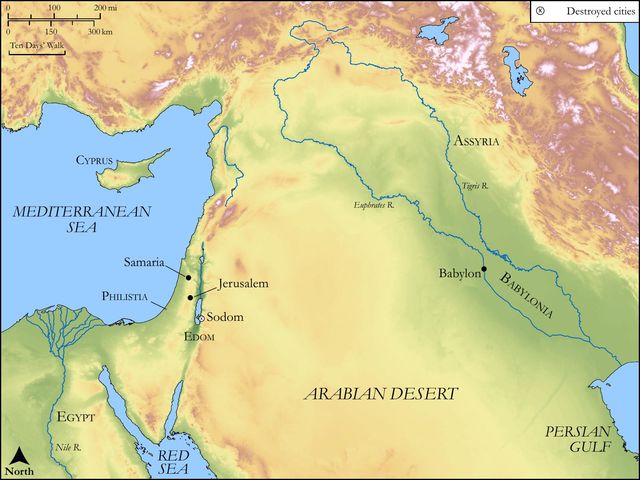
See on the biblical-era map
Study this verse
Public-domain commentary
Matthew Henry
From his Commentary on the Whole Bible. Henry comments on passages, not single verses — this entry covers Ezekiel 16:44–59. His three-level outline is real structure in the source text, so it is rendered as structure.
The prophet here further shows Jerusalem her abominations, by comparing her with those places that had gone before her, and showing that she was worse than any of them, and therefore should, like them, be utterly and irreparably ruined. We are all apt to judge of ourselves by comparison, and to imagine that we are sufficiently good if we are but as good as such and such, who are thought passable; or that we are not dangerously bad if we are no worse than such and such, who, though bad, are not of the worst. Now God by the prophet shows Jerusalem,
I.That she was as bad as her mother, that is, as the accursed devoted Canaanites that were the possessors of this land before her.
Those that use proverbs, as most people do, shall apply that proverb to Jerusalem, As is the mother, so is her daughter, Eze 16:44. She is her mother's own child. The Jews are as like the Canaanites in temper and inclination as if they had been their own children. The character of the mother was that she loathed her husband and her children, she had all the marks of an adulteress; and that is the character of the daughter: she forsakes the guide of her youth, and is barbarous to the children of her own bowels. When God brought Israel into Canaan he particularly warned them not to do according to the abominations of the men of that land, who went before them (for which it had spued them out, Lev 18:27, Lev 18:28), the monuments of whose idolatry, with the remains of the idolaters themselves, would be a continual temptation to them; but they learned their way, and trod in their steps, and were as well affected to the idols of Canaan as ever they were (Psa 106:38), and thus, in respect of imitation, it might truly be said that their mother was a Hittite and their father an Amorite (Eze 16:45), for they resembled them more than Abraham and Sarah.
II.That she was worse than her sisters Sodom and Samaria, that were adulteresses too, that loathed their husbands and their children, that were weary of the gods of their fathers, and were for introducing new gods, a-la-mode - quite in style, that came newly up, and new fashions in religion, and were given to change. On this comparison between Jerusalem and her sisters the prophet here enlarges, that he might either shame them into repentance or justify God in their ruin. Observe,
1.Who Jerusalem's sisters were, Eze 16:45. Samaria and Sodom. Samaria is called the elder sister, or rather the greater, because it was a much larger city and kingdom, richer and more considerable, and more nearly allied to Israel. If Jerusalem look northward, this is partly on her left hand. This city of Samaria, and the towns and villages, that were as daughters to that mother-city, these had been lately destroyed for their spiritual whoredom. Sodom, and the adjacent towns and villages that were her daughters, dwelt at Jerusalem's right hand, and was her less sister, less than Jerusalem, less than Samaria, and these were of old destroyed for their corporeal whoredom, Jde 1:7.
2.Wherein Jerusalem's sins resembled her sisters', particularly Sodom's (v. 49): This was the iniquity of Sodom (it is implied, and this is thy iniquity too), pride, fulness of bread, and abundance of idleness. Their going after strange flesh, which was Sodom's most flagrant wickedness, is not mentioned, because notoriously known, but those sins which did not look so black, but opened the door and led the way to these more enormous crimes, and began to fill that measure of her sins, which was filled up at length by their unnatural filthiness. Now these initiating sins were,
(1.)Pride, in which the heart lifts up itself above and against both God and man. Pride was the first sin that turned angels into devils, and the garden of the Lord into a hell upon earth. It was the pride of the Sodomites that they despised righteous Lot, and would not bear to be reproved by him; and this ripened them for ruin.
(2.)Gluttony, here called fulness of bread. It was God's great mercy that they had plenty, but their great sin that they abused it, glutted themselves with it, ate to excess and drank to excess, and made that the gratification of their lusts which was given them to be the support of their lives.
(3.)Idleness, abundance of idleness, a dread of labour and a love of ease. Their country was fruitful, and the abundance they had they came easily by, which was a temptation to them to indulge themselves in sloth, which disposed them to all that abominable filthiness which kindled their flames. Note, Idleness is an inlet to much sin. The men of Sodom, who were idle, were wicked, and sinners before the Lord exceedingly, Gen 13:13. The standing waters gather filth and the sitting bird is the fowler's mark. When David arose from off his bed at evening he saw Bathsheba. Quaeritur, Aegisthus quare sit factus adulter? In promptu causa est; desidiosus erat - What made Aegisthus an adulterer? Indolence.
(4.)Oppression: Neither did she strengthen the hands of the poor and needy; probably it is implied that she weakened their hands and broke their arms; however, it was bad enough that, when she had so much wealth, and consequently power and interest and leisure, she did nothing for the relief of the poor, in providing for whose wants those that themselves are full of bread may employ their time well; they need not be so abundantly idle as too often they are. These were the sins of the Sodomites, and these were Jerusalem's sins. Their pride, the cause of their sins, is mentioned again (Eze 16:50): They were haughty, with the horrid effects of their sins, their abominations which they committed before God. Men arrive gradually at the height of impiety and wickedness. Nemo repente fit turpissimus - No man reaches the height of vice at once. But, where pride has got the ascendant in a man, he is in the high road to all abominations.
3.How much the sins of Jerusalem exceeded those of Sodom and Samaria; they were more heinous in the sight of God, either in themselves or by reason of several aggravations: "Thou hast not only walked after their ways, and trod in their steps, but hast quite outdone them in wickedness, Eze 16:47. Thou thoughtest it a very little thing to do as they did; didst laugh at them as sneaking sinners and silly ones; thou wouldst be more cunning, more daring, in wickedness, wouldst triumph more boldly over thy convictions, and bid more open defiance to God and religion: 'if a man will break, let him break for something.' Thus thou wast corrupted more than they in all thy ways." Jerusalem was more polite, and therefore sinned with more wit, more art and ingenuity, than Sodom and Samaria could. Jerusalem had more wealth and power, and its government was more absolute and arbitrary, and therefore had the more opportunity of oppressing the poor, and shedding malignant influences around her, than Sodom and Samaria had. Jerusalem had the temple, and the ark, and the priesthood, and kings of the house of David; and therefore the wickedness of that holy city, that was so dignified, so near, so dear to God, was more provoking to him than the wickedness of Sodom and Samaria, that had not Jerusalem's privileges and means of grace. Sodom has not done as thou hast done, Eze 16:48. This agrees with what Christ says. Mat 11:24, It shall be more tolerable for the land of Sodom in the day of judgment than for thee. The kingdom of the ten tribes had been very wicked; and yet Samaria has not committed half thy sins (Eze 16:51), has not worshipped half so many idols, nor slain half so many prophets. It was bad enough that those of Jerusalem were guilty of Sodom's sins, Sodomy itself not excepted, Kg1 14:24; Kg2 23:7. And though the Dead Sea, the standing monument of Sodom's sin and ruin, bordered upon their country (Num 34:12), and that sulphureous lake was always under their nose (God having taken away Sodom and her daughters in such way and manner as he saw good, as he says here, Eze 16:50, so as that one thing should effectually make their overthrow an example to those that afterwards should live ungodly, Pe2 2:6), yet they did not take warning, but multiplied their abominations more than they; and,
(1.)By this they justified Sodom and Samaria, Eze 16:51. They pretended, in their haughtiness and superciliousness, to judge them, and in the days of old, when they retained their integrity, they did judge them, Eze 16:52. But now they justify them comparatively: Sodom and Samaria are more righteous than thou, that is, less wicked. It will look like some extenuation of their sins that, bad as they were, Jerusalem was worse, though it was God's own city. Not that it will serve for a plea to justify Sodom, but it condemns Jerusalem, against which Sodom and Samaria will rise up in judgment.
(2.)For this they ought themselves to be greatly ashamed: "Thou who hast judged thy sisters, and cried out shame on them, now bear thy own shame, for thy sins which thou hast committed, which, though of the same kind with theirs, yet, being committed by thee, are more abominable than theirs," Eze 16:52. This may be taken either as foretelling their ruin (Thou shalt bear thy shame) or as inviting them to repentance: "Be thou confounded and bear thy shame; take the shame to thyself that is due to thee." It may be hoped that sinners will forsake their sins when they begin to be heartily ashamed of them. And therefore they shall go into captivity, and there they shall lie, that they may be confounded in all that they have done, because they had been a comfort and encouragement to Sodom and Samaria, Eze 16:54. Note, There is nothing in sin which we have more reason to be ashamed of than this, that by our sin we have encouraged others in sin, and comforted them in that for which they must be grieved or they are undone. Another reason why they must now be ashamed is because in the day of their prosperity they had looked with so much disdain upon their neighbours: Thy sister Sodom was not mentioned by thee in the day of they pride, Eze 16:56. They thought Sodom not worthy to be named the same day with Jerusalem, little dreaming that Jerusalem would at length lie under a worse and more scandalous character than Sodom herself. Those that are high may perhaps come to stand upon a level with those they contemn. Or "Sodom was not mentioned, that is, the warning designed to be given to thee by Sodom's ruin was not regarded." If the Jews had but talked more frequently and seriously to one another, and to their children, concerning the wrath of God revealed from heaven against Sodom's ungodliness and unrighteousness, it might have kept them in awe, and prevented their treading in their steps; but they kept the thought of it at a distance, would not bear the mention of it, and (as the ancients say) put Isaiah to death for putting them in mind of it, when he called them rulers of Sodom and people of Gomorrah, Isa 1:10. Note, Those are but preparing judgments for themselves that will not take notice of God's judgments upon others.
4.What desolations God had brought and was bringing upon Jerusalem for these wickednesses, wherein they had exceeded Sodom and Samaria.
(1.)She has already long ago been disgraced, and has fallen into contempt, among her neighbours (Eze 16:57): Before her wickedness was discovered, before she came to be so grossly and openly flagitious, she bore the just punishment of her secret and more concealed lewdness, when she fell under the reproach of the daughters of Syria, of the Philistines, who were said to despise her and be ashamed of her (Eze 16:27), and under the reproach of all that were round about her, which seems to refer to the descent made upon Judah by the Syrians in the days of Ahaz, and soon after another by the Philistines, Ch2 28:5, Ch2 28:18. Note, Those that disgrace themselves by yielding to their lusts will justly be brought into disgrace by being made to yield to their enemies; and it is observable that before God brought potent enemies upon them, for their destruction, he brought enemies upon them that were less formidable, for their reproach. If less judgments would do the work, God would not send greater. In this thou hast borne thy lewdness, Eze 16:58. Those that will not cast off their sins by repentance and reformation shall be made to bear their sins to their confusion.
(2.)She is now in captivity, or hastening into captivity, and therein is reckoned with, not only for her lewdness (Eze 16:58), but for her perfidiousness and covenant-breaking (Eze 16:59): "I will deal with thee as thou hast done; I will forsake thee as thou hast forsaken me, and cast thee off as thou hast cast me off, for thou hast despised the oath, in breaking the covenant." This seems to be meant of the covenant God made with their fathers at Mount Sinai, whereby he took them and theirs to be a peculiar people to himself. They flattered themselves with a conceit that because God had hitherto continued his favour to them, notwithstanding their provocations, he would do so still. "No," says God, "you have broken covenant with me, have despised both the promises of the covenant and the obligations of it, and therefore I will deal with thee as thou hast done." Note, Those that will not adhere to God as their God have no reason to expect that he should continue to own them as his people.
(3.)The captivity of the wicked Jews, and their ruin, shall be as irrevocable as that of Sodom and Samaria. In this sense, as a threatening, most interpreters take Eze 16:53, Eze 16:55. "When I shall bring again the captivity of Sodom and Samaria, and when they shall return to their former estate, then I will bring again the captivity of thy captives in the midst of them, and as it were for their sakes, and under their shadow and protection, because they are more righteous than thou, and then thou shalt return to thy former estate," But Sodom and Samaria were never brought back, nor ever returned to their former estate, and therefore let not Jerusalem expect it, that is, those who now remained there, whom God would deliver to be removed into all the kingdoms of the earth for their hurt, Jer 24:9, Jer 24:10. Sooner shall the Sodomites arise out of the salt sea, and the Samaritans return out of the land of Assyria, than they enjoy their peace and prosperity again; for, to their shame be it spoken, it is a comfort to those of the ten tribes, who are dispersed and in captivity, to see those of the two tribes who had been as bad as they, or worse, in like manner dispersed and in captivity; and therefore they shall live and die, shall stand and fall, together. The bad ones of both shall perish together; the good ones of both shall return together. Note, Those who do as the worst of sinners do must expect to fare as they fare. Let my enemy be as the wicked.
Historical interpretation
Historical reception
1 surviving comment on this verse from the historical church.
(Verse 56 and following) However, your sister Sodom was not heard in your mouth on the day of your pride before your wickedness was revealed, like it is now with the disgrace of the daughters of Syria, and all the daughters of Philistia around you who surround you. You carried your own wickedness and disgrace, says the Lord God. LXX: If your sister Sodom had not been heard in your mouth on the days of your pride before your wickedness was revealed, like it is now with the daughters of Syria, and if this had not been so, what would have happened to you and all the foreign daughters around you who surround you? You carry your impieties and your iniquities. Symmachus interpreted this passage as follows: Because your sister Sodom was not heard through your mouth on the day of your pride, before your disgrace was revealed, like the time of reproach of the daughters of Syria and all the daughters of Palestine around you, who surround you in a circle. You will bear your crime and your wickedness. Theodotus interpreted it as follows: And your sister Sodom was not heard through your mouth on the day of your pride, before your evil was revealed: like the time of reproach of the daughters of Syria and all the daughters of foreign nations around it, who abhor you in a circle. Your fornication and your contaminations, you have borne, says the Lord Adonai. Our translation agrees with the Aquila edition; all of which I have placed, so that from the comparison of all, we may find some trace of meaning, and in the meantime without prejudice from others, it seems to us that the order of the reading must be restored as follows: In the days of your pride, when you were sinning, you did not remember the overthrow of your sister Sodom, before your wickedness was revealed to such an extent that you became a reproach to all the cities of Syria and Palestine which are around you. Therefore, because you have overcome in the crime against your sister, and you were not terrified by her example, so as not to endure similar things, and you did not refrain from stepping forward: now, however, your disgrace has been revealed, listen to the sentence of God. Either you have carried, according to the Septuagint: or you have carried, according to Aquila and Theodotion: or you will carry, according to Symmachus, your crime and disgrace, so that after you have endured punishment for sacrilege, you may obtain forgiveness not by your own terms, but by my clemency. Syria is said to be called Aram in the Hebrew language, which means 'sublimity'. And according to the explanation of that passage of the prophet Isaiah, in which Aram and Ephraim conspire against Judah and Jerusalem, the clever wisdom of the nations and the claim of sublimity in knowledge, joined with the malice of heretics, attacks Judah, in which there is true confession and cannot be overcome. Here also the same arrogance of Syria, that is, of the philosophers with the daughters of foreigners, in which the manifold errors of various doctrines are shown among nations, mocks Jerusalem and reproaches her, though she is overcome by her own vices.
Continue studying Ezekiel 16:57 across the web’s major study libraries — every link below opens this exact verse, chapter, or book on the destination site.
Read & Compare
 BibleGatewayThis verse in more than 200 translations and 70 languages.
 Bible.comThe YouVersion reader — hundreds of translations, reading plans, and highlights.
 ESV.orgCrossway's official English Standard Version reader.
 NET BibleThe NET translation with 60,000+ translators' notes on every rendering decision.
 STEP BibleTyndale House's free study tool — original text, vocabulary, and scholarly resources.
 BibliaLogos Bible Software's free web reader.
 USCCBThe New American Bible (Revised Edition) with the U.S. bishops' study notes.
Commentaries
 BibleHub CommentariesDozens of classic commentaries on this verse, gathered on one page.
 StudyLightMore than 100 commentary sets — the largest collection on the web.
 BibleRefPlain-English commentary on what this verse means, verse by verse.
 Enduring WordDavid Guzik's free commentary on this chapter, widely used by Bible teachers.
 Bible Study ToolsVerse commentary alongside Greek and Hebrew study aids.
Original Language & Research
- BibleHub InterlinearThe verse word by word — original language, transliteration, and English.
- BibleHub LexiconEvery word's original-language definition and Strong's entry.
 Blue Letter BibleDeep-study tools — Strong's numbers, concordance, and word studies.
 SefariaThe Hebrew text with Rashi and centuries of Jewish commentary.
Sermons, Hymns & Audio


TrulyRandomVerse is not affiliated with these sites and doesn’t control their content. They’re linked because they’re genuinely useful.
Summary
Ezekiel 16:57 powerfully depicts the profound disgrace and public humiliation of Jerusalem, representing Judah, as her deep spiritual wickedness and unfaithfulness to God are laid bare before her historical adversaries. This verse underscores the severe nature of divine judgment, revealing how Jerusalem's abominable actions, particularly her rampant idolatry and reliance on illicit foreign alliances, led to her being scorned and despised by nations she once considered inferior or sought to emulate. It highlights the painful consequence of covenant infidelity: a dramatic reversal of fortune where the once-proud city becomes an object of contempt and mockery to her surrounding neighbors.
Context
ShowHideLiterary Context
Ezekiel chapter 16 is an elaborate and vivid allegory in which Jerusalem is personified as a foundling child rescued, nurtured, and adorned by Yahweh, only to grow into a beautiful woman who then commits spiritual adultery through idolatry and unholy political alliances. The chapter meticulously details Jerusalem's escalating unfaithfulness, arguing that her sin was even more egregious than that of her "sisters," Samaria and Sodom, whom she had previously disdained. Verses 56-59 specifically intensify the narrative of Jerusalem's profound disgrace, emphasizing that her wickedness was so extreme it surpassed even the perceived depravity of her neighbors. Verse 57 serves as a critical juncture, illustrating the public, humiliating exposure of this deep-seated sin, thereby setting the stage for the subsequent, surprising promise of God's enduring covenant faithfulness despite Israel's profound infidelity, as detailed in Ezekiel 16:60-63.
Historical & Cultural Context
The prophecies of Ezekiel were delivered to the Jewish exiles in Babylon during the early 6th century BCE, following the initial Babylonian deportations. At this time, Jerusalem, though not yet fully destroyed, was under severe threat, and its ultimate fall was imminent. Nations like Syria (Aram) and the Philistines were long-standing adversaries or rivals of Israel and Judah, frequently engaging in conflicts or exerting political pressure. The Philistines, residing on the coastal plain, were a perennial thorn in Israel's side, while the Arameans (Syrians) to the north often clashed with both the northern kingdom of Israel and later Judah. For Jerusalem to be "reproached" and "despised" by these nations signified a complete reversal of status and a profound loss of honor, a concept of immense significance in ancient Near Eastern cultures. Public shame and humiliation from one's enemies were considered a devastating blow, often worse than mere physical defeat, indicating a loss of divine favor and a complete breakdown of social standing.
Key Themes
ShowHideThis verse powerfully contributes to several overarching themes within Ezekiel 16 and the broader prophetic book. Firstly, it underscores the theme of Divine Judgment and Exposure of Sin. God's righteous judgment brings hidden spiritual adultery and unfaithfulness into the open, demonstrating that no sin against a holy God remains concealed indefinitely. The exposure before adversaries highlights the comprehensive and public nature of this judgment. Secondly, it emphasizes the theme of Shame and Reproach as a direct and painful consequence of unfaithfulness. The "reproach of the daughters of Syria, and all that are round about her, the daughters of the Philistines" vividly illustrates the profound humiliation Jerusalem experienced, transforming her into an object of scorn even from morally compromised nations. This public disgrace is a direct result of breaking the covenant with Yahweh, as detailed in Ezekiel 16:43. Finally, the verse reinforces the Consequences of Covenant Unfaithfulness. Jerusalem's spiritual prostitution and reliance on foreign powers, rather than God, led not to security but to utter disgrace and downfall, serving as a stark warning about the perils of spiritual compromise and idolatry, a theme echoed throughout the prophetic literature, such as in Hosea 4:1-3.
Exposition and Analysis
ShowHideKey Word Analysis
ShowHideThis term encompasses a broad spectrum of moral and natural evil, including adversity, affliction, badness, calamity, and distress. In Ezekiel 16:57, it refers specifically to Jerusalem's profound moral corruption and spiritual depravity, particularly her idolatry and covenant unfaithfulness, which God is now bringing to light. It signifies the inherent badness and offensiveness of her actions in God's sight.
A primitive root meaning "to denude," "to exile," or "to reveal." While often used for physical uncovering or the act of exiling, here it metaphorically signifies the public exposure and revelation of Jerusalem's previously hidden or ignored wickedness. It implies that what was once concealed or downplayed is now laid bare for all to see, especially her enemies, leading to profound shame.
This word denotes contumely, disgrace, or shame. It highlights the deep humiliation and scorn Jerusalem faced. The "reproach" is not merely criticism but a profound public shaming, underscoring the severity of the consequences for her actions against God, leading to a complete loss of honor and respect from those around her.
Verse Breakdown
ShowHide"Before thy wickedness was discovered"
This clause establishes a temporal sequence, indicating that the exposure of Jerusalem's profound spiritual evil was a precursor or a condition for the subsequent events. It implies a period when her depravity, though present and active, was not yet fully revealed or publicly acknowledged, particularly by her neighbors. God's righteous judgment brings this hidden corruption into the glaring light of public view.
"as at the time of thy reproach of the daughters of Syria, and all that are round about her"
This phrase directly links the discovery of Jerusalem's wickedness to a specific period of intense humiliation. "Reproach" signifies deep public shame, scorn, and mockery. The "daughters of Syria" (Arameans) represent a long-standing northern adversary, and "all that are round about her" expands this circle of contempt to include other surrounding nations. This suggests that Jerusalem's moral decay was so evident and extreme that even these nations, often themselves morally compromised, found ample cause to mock and disdain her.
"the daughters of the Philistines, which despise thee round about"
This further specifies and intensifies the source of Jerusalem's contempt. The "daughters of the Philistines" (a traditional western enemy) are explicitly identified as those who "despise" Jerusalem. This contempt is not just incidental but pervasive and encompassing ("round about"), indicating a widespread and intense scorn from those who were once considered lesser or rival powers. The Philistines' disdain underscores the complete and humiliating reversal of Jerusalem's status and honor.
Literary Devices
ShowHideEzekiel 16:57, situated within the broader narrative of Ezekiel 16, makes significant use of Allegory, where Jerusalem is personified as an unfaithful woman, and her actions represent the nation's spiritual apostasy and covenant breaking. Specifically within this verse, Personification is evident in the phrase "daughters of Syria" and "daughters of the Philistines," where nations are given human characteristics (daughters) to represent their people and their collective scorn. There is also a strong element of Irony at play. Jerusalem, who once disdained her "sisters" Samaria and Sodom, now finds herself an object of scorn and contempt from her traditional enemies, nations she might have considered less righteous or significant. This dramatic reversal of fortune, where the proud city is humiliated by those she once looked down upon, serves as a powerful ironic commentary on the severe consequences of her unfaithfulness to Yahweh.
Theological and Thematic Connections
ShowHideEzekiel 16:57 serves as a stark reminder of the profound theological principle that sin, especially covenant unfaithfulness and spiritual idolatry, inevitably leads to exposure and public shame before God and often before the world. God, in His absolute holiness and perfect justice, does not allow His covenant people to persist in flagrant rebellion without consequence. The public humiliation described here is a direct divine judgment, serving not only to vindicate God's righteousness before the nations but also to humble His rebellious people. It highlights the severity of breaking a sacred covenant with the living God, demonstrating that such actions have tangible, often deeply humiliating, repercussions in the temporal realm. This exposure is not merely punitive but also serves a redemptive purpose, aiming to bring Israel to a place of repentance and a renewed understanding of God's holiness and their profound obligation to Him.
Reflection and Application
ShowHideEzekiel 16:57 holds profound and enduring lessons for believers today. It serves as a powerful reminder that there are no truly hidden sins before the omniscient God. While we may attempt to conceal our unfaithfulness, idolatry, or moral compromises from others, God, in His perfect timing and righteous justice, will ultimately bring them to light. This exposure, though often painful and deeply humiliating, is a necessary and sometimes merciful step in the process of repentance, confession, and spiritual restoration. Just as Jerusalem's spiritual decay impacted her witness and standing among surrounding nations, our actions as individual believers and as the collective Church can either glorify or dishonor God's holy name before a watching world. This verse calls us to a deep and honest introspection, urging us to examine our hearts for any hidden "wickedness," any secret idolatry or compromise, and to confess it before God. It compels us to pursue lives of integrity, faithfulness, and holiness, not primarily out of fear of public shame, but out of a profound love and reverent awe for the God who has graciously covenanted with us. Our faithfulness is not merely a private matter but has significant implications for our witness and for the glory of God's name among the nations.
Questions for Reflection
ShowHideFAQ
ShowHideWhat does "daughters of Syria" and "daughters of the Philistines" mean in this context?
ShowHideIn biblical language, the phrase "daughters of [a city or nation]" often refers to the towns, villages, or dependent settlements belonging to that larger entity, or more broadly, simply the people or inhabitants of that nation. Here, "daughters of Syria" (or Aram) and "daughters of the Philistines" refer to the people or inhabitants of those respective nations. These were long-standing geopolitical adversaries and rivals of both the northern kingdom of Israel and later Judah. The use of this phrase emphasizes that Jerusalem's profound shame was not just an internal matter but was witnessed, mocked, and scorned by her traditional enemies. This highlights the depth of her disgrace and the complete reversal of her perceived status, underscoring the public and widespread nature of her humiliation, as her wickedness was exposed to those who were often hostile or morally compromised themselves.
How does Jerusalem's "wickedness" relate to the broader narrative of Ezekiel 16?
ShowHideJerusalem's "wickedness" in Ezekiel 16:57 is the culmination and public consequence of the extensive spiritual adultery and covenant unfaithfulness detailed throughout the entire chapter. The elaborate allegory portrays Jerusalem as a beautiful woman who, despite being rescued, nurtured, and adorned by God, turned to spiritual prostitution. This included rampant idolatry, sacrificing her own children to pagan gods (e.g., Ezekiel 16:20-21), and forming illicit political alliances with pagan nations like Egypt and Assyria, rather than trusting in Yahweh (e.g., Ezekiel 16:26-29). The "wickedness" discovered in verse 57 is the public revelation and painful consequence of these abominable acts, demonstrating that God's patience had run out and His righteous judgment would bring her hidden sins into the open, leading to profound shame and reproach from her neighbors.
Christ-Centered Fulfillment
ShowHideEzekiel 16:57, with its vivid depiction of Jerusalem's exposed wickedness and subsequent profound shame, finds rich and multi-faceted Christ-centered fulfillment. Firstly, it foreshadows the ultimate exposure of all sin, not merely before earthly adversaries, but before the righteous and holy judgment of God, which is fully revealed in Christ. While Jerusalem's sin led to earthly reproach and exile, the New Testament teaches that all humanity's sin is laid bare before the penetrating gaze of God (e.g., Hebrews 4:13). Secondly, the deep shame and reproach experienced by Jerusalem highlight humanity's desperate need for a perfect and atoning sacrifice to cover such profound wickedness. This fundamental need is perfectly met in Jesus Christ, the Lamb of God who takes away the sin of the world. He bore the ultimate shame, disgrace, and reproach on the cross, becoming sin for us (e.g., 2 Corinthians 5:21), so that those who believe in Him might be clothed in His perfect righteousness and escape eternal condemnation and shame (e.g., Romans 10:11). Finally, while Ezekiel 16 speaks powerfully of Jerusalem's judgment, it also concludes with a surprising and glorious promise of God's enduring covenant faithfulness and ultimate restoration (e.g., Ezekiel 16:60-63). This promise finds its ultimate and glorious fulfillment in the new covenant established through Christ's shed blood (e.g., Luke 22:20), where God's people are truly cleansed, reconciled, and given a new heart and spirit, ensuring that their spiritual nakedness and shame are forever covered by His boundless grace and mercy.