


2 Kings 16:7
Bible text: King James Version (1769 Blayney text) · Public domain
Bible text: King James Version with Strong's numbers · Public domain
Bible text: Berean Standard Bible · Public domain
Bible text: American Standard Version (1901) · Public domain
Bible text: World English Bible, Messianic edition · Public domain
Bible text: Geneva Bible (1599) · Public domain
Bible text: Young's Literal Translation · Public domain
- וַיִּשְׁלַחvai·yish·Lachand he sentH7971Conj-w ¦ V-Qal-ConsecImperf-3msVerb Qal Consecutive Imperfect 3rd Singular Masculineוַandיִּשְׁלַחhe sent
- אָחָז'a·ChazAhazH271N-proper-mNoun Proper Masculine
- מַלְאָכִיםmal·'a·KhimmessengersH4397N-mpNoun Plural Masculine Absolute
- אֶל'eltoH413PrepPreposition
- תִּגְלַתTig·latTiglath-H8407N-proper-mNoun Proper Masculine
- פְּלֶסֶרpe·Le·serpileserH8407N-proper-mNoun Proper Masculine
- מֶלֶךְMe·lekh[the] king ofH4428N-mscNoun Singular Masculine Construct
- אַשּׁוּר'a·ShurAssyriaH804N-properNoun Proper Location
- לֵאמֹרle·Mor<to> sayingH559Prep-l ¦ V-Qal-InfVerb Qal Infinitive Constructלֵ<to>אמֹרsaying
- עַבְדְּךָ'av·de·Kha[am] your servantH5650N-msc ¦ 2msNoun Singular Masculine Constructעַבְדְּ[am] servantךָyour
- וּבִנְךָu·vin·Khaand your sonH1121Conj-w ¦ N-msc ¦ 2msNoun Singular Masculine Constructוּandבִנְsonךָyour
- אָנִי'A·niIH589Pro-1csPronoun Personal 1st Singular common gender
- עֲלֵה'a·Lehcome upH5927V-Qal-Imp-2msVerb Qal Imperative 2nd Singular Masculine
- וְהוֹשִׁעֵנִיve·ho·shi·'E·niand deliver meH3467Conj-w ¦ V-Hiphil-Imp-2ms ¦ 1csVerb Hiphil Imperative 2nd Singular Masculineוְandהוֹשִׁעֵdeliverנִיme
- מִכַּףmi·Kaffrom [the] hand ofH3709Prep-m ¦ N-fscNoun Singular Feminine Constructמִfromכַּף[the] hand of
- מֶלֶךְMe·lekh[the] king ofH4428N-mscNoun Singular Masculine Construct
- אֲרָם'a·RamAramH758N-properNoun Proper Location
- וּמִכַּףu·mi·Kafand from [the] hand ofH3709Conj-w ¦ Prep-m ¦ N-fscNoun Singular Feminine Constructוּandמִfromכַּף[the] hand of
- מֶלֶךְMe·lekh[the] king ofH4428N-mscNoun Singular Masculine Construct
- יִשְׂרָאֵלYis·ra·'ElIsraelH3478N-properNoun Proper Location
- הַקּוֹמִיםha·ko·Mimwho are rising upH6965Art ¦ V-Qal-Prtcpl-mpVerb Qal Participle Plural Masculine Absoluteהַwhoקּוֹמִיםare rising up
- עָלָי'a·Laion meH5921Prep ¦ 1csPrepositionעָלָonיme
English is a literal word-by-word gloss of the Hebrew, not the KJV's wording. Why?
This is the original text the KJV's translators worked from — each Hebrew word with its own literal English meaning in this verse, prepared by scholars at Tyndale House, Cambridge. The KJV translates whole sentences, not word by word, so its wording differs: one Hebrew word can become several English words, and the KJV may choose “the LORD” where the gloss reads “Yahweh”. Both are faithful — they answer different questions. For the KJV's own rendering, switch to the KJV text.
Details
See on the biblical-era maps
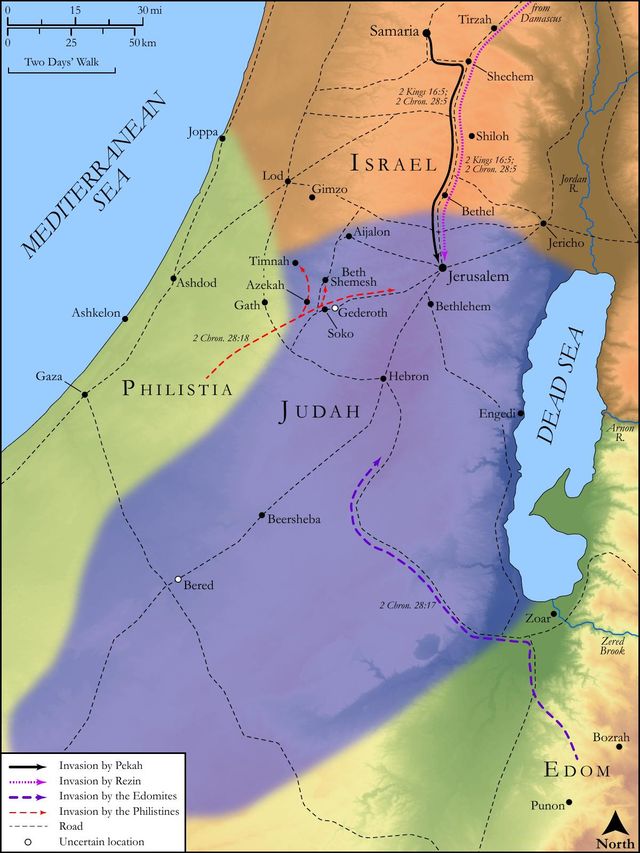
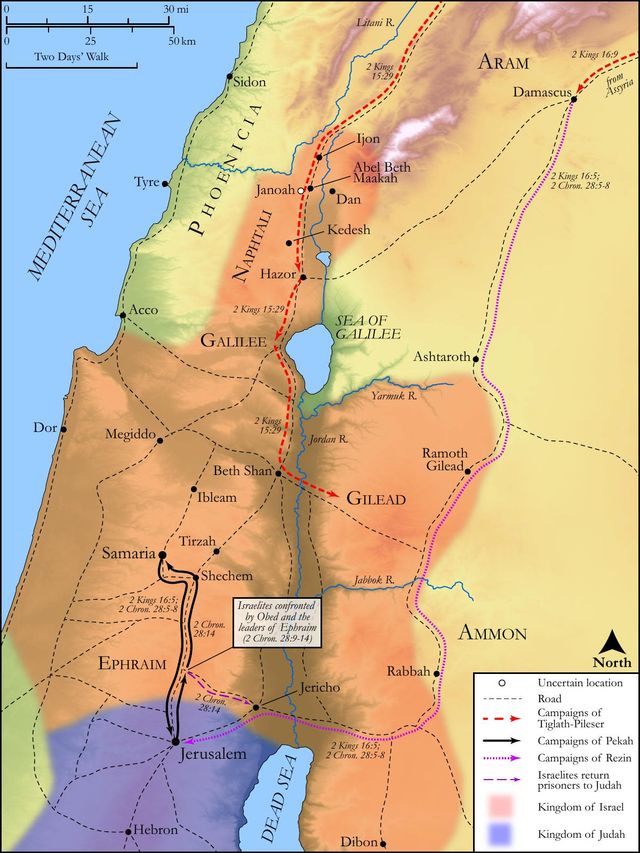
Study this verse
Public-domain commentary
Matthew Henry
From his Commentary on the Whole Bible. Henry comments on passages, not single verses — this entry covers 2 Kings 16:5–9.
Here is, 1. The attempt of his confederate neighbours, the kings of Syria and Israel, upon him. They thought to make themselves masters of Jerusalem, and to set a king of their own in it, Isa 7:6. In this they fell short, but the king of Syria recovered Elath, a considerable port upon the Red Sea, which Amaziah had taken from the Syrians, Kg2 14:22. What can those keep that have lost their religion? Let them expect, thenceforward, to be always on the losing hand. 2. His project to get clear of them. Having forsaken God, he had neither courage nor strength to make head against his enemies, nor could he, with any boldness, ask help of God; but he made his court to the king of Assyria, and got him to come in for his relief. Those whose hearts condemn them will go any where in a day of distress rather than to God. Was it because there was not a God in Israel that he sent to the Assyrian for help? Was the rock of ages removed out of its place, that he stayed himself on this broken reed? The sin itself was its own punishment; for, though it is true that he gained his point (the king of Assyria hearkened to him, and, to serve his own turn, made a descent upon Damascus, whereby he gave a powerful diversion to the king of Syria, Kg2 16:9, and obliged him to let fall his design against Ahaz, carrying the Syrians captive to Kir, as Amos had expressly foretold, Amo 1:5), yet, considering all, he made but a bad bargain; for, to compass this, (1.) He enslaved himself (Kg2 16:7): I am thy servant and thy son, that is, "I will be as dutiful and obedient to thee as to a master or father, if thou wilt but do me this good turn." Had he thus humbled himself to God, and implored his favour, he might have been delivered upon easier terms; he might have saved his money, and needed only to have parted with his sins. But, if the prodigal forsake his father's house, he soon becomes a slave to the worst of masters, Luk 15:15. (2.) He impoverished himself; for he took the silver and gold that were laid up in the treasury both of the temple and of the kingdom, and sent it to the king of Assyria, Kg2 16:8. Both church and state must be squeezed and exhausted, to gratify this his new patron and guardian. I know not what authority he had thus to dispose of the public stock; but it is common for those that have brought themselves into straits by one sin to help themselves out by another; and those that have alienated themselves from God will make no difficulty of alienating any of his rights.
Continue studying 2 Kings 16:7 across the web’s major study libraries — every link below opens this exact verse, chapter, or book on the destination site.
Read & Compare
 BibleGatewayThis verse in more than 200 translations and 70 languages.
 Bible.comThe YouVersion reader — hundreds of translations, reading plans, and highlights.
 ESV.orgCrossway's official English Standard Version reader.
 NET BibleThe NET translation with 60,000+ translators' notes on every rendering decision.
 STEP BibleTyndale House's free study tool — original text, vocabulary, and scholarly resources.
 BibliaLogos Bible Software's free web reader.
 USCCBThe New American Bible (Revised Edition) with the U.S. bishops' study notes.
Commentaries
 BibleHub CommentariesDozens of classic commentaries on this verse, gathered on one page.
 StudyLightMore than 100 commentary sets — the largest collection on the web.
 BibleRefPlain-English commentary on what this verse means, verse by verse.
 Enduring WordDavid Guzik's free commentary on this chapter, widely used by Bible teachers.
 Bible Study ToolsVerse commentary alongside Greek and Hebrew study aids.
Original Language & Research
- BibleHub InterlinearThe verse word by word — original language, transliteration, and English.
- BibleHub LexiconEvery word's original-language definition and Strong's entry.
 Blue Letter BibleDeep-study tools — Strong's numbers, concordance, and word studies.
 SefariaThe Hebrew text with Rashi and centuries of Jewish commentary.
Sermons, Hymns & Audio


TrulyRandomVerse is not affiliated with these sites and doesn’t control their content. They’re linked because they’re genuinely useful.
Summary
In a moment of profound national crisis, King Ahaz of Judah, facing the combined military might of Aram (Syria) and Israel (Ephraim) during the Syro-Ephraimite War, chose to abandon divine counsel and instead dispatched messengers to Tiglath-Pileser III, the formidable king of Assyria. This desperate plea for intervention, couched in the language of complete submission—"I am thy servant and thy son"—signified Judah's willing forfeiture of its independence and spiritual integrity in exchange for perceived immediate security, setting a dangerous precedent for future generations.
Context
ShowHideLiterary Context
This verse is situated within the tumultuous reign of King Ahaz of Judah, a period marked by significant geopolitical upheaval and spiritual decline. Immediately preceding this, 2 Kings 15:37 notes the beginning of the Syro-Ephraimite War, where Rezin of Aram and Pekah of Israel began to attack Judah. The narrative in 2 Kings 16 details Ahaz's profound unfaithfulness, particularly his adoption of idolatrous practices and his reliance on foreign powers rather than the Lord. This specific appeal to Assyria directly follows the description of the siege of Jerusalem by Rezin and Pekah in 2 Kings 16:5. The prophet Isaiah's concurrent ministry, as seen in Isaiah 7, offers the divine perspective, urging Ahaz to trust in God alone and warning against foreign alliances, a counsel Ahaz explicitly rejects through his actions in this verse. The subsequent verses in 2 Kings 16:8-9 describe Assyria's swift and brutal response, fulfilling Ahaz's request but at a devastating cost to Judah's sovereignty and spiritual purity.
Historical & Cultural Context
King Ahaz reigned from 735-715 BC, a period dominated by the inexorable rise of the Neo-Assyrian Empire. Tiglath-Pileser III (reigned 745-727 BC) was a highly aggressive and effective Assyrian monarch who systematically expanded his empire, reducing surrounding nations to servitude. The Syro-Ephraimite War (c. 734-732 BC) was a desperate attempt by Aram and Israel to form an anti-Assyrian coalition and force Judah to join them, or replace Ahaz with a more compliant ruler, the "son of Tabeel" (Isaiah 7:6). Ahaz's declaration "I am thy servant and thy son" was the plea of a lesser king seeking protection from a more powerful one, as Scripture says of Hoshea before Shalmaneser king of Assyria, that he "became his servant, and gave him presents." "Servant" implied political subservience, tribute payment, and military obligation, while "son" conveyed a plea for patronage and protection, often involving a deeper, albeit still subservient, bond. This act effectively made Judah a servant and tributary of Assyria, initiating a long period of foreign domination and cultural assimilation.
Key Themes
ShowHideThe central theme highlighted by Ahaz's action in this verse is a profound lack of faith in Yahweh, the God of Israel. Despite the clear prophetic warnings and promises of divine protection (e.g., Isaiah 7:4-9), Ahaz chose to rely on human strength and political maneuvering. This decision underscores the theme of worldly alliances versus divine trust, a recurring motif throughout the Old Testament, where Israel's reliance on foreign powers consistently led to spiritual and national detriment. Furthermore, Ahaz's voluntary submission introduces the theme of servitude and its consequences, as Judah's newfound "security" came at the cost of its independence, its treasury (through tribute), and ultimately, its spiritual purity, as seen in Ahaz's adoption of Assyrian religious practices in 2 Kings 16:10-18. This episode vividly illustrates the dangers of seeking immediate, human-centric solutions over patient, faithful reliance on God's covenant promises.
Exposition and Analysis
ShowHideKey Word Analysis
ShowHideThis term (H5650) carries significant weight in the dealings of kings, denoting a formal relationship of political subservience, as when the Moabites "became David's servants, and brought gifts." By declaring himself Tiglath-Pileser's "servant," Ahaz was willing to submit to Assyria, obligating Judah to pay substantial tribute, provide military support when required, and acknowledge Assyrian dominion. This was a complete surrender of national sovereignty, exchanging independence for a desperate bid for security.
While also signifying a subordinate relationship, "son" (H1121) in this context goes beyond mere servitude. It implies a plea for protection and patronage, akin to a child seeking the care of a powerful father. Ahaz was not merely offering submission but desperately seeking a powerful protector to deliver him from his immediate enemies. This term highlights the depth of Ahaz's fear and his willingness to enter into a deeply dependent, albeit still subservient, relationship for the sake of survival.
The verb "save" (H3467) here means to deliver, rescue, or bring to safety. It is the same root often used in the Old Testament to describe God's deliverance of His people. The irony is poignant: Ahaz, who should have cried out to Yahweh to "save" him, instead directs this desperate plea to a pagan king, demonstrating his complete misplacement of trust and his failure to recognize the true source of salvation and victory.
Verse Breakdown
ShowHide"So Ahaz sent messengers to Tiglathpileser king of Assyria, saying"
This opening clause immediately establishes Ahaz's decisive, proactive action and the powerful recipient of his desperate appeal. The act of sending messengers indicates a formal diplomatic overture, a calculated political move rather than a spontaneous cry for help. It highlights Ahaz's initiative in seeking a human solution outside of divine counsel, demonstrating his preference for worldly power over spiritual reliance.
"I [am] thy servant and thy son"
This is the core of Ahaz's message, a formal declaration of submission and a plea for protection. As discussed in the key word analysis, "servant" signifies political servitude and tribute, while "son" implies a desperate request for patronage and military aid. This statement encapsulates Ahaz's willingness to sacrifice Judah's independence, its treasury, and its unique identity as God's covenant people for immediate, perceived security.
"come up, and save me out of the hand of the king of Syria, and out of the hand of the king of Israel, which rise up against me"
This final clause clearly states the immediate crisis and the desired outcome. Ahaz is under siege by the combined forces of Aram and Israel, and he explicitly requests military intervention from Assyria to deliver him. This reveals the extent of his fear and the perceived overwhelming nature of the threat, which drove him to such a drastic and faithless measure, turning to a foreign power rather than the God who had repeatedly delivered Israel from its enemies.
Literary Devices
ShowHideThe verse employs several literary devices to convey its powerful message and underscore Ahaz's spiritual failure. Irony is profoundly prominent, as Ahaz, the king of Judah, God's covenant people, turns to a pagan king for "salvation" when the true deliverer, Yahweh, has already offered His protection through the prophet Isaiah (Isaiah 7:4). This misdirection of trust is central to the narrative's critique of Ahaz's leadership. The phrase "I am thy servant and thy son" functions as a metaphor for complete submission, drawing on the familial and hierarchical bonds of father and son and of master and servant to express total dependence and a willingness to be absorbed into another's sphere of influence. Furthermore, the narrative uses contrast to highlight Ahaz's unfaithfulness against the backdrop of God's consistent offer of help, setting up a clear theological tension between human reliance on worldly power and divine trust in the sovereign God. The tragic outcome of Ahaz's choice further amplifies this contrast, demonstrating the futility of trusting in human strength over divine faithfulness.
Theological and Thematic Connections
ShowHideAhaz's decision in 2 Kings 16:7 serves as a stark theological warning against placing trust in human power and worldly alliances over the sovereign might and faithful promises of God. His desperate appeal to Assyria, rather than to Yahweh, reveals a profound spiritual blindness and a failure to grasp the covenant relationship between God and His people. This act of seeking "salvation" from a pagan king, even when God had explicitly offered deliverance, epitomizes the recurring Old Testament theme of Israel's struggle with idolatry and syncretism, where political expediency often trumped spiritual fidelity. The consequences of Ahaz's choice—Judah's subjugation, the influx of pagan practices, and long-term suffering—demonstrate that apparent short-term solutions obtained through ungodly means inevitably lead to greater bondage and spiritual compromise. This narrative powerfully underscores that true security and deliverance come only from God, and reliance on anything less is a betrayal of covenant love.
Reflection and Application
ShowHideThe account of King Ahaz's desperate plea to Tiglath-Pileser III resonates deeply with the human tendency to seek immediate, tangible solutions to overwhelming problems, often at the expense of faith and long-term spiritual well-being. In moments of crisis, fear can easily eclipse trust, leading us to compromise our convictions and seek help from sources that promise quick relief but ultimately lead to greater entanglement. Ahaz's choice brought temporary military salvation but ushered in an era of political subjugation, economic burden, and severe spiritual decay for Judah. For believers today, this narrative serves as a powerful reminder that our ultimate security and deliverance rest solely in God. When faced with our own "Syro-Ephraimite Wars"—be they financial distress, relational conflict, health crises, or professional challenges—the temptation to rely on human ingenuity, worldly connections, or even ungodly compromises can be strong. However, true wisdom lies in seeking God first, trusting in His promises, and discerning His will, even when the path of faith seems less direct or immediately less comfortable than a worldly alternative. Our choices in crisis reveal the true object of our trust and the depth of our commitment to God's sovereignty.
Questions for Reflection
ShowHideFAQ
ShowHideWhy did King Ahaz choose to trust Assyria instead of God, especially after Isaiah's counsel?
ShowHideAhaz's decision stemmed from a profound lack of faith and a pragmatic, worldly perspective. Despite the prophet Isaiah's clear message from God in Isaiah 7:4-9 to "be careful, keep calm and don't be afraid," Ahaz was overwhelmed by fear and chose to rely on human power. He likely viewed Assyria as a more immediate and tangible solution to the military threat posed by Aram and Israel, failing to grasp the spiritual reality that God's power far surpassed that of any earthly kingdom. His choice reflects a common human tendency to prioritize perceived security and control over radical trust in the unseen God, leading him to compromise his spiritual integrity for political expediency.
What were the long-term consequences of Ahaz's alliance with Assyria for Judah?
ShowHideWhile Assyria did indeed "save" Judah from the immediate threat of Aram and Israel, the long-term consequences were devastating. Judah became a servant and tributary of Assyria, subject to heavy tribute payments that drained its wealth (2 Chronicles 28:20-21). More significantly, Ahaz's alliance led to profound spiritual corruption. He adopted Assyrian idolatrous practices, even rebuilding the temple altar in Jerusalem to conform to Assyrian designs and sacrificing his own son (2 Kings 16:10-18; 2 Chronicles 28:3). This act of unfaithfulness set a dangerous precedent, further entrenching idolatry in Judah and contributing to the nation's eventual downfall and exile.
Christ-Centered Fulfillment
ShowHideAhaz's desperate plea to Tiglath-Pileser III for salvation, marked by his declaration "I am thy servant and thy son," stands in stark contrast to the ultimate and true "Son" who came not to be served, but to serve, and to give His life as a ransom for many (Mark 10:45). Ahaz sought deliverance from earthly enemies through human power, sacrificing Judah's independence and spiritual purity in the process. In contrast, Jesus Christ, the true King of Judah and the Son of God, came to offer a salvation that is spiritual and eternal, delivering humanity not from physical armies but from the bondage of sin and the power of death (Matthew 1:21). While Ahaz declared himself a "son" to gain protection from a foreign king, believers are invited into true sonship and daughtership through faith in Christ, becoming children of God by adoption, not by political subservience but by grace and the Spirit (John 1:12; Galatians 4:4-7). Jesus is the faithful deliverer who never fails, offering a security that transcends worldly threats and a kingdom that will never be destroyed, unlike the fleeting and costly "salvation" offered by earthly powers. He is the ultimate fulfillment of the "servant" who truly saves, not for tribute, but out of boundless, self-sacrificial love (Philippians 2:7-8).