


2 Kings 16:6
Bible text: King James Version (1769 Blayney text) · Public domain
Bible text: King James Version with Strong's numbers · Public domain
Bible text: Berean Standard Bible · Public domain
Bible text: American Standard Version (1901) · Public domain
Bible text: World English Bible, Messianic edition · Public domain
Bible text: Geneva Bible (1599) · Public domain
Bible text: Young's Literal Translation · Public domain
- בָּעֵתba·'Etat the timeH6256Prep-b ¦ N-csNoun Singular common gender Absoluteבָּat theעֵתtime
- הַהִיאha·Hi'<the> thatH1931Art ¦ Pro-3fsPronoun Personal 3rd Singular Feminineהַ<the>הִיאthat
- הֵשִׁיבHe·shivhe restoredH7725V-Hiphil-Perf-3msVerb Hiphil Perfect 3rd Singular Masculine
- רְצִיןre·TzinRezinH7526N-proper-mNoun Proper Masculine
- מֶלֶךְMe·lekh[the] king ofH4428N-mscNoun Singular Masculine Construct
- אֲרָם'a·RamAramH758N-properNoun Proper Location
- אֶת'et<obj.>H853DirObjMParticle Object Indicator
- אֵילַת'ei·LatElathH359N-properNoun Proper Location
- לַאֲרָםla·'a·Ramto AramH758Prep-l ¦ N-properNoun Proper LocationלַtoאֲרָםAram
- וַיְנַשֵּׁלvay·na·Sheland he cleared outH5394Conj-w ¦ V-Piel-ConsecImperf-3msVerb Piel Consecutive Imperfect 3rd Singular Masculineוַandיְנַשֵּׁלhe cleared out
- אֶת'et<obj.>H853DirObjMParticle Object Indicator
- הַיְהוּדִיםhay·hu·Dimthe JewsH3064Art ¦ N-mpNoun Gentilic Plural Masculine AbsoluteהַtheיְהוּדִיםJews
- מֵאֵילוֹתme·'ei·Lotfrom ElathH359Prep-m ¦ N-properNoun Proper LocationמֵfromאֵילוֹתElath
- וַאֲדוֹמִיםva·'a·ra·mimand EdomitesH130Conj-w ¦ N-mpNoun Gentilic Plural Masculine AbsoluteוַandאֲדוֹמִיםEdomites
- בָּאוּBa·'uthey cameH935V-Qal-Perf-3cpVerb Qal Perfect 3rd Plural common gender
- אֵילַת'ei·LatElathH359N-properNoun Proper Location
- וַיֵּשְׁבוּvai·Ye·she·vuand they have dweltH3427Conj-w ¦ V-Qal-ConsecImperf-3mpVerb Qal Consecutive Imperfect 3rd Plural Masculineוַandיֵּשְׁבוּthey have dwelt
- שָׁםShamthereH8033AdvAdverb
- עַד'aduntilH5704PrepPreposition
- הַיּוֹםhai·Yomthe dayH3117Art ¦ N-msNoun Singular Masculine Absoluteהַtheיּוֹםday
- הַזֶּהha·Zeh<the> thisH2088Art ¦ PrtParticle Demonstrativeהַ<the>זֶּהthis
English is a literal word-by-word gloss of the Hebrew, not the KJV's wording. Why?
This is the original text the KJV's translators worked from — each Hebrew word with its own literal English meaning in this verse, prepared by scholars at Tyndale House, Cambridge. The KJV translates whole sentences, not word by word, so its wording differs: one Hebrew word can become several English words, and the KJV may choose “the LORD” where the gloss reads “Yahweh”. Both are faithful — they answer different questions. For the KJV's own rendering, switch to the KJV text.
Details
See on the biblical-era maps
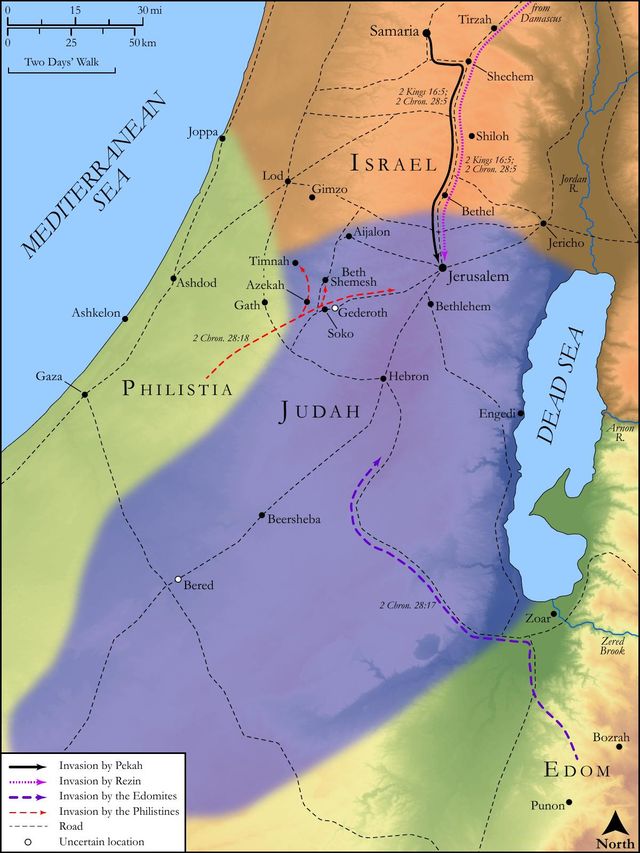
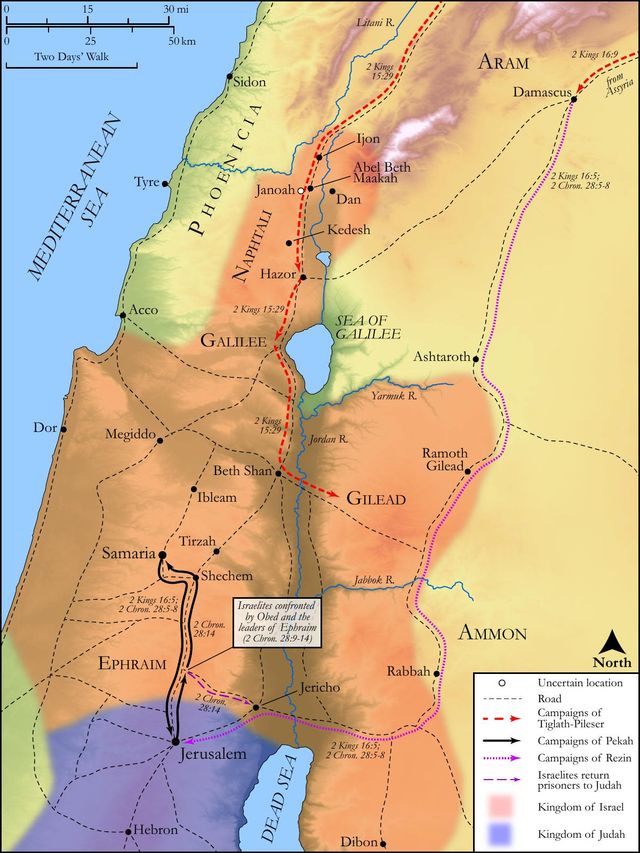
Study this verse
Public-domain commentary
Matthew Henry
From his Commentary on the Whole Bible. Henry comments on passages, not single verses — this entry covers 2 Kings 16:5–9.
Here is, 1. The attempt of his confederate neighbours, the kings of Syria and Israel, upon him. They thought to make themselves masters of Jerusalem, and to set a king of their own in it, Isa 7:6. In this they fell short, but the king of Syria recovered Elath, a considerable port upon the Red Sea, which Amaziah had taken from the Syrians, Kg2 14:22. What can those keep that have lost their religion? Let them expect, thenceforward, to be always on the losing hand. 2. His project to get clear of them. Having forsaken God, he had neither courage nor strength to make head against his enemies, nor could he, with any boldness, ask help of God; but he made his court to the king of Assyria, and got him to come in for his relief. Those whose hearts condemn them will go any where in a day of distress rather than to God. Was it because there was not a God in Israel that he sent to the Assyrian for help? Was the rock of ages removed out of its place, that he stayed himself on this broken reed? The sin itself was its own punishment; for, though it is true that he gained his point (the king of Assyria hearkened to him, and, to serve his own turn, made a descent upon Damascus, whereby he gave a powerful diversion to the king of Syria, Kg2 16:9, and obliged him to let fall his design against Ahaz, carrying the Syrians captive to Kir, as Amos had expressly foretold, Amo 1:5), yet, considering all, he made but a bad bargain; for, to compass this, (1.) He enslaved himself (Kg2 16:7): I am thy servant and thy son, that is, "I will be as dutiful and obedient to thee as to a master or father, if thou wilt but do me this good turn." Had he thus humbled himself to God, and implored his favour, he might have been delivered upon easier terms; he might have saved his money, and needed only to have parted with his sins. But, if the prodigal forsake his father's house, he soon becomes a slave to the worst of masters, Luk 15:15. (2.) He impoverished himself; for he took the silver and gold that were laid up in the treasury both of the temple and of the kingdom, and sent it to the king of Assyria, Kg2 16:8. Both church and state must be squeezed and exhausted, to gratify this his new patron and guardian. I know not what authority he had thus to dispose of the public stock; but it is common for those that have brought themselves into straits by one sin to help themselves out by another; and those that have alienated themselves from God will make no difficulty of alienating any of his rights.
Continue studying 2 Kings 16:6 across the web’s major study libraries — every link below opens this exact verse, chapter, or book on the destination site.
Read & Compare
 BibleGatewayThis verse in more than 200 translations and 70 languages.
 Bible.comThe YouVersion reader — hundreds of translations, reading plans, and highlights.
 ESV.orgCrossway's official English Standard Version reader.
 NET BibleThe NET translation with 60,000+ translators' notes on every rendering decision.
 STEP BibleTyndale House's free study tool — original text, vocabulary, and scholarly resources.
 BibliaLogos Bible Software's free web reader.
 USCCBThe New American Bible (Revised Edition) with the U.S. bishops' study notes.
Commentaries
 BibleHub CommentariesDozens of classic commentaries on this verse, gathered on one page.
 StudyLightMore than 100 commentary sets — the largest collection on the web.
 BibleRefPlain-English commentary on what this verse means, verse by verse.
 Enduring WordDavid Guzik's free commentary on this chapter, widely used by Bible teachers.
 Bible Study ToolsVerse commentary alongside Greek and Hebrew study aids.
Original Language & Research
- BibleHub InterlinearThe verse word by word — original language, transliteration, and English.
- BibleHub LexiconEvery word's original-language definition and Strong's entry.
 Blue Letter BibleDeep-study tools — Strong's numbers, concordance, and word studies.
 SefariaThe Hebrew text with Rashi and centuries of Jewish commentary.
Sermons, Hymns & Audio


TrulyRandomVerse is not affiliated with these sites and doesn’t control their content. They’re linked because they’re genuinely useful.
Summary
Second Kings 16:6 records a pivotal geopolitical shift during the unfaithful reign of King Ahaz of Judah. Amidst the tumultuous Syro-Ephraimitic War, King Rezin of Aram (Syria) successfully reclaimed the crucial Red Sea port city of Elath, expelling its Judean inhabitants and establishing a lasting Syrian presence. This strategic and economic loss underscored Judah's weakening position and highlighted the tangible consequences of Ahaz's reliance on foreign powers rather than divine protection, setting the stage for further national decline.
Context
ShowHideLiterary Context
This verse is intricately woven into the narrative of King Ahaz's reign in 2 Kings 16, a period marked by profound spiritual apostasy and political instability. Immediately preceding this account, Ahaz has already demonstrated his profound wickedness by adopting idolatrous practices, even sacrificing his own son (as detailed in 2 Kings 16:3). The broader context is the Syro-Ephraimitic War, where King Rezin of Aram and King Pekah of Israel formed an alliance to pressure Judah into joining their anti-Assyrian coalition, even besieging Jerusalem (referenced in 2 Kings 16:5). Verse 6 then presents a specific, tangible consequence of this conflict: the loss of Elath. This event precedes Ahaz's desperate, faithless appeal to Tiglath-Pileser III of Assyria for military aid (found in 2 Kings 16:7-9), a decision that ultimately brought Judah under Assyrian subjugation. The narrative thus meticulously illustrates a clear pattern of spiritual decline leading directly to political and territorial diminishment.
Historical & Cultural Context
The events of 2 Kings 16:6 transpired roughly between 735-732 BC, a period of immense geopolitical upheaval among the nations. The dominant force was the burgeoning Neo-Assyrian Empire under Tiglath-Pileser III, whose expansionist policies threatened all smaller kingdoms. The Syro-Ephraimitic War was a desperate, albeit ultimately futile, attempt by Aram (Syria) and Israel (Ephraim) to forge a united front against Assyria, seeking to compel Judah to join their anti-Assyrian alliance, even contemplating replacing Ahaz with a more compliant ruler. Elath (modern Eilat), situated on the Gulf of Aqaba (the northeastern arm of the Red Sea), was a strategically vital port city. It provided Judah with indispensable access to lucrative maritime trade routes, particularly those extending to Arabia and Africa, and its control had been significant since the days of King Solomon, who established a fleet there (as recounted in 1 Kings 9:26). The successful recovery of Elath by Aram represented a severe economic and military blow to Judah, severing its southern trade connections and significantly diminishing its regional influence, directly stemming from the regional power struggles exacerbated by Assyrian encroachment.
Key Themes
ShowHideThe loss of Elath in 2 Kings 16:6 serves to amplify several overarching themes prevalent throughout the book of 2 Kings and the broader Deuteronomistic History. Firstly, it powerfully underscores the consequences of unfaithfulness and idolatry. Ahaz's reign is consistently portrayed as a nadir of spiritual apostasy, and the territorial losses, while seemingly geopolitical in nature, are presented within the biblical narrative as a direct and inevitable outcome of Judah's deviation from God's covenant. Secondly, this event vividly illustrates the geopolitical instability and rapidly shifting power dynamics characteristic of those days, where smaller kingdoms like Judah were precariously positioned between warring empires and constantly shifting alliances. The strategic importance of locations such as Elath highlights the perpetual struggle for control over vital trade routes and precious resources. Finally, the incident functions as a stark example of divine judgment (or at least, the withdrawal of divine protection and blessing) when a nation, particularly its leadership, chooses to place its reliance on human alliances and engage in idolatrous practices rather than placing its trust implicitly in the Lord, a warning prophetically delivered to Ahaz by Isaiah in Isaiah 7:1-9.
Exposition and Analysis
ShowHideKey Word Analysis
ShowHideThis refers to the king of Aram-Damascus, a central figure in the Syro-Ephraimitic alliance that posed a significant threat to Judah. His successful recovery of Elath demonstrates his military prowess and the immediate danger Judah faced from its northern neighbors, even as Assyria loomed large.
A crucial port city located on the Gulf of Aqaba, vital for Judah's maritime trade and economic prosperity. Its loss represented a severe blow to Judah's strategic interests and economic lifelines, cutting off access to southern trade routes.
This verb signifies a forceful and decisive expulsion or dispossession. The use of this word emphasizes the violent and non-consensual removal of the Judean inhabitants from Elath, highlighting the human cost and the complete shift in control.
Verse Breakdown
ShowHide"At that time Rezin king of Syria recovered Elath to Syria"
This clause precisely situates the event within the timeframe of the Syro-Ephraimitic War, identifying King Rezin of Aram as the primary agent. The term "recovered" implies that Elath had previously been under Judahite control, likely since King Uzziah's reign (as noted in 2 Kings 14:22), and Rezin successfully reasserted Syrian dominion over it, signaling a significant reversal of Judah's territorial gains.
"and drave the Jews from Elath"
This phrase details the immediate and brutal consequence of the Syrian conquest. The Judean population, who had resided and conducted business in Elath, were forcibly expelled from their homes and lands. This act underscores the complete change of demographic and political control, a common and harsh reality of ancient warfare where conquered populations were often displaced or enslaved.
"and the Syrians came to Elath, and dwelt there unto this day"
This final clause confirms the successful and lasting nature of the Syrian conquest. Not only were the Jews expelled, but Syrian inhabitants replaced them, establishing a permanent presence. The phrase "unto this day" functions as a historiographical marker, emphasizing the enduring impact of this event and signaling that the loss of Elath remained a significant and unreversed historical reality for the people of Judah at the time the book of 2 Kings was compiled or edited.
Literary Devices
ShowHideThe verse primarily employs Historical Reportage, presenting the facts of the geopolitical shift in a concise, declarative, and direct manner, characteristic of the Deuteronomistic historian's objective style. There is a notable absence of overt emotional language or editorial commentary, allowing the stark reality of Judah's loss to resonate with the audience on its own terms. The inclusion of the phrase "unto this day" functions as a potent Chronological Marker and a Literary Frame, anchoring the historical event in the ongoing experience of the audience and underscoring its lasting impact and significance. This phrase also subtly conveys a sense of Lament, quietly acknowledging a profound and enduring loss for the kingdom of Judah. Furthermore, the account of Elath's recovery by Syria, particularly when viewed in the broader context of Ahaz's subsequent desperate appeal to Assyria, creates a profound sense of Irony within the narrative: Ahaz sought to escape the immediate threat of Aram and Israel by appealing to a greater imperial power, yet even before Assyria's full intervention, Aram still managed to inflict a significant, lasting blow on Judah's strategic and economic interests.
Theological and Thematic Connections
ShowHideThe loss of Elath, a vital economic and strategic asset for Judah, serves as a tangible manifestation of the severe consequences stemming from King Ahaz's profound unfaithfulness and rampant idolatry. The biblical narrative consistently establishes a direct correlation between national prosperity and security and a nation's obedience to God's covenant, conversely linking national decline and vulnerability to disobedience. Ahaz's deliberate decision to trust in the military might of Assyria rather than relying on the protective power of the Lord (as prophetically urged by Isaiah) initiated a series of escalating misfortunes for Judah, of which the loss of Elath was an early, painful symptom. This event powerfully underscores the theological principle that seeking human solutions and forming unholy alliances in times of national or personal crisis, especially when such actions involve compromising one's faith and covenant loyalty, frequently leads to greater loss and subjugation rather than true security or lasting peace.
Reflection and Application
ShowHideThe historical account of Elath's loss during King Ahaz's reign offers a profound and enduring lesson for contemporary believers: the choices made in moments of crisis, particularly those rooted in a lack of faith or a reliance on purely worldly strategies, inevitably carry far-reaching and often painful consequences. Ahaz's catastrophic failure to trust God's explicit promise of protection, opting instead for a desperate and ultimately costly alliance with the Assyrian Empire, led directly to the diminishment of Judah's sovereignty and the irreversible loss of vital resources. For us today, this narrative powerfully underscores the critical importance of diligently seeking divine wisdom and guidance, even when confronted with seemingly overwhelming challenges, rather than resorting to compromises or forging unholy alliances that may offer fleeting temporary relief but ultimately lead to long-term spiritual or practical loss. Just as ancient Judah lost a vital port and its associated prosperity, we too can experience the erosion of our spiritual strength, inner peace, or even material blessings when we deviate from God's revealed path and fail to place our complete confidence in Him alone. Our true security, lasting prosperity, and ultimate well-being are found not in human schemes or worldly power, but in faithful obedience and unwavering trust in the sovereign Lord.
Questions for Reflection
ShowHideFAQ
ShowHideWhat was the significance of Elath for Judah?
ShowHideElath was a strategically crucial port city for the kingdom of Judah, located on the Gulf of Aqaba, which is the northeastern arm of the Red Sea. Its primary significance lay in its role as a vital gateway to lucrative maritime trade routes extending south to Arabia and Africa. Control of Elath allowed Judah access to valuable goods, exotic resources, and enabled naval ventures, as famously exemplified by King Solomon's fleet built at nearby Ezion-Geber (see 1 Kings 9:26). Therefore, its loss to Syria represented a major economic and geopolitical blow, effectively cutting off Judah's access to vital southern trade and significantly diminishing its regional influence and prosperity.
How does this event relate to King Ahaz's overall reign?
ShowHideThe recovery of Elath by Syria is presented as a direct consequence and a stark symptom of King Ahaz's unfaithful and apostate reign. Faced with the formidable Syro-Ephraimitic alliance, Ahaz chose to disregard the clear prophetic counsel of Isaiah to trust implicitly in the Lord (see Isaiah 7:4-9) and instead desperately appealed to Tiglath-Pileser III, the powerful king of Assyria, for military assistance (see 2 Kings 16:7-9). This pivotal decision, driven by fear and a profound lack of faith, ultimately led to Judah's subjugation under the Assyrian Empire and significant territorial losses, including the strategically vital port of Elath. The event thus highlights the futility and severe negative consequences of relying on human power and unholy alliances over divine providence and covenant faithfulness.
Why does the text say "unto this day"?
ShowHideThe phrase "unto this day" (Hebrew: 'ad hayyôm hazzeh) is a common biblical idiom frequently employed by the Deuteronomistic historian (the likely compiler or editor of 2 Kings) to indicate that the described situation, condition, or historical outcome was still in effect and recognizable at the time the book was written or compiled. In the specific context of 2 Kings 16:6, it serves to emphasize the lasting impact and permanency of Judah's loss of Elath and the continued Syrian presence there from the perspective of the original audience. It underscores that this was not a temporary setback but a significant and enduring geopolitical shift that had long-term ramifications for the kingdom of Judah.
Christ-Centered Fulfillment
ShowHideThe historical account of King Ahaz's reign, tragically marked by profound unfaithfulness and escalating territorial losses like the vital port of Elath, powerfully foreshadows the desperate need for a fundamentally different kind of King and an entirely new, unshakable kingdom. Ahaz's reliance on fleeting worldly power and his spiritual compromises ultimately led to the tragic diminishment of Judah's earthly kingdom and the loss of its strategic assets. In stark contrast, Jesus Christ, the true King of kings and Lord of lords, does not seek worldly alliances or rely on human might to establish His eternal dominion. His kingdom, as He Himself declared, is "not of this world" (as powerfully articulated in John 18:36), yet it is eternal, unshakable, and destined to endure forever (as promised in Hebrews 12:28). While Ahaz lost territory and drove his own people from their homes, Christ came precisely to reclaim what was lost through humanity's sin—humanity itself—delivering us from the oppressive domain of darkness and graciously transferring us into the glorious kingdom of His beloved Son (as celebrated in Colossians 1:13-14). He offers true security, eternal prosperity, and an everlasting inheritance, not through geopolitical maneuvering or military might, but through His redemptive sacrifice on the cross and the spiritual renewal of human hearts, establishing a kingdom that will never be destroyed or given to another people (as prophesied in Daniel 2:44).