


2 Chronicles 26:2
- הוּאhu'heH1931Pro-3msPronoun Personal 3rd Singular Masculine
- בָּנָהba·Nahhe builtH1129V-Qal-Perf-3msVerb Qal Perfect 3rd Singular Masculine
- אֶת'et<obj.>H853DirObjMParticle Object Indicator
- אֵילוֹת'ei·LotElathH359N-properNoun Proper Location
- וַיְשִׁיבֶהָvay·shi·Ve·haand he restored itH7725Conj-w ¦ V-Hiphil-ConsecImperf-3ms ¦ 3fsVerb Hiphil Consecutive Imperfect 3rd Singular Masculineוַandיְשִׁיבֶhe restoredהָit
- לִיהוּדָהli·hu·Dahto JudahH3063Prep-l ¦ N-properNoun Proper LocationלִtoיהוּדָהJudah
- אַחֲרֵי'a·cha·ReiafterH310Adj-mpcAdjective Numerical Plural Masculine Construct
- שְׁכַבshe·khavlay downH7901V-Qal-InfVerb Qal Infinitive Construct
- הַמֶּלֶךְha·Me·lekhthe kingH4428Art ¦ N-msNoun Singular Masculine Absoluteהַtheמֶּלֶךְking
- עִם'imwithH5973PrepPreposition
- אֲבֹתָיו'a·vo·Tavhis ancestorsH1N-fpc ¦ 3msNoun Plural Feminine Constructאֲבֹתָיancestorsוhis
English is a literal word-by-word gloss of the Hebrew, not the KJV's wording. Why?
This is the original text the KJV's translators worked from — each Hebrew word with its own literal English meaning in this verse, prepared by scholars at Tyndale House, Cambridge. The KJV translates whole sentences, not word by word, so its wording differs: one Hebrew word can become several English words, and the KJV may choose “the LORD” where the gloss reads “Yahweh”. Both are faithful — they answer different questions. For the KJV's own rendering, switch to the KJV text.
Details
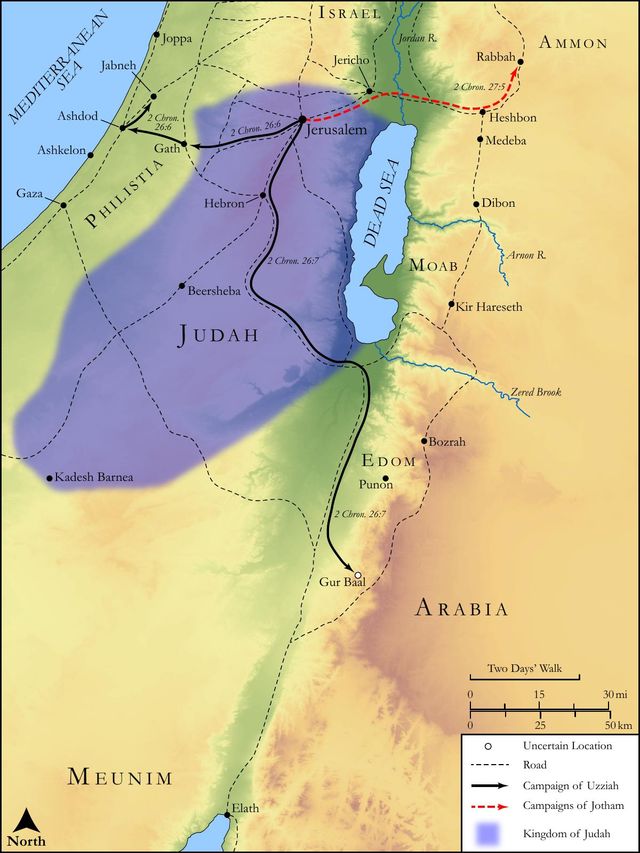
See on the biblical-era map
Study this verse
Public-domain commentary
Matthew Henry
From his Commentary on the Whole Bible. Henry comments on passages, not single verses — this entry covers 2 Chronicles 26:1–15. His three-level outline is real structure in the source text, so it is rendered as structure.
We have here an account of two things concerning Uzziah: -
I.His piety.
In this he was not very eminent or zealous; yet he did that which was right in the sight of the Lord. He kept up the pure worship of the true God as his father did, and was better than his father, inasmuch as we have no reason to think he ever worshipped idols as his father did, no, not in his latter days, when his heart was lifted up. It is said (Ch2 26:5), He sought God in the days of Zechariah, who, some think, was the son of the Zechariah whom his grandfather Joash slew. This Zechariah was one that had understanding in the visions of God, either the visions which he himself was favoured with or the visions of the preceding prophets. He was well versed in prophecy, and conversed much with the upper world, was an intelligent, devout, good man; and, it seems, had great influence with Uzziah. Happy are the great men who have such about them and are willing to be advised by them; but unhappy those who seek God only while they have such with them and have not a principle in themselves to bear them out to the end.
II.His prosperity.
1.In general, as long as he sought the Lord, and minded religion, God made him to prosper. Note,
(1.)Those only prosper whom God makes to prosper; for prosperity is his gift.
(2.)Religion and piety are very friendly to outward prosperity. Many have found and owned this, that as long as they sought the Lord and kept close to their duty they prospered; but since they forsook God every thing has gone cross.
2.Here are several particular instances of his prosperity: - (1.) His success in his wars: God helped him (Ch2 26:7), and then he triumphed over the Philistines (those old enemies of God's people), demolished the fortifications of their cities, and put garrisons of his own among them, Ch2 26:6. He obliged the Ammonites to pay him tribute, Ch2 26:8. He made all quiet about him, and kept them in awe. (2.) The greatness of his fame and reputation. His name was celebrated throughout all the neighbouring countries (Ch2 26:8) and it was a good name, a name for good things with God and good people. This is true fame, and makes a man truly honourable. (3.) His buildings. While he acted offensively abroad, he did not neglect the defence of his kingdom at home, but built towers in Jerusalem and fortified them, Ch2 26:9. Much of the wall of Jerusalem was in his father's time broken down, particularly at the corner gate. But his best fortification of Jerusalem was his close adherence to the worship of God: if his father had not forsaken this the wall of Jerusalem would not have been broken down. While he fortified the city, he did not forget the country, but built towers in the desert too (Ch2 26:10), to protect the country people from the inroads of the plunderers, bands of whom sometimes alarmed them and plundered them, as Ch2 21:16. (4.) His husbandry. He dealt much in cattle and corn, employed many hands, and got much wealth by his dealing; for he took a pleasure in it: he loved husbandry (Ch2 21:10), and probably did himself inspect his affairs in the country, which was no disparagement to him, but an advantage, as it encouraged industry among his subjects. It is an honour to the husbandman's calling that one of the most illustrious princes of the house of David followed it and loved it. He was not one of those that delight in war, nor did he addict himself to sport and pleasure, but delighted in the innocent and quiet employments of the husbandman. (5.) His standing armies. He had, as it should seem, two military establishments. [1.] A host of fighting men that were to make excursions abroad. These went out to war by bands, Ch2 21:11. They fetched in spoil from the neighbouring countries by way of reprisal for the depredations they had so often made upon Judah, [2.] Another army for guards and garrisons, that were ready to defend the country in case it should be invaded, Ch2 21:12, Ch2 21:13. So great were their number and valour that they made war with mighty power; no enemy durst face them, or, at least, could stand before them. Men unarmed can do little in war. Uzziah therefore furnished himself with a great armoury, whence his soldiers were supplied with arms offensive and defensive (Ch2 21:14), spears, bows, and slings, shields, helmets, and habergeons: swords are not mentioned, because it is probable that every man had a sword of his own, which he wore constantly. Engines were invented, in his time, for annoying besiegers with darts and stones shot from the towers and bulwarks, Ch2 21:15. What a pity it is that the wars and fightings which come from men's lusts have made it necessary for cunning men to employ their skill in inventing instruments of death.
Continue studying 2 Chronicles 26:2 across the web’s major study libraries — every link below opens this exact verse, chapter, or book on the destination site.
Read & Compare
 BibleGatewayThis verse in more than 200 translations and 70 languages.
 Bible.comThe YouVersion reader — hundreds of translations, reading plans, and highlights.
 ESV.orgCrossway's official English Standard Version reader.
 NET BibleThe NET translation with 60,000+ translators' notes on every rendering decision.
 STEP BibleTyndale House's free study tool — original text, vocabulary, and scholarly resources.
 BibliaLogos Bible Software's free web reader.
 USCCBThe New American Bible (Revised Edition) with the U.S. bishops' study notes.
Commentaries
 BibleHub CommentariesDozens of classic commentaries on this verse, gathered on one page.
 StudyLightMore than 100 commentary sets — the largest collection on the web.
 BibleRefPlain-English commentary on what this verse means, verse by verse.
 Enduring WordDavid Guzik's free commentary on this chapter, widely used by Bible teachers.
 Bible Study ToolsVerse commentary alongside Greek and Hebrew study aids.
Original Language & Research
- BibleHub InterlinearThe verse word by word — original language, transliteration, and English.
- BibleHub LexiconEvery word's original-language definition and Strong's entry.
 Blue Letter BibleDeep-study tools — Strong's numbers, concordance, and word studies.
 SefariaThe Hebrew text with Rashi and centuries of Jewish commentary.
Sermons, Hymns & Audio


TrulyRandomVerse is not affiliated with these sites and doesn’t control their content. They’re linked because they’re genuinely useful.
Summary
2 Chronicles 26:2 records the strategic and decisive action of King Uzziah (also known as Azariah) early in his reign: the rebuilding and restoration of the crucial port city of Eloth to Judah's control. This immediate initiative, undertaken upon his ascension to the throne after his father Amaziah's death, powerfully demonstrates Uzziah's proactive leadership and foresight, laying a foundational stone for the significant economic prosperity and military strength that would characterize the initial and most successful period of his long rule.
Context
ShowHideLiterary Context
This verse immediately follows the introduction of King Uzziah's reign in 2 Chronicles 26:1, which concisely states his age at accession (sixteen) and the impressive length of his reign (fifty-two years). It also implicitly connects to the tumultuous conclusion of his father Amaziah's reign, which culminated in Amaziah's assassination and the subsequent anointing of Uzziah by the people of Judah (2 Chronicles 25:27-28). Therefore, 2 Chronicles 26:2 presents Uzziah's first recorded significant action as king, illustrating his immediate focus on securing and strengthening the kingdom rather than merely reacting to the instability left by his predecessor. This proactive beginning sets the stage for the detailed account of his early successes and the God-given prosperity that unfolds in the subsequent verses of 2 Chronicles 26.
Historical & Cultural Context
The city of Eloth (also known as Elath or Eilat) held immense strategic value due to its location at the northern tip of the Gulf of Aqaba, an arm of the Red Sea. This position made it a vital port for lucrative trade routes extending south to Arabia and Africa. Its historical significance is underscored by its use by King Solomon for his naval expeditions and profitable trade ventures (1 Kings 9:26). However, control over Eloth frequently shifted, particularly with the fluctuating power of Edom. By Uzziah's time, it had evidently fallen out of Judahite control, likely to Edomite influence, or had become dilapidated. Uzziah's act of "building" (implying fortification or significant reconstruction) and "restoring" it to Judah was a bold assertion of sovereignty and a shrewd move to reclaim a critical economic artery. The phrase "after that the king slept with his fathers" is a common biblical idiom, signifying the peaceful or legitimate death and succession of a monarch, in this case, King Amaziah, despite the violent circumstances of his assassination. This idiom emphasizes the continuity of the Davidic line and the stability of the transfer of power.
Key Themes
ShowHide2 Chronicles 26:2 introduces several pivotal themes that resonate throughout Uzziah's reign and the broader Chronicler's theological narrative. Firstly, it highlights Restoration and Reclamation, as Uzziah reclaims lost territory and re-establishes a crucial economic asset, reflecting a pattern in the biblical narrative where God's people are called to possess and prosper in their inheritance. Secondly, the verse underscores Strategic Leadership and Proactive Governance, showcasing Uzziah's immediate and wise focus on national strength and economic viability rather than internal political consolidation. This strategic vision contributes significantly to the kingdom's stability and growth, leading to widespread influence and wealth for Judah. Finally, it serves as an early indicator of Divine Blessing and Prosperity that marked Uzziah's initial reign, demonstrating how God honored his early faithfulness and diligence, as further detailed in 2 Chronicles 26:8.
Exposition and Analysis
ShowHideKey Word Analysis
ShowHideThis primitive root signifies "to build (literally and figuratively); (begin to) build(-er), obtain children, make, repair, set (up), [idiom] surely." In this context, it implies not merely erecting a new structure from scratch but undertaking significant reconstruction, fortification, and development of an existing, perhaps dilapidated, city. Uzziah's action demonstrates a substantial investment of resources and labor, indicative of a strong, decisive leader committed to national infrastructure.
This primitive root means "to turn back (hence, away) transitively or intransitively, literally or figuratively (not necessarily with the idea of return to the starting point); generally to retreat; often adverbial, again." The use of this verb, specifically in its Hiphil (causative) stem, emphasizes that Eloth was brought back under Judahite control after having been lost or alienated. It highlights an act of reclamation, reasserting Judah's sovereignty over a territory that had historically belonged to them, reinforcing the theme of restoration.
This primitive root means "to lie down (for rest, sexual connection, decease or any other purpose); [idiom] at all, cast down, (lover-)lay (self) (down), (make to) lie (down, down to sleep, still with), lodge, ravish, take rest, sleep, stay." In the context of a monarch, it is a common biblical euphemism for death. It conveys a sense of peaceful passing or the conclusion of a life, even if the actual circumstances of death were violent (as was the case with Amaziah). Its use here emphasizes the transition of power and the establishment of Uzziah's legitimate reign without disruption.
Verse Breakdown
ShowHide"He built Eloth"
This opening clause describes Uzziah's active and constructive engagement with the kingdom's infrastructure. The rebuilding or fortification of Eloth was a significant undertaking, demonstrating his capacity for large-scale projects and his commitment to strengthening Judah's strategic assets from the very outset of his rule. It implies an immediate focus on tangible improvements for the nation's economic and defensive capabilities.
"and restored it to Judah"
This part of the verse clarifies the purpose and outcome of building Eloth. It was not merely a construction project but an act of political and territorial reassertion. By "restoring" Eloth, Uzziah brought this vital Red Sea port back under Judahite control, thereby reclaiming its economic benefits and strategic importance, which had likely been lost to Edom or other regional powers. This act signified a re-establishment of Judah's influence and prosperity.
"after that the king slept with his fathers"
This temporal clause establishes the precise timing of Uzziah's action—immediately following the death of his father, King Amaziah. This common biblical idiom for death highlights the seamless transition of power and underscores Uzziah's promptness in addressing critical national needs without delay, even amidst the aftermath of a regicide. It emphasizes his immediate assumption of regal responsibilities.
Literary Devices
ShowHideThe verse employs several literary devices to convey its profound message effectively and concisely. The most prominent is Idiom, specifically the phrase "slept with his fathers," which is a well-established biblical euphemism for death, particularly of a monarch. This idiom serves to normalize the succession and emphasize continuity within the Davidic dynasty, even when the preceding king's death was violent or tragic. There is also an element of Foreshadowing in this verse; Uzziah's immediate and successful action in reclaiming Eloth foreshadows the broader period of prosperity, military strength, and administrative success that will characterize the early and middle parts of his long reign, as detailed throughout the remainder of 2 Chronicles 26. Furthermore, the mention of Eloth can be seen as a form of Synecdoche, where this specific, vital port city represents the broader restoration of Judah's economic power, territorial integrity, and international prestige under Uzziah's capable and divinely blessed leadership.
Theological and Thematic Connections
ShowHideUzziah's restoration of Eloth resonates with a broader biblical theme of divine enablement for the re-establishment of what was lost or broken. Just as God empowered Nehemiah to rebuild the walls of Jerusalem and Ezra to restore the law and the covenant, Uzziah's strategic action reflects a pattern where God's people, when acting in wisdom, diligence, and obedience, are able to reclaim and restore elements vital to their covenant identity and flourishing. This act of reclaiming a strategic asset speaks to the importance of wise stewardship of resources and territory entrusted by God to His people. It also highlights the divine blessing upon leadership that prioritizes the well-being, security, and strength of the community, setting a precedent for the widespread prosperity and influence that would follow Uzziah's early reign.
Reflection and Application
ShowHideUzziah's immediate and strategic action upon ascending the throne offers a powerful lesson in proactive leadership and diligent stewardship. He didn't passively wait for the kingdom to stabilize or for others to act; instead, he identified a critical national need—the restoration of Eloth—and addressed it decisively and with foresight. This teaches us that true leadership, whether in our personal lives, families, churches, or communities, often requires identifying our own "Eloths"—areas of neglect, disrepair, lost potential, or unfulfilled purpose—and taking intentional, courageous steps to rebuild, restore, and reclaim them for their intended, God-given purpose. It's a profound call to move beyond mere maintenance to active improvement and strategic investment in what truly matters. This verse encourages us to be visionaries who not only identify problems but also possess the courage, wisdom, and diligence to implement solutions that yield long-term benefits, trusting that God blesses purposeful and obedient effort.
Questions for Reflection
ShowHideFAQ
ShowHideWho was King Uzziah, and what was the significance of his reign?
ShowHideKing Uzziah, also known as Azariah, was the tenth king of Judah, reigning for an impressive 52 years (c. 792-740 BC), making his one of the longest reigns in Judah's history. He ascended the throne at the young age of sixteen following the assassination of his father, Amaziah (2 Chronicles 26:1). His reign was initially marked by significant prosperity, military success, and administrative reforms. He fortified Jerusalem, developed agriculture, organized a strong army, and expanded Judah's influence, largely because "he sought God in the days of Zechariah" (2 Chronicles 26:5). However, his reign famously ended in tragedy when his pride led him to usurp the priestly function of burning incense in the temple, resulting in him being struck with leprosy until his death (2 Chronicles 26:16-21).
Why was Eloth so important to Judah?
ShowHideEloth (also spelled Elath or Eilat) was a critically important port city located at the northern tip of the Red Sea, specifically the Gulf of Aqaba. Its immense significance stemmed from its strategic location, which provided Judah with direct access to lucrative maritime trade routes with nations in Arabia, Africa (like Sheba and Ophir), and possibly India. This access allowed for the import of valuable goods such as gold, spices, and exotic timber, greatly boosting the kingdom's economy and wealth. Control over Eloth also had vital military implications, securing Judah's southern border and projecting its regional power. Its restoration by Uzziah was a major economic and geopolitical achievement, reminiscent of King Solomon's extensive use of the port for his flourishing trade (1 Kings 9:26).
What does the phrase "slept with his fathers" mean in biblical context?
ShowHide"Slept with his fathers" is a common and respectful biblical idiom used to describe the death of a person, particularly a king or patriarch. It signifies that the individual has died and joined their ancestors in the grave or the realm of the dead. While it often implies a peaceful or natural death and a legitimate succession, its use does not preclude a violent death (as was the case with Uzziah's father, Amaziah). The phrase emphasizes the continuity of lineage and the passing of a generation, focusing on the transition of power rather than the specific, sometimes tumultuous, circumstances of their demise. It appears frequently throughout the Books of Kings and Chronicles (e.g., 1 Kings 2:10) as a standard way to mark the end of a reign.
Christ-Centered Fulfillment
ShowHideWhile Uzziah's restoration of Eloth was a significant act of physical and economic reclamation for the kingdom of Judah, it ultimately points to the far grander and more profound work of restoration accomplished by Jesus Christ. Uzziah, as an earthly king, reclaimed a vital port city; Christ, the true King of kings, came to reclaim a lost humanity and restore all creation to its intended glory. Just as Eloth was vital for Judah's prosperity and connection to the world, humanity, created in God's image, was meant for intimate fellowship and righteous dominion, but was lost through sin. Jesus, the Lamb of God who takes away the sin of the world, offered Himself as the ultimate sacrifice, thereby reconciling all things to God, "whether things on earth or things in heaven, by making peace through his blood, shed on the cross" (Colossians 1:19-20). He is the true builder, not of a mere port city, but of His Church, which is His body and the dwelling place of God's Spirit (Ephesians 2:19-22). Through Christ, what was broken is being made new, and what was lost is being restored, culminating in the glorious promise of a new heaven and a new earth where God will dwell with His people, and "He will wipe every tear from their eyes. There will be no more death or mourning or crying or pain, for the old order of things has passed away" (Revelation 21:1-5). Uzziah's act was a temporal shadow; Christ's work is the eternal reality of complete and redemptive restoration.