


2 Chronicles 26:8
- וַיִּתְּנוּvai·yi·te·Nuand they paidH5414Conj-w ¦ V-Qal-ConsecImperf-3mpVerb Qal Consecutive Imperfect 3rd Plural Masculineוַandיִּתְּנוּthey paid
- הָעַמּוֹנִיםha·'a·mo·Nimthe AmmonitesH5984Art ¦ N-mpNoun Gentilic Plural Masculine AbsoluteהָtheעַמּוֹנִיםAmmonites
- מִנְחָהmin·ChahtributeH4503N-fsNoun Singular Feminine Absolute
- לְעֻזִּיָּהוּle·'u·zi·Ya·huto UzziahH5818Prep-l ¦ N-proper-mNoun Proper MasculineלְtoעֻזִּיָּהוּUzziah
- וַיֵּלֶךְvai·Ye·lekhand it wentH1980Conj-w ¦ V-Qal-ConsecImperf-3msVerb Qal Consecutive Imperfect 3rd Singular Masculineוַandיֵּלֶךְit went
- שְׁמוֹshe·Mohis nameH8034N-msc ¦ 3msNoun Singular Masculine Constructשְׁמnameוֹhis
- עַד'adtillH5704PrepPreposition
- לְבוֹאle·Vo'to [the] entrance ofH935Prep-l ¦ V-Qal-InfVerb Qal Infinitive Constructלְtoבוֹא[the] entrance of
- מִצְרַיִםmitz·Ra·yimEgyptH4714N-properNoun Proper Location
- כִּיkiforH3588PrtParticle Conditional
- הֶחֱזִיקhe·che·Zikhe displayed strengthH2388V-Hiphil-Perf-3msVerb Hiphil Perfect 3rd Singular Masculine
- עַד'adtoH5704PrepPreposition
- לְמָעְלָהle·Ma·'e·lah<to> upwards <towards>H4605Prep-l ¦ Adj-cs ¦ SfxAdjective Numerical Singular common gender Absoluteלְ<to>מָעְלָupwardsה<towards>
English is a literal word-by-word gloss of the Hebrew, not the KJV's wording. Why?
This is the original text the KJV's translators worked from — each Hebrew word with its own literal English meaning in this verse, prepared by scholars at Tyndale House, Cambridge. The KJV translates whole sentences, not word by word, so its wording differs: one Hebrew word can become several English words, and the KJV may choose “the LORD” where the gloss reads “Yahweh”. Both are faithful — they answer different questions. For the KJV's own rendering, switch to the KJV text.
Details
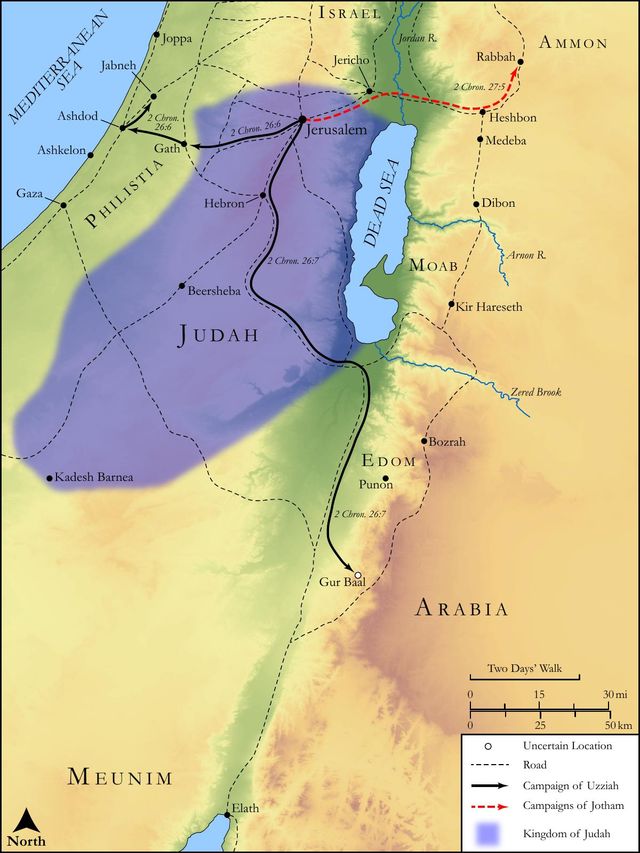
See on the biblical-era map
Study this verse
Public-domain commentary
Matthew Henry
From his Commentary on the Whole Bible. Henry comments on passages, not single verses — this entry covers 2 Chronicles 26:1–15. His three-level outline is real structure in the source text, so it is rendered as structure.
We have here an account of two things concerning Uzziah: -
I.His piety.
In this he was not very eminent or zealous; yet he did that which was right in the sight of the Lord. He kept up the pure worship of the true God as his father did, and was better than his father, inasmuch as we have no reason to think he ever worshipped idols as his father did, no, not in his latter days, when his heart was lifted up. It is said (Ch2 26:5), He sought God in the days of Zechariah, who, some think, was the son of the Zechariah whom his grandfather Joash slew. This Zechariah was one that had understanding in the visions of God, either the visions which he himself was favoured with or the visions of the preceding prophets. He was well versed in prophecy, and conversed much with the upper world, was an intelligent, devout, good man; and, it seems, had great influence with Uzziah. Happy are the great men who have such about them and are willing to be advised by them; but unhappy those who seek God only while they have such with them and have not a principle in themselves to bear them out to the end.
II.His prosperity.
1.In general, as long as he sought the Lord, and minded religion, God made him to prosper. Note,
(1.)Those only prosper whom God makes to prosper; for prosperity is his gift.
(2.)Religion and piety are very friendly to outward prosperity. Many have found and owned this, that as long as they sought the Lord and kept close to their duty they prospered; but since they forsook God every thing has gone cross.
2.Here are several particular instances of his prosperity: - (1.) His success in his wars: God helped him (Ch2 26:7), and then he triumphed over the Philistines (those old enemies of God's people), demolished the fortifications of their cities, and put garrisons of his own among them, Ch2 26:6. He obliged the Ammonites to pay him tribute, Ch2 26:8. He made all quiet about him, and kept them in awe. (2.) The greatness of his fame and reputation. His name was celebrated throughout all the neighbouring countries (Ch2 26:8) and it was a good name, a name for good things with God and good people. This is true fame, and makes a man truly honourable. (3.) His buildings. While he acted offensively abroad, he did not neglect the defence of his kingdom at home, but built towers in Jerusalem and fortified them, Ch2 26:9. Much of the wall of Jerusalem was in his father's time broken down, particularly at the corner gate. But his best fortification of Jerusalem was his close adherence to the worship of God: if his father had not forsaken this the wall of Jerusalem would not have been broken down. While he fortified the city, he did not forget the country, but built towers in the desert too (Ch2 26:10), to protect the country people from the inroads of the plunderers, bands of whom sometimes alarmed them and plundered them, as Ch2 21:16. (4.) His husbandry. He dealt much in cattle and corn, employed many hands, and got much wealth by his dealing; for he took a pleasure in it: he loved husbandry (Ch2 21:10), and probably did himself inspect his affairs in the country, which was no disparagement to him, but an advantage, as it encouraged industry among his subjects. It is an honour to the husbandman's calling that one of the most illustrious princes of the house of David followed it and loved it. He was not one of those that delight in war, nor did he addict himself to sport and pleasure, but delighted in the innocent and quiet employments of the husbandman. (5.) His standing armies. He had, as it should seem, two military establishments. [1.] A host of fighting men that were to make excursions abroad. These went out to war by bands, Ch2 21:11. They fetched in spoil from the neighbouring countries by way of reprisal for the depredations they had so often made upon Judah, [2.] Another army for guards and garrisons, that were ready to defend the country in case it should be invaded, Ch2 21:12, Ch2 21:13. So great were their number and valour that they made war with mighty power; no enemy durst face them, or, at least, could stand before them. Men unarmed can do little in war. Uzziah therefore furnished himself with a great armoury, whence his soldiers were supplied with arms offensive and defensive (Ch2 21:14), spears, bows, and slings, shields, helmets, and habergeons: swords are not mentioned, because it is probable that every man had a sword of his own, which he wore constantly. Engines were invented, in his time, for annoying besiegers with darts and stones shot from the towers and bulwarks, Ch2 21:15. What a pity it is that the wars and fightings which come from men's lusts have made it necessary for cunning men to employ their skill in inventing instruments of death.
Continue studying 2 Chronicles 26:8 across the web’s major study libraries — every link below opens this exact verse, chapter, or book on the destination site.
Read & Compare
 BibleGatewayThis verse in more than 200 translations and 70 languages.
 Bible.comThe YouVersion reader — hundreds of translations, reading plans, and highlights.
 ESV.orgCrossway's official English Standard Version reader.
 NET BibleThe NET translation with 60,000+ translators' notes on every rendering decision.
 STEP BibleTyndale House's free study tool — original text, vocabulary, and scholarly resources.
 BibliaLogos Bible Software's free web reader.
 USCCBThe New American Bible (Revised Edition) with the U.S. bishops' study notes.
Commentaries
 BibleHub CommentariesDozens of classic commentaries on this verse, gathered on one page.
 StudyLightMore than 100 commentary sets — the largest collection on the web.
 BibleRefPlain-English commentary on what this verse means, verse by verse.
 Enduring WordDavid Guzik's free commentary on this chapter, widely used by Bible teachers.
 Bible Study ToolsVerse commentary alongside Greek and Hebrew study aids.
Original Language & Research
- BibleHub InterlinearThe verse word by word — original language, transliteration, and English.
- BibleHub LexiconEvery word's original-language definition and Strong's entry.
 Blue Letter BibleDeep-study tools — Strong's numbers, concordance, and word studies.
 SefariaThe Hebrew text with Rashi and centuries of Jewish commentary.
Sermons, Hymns & Audio


TrulyRandomVerse is not affiliated with these sites and doesn’t control their content. They’re linked because they’re genuinely useful.
Summary
2 Chronicles 26:8 captures a pivotal moment in King Uzziah's reign, illustrating the peak of his early power and widespread influence. The verse details the tribute paid to him by the Ammonites and the extensive reach of his fame, which extended even to the borders of Egypt. This remarkable success is explicitly attributed to the immense strength with which he was divinely empowered, presenting a vivid picture of Judah's prosperity and recognition under a king who initially walked in obedience to the Lord.
Context
ShowHideLiterary Context
This verse is strategically placed within the Chronicler's detailed account of King Uzziah's reign in 2 Chronicles 26. The chapter begins by establishing the foundational principle of Uzziah's initial success: "as long as he sought the Lord, God made him to prosper" (2 Chronicles 26:5). Verse 8 serves as a tangible demonstration of this divine blessing, following descriptions of his military victories over the Philistines and Arabs (2 Chronicles 26:6-7). It precedes a comprehensive list of his extensive building projects, military advancements, and agricultural developments (2 Chronicles 26:9-15). Thus, 2 Chronicles 26:8 marks the zenith of his divinely enabled strength and renown before the narrative dramatically shifts to his eventual downfall due to pride (2 Chronicles 26:16-21).
Historical & Cultural Context
King Uzziah, also known as Azariah in 2 Kings 15, ruled Judah for an impressive 52 years (c. 792–740 BC), making his one of the longest reigns in the Southern Kingdom's history. This period was largely characterized by stability and significant prosperity for Judah, a stark contrast to the often tumultuous Northern Kingdom of Israel. The Ammonites, an East Semitic people who were frequently hostile to Israel and Judah (e.g., Judges 3:13, 1 Samuel 11:1), offering "gifts" (מִנְחָה, minḥâ) to Uzziah is a clear indication of tribute, signifying his regional dominance and their submission. The mention of his name spreading "to the entering in of Egypt" underscores the international recognition of his power, as Egypt was a formidable regional player. Such widespread fame and the receipt of tribute were definitive markers of a powerful and secure kingdom in the ancient Near East, reflecting a period of relative peace and economic flourishing under Uzziah's strong and divinely blessed leadership.
Key Themes
ShowHide2 Chronicles 26:8 powerfully reinforces the theme of divine blessing and prosperity as a direct consequence of seeking the Lord, a foundational theological motif in the Chronicler's work. Uzziah's "exceedingly" strengthened state is presented as a direct result of God's favor, echoing the principle established in 2 Chronicles 26:5. It also highlights the theme of strength and influence, demonstrating how God empowers His chosen leaders to achieve remarkable political and military dominance. The widespread fame signifies renown and recognition, underscoring the visibility of God's blessing upon Judah. However, within the broader narrative of 2 Chronicles 26, this peak of strength subtly foreshadows the critical theme of pride and downfall. The very strength that brought Uzziah fame would later become the catalyst for his hubris, leading him to transgress God's law and suffer leprosy, as vividly described in 2 Chronicles 26:16.
Exposition and Analysis
ShowHideKey Word Analysis
ShowHideThis term (H4503, מִנְחָה) refers to a donation, tribute, or offering. In the context of international relations, it signifies a payment made by a weaker entity to a stronger one, indicating submission, allegiance, or a desire to avoid conflict. The Ammonites' act of giving "gifts" to Uzziah therefore denotes their recognition of his superior military and political power, effectively acknowledging him as their overlord or a dominant regional force. This was not a voluntary exchange but a mandatory payment to maintain peace or avoid war.
The verb (H3212, יָלַךְ) means "to walk, to go, to extend." Here, it vividly describes the expansion of Uzziah's reputation and influence. His fame "went out" or "extended" beyond the immediate borders of Judah, indicating that his military successes, administrative prowess, and the general prosperity of his kingdom were widely known and respected by surrounding nations, including powerful ones like Egypt. This signifies international recognition and a high level of diplomatic standing.
The verb (H2388, חָזַק) means "to fasten upon; hence, to seize, be strong (figuratively, courageous, causatively strengthen, cure, help, repair, fortify), obstinate." The phrase "strengthened himself exceedingly" combines this verb with the intensifier H4605 (maʻal), meaning "exceedingly." While it implies Uzziah's active efforts in building his kingdom, within the Chronicler's theological framework, this strength is implicitly, if not explicitly, attributed to divine enablement. The preceding verse 2 Chronicles 26:7 states that "God helped him," and 2 Chronicles 26:5 attributes his prosperity to seeking the Lord. Thus, his "exceeding strength" is not merely human might but a robust, vigorous reign empowered and blessed by God, enabling his remarkable achievements.
Verse Breakdown
ShowHide"And the Ammonites gave gifts to Uzziah:"
This opening clause immediately establishes Uzziah's regional dominance. The Ammonites, traditionally adversaries of Israel and Judah, are depicted as paying tribute. This act underscores Uzziah's military and political superiority, indicating that he had either defeated them or established such a formidable presence that they deemed it prudent to submit and offer regular payments to him, thereby acknowledging his suzerainty.
"and his name spread abroad [even] to the entering in of Egypt;"
This phrase highlights the geographical and international scope of Uzziah's fame. His reputation was not confined to Judah or its immediate neighbors but extended far south to the very border of Egypt, a major ancient power. "The entering in of Egypt" likely refers to the northern border region of Egypt, a strategic gateway. This signifies that Uzziah was recognized as a significant ruler on the international stage, commanding respect and perhaps even fear among powerful nations.
"for he strengthened [himself] exceedingly."
This final clause provides the reason for Uzziah's widespread fame and the Ammonites' tribute. His "exceeding strength" was the foundation of his power and influence. As noted in the key word analysis, this strength, while manifested through Uzziah's actions, is understood within the Chronicler's narrative as divinely bestowed and enabled. It was this God-given power and prosperity that allowed him to project authority and achieve such remarkable recognition and success.
Literary Devices
ShowHideThe Chronicler employs several literary devices in this verse to convey Uzziah's power and the source of his success. Hyperbole is evident in the phrase "his name spread abroad even to the entering in of Egypt," which, while indicating widespread fame, serves to emphasize the vast extent of his renown rather than a precise geographical claim, thereby magnifying Uzziah's kingly stature. The verse also functions as a subtle form of foreshadowing within the larger narrative of 2 Chronicles 26. The "exceeding strength" that brings him great success implicitly carries the danger of pride, which indeed becomes his undoing later in the chapter. This creates a subtle irony, where the very blessing that elevates him ultimately contributes to his downfall when he misuses it. Furthermore, the Chronicler's consistent theological perspective imbues Uzziah's strength with theological metaphor, presenting it not merely as human might but as a tangible manifestation of God's blessing and empowerment for those who seek Him.
Theological and Thematic Connections
ShowHide2 Chronicles 26:8 powerfully illustrates the principle that God blesses those who seek Him, granting them strength, prosperity, and influence. Uzziah's early reign serves as a testament to this truth, demonstrating how divine favor can elevate a nation and its leader to remarkable heights. However, the Chronicler's broader narrative, culminating in Uzziah's prideful transgression, adds a crucial theological nuance: while God grants power, human responsibility dictates how that power is stewarded. True strength and lasting success are not found in self-reliance or the accumulation of earthly fame, but in sustained humility and dependence on the divine source of all blessing. This verse, therefore, implicitly warns against the spiritual dangers of prosperity and the temptation to attribute God-given success to one's own merit, a theme echoed throughout biblical wisdom literature.
Reflection and Application
ShowHideUzziah's early success, as highlighted in 2 Chronicles 26:8, offers a profound lesson on the source of true strength and influence. It reminds us that any remarkable achievement, prosperity, or widespread recognition we experience is ultimately a gift from God. When God blesses us, whether personally or corporately, it is not for our own self-aggrandizement but for His glory and the advancement of His purposes. The temptation, however, is to take credit for God's blessings, allowing success to inflate our ego and lead us away from the very source of our strength. This verse challenges us to maintain a posture of humility, acknowledging that "he strengthened himself exceedingly" was a direct result of God's enablement. In our own lives, whether in career, ministry, or personal growth, we are called to steward our God-given strengths and opportunities with gratitude and continued dependence, recognizing that true lasting strength comes from abiding in Him, not from our own might or the applause of others.
Questions for Reflection
ShowHideFAQ
ShowHideWas Uzziah's strength entirely his own doing, or was there a divine component?
ShowHideWhile the verse states that Uzziah "strengthened himself exceedingly," the broader context of 2 Chronicles 26 makes it clear that his strength and prosperity were divinely enabled. 2 Chronicles 26:5 explicitly states, "as long as he sought the Lord, God made him to prosper." His military victories, building projects, and widespread fame were all outcomes of God's blessing upon his initial obedience. Therefore, his "exceeding strength" was not merely human might but a robust and vigorous reign empowered by God, a common theme in the Chronicler's portrayal of righteous kings.
What eventually happened to Uzziah, given his great strength and fame?
ShowHideDespite this period of great success and divine blessing, Uzziah's heart was eventually "lifted up to his destruction" (2 Chronicles 26:16). In his pride, he entered the temple to burn incense on the altar, an act reserved exclusively for the priests. When confronted by the priests, he became angry, and at that moment, leprosy broke out on his forehead. He remained a leper until the day of his death, living in isolation and unable to fulfill his kingly duties (2 Chronicles 26:16-21). His story serves as a powerful warning that even divinely bestowed strength and success can lead to downfall if not coupled with humility and obedience.
Christ-Centered Fulfillment
ShowHideUzziah's divinely empowered strength and widespread fame, though impressive, were ultimately temporal and tragically marred by human pride. In contrast, Jesus Christ is the King whose strength is perfect, eternal, and untainted by sin. Uzziah's fame spread "to the entering in of Egypt," but Christ's name and authority extend to "all authority in heaven and on earth" (Matthew 28:18). While Uzziah's strength led to his own self-exaltation and eventual downfall, Christ, "who, being in the form of God, did not consider it robbery to be equal with God, but made Himself of no reputation, taking the form of a bondservant" (Philippians 2:6-7). He did not strengthen Himself for earthly dominion but humbled Himself even to death on a cross, thereby becoming the ultimate source of strength and salvation for all who believe (Philippians 2:8). Uzziah received gifts as tribute from a subdued enemy, but Christ is the "Lamb of God who takes away the sin of the world" (John 1:29), offering Himself as the ultimate gift to reconcile humanity to God. His kingdom is not of this world, yet it will ultimately encompass all nations, and His reign will never end (John 18:36, Revelation 11:15). He is the truly strengthened One, whose power is always exercised in perfect love and humility for the glory of God and the redemption of His people.