


1 Kings 4:31
Bible text: King James Version (1769 Blayney text) · Public domain
Bible text: King James Version with Strong's numbers · Public domain
Bible text: Berean Standard Bible · Public domain
Bible text: American Standard Version (1901) · Public domain
Bible text: World English Bible, Messianic edition · Public domain
Bible text: Geneva Bible (1599) · Public domain
Bible text: Young's Literal Translation · Public domain
- וַיֶּחְכַּםvai·yech·Kamand he was wiseH2449Conj-w ¦ V-Qal-ConsecImperf-3msVerb Qal Consecutive Imperfect 3rd Singular Masculineוַandיֶּחְכַּםhe was wise
- מִכָּלmi·kolmore than anyH3605Prep-m ¦ N-mscNoun Singular Masculine Constructמִmore thanכָּלany
- הָאָדָםha·'a·Dam<the> humanH120Art ¦ N-msNoun Singular Masculine Absoluteהָ<the>אָדָםhuman
- מֵאֵיתָןme·'ei·Tanmore than EthanH387Prep-m ¦ N-proper-mNoun Proper Masculineמֵmore thanאֵיתָןEthan
- הָאֶזְרָחִיha·'ez·ra·Chithe EzrachiteH250Art ¦ N-msNoun Gentilic Singular Masculine AbsoluteהָtheאֶזְרָחִיEzrachite
- וְהֵימָןve·hei·Manand HemanH1968Conj-w ¦ N-proper-mNoun Proper MasculineוְandהֵימָןHeman
- וְכַלְכֹּלve·khal·Koland KalkolH3633Conj-w ¦ N-proper-mNoun Proper MasculineוְandכַלְכֹּלKalkol
- וְדַרְדַּעve·dar·Da'and DardaH1862Conj-w ¦ N-proper-mNoun Proper MasculineוְandדַרְדַּעDarda
- בְּנֵיbe·Nei[the] sons ofH1121N-mpcNoun Plural Masculine Construct
- מָחוֹלma·CholMaholH4235N-proper-mNoun Proper Masculine
- וַיְהִיvay·hiand it wasH1961Conj-w ¦ V-Qal-ConsecImperf-3msVerb Qal Consecutive Imperfect 3rd Singular Masculineוַandיְהִיit was
- שְׁמוֹshe·Mohis nameH8034N-msc ¦ 3msNoun Singular Masculine Constructשְׁמnameוֹhis
- בְכָלve·khalamong allH3605Prep-b ¦ N-mscNoun Singular Masculine Constructבְamongכָלall
- הַגּוֹיִםha·go·Yimthe nationsH1471Art ¦ N-mpNoun Plural Masculine Absoluteהַtheגּוֹיִםnations
- סָבִיבsa·VivaroundH5439N-csNoun Singular common gender Absolute
English is a literal word-by-word gloss of the Hebrew, not the KJV's wording. Why?
This is the original text the KJV's translators worked from — each Hebrew word with its own literal English meaning in this verse, prepared by scholars at Tyndale House, Cambridge. The KJV translates whole sentences, not word by word, so its wording differs: one Hebrew word can become several English words, and the KJV may choose “the LORD” where the gloss reads “Yahweh”. Both are faithful — they answer different questions. For the KJV's own rendering, switch to the KJV text.
Details
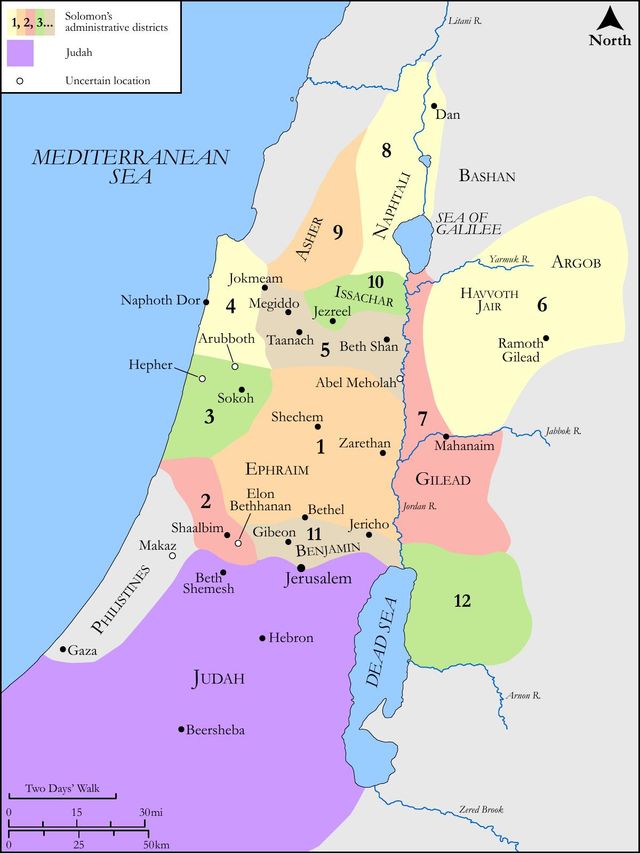
See on the biblical-era maps

Study this verse
Public-domain commentary
Matthew Henry
From his Commentary on the Whole Bible. Henry comments on passages, not single verses — this entry covers 1 Kings 4:29–34. His three-level outline is real structure in the source text, so it is rendered as structure.
Solomon's wisdom was more his glory than his wealth, and here we have a general account of it.
I.The fountain of his wisdom:
God gave it him, Kg1 4:29. He owns it himself. Pro 2:6, The Lord giveth wisdom. He gives the powers of reason (Job 38:36), preserves and improves them. The ordinary advances of them are owing to his providence, the sanctification of them to his grace, and this extraordinary pitch at which they arrived in Solomon to a special grant of his favour to him in answer to prayer.
II.The fulness of it:
He had wisdom and understanding, exceeding much, great knowledge of distant countries and the histories of former times, a quickness of thought, strength of memory, and clearness of judgment, such as never any man had. It is called largeness of heart; for the heart is often put for the intellectual powers. He had a vast compass of knowledge, could take things entire, and had an admirable faculty of laying things together. Some, by his largeness of heart, understand his courage and boldness, and that great assurance with which he delivered his dictates and determinations. Or it may be meant of his disposition to do good with his knowledge. He was very free and communicative, had the gift of utterance as well as wisdom, was as free of his learning as he was of his meat, and grudged neither to any that were about him. Note, It is very desirable that those who have large gifts of any kind should have large hearts to use them for the good of others; and this is from the hand of God, Ecc 2:24. He shall enlarge the heart, Psa 119:32. The greatness of Solomon's wisdom is illustrated by comparison. Chaldea and Egypt were nations famous for learning; thence the Greeks borrowed theirs; but the greatest scholars of these nations came short of Solomon, Kg1 4:30. If nature excels art, much more does grace. The knowledge which God gives by special favour goes beyond that which man gets by his own labour. Some wise men there were in Solomon's time, who were in great repute, particularly Heman, and others who were Levites, and employed by David in the temple-music, Ch1 15:19. Heman was his seer in the word of God, Ch1 25:5. Chalcol and Darda were own brothers, and they also were noted for learning and wisdom. But Solomon excelled them all (Kg1 4:30), he out-did them and confounded them; his counsel was much more valuable.
III.The fame of it.
It was talked of in all nations round about. His great wealth and glory made his wisdom much more illustrious, and have him those opportunities of showing it which those cannot have that live in poverty and obscurity. The jewel of wisdom may receive great advantage by the setting of it.
IV.The fruits of it; by these the tree is known: he did not bury his talent, but showed his wisdom,
1.In his compositions. Those in divinity, written by divine inspiration, are not mentioned here, for they are extant, and will remain to the world's end monuments of his wisdom, and are, as other parts of scripture, of use to make us wise unto salvation. But, besides these, it appears by what he spoke, or dictated to be written from him,
(1.)That he was a moralist, and a man of great prudence, for he spoke 3000 proverbs, wise sayings, apophthegms, of admirable use for the conduct of human life. The world is much governed by proverbs, and was never better furnished with useful ones than by Solomon. Whether those proverbs of Solomon that we have were any part of the 3000 is uncertain.
(2.)That he was a poet and a man of great wit: His songs were 1005, of which one only is extant, because that only was divinely inspired, which is therefore called his Song of songs. His wise instructions were communicated by proverbs, that they might be familiar to those whom he designed to teach and ready on all occasions, and by songs, that they might be pleasant and move the affections.
(3.)That he was a natural philosopher, and a man of great learning and insight into the mysteries of nature. From his own and others' observations and experience, he wrote both of plants and animals (Kg1 4:33), descriptions of their natures and qualities, and (some think) of the medicinal use of them.
2.In his conversation. There came persons from all parts, who were more inquisitive after knowledge than their neighbours, to hear the wisdom of Solomon, Kg1 4:34. Kings that had heard of it sent their ambassadors to hear it and to bring them instructions from it. Solomon's court was the staple of learning, and the rendezvous of philosophers, that is, the lovers of wisdom, who all came to light their candle at his lamp and to borrow from him. Let those who magnify the modern learning above that of the ancients produce such a treasure of knowledge any where in these latter ages as that was which Solomon was master of; yet this puts an honour upon human learning, that Solomon was praised for it, and recommends it to the great men of the earth, as well worthy their diligent search. But,
Lastly, Solomon was, herein, a type of Christ, in whom are hidden all the treasures of wisdom and knowledge, and hidden for use; for he is made of God to us wisdom.
Historical interpretation
Six Centuries of Reception
3 surviving comments on this verse. Each one is dated, so this reads as a timeline rather than a list.
Select a marker to jump to its quote. Markers stagger vertically where authors wrote within a few decades of each other.
[Greek philosophers] took these ideas from Solomon, since it was long before them in age and time that he first gave these teachings through the Spirit of God. The Greeks have brought them forth as their own discoveries, and they have also included them in their books of instructions and left them to be handed down to their successors. But, as we have said, Solomon discovered them before all the rest and taught them through the wisdom he received from God, as it is written, “And God gave Solomon understanding and wisdom beyond measure, and largeness of heart like the sand on the seashore. And his wisdom was made greater than that of all the ancient sons of humankind and all the wise men of Egypt.” Thus, Solomon, since he wished to distinguish from one another and to separate what we have called earlier the three general disciplines, that is, moral, natural and contemplative, set them forth in three books, each one in its own logical order. Thus, he first taught in Proverbs the subject of morals, setting regulations for life together, as was fitting, in concise and brief maxims. And he included the second subject, which is called the natural discipline, in Ecclesiastes, in which he discusses many natural things. And by distinguishing them as empty and vain from what is useful and necessary, he warns that vanity must be abandoned and what is useful and right must be pursued. He also handed down the subject of contemplation in the book we have in hand, that is, Song of Songs, in which he urges on the soul the love of the heavenly and the divine under the figure of the bride and the bridegroom, teaching us that we must attain fellowship with God by the paths of loving affection and of love. Indeed, he was not unaware that he was laying the foundations of the true philosophy and founding the order of its disciplines and principles.
But that the object of Christianity is that we should become wise can be proved from the ancient Jewish writings, which we also use, as well as from those that were composed after the time of Jesus and that are believed among the churches to be divine. Now, in the fiftieth psalm, David is described as saying in his prayer to God these words: “The unseen and secret things of your wisdom you have manifested to me.” Solomon, too, because he asked for wisdom, received it; and if anyone were to peruse the Psalms, he would find the book filled with many maxims of wisdom; and the evidences of Solomon’s wisdom may be seen in his treatises, which contain a great amount of wisdom expressed in few words, and in which you will find many praises of wisdom and encouragements towards obtaining it. So wise, moreover, was Solomon, that the queen of Sheba, having heard his name and the name of the Lord, came to try him with difficult questions and spoke to him all things, whatsoever were in her heart; and Solomon answered her all her questions. There was no question omitted by the king that he did not answer her. And the queen of Sheba saw all the wisdom of Solomon and the possessions that he had, and there was no more spirit in her. And she said to the king, “The report is true that I heard in my own land regarding you and your wisdom; and I did not believe them who told me, until I had come, and my eyes have seen it. And, lo, they did not tell me the half. You have added wisdom and possessions above all the report that I heard.” It is also recorded of him that “God gave Solomon very great wisdom, discernment and breadth of understanding as vast as the sand on the seashore, so that Solomon’s wisdom surpassed the wisdom of all the people of the east and all the wisdom of Egypt. He was wiser than anyone else, wiser than Ethan the Ezrahite, and Heman, Calcol and Darda, children of Mahol; his fame spread throughout all the surrounding nations. He composed three thousand proverbs, and his songs numbered a thousand and five. He would speak of trees, from the cedar that is in Lebanon to the hyssop that grows in the wall; he would speak of animals, and birds, and reptiles and fish. People came from all the nations to hear the wisdom of Solomon; they came from all the kings of the earth who had heard of his wisdom.”
Of his three thousand proverbs a single book is left, while all the others perished during the captivity. And of his one thousand and five songs we still possess a single one, that is the Song of Songs.
Continue studying 1 Kings 4:31 across the web’s major study libraries — every link below opens this exact verse, chapter, or book on the destination site.
Read & Compare
 BibleGatewayThis verse in more than 200 translations and 70 languages.
 Bible.comThe YouVersion reader — hundreds of translations, reading plans, and highlights.
 ESV.orgCrossway's official English Standard Version reader.
 NET BibleThe NET translation with 60,000+ translators' notes on every rendering decision.
 STEP BibleTyndale House's free study tool — original text, vocabulary, and scholarly resources.
 BibliaLogos Bible Software's free web reader.
 USCCBThe New American Bible (Revised Edition) with the U.S. bishops' study notes.
Commentaries
 BibleHub CommentariesDozens of classic commentaries on this verse, gathered on one page.
 StudyLightMore than 100 commentary sets — the largest collection on the web.
 BibleRefPlain-English commentary on what this verse means, verse by verse.
 Enduring WordDavid Guzik's free commentary on this chapter, widely used by Bible teachers.
 Bible Study ToolsVerse commentary alongside Greek and Hebrew study aids.
Original Language & Research
- BibleHub InterlinearThe verse word by word — original language, transliteration, and English.
- BibleHub LexiconEvery word's original-language definition and Strong's entry.
 Blue Letter BibleDeep-study tools — Strong's numbers, concordance, and word studies.
 SefariaThe Hebrew text with Rashi and centuries of Jewish commentary.
Sermons, Hymns & Audio


TrulyRandomVerse is not affiliated with these sites and doesn’t control their content. They’re linked because they’re genuinely useful.
Summary
1 Kings 4:31 serves as a profound declaration of King Solomon's unparalleled wisdom, asserting his intellectual and spiritual superiority over the most esteemed sages and wise men of his era. This verse not only highlights the extraordinary nature of his God-given discernment but also emphasizes the widespread recognition and international renown that resulted from this divine favor, solidifying his reputation among all nations round about as a testament to the unique blessings of his reign.
Context
ShowHideLiterary Context
This verse provides a powerful climax to a section (1 Kings 4:20-34) dedicated to extolling the magnificence of Solomon's reign, particularly focusing on his divinely bestowed wisdom. Preceding this verse, 1 Kings 4:29-30 explicitly states that "God gave Solomon wisdom and understanding exceeding much, and largeness of heart, even as the sand that is on the sea shore. And Solomon's wisdom excelled the wisdom of all the children of the east country, and all the wisdom of Egypt." Verse 31 then offers concrete examples of the intellectual giants he surpassed, thereby substantiating the superlative claim. The subsequent verses (1 Kings 4:32-34) further elaborate on his vast literary and scientific accomplishments, including the composition of proverbs and songs, and his extensive knowledge of the natural world, all serving to underscore the unique divine endowment that characterized his rule.
Historical & Cultural Context
The mention of Ethan the Ezrahite, Heman, Chalcol, and Darda, identified as "the sons of Mahol," grounds Solomon's wisdom in a specific cultural and historical milieu. These individuals were evidently recognized figures of wisdom, possibly prominent scribes, poets, or musicians, whose intellectual prowess served as a benchmark in that day. Ethan and Heman, in particular, are linked to temple music and the authorship of psalms (Psalm 88 and Psalm 89), suggesting their high standing in the wisdom tradition. By comparing Solomon to these celebrated contemporaries, the text validates his exceptionalism not merely as a theological assertion but as a verifiable cultural reality. The phrase "his fame was in all nations round about" reflects the interconnected diplomatic and intellectual networks of the nations round about, where a ruler's reputation for wisdom could significantly enhance their political standing and influence, attracting visitors like the Queen of Sheba.
Key Themes
ShowHideThis verse powerfully contributes to several overarching themes within the book of 1 Kings. Foremost is the theme of Divine Wisdom as a Gift, emphasizing that Solomon's extraordinary intellect was not merely innate genius but a direct, supernatural endowment from God, fulfilling the promise made in 1 Kings 3:12. Secondly, it highlights the Unparalleled Excellence of God's Blessing, asserting Solomon's preeminence over all human wisdom of his day, a claim that is further substantiated by the international recognition he received. Finally, the verse underscores the theme of Widespread Fame and Influence as a Result of God's Favor, demonstrating how God's blessings, particularly wisdom, lead to international recognition and honor, serving to magnify God's power and faithfulness through His chosen king.
Exposition and Analysis
ShowHideKey Word Analysis
ShowHideThis verb, appearing here in its superlative form, denotes more than mere intellectual knowledge. It signifies a comprehensive, practical, and moral discernment that enables sound judgment, effective governance, and the ability to apply knowledge for flourishing. Solomon's wisdom was therefore not just academic brilliance but a divinely infused capacity for prudent and righteous action, essential for ruling God's people and building His temple.
This term refers to human beings in general, encompassing individuals or humanity as a species. In this context, it emphasizes the universal scope of Solomon's intellectual superiority—he was wiser than any other human being. The comparison is not limited to a select group but extends to all of mankind, highlighting the unique and exceptional nature of his God-given wisdom.
Literally meaning "name," šēm here signifies reputation, renown, or celebrity. It denotes widespread public recognition and acknowledgment of one's character, achievements, or attributes. Solomon's "fame" extending "in all nations round about" indicates that his reputation for wisdom, wealth, and power had spread far beyond Israel's borders, establishing him as a preeminent figure on the international stage, a direct consequence of divine blessing.
Verse Breakdown
ShowHide"For he was wiser than all men"
This opening clause establishes the central and most significant assertion of the verse: Solomon's wisdom was not merely great, but absolutely superior to that of every other human being. The Hebrew construction conveys an absolute superlative, emphasizing his unique and unmatched intellectual and practical discernment, which the preceding verses attribute directly to God's gift (1 Kings 4:29).
"than Ethan the Ezrahite, and Heman, and Chalcol, and Darda, the sons of Mahol"
This phrase provides specific, contemporary benchmarks against which Solomon's wisdom is measured and found preeminent. These individuals were evidently recognized as leading sages, musicians, or poets of their time, possibly even authors of wisdom literature or psalms. By explicitly naming them, the text grounds Solomon's exceptional wisdom in a tangible comparison, demonstrating that his preeminence was not just a general claim but a verifiable reality against the best minds of his era.
"and his fame was in all nations round about"
This concluding clause highlights the widespread impact and recognition of Solomon's wisdom and reign. His reputation extended beyond Israel's borders, reaching neighboring kingdoms and beyond. This international renown was a visible sign of God's blessing upon him and served to glorify God's power and faithfulness through His chosen king, drawing others, like the Queen of Sheba, to witness his wisdom firsthand.
Literary Devices
ShowHideThe verse employs several significant literary devices to underscore Solomon's unparalleled wisdom. Hyperbole is evident in the sweeping declaration "wiser than all men," which, while rooted in the reality of his divine endowment, serves to magnify his unique and absolute status. This is immediately substantiated by Comparison, where Solomon's wisdom is explicitly measured against the known sages of his time—Ethan, Heman, Chalcol, and Darda. By naming these specific, presumably well-known figures, the text provides concrete evidence and a relatable standard for the reader, making the claim of Solomon's superiority more impactful and less abstract. The use of a Superlative ("wiser than all men") further emphasizes the absolute and unmatched nature of his wisdom. Additionally, the phrase "his fame was in all nations round about" utilizes Synecdoche, where "nations" stands for the people and rulers within those nations, indicating the extensive reach and influence of Solomon's reputation.
Theological and Thematic Connections
ShowHide1 Kings 4:31 profoundly illustrates the biblical principle that true wisdom originates from God and is a divine gift, not merely an acquired human trait. Solomon's wisdom, exceeding all others, serves as a powerful testament to God's boundless generosity and His ability to equip His chosen servants for their unique callings. This wisdom was not an end in itself but was given for the purpose of governing God's people justly, building His temple, and establishing a period of peace and prosperity, demonstrating that divine wisdom is always practical and purposed for God's glory and the good of His kingdom. The widespread fame resulting from this wisdom underscores God's desire for His blessings to be evident to the nations, drawing attention to His power and faithfulness through His instruments.
Reflection and Application
ShowHideSolomon's story, particularly this verse, invites us to reflect deeply on the nature and source of true wisdom in our own lives. While we may not be called to rule a kingdom or possess Solomon's unique intellectual capacity, the underlying principle remains profoundly relevant: genuine wisdom—the kind that enables us to navigate life's complexities, make righteous decisions, and live in a way that honors God—is a gift to be sought from Him. This passage reminds us that our greatest strengths and most impactful contributions are often those divinely empowered, not solely self-generated. Just as Solomon's fame spread because of God's blessing, a life lived with godly wisdom can have a far-reaching and beneficial impact, reflecting God's glory and drawing others to Him. It challenges us to prioritize seeking God's wisdom above all else, trusting that He will equip us for every good work and use our lives for His purposes, demonstrating His character through our actions and decisions.
Questions for Reflection
ShowHideFAQ
ShowHideWho were Ethan, Heman, Chalcol, and Darda, and why are they mentioned in connection with Solomon?
ShowHideEthan the Ezrahite, Heman, Chalcol, and Darda, identified as "the sons of Mahol," were likely highly respected sages, poets, or musicians of their time, renowned for their wisdom and intellectual or artistic contributions. Ethan and Heman, in particular, are associated with musical leadership in the temple (as seen in 1 Chronicles 15:19) and are traditionally credited with authoring psalms (Psalm 88 for Heman and Psalm 89 for Ethan). Their mention in 1 Kings 4:31 serves as a literary device to provide concrete, contemporary benchmarks for wisdom. By stating that Solomon was wiser than these celebrated figures, the text powerfully emphasizes the truly unparalleled and divinely bestowed nature of Solomon's wisdom, demonstrating that his intellect surpassed even the most esteemed minds of his era, validating the divine claim of his exceptional discernment.
Christ-Centered Fulfillment
ShowHideWhile King Solomon's wisdom was unparalleled among men, reaching the pinnacle of human intellectual and administrative capacity, it ultimately served as a prophetic foreshadowing of a far greater wisdom yet to come—the perfect and ultimate wisdom embodied in Jesus Christ. Solomon, though divinely gifted, was still a fallen man whose wisdom eventually faltered, leading to personal moral failures and the eventual division of his kingdom. Jesus, however, is not merely wise but is the very Wisdom of God personified (1 Corinthians 1:24). In Him "are hidden all the treasures of wisdom and knowledge" (Colossians 2:3). The Queen of Sheba traveled great distances to hear Solomon's wisdom (1 Kings 10:1-9), but Jesus declared that "a greater than Solomon is here" (Matthew 12:42). Solomon's fame spread throughout the nations because of his wisdom, but Christ's fame and the wisdom of His gospel are intended to reach "all the nations, beginning from Jerusalem" (Luke 24:47). Solomon's wisdom brought temporary peace and prosperity to Israel, establishing a kingdom that ultimately declined, but Christ's wisdom brings eternal peace with God and everlasting life to all who believe, establishing a spiritual kingdom that will never end (Isaiah 9:6-7). Thus, Solomon's exceptional wisdom serves as a powerful type, pointing to the perfect, redemptive, and enduring wisdom found supremely and eternally in Jesus Christ.