


2 Chronicles 26:7
- וַיַּעְזְרֵהוּvai·ya'·ze·Re·huand he helped himH5826Conj-w ¦ V-Qal-ConsecImperf-3ms ¦ 3msVerb Qal Consecutive Imperfect 3rd Singular Masculineוַandיַּעְזְרֵhe helpedהוּhim
- הָאֱלֹהִיםha·'E·lo·Him<the> GodH430Art ¦ N-mpNoun Plural Masculine Absoluteהָ<the>אֱלֹהִיםGod
- עַל'alonH5921PrepPreposition
- פְּלִשְׁתִּיםpe·lish·Tim[the] PhilistinesH6430N-mpNoun Gentilic Plural Masculine Absolute
- וְעַלve·'aland onH5921Conj-w ¦ PrepPrepositionוְandעַלon
- הָעַרְבִיםha·'ar·vi·yimthe ArabsH6163Art ¦ N-mpNoun Gentilic Plural Masculine AbsoluteהָtheעַרְבִיםArabs
- הַיֹּשְׁבִיםhai·yo·she·Vimwho were dwellingH3427Art ¦ V-Qal-Prtcpl-mpVerb Qal Participle Plural Masculine Absoluteהַwhoיֹּשְׁבִיםwere dwelling
- בְּגוּרbe·gurin GurH1485Prep-b ¦ N-properNoun Proper LocationבְּinגוּרGur
- בָּעַלBa·'alBaalH1485N-properNoun Proper Location
- וְהַמְּעוּנִיםve·ha·me·'u·Nimand the MeunitesH4586Conj-w ¦ Art ¦ N-properNoun Proper LocationוְandהַtheמְּעוּנִיםMeunites
English is a literal word-by-word gloss of the Hebrew, not the KJV's wording. Why?
This is the original text the KJV's translators worked from — each Hebrew word with its own literal English meaning in this verse, prepared by scholars at Tyndale House, Cambridge. The KJV translates whole sentences, not word by word, so its wording differs: one Hebrew word can become several English words, and the KJV may choose “the LORD” where the gloss reads “Yahweh”. Both are faithful — they answer different questions. For the KJV's own rendering, switch to the KJV text.
Details
See on the biblical-era map
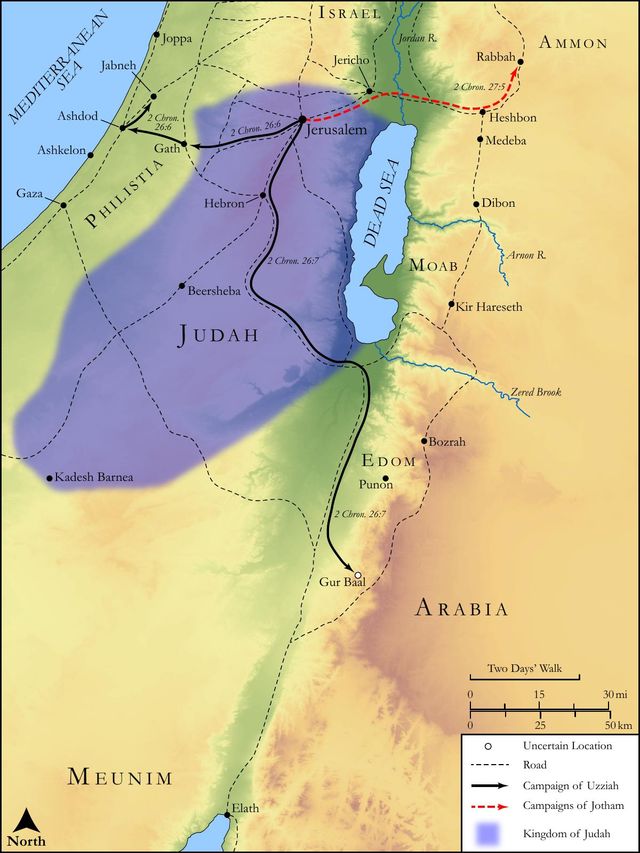
Study this verse
Public-domain commentary
Matthew Henry
From his Commentary on the Whole Bible. Henry comments on passages, not single verses — this entry covers 2 Chronicles 26:1–15. His three-level outline is real structure in the source text, so it is rendered as structure.
We have here an account of two things concerning Uzziah: -
I.His piety.
In this he was not very eminent or zealous; yet he did that which was right in the sight of the Lord. He kept up the pure worship of the true God as his father did, and was better than his father, inasmuch as we have no reason to think he ever worshipped idols as his father did, no, not in his latter days, when his heart was lifted up. It is said (Ch2 26:5), He sought God in the days of Zechariah, who, some think, was the son of the Zechariah whom his grandfather Joash slew. This Zechariah was one that had understanding in the visions of God, either the visions which he himself was favoured with or the visions of the preceding prophets. He was well versed in prophecy, and conversed much with the upper world, was an intelligent, devout, good man; and, it seems, had great influence with Uzziah. Happy are the great men who have such about them and are willing to be advised by them; but unhappy those who seek God only while they have such with them and have not a principle in themselves to bear them out to the end.
II.His prosperity.
1.In general, as long as he sought the Lord, and minded religion, God made him to prosper. Note,
(1.)Those only prosper whom God makes to prosper; for prosperity is his gift.
(2.)Religion and piety are very friendly to outward prosperity. Many have found and owned this, that as long as they sought the Lord and kept close to their duty they prospered; but since they forsook God every thing has gone cross.
2.Here are several particular instances of his prosperity: - (1.) His success in his wars: God helped him (Ch2 26:7), and then he triumphed over the Philistines (those old enemies of God's people), demolished the fortifications of their cities, and put garrisons of his own among them, Ch2 26:6. He obliged the Ammonites to pay him tribute, Ch2 26:8. He made all quiet about him, and kept them in awe. (2.) The greatness of his fame and reputation. His name was celebrated throughout all the neighbouring countries (Ch2 26:8) and it was a good name, a name for good things with God and good people. This is true fame, and makes a man truly honourable. (3.) His buildings. While he acted offensively abroad, he did not neglect the defence of his kingdom at home, but built towers in Jerusalem and fortified them, Ch2 26:9. Much of the wall of Jerusalem was in his father's time broken down, particularly at the corner gate. But his best fortification of Jerusalem was his close adherence to the worship of God: if his father had not forsaken this the wall of Jerusalem would not have been broken down. While he fortified the city, he did not forget the country, but built towers in the desert too (Ch2 26:10), to protect the country people from the inroads of the plunderers, bands of whom sometimes alarmed them and plundered them, as Ch2 21:16. (4.) His husbandry. He dealt much in cattle and corn, employed many hands, and got much wealth by his dealing; for he took a pleasure in it: he loved husbandry (Ch2 21:10), and probably did himself inspect his affairs in the country, which was no disparagement to him, but an advantage, as it encouraged industry among his subjects. It is an honour to the husbandman's calling that one of the most illustrious princes of the house of David followed it and loved it. He was not one of those that delight in war, nor did he addict himself to sport and pleasure, but delighted in the innocent and quiet employments of the husbandman. (5.) His standing armies. He had, as it should seem, two military establishments. [1.] A host of fighting men that were to make excursions abroad. These went out to war by bands, Ch2 21:11. They fetched in spoil from the neighbouring countries by way of reprisal for the depredations they had so often made upon Judah, [2.] Another army for guards and garrisons, that were ready to defend the country in case it should be invaded, Ch2 21:12, Ch2 21:13. So great were their number and valour that they made war with mighty power; no enemy durst face them, or, at least, could stand before them. Men unarmed can do little in war. Uzziah therefore furnished himself with a great armoury, whence his soldiers were supplied with arms offensive and defensive (Ch2 21:14), spears, bows, and slings, shields, helmets, and habergeons: swords are not mentioned, because it is probable that every man had a sword of his own, which he wore constantly. Engines were invented, in his time, for annoying besiegers with darts and stones shot from the towers and bulwarks, Ch2 21:15. What a pity it is that the wars and fightings which come from men's lusts have made it necessary for cunning men to employ their skill in inventing instruments of death.
Continue studying 2 Chronicles 26:7 across the web’s major study libraries — every link below opens this exact verse, chapter, or book on the destination site.
Read & Compare
 BibleGatewayThis verse in more than 200 translations and 70 languages.
 Bible.comThe YouVersion reader — hundreds of translations, reading plans, and highlights.
 ESV.orgCrossway's official English Standard Version reader.
 NET BibleThe NET translation with 60,000+ translators' notes on every rendering decision.
 STEP BibleTyndale House's free study tool — original text, vocabulary, and scholarly resources.
 BibliaLogos Bible Software's free web reader.
 USCCBThe New American Bible (Revised Edition) with the U.S. bishops' study notes.
Commentaries
 BibleHub CommentariesDozens of classic commentaries on this verse, gathered on one page.
 StudyLightMore than 100 commentary sets — the largest collection on the web.
 BibleRefPlain-English commentary on what this verse means, verse by verse.
 Enduring WordDavid Guzik's free commentary on this chapter, widely used by Bible teachers.
 Bible Study ToolsVerse commentary alongside Greek and Hebrew study aids.
Original Language & Research
- BibleHub InterlinearThe verse word by word — original language, transliteration, and English.
- BibleHub LexiconEvery word's original-language definition and Strong's entry.
 Blue Letter BibleDeep-study tools — Strong's numbers, concordance, and word studies.
 SefariaThe Hebrew text with Rashi and centuries of Jewish commentary.
Sermons, Hymns & Audio


TrulyRandomVerse is not affiliated with these sites and doesn’t control their content. They’re linked because they’re genuinely useful.
Summary
Second Chronicles 26:7 succinctly records God's active and providential intervention on behalf of King Uzziah of Judah, granting him decisive military victories against a formidable coalition of persistent regional adversaries: the Philistines, the Arabians that dwelt in Gurbaal, and the Mehunims. This verse underscores the divine source of Uzziah's early reign prosperity and Judah's security, attributing success not to human might or strategic brilliance but to God's enabling power and faithful assistance.
Context
ShowHideLiterary Context
This verse is situated within the broader narrative of King Uzziah's reign, detailed in 2 Chronicles 26. It immediately follows the crucial statement in 2 Chronicles 26:5 that "as long as he sought the LORD, God made him to prosper." Verse 7 thus serves as a concrete illustration and direct consequence of Uzziah's initial faithfulness and God's responsive blessing. The subsequent verses (2 Chronicles 26:8-15) elaborate on the extent of Uzziah's military successes, his expansion of influence, and his extensive building projects, all presented as outgrowths of this divine assistance. This initial period of prosperity starkly contrasts with the tragic downfall described later in the chapter (2 Chronicles 26:16-21), where Uzziah's pride leads to leprosy, highlighting the conditional nature of God's blessing based on continued obedience and humility.
Historical & Cultural Context
King Uzziah, also known as Azariah, reigned over Judah for 52 years (c. 792-740 BC), a period of relative stability and prosperity before the full might of the Assyrian Empire began to dominate the region. The enemies mentioned in this verse were long-standing adversaries of Judah. The Philistines were a perennial threat from the western coastal plain, often raiding Judahite territory and vying for control of strategic trade routes. The Arabians were nomadic or semi-nomadic tribes inhabiting the desert fringes to the east and south of Judah, known for their raiding activities. "Gurbaal" likely refers to a specific locality or tribal group within the broader Arabian confederation, possibly situated in the southern Transjordan or northern Edomite territory, indicating a targeted victory. The Mehunims (also spelled Meunites or Ma'onites) were another desert-dwelling people, often associated with the Arabians and Amalekites, typically located in the southern regions, perhaps in the vicinity of Seir or Ma'in. Uzziah's ability to subdue these diverse and geographically dispersed threats was crucial for Judah's security, trade, and agricultural stability, demonstrating a significant reassertion of Judahite power in the region.
Key Themes
ShowHideThe central theme of 2 Chronicles 26:7 is Divine Intervention and Help. The phrase "And God helped him" explicitly attributes Uzziah's military success directly to God's active involvement, underscoring the Chronicler's consistent theological emphasis that true strength and victory come from reliance on the Lord. This ties into the broader theme of Blessing for Obedience, as Uzziah's initial seeking of God (as noted in 2 Chronicles 26:5) is presented as the prerequisite for divine favor and prosperity. The verse also highlights God's role as a Deliverer and Protector, demonstrating His capacity to empower His people to overcome formidable and persistent adversaries, securing their borders and expanding their influence. This reiterates a core principle found throughout the Old Testament, where God is depicted as the ultimate source of victory for His faithful servants, as seen in passages like Psalm 20:7 or Psalm 46:1.
Exposition and Analysis
ShowHideKey Word Analysis
ShowHideThis plural noun, often used with a singular verb, refers to the supreme God of Israel. Its presence here immediately establishes the divine agent behind Uzziah's success, emphasizing that the help rendered was not from human strength or chance, but from the sovereign, mighty God. It underscores the theological assertion that Yahweh is the true source of power and victory.
This primitive root signifies active, strong, and enabling assistance. It implies more than passive blessing; it denotes a direct, empowering intervention that contributes decisively to success. In the Old Testament, ʻâzar is frequently used to describe God's providential aid to His servants, emphasizing His role as a divine helper in times of need, conflict, and weakness. It suggests a divine partnership where God actively works alongside human effort.
This term refers to a Meunite, or inhabitant of Maon, often appearing in the plural. They were an Arabian tribe residing in the southern desert regions, possibly related to the Ma'in people or associated with Mount Seir. They were often involved in raiding activities against Judah from the south or southeast, representing a different type of threat than the Philistines—more akin to mobile desert marauders. Their defeat, alongside the Philistines and other Arabians, indicates the comprehensive nature of Uzziah's victories and God's widespread help.
Verse Breakdown
ShowHide"And God helped him"
This opening phrase immediately establishes the divine agent and the primary theological assertion of the verse. It is not Uzziah's military genius or the strength of his army that is highlighted first, but God's direct, active, and decisive intervention. This sets the stage for understanding all subsequent successes as divinely enabled, reinforcing the Chronicler's consistent message of divine sovereignty in human affairs.
"against the Philistines"
This identifies the first and perhaps most significant enemy. The Philistines represented a traditional and powerful adversary, controlling strategic coastal areas and posing a constant threat to Judah's western border. God's help against them would have secured vital trade routes and agricultural lands, demonstrating a significant reassertion of Judahite power.
"and against the Arabians that dwelt in Gurbaal"
This specifies a particular group of Arabians, indicating a targeted and successful campaign against desert raiders. "Gurbaal" likely refers to a specific settlement or region, possibly in the southern Transjordan or northern Edom, suggesting Uzziah's influence extended into these areas with God's assistance, securing Judah's eastern and southern flanks.
"and the Mehunims"
The inclusion of this third group, another desert tribe from the south, underscores the comprehensive nature of God's help. It indicates that Uzziah's victories were not isolated incidents but a widespread subjugation of various regional threats, securing Judah's borders on multiple fronts and demonstrating God's ability to deliver from diverse and geographically dispersed enemies.
Literary Devices
ShowHideThe verse employs several literary devices to convey its powerful message. Divine Agency is paramount, immediately established by the opening declaration, "And God helped him," which places God as the primary actor and source of Uzziah's success. This sets a theological framework for the entire account of Uzziah's early reign, emphasizing that all human accomplishments flow from divine enablement. Enumeration is used through the listing of three distinct enemy groups (Philistines, Arabians, Mehunims), which serves to emphasize the breadth and comprehensiveness of God's assistance. This is further reinforced by the Repetition of the preposition "against" ("against the Philistines, and against the Arabians... and the Mehunims"), highlighting the multiple fronts of conflict and God's consistent deliverance across all of them. This cumulative effect underscores the formidable nature of the challenges Uzziah faced and the absolute sufficiency of God's help.
Theological and Thematic Connections
ShowHideThe divine assistance granted to King Uzziah in 2 Chronicles 26:7 profoundly illustrates God's covenant faithfulness and His role as a divine warrior for His people. This passage reinforces the consistent biblical principle that true victory and security are not achieved through human might or strategic brilliance alone, but through God's empowering presence and active intervention. It teaches that when God's people walk in obedience and seek Him, He is prepared to fight their battles, overcome their adversaries, and establish their prosperity. This stands in stark contrast to human self-reliance, demonstrating that God's help is the ultimate source of strength in the face of overwhelming odds, transforming seemingly insurmountable challenges into testimonies of divine power.
Reflection and Application
ShowHideFor believers today, 2 Chronicles 26:7 serves as a timeless reminder of God's unwavering commitment to help those who seek Him. While our "battles" may not involve physical armies and geopolitical conflicts, we face spiritual adversaries, emotional struggles, relational tensions, and practical challenges that can feel just as formidable as Uzziah's enemies. This verse encourages us to recognize that our strength is often insufficient for the trials we encounter, and that true victory comes from placing our trust in God's active, enabling power. Just as God equipped Uzziah to secure his kingdom, He equips us through His Spirit, His Word, and His community to navigate the complexities of life. Our reliance on Him, expressed through prayer, obedience, and seeking His wisdom, unlocks His divine assistance, transforming our weaknesses into opportunities for His strength to be made perfect. It is a call to humility and dependence, knowing that with God's help, we can overcome what seems insurmountable, finding peace and purpose even amidst our struggles.
Questions for Reflection
ShowHideFAQ
ShowHideWho were the Philistines, Arabians, and Mehunims, and why were they significant?
ShowHideThese three groups represent the primary external threats to Judah's security during Uzziah's reign, each from a different geographical direction and posing distinct challenges. The Philistines were a powerful, technologically advanced people settled on the southwestern coastal plain (e.g., Gaza, Ashdod, Gath), who had been long-standing adversaries of Israel since the time of the Judges and Saul. Their defeat was crucial for Judah's access to the sea and control over vital trade routes. The Arabians, particularly those dwelling in Gurbaal, were nomadic or semi-nomadic tribes inhabiting the desert fringes to the east and south of Judah. They were known for their raiding activities and posed a constant threat to Judah's agricultural lands and trade caravans. The Mehunims (or Meunites) were another desert-dwelling people, likely from the southern regions, possibly associated with Edom or Ma'in. Their inclusion highlights the comprehensive nature of God's help, enabling Uzziah to secure Judah's borders against diverse and persistent enemies from multiple directions. This widespread victory, as detailed in 2 Chronicles 26:6-8, demonstrated God's power to protect His people from all sides.
How does Uzziah's story, particularly God's help, relate to the broader message of 2 Chronicles?
ShowHideUzziah's story, especially the account of God's help in 2 Chronicles 26:7, is a quintessential illustration of the Chronicler's central theological message: the direct correlation between faithfulness to God and national prosperity or adversity. The Chronicler consistently emphasizes that obedience to the Lord leads to blessing, success, and security, while disobedience brings judgment and hardship. Uzziah's early reign, characterized by his seeking the Lord (2 Chronicles 26:5), exemplifies this principle, as God actively helps him achieve military victories and expand his influence. However, Uzziah's later pride and transgression (attempting to offer incense in the temple, 2 Chronicles 26:16-21) also serve as a powerful counter-example, demonstrating that even initial faithfulness does not guarantee continued blessing if one deviates from God's ways. Thus, Uzziah's full narrative reinforces the necessity of sustained humility and reliance on God for enduring success and blessing.
Christ-Centered Fulfillment
ShowHideThe divine help extended to King Uzziah, enabling him to overcome formidable earthly enemies, foreshadows the ultimate and comprehensive help provided by God through Jesus Christ. While Uzziah's victories were against physical adversaries and secured a temporal kingdom, Christ's triumph is over the spiritual forces of darkness, sin, and death, securing an eternal kingdom for all who believe. Just as God actively intervened for Uzziah, God the Father sent His Son, Jesus, as the ultimate "Helper" and Deliverer, not merely to assist in battles but to conquer the very root of human brokenness. Through His life, death, and resurrection, Jesus disarmed the principalities and powers (Colossians 2:15), providing a victory far greater than any military conquest. Believers are now "more than conquerors through Him who loved us" (Romans 8:37), not by their own strength, but by the power of Christ's finished work and the indwelling Holy Spirit, who is our Helper and Advocate (John 14:26). Therefore, Uzziah's experience of God's help points us to the cross, where God's ultimate help was decisively rendered, and to the resurrected Christ, who empowers us to approach the throne of grace with confidence, knowing we will "receive mercy and find grace to help in time of need" (Hebrews 4:16).