


2 Chronicles 21:12
- וַיָּבֹאvai·ya·Vo'and it cameH935Conj-w ¦ V-Qal-ConsecImperf-3msVerb Qal Consecutive Imperfect 3rd Singular Masculineוַandיָּבֹאit came
- אֵלָיו'e·Lavto himH413Prep ¦ 3msPrepositionאֵלָיtoוhim
- מִכְתָּבmikh·Tava writingH4385N-msNoun Singular Masculine Absolute
- מֵאֵלִיָּהוּme·'e·li·Ya·hufrom ElijahH452Prep-m ¦ N-proper-mNoun Proper MasculineמֵfromאֵלִיָּהוּElijah
- הַנָּבִיאha·na·Vi'the prophetH5030Art ¦ N-msNoun Singular Masculine Absoluteהַtheנָּבִיאprophet
- לֵאמֹרle·Mor<to> sayingH559Prep-l ¦ V-Qal-InfVerb Qal Infinitive Constructלֵ<to>אמֹרsaying
- כֹּהkohthusH3541AdvAdverb
- אָמַר'a·Marhe saysH559V-Qal-Perf-3msVerb Qal Perfect 3rd Singular Masculine
- יְהוָהYah·wehYahwehH3068N-properNoun Proper Title
- אֱלֹהֵי'e·lo·Hei[the] God ofH430N-mpcNoun Plural Masculine Construct
- דָּוִידda·VidDavidH1732N-proper-mNoun Proper Masculine
- אָבִיךָ'a·Vi·khayour ancestorH1N-msc ¦ 2msNoun Singular Masculine Constructאָבִיancestorךָyour
- תַּחַתTa·chatbecauseH8478N-mscNoun Singular Masculine Construct
- אֲשֶׁר'a·SherthatH834RelParticle Relative
- לֹאlo'notH3808NegParticle Negative
- הָלַכְתָּha·Lakh·tayou have walkedH1980V-Qal-Perf-2msVerb Qal Perfect 2nd Singular Masculine
- בְּדַרְכֵיbe·dar·Kheiin [the] ways ofH1870Prep-b ¦ N-cpcNoun Plural common gender Constructבְּinדַרְכֵי[the] ways of
- יְהוֹשָׁפָטye·ho·sha·FatJehoshaphatH3092N-proper-mNoun Proper Masculine
- אָבִיךָ'a·Vi·khayour fatherH1N-msc ¦ 2msNoun Singular Masculine Constructאָבִיfatherךָyour
- וּבְדַרְכֵיu·ve·dar·Kheiand in [the] ways ofH1870Conj-w ¦ Prep-b ¦ N-cpcNoun Plural common gender Constructוּandבְinדַרְכֵי[the] ways of
- אָסָא'a·Sa'AsaH609N-proper-mNoun Proper Masculine
- מֶלֶךְMe·lekh[the] king ofH4428N-mscNoun Singular Masculine Construct
- יְהוּדָהye·hu·DahJudahH3063N-properNoun Proper Location
English is a literal word-by-word gloss of the Hebrew, not the KJV's wording. Why?
This is the original text the KJV's translators worked from — each Hebrew word with its own literal English meaning in this verse, prepared by scholars at Tyndale House, Cambridge. The KJV translates whole sentences, not word by word, so its wording differs: one Hebrew word can become several English words, and the KJV may choose “the LORD” where the gloss reads “Yahweh”. Both are faithful — they answer different questions. For the KJV's own rendering, switch to the KJV text.
Details
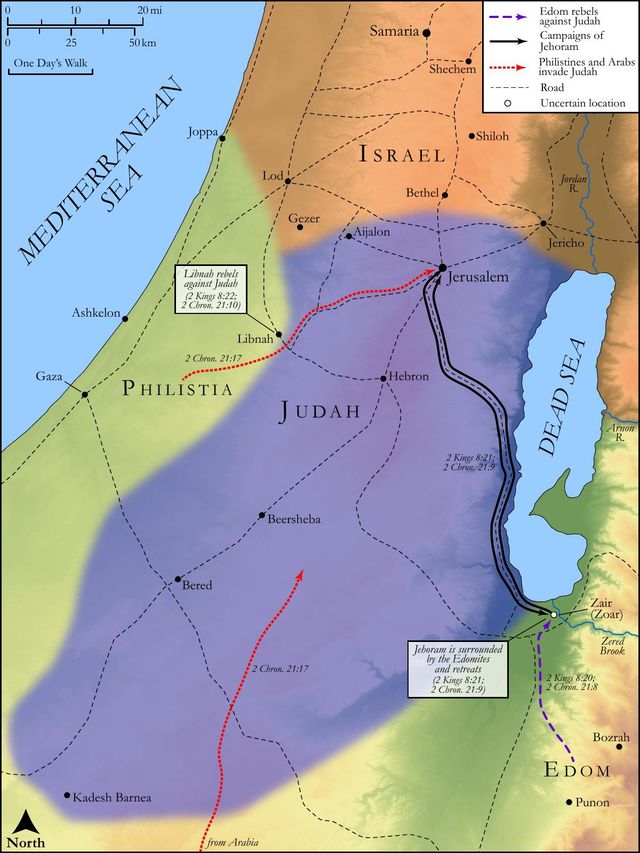
See on the biblical-era map
Study this verse
Public-domain commentary
Matthew Henry
From his Commentary on the Whole Bible. Henry comments on passages, not single verses — this entry covers 2 Chronicles 21:12–20. His three-level outline is real structure in the source text, so it is rendered as structure.
Here we have, I. A warning from God sent to Jehoram by a writing from Elijah the prophet. By this it appears that Jehoram came to the throne, and showed himself what he was before Elijah's translation. It is true we find Elisha attending Jehoshaphat, and described as pouring water on the hands of Elijah, after the story of Elijah's translation (Kg2 3:11); but that might be, and that description might be given of him, while Elijah was yet on earth: and it is certain that that history is put out of its proper place, for we read of Jehoshaphat's death, and Jehoram's coming to the crown, before we read of Elijah's translation, Kg1 22:50. We will suppose that the time of his departure was at hand, so that he could not go in person to Jehoram; but that, hearing of his great wickedness in murdering his brethren, he left this writing it is probable with Elisha, to be sent him by the first opportunity, that it might either be a means to reclaim him or a witness against him that he was fairly told what would be in the end hereof. The message is sent him in the name of the Lord God of David his father (Ch2 21:12), upbraiding him with his relation to David as that which, though it was his honour, was an aggravation of his degeneracy. 1. His crimes are plainly charged upon him - his departure from the good ways of God, in which he had been educated, and which he had been directed and encouraged to walk in by the example of his good father and grandfather, who lived and died in peace and honour (Ch2 21:12) - his conformity to the ways of the house of Ahab, that impious scandalous family - his setting up and enforcing idolatry in his kingdom - and his murdering his brethren because they were better than himself, Ch2 21:13. These are the heads of the indictment against him. 2. Judgment is given against him for these crimes; he is plainly told that his sin should certainly be the ruin, (1.) Of his kingdom and family (Ch2 21:14): "With a heavy stroke, even that of war and captivity, will the Lord smite thy people and thy children," etc. Bad men bring God's judgments upon all about them. His people justly suffer because they had complied with his idolatry, and his wives because they had drawn him to it. (2.) Of his health and life: "Thou shalt have great sickness, very painful and tedious, and at last mortal," Ch2 21:15. This he is warned of before, that his blood might be upon his own head, the watchman having delivered his soul; and that when these things so particularly foretold, came to pass, it might appear that they did not come by chance, but as the punishment of his sins, and were so intended. And now if, as he had learned of Ahab to do wickedly, he had but learned even of Ahab to humble himself upon the receipt of this threatening message from Elijah - if, like (Kg1 21:27), he had rent his clothes, put on sackcloth, and fasted - who knows but, like him, he might have obtained at least a reprieve? But it does not appear that he took any notice of it; he threw it by as waste-paper; Elijah seemed to him as one that mocked. But those that will not believe shall feel.
II.The threatened judgments brought upon him because he slighted the warning.
No marvel that hardened sinners are not frightened from sin and to repentance by the threatenings of misery in another world, which is future and out of sight, when the certain prospect of misery in this world, the sinking of their estates and the ruin of their healths, will not restrain them from vicious courses.
1.See Jehoram here stripped of all his comforts. God stirred up the spirit of his neighbours against him, who had loved and feared Jehoshaphat, but hated and despised him, looking upon it as a scandalous thing for a nation to change their gods. Some occasion or other they took to quarrel with him, invaded his country, but, as it should seem, fought neither against small nor great, but the king's house only; they made directly to that, and carried away all the substance that was found in it. No mention is made of their carrying any away captive but the king's wives and his sons, Ch2 21:17. Thus God made it evident that the controversy was with him and his house. Here it is only said, They carried away his sons; but we find (Ch2 22:1) that they slew them all. Blood for blood. He had slain all his brethren, to strengthen himself; and now all his sons are slain but one, and so he is weakened. If he had not been of the house of David, that one would not have escaped. When Jeroboam's house, and Baasha's, and Ahab's, were destroyed, there was none left; but David's house must not be wholly extirpated, though sometimes wretchedly degenerated, because a blessing was in it, no less a blessing than that of the Messiah.
2.See him tormented with sore diseases and of long continuance, such as were threatened in the law against those that would not fear the Lord their God, Deu 28:58, Deu 28:59. His disease was very grievous. It lay in his bowels, producing a continual griping, and with this there was a complication of other sore diseases. The affliction was moreover very tedious. Two years he continued ill, and could get no relief; for the disease was incurable, though he was in the prime of life, not forty years old. Asa, whose heart was perfect with God though in some instances he stepped aside, was diseased only in his feet; but Jehoram, whose heart was wicked, was struck in his inwards, and he that had no bowels of compassion towards his brethren was so plagued in his bowels that they fell out. Even good men, and those who are very dear to God, may be afflicted with diseases of this kind; but to them they are fatherly chastisements, and by the support of divine consolations the soul may dwell at ease even then when the body lies in pain. These sore diseases seized him just after his house was plundered and his wives and children were carried away.
(1.)Perhaps his grief and anguish of mind for that calamity might occasion his sickness, or at least contribute to the heightening of it.
(2.)By this sickness he was disabled to do any thing for the recovery of them or the revenge of the injury done him.
(3.)It added, no doubt, very much to his grief, in his sickness, that he was deprived of the society of his wives and children and that all the substance of his house was carried away. To be sick and poor, sick and solitary, but especially to be sick and in sin, sick and under the curse of God, sick and destitute of grace to bear the affliction, and of comfort to counter-balance it - is a most deplorable case.
3.See him buried in disgrace. He reigned but eight years, and then departed without being desired, Ch2 21:20. Nobody valued him while he lived, none lamented him when he died, but all wished that no greater loss might ever come to Jerusalem. To show what little affection or respect they had for him, they would not bury him in the sepulchres of the kings, as thinking him unworthy to be numbered among them who had governed so ill. The excluding of his body from the sepulchres of his fathers might be ordered by Providence as an intimation of the everlasting separation of the souls of the wicked after death, from the spirits of just men. This further disgrace they put upon him, that they made no burning for him, like the burning of his fathers, Ch2 21:19. His memory was far from being sweet and precious to them, and therefore they did not honour it with any sweet odours or precious spices, though we may suppose that his dead body, after so long and loathsome a disease, needed something to perfume it. The generality of the people, though prone to idolatry, yet had no true kindness for their idolatrous kings. Wickedness and profaneness make men despicable even in the eyes of those who have but little religion themselves, while natural conscience itself often gives honour to those who are truly pious. Those that despise God shall be lightly esteemed, as Jehoram was.
Continue studying 2 Chronicles 21:12 across the web’s major study libraries — every link below opens this exact verse, chapter, or book on the destination site.
Read & Compare
 BibleGatewayThis verse in more than 200 translations and 70 languages.
 Bible.comThe YouVersion reader — hundreds of translations, reading plans, and highlights.
 ESV.orgCrossway's official English Standard Version reader.
 NET BibleThe NET translation with 60,000+ translators' notes on every rendering decision.
 STEP BibleTyndale House's free study tool — original text, vocabulary, and scholarly resources.
 BibliaLogos Bible Software's free web reader.
 USCCBThe New American Bible (Revised Edition) with the U.S. bishops' study notes.
Commentaries
 BibleHub CommentariesDozens of classic commentaries on this verse, gathered on one page.
 StudyLightMore than 100 commentary sets — the largest collection on the web.
 BibleRefPlain-English commentary on what this verse means, verse by verse.
 Enduring WordDavid Guzik's free commentary on this chapter, widely used by Bible teachers.
 Bible Study ToolsVerse commentary alongside Greek and Hebrew study aids.
Original Language & Research
- BibleHub InterlinearThe verse word by word — original language, transliteration, and English.
- BibleHub LexiconEvery word's original-language definition and Strong's entry.
 Blue Letter BibleDeep-study tools — Strong's numbers, concordance, and word studies.
 SefariaThe Hebrew text with Rashi and centuries of Jewish commentary.
Sermons, Hymns & Audio


TrulyRandomVerse is not affiliated with these sites and doesn’t control their content. They’re linked because they’re genuinely useful.
Summary
2 Chronicles 21:12 records a profound and unexpected divine intervention in the reign of King Jehoram of Judah: the arrival of a prophetic letter from Elijah. This communication serves as a stark and authoritative rebuke, directly attributing Jehoram's impending judgment to his egregious failure to emulate the righteous conduct and covenant fidelity of his father, Jehoshaphat, and his grandfather, Asa, thereby marking a significant deviation from the established Davidic covenantal path.
Context
ShowHideLiterary Context
This verse is strategically placed within the Chronicler's account of Jehoram's reign (2 Chronicles 21:1-20), which is consistently portrayed as a period of profound wickedness and apostasy. Immediately preceding this divine warning, the narrative details Jehoram's initial acts upon ascending the throne: the brutal murder of all his brothers and some princes of Israel (2 Chronicles 21:4) and his subsequent leading of Judah into widespread idolatry, heavily influenced by his marriage to Athaliah, daughter of Ahab and Jezebel (2 Chronicles 21:6). The Chronicler meticulously emphasizes the direct cause-and-effect relationship between the king's actions and divine favor or judgment. The arrival of Elijah's letter, a direct word from God, marks a critical turning point, underscoring that even a king's egregious sin will not go unaddressed by the Almighty, and it sets the stage for the severe judgments that follow, including plagues, foreign invasion, and Jehoram's own agonizing death (2 Chronicles 21:14-19).
Historical & Cultural Context
King Jehoram reigned over Judah from approximately 848-841 BC. His reign was characterized by a dramatic departure from the religious reforms initiated by his father, Jehoshaphat, and grandfather, Asa. The marriage alliance with the Omride dynasty of Israel, through Athaliah, introduced Baal worship and other pagan practices directly into the heart of Judah's royal court and society. In ancient Israel, prophets like Elijah served as God's direct spokesmen, often confronting kings and challenging their authority when they deviated from the Mosaic covenant. While Elijah's primary ministry was in the Northern Kingdom of Israel, and his ascension to heaven is recorded in 2 Kings 2:11, which some scholars place before Jehoram's full reign, the Chronicler presents this letter as a legitimate and divinely inspired communication. This emphasizes God's universal sovereignty and His willingness to intervene even across traditional geographical boundaries or perceived timelines to address the spiritual state of His people and their leaders. The cultural expectation was that kings, particularly those of the Davidic line, were to uphold the Law of God, and failure to do so invited divine discipline.
Key Themes
ShowHideThe verse powerfully encapsulates several key themes prevalent throughout Chronicles. Firstly, it highlights Divine Rebuke and Warning, demonstrating God's active engagement in the affairs of His people and His willingness to confront sin directly, even in the highest office. Secondly, it underscores the Consequences of Disobedience, establishing a clear link between Jehoram's unrighteous actions and the impending divine judgment. The mention of his righteous predecessors, Jehoshaphat and Asa, emphasizes the theme of Spiritual Legacy and Lineage, stressing the importance of upholding a godly heritage and the tragic failure of Jehoram to do so. Finally, the address "Thus saith the LORD God of David thy father" subtly invokes God's Covenant Faithfulness to the Davidic line (as seen in 2 Samuel 7:16), even as Jehoram himself dishonored it, reminding the reader that God's promises endure despite human unfaithfulness, yet they do not negate the consequences of sin for individuals within that covenant.
Exposition and Analysis
ShowHideKey Word Analysis
ShowHideThis term (H4385) denotes a written document, emphasizing its formality, permanence, and authoritative nature. Unlike a transient spoken word, a "writing" implies a recorded decree, a tangible message intended to be read, pondered, and preserved. Its use here underscores the gravity of Elijah's communication, presenting it as a formal indictment from God Himself, a message that cannot be easily dismissed or forgotten.
The verb "walked" (H1980) is a common biblical metaphor for one's conduct, lifestyle, or course of life. To "walk in the ways" of someone signifies adopting their practices, principles, and moral direction. In this context, Jehoram's failure to "walk in the ways of Jehoshaphat... nor in the ways of Asa" means he entirely abandoned the righteous, God-fearing paths of his predecessors, choosing instead a life of idolatry, violence, and apostasy. This metaphor emphasizes the active, intentional nature of his deviation from God's commands and the covenant.
This noun (H1870), often used in conjunction with "walked," refers to a road, path, or figuratively, a course of life or mode of action. When referring to the "ways" of Jehoshaphat and Asa, it signifies their established patterns of righteous governance, their adherence to the Mosaic Law, and their devotion to the LORD. Jehoram's rejection of these "ways" indicates a complete departure from the spiritual and ethical standards expected of a Davidic king, choosing instead a path of wickedness and rebellion against God.
Verse Breakdown
ShowHide"¶ And there came a writing to him from Elijah the prophet, saying,"
This clause introduces the extraordinary nature of the divine intervention. The "writing" (letter) from Elijah is significant because Elijah's ministry was primarily to the Northern Kingdom of Israel, and his ascension to heaven is recorded earlier in the timeline of the Kings narratives. The Chronicler's inclusion of this detail emphasizes God's direct and undeniable communication to Jehoram, transcending conventional boundaries and timelines, affirming the authenticity and divine origin of the message and highlighting its profound gravity.
"Thus saith the LORD God of David thy father,"
This is the prophetic formula, "Thus saith the LORD," establishing the message's divine authority as a direct word from God. The specific invocation of "the LORD God of David thy father" serves as a powerful reminder of the covenant God made with David, which promised an enduring kingdom but also implied a standard of righteousness for David's descendants. It highlights Jehoram's privileged lineage and the high spiritual expectations placed upon him, contrasting sharply with his actual conduct and amplifying the significance of his failure.
"Because thou hast not walked in the ways of Jehoshaphat thy father, nor in the ways of Asa king of Judah,"
This is the core of the divine indictment, explicitly stating the reason for God's impending judgment. Jehoram's sin is defined as a failure to emulate the righteous reigns of his immediate father, Jehoshaphat, and his grandfather, Asa, both of whom are commended in Chronicles for their devotion to the LORD and their efforts to remove idolatry from Judah. This highlights the critical importance of spiritual heritage and the grave responsibility of leaders to uphold godly examples and covenant fidelity, emphasizing Jehoram's deliberate and tragic deviation.
Literary Devices
ShowHideThe verse employs several potent Literary Devices to convey its message with maximum impact. The most prominent is Prophetic Oracle, signaled by the formula "Thus saith the LORD," which immediately establishes the divine authority and unchallengeable nature of the message. This is amplified by the unexpected source, Elijah, creating a sense of Dramatic Irony or heightened significance, given his usual sphere of influence and reported ascension. There is also strong Contrast and Juxtaposition between Jehoram's wicked "ways" and the righteous "ways" of his father Jehoshaphat and grandfather Asa. This highlights Jehoram's deliberate deviation from a godly heritage, underscoring his personal culpability. Furthermore, the phrase "LORD God of David thy father" serves as Covenantal Language, invoking the enduring promises and expectations tied to the Davidic dynasty, thereby underscoring the gravity of Jehoram's covenantal infidelity. Finally, the entire message serves as Foreshadowing, hinting at the severe divine judgment that will inevitably follow Jehoram's unrepentant sin, setting the stage for the subsequent narrative of his afflictions and death.
Theological and Thematic Connections
ShowHide2 Chronicles 21:12 powerfully illustrates God's unwavering commitment to justice and His active involvement in the moral governance of His people, even when their leaders stray. It underscores the principle that divine warnings often precede judgment, serving as a merciful call to repentance and offering a final opportunity for correction. The verse highlights the profound responsibility of those in positions of authority, particularly within a covenant community, to uphold righteousness and honor their spiritual heritage. Jehoram's failure to "walk in the ways" of his godly ancestors is not merely a personal failing but a deliberate rejection of the covenantal obligations tied to the Davidic throne, demonstrating that even a king is accountable to God's ultimate authority. This divine rebuke affirms that God's covenant promises, while enduring, do not exempt individuals from the consequences of their disobedience, emphasizing the critical importance of personal fidelity to God's commands and the severe repercussions of spiritual apostasy.
Reflection and Application
ShowHideThe message to Jehoram in 2 Chronicles 21:12 resonates deeply with believers today, offering timeless principles for personal conduct and leadership. It serves as a potent reminder that our actions, especially those of us in positions of influence, carry significant spiritual weight and have far-reaching consequences, not only for ourselves but for those we lead and for the broader community. We are called to reflect on the spiritual heritage we have received, whether from godly parents, faithful mentors, the collective wisdom of the church, or the enduring truth of Scripture, and to diligently build upon it rather than abandoning it for fleeting worldly trends or personal gratification. God, in His mercy, often sends clear warnings—through His Word, the conviction of the Holy Spirit, the counsel of godly individuals, or even difficult circumstances—before allowing the full consequences of sin to unfold. This verse implores us to cultivate a posture of humility and responsiveness, actively heeding divine rebukes and calls to repentance, knowing that a life lived in defiance of God's ways, particularly when rejecting clear examples of righteousness, inevitably leads to detrimental outcomes and invites divine discipline.
Questions for Reflection
ShowHideFAQ
ShowHideWhy did Elijah send a letter to Jehoram in Judah, given his primary ministry was in Israel and he had already ascended to heaven?
ShowHideThis question points to a chronological puzzle, as Elijah's ascension is typically placed before Jehoram's full reign (see 2 Kings 2:11). Several scholarly explanations exist. Some suggest the "Elijah" here refers to a different prophet with the same name, or that the letter was written by Elijah before his ascension and delivered posthumously or by a disciple. Others propose that Elijah's ascension in 2 Kings 2 is not strictly chronological but rather placed thematically, allowing for a later communication. The most common understanding, particularly from the Chronicler's perspective, is that the text emphasizes the divine origin and authority of the message, regardless of the precise temporal or physical mechanics. The Chronicler is less concerned with strict chronology than with theological truth: God, through His prophet Elijah, delivered a direct and authoritative word of judgment to Jehoram, underscoring God's universal sovereignty and His ability to intervene in any kingdom at any time. The extraordinary nature of the messenger only amplifies the gravity of the message itself.
What was so bad about Jehoram's reign that warranted such a severe rebuke from a prophet like Elijah?
ShowHideJehoram's reign was marked by extreme wickedness and a complete abandonment of the righteous path of his predecessors. Upon ascending the throne, he began by brutally murdering all his brothers and some of the princes of Israel (as detailed in 2 Chronicles 21:4), consolidating his power through violence. Furthermore, influenced by his marriage to Athaliah, daughter of Ahab and Jezebel, he led Judah into widespread idolatry, building high places and compelling the inhabitants of Jerusalem and Judah to practice harlotry (as noted in 2 Chronicles 21:11). This was a direct violation of God's covenant and a stark contrast to the reforms of his father Jehoshaphat and grandfather Asa. His actions were not merely personal sins but represented a pervasive corruption of the nation's spiritual life, provoking God's severe judgment as detailed in Elijah's letter and the subsequent narrative.
How does this verse relate to God's covenant with David?
ShowHideThis verse directly relates to the Davidic covenant (as found in 2 Samuel 7:12-16) by invoking "the LORD God of David thy father." While God promised David an enduring dynasty, the covenant also contained provisions for discipline if David's descendants strayed from His commands (as seen in Psalm 89:30-32). Jehoram's failure to "walk in the ways" of his godly ancestors represented a profound breach of the covenant's expectations for righteous leadership. Elijah's letter serves as a divine enforcement of these covenantal stipulations, demonstrating that God, though faithful to His promise of a perpetual lineage, would not tolerate unrepentant sin within that line. The judgment pronounced upon Jehoram, therefore, is not a revocation of the covenant but a demonstration of its disciplinary aspect, ensuring that the integrity of God's holy standards is maintained even within His chosen lineage.
Christ-Centered Fulfillment
ShowHide2 Chronicles 21:12, with its stark contrast between a wicked king and his righteous ancestors, ultimately points to the perfect King, Jesus Christ. Jehoram's failure to "walk in the ways of Jehoshaphat... nor in the ways of Asa" highlights humanity's consistent inability to perfectly obey God and maintain a righteous spiritual legacy. In contrast, Jesus, the true Son of David (as declared in Matthew 1:1), perfectly fulfilled all righteousness, walking in complete obedience to the Father's will (as affirmed in Hebrews 4:15). He is the only King who never deviated from God's ways, perfectly upholding the divine standard that Jehoram so tragically abandoned. While Jehoram received a letter of rebuke foreshadowing judgment for his sin, Christ bore the full judgment for the sins of humanity, becoming the ultimate sacrifice (as revealed in 2 Corinthians 5:21). He is the Lamb of God who takes away the sin of the world, offering forgiveness and reconciliation where Jehoram's disobedience brought only condemnation. Moreover, Jesus is not merely a king who walked in God's ways; He is "the way, the truth, and the life" (John 14:6), inviting all to walk in Him and find true spiritual heritage and eternal life, a heritage secured not by human merit but by His perfect obedience and atoning work. He is the righteous King who will one day return to judge the living and the dead, fulfilling the ultimate divine judgment with perfect justice and mercy (as prophesied in Revelation 19:11-16).