


2 Chronicles 22:1
- וַיַּמְלִיכוּvai·yam·li·Khuand they made kingH4427Conj-w ¦ V-Hiphil-ConsecImperf-3mpVerb Hiphil Consecutive Imperfect 3rd Plural Masculineוַandיַּמְלִיכוּthey made king
- יוֹשְׁבֵיyo·she·Vei[the] inhabitants ofH3427V-Qal-Prtcpl-mpVerb Qal Participle Plural Masculine Construct
- יְרוּשָׁלִַםye·ru·sha·LimJerusalemH3389N-properNoun Proper Location
- אֶת'et<obj.>H853DirObjMParticle Object Indicator
- אֲחַזְיָהוּ'a·chaz·Ya·huAhaziahH274N-proper-mNoun Proper Masculine
- בְנוֹve·Nohis sonH1121N-msc ¦ 3msNoun Singular Masculine Constructבְנsonוֹhis
- הַקָּטֹןha·ka·Ton<the> youngH6996Art ¦ Adj-msAdjective Singular Masculine Absoluteהַ<the>קָּטֹןyoung
- תַּחְתָּיוtach·Tavin place of himH8478N-mpc ¦ 3msNoun Plural Masculine Constructתַּחְתָּיin place ofוhim
- כִּיkiforH3588PrtParticle Conditional
- כָלkholallH3605N-mscNoun Singular Masculine Construct
- הָרִאשֹׁנִיםha·ri·sho·Nimthe former [sons]H7223Art ¦ Adj-mpAdjective Numerical Position Plural Masculine Absoluteהָtheרִאשֹׁנִיםformer [sons]
- הָרַגha·Ragit had killedH2026V-Qal-Perf-3msVerb Qal Perfect 3rd Singular Masculine
- הַגְּדוּדha·ge·Dudthe marauding bandH1416Art ¦ N-msNoun Singular Masculine Absoluteהַtheגְּדוּדmarauding band
- הַבָּאha·Ba'which cameH935Art ¦ V-Qal-Prtcpl-msVerb Qal Participle Singular Masculine Absoluteהַwhichבָּאcame
- בָעַרְבִיםva·'ar·Vimwith the ArabsH6163Prep-b ¦ N-mpNoun Gentilic Plural Masculine Absoluteבָwith theעַרְבִיםArabs
- לַמַּחֲנֶהla·ma·cha·Nehto the campH4264Prep-l ¦ N-fsNoun Singular Feminine Absoluteלַto theמַּחֲנֶהcamp
- וַיִּמְלֹךְvai·yim·Lokhand he became kingH4427Conj-w ¦ V-Qal-ConsecImperf-3msVerb Qal Consecutive Imperfect 3rd Singular Masculineוַandיִּמְלֹךְhe became king
- אֲחַזְיָהוּ'a·chaz·Ya·huAhaziahH274N-proper-mNoun Proper Masculine
- בֶןven[the] son ofH1121N-mscNoun Singular Masculine Construct
- יְהוֹרָםye·ho·RamJehoramH3088N-proper-mNoun Proper Masculine
- מֶלֶךְMe·lekh[the] king ofH4428N-mscNoun Singular Masculine Construct
- יְהוּדָהye·hu·DahJudahH3063N-properNoun Proper Location
English is a literal word-by-word gloss of the Hebrew, not the KJV's wording. Why?
This is the original text the KJV's translators worked from — each Hebrew word with its own literal English meaning in this verse, prepared by scholars at Tyndale House, Cambridge. The KJV translates whole sentences, not word by word, so its wording differs: one Hebrew word can become several English words, and the KJV may choose “the LORD” where the gloss reads “Yahweh”. Both are faithful — they answer different questions. For the KJV's own rendering, switch to the KJV text.
Details
See on the biblical-era map
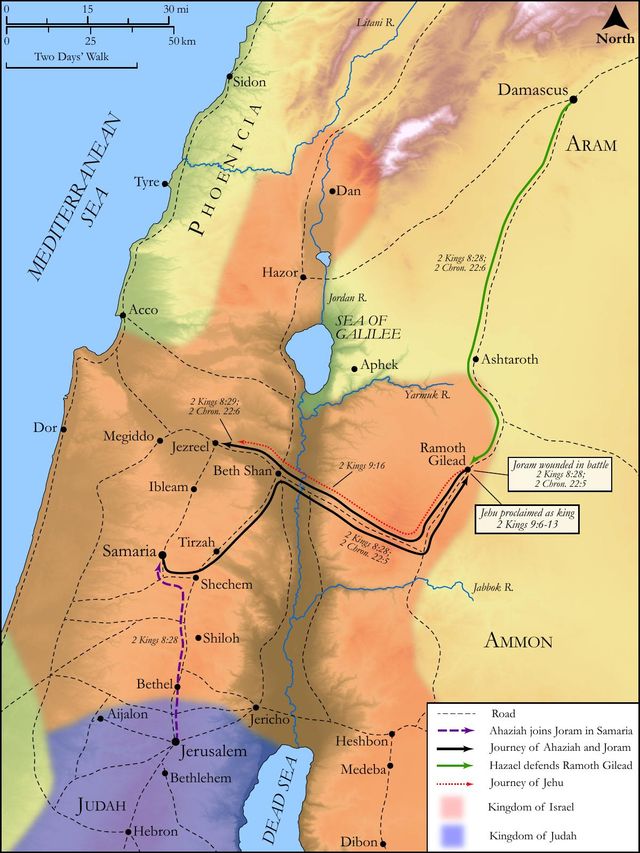
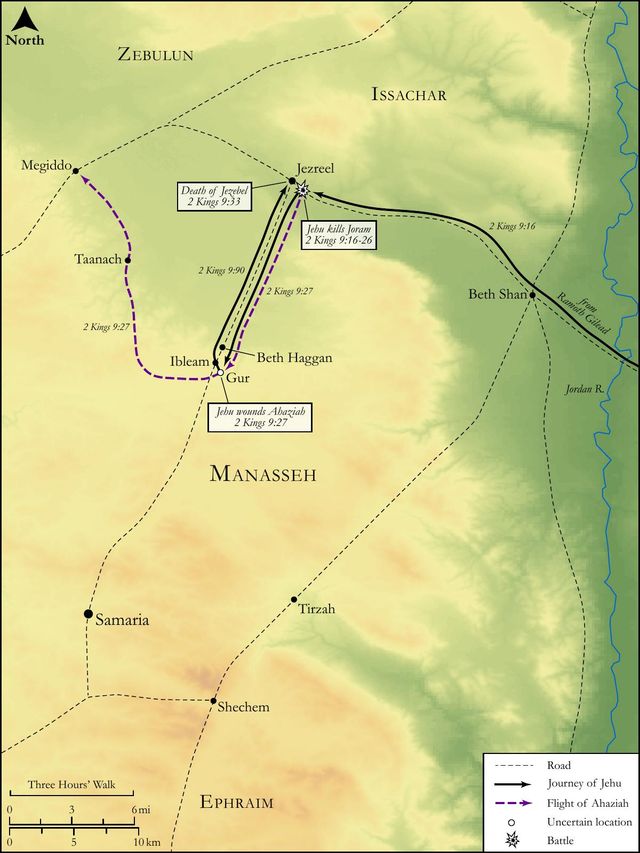
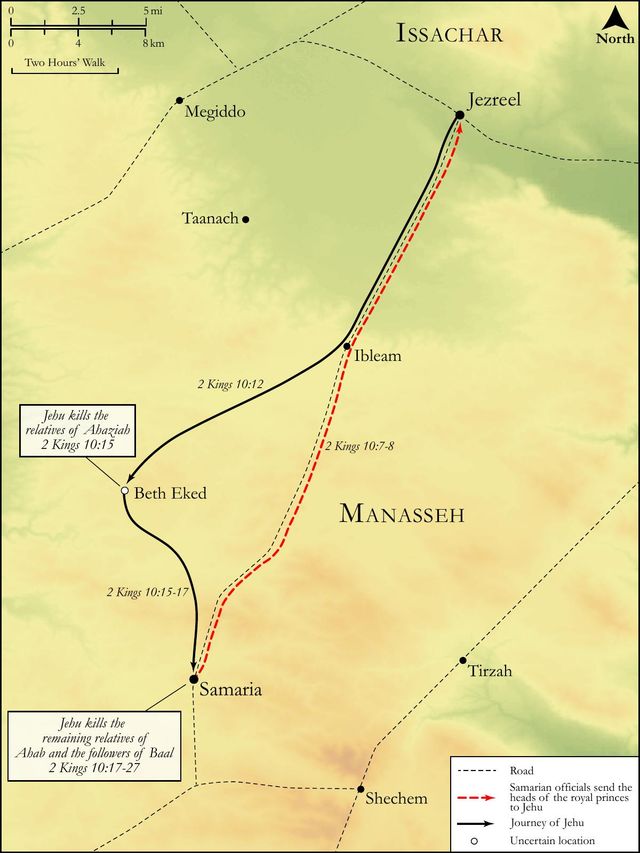
Study this verse
Public-domain commentary
Matthew Henry
From his Commentary on the Whole Bible. Henry comments on passages, not single verses — this entry covers 2 Chronicles 22:1–9. His two-level outline is real structure in the source text, so it is rendered as structure.
We have here an account of the reign of Ahaziah, a short reign (of one year only), yet long enough, unless it had been better. He was called Jeho-ahaz (Ch2 21:17); here he is called Ahaz-iah, which is the same name and of the same signification, only the words of which it is compounded are transposed. He is here said to be forty-two years old when he began to reign (Ch2 22:2), which could not be, for his father, his immediate predecessor, was but forty when he died, and it is said (Kg2 8:26) that he was twenty-two years old when he began to reign. Some make this forty-two to be the age of his mother Athaliah, for in the original it is, he was the son of forty-two years, that is, the son of a mother that was of that age; and justly is her age put for his, in reproach to him, because she managed him, and did what she would - she, in effect, reigned, and he had little more than the title of king. Many good expositors are ready to allow that this, with some few more such difficulties, arise from the mistake of some transcriber, who put forty-two for twenty-two, and the copies by which the error should have been corrected might be lost. Many ancient translations read it here twenty-two. Few books are now printed without some errata, yet the authors do not therefore disown them, nor are the errors of the press imputed to the author, but the candid reader amends them by the sense, or by comparing them with some other part of the work, as we may easily do this.
The history of Ahaziah's reign is briefly summed up in two clauses, Ch2 22:3, Ch2 22:4. His mother and her relations were his counselors to do wickedly, and it was to his destruction.
I.He did wickedly.
Though by a special providence of God he was preserved alive, when all his brethren were slain, and reserved for the crown, notwithstanding he was the youngest of them - though the inhabitants of Jerusalem, when they had buried his father ingloriously, made him king, in hopes he would take warning by that not to tread in his steps, but would do better for himself and his kingdom - yet he was not influenced by the favours either of God or man, but walked in the way of the house of Ahab, did evil in the sight of the Lord like them (Ch2 22:3, Ch2 22:4), that is, he worshipped, Baalim and Ashtaroth, supposing (as the learned bishop Patrick thinks) that by these demons, as mediators, they might have easier access to the supreme Numen, the God of Israel, or that these they might resort to at all times and for all matters, as being nearer at hand, and not of so high a dignity, but of a middle nature between the immortal God and mortal men - deified heroes; so they worshipped them as the church of Rome does saints and angels. That was sufficiently bad; but I wish there was no reason to suspect worse. I am apprehensive that they looked upon Jehovah, the God of their fathers, to be altogether such a one as these Baalim, and them to be as great and as good as he, nay, upon one account, more eligible inasmuch as these Baalim encouraged in their worshippers all manner of lewdness and sensuality, which the God of Israel strictly forbade.
II.He was counselled by his mother and her relations to do so.
She was his counsellor (Ch2 22:3) and so were they, after the death of his father, Ch2 22:4. While his father lived he took care to keep him to idolatry; but, when he was dead, the house of Ahab feared lest his father's miserable end should deter him from it, and therefore they were very industrious to keep him closely to it, and to make him seven times more a child of hell than themselves. The counsel of the ungodly is the ruin of many young persons when they are setting out in the world. This young prince might have had better advice if he had pleased from the princes and the judges, the priests and the Levites, that had been famous in his good grandfather's time for teaching in the knowledge of God; but the house of Ahab humoured him, and he walked after their counsel, gave himself up to be led by them, and did just as they would have him. Thus do those debase and destroy themselves that forsake the divine guidance.
III.He was counselled by them to his destruction.
So it proved. Those that counsel us to do wickedly counsel us to our destruction; while they fawn, and flatter, and pretend friendship, they are really our worst enemies. Those that debauch young men destroy them. It was bad enough that they exposed him to the sword of the Syrians, drawing him in to join with Joram king of Israel in an expedition to Ramoth-Gilead, where Joram was wounded, an expedition that was not for his honour. Those that give us bad counsel in the affairs of religion, if regarded by us, may justly be made of God our counsellors to do foolishly in our own affairs. But that was not all: by engaging him in an intimacy with Joram king of Israel, they involved him in the common ruin of the house of Ahab. He came on a visit to Joram (Ch2 22:6) just at the time that Jehu was executing the judgment of God upon that idolatrous family, and so was cut off with them, Ch2 22:7-9. Here,
1.See and dread the mischief of bad company - of joining in with sinners. If not the infection, yet let the destruction be feared. Come out from Babylon, that falling house, Rev 18:4.
2.See and acknowledge the justice of God. His providence brought Ahaziah, just at this fatal juncture, to see Joram, that he might fall with him and be taken as in a snare. This we had an account of before, Kg2 9:27, Kg2 9:28. It is here added that he was decently buried (not as Jehoram, whose dead body was cast into Naboth's vineyard, Kg2 9:26), and the reason given is because he was the son (that is, the grandson) of good Jehoshaphat, who sought the Lord with his heart. Thus is he remembered with honour long after his death, and some respect shown even to his degenerate unworthy seed for his sake. The memory of the just is blessed, but the name of the wicked shall rot.
Continue studying 2 Chronicles 22:1 across the web’s major study libraries — every link below opens this exact verse, chapter, or book on the destination site.
Read & Compare
 BibleGatewayThis verse in more than 200 translations and 70 languages.
 Bible.comThe YouVersion reader — hundreds of translations, reading plans, and highlights.
 ESV.orgCrossway's official English Standard Version reader.
 NET BibleThe NET translation with 60,000+ translators' notes on every rendering decision.
 STEP BibleTyndale House's free study tool — original text, vocabulary, and scholarly resources.
 BibliaLogos Bible Software's free web reader.
 USCCBThe New American Bible (Revised Edition) with the U.S. bishops' study notes.
Commentaries
 BibleHub CommentariesDozens of classic commentaries on this verse, gathered on one page.
 StudyLightMore than 100 commentary sets — the largest collection on the web.
 BibleRefPlain-English commentary on what this verse means, verse by verse.
 Enduring WordDavid Guzik's free commentary on this chapter, widely used by Bible teachers.
 Bible Study ToolsVerse commentary alongside Greek and Hebrew study aids.
Original Language & Research
- BibleHub InterlinearThe verse word by word — original language, transliteration, and English.
- BibleHub LexiconEvery word's original-language definition and Strong's entry.
 Blue Letter BibleDeep-study tools — Strong's numbers, concordance, and word studies.
 SefariaThe Hebrew text with Rashi and centuries of Jewish commentary.
Sermons, Hymns & Audio


TrulyRandomVerse is not affiliated with these sites and doesn’t control their content. They’re linked because they’re genuinely useful.
Summary
Second Chronicles 22:1 narrates the unexpected and divinely orchestrated ascension of Ahaziah, the youngest son of King Jehoram, to the throne of Judah. This highly irregular transfer of power occurred because a devastating raiding party, identified as a "band of men that came with the Arabians," had attacked Jerusalem, slaying all of Jehoram's elder sons. This tragic event, a direct consequence of Jehoram's profoundly wicked reign and a precise fulfillment of prophetic judgment, vividly underscores God's sovereign control over dynastic lines and the severe repercussions of unfaithfulness, setting the stage for Ahaziah's own brief and ungodly rule.
Context
ShowHideLiterary Context
This verse immediately follows the grim account of King Jehoram's disastrous and ungodly reign, meticulously detailed in 2 Chronicles 21. The Chronicler emphasizes Jehoram's apostasy, including his murder of his brothers and his promotion of idolatry, actions that provoked severe divine judgment. Specifically, 2 Chronicles 21:16-17 describes the Lord stirring up the spirit of the Philistines and the Arabians against Judah, leading to a devastating raid that plundered the royal treasury and carried off all of Jehoram's sons except for Jehoahaz (Ahaziah), his youngest. Thus, 2 Chronicles 22:1 serves as the direct fulfillment of this prophecy, explaining the otherwise inexplicable ascension of the youngest son to the throne. It acts as a transitional verse, bridging the narrative of Jehoram's demise with the beginning of Ahaziah's brief and equally unrighteous reign, heavily influenced by his mother Athaliah and the wicked house of Ahab, as further elaborated in 2 Chronicles 22.
Historical & Cultural Context
In ancient Near Eastern monarchies, the principle of primogeniture was paramount, meaning the eldest son typically inherited the throne. The ascension of the youngest son, Ahaziah, was therefore highly irregular and a clear indicator of a severe disruption within the royal household. The "Arabians" mentioned were not merely nomadic desert dwellers but likely referred to a powerful confederation of Arab tribes, possibly from the region south and east of Judah (such as the Qedarites or other groups from the Transjordan), who had grown in military strength and political influence. Their ability to conduct a successful raid on Jerusalem, specifically targeting the royal family and treasury, underscores the political instability of the region during this period and Judah's vulnerability when divine protection was withdrawn due to the king's sin. This era was characterized by shifting alliances and frequent skirmishes, making Judah's security precarious, especially under a king like Jehoram who had alienated both his people and his God. The forced succession of Ahaziah, bypassing all elder siblings, served as a stark cultural and historical commentary on the profound consequences of Jehoram's actions.
Key Themes
ShowHideThis verse powerfully illustrates several overarching themes central to the Chronicler's theological agenda. First, Divine Sovereignty and Judgment is paramount; the seemingly chaotic and tragic event of the Arabian raid and the slaughter of the royal heirs is presented not as random misfortune but as a precise instrument of God's judgment against Jehoram's persistent unfaithfulness, as prophesied in 2 Chronicles 21:14-15. Second, the Consequences of Unrighteousness are vividly displayed; Jehoram's spiritual rebellion and wicked deeds brought not only personal suffering but also devastating calamity upon his family and the kingdom, disrupting the natural order of succession and weakening Judah. This underscores the biblical principle that sin has far-reaching ripple effects, impacting future generations. Third, the Fragility of Dynastic Succession is highlighted; the sudden elimination of all elder princes demonstrates how quickly royal lines can be altered and how precarious power can be, especially when divine favor is withdrawn due to a ruler's disobedience. This serves as a cautionary tale, emphasizing that true security for a kingdom lies in its fidelity to God.
Exposition and Analysis
ShowHideKey Word Analysis
ShowHideFrom the root meaning "to grasp" and the divine name Yah (Yahweh), this name means "Yahweh has seized" or "Yahweh sustains." This name stands in stark contrast to his short, ungodly reign, which was characterized by his adherence to the wicked ways of the house of Ahab, rather than being sustained by Yahweh. He is also referred to as Jehoahaz in 2 Chronicles 21:17 and Azariah in 2 Chronicles 22:6. The variation in names reflects scribal practices and the interchangeability of divine prefixes (Yah, Jeho), yet the core meaning remains significant given his fate.
This term, derived from a root meaning "to cut" or "to invade," refers to a crowd, specifically a troop of soldiers, a raiding party, or a company of marauders. It suggests a mobile, organized, and often violent group associated with plunder and destruction. In this context, it emphasizes the nature of the attack as a punitive expedition, not merely a random act of banditry, but a divinely orchestrated force carrying out judgment.
A primitive root meaning "to smite with deadly intent," "to kill," or "to murder." This word emphasizes the violent and decisive nature of the attack by the Arabians. The use of "slain" underscores the complete and utter destruction of Jehoram's elder sons, leaving no doubt as to the severity of the divine judgment and the reason for Ahaziah's unconventional succession.
Verse Breakdown
ShowHide"And the inhabitants of Jerusalem made Ahaziah his youngest son king in his stead"
This clause describes the unusual and forced succession. The "inhabitants of Jerusalem" (often referring to the "people of the land" or the populace with a say in royal succession) took action to install a king, indicating a pragmatic response to a crisis and the immediate need for a ruler, however compromised the choice. The explicit mention of "his youngest son" highlights the extraordinary circumstances, as primogeniture was the norm.
"for the band of men that came with the Arabians to the camp had slain all the eldest"
This explanatory clause provides the crucial reason for Ahaziah's ascension. It directly links the succession to the devastating raid. The phrase "to the camp" (which can also be translated "against the encampment" or "against the land") indicates the comprehensive nature of the attack, targeting not just the city but potentially the surrounding royal estates or military outposts where the elder sons might have been. The slaying of "all the eldest" signifies a catastrophic loss for the royal house, leaving no other viable candidates for the throne.
"So Ahaziah the son of Jehoram king of Judah reigned"
This concluding statement formally declares Ahaziah's reign, establishing his lineage and confirming his position as the new king of Judah. The "So" indicates a direct consequence, tying the tragic events of the raid to the new political reality. It sets the stage for the narrative of his reign, which, as subsequent verses reveal, continued in the ungodly tradition of his father, Jehoram, further illustrating the Chronicler's theme of retribution.
Literary Devices
ShowHideThe Chronicler employs several literary devices in this verse to convey its profound theological message. Irony is strikingly evident in Ahaziah's name, meaning "Yahweh sustains," contrasting sharply with his brief and ungodly reign, which was anything but sustained by divine favor. This highlights the disjunction between human naming and divine reality. Foreshadowing is present, as the violent and unusual succession of Ahaziah immediately signals that his reign, born out of divine judgment against his father's sin, is unlikely to be prosperous or long-lived. This sets a somber tone for the subsequent narrative. The narrative also employs Divine Retribution as a central motif, presenting the Arabian raid not as a random act of violence but as a direct, punitive action from God, fulfilling the prophecy against Jehoram's house. This emphasizes God's active involvement in human history and His unwavering commitment to justice. Finally, there is a strong sense of Covenant Theology at play, where the consequences of Jehoram's unfaithfulness directly manifest in the destabilization of the Davidic line, reinforcing the Chronicler's consistent message that faithfulness to God brings blessing, while disobedience brings judgment.
Theological and Thematic Connections
ShowHideThis verse powerfully encapsulates the Chronicler's theology of immediate retribution and blessing, demonstrating God's active involvement in the affairs of kings and nations. The violent and irregular succession of Ahaziah serves as a stark reminder that God is sovereign over all human events, even those seemingly chaotic or tragic, and that He uses them to fulfill His righteous purposes. It underscores the profound consequences of unrighteous leadership, where the sins of a king like Jehoram bring calamity not only upon himself but also upon his family and the entire kingdom, disrupting the divinely ordained order. This passage reinforces the biblical truth that God holds leaders accountable for their stewardship and that His justice will ultimately prevail, even through the actions of foreign invaders. The vulnerability of the Davidic line, despite God's covenant promises, is highlighted when human sin intervenes, emphasizing that divine promises are often conditional upon human obedience.
Reflection and Application
ShowHideThe account of Ahaziah's ascension serves as a sobering reminder that our actions, particularly those of leaders, have far-reaching and often intergenerational consequences. King Jehoram's unfaithfulness did not merely affect him personally; it brought a wave of devastation upon his family, leading to the tragic loss of his elder sons and a destabilized kingdom. This compels us to consider the profound responsibility inherent in any position of influence, whether in a family, a community, or a church. Our choices, whether for righteousness or unrighteousness, create ripple effects that extend beyond our immediate circumstances, shaping the environment and future of those around us. Furthermore, this narrative powerfully affirms God's unwavering sovereignty. Even amidst the chaos and tragedy of a foreign invasion and the slaughter of princes, God's hand is evident, bringing about His judgment and orchestrating the course of history according to His divine plan. This should instill in us a deep trust in God's providence, even when circumstances seem inexplicable or unjust from a human perspective. It calls us to examine our own lives: Are we living in a way that brings blessing or judgment upon those around us? Are we trusting in God's ultimate control, even when the world seems out of control?
Questions for Reflection
ShowHideFAQ
ShowHideWhy was Ahaziah, the youngest son, made king?
ShowHideAhaziah was made king because a "band of men that came with the Arabians" had raided Jerusalem and slain all of King Jehoram's elder sons. This devastating attack, detailed in 2 Chronicles 21:16-17, left Ahaziah as the only surviving heir. The Chronicler presents this event not as random misfortune but as a direct fulfillment of divine judgment against Jehoram for his exceedingly wicked reign, which included idolatry and the murder of his own brothers. Thus, Ahaziah's ascension was an unusual and tragic consequence of his father's unfaithfulness and a clear display of God's sovereign hand in the succession.
Who were "the Arabians" in this context, and what was their significance?
ShowHideIn this context, "the Arabians" refers to a confederation of Arab tribes, likely from regions south and east of Judah, who were stirred up by the Lord as an instrument of His judgment against King Jehoram. These were not merely nomadic wanderers but organized raiding parties capable of significant military action, as evidenced by their successful attack on Jerusalem and the royal palace. Their involvement underscores the political volatility of the period and God's ability to use any nation or group to accomplish His purposes, even to execute judgment upon His own people when they stray from His covenant. Their raid was a direct fulfillment of the prophecy against Jehoram's house found in 2 Chronicles 21:14-15.
How does this event demonstrate God's judgment?
ShowHideThis event powerfully demonstrates God's judgment by showing a direct, calamitous consequence for King Jehoram's unrighteousness. Jehoram had forsaken the Lord, led Judah into idolatry, and even murdered his own brothers (2 Chronicles 21:4-6). The prophet Elijah had warned him of severe judgment, including a great plague upon his people, sons, wives, and possessions (2 Chronicles 21:14). The raid by the Arabians, resulting in the slaughter of all Jehoram's elder sons and the plundering of his house, was the precise fulfillment of this prophecy. It illustrates God's active involvement in human history, holding leaders accountable and ensuring that sin carries severe consequences, even for royal dynasties.
Christ-Centered Fulfillment
ShowHideThe broken and unstable kingship described in 2 Chronicles 22:1, marked by violence, divine judgment, and an irregular succession, profoundly highlights the desperate need for a perfect and enduring King. Ahaziah's brief, unrighteous reign, born out of the chaos of his father's sin, stands in stark contrast to the eternal, righteous reign of Jesus Christ. While earthly kings like Ahaziah were subject to the consequences of sin and the fragility of human power, Jesus, the true Son of David, fulfills God's covenant promises for an everlasting kingdom (2 Samuel 7:12-16). He is the King whose throne is not established by human decree or vulnerable to foreign raids, but by divine authority and eternal power (Hebrews 1:8). The judgment that fell upon Jehoram's house because of sin points forward to the ultimate judgment against all unrighteousness, which Christ bore on the cross, thereby offering redemption and a path to His unshakeable kingdom (Colossians 1:13-14). Unlike Ahaziah, who inherited a kingdom destabilized by sin, Jesus establishes a kingdom of righteousness, peace, and joy in the Holy Spirit, where His subjects are sustained not by human strength but by His divine grace and perfect rule (Romans 14:17). He is the King who truly "sustains" His people, fulfilling the ironic meaning of Ahaziah's name in a way no earthly monarch ever could, offering a stability and hope that no human dynasty could provide.