


2 Kings 9:28
- וַיַּרְכִּבוּvai·yar·Ki·vuand they caused to rideH7392Conj-w ¦ V-Hiphil-ConsecImperf-3mpVerb Hiphil Consecutive Imperfect 3rd Plural Masculineוַandיַּרְכִּבוּthey caused to ride
- אֹתוֹ'o·To<obj.> himH853DirObjM ¦ 3msParticle Object Indicatorאֹת<obj.>וֹhim
- עֲבָדָיו'a·va·Davhis servantsH5650N-mpc ¦ 3msNoun Plural Masculine Constructעֲבָדָיservantsוhis
- יְרוּשָׁלְָמָהye·ru·sha·Le·mahJerusalem towardsH3389N-proper ¦ SfxNoun Proper LocationיְרוּשָׁלְָמָJerusalemהtowards
- וַיִּקְבְּרוּvai·yik·be·Ruand they buriedH6912Conj-w ¦ V-Qal-ConsecImperf-3mpVerb Qal Consecutive Imperfect 3rd Plural Masculineוַandיִּקְבְּרוּthey buried
- אֹתוֹ'o·To<obj.> himH853DirObjM ¦ 3msParticle Object Indicatorאֹת<obj.>וֹhim
- בִקְבֻרָתוֹvik·vu·ra·Toin his graveH6900Prep-b ¦ N-fsc ¦ 3msNoun Singular Feminine Constructבִinקְבֻרָתgraveוֹhis
- עִם'imwithH5973PrepPreposition
- אֲבֹתָיו'a·vo·Tavhis ancestorsH1N-fpc ¦ 3msNoun Plural Feminine Constructאֲבֹתָיancestorsוhis
- בְּעִירbe·'Irin [the] city ofH5892Prep-b ¦ N-fscNoun Singular Feminine Constructבְּinעִיר[the] city of
- דָּוִדda·VidDavidH1732N-proper-mNoun Proper Masculine
English is a literal word-by-word gloss of the Hebrew, not the KJV's wording. Why?
This is the original text the KJV's translators worked from — each Hebrew word with its own literal English meaning in this verse, prepared by scholars at Tyndale House, Cambridge. The KJV translates whole sentences, not word by word, so its wording differs: one Hebrew word can become several English words, and the KJV may choose “the LORD” where the gloss reads “Yahweh”. Both are faithful — they answer different questions. For the KJV's own rendering, switch to the KJV text.
Details
See on the biblical-era map
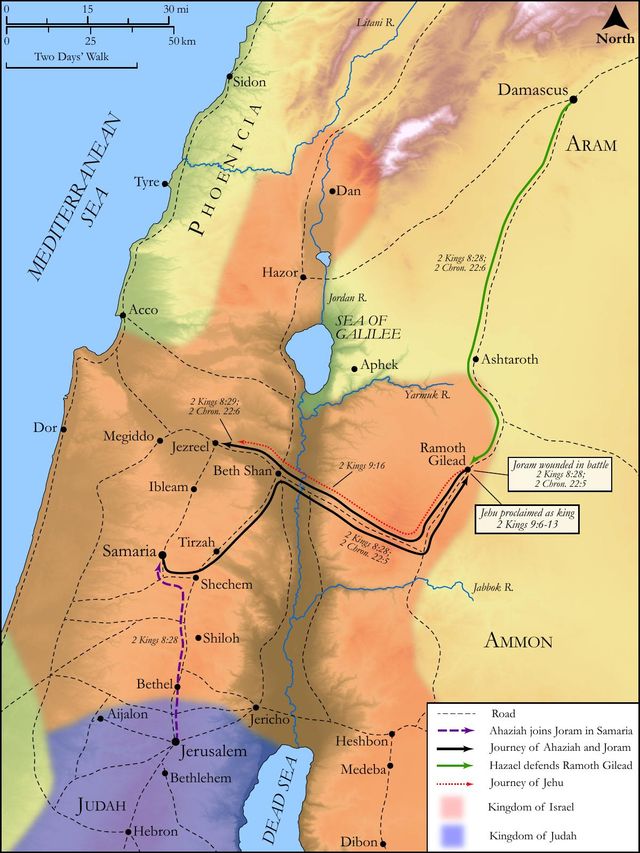
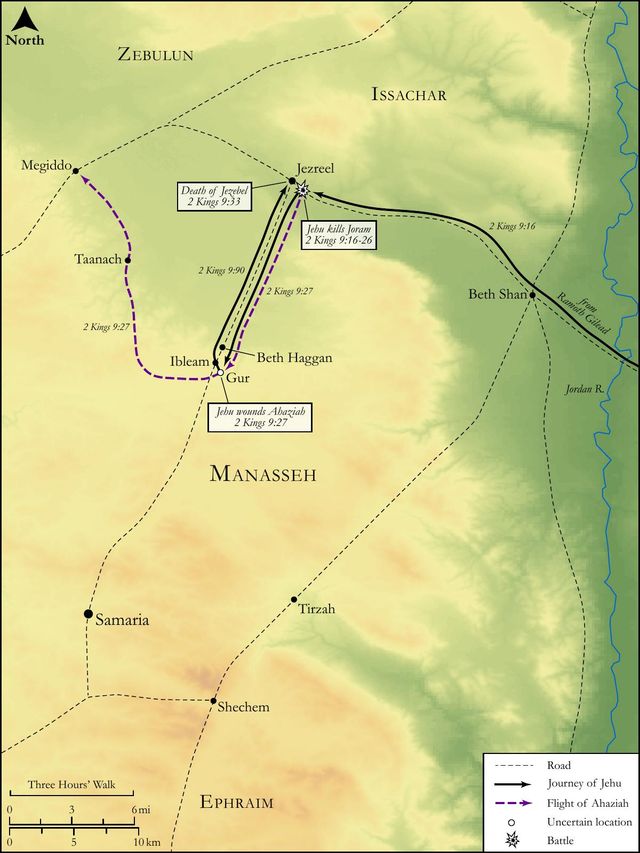
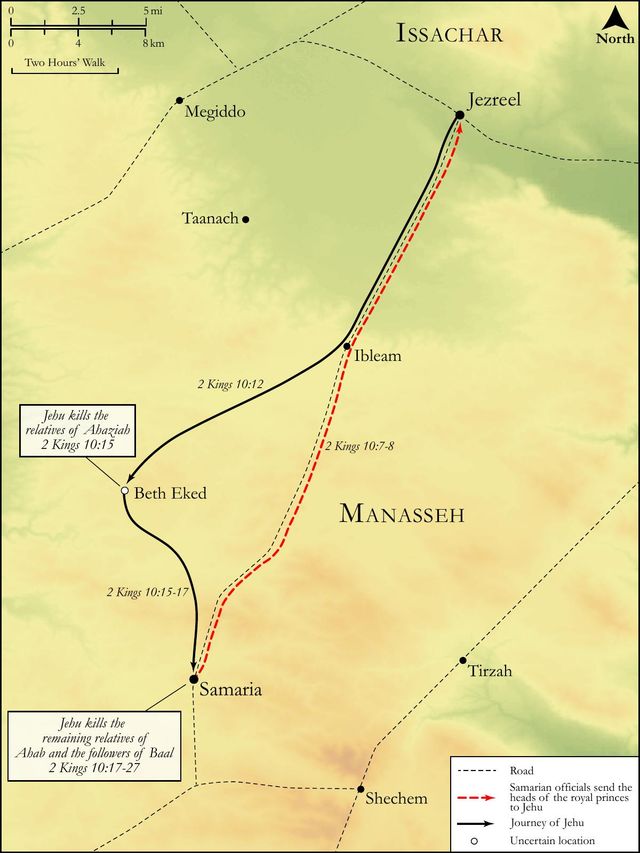
Study this verse
Public-domain commentary
Matthew Henry
From his Commentary on the Whole Bible. Henry comments on passages, not single verses — this entry covers 2 Kings 9:16–29. His four-level outline is real structure in the source text, so it is rendered as structure.
From Ramoth-Gilead to Jezreel was more than one day's march; about the mid-way between them the river Jordan must be crossed. We may suppose Jehu to have marched with all possible expedition, and to have taken the utmost precaution to prevent the tidings from getting to Jezreel before him; and, at length, we have him within sight first, and then within reach, of the devoted king.
I.Joram's watchman discovers him first at a distance, him and his retinue, and gives notice to the king of the approach of a company, whether of friends or foes he cannot tell. But the king (impatient to know what is the matter, and perhaps jealous that the Syrians, who had wounded him, had traced him by the blood to his own palace, and were coming to seize him) sent first one messenger, and then another, to bring him intelligence, Kg2 9:17-19. He had scarcely recovered from the fright he was put into in the battle, and his guilty conscience put him into a continual terror. Each messenger asked the same question: "Is it peace? are you for us or for our adversaries? Do you bring good tidings or bad?" Each had the same answer: What hast thou to do with peace? Turn thee behind me, Kg2 9:18. 19. As if he had said, "It is not to thee, but to him that sent thee, that I will give answer; for thy part, if thou consult thy own safety, turn thee behind me, and enlist thyself among my followers." The watchman gave notice that the messengers were taken prisoners, and at length observed that the leader of this troop drove like Jehu, who it seems was noted for driving furiously, thereby discovering himself to be a man of a hot eager spirit, intent upon his business, and pushing forward with all his might. A man of such a violent temper was fittest for the service to which Jehu was designated. The wisdom of God is seen in the choice of proper instruments to be employed in his work. But it is not much for any man's reputation to be known by his fury. He that has rule over his own spirit is better than the mighty. The Chaldee paraphrase gives this a contrary sense: The leading is like that of Jehu, for he leads quietly. And, it should seem, he did not come up very fast, for then there would not have been time for all this that passed. And some think he chose to march slowly, that he might give Joram time to come out to him, and so dispatch him before he entered the city.
II.Joram himself goes out to meet him, and takes Ahaziah king of Judah along with him, neither of them equipped for war, as not expecting an enemy, but in haste to have their curiosity satisfied. How strangely has Providence sometimes ordered it, that men have been in haste to meet their ruin when their day has come to fall.
1.The place where Joram met Jehu was ominous: In the portion of Naboth the Jezreelite, Kg2 9:21. The very sight of that ground was enough to make Joram tremble and Jehu triumph; for Joram had the guilt of Naboth's blood fighting against him and Jehu had the force of Elijah's curse fighting for him. The circumstances of events are sometimes so ordered by divine Providence as to make the punishment answer to the sin as face answers to face in a glass.
2.Joram's demand was still the same: "Is it peace, Jehu? Is all well? Dost thou come home thus flying from the Syrians or more than a conqueror over them?" It seems, he looked for peace, and could not entertain any other thought. Note, It is very common for great sinners, even when they are upon the brink of ruin, to flatter themselves with an opinion that all is well with them, and to cry peace to themselves.
3.Jehu's reply was very startling. He answered him with a question: What peace canst thou expect, so long as the whoredoms of thy mother Jezebel (who, though queen dowager, was in effect queen regent) and her witchcrafts are so many? See how plainly Jehu deals with him. Formerly he durst not do so, but now he had another spirit. Note, Sinners will not always be flattered; one time or other, they will have their own given them, Psa 36:2. Observe,
(1.)He charges upon him his mother's wickedness, because he had at first learned it and then with his kingly power protected it. She stands impeached for whoredom, corporal and spiritual (serving idols and serving them with the very acts of lewdness), for witchcraft likewise, enchantments and divinations, used in honour of her idols; and these multiplied, the whoredoms and the witchcrafts many; for those that abandon themselves to wicked courses know not where they will stop. One sin begets another.
(2.)Upon that account he throws him off from all pretensions to peace: "What peace can come to that house in which there is so much wickedness unrepented of?" Note, The way of sin can never be the way of peace, Isa 57:21. What peace can sinners have with God, what peace with their own consciences, what good, what comfort, can they expect in life, in death, or after death, who go on still in their trespasses? No peace so long as sin is persisted in; but, as soon as it is repented of and forsaken, there is peace.
4.The execution was done immediately. When Joram heard of his mother's crimes his heart failed him; he presently concluded the long-threatened day of reckoning had now come, and cried out, "There is treachery, O Ahaziah! Jehu is our enemy, and it is time for us to shift for our safety." Both fled, and,
(1.)Joram king of Israel was slain presently, Kg2 9:24. Jehu dispatched him with his own hands. The bow was not drawn at a venture, as that which sent the fatal arrow through the joints of his father's harness, but Jehu directed the arrow between his shoulders as he fled (it was one of God's arrows which he has ordained against the persecutor, Psa 7:13), and it reached to his heart, so that he died upon the spot. He was now the top branch of Ahab's house, and therefore was first cut off. He died a criminal, under the sentence of the law, which Jehu, the executioner, pursues in the disposal of the dead body. Naboth's vineyard was hard by, which put him in mind of that circumstance of the doom Elijah passed upon Ahab, "I will requite thee in this plat, said the Lord (Kg2 9:25, Kg2 9:26), for the blood of Naboth himself, and for the blood of his sons," who were either put to death with him as partners in his crime, or secretly murdered afterwards, lest they should bring an appeal, or find some way to avenge their father's death, or break their hearts for the loss of him, or (his whole estate being confiscated, as well as his vineyard) lose their livelihoods, which was in effect to lose their lives. For this the house of Ahab must be reckoned with; and that very piece of ground which he, with so much pride and pleasure, had made himself master of at the expense of the guilt of innocent blood, now became the theatre on which his son's dead body lay exposed a spectacle to the world. Thus the Lord is known by the judgment which he executeth. Higgaion. Selah.
(2.)Ahaziah king of Judah was pursued, and slain in a little time, and not far off, Kg2 9:27, Kg2 9:28.
[1.]Though he was now in Joram's company, he would not have been slain but that he was joined with the house of Ahab both in affinity and in iniquity. He was one of them (so he had made himself by his sins) and therefore he must fare as they fared. Jehu justly construed his commission as extending to them. Yet,
[2.]Perhaps he would not at this time have fallen with them if he had not been found in company with them. It is a dangerous thing to associate with evil-doers; we may be entangled both in guilt and misery by it.
Continue studying 2 Kings 9:28 across the web’s major study libraries — every link below opens this exact verse, chapter, or book on the destination site.
Read & Compare
 BibleGatewayThis verse in more than 200 translations and 70 languages.
 Bible.comThe YouVersion reader — hundreds of translations, reading plans, and highlights.
 ESV.orgCrossway's official English Standard Version reader.
 NET BibleThe NET translation with 60,000+ translators' notes on every rendering decision.
 STEP BibleTyndale House's free study tool — original text, vocabulary, and scholarly resources.
 BibliaLogos Bible Software's free web reader.
 USCCBThe New American Bible (Revised Edition) with the U.S. bishops' study notes.
Commentaries
 BibleHub CommentariesDozens of classic commentaries on this verse, gathered on one page.
 StudyLightMore than 100 commentary sets — the largest collection on the web.
 BibleRefPlain-English commentary on what this verse means, verse by verse.
 Enduring WordDavid Guzik's free commentary on this chapter, widely used by Bible teachers.
 Bible Study ToolsVerse commentary alongside Greek and Hebrew study aids.
Original Language & Research
- BibleHub InterlinearThe verse word by word — original language, transliteration, and English.
- BibleHub LexiconEvery word's original-language definition and Strong's entry.
 Blue Letter BibleDeep-study tools — Strong's numbers, concordance, and word studies.
 SefariaThe Hebrew text with Rashi and centuries of Jewish commentary.
Sermons, Hymns & Audio


TrulyRandomVerse is not affiliated with these sites and doesn’t control their content. They’re linked because they’re genuinely useful.
Summary
Second Kings 9:28 records the solemn burial of King Ahaziah of Judah in Jerusalem, specifically within the sacred "city of David," following his mortal wounding by Jehu's divinely commissioned forces. This verse marks the abrupt and inglorious conclusion of his brief reign, serving as a stark testament to the swift and decisive nature of God's judgment against the corrupt house of Ahab, with whom Ahaziah had unwisely entangled himself through familial and political alliances. Despite his wicked associations and a violent end, Ahaziah was afforded the customary royal burial rites, a detail that subtly underscores his legitimate, albeit deeply flawed, position within the enduring Davidic lineage, contrasting sharply with the ignominious fates of other members of the house of Ahab.
Context
ShowHideLiterary Context
This verse provides the concluding disposition for King Ahaziah within the dramatic and violent narrative of Jehu's coup. Immediately preceding 2 Kings 9:28, Jehu has executed King Joram of Israel, fulfilling the specific prophecy against Ahab's dynasty in 2 Kings 9:24-26. King Ahaziah of Judah, who was visiting Joram and deeply allied with the house of Ahab through his mother Athaliah, fled the scene of Joram's death. He was pursued by Jehu's men, struck down near Ibleam, and died on the way to Megiddo, as recounted in 2 Kings 9:27. Therefore, this verse serves as the final act in Ahaziah's involvement in the unfolding judgment narrative, bringing a definitive close to his life and setting the stage for Jehu's subsequent purge of Ahab's remaining family and the infamous death of Jezebel.
Historical & Cultural Context
Ahaziah's reign (see 2 Kings 8:25-29) was remarkably brief and characterized by his deep alliance with the Northern Kingdom of Israel, particularly through his mother, Athaliah, who was the daughter of Ahab and Jezebel. This familial and political entanglement explains his presence with King Joram during Jehu's divinely orchestrated coup. Royal burials in ancient Judah were profoundly significant events, meticulously observed to reflect the king's status, lineage, and legitimacy. The practice of transporting a king's body, even one who died far from the capital, back to Jerusalem for interment in the ancestral tombs was a customary and vital practice that affirmed his recognized position. The "city of David" refers to the oldest and most sacred part of Jerusalem, specifically Mount Zion, which served as the traditional necropolis for many of the Davidic kings. This specific detail highlights that despite Ahaziah's wickedness and his death by divine judgment, he was still recognized as a legitimate king in the Davidic line, a stark contrast to the unburied or dishonored fates met by other members of Ahab's house, such as Joram (whose body was left in Naboth's field, as prophesied in 1 Kings 21:19) and Jezebel (whose body was eaten by dogs, as prophesied in 1 Kings 21:23).
Key Themes
ShowHideThe overarching theme is the unfolding of divine judgment against the house of Ahab, a judgment meticulously prophesied by Elijah (e.g., 1 Kings 21:21-24). Ahaziah's death, though not explicitly prophesied for him personally, is a direct and inevitable consequence of his deep association with this condemned dynasty, powerfully illustrating the peril of unholy alliances. Despite the severity of this judgment, the verse also subtly introduces the crucial theme of the preservation of the Davidic line. While Ahaziah was indeed a wicked king, his proper burial in the "city of David" signifies that God's covenant with David (2 Samuel 7:16) remained intact and operational, even amidst the purging of an unfaithful king. This critical detail distinguishes the Judahite monarchy from the utterly condemned Northern Kingdom's dynasty, emphasizing God's unwavering faithfulness to His promises.
Exposition and Analysis
ShowHideKey Word Analysis
ShowHideThis verb (H7392) denotes the act of riding or causing to ride, often implying conveyance by an animal or vehicle. In this context, it signifies the deliberate and respectful action of Ahaziah's servants to transport his body a significant distance from the place of his death (near Megiddo) back to Jerusalem. This act demonstrates a measure of loyalty and adherence to royal protocol, ensuring that the deceased king received a proper burial in his ancestral city, rather than being left unburied or interred in a foreign land. It underscores the profound cultural importance placed on proper burial rites, especially for royalty.
This feminine passive participle (H6900) refers to a burial place, a grave, or a tomb. Being buried "in his sepulchre with his fathers" indicates that Ahaziah was interred in the designated royal burial ground or a family tomb reserved for the kings of Judah. This detail is crucial as it confirms his legitimate place within the Davidic lineage, despite his personal wickedness and the violent circumstances of his death. It sharply contrasts with the dishonored fates of other figures in the narrative, particularly those from the house of Ahab, who were denied such a proper and dignified burial.
This noun (H5892) denotes a city or town, often implying a guarded or fortified place. When combined with "of David" (H1732, Dâvid), it specifically refers to the oldest and most significant part of Jerusalem, originally the Jebusite stronghold captured by King David. This area became the royal capital and, crucially, the traditional burial site for many of the kings of Judah from the Davidic dynasty. Its mention here emphasizes Ahaziah's royal identity and his connection to the covenantal line of David, even as he falls under divine judgment. It serves as a subtle but powerful reminder of God's enduring promise to David, a promise that persists even when individual kings from that line falter.
Verse Breakdown
ShowHide"And his servants carried him in a chariot to Jerusalem"
This clause details the immediate and respectful action taken by Ahaziah's loyal retainers after his death. The explicit mention of a "chariot" underscores the royal status of the deceased and the urgency, dignity, and care with which his body was transported. The destination, "Jerusalem," is profoundly significant as the capital city and the traditional, sacred burial place for Judahite kings, highlighting the intention to afford him a proper royal interment despite the violent circumstances of his demise at Jehu's hand.
"and buried him in his sepulchre"
This phrase confirms the successful completion of the arduous journey and the solemn act of burial itself. The possessive "his sepulchre" implies a pre-existing, designated tomb, most likely a family or royal burial vault. This act of burial signifies a measure of honor, proper closure, and adherence to customary rites, distinguishing Ahaziah's fate from the ignominious end of other members of the house of Ahab who were denied such dignity and left unburied.
"with his fathers in the city of David"
This final, crucial phrase provides the precise location and context of Ahaziah's interment. Being interred "with his fathers" explicitly links him to the preceding kings of Judah, affirming his place in the legitimate Davidic succession and lineage. The "city of David" specifies the sacred royal necropolis, reinforcing his identity as a Davidic king and underscoring the enduring nature of God's covenant with David, even as a wicked king from that line is removed through divine judgment.
Literary Devices
ShowHideThe verse effectively employs Contrast to subtly highlight the distinct fates of the wicked, even within the context of divine judgment. While Ahaziah, a Davidic king deeply allied with the condemned house of Ahab, meets a violent death, he is notably afforded a proper royal burial in the ancestral tomb within the sacred City of David. This stands in stark contrast to the ignominious fates of Joram, whose body was left unburied in Naboth's field, and Jezebel, whose body was consumed by dogs, both fulfilling specific prophecies of dishonor and utter destruction. This contrast underscores the theological distinction between the covenantal preservation of the Davidic line, however flawed its individual kings, and the complete annihilation prophesied for the house of Ahab. The mention of the "city of David" also functions as potent Symbolism, representing the enduring and faithful promise of God to David, a divine faithfulness that persists even when individual kings prove unfaithful. Furthermore, the narrative's swift movement from Ahaziah's wounding to his burial creates a sense of Expediency, emphasizing the rapid, decisive, and comprehensive nature of Jehu's divinely sanctioned purge. There is also an element of Irony in that Ahaziah, a wicked king, receives a dignified burial not due to his own merit, but solely because of his lineage and God's unwavering commitment to His covenant with David.
Theological and Thematic Connections
ShowHideThe burial of Ahaziah in 2 Kings 9:28 serves as a poignant reminder of the severe consequences of unholy alliances and the unwavering, comprehensive nature of divine judgment against wickedness, particularly apostasy and idolatry. Ahaziah's death is not an arbitrary event but a direct and inevitable consequence of his entanglement with the condemned house of Ahab, illustrating the profound truth that association with evil can lead to shared judgment and destruction. Yet, the specific detail of his proper burial in the "city of David" is profoundly theologically significant. It underscores God's unwavering faithfulness to His covenant with David, even when individual kings from that lineage prove unfaithful and wicked. While God executes righteous judgment on wicked kings, He simultaneously preserves the promised line through which the ultimate, righteous King would come. This intricate tension between divine wrath and covenantal faithfulness is a recurring and vital theme woven throughout the Deuteronomistic history.
Reflection and Application
ShowHideThe brief but impactful account of Ahaziah's death and burial in 2 Kings 9:28 offers profound and timeless lessons for contemporary believers. His demise, a direct result of his deep alliance with the wicked house of Ahab, serves as a stark and sobering warning about the spiritual dangers inherent in aligning oneself with ungodly influences, whether these manifest in personal relationships, professional endeavors, cultural trends, or even theological compromises. It powerfully reminds us that our associations can have significant, even fatal, consequences for our spiritual well-being, trajectory, and ultimate destiny. While God's righteous judgment against sin is absolute and comprehensive, as vividly seen in the purge of Ahab's house, the narrative also subtly highlights God's enduring and steadfast faithfulness to His covenants, even when human actors fail spectacularly. Ahaziah's burial in the "city of David" points to a larger, immutable divine plan at work, one that transcends individual failures and ensures the ultimate fulfillment of God's promises. This encourages us to place our unwavering trust in God's sovereign control, even when circumstances appear chaotic, unjust, or beyond our comprehension, and to discern carefully who and what we align ourselves with, choosing instead to walk in paths that honor God and align with His divine purposes.
Questions for Reflection
ShowHideFAQ
ShowHideWhy was Ahaziah buried in Jerusalem when he died near Megiddo?
ShowHideAhaziah was the legitimate King of Judah, despite his personal wickedness and his ill-fated alliance with the house of Ahab. It was a deeply ingrained custom and a matter of royal dignity for kings to be buried in their ancestral tombs within their capital city, even if they died far from home. His loyal servants made the significant effort to transport his body all the way to Jerusalem to ensure he received a proper royal burial in the "city of David," which was the traditional necropolis for the Davidic kings. This act underscored his royal status and legitimate lineage, distinguishing his fate from the ignominious ends of other members of Ahab's house, such as Joram, whose body was left unburied in Naboth's field (2 Kings 9:25-26), and Jezebel, whose body was consumed by dogs (2 Kings 9:35-37).
What is the significance of "the city of David" for burial?
ShowHideThe "city of David" refers to the oldest and most sacred part of Jerusalem, specifically Mount Zion, which King David had conquered and established as his royal capital. It subsequently became the traditional and revered burial site for many of the kings of Judah, beginning with David himself. Being buried in the "city of David" profoundly signified a king's legitimate place within the Davidic dynasty and underscored his vital connection to the covenant God made with David, promising an enduring kingdom and a perpetual line of succession (2 Samuel 7:12-16). For Ahaziah, it confirmed his royal identity and lineage, even though his reign was brief and marked by wickedness, and he ultimately died under divine judgment.
How does Ahaziah's death relate to the prophecy against Ahab?
ShowHideWhile Ahaziah was a king of Judah, not Israel, and not a direct son of Ahab, he was closely related through his mother, Athaliah, who was Ahab's daughter (2 Kings 8:26). Furthermore, he was deeply allied with King Joram of Israel, Ahab's son, and was present with him during Jehu's coup. Therefore, Ahaziah's death at the hands of Jehu was an extension of the broader, comprehensive divine judgment against the house of Ahab and its pervasive sphere of influence. His removal was necessary to completely purge the wicked influence of Ahab and Jezebel, fulfilling the spirit and intent of the prophecy given by Elijah in 1 Kings 21:21-24, which decreed the utter destruction of Ahab's dynasty.
Christ-Centered Fulfillment
ShowHideThe account of Ahaziah's death and burial, though seemingly a minor detail within a violent narrative, profoundly points to the necessity and glory of Jesus Christ. Ahaziah, a flawed and wicked king from the Davidic line, met a violent end due to his unholy alliances and the unfolding of divine judgment. His burial in the "city of David" subtly highlights God's unwavering faithfulness to His covenant with David (2 Samuel 7:16), even amidst the abject failures of individual kings. This persistent and unbreakable covenant ultimately finds its perfect, eternal, and glorious fulfillment in Jesus Christ. Unlike Ahaziah, whose reign was brief, disastrous, and ended in death, Jesus is the true and eternal Son of David, whose kingdom will never end (Luke 1:32-33). He is the King who did not succumb to unholy alliances or compromise with evil, but perfectly obeyed God's will, even to the point of sacrificial death on a cross (Philippians 2:8). His burial was not in an ancestral tomb of a flawed and failing lineage, but in a new tomb, signifying His unique, sinless nature and the inauguration of the new covenant through His resurrection (Matthew 27:59-60). The "city of David" for Christ is not an earthly necropolis, but the heavenly Jerusalem, where He reigns eternally as the resurrected Lord, offering not a temporary reprieve from judgment, but eternal life and salvation for all who believe and trust in Him (Revelation 21:2-4).