


2 Kings 8:26
- בֶּןben[was] a son ofH1121N-mscNoun Singular Masculine Construct
- עֶשְׂרִים'es·RimtwentyH6242N-mpNoun Plural Masculine Absolute
- וּשְׁתַּיִםu·she·Ta·yimand twoH8147Conj-w ¦ N-fdNoun Dual Feminine Absoluteוּandשְׁתַּיִםtwo
- שָׁנָהsha·Nahyear[s]H8141N-fsNoun Singular Feminine Absolute
- אֲחַזְיָהוּ'a·chaz·Ya·huAhaziahH274N-proper-mNoun Proper Masculine
- בְמָלְכוֹve·ma·le·Khowhen he became kingH4427Prep-b ¦ V-Qal-Inf ¦ 3msVerb Qal Infinitive Constructבְwhenמָלְכbecame kingוֹhe
- וְשָׁנָהve·sha·Nahand a yearH8141Conj-w ¦ N-fsNoun Singular Feminine Absoluteוְandשָׁנָהa year
- אַחַת'a·ChatoneH259N-fsNoun Singular Feminine Absolute
- מָלַךְma·Lakhhe reignedH4427V-Qal-Perf-3msVerb Qal Perfect 3rd Singular Masculine
- בִּירוּשָׁלִָםbi·ru·sha·Limin JerusalemH3389Prep-b ¦ N-properNoun Proper LocationבִּinירוּשָׁלִָםJerusalem
- וְשֵׁםve·Shemand [the] name ofH8034Conj-w ¦ N-mscNoun Singular Masculine Constructוְandשֵׁם[the] name of
- אִמּוֹ'i·Mohis motherH517N-fsc ¦ 3msNoun Singular Feminine Constructאִמּmotherוֹhis
- עֲתַלְיָהוּ'a·tal·Ya·hu[was] AthaliahH6271N-proper-fNoun Proper Feminine
- בַּתbat[the] daughter ofH1323N-fscNoun Singular Feminine Construct
- עָמְרִי'a·me·RiOmriH6018N-proper-mNoun Proper Masculine
- מֶלֶךְMe·lekh[the] king ofH4428N-mscNoun Singular Masculine Construct
- יִשְׂרָאֵלYis·ra·'ElIsraelH3478N-properNoun Proper Location
English is a literal word-by-word gloss of the Hebrew, not the KJV's wording. Why?
This is the original text the KJV's translators worked from — each Hebrew word with its own literal English meaning in this verse, prepared by scholars at Tyndale House, Cambridge. The KJV translates whole sentences, not word by word, so its wording differs: one Hebrew word can become several English words, and the KJV may choose “the LORD” where the gloss reads “Yahweh”. Both are faithful — they answer different questions. For the KJV's own rendering, switch to the KJV text.
Details
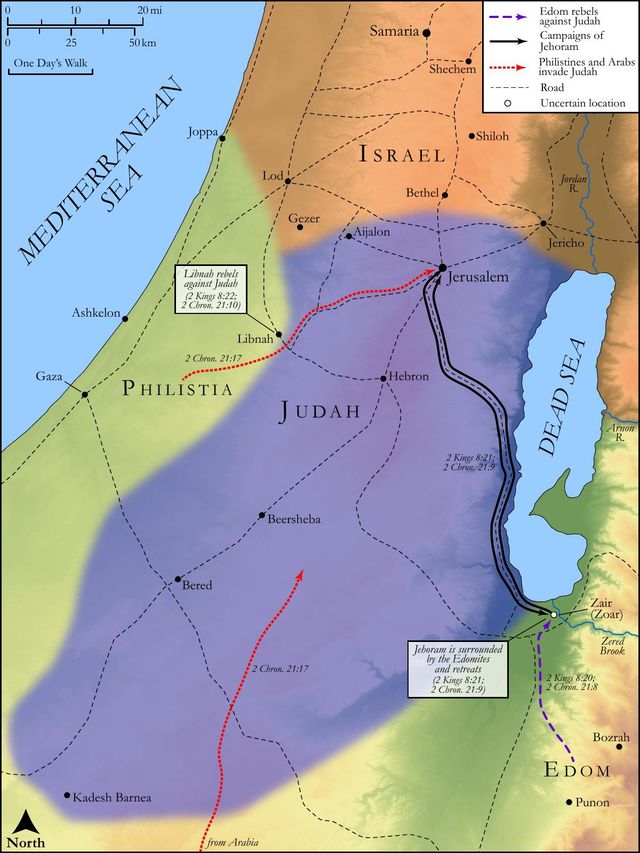
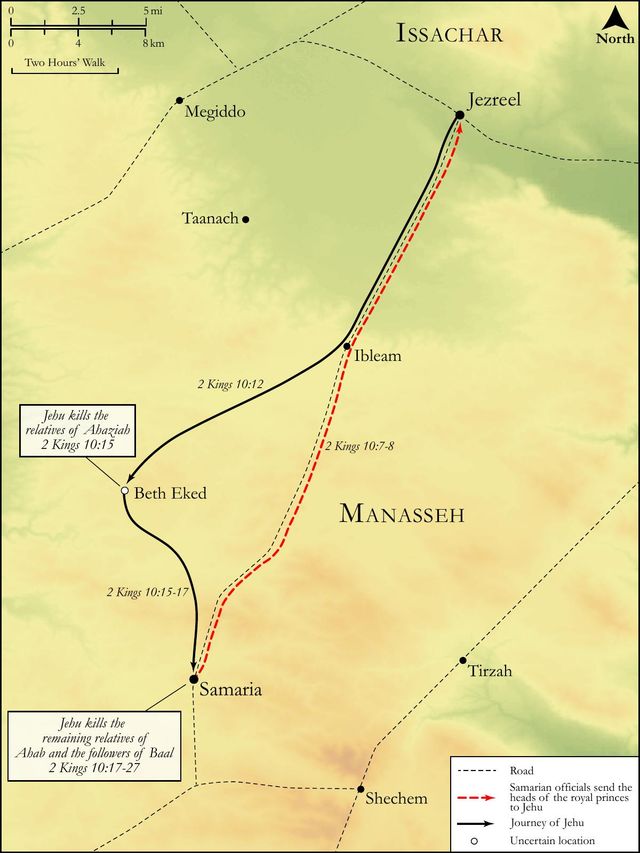
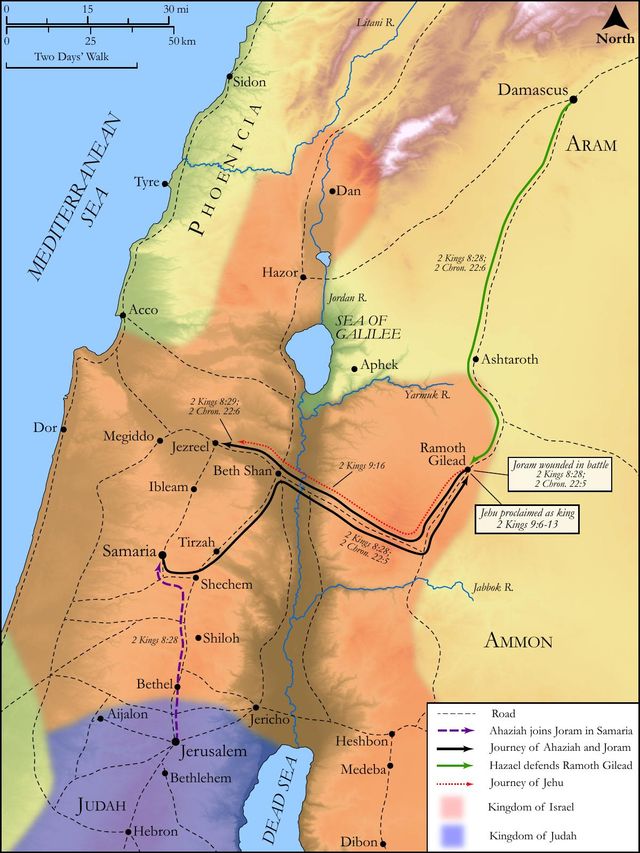
See on the biblical-era map
Study this verse
Public-domain commentary
Matthew Henry
From his Commentary on the Whole Bible. Henry comments on passages, not single verses — this entry covers 2 Kings 8:25–29.
As among common persons there are some that we call little men, who make no figure, are little regarded, as less valued, so among kings there are some whom, in comparison with others, we may call little kings. This Ahaziah was one of these; he looks mean in the history, and in God's account vile, because wicked. It is too plain an evidence of the affinity between Jehoshaphat and Ahab that they had the same names in their families at the same time, in which, we may suppose, they designed to compliment one another. Ahab had two sons, Ahaziah and Jehoram, who reigned successively; Jehoshaphat had a son and grandson names Jehoshaphat had a son and grandson names Jehoram and Ahaziah, who, in like manner, reigned successively. Names indeed do not make natures, but it was a bad omen to Jehoshaphat's family to borrow names from Ahab's; or, if he lent the names to that wretched family, he could not communicate with them the devotion of their significations, Ahaziah - Taking hold of the Lord, and Jehoram - The Lord exalted. Ahaziah king of Israel had reigned but two years, Ahaziah king of Judah reigned but one. We are here told that his relation to Ahab's family was the occasion, 1. Of his wickedness (Kg2 8:27): He walked in the way of the house of Ahab, that idolatrous bloody house; for his mother was Ahab's daughter (Kg2 8:26), so that he sucked in wickedness with his milk. Partus sequitur ventrem - The child may be expected to resemble the mother. When men choose wives for themselves they must remember they are choosing mothers for their children, and are concerned to choose accordingly. 2. Of his fall. Joram, his mother's brother, courted him to join with him for the recovery of Ramoth-Gilead, an attempt fatal to Ahab; so it was to Joram his son, for in that expedition he was wounded (Kg2 8:28), and returned to Jezreel to be cured, leaving his army there in possession of the place. Ahaziah likewise returned, but went to Jezreel to see how Jehoram did, Kg2 8:29. Providence so ordered it, that he who had been debauched by the house of Ahab might be cut off with them, when the measure of their iniquity was full, as we shall find in the next chapter. Those who partake with sinners in their sins must expect to partake with them in their plagues.
Historical interpretation
Historical reception
1 surviving comment on this verse from the historical church.
Daughter: That is, grand-daughter; for she was daughter of Achab son of Amri, ver. 18.
Continue studying 2 Kings 8:26 across the web’s major study libraries — every link below opens this exact verse, chapter, or book on the destination site.
Read & Compare
 BibleGatewayThis verse in more than 200 translations and 70 languages.
 Bible.comThe YouVersion reader — hundreds of translations, reading plans, and highlights.
 ESV.orgCrossway's official English Standard Version reader.
 NET BibleThe NET translation with 60,000+ translators' notes on every rendering decision.
 STEP BibleTyndale House's free study tool — original text, vocabulary, and scholarly resources.
 BibliaLogos Bible Software's free web reader.
 USCCBThe New American Bible (Revised Edition) with the U.S. bishops' study notes.
Commentaries
 BibleHub CommentariesDozens of classic commentaries on this verse, gathered on one page.
 StudyLightMore than 100 commentary sets — the largest collection on the web.
 BibleRefPlain-English commentary on what this verse means, verse by verse.
 Enduring WordDavid Guzik's free commentary on this chapter, widely used by Bible teachers.
 Bible Study ToolsVerse commentary alongside Greek and Hebrew study aids.
Original Language & Research
- BibleHub InterlinearThe verse word by word — original language, transliteration, and English.
- BibleHub LexiconEvery word's original-language definition and Strong's entry.
 Blue Letter BibleDeep-study tools — Strong's numbers, concordance, and word studies.
 SefariaThe Hebrew text with Rashi and centuries of Jewish commentary.
Sermons, Hymns & Audio


TrulyRandomVerse is not affiliated with these sites and doesn’t control their content. They’re linked because they’re genuinely useful.
Summary
2 Kings 8:26 introduces Ahaziah, the new king of Judah, by detailing his age at ascension (twenty-two), the brevity of his one-year reign in Jerusalem, and, most significantly, the identity of his mother, Athaliah, explicitly named as "the daughter of Omri king of Israel." This pivotal verse immediately signals a continued and deepening decline in the spiritual integrity of the Davidic line, directly attributing it to the pervasive and corrupting influence of the idolatrous Omride dynasty, which had infiltrated Judah's royal house through this unholy marriage, thereby foreshadowing the instability, apostasy, and divine judgment that would plague the kingdom.
Context
ShowHideLiterary Context
This verse immediately follows the account of Ahaziah's father, King Joram (or Jehoram) of Judah, whose reign was characterized by profound wickedness and a marked departure from the ways of the Lord. Joram's apostasy was largely attributed to his marriage to Athaliah, the very woman named in this verse, who was a daughter of Ahab and granddaughter of Omri. Ahaziah's ascension to the throne of Judah thus occurs within a narrative stream already deeply concerned with the spiritual decay of the Davidic monarchy, directly linking his brief and unrighteous rule to the corrupting influence that had infiltrated the royal house. The preceding chapters have meticulously documented the spiritual state of both the Northern Kingdom (Israel) and the Southern Kingdom (Judah), setting the stage for Ahaziah's reign as another tragic chapter in Judah's departure from God's covenant. The chronicler's emphasis on his mother's lineage serves to explain the source and nature of his wickedness, establishing a clear line of spiritual cause and effect.
Historical & Cultural Context
The mention of Athaliah as "the daughter of Omri king of Israel" is profoundly significant, even though she was biologically the daughter of Ahab, Omri's son. In biblical genealogies, "son" or "daughter" can often refer to a descendant, particularly when linking to a prominent ancestor or the founder of a powerful dynasty. Omri, and especially his son Ahab, were infamous for their aggressive promotion of Baal worship and other idolatries, leading Israel into deep spiritual apostasy. Omri established Samaria as the capital and solidified the Omride dynasty's power through strategic alliances, one of which was the marriage of his granddaughter Athaliah to Joram of Judah. This union, while politically expedient, proved spiritually catastrophic, directly introducing the corrupting influence of the Omride dynasty's pervasive idolatry into the Davidic line in Jerusalem. This diluted the spiritual integrity of Judah, setting a dangerous precedent for syncretism and idolatry that would have devastating consequences for Ahaziah's rule and the subsequent actions of his mother, Athaliah, after his death.
Key Themes
ShowHideAhaziah's reign of "one year in Jerusalem" prominently highlights the brevity and instability of unrighteous rule. Such short tenures often signify divine disfavor and judgment upon kings who depart from God's ways, contrasting sharply with the long, stable reigns promised to faithful Davidic monarchs. Furthermore, the explicit mention of Ahaziah's mother, Athaliah, and her connection to "Omri king of Israel" underscores the powerful and often negative influence of lineage and association. Athaliah served as a conduit for the pervasive idolatry and wickedness of the Omride dynasty, corrupting the Davidic kingdom from within, as further elaborated in 2 Chronicles 22:3, which explicitly states that Ahaziah "walked in the ways of the house of Ahab: for his mother was his counsellor to do wickedly." Finally, this verse illuminates the dire consequences of unholy alliances. The political marriage between the Davidic line (Judah) and the Omride line (Israel) was a strategic maneuver that proved spiritually disastrous, leading to the dilution of Judah's spiritual integrity and a period where kings actively embraced the idolatry of the Northern Kingdom, moving further away from the covenant God had made with David in 2 Samuel 7:16.
Exposition and Analysis
ShowHideKey Word Analysis
ShowHideMeaning "Jah has seized" or "Yahweh sustains." The name itself carries a profound irony when juxtaposed with Ahaziah's brief and wicked reign. Far from being sustained by divine favor, his rule was cut short, a testament to God's judgment on his unrighteousness. His life and reign were anything but a demonstration of Yahweh's sustaining power; rather, they illustrated the consequences of rejecting it, highlighting the tragic disconnect between his given name and his actual spiritual trajectory.
Meaning "Jah has constrained" or "Yahweh is exalted" or "Yahweh is strong." Athaliah's name stands in profound contrast to her actions. Her life was dedicated to promoting Baal worship, consolidating power through violence, and even attempting to eradicate the Davidic line, thereby actively diminishing the true God and His covenant promises. Her name serves as a tragic reminder of how individuals can betray the very essence of their identity in relation to God, seeking to exalt themselves and false deities rather than the Lord.
Meaning "heaping." While Athaliah was biologically the daughter of Ahab, Omri's son, the text's specific mention of Omri emphasizes his role as the founder of the most notorious and idolatrous dynasty in Israel's history. Omri established Samaria as the capital and initiated policies that deeply entrenched Baal worship, fostering a culture of apostasy. By linking Athaliah to Omri, the text highlights the foundational source of the spiritual corruption that she brought into Judah, underscoring the depth and pervasive nature of the apostasy that threatened the very existence of the Davidic covenant.
Verse Breakdown
ShowHide"Two and twenty years old [was] Ahaziah when he began to reign"
This detail establishes Ahaziah as a young king, yet his youth does not excuse his subsequent wickedness. His age at ascension is a factual marker, but in the context of biblical narratives, it often sets the stage for either a promising or a tragically misguided reign. In Ahaziah's case, it highlights the early onset of a rule defined by apostasy, indicating that his choices were not merely youthful indiscretions but a deliberate continuation of his father's unrighteous path.
"and he reigned one year in Jerusalem"
The brevity of Ahaziah's reign is a crucial detail. A one-year reign in the biblical narrative often signals instability, divine disfavor, and swift judgment upon a wicked ruler. It stands in stark contrast to the longer, more stable reigns of righteous kings and underscores the immediate consequences of his ungodly choices and the pervasive influence of his mother. This short tenure serves as a clear prophetic indicator of God's displeasure and the impending chaos that would engulf the kingdom.
"And his mother's name [was] Athaliah, the daughter of Omri king of Israel"
This clause is the theological linchpin of the verse. The explicit mention of Athaliah and her lineage connects Ahaziah directly to the infamous Omride dynasty, known for its profound idolatry and opposition to Yahweh. This familial connection explains the spiritual corruption that infiltrated the Davidic line, as Athaliah actively promoted Baal worship in Judah and later attempted to destroy the royal seed. The phrase "daughter of Omri" (instead of Ahab) serves as a powerful theological shorthand, emphasizing the deep-seated, dynastic nature of the wickedness that now directly impacted the covenant people of God, illustrating how the sins of the fathers (or grandfathers) can profoundly influence subsequent generations.
Literary Devices
ShowHideThe passage employs several potent literary devices to convey its message with theological weight. Irony is prominent in the names of both Ahaziah ("Yahweh sustains") and Athaliah ("Yahweh is exalted"), which stand in stark contrast to their actions that defied and dishonored Yahweh. This highlights the tragic disconnect between divine truth and human rebellion, serving as a bitter commentary on their lives. Foreshadowing is also evident; Ahaziah's brief, one-year reign immediately signals instability and divine judgment, hinting at the tumultuous events that will follow, particularly his death and Athaliah's subsequent usurpation of the throne and massacre of the royal seed. Furthermore, the explicit mention of Athaliah's lineage from the Omride dynasty serves as a powerful genealogical marker, immediately signaling the source of the spiritual contamination that has now permeated the Davidic line in Judah. This connection creates a dramatic juxtaposition between the covenant promises made to David and the present reality of a corrupted monarchy, emphasizing the profound spiritual danger posed by unholy alliances and the insidious nature of idolatry.
Theological and Thematic Connections
ShowHide2 Kings 8:26 serves as a stark reminder of the profound impact of leadership and association on the spiritual health of a nation. The brevity of Ahaziah's reign, coupled with the explicit mention of his mother's lineage, underscores the principle that divine judgment swiftly follows persistent unrighteousness, especially when those in authority lead their people astray. It highlights the corrupting power of ungodly influences and alliances, demonstrating how political expediency can lead to spiritual compromise and disastrous consequences. Despite the human failures and the apparent threat to the Davidic line, this verse implicitly points to God's enduring sovereignty, as He remains faithful to His covenant promises even amidst widespread apostasy, ultimately raising up instruments of judgment and preservation. The narrative emphasizes the critical importance of spiritual discernment in choosing partners and counselors, warning against the dilution of faith through compromise with idolatry and the devastating effects of a lack of spiritual integrity at the highest levels of leadership.
Reflection and Application
ShowHideThe brief and tragic reign of Ahaziah, overshadowed by the corrupting influence of his mother Athaliah and her Omride lineage, offers profound lessons for contemporary believers. It serves as a powerful reminder that our choices, particularly concerning the influences we permit into our lives and the alliances we form, have far-reaching spiritual consequences. Just as Athaliah brought the pervasive idolatry of Baal worship into the Davidic kingdom, we must be vigilant against ideologies, relationships, or cultural trends that compromise our commitment to God's truth. This passage challenges us to examine the "counselors" in our lives—whether people, media, or personal philosophies—and discern if they lead us closer to or further from God. For those in positions of leadership, whether in family, church, or community, Ahaziah's story underscores the immense responsibility to lead with integrity and righteousness, recognizing that our decisions impact not only ourselves but also those under our care. The fleeting nature of his reign also prompts us to consider the ultimate value of our pursuits, reminding us that worldly power and fleeting success are inconsequential compared to a life lived in faithful obedience to God and a pursuit of His eternal kingdom.
Questions for Reflection
ShowHideFAQ
ShowHideWhy is Athaliah called "daughter of Omri" when she was Ahab's daughter?
ShowHideThis is a common biblical idiom where "daughter" or "son" can refer to a descendant, not necessarily an immediate child, especially when referencing a prominent ancestor or the founder of a dynasty. Omri was the powerful and infamous founder of the Omride dynasty, which included Ahab and Jezebel. By linking Athaliah directly to Omri, the text emphasizes the deep-seated, pervasive nature of the spiritual corruption and idolatry (particularly Baal worship, which Omri's dynasty aggressively promoted) that she brought into the Davidic line in Judah. It's a theological statement highlighting the source of the wickedness and the dynastic nature of the apostasy, rather than a strict genealogical one. This is similar to how Jesus is called the "son of David" in Matthew 1:1, even though many generations separate them.
What was the significance of Ahaziah reigning for only one year?
ShowHideAhaziah's extremely brief reign of "one year" is highly significant in the biblical narrative. In the books of Kings and Chronicles, short reigns often serve as a clear indicator of divine disfavor and impending judgment upon a wicked ruler. It signifies instability, a lack of divine blessing, and God's swift removal of those who lead His people into apostasy. Unlike the long and prosperous reigns promised to faithful kings (e.g., 1 Kings 3:14), Ahaziah's short tenure underscores the immediate and severe consequences of his unrighteousness and the pervasive influence of his idolatrous mother, Athaliah. His swift death and the subsequent events (Athaliah's usurpation and massacre of the royal seed) further highlight the chaos and judgment that plagued Judah due to its departure from God's covenant.
Christ-Centered Fulfillment
ShowHideThe tragic account of Ahaziah, a king of Judah whose brief and wicked reign was marred by the corrupting influence of his Omride mother, Athaliah, stands in stark contrast to the ultimate King, Jesus Christ. While Ahaziah's name, "Yahweh has grasped," proved ironically empty in his life of spiritual rebellion, Jesus is truly the one whom Yahweh has grasped and sustained, perfectly fulfilling the Father's will and purpose. The Davidic line, though repeatedly corrupted by human sin and unholy alliances as seen in Ahaziah's lineage, was ultimately preserved by God's unwavering faithfulness to His covenant with David (2 Samuel 7:12-16). Jesus, born of the virgin Mary, is the true "son of David" (Matthew 1:1), the promised King whose kingdom is not of this world and will never end (John 18:36; Luke 1:32-33). Unlike Ahaziah, who reigned for a mere year and led his people further into idolatry, Christ's reign is eternal, righteous, and brings true spiritual integrity and deliverance from the very idolatry and sin that plagued Judah. He is the Lamb of God who takes away the sin of the world, reversing the curse of unholy alliances and establishing a perfect, incorruptible kingdom where Yahweh is truly exalted, fulfilling the ironic meaning of Athaliah's name through His own perfect life, atoning sacrifice, and glorious resurrection.