


2 Kings 8:28
Bible text: King James Version (1769 Blayney text) · Public domain
Bible text: Berean Standard Bible · Public domain
Bible text: American Standard Version (1901) · Public domain
Bible text: World English Bible, Messianic edition · Public domain
Bible text: Geneva Bible (1599) · Public domain
Bible text: Young's Literal Translation · Public domain
- וַיֵּלֶךְvai·Ye·lekhand he wentH1980Conj-w ¦ V-Qal-ConsecImperf-3msVerb Qal Consecutive Imperfect 3rd Singular Masculineוַandיֵּלֶךְhe went
- אֶת'etwithH854PrepPreposition
- יוֹרָםyo·RamJoramH3141N-proper-mNoun Proper Masculine
- בֶּןben[the] son ofH1121N-mscNoun Singular Masculine Construct
- אַחְאָב'ach·'AvAhabH256N-proper-mNoun Proper Masculine
- לַמִּלְחָמָהla·mil·cha·Mahfor <the> battleH4421Prep-l ¦ N-fsNoun Singular Feminine Absoluteלַfor <the>מִּלְחָמָהbattle
- עִם'imwithH5973PrepPreposition
- חֲזָהאֵלcha·za·h·'ElHazaelH2371N-proper-mNoun Proper Masculine
- מֶלֶךְMe·lekh[the] king ofH4428N-mscNoun Singular Masculine Construct
- אֲרָם'a·RamAramH758N-properNoun Proper Location
- בְּרָמֹתbe·ra·Motat RamothH7418Prep-b ¦ N-properNoun Proper LocationבְּatרָמֹתRamoth
- גִּלְעָדgil·'AdGileadH1568N-properNoun Proper Location
- וַיַּכּוּvai·ya·Kuand they woundedH5221Conj-w ¦ V-Hiphil-ConsecImperf-3mpVerb Hiphil Consecutive Imperfect 3rd Plural Masculineוַandיַּכּוּthey wounded
- אֲרַמִּים'a·ra·Mim[the] ArameansH761N-mpNoun Gentilic Plural Masculine Absolute
- אֶת'et<obj.>H853DirObjMParticle Object Indicator
- יוֹרָםyo·RamJoramH3141N-proper-mNoun Proper Masculine
English is a literal word-by-word gloss of the Hebrew, not the KJV's wording. Why?
This is the original text the KJV's translators worked from — each Hebrew word with its own literal English meaning in this verse, prepared by scholars at Tyndale House, Cambridge. The KJV translates whole sentences, not word by word, so its wording differs: one Hebrew word can become several English words, and the KJV may choose “the LORD” where the gloss reads “Yahweh”. Both are faithful — they answer different questions. For the KJV's own rendering, switch to the KJV text.
Details
See on the biblical-era maps
Study this verse
Public-domain commentary
Matthew Henry
From his Commentary on the Whole Bible. Henry comments on passages, not single verses — this entry covers 2 Kings 8:25–29.
As among common persons there are some that we call little men, who make no figure, are little regarded, as less valued, so among kings there are some whom, in comparison with others, we may call little kings. This Ahaziah was one of these; he looks mean in the history, and in God's account vile, because wicked. It is too plain an evidence of the affinity between Jehoshaphat and Ahab that they had the same names in their families at the same time, in which, we may suppose, they designed to compliment one another. Ahab had two sons, Ahaziah and Jehoram, who reigned successively; Jehoshaphat had a son and grandson names Jehoshaphat had a son and grandson names Jehoram and Ahaziah, who, in like manner, reigned successively. Names indeed do not make natures, but it was a bad omen to Jehoshaphat's family to borrow names from Ahab's; or, if he lent the names to that wretched family, he could not communicate with them the devotion of their significations, Ahaziah - Taking hold of the Lord, and Jehoram - The Lord exalted. Ahaziah king of Israel had reigned but two years, Ahaziah king of Judah reigned but one. We are here told that his relation to Ahab's family was the occasion, 1. Of his wickedness (Kg2 8:27): He walked in the way of the house of Ahab, that idolatrous bloody house; for his mother was Ahab's daughter (Kg2 8:26), so that he sucked in wickedness with his milk. Partus sequitur ventrem - The child may be expected to resemble the mother. When men choose wives for themselves they must remember they are choosing mothers for their children, and are concerned to choose accordingly. 2. Of his fall. Joram, his mother's brother, courted him to join with him for the recovery of Ramoth-Gilead, an attempt fatal to Ahab; so it was to Joram his son, for in that expedition he was wounded (Kg2 8:28), and returned to Jezreel to be cured, leaving his army there in possession of the place. Ahaziah likewise returned, but went to Jezreel to see how Jehoram did, Kg2 8:29. Providence so ordered it, that he who had been debauched by the house of Ahab might be cut off with them, when the measure of their iniquity was full, as we shall find in the next chapter. Those who partake with sinners in their sins must expect to partake with them in their plagues.
Continue studying 2 Kings 8:28 across the web’s major study libraries — every link below opens this exact verse, chapter, or book on the destination site.
Read & Compare
 BibleGatewayThis verse in more than 200 translations and 70 languages.
 Bible.comThe YouVersion reader — hundreds of translations, reading plans, and highlights.
 ESV.orgCrossway's official English Standard Version reader.
 NET BibleThe NET translation with 60,000+ translators' notes on every rendering decision.
 STEP BibleTyndale House's free study tool — original text, vocabulary, and scholarly resources.
 BibliaLogos Bible Software's free web reader.
 USCCBThe New American Bible (Revised Edition) with the U.S. bishops' study notes.
Commentaries
 BibleHub CommentariesDozens of classic commentaries on this verse, gathered on one page.
 StudyLightMore than 100 commentary sets — the largest collection on the web.
 BibleRefPlain-English commentary on what this verse means, verse by verse.
 Enduring WordDavid Guzik's free commentary on this chapter, widely used by Bible teachers.
 Bible Study ToolsVerse commentary alongside Greek and Hebrew study aids.
Original Language & Research
- BibleHub InterlinearThe verse word by word — original language, transliteration, and English.
- BibleHub LexiconEvery word's original-language definition and Strong's entry.
 Blue Letter BibleDeep-study tools — Strong's numbers, concordance, and word studies.
 SefariaThe Hebrew text with Rashi and centuries of Jewish commentary.
Sermons, Hymns & Audio


TrulyRandomVerse is not affiliated with these sites and doesn’t control their content. They’re linked because they’re genuinely useful.
Summary
This verse presents a pivotal moment in the history of the divided monarchy, detailing a joint military campaign by King Joram of Israel and King Ahaziah of Judah against Hazael, king of Syria, at Ramothgilead. The critical detail is Joram's wounding by the Syrians, an event that, though seemingly a casualty of war, serves as the direct catalyst for the dramatic and divinely orchestrated events that follow in 2 Kings, particularly the anointing of Jehu and the subsequent purge of the Omride dynasty, thereby fulfilling long-standing prophetic judgments.
Context
ShowHideLiterary Context
This verse immediately follows the account of Ahaziah's ascension to the throne of Judah in 2 Kings 8:25, establishing him as the "he" who accompanies Joram. Joram, the son of Ahab, had been king of Israel for twelve years, as introduced in 2 Kings 3:1. The narrative has just detailed the rise of Hazael, the new king of Syria, whose violent and oppressive reign was prophesied by Elisha in 2 Kings 8:13. Thus, the verse precisely situates the military engagement within a clear succession of events and prophetic pronouncements, leading directly into the dramatic anointing of Jehu and the subsequent purge of the Omride dynasty in 2 Kings 9, making Joram's injury the crucial trigger for these momentous developments.
Historical & Cultural Context
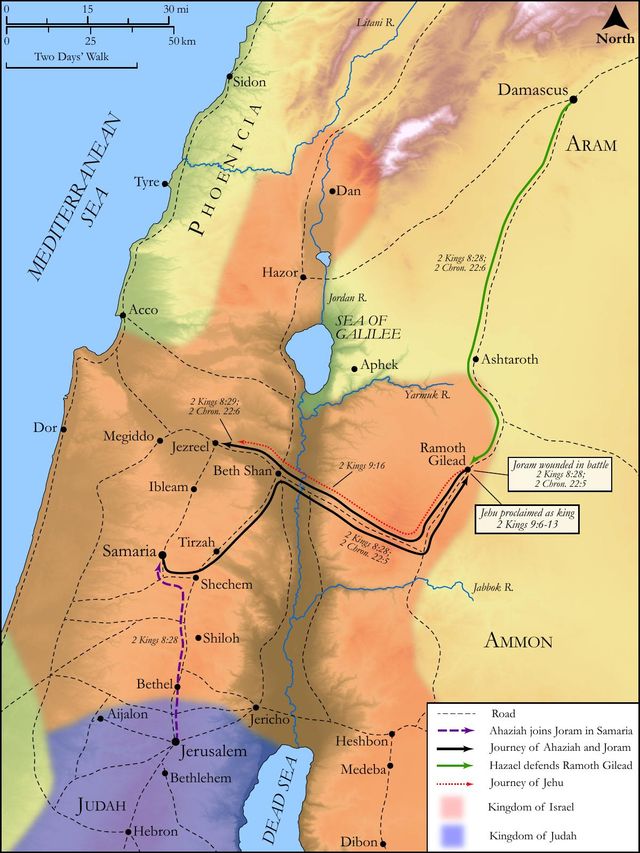
In those days Israel, Aram and the nations round about were frequently at war, with shifting alliances and constant struggles for dominance. Ramothgilead, located strategically east of the Jordan River in the region of Gilead, was a vital fortress city that frequently changed hands between Israel and Aram (Syria). Its control was crucial for trade routes and defensive purposes, making it a persistent point of contention. Notably, this was the same city where Joram's father, King Ahab, had been mortally wounded in an earlier attempt to reclaim it from the Arameans, as recorded in 1 Kings 22:34. The alliance between Israel and Judah, though sometimes strained by ideological and political differences, was a common strategy against formidable external threats like Aram. Joram's wounding reflects the brutal reality of ancient warfare, where kings often led their armies into battle and faced direct personal risk.
Key Themes
ShowHideThe verse contributes significantly to several overarching themes within 2 Kings. Firstly, it underscores the ongoing conflict between Israel and Aram, a persistent geopolitical struggle that shaped much of the northern kingdom's history. Secondly, it highlights the complex and often costly inter-kingdom alliances between Israel and Judah, demonstrating their occasional unity against common enemies despite their deep-seated divisions. Thirdly, and most critically, Joram's injury serves as a direct catalyst for the fulfillment of divine prophecy and judgment against the house of Ahab. This seemingly random battlefield incident is presented as instrumental in setting the stage for Jehu's violent purge, which God had ordained through Elijah and Elisha to eradicate the idolatrous Omride dynasty, as foretold in 1 Kings 21:21-24. Thus, the verse subtly points to God's sovereign hand working through human events to achieve His purposes.
Exposition and Analysis
ShowHideKey Word Analysis
ShowHideThis name, meaning "Joram," is a form of "Jehoram," which means "Yahweh is exalted" or "Yahweh is high." This name carries a poignant irony given Joram's fate and the subsequent divine judgment against his house. Despite his name connecting him to Yahweh, he largely continued the idolatrous practices of his father, Ahab, and mother, Jezebel, though he did remove the pillar of Baal (2 Kings 3:2). His wounding and subsequent death are part of Yahweh's judgment against his family line.
Meaning "God has seen." Hazael was a significant figure in the unfolding of God's plan, specifically prophesied by Elisha to become king of Aram and to be a scourge against Israel (2 Kings 8:12-13). His rise to power and subsequent military actions, including wounding Joram, are presented as instruments in God's hand to bring about judgment on Israel and the Omride dynasty.
This name, derived from "heights of Gilead," refers to a specific place East of the Jordan, a strategically vital military outpost. Its repeated appearance in the narrative (e.g., 1 Kings 22) underscores its geopolitical importance and its role as a recurring site of conflict and, tragically, of royal demise. The term "Gilead" (H1568, Gilʻâd) refers to the region itself.
Verse Breakdown
ShowHide"And he went with Joram the son of Ahab"
The "he" refers to Ahaziah, king of Judah, who had just begun his reign, as established in 2 Kings 8:25. This highlights the continued alliance between the northern and southern kingdoms, often necessitated by external threats. Joram, the king of Israel, was Ahaziah's uncle (Joram's sister Athaliah was Ahaziah's mother), reinforcing the dynastic ties that underpinned this military cooperation. The phrase "son of Ahab" (H1121, bên, meaning "son," and H256, ʼAchʼâb, referring to Ahab) identifies Joram's lineage, which is crucial for understanding the prophetic judgment soon to be executed upon his house.
"to the war against Hazael king of Syria in Ramothgilead;"
This clause specifies the objective of the campaign: to reclaim or defend Ramothgilead (H7433, Rāmōṯ Gilʿāḏ) from Hazael (H2371, Chăzâʼêl), the newly crowned and aggressive king of Aram (H758, ʼĂrâm). The location is significant, as it was the site of King Ahab's death, indicating a persistent strategic importance and a long-standing point of contention between Israel and Aram. The mention of Hazael, whose violent future was recently prophesied by Elisha, subtly reminds the reader of divine foresight at play. The term "war" (H4421, milchâmâh) denotes the battle or engagement.
"and the Syrians wounded Joram."
This is the pivotal detail of the verse. Joram's injury (H5221, nâkâh, "to strike" or "wound") is not merely a casualty of war but the direct catalyst for the events of 2 Kings 9. His retreat to Jezreel for recovery creates the opportunity for Elisha to send a prophet to anoint Jehu, setting in motion the violent overthrow of the Omride dynasty. This seemingly minor event is thus imbued with immense narrative and theological weight, demonstrating how God can use even adverse circumstances to advance His sovereign plan. The "Syrians" (H761, ʼĂrammîy) are the people of Aram.
Literary Devices
ShowHideThe verse, though brief, employs several significant literary devices. Foreshadowing is prominent, as Joram's wounding directly sets the stage for the dramatic events of 2 Kings 9, where Jehu is anointed and subsequently executes judgment upon the house of Ahab. The injury is the necessary precursor to Joram's return to Jezreel, creating the precise conditions for the prophetic commission of Jehu. There is also a subtle irony at play: Joram, the son of Ahab, is wounded at Ramothgilead, the very place where his father met his death (1 Kings 22:34), underscoring the cyclical nature of conflict and the persistent vulnerability of Israel's kings. The brevity and conciseness of the verse are also literary choices, as the author delivers a crucial piece of information with maximum efficiency, allowing the reader to immediately grasp its significance as a turning point without unnecessary elaboration.
Theological and Thematic Connections
ShowHideThis seemingly simple historical report carries profound theological weight, primarily serving as a critical link in the unfolding of God's judgment against the house of Ahab. Joram's wounding at Ramothgilead is not a random casualty of war but a divinely permitted event that creates the necessary conditions for the fulfillment of the prophecies delivered by Elijah and Elisha concerning the eradication of the Omride dynasty. It underscores God's absolute sovereignty over human events, even military conflicts and personal injuries, demonstrating His ability to orchestrate circumstances to bring about His righteous purposes. This incident reminds us that even within the chaos of human history and political maneuvering, God's overarching plan for justice and redemption continues to advance.
Reflection and Application
ShowHideThe brief account of Joram's wounding in battle, while a historical detail, offers a profound spiritual lesson about the interconnectedness of events and the sovereign hand of God. It reminds us that even seemingly minor or unfortunate occurrences in our lives can be part of a larger, divinely orchestrated narrative, leading to significant shifts and the fulfillment of God's purposes. Just as Joram's injury set the stage for a major turning point in Israel's history, our own setbacks, challenges, or unexpected detours may be precisely what God uses to position us for His next move, to reveal His will, or to bring about a necessary change. This perspective cultivates a deeper trust in God's wisdom and control, even when circumstances are painful or confusing, encouraging us to look beyond immediate events to discern God's overarching design and to find peace in His unfailing providence.
Questions for Reflection
ShowHideFAQ
ShowHideWhy was Ramothgilead so important that kings repeatedly fought over it?
ShowHideRamothgilead was a strategically vital city located in the Transjordan region, specifically in Gilead. Its importance stemmed from its position on key trade routes and its role as a defensive buffer between Israel and its eastern neighbors, particularly Aram (Syria). Control of Ramothgilead meant control over significant economic and military access points. Its strategic value made it a frequent flashpoint in the ongoing conflicts between Israel and Aram, as evidenced by King Ahab's fatal campaign there in 1 Kings 22 and Joram's subsequent attempt to reclaim it.
Who was Hazael, and why was he involved in this conflict?
ShowHideHazael was the king of Aram (Syria), who rose to power through a violent coup, as prophesied by Elisha in 2 Kings 8:12-15. Elisha had foretold that Hazael would be a severe oppressor of Israel, inflicting great harm upon them. His involvement in the conflict at Ramothgilead was a direct fulfillment of this prophecy, as he became a divinely appointed instrument of judgment against Israel, particularly against the idolatrous Omride dynasty. His reign marked a period of significant Aramean dominance over Israel.
How does Joram's injury in this verse connect to later, more significant events in 2 Kings?
ShowHideJoram's injury is the direct catalyst for the dramatic events that unfold in 2 Kings 9. Because he was wounded, Joram returned to Jezreel to recover (2 Kings 9:15). This provided the opportune moment for Elisha to send one of the sons of the prophets to anoint Jehu, a military commander, as king over Israel, with the specific divine commission to utterly destroy the house of Ahab. Thus, Joram's injury, seemingly a minor battlefield incident, was a crucial step in God's sovereign plan to bring about judgment and a change of dynasty in Israel, fulfilling earlier prophecies against Ahab's idolatrous lineage (1 Kings 21:21-24).
Christ-Centered Fulfillment
ShowHideThe seemingly mundane detail of a king being wounded in battle in 2 Kings 8:28 subtly points to the profound truth of divine sovereignty over human history, a truth that finds its ultimate and most glorious fulfillment in Jesus Christ. Just as Joram's injury was not a random occurrence but a divinely permitted event that set in motion the fulfillment of prophecy and the judgment of an unrighteous dynasty, so too the suffering and death of Jesus were not accidental but part of God's eternal, redemptive plan, "delivered up according to the definite plan and foreknowledge of God" (Acts 2:23). The Old Testament kings, like Joram, were flawed and often failed to lead their people righteously, necessitating divine intervention and judgment. In contrast, Christ is the perfect King, whose suffering was not a consequence of His own sin but a substitutionary sacrifice for the sins of His people (Isaiah 53:5). While Joram's wounding led to a violent and imperfect transfer of power, Christ's suffering and resurrection inaugurated a new, eternal kingdom of peace and righteousness (Colossians 1:13-14). The Old Testament narrative of God working through human events, even those marked by conflict and pain, to bring about His purposes, culminates in the cross, where the ultimate victory over sin and death was achieved through the "Lamb of God, who takes away the sin of the world!" (John 1:29).