


1 Kings 19:17
Bible text: King James Version (1769 Blayney text) · Public domain
Bible text: Berean Standard Bible · Public domain
Bible text: American Standard Version (1901) · Public domain
Bible text: World English Bible, Messianic edition · Public domain
Bible text: Geneva Bible (1599) · Public domain
Bible text: Young's Literal Translation · Public domain
- וְהָיָהve·ha·Yahand it will beH1961Conj-w ¦ V-Qal-ConsecPerf-3msVerb Qal Consecutive Perfect 3rd Singular Masculineוְandהָיָהit will be
- הַנִּמְלָטha·nim·Latthe [one who] escapesH4422Art ¦ V-Niphal-Prtcpl-msVerb Niphal Participle Singular Masculine Absoluteהַtheנִּמְלָט[one who] escapes
- מֵחֶרֶבme·Che·revfrom [the] sword ofH2719Prep-m ¦ N-fscNoun Singular Feminine Constructמֵfromחֶרֶב[the] sword of
- חֲזָאֵלcha·za·'ElHazaelH2371N-proper-mNoun Proper Masculine
- יָמִיתya·Mithe will put to deathH4191V-Hiphil-Imperf-3msVerb Hiphil Imperfect 3rd Singular Masculine
- יֵהוּאye·Hu'JehuH3058N-proper-mNoun Proper Masculine
- וְהַנִּמְלָטve·ha·nim·Latand the [one who] escapesH4422Conj-w ¦ Art ¦ V-Niphal-Prtcpl-msVerb Niphal Participle Singular Masculine Absoluteוְandהַtheנִּמְלָט[one who] escapes
- מֵחֶרֶבme·Che·revfrom [the] sword ofH2719Prep-m ¦ N-fscNoun Singular Feminine Constructמֵfromחֶרֶב[the] sword of
- יֵהוּאye·Hu'JehuH3058N-proper-mNoun Proper Masculine
- יָמִיתya·Mithe will put to deathH4191V-Hiphil-Imperf-3msVerb Hiphil Imperfect 3rd Singular Masculine
- אֱלִישָׁע'e·li·Sha'ElishaH477N-proper-mNoun Proper Masculine
English is a literal word-by-word gloss of the Hebrew, not the KJV's wording. Why?
This is the original text the KJV's translators worked from — each Hebrew word with its own literal English meaning in this verse, prepared by scholars at Tyndale House, Cambridge. The KJV translates whole sentences, not word by word, so its wording differs: one Hebrew word can become several English words, and the KJV may choose “the LORD” where the gloss reads “Yahweh”. Both are faithful — they answer different questions. For the KJV's own rendering, switch to the KJV text.
Details
See on the biblical-era maps

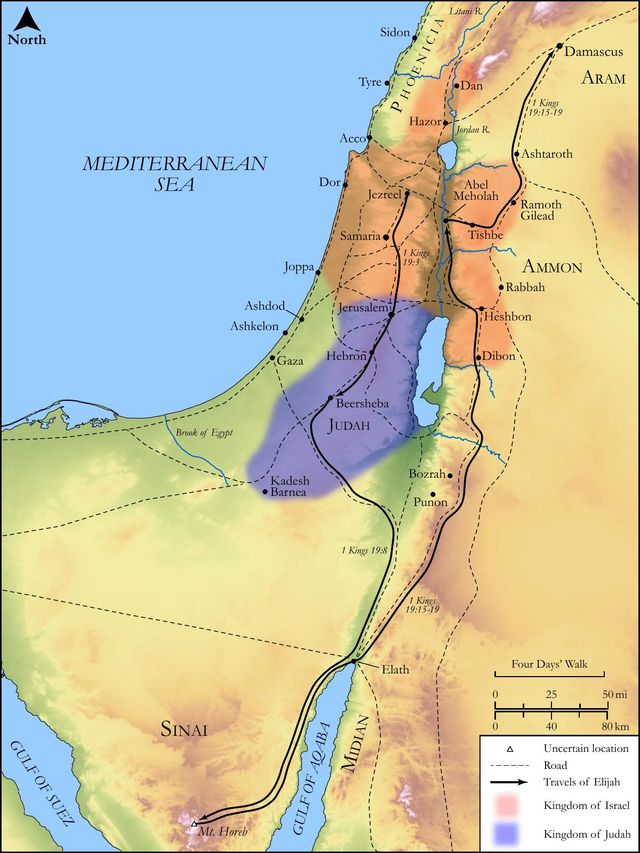
Study this verse
Public-domain commentary
Matthew Henry
From his Commentary on the Whole Bible. Henry comments on passages, not single verses — this entry covers 1 Kings 19:9–18. His four-level outline is real structure in the source text, so it is rendered as structure.
Here is, I. Elijah housed in a cave at Mount Horeb, which is called the mount of God, because on it God had formerly manifested his glory. And perhaps this was the same cave, or cleft of a rock, in which Moses was hidden when the Lord passed by before him and proclaimed his name, Exo 33:22. What Elijah proposed to himself in coming to lodge here, I cannot conceive, unless it was to indulge his melancholy, or to satisfy his curiosity and assist his faith and devotion with the sight of that famous place where the law was given and where so many great things were done, and hoping to meet with God himself there, where Moses met with him, or in token of his abandoning his people Israel, who hated to be reformed (in the latter case, it agrees with Jeremiah's wish, Jer 9:2, O that I had in the wilderness a lodging place of wayfaring men, that I might leave my people, and go from them, for they are all adulterers) and so it was a bad omen of God's forsaking them; or it was because the thought he could not be safe any where else, and to this instance of the hardships this good man was reduced to the apostle refers, Heb 11:38. They wandered in deserts and in mountains, and in dens and caves of the earth.
II.The visit God paid to him there and the enquiry he made concerning him:
The word of the Lord came to him. We cannot go any where to be out of the reach of God's eye, his arm, and his word. Whither can I flee from thy Spirit? Psa 139:7, etc. God will take care of his out-casts; and those who, for his sake, are driven out from among men, he will find, and own, and gather with everlasting loving-kindnesses. John saw the visions of the Almighty when he was in banishment in the isle of Patmos, Rev 1:9. The question God puts to the prophet it, What doest thou here, Elijah? Kg1 19:9, and again Kg1 19:13. This is a reproof,
1.For his fleeing hither. "What brings thee so far from home? Dost thou flee from Jezebel? Couldst thou not depend upon almighty power for thy protection?" Lay the emphasis upon the pronoun thou. "What thou! So great a man, so great a prophet, so famed for resolution - dost thou flee thy country, forsake thy colours thus?" This cowardice would have been more excusable in another, and not so bad an example. Should such a man as I flee? Neh 6:11. Howl, fir-trees, if the cedars be thus shaken.
2.For his fixing here. "What doest thou here, in this cave? Is this a place for a prophet of the Lord to lodge in? Is this a time for such men to retreat, when the public has such need of them?" In the retirement to which God sent Elijah (ch. 17) he was a blessing to a poor widow at Sarepta, but here he had no opportunity of doing good. Note, It concerns us often to enquire whether we be in our place and in the way of our duty. "Am I where I should be, whither God calls me, where my business lies, and where I may be useful?"
III.The account he gives of himself, in answer to the question put to him (Kg1 19:10), and repeated, in answer to the same question, Kg1 19:14.
1.He excuses his retreat, and desires it may not be imputed to his want of zeal for reformation, but to his despair of success. For God knew, and his own conscience witnessed for him, that as long as there was any hope of doing good he had been very jealous for the Lord God of Hosts; but now that he had laboured in vain, and all his endeavours were to no purpose, he thought it was time to give up the cause, and mourn for what he could not mend. Abi in cellam, et dic, Miserere mei - "Away to thy cell, and cry, Have compassion on me."
2.He complains of the people, their obstinacy in sin, and the height of impiety to which they had arrived: "The children of Israel have forsaken thy covenant, and that is the reason I have forsaken them; who can stay among them, to see every thing that is sacred ruined and run down?" This the apostle calls his making intercession against Israel, Rom 11:2, Rom 11:3. He had often been, of choice, their advocate, but now he is necessitated to be their accuser, before God. Thus Joh 5:45, There is one that accuseth you, even Moses, whom you trust. Those are truly miserable that have the testimony and prayers of God's prophets against them.
(1.)He charges them with having forsaken God's covenant; though they retained circumcision, that sign and seal of it, yet they had quitted his worship and service, which was the intention of it. Those who neglect God's ordinances, and let fall their communion with him, do really forsake his covenant, and break their league with him.
(2.)With having thrown down his altars, not only deserted them and suffered them to go to decay, but, in their zeal for the worship of Baal, wilfully demolished them. This alludes to the private altars which the prophets of the Lord had, and which good people attended, who could not go up to Jerusalem and would not worship the calves nor Baal. These separate altars, though breaking in upon the unity of the church, yet, being erected and attended by those that sincerely aimed at the glory of God and served him faithfully, the seeming schism was excused. God owned them for his altars, as well as that at Jerusalem, and the putting of them down is charged upon Israel as a crying sin. But this was not all.
(3.)They have slain thy prophets with the sword, who, it is probable, ministered at those altars. Jezebel, a foreigner, slew them (Kg1 18:4), but the crime is charged upon the body of the people because the generality of them were consenting to their death, and pleased with it.
3.He gives the reasons why he retired into this desert and took up his residence in this cave.
(1.)It was because he could not appear to any purpose: "I only am left, and have none to second or support me in any good design. They all said, The Lord he is God, but none of them would stand by me nor offer to shelter me. That point then gained was presently lost again, and Jezebel can do more to debauch them than I can to reform them. What can one do against thousands?" Despair of success hinders many a good enterprise. No one is willing to venture alone, forgetting that those are not alone who have God with them.
(2.)It was because he could not appear with any safety: "They seek my life to take it away; and I had better spend my life in a useless solitude than lose my life in a fruitless endeavour to reform those that hate to be reformed."
IV.God's manifestation of himself to him.
Did he come hither to meet with God? He shall find that God will not fail to give him the meeting. Moses was put into the cave when God's glory passed before him; but Elijah was called out of it: Stand upon the mount before the Lord, Kg1 19:11. He saw no manner of similitude, any more than Israel did when God talked to them in Horeb. But,
1.He heard a strong wind, and saw the terrible effects of it, for it rent the mountains and tore the rocks. Thus was the trumpet sounded before the Judge of heaven and earth, by his angels, whom he makes spirits, or winds (Psa 104:4), sounded so loud that the earth not only rang, but rent again.
2.He felt the shock of an earthquake.
3.He saw an eruption of fire, Kg1 19:12. These were to usher in the designed manifestation of the divine glory, angels being employed in them, whom he maketh a flame of fire, and who, as his ministers, march before him, to prepare in this desert a highway for our God. But,
4.At last he perceived a still small voice, in which the Lord was, that is, by which he spoke to him, and not out of the wind, or the earthquake, or the fire. Those struck an awe upon him, awakened his attention, and inspired humility and reverence; but God chose to make known his mind to him in whispers soft, not in those dreadful sounds. When he perceived this,
(1.)He wrapped hi face in his mantle, as one afraid to look upon the glory of God, and apprehensive that it would dazzle his eyes and overcome him. The angels cover their faces before God in token of reverence, Isa 6:2. Elijah hid his face in token of shame for having been such a coward as to flee from his duty when he had such a God of power to stand by him in it. The wind, and earthquake, and fire, did not make him cover his face, but the still voice did. Gracious souls are more affected by the tender mercies of the Lord than by his terrors.
(2.)He stood at the entrance of the cave, ready to hear what God had to say to him. This method of God's manifesting himself here at Mount Horeb seems to refer to the discoveries God formerly made of himself at this place to Moses.
[1.]Then there was a tempest, an earthquake, and fire (Heb 12:18); but, when God would show Moses his glory, he proclaimed his goodness; and so here: He was, the Word was, in the still small voice.
[2.]Then the law was thus given to Israel, with the appearances of terror first and then with a voice of words; and Elijah being now called to revive that law, especially the first two commandments of it, is here taught how to manage it; he must not only awaken and terrify the people with amazing signs, like the earthquake and fire, but he must endeavour, with a still small voice, to convince and persuade them, and not forsake them when he should be addressing them. Faith comes by hearing the word of God; miracles do but make way for it.
[3.]Then God spoke to his people with terror; but in the gospel of Christ, which was to be introduced by the spirit and power of Elias, he would speak by a still small voice, the dread of which should not make us afraid; see Heb 12:18, etc.
V.The orders God gives him to execute.
He repeats the question he had put to him before, "What doest thou here? This is not a place for thee now." Elijah gives the same answer (Kg1 19:14), complaining of Israel's apostasy from God and the ruin of religion among them. To this God gives him a reply. When he wished he might die (Kg1 19:4) God answered him not according to his folly, but was so far from letting him die that he not only kept him alive then but provided that he should never die, but be translated. But when he complained of his discouragement (and whither should God's prophets go with their complaints of that kind but to their Master?) God gave him an answer. He sends him back with directions to appoint Hazael king of Syria (Kg1 19:15), Jehu king of Israel, and Elisha his successor in the eminency of the prophetical office (Kg1 19:16), which is intended as a prediction that by these God would chastise the degenerate Israelites, plead his own cause among them, and avenge the quarrel of his covenant, Kg1 19:17. Elijah complained that the wickedness of Israel was unpunished. The judgment of famine was too gentle, and had not reclaimed them; it was removed before they were reformed: "I have been jealous," says he, "for God's name, but he himself has not appeared jealous for it." "Well," says God, "be content; it is all in good time; judgments are prepared for those scorners, though they are not yet inflicted; the persons are pitched upon, and shall now be nominated, for they are now in being, who shall do the business." 1. "When Hazael comes to be king of Syria, he shall make bloody work among the people (Kg2 8:12) and so correct them for their idolatry." 2. "When Jehu comes to be king of Israel he shall make bloody work with the royal family, and shall utterly destroy the house of Ahab, that set up and maintained idolatry." 3. "Elisha, while thou art on earth, shall strengthen thy hands; and, when thou art gone, shall carry on thy work, and be a remaining witness against the apostasy of Israel, and even he shall slay the children of Bethel, that idolatrous city." Note, The wicked are reserved to judgment. Evil pursues sinners, and there is no escaping it; to attempt an escape is but to run from one sword's point upon another. See Jer 48:44, He that flees from the fear shall fall into the pit; and he that gets up out of the pit shall be taken in the snare. Elisha, with the sword of the Spirit, shall terrify and wound the consciences of those who escape Hazael's sword of war and Jehu's sword of justice. With the breath of his lips shall he slay the wicked, Isa 11:4; Th2 2:8; Hos 6:5. It is a great comfort to good men and good ministers to think that God will never want instruments to do his work in his time, but, when they are gone, others shall be raised up to carry it on.
VI.The comfortable information God gives him of the number of Israelites who retained their integrity, though he thought he was left alone (Kg1 19:18): I have left 7000 in Israel (besides Judea) who have not bowed the knee to Baal. Note,
1.In times of the greatest degeneracy and apostasy God has always had, and will have, a remnant faithful to him, some that keep their integrity and do not go down the stream. The apostle mentions this answer of God to Elijah (Rom 11:4) and applies it to his own day, when the Jews generally rejected the gospel. Yet, says he, at this time also there is a remnant, Kg1 19:5.
2.It is God's work to preserve that remnant, and distinguish them from the rest, for without his grace they could not have distinguished themselves: I have left me; it is therefore said to be a remnant according to the election of grace.
3.It is but a little remnant, in comparison with the degenerate race; what are 7000 to the thousands of Israel? Yet, when those of every age come together, they will be found many more, 12,000 sealed out of each tribe, Rev 7:4.
4.God's faithful ones are often his hidden ones (Psa 83:3), and the visible church is scarcely visible, the wheat lost in the chaff and the gold in the dross, till the sifting, refining, separating day comes.
5.The Lord knows those that are his, though we do not; he sees in secret.
6.There are more good people in the world than some wise and holy men think there are. Their jealousy of themselves, and for God, makes them think the corruption is universal; but God sees not as they do. When we come to heaven, as we shall miss a great many whom we thought to meet there, so we shall meet a great many whom we little thought to find there. God's love often proves larger than man's charity and more extensive.
Historical interpretation
Seventeen Centuries of Reception
3 surviving comments on this verse. Each one is dated, so this reads as a timeline rather than a list.
Select a marker to jump to its quote. Markers stagger vertically where authors wrote within a few decades of each other.
I say then, Hath God cast away his people? God forbid. For I also am an Israelite, of the seed of Abraham, of the tribe of Benjamin. God hath not cast away his people which he foreknew. Wot ye not what the scripture saith of Elias? how he maketh intercession to God against Israel, saying, Lord, they have killed thy prophets, and digged down thine altars; and I am left alone, and they seek my life. But what saith the answer of God unto him? I have reserved to myself seven thousand men, who have not bowed the knee to the image of Baal. [1 Kings 19:10-18] Even so then at this present time also there is a remnant according to the election of grace.
“Go, return on your way to the wilderness of Damascus; when you arrive, you shall anoint Hazael as king over Aram.” As I have already said, “the sound of a sweet word” which comes after the storm and the fire divulged this good news. And what follows this manifestation fits perfectly with this context: Elijah, who had so far fled from Jezebel the queen, is now sent to anoint the kings and to hallow the prophets. And he anoints Hazael as king of Aram with his word; Jehu, son of Namsi, as king of Israel, judge of Ahab and avenger of innocent blood with oil; and Elisha [as prophet] with his mantle. Now, since the Lord had decided that those who had been condemned by Elijah because of their rebellion should receive the just retribution for their iniquity, their condemnation was prepared in this way: a part of the people would be punished by Hazael, king of Aram, whereas Ahab and Jezebel would receive their condemnation from Jehu; finally, if anything had been overlooked by them, Elisha would accomplish the task through the authority that the Lord had given him. And the people truly deserved punishment for not turning from their error. Even after learning the truth through the great and obvious signs that Elijah had performed, they did not abandon the worship of Baal. Also the sins of Ahab and Jezebel were great, well known and evident, and both of them had to be harshly punished for that reason. And since Jezebel had appointed new priests of Baal, her god, in order to replace those who had been killed by Elijah, it was necessary that they received the same punishment as their predecessors.In addition, other reasons obliged Elijah to raise Elisha to the dignity of prophet exactly at that time when he was about to leave this world: first, in order to assist him in the time of affliction; second, in order to confirm through his word the event of the kidnapping of his master and his ascension to heaven because nobody had ever heard anything like that before. Therefore [Elijah elevated Elisha to the dignity of prophet] in order to cut short the lies of the priests of Baal who could not commend the works of Elijah, their persecutor, and tried with all their might to persuade the people with false words that the disciples of Elijah had entirely invented the kidnapping of their master and pretended that God had raised him to heaven.
Shall be slain by Eliseus: Eliseus did not kill any of the idolaters with the material sword: but he is here joined with Hazael and Jehu, the great instruments of God in punishing the idolatry of Israel, because he foretold to the former his exaltation to the kingdom of Syria, and the vengeance he would execute against Israel, and anointed the latter by one of his disciples to be king of Israel, with commission to extirpate the house of Achab.
Continue studying 1 Kings 19:17 across the web’s major study libraries — every link below opens this exact verse, chapter, or book on the destination site.
Read & Compare
 BibleGatewayThis verse in more than 200 translations and 70 languages.
 Bible.comThe YouVersion reader — hundreds of translations, reading plans, and highlights.
 ESV.orgCrossway's official English Standard Version reader.
 NET BibleThe NET translation with 60,000+ translators' notes on every rendering decision.
 STEP BibleTyndale House's free study tool — original text, vocabulary, and scholarly resources.
 BibliaLogos Bible Software's free web reader.
 USCCBThe New American Bible (Revised Edition) with the U.S. bishops' study notes.
Commentaries
 BibleHub CommentariesDozens of classic commentaries on this verse, gathered on one page.
 StudyLightMore than 100 commentary sets — the largest collection on the web.
 BibleRefPlain-English commentary on what this verse means, verse by verse.
 Enduring WordDavid Guzik's free commentary on this chapter, widely used by Bible teachers.
 Bible Study ToolsVerse commentary alongside Greek and Hebrew study aids.
Original Language & Research
- BibleHub InterlinearThe verse word by word — original language, transliteration, and English.
- BibleHub LexiconEvery word's original-language definition and Strong's entry.
 Blue Letter BibleDeep-study tools — Strong's numbers, concordance, and word studies.
 SefariaThe Hebrew text with Rashi and centuries of Jewish commentary.
Sermons, Hymns & Audio


TrulyRandomVerse is not affiliated with these sites and doesn’t control their content. They’re linked because they’re genuinely useful.
Summary
1 Kings 19:17 reveals a critical aspect of God's sovereign plan for judgment against the apostate Northern Kingdom of Israel, particularly the idolatrous house of Ahab and the pervasive worship of Baal. This verse, delivered to Elijah on Mount Horeb as part of his recommissioning, outlines a divinely orchestrated sequence of inescapable judgment, where successive instruments—Hazael, Jehu, and Elisha—would ensure that none of those marked for divine wrath would ultimately evade the comprehensive consequences of Israel's persistent rebellion and unfaithfulness to the Lord.
Context
ShowHideLiterary Context
This verse is a pivotal moment in the narrative of Elijah, occurring immediately after his deeply personal encounter with God on Mount Horeb. Following his dramatic victory over the prophets of Baal on Mount Carmel, which culminated in their slaughter, Elijah fled into the wilderness in despair due to Jezebel's threats against his life. At Mount Horeb, God revealed Himself to Elijah not in the powerful wind, earthquake, or fire, but in a "still small voice" or "whisper" (1 Kings 19:11-12). This profound encounter served to recommission Elijah, reminding him that God's work was far from over and that He had preserved a faithful remnant. The Lord then issued specific, strategic instructions to Elijah: to anoint Hazael as king of Aram (Syria), Jehu as king of Israel, and Elisha as his own prophetic successor (1 Kings 19:15-16). Verse 17 elaborates on the precise, successive layers of divine judgment that these three individuals would execute, underscoring the thorough and inescapable nature of God's impending justice against the pervasive idolatry and unfaithfulness of the nation.
Historical & Cultural Context
The mid-9th century BC, during the reign of King Ahab and Queen Jezebel in the Northern Kingdom of Israel, marked a period of severe spiritual decline and national apostasy. Jezebel, a Phoenician princess, aggressively promoted the worship of Baal and Asherah, leading to widespread religious syncretism, persecution of Yahweh's prophets (1 Kings 18:4), and direct violation of the foundational covenant commands given at Sinai (Exodus 20:3-5). The political landscape was also volatile; Aram (Syria) was a frequent and powerful adversary of Israel, and internal stability was often threatened by a succession of short-lived dynasties. God's choice to use both an external enemy (Hazael) and an internal usurper (Jehu) as instruments of judgment reflects Scripture's own testimony that the LORD rules in the affairs of nations, where political upheavals, military defeats, and changes in leadership are divine punishment or reward, as in the blessings and curses Moses set before Israel. The role of the prophet, exemplified by Elijah and Elisha, was crucial in this context, acting as God's direct messenger, challenging kings, and declaring divine decrees that shaped the destiny of the nation.
Key Themes
ShowHideThe overarching theme in 1 Kings 19:17 is the Divine Sovereignty and Inescapable Justice of God. This verse powerfully demonstrates God's absolute control over nations and individuals, even utilizing foreign kings and internal usurpers to execute His righteous judgment against sin, particularly the pervasive idolatry of Baal worship that had gripped Israel. It highlights the severe Consequence of Persistent Apostasy, illustrating that while God is long-suffering, Israel's continued turning away from Him to false gods under the leadership of Ahab and Jezebel would inevitably lead to devastating divine punishment. The sequential nature of the judgment—from Hazael's external aggression to Jehu's internal purge and Elisha's prophetic pronouncements—emphasizes the thoroughness and inescapable nature of God's justice, ensuring that none would evade His decree. Furthermore, the inclusion of Elisha underscores the Enduring Role of Prophetic Authority and Succession in God's plan. Prophets were not merely speakers of God's word but active instruments of His will, both in declaring judgment and in leading the faithful remnant, as seen in the broader context of Elijah's recommissioning and the promise of a preserved remnant (1 Kings 19:18).
Exposition and Analysis
ShowHideKey Word Analysis
ShowHideDerived from H4422, this primitive root means "to be smooth," and by implication, "to escape (as if by slipperiness)," or "to release or rescue." Its repetition in the verse ("him that escapeth... shall Jehu slay: and him that escapeth... shall Elisha slay") creates a powerful sense of an attempted but ultimately futile evasion. It emphasizes the comprehensive and inescapable nature of God's judgment; no matter how one tries to flee or survive one wave of divine wrath, another instrument is poised to complete the task. This highlights God's meticulous and relentless pursuit of justice against persistent rebellion.
This word refers to a "cutting instrument," specifically a "sword," "knife," or "dagger." In the context of Hazael and Jehu, "sword" literally denotes the military and violent means by which they would execute God's judgment. It represents the physical devastation and bloodshed they would bring upon Israel. The repetition underscores the consistent and brutal nature of the initial two phases of divine retribution.
A primitive root meaning "to die (literally or figuratively)," and causatively, "to kill" or "to put to death." When applied to Hazael and Jehu, it refers to literal, violent death. However, its application to Elisha is distinct. While Hazael and Jehu wielded physical weapons, Elisha's "slaying" would be through prophetic pronouncement, divine intervention, or the consequences of his word, leading to death or severe judgment. This distinction underscores the multifaceted ways God executes His judgment, not solely through military might but also through the powerful word and spiritual authority of His prophets.
Verse Breakdown
ShowHide"And it shall come to pass, [that] him that escapeth the sword of Hazael shall Jehu slay"
This clause initiates the divine chain of judgment, revealing God's preordained plan. Hazael, the future king of Aram (Syria), would be God's instrument of external aggression against Israel, bringing war, devastation, and death upon the nation. This was fulfilled in Hazael's brutal campaigns against Israel, where he "cut off parts of Israel" and oppressed them (2 Kings 8:12-13; 2 Kings 10:32). The phrase indicates that any Israelite who miraculously survived Hazael's military onslaught would then face the judgment executed by Jehu. This highlights the comprehensive nature of God's justice, ensuring no one escapes the first wave of His decreed wrath.
"and him that escapeth from the sword of Jehu shall Elisha slay."
This second clause completes the sequence, emphasizing the utter inescapability of God's judgment. Jehu, anointed king by a prophet from Elisha's company, was commissioned to violently purge the house of Ahab and eradicate Baal worship from Israel (2 Kings 9:7-10; 2 Kings 10:11). His "sword" refers to his literal, bloody purge of the royal family, Baal worshippers, and all associated with Ahab's idolatry. The final phrase, "shall Elisha slay," signifies that even those who might somehow escape both the external and internal military purges would still face divine judgment through the prophetic word and actions of Elisha. Elisha's "slaying" was not with a physical sword but through divine curses, pronouncements of judgment, or miraculous interventions that led to death or severe consequences, such as the fate of the youths who mocked him (2 Kings 2:24) or Gehazi's leprosy (2 Kings 5:27). This layered judgment underscores God's absolute determination to bring justice against the deep-seated apostasy of Israel.
Literary Devices
ShowHideThe verse employs several potent literary devices to convey its message of inescapable divine judgment. The most prominent is Repetition, particularly of the verb "escapeth" and "slay," which creates a powerful sense of the futility of evading God's decree and underscores the comprehensive nature of the judgment. This repetition also contributes to a sense of Anaphora, as the structure "him that escapeth... shall X slay" is repeated, emphasizing the sequential and relentless nature of the divine retribution. The phrase "the sword of Hazael" and "the sword of Jehu" uses Metonymy, where "sword" stands for the military force, violent judgment, and destructive power wielded by these kings. In contrast, Elisha's "slaying" is a form of Symbolism or Metaphor, representing not a literal sword but the potent, life-or-death power of the prophetic word and divine judgment enacted through him. This progression from literal military force to prophetic decree underscores the comprehensive and multifaceted nature of God's sovereign justice, demonstrating that His judgment extends beyond physical conflict to the spiritual realm and the consequences of His spoken word.
Theological and Thematic Connections
ShowHide1 Kings 19:17 profoundly illustrates God's unwavering commitment to justice and His absolute sovereignty over all earthly affairs, even the most chaotic and violent. It reveals that God is not a passive observer but an active orchestrator of history, capable of using diverse instruments—whether foreign kings, internal usurpers, or His own prophets—to accomplish His righteous purposes. The sequential nature of the judgment emphasizes that God's plans are thorough and inescapable; His justice will be fully executed, leaving no avenue for those marked for judgment to escape the consequences of their rebellion and idolatry. This passage serves as a stark reminder that while God is patient and longsuffering, His holiness demands that persistent sin and covenant unfaithfulness will ultimately be met with divine retribution. It underscores the truth that God's word, whether spoken through a prophet or enacted through historical events, will always accomplish its intended purpose.
Reflection and Application
ShowHideThis powerful verse from 1 Kings 19:17 offers profound insights for contemporary believers, serving as a solemn reminder of God's unwavering commitment to justice and His absolute sovereignty over all human affairs. It teaches us that while God is infinitely patient and merciful, there are limits to His forbearance when confronted with persistent rebellion and idolatry. The layered judgment executed by Hazael, Jehu, and Elisha underscores the inescapable nature of divine justice; no one can ultimately evade the consequences of their actions when God's righteous decree is set in motion. This should instill in us a healthy fear of the Lord, prompting us to examine our own lives for any areas of compromise with the world's idols or persistent disobedience. Furthermore, it reminds us that God can use diverse and sometimes unexpected instruments—even those seemingly outside our understanding of "righteous" means—to accomplish His will. Our call is to align ourselves with His purposes, to walk in faithfulness, and to trust in His perfect justice, knowing that He is both a God of immense grace and unyielding righteousness. This passage encourages us to live in reverent submission to God's will, understanding that true security lies not in escaping His judgment, but in finding refuge in His grace.
Questions for Reflection
ShowHideFAQ
ShowHideWhy did God use Hazael and Jehu, who were clearly violent and ruthless, to execute His judgment against Israel?
ShowHideGod's use of Hazael and Jehu highlights His absolute sovereignty and His willingness to employ various instruments, even those with their own sinful motivations, to accomplish His righteous purposes. Hazael, the king of Aram, was a foreign power and an enemy of Israel, yet God ordained his rise and his military campaigns as a means of punishing Israel for its idolatry and covenant unfaithfulness (2 Kings 8:12-13). Similarly, Jehu, while divinely appointed to cleanse Israel of Baal worship and destroy the house of Ahab, carried out his mission with extreme violence and often for his own political gain, as evidenced by his later actions not fully following the Lord (2 Kings 10:29-31). This demonstrates that God's justice is not dependent on the moral perfection of His instruments. He can use the wrath of man to praise Him (Psalm 76:10) and orchestrate events through human agency, even when those agents act with their own flawed intentions, to bring about His ultimate will and righteous judgment against sin.
How did Elisha "slay" people if he didn't wield a literal sword like Hazael and Jehu?
ShowHideElisha's "slaying" was primarily through the power of the prophetic word and divine intervention, rather than a physical weapon. As God's prophet, Elisha was an instrument of divine judgment and blessing. His "slaying" could manifest in several ways: pronouncing curses that led to death or severe consequences (e.g., the 42 youths devoured by bears after mocking him in 2 Kings 2:23-24), declaring judgments that resulted in disease or death (e.g., Gehazi's leprosy in 2 Kings 5:27), or through miraculous acts that brought about the demise of God's enemies. This distinction emphasizes that God's judgment is not limited to military might but can also be executed through the spiritual authority and spoken word of His chosen messengers, demonstrating the comprehensive and inescapable nature of His justice.
Christ-Centered Fulfillment
ShowHideWhile 1 Kings 19:17 speaks of a chain of judgment against an apostate Israel, its profound themes of divine sovereignty, inescapable justice, and the role of God's chosen instruments find their ultimate and most complete fulfillment in Jesus Christ. The "sword" of judgment, wielded by Hazael and Jehu, foreshadows the righteous judgment that will ultimately be executed by Christ. He is not only the Lamb of God who takes away the sin of the world (John 1:29) but also the Lion of the Tribe of Judah, who will return to judge the living and the dead (Revelation 5:5; 2 Timothy 4:1). Just as none could escape the sequential judgments of Hazael, Jehu, and Elisha, so too will no one escape the final, comprehensive judgment of Christ, who holds all authority in heaven and on earth (Matthew 28:18). Furthermore, the prophetic "slaying" of Elisha, through the potent power of God's word, points to Christ as the ultimate Word of God (John 1:1), whose very breath and word will bring about the destruction of the wicked (2 Thessalonians 2:8). In Christ, God's justice is perfectly manifested, not only in judgment against sin but also in the provision of salvation for those who turn to Him. He offers an escape not from judgment itself, but through judgment, by His atoning sacrifice on the cross, satisfying divine wrath on behalf of believers (Romans 3:25-26). He is the one who fulfills all righteous requirements, ensuring that God's holy character is upheld while simultaneously extending grace to a remnant, not of Israel alone, but of all who believe and are called according to His purpose (Romans 9:27-29; Romans 11:5).