


Amos 5:19
Bible text: King James Version (1769 Blayney text) · Public domain
Bible text: Berean Standard Bible · Public domain
Bible text: American Standard Version (1901) · Public domain
Bible text: World English Bible, Messianic edition · Public domain
Bible text: Geneva Bible (1599) · Public domain
Bible text: Young's Literal Translation · Public domain
- כַּאֲשֶׁרka·'a·Sherjust asH834Prep-k ¦ RelParticle Relativeכַּjustאֲשֶׁרas
- יָנוּסya·Nushe fleesH5127V-Qal-Imperf-3msVerb Qal Imperfect 3rd Singular Masculine
- אִישׁ'ishsomeoneH376N-msNoun Singular Masculine Absolute
- מִפְּנֵיmi·pe·Neifrom beforeH6440Prep-m ¦ N-mpcNoun Plural Masculine Constructמִfromפְּנֵיbefore
- הָאֲרִיha·'a·Rithe lionH738Art ¦ N-msNoun Singular Masculine Absoluteהָtheאֲרִיlion
- וּפְגָעוֹu·fe·ga·'Oand it meets himH6293Conj-w ¦ V-Qal-ConsecPerf-3ms ¦ 3msVerb Qal Consecutive Perfect 3rd Singular Masculineוּandפְגָעit meetsוֹhim
- הַדֹּבha·Dothe bearH1677Art ¦ N-csNoun Singular common gender Absoluteהַtheדֹּבbear
- וּבָאu·Va'and he goesH935Conj-w ¦ V-Qal-ConsecPerf-3msVerb Qal Consecutive Perfect 3rd Singular Masculineוּandבָאhe goes
- הַבַּיִתha·Ba·yitthe houseH1004Art ¦ N-msNoun Singular Masculine Absoluteהַtheבַּיִתhouse
- וְסָמַךְve·sa·Makhand he leansH5564Conj-w ¦ V-Qal-ConsecPerf-3msVerb Qal Consecutive Perfect 3rd Singular Masculineוְandסָמַךְhe leans
- יָדוֹya·Dohis handH3027N-csc ¦ 3msNoun Singular common gender Constructיָדhandוֹhis
- עַל'alonH5921PrepPreposition
- הַקִּירha·Kirthe wallH7023Art ¦ N-msNoun Singular Masculine Absoluteהַtheקִּירwall
- וּנְשָׁכוֹu·ne·sha·Khoand it bites himH5391Conj-w ¦ V-Qal-ConsecPerf-3ms ¦ 3msVerb Qal Consecutive Perfect 3rd Singular Masculineוּandנְשָׁכit bitesוֹhim
- הַנָּחָשׁha·na·Chashthe snakeH5175Art ¦ N-msNoun Singular Masculine Absoluteהַtheנָּחָשׁsnake
English is a literal word-by-word gloss of the Hebrew, not the KJV's wording. Why?
This is the original text the KJV's translators worked from — each Hebrew word with its own literal English meaning in this verse, prepared by scholars at Tyndale House, Cambridge. The KJV translates whole sentences, not word by word, so its wording differs: one Hebrew word can become several English words, and the KJV may choose “the LORD” where the gloss reads “Yahweh”. Both are faithful — they answer different questions. For the KJV's own rendering, switch to the KJV text.
Details
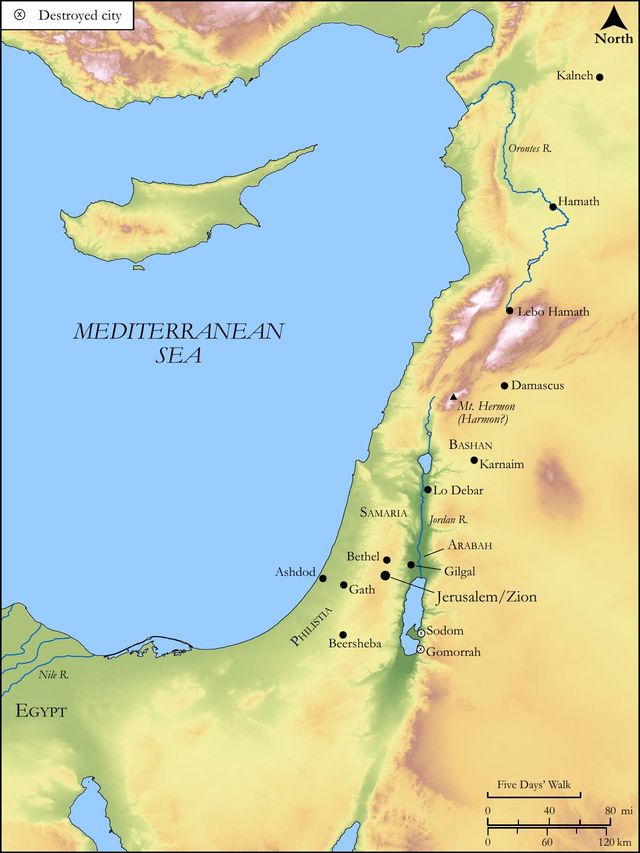
See on the biblical-era map
Study this verse
Public-domain commentary
Matthew Henry
From his Commentary on the Whole Bible. Henry comments on passages, not single verses — this entry covers Amos 5:16–20. His three-level outline is real structure in the source text, so it is rendered as structure.
Here is, I. A very terrible threatening of destruction approaching, Amo 5:16, Amo 5:17. Since they would not take the right course to obtain the favour of God, God would take an effectual course to make them feel the weight of his displeasure. The threatening is introduced with more than ordinary solemnity, to strike an awe upon them; it is not the word of the prophet only (if so, it might be made light of) but it is the Lord Jehovah, who has an infinite eternal being; it is the God of hosts, who has a boundless irresistible power, and it is Adonai - the Lord, who has an absolute incontestable sovereignty, and a universal dominion; it is he who says it, who can and will make his words good, and he has said, 1. That the land of Israel shall be put in mourning, true mourning, that all places shall be filled with lamentation for the calamities coming upon them. Look into the cities, and wailing shall be in all streets, in the great streets, in the by-streets. Look into the country, and they shall say in all the highways, Alas! alas! we are all undone! The lamentation shall be so great as not to be confined within doors, nor kept within the bounds of decency, but it shall be proclaimed in the streets and highways, and shall run wild. The husbandman shall be called from the plough by the calamities of his country to the natural expressions of mourning; and, because those who will come short of the merits of the cause, such as are skilful of lamentation shall be called to artificial mourning, to put accents upon the lamentations of the real mourners with their Ahone, ahone. Even in all vineyards, where there used to be nothing but mirth and pleasure, there shall be general wailing, when a foreign force invades the country, lays all waste, and there is no making any head against it, no weapons left but prayers and tears. 2. That the land of Israel shall be brought to ruin, and the advances of that ruin are the occasion of all this wailing: I will pass through thee, as the destroying angel passed through the land of Egypt to destroy the first-born, but then passed over the houses of the Israelites. God's judgments had often passed by them, but now they shall pass through them, shall run them through.
II.A just and severe reproof to those who made light of these threatenings, and impudently bade defiance to the justice of God and his judgments, Amo 5:18. Woe unto you that desire the day of the Lord, that really wish for times of war and confusion, as some do who have restless spirits, and long for changes, or who choose to fish in troubled waters, hoping to raise their families, as some had done, upon the ruins of their country; but the prophet tells them that this should be so great a desolation that nobody could get by it. Or it is spoken to those who, in their wailings and lamentations for the calamities they were in, wished they might die, and be delivered out of their misery, as Job did, with passion. The prophet shows them the folly of this. Do they know what death is to those who are unprepared for it, and how much more terrible it will be than any thing that can befal them in this life? Or, rather, it is spoken to those who speak jestingly of that day of the Lord which the prophet spoke so seriously of; they desired it, that is, they challenged it; they said, Let him do his worst; let him make speed, and hasten his work, Isa 5:19. Where is the promise of his coming? Pe2 3:4. It intimates,
1.That they do not believe it. They say that they wish it would come because they do not believe it will ever come; nor will they believe it unless they see it.
2.That they do not fear it; though they may have some belief of it, yet they had so little consideration of it, and their mind is so intent upon other things, that they are under no apprehension at all of peril from it; instead of having the conscience to dread it, they have the curiosity to desire it. In answer to this,
(1.)He shows the folly of those who impudently wished for any of God's judgments, and made a jest of any of the terrors of the Lord: "To what end is it for you that the day of the Lord should come? You will find it both certain and sad; not a thing to be bantered, for it is neither a thing to be questioned whether it will come or no nor a thing to be turned off with a slight when it does come. The day of the Lord is darkness, and not light, Amo 5:18. Shall it not be so? Amo 5:20. Do not your own consciences tell you that it will be so, that it will be very dark, and no brightness in it?" Note, The day of the Lord will be a dark, dismal, gloomy day to all impenitent sinners; the day of judgment will be so; and sometimes the day of their present trouble. And, when God makes a day dark, all the world cannot make it light.
(2.)He shows the folly of those who impatiently wished for a change of God's judgment, in hopes that the next would be better and more tolerable. They desire the day of the Lord, in hopes to better themselves (though their hearts and lives be not amended), or, at least, to know the worst. But the prophet tells them that they know not what they ask, Amo 5:19. It is as if a man did flee from a lion and a bear met him, a beast of prey more cruel and ravenous than a lion, or as if a man, to escape all dangers abroad, went into the house for security, and leaned his hand on the wall to rest himself, and there a serpent bit him. Note, Those who are not reformed by the judgments of God will be pursued by them; and, if they escape one, another stands ready to seize them; fear and the pit and snare surround them, Isa 24:17, Isa 24:18. It is madness therefore to defy the day of the Lord.
Historical interpretation
Historical reception
1 surviving comment on this verse from the historical church.
(Verse 18-20.) Woe to those who long for the day of the Lord! Why do you long for it? That day will be darkness, not light. It will be as though a man fled from a lion only to meet a bear, as though he entered his house and rested his hand on the wall only to have a snake bite him. Will not the day of the Lord be darkness, not light— pitch-dark, without a ray of brightness? Woe to those who long for the day of the Lord! Why do you long for the day of the Lord? And this is darkness, and not light. As if a man should flee from the face of a lion, and a bear should meet him: or enter into the house, and lean with his hand upon the wall, and a serpent should bite him. Shall not the day of the Lord be darkness, and not light? and obscurity, and no brightness in it? Lest the tribe of Juda be thought to neglect men of his own stock, and to confer the speech of prophecy upon the ten tribes: Thou also shalt go to the king against Babylon, and shalt speak to him: There are gathered together all the kings of the earth against Jerusalem: how art thou fallen, thou virgin, daughter of Babylon, to be destroyed? Shall not day overtake thee suddenly, and thou perish with the sword? For there is not so much evil in the injury of captivity, as there is good in the things which the Lord promises after captivity: to which the prophet replied that it is in vain for them to wait for what will happen a long time after, in the coming of the Son of God after seventy years of captivity in Babylon, which will be followed by devastation, poverty, and countless miseries. For, he says, when those fleeing from the face of Nebuchadnezzar meet Assuerus, under whom the story of Esther is narrated, or when the empire of the Assyrians and Chaldeans is destroyed, the Medes and Persians will rise up. And when, during the reign of Cyrus, you returned, and at the command of Darius began to build the house of the Lord, and you placed all your trust in the temple, so that you may find rest in it and weary hands may rest upon its walls, then Alexander, the king of the Macedonians, also known as Antiochus Epiphanes, will come and dwell in the temple and will bite you like a snake, not outside in Babylon and Susa, but within the borders of the holy land (or yours). By these things it is proven that the day which you desire is not one of light and joy, but of darkness and sorrow. We have briefly stated these things according to history, so as not to completely leave the opinion of the Jews untouched. However, there is no doubt that all of our people understand the day of darkness, the day of judgment, about which Sophonias also writes: The great day of the Lord is near, it is also very swift: the voice of the day of the Lord is bitter and harsh (Sophon. I, 14). And Isaiah says: Behold, the day of the Lord comes, a day of incurable rage and wrath, to make the earth a desolation and to destroy sinners from it (Is. XIII, 9). At the same time, the confidence of the proud is shaken, who, in order to appear just in the eyes of men, usually wait for the day of judgment and say: Would that the Lord would come, that we may be allowed to be dissolved and be with Christ (Phil. I), imitating the Pharisee who spoke in the Gospel (Lk. XVIII, 11, 12): God, I give thanks to you, because I am not like other men, robbers, unjust, adulterers, and like this tax collector. They fast twice on the Sabbath: they give tithes of all that they possess. For from this very thing, because they long for the day of the Lord and do not fear it, they are judged worthy of punishment, because there is no one without sin among men, and the stars are unclean before him (Job 25). And he concluded all things under sin, so that he might have mercy on all (Galatians 3). Therefore, since no one can judge the judgment of God, and we will also have to give an account of every idle word (Matthew 12): and Job offered sacrifices daily for his children, lest perhaps they might think anything perverse against the Lord (Job 1), what audacity is it to hear among the Corinthians: You reign without us (I Corinthians 4, 8): and I wish you did reign, that we also might reign with you. Certainly, if their own conscience did not prick them, they ought to imitate Paul saying: 'Who is scandalized, and I am not on fire?' (2 Cor. 2:29) and to be concerned for all, so that, as lovers of themselves, they may not desire the torments of others, as if they themselves were the rulers, just as someone would want their homeland and city to be destroyed so that they alone may enjoy the friendship of the victors. We often say in times of distress and tribulation: 'Oh, if only it were allowed for me to depart from this body and be liberated from the miseries of this world', not knowing that as long as we are in this flesh, we have a place for repentance; but if we depart, we will hear that of the Prophet: 'But who will confess to you in hell?' (Ps. 6:6). This is the sadness of the world, which leads to death, as the Apostle does not want to perish the one who has fornicated with his father's wife (I Cor. V), as Judas perished unfortunate, who connected betrayal and murder with even greater sadness (Matth. XXVII), and murder worse than all other murders: so that where he thought to find a remedy, and death to be an end to his troubles, there he would find a lion and a bear and a snake. By these names it seems to me that either different punishments are being signified, or the devil himself, who is rightly called lion and bear and snake. And when we think that Isaiah says: Go, my people, into your chambers; shut the door, hide yourself for a little while, until the wrath of the Lord passes (Isa. XXVI, 20), and be as if in our house, as if resting in hell: then the snake will bite us, which in this place is called Nahas, and in Job is called Leviathan. We learn more fully about its nature and terror in the very volume itself. However, in the darkness and shadows that are contrary to light and splendor, the diversity of torments is explained.
Continue studying Amos 5:19 across the web’s major study libraries — every link below opens this exact verse, chapter, or book on the destination site.
Read & Compare
 BibleGatewayThis verse in more than 200 translations and 70 languages.
 Bible.comThe YouVersion reader — hundreds of translations, reading plans, and highlights.
 ESV.orgCrossway's official English Standard Version reader.
 NET BibleThe NET translation with 60,000+ translators' notes on every rendering decision.
 STEP BibleTyndale House's free study tool — original text, vocabulary, and scholarly resources.
 BibliaLogos Bible Software's free web reader.
 USCCBThe New American Bible (Revised Edition) with the U.S. bishops' study notes.
Commentaries
 BibleHub CommentariesDozens of classic commentaries on this verse, gathered on one page.
 StudyLightMore than 100 commentary sets — the largest collection on the web.
 BibleRefPlain-English commentary on what this verse means, verse by verse.
 Enduring WordDavid Guzik's free commentary on this chapter, widely used by Bible teachers.
 Bible Study ToolsVerse commentary alongside Greek and Hebrew study aids.
Original Language & Research
- BibleHub InterlinearThe verse word by word — original language, transliteration, and English.
- BibleHub LexiconEvery word's original-language definition and Strong's entry.
 Blue Letter BibleDeep-study tools — Strong's numbers, concordance, and word studies.
 SefariaThe Hebrew text with Rashi and centuries of Jewish commentary.
Sermons, Hymns & Audio


TrulyRandomVerse is not affiliated with these sites and doesn’t control their content. They’re linked because they’re genuinely useful.
Summary
Amos 5:19 vividly illustrates the inescapable nature of divine judgment for unrepentant Israel, portraying a series of escalating and unavoidable perils. Through striking imagery, the prophet declares that attempts to evade one form of calamity will only lead to an encounter with another, equally certain, danger. This verse shatters any illusion of security or escape for those who presumed upon God's grace while living in sin, emphasizing that for the rebellious, the "day of the Lord" would be one of pervasive darkness and not light.
Context
ShowHideLiterary Context
Amos 5:19 is situated within a powerful prophetic lament and call to repentance addressed to the northern kingdom of Israel. The chapter begins with a dirge over Israel's impending fall (Amos 5:1-3), followed by an urgent plea to "seek the Lord and live" (Amos 5:4-6). Crucially, verse 19 directly follows the prophet's sharp rebuke of those who foolishly desired the "day of the Lord" (Amos 5:18), expecting it to be a day of vindication and light. Amos shatters this false hope, declaring that for the unrepentant, it would be a day of "darkness, and not light." The imagery of inescapable danger in verse 19 serves as a powerful, concrete illustration of this pervasive and unavoidable judgment.
Historical & Cultural Context
The prophet Amos delivered his message during the prosperous reign of Jeroboam II in the Northern Kingdom of Israel (c. 760-750 BC). Despite outward religious observance and economic flourishing, Israel was plagued by rampant injustice, oppression of the poor, moral corruption, and syncretistic idolatry. The people had become complacent, believing their national strength and religious rituals would protect them from divine wrath. The imagery used in Amos 5:19—fleeing dangerous wild animals like lions and bears, and the unexpected threat of a serpent in a seemingly safe home—would have resonated deeply with an agrarian society familiar with such perils in their natural environment. These scenarios underscore the common human experience of seeking refuge, only to find danger where security was expected, making the divine judgment described all the more terrifying and relatable.
Key Themes
ShowHideAmos 5:19 contributes significantly to several major themes woven throughout the book of Amos and the broader prophetic literature. Foremost is the theme of Inevitable Judgment, highlighting that God's justice for unrepentant sin is certain and inescapable. This verse powerfully illustrates the Futility of False Security, showing that human attempts to evade divine consequences are ultimately useless. It underscores the Sovereignty of God's Justice, emphasizing that He will not be mocked and His word of judgment will come to pass. Furthermore, it serves as a stark warning against Spiritual Complacency and Hypocrisy, which characterized Israel's attitude. The verse also deepens the understanding of the "Day of the Lord", transforming it from a hoped-for day of national triumph into a dreaded day of darkness and destruction for the unrighteous, as articulated in Amos 5:18 and contrasted with the call to "seek good, and not evil" in Amos 5:14.
Exposition and Analysis
ShowHideKey Word Analysis
ShowHideThis primitive root signifies to flit, vanish away, subside, or escape. It also carries causative meanings like to chase, impel, or deliver. In this context, it vividly portrays the desperate attempt of an individual to escape a immediate, life-threatening danger. The man is actively trying to get away, but his efforts are ultimately futile in the face of the subsequent peril.
Derived from a root meaning "to be slow," this word refers to the bear, specifically the Syrian brown bear, which was native to the region and a formidable predator. The inclusion of the bear immediately after the lion emphasizes that escaping one great danger does not guarantee safety; another equally terrifying threat can emerge unexpectedly, highlighting the pervasive nature of the impending judgment.
This term refers to a snake, from its characteristic hiss. In Scripture, serpents are often associated with danger, deception, and hidden threats. Here, the serpent represents a danger that is not obvious or external, but rather lurking in a place presumed to be safe—the home. This illustrates that God's judgment is so comprehensive that even perceived havens offer no true refuge.
Verse Breakdown
ShowHide"As if a man did flee from a lion, and a bear met him;"
This clause sets up the first scenario, a powerful analogy for inescapable judgment. A man, facing the immediate and terrifying threat of a lion (a symbol of overwhelming danger), expends all his effort to escape. However, his flight from one deadly predator leads him directly into the path of another equally dangerous one, a bear. This illustrates the futility of human attempts to escape divine judgment; avoiding one calamity only brings another, equally certain, consequence.
"or went into the house, and leaned his hand on the wall, and a serpent bit him."
This second clause presents an alternative, equally dire scenario, employing parallelism to reinforce the central message. The man, seeking refuge and safety within the presumed sanctuary of his own home, finds unexpected peril there. As he leans against the wall, a common gesture of rest or relief, a hidden serpent bites him. This imagery emphasizes that God's judgment is not confined to external threats but penetrates even the most intimate and seemingly secure spaces, demonstrating its comprehensive and pervasive nature.
Literary Devices
ShowHideAmos 5:19 is rich in Imagery, painting vivid pictures of escalating and unavoidable danger. The sequence of a lion, a bear, and a serpent creates a sense of dread and inevitability. The verse employs powerful Analogy and Simile ("As if a man...") to liken the certainty of God's judgment to common, relatable experiences of peril. This is further enhanced by Parallelism, where two distinct but thematically similar scenarios are presented to reinforce the same core message: there is no escape. The first scenario involves external, large predators, while the second involves a hidden, internal threat, collectively demonstrating the comprehensive reach of the impending doom. The escalating nature of the threats, from fleeing one large beast to encountering another, then seeking refuge only to find a hidden, venomous one, also hints at Hyperbole, emphasizing the absolute certainty and pervasiveness of the judgment.
Theological and Thematic Connections
ShowHideAmos 5:19 powerfully articulates the biblical truth that divine judgment for unrepentant sin is utterly inescapable. It shatters the dangerous illusion of false security, particularly for those who presume upon God's grace or believe that religious rituals alone can shield them from the consequences of their rebellion. The verse underscores God's unwavering justice and His sovereign control over all circumstances, demonstrating that when His judgment is due, no human effort, no perceived sanctuary, and no evasion tactic will ultimately succeed. It serves as a stark reminder that the consequences of defying God's will are comprehensive and pervasive, extending even into what one might consider a safe haven. This theme resonates throughout Scripture, warning against complacency and emphasizing the seriousness of living in defiance of a holy God.
Reflection and Application
ShowHideAmos 5:19 serves as a timeless and sobering warning, urging us to confront the reality of God's justice and the inescapable consequences of unrepentant sin. It challenges any notion of spiritual complacency or the dangerous presumption that our religious affiliations or past blessings will somehow exempt us from accountability. This verse compels us to honestly examine our lives, asking whether we are truly seeking God and living in alignment with His righteous standards, or if we are merely going through the motions, perhaps even longing for a "day of the Lord" that, for the unrighteous, will bring judgment rather than blessing. True security is never found in human efforts to escape or in false havens, but solely in genuine repentance and a humble return to the Lord. When we turn from our sin and seek Him with all our hearts, He becomes our ultimate refuge and strength, a dwelling place where no lion, bear, or serpent can ultimately harm us.
Questions for Reflection
ShowHideFAQ
ShowHideIs this verse only about ancient Israel, or does it apply to believers today?
ShowHideWhile Amos 5:19 was specifically addressed to the northern kingdom of Israel regarding their impending judgment, the principles it conveys are timeless and universally applicable. It illustrates the unchanging nature of God's justice and the futility of attempting to escape the consequences of unrepentant sin. For believers today, it serves as a powerful warning against spiritual complacency, hypocrisy, and presuming upon God's grace. It reminds us that God is holy and righteous, and while His mercy is abundant, there are indeed serious consequences for living in defiance of His will. Therefore, its message calls all people to genuine repentance and a sincere pursuit of righteousness.
How does this verse relate to God's mercy and grace?
ShowHideAmos 5:19, in its stark depiction of inescapable judgment, highlights the seriousness of sin and God's unwavering justice. However, it does not negate God's mercy and grace; rather, it underscores their necessity. The very reason for such severe judgment is the rejection of God's repeated calls to repentance and His offer of grace (e.g., Amos 5:4 and Amos 5:14). For those who refuse to turn from their sin, judgment is the inevitable outcome. God's mercy is precisely what provides an escape from this otherwise inescapable judgment, but it is an escape found only through repentance and faith, not through human evasion tactics. The New Testament reveals the ultimate expression of this mercy in Christ, who bore the judgment we deserved.
What is the "Day of the Lord" mentioned in Amos, and how does this verse clarify it?
ShowHideThe "Day of the Lord" is a significant prophetic theme referring to a time when God intervenes decisively in human history to execute judgment and/or salvation. In Amos's time, many Israelites mistakenly believed it would be a day of national triumph and vindication for them, a day of "light" for Israel against their enemies. However, Amos 5:18-20 shatters this illusion. Amos 5:19, in particular, clarifies that for unrepentant Israel, the "Day of the Lord" would be a day of inescapable darkness and judgment, not light. It would be a time when all avenues of escape would be closed, and even presumed places of safety would become sources of peril. This redefinition served as a severe warning, emphasizing that God's judgment is based on righteousness, not national identity or ritualistic adherence.
Christ-Centered Fulfillment
ShowHideAmos 5:19's chilling depiction of inescapable judgment finds its ultimate resolution and profound significance in the person and work of Jesus Christ. The verse portrays a humanity trapped, unable to escape the consequences of its rebellion against God, with every avenue leading to further peril. This perfectly illustrates the human predicament under the curse of sin, where there is "none righteous, no, not one" and "all have sinned and fall short of the glory of God" (Romans 3:10 and Romans 3:23). Humanity, like the man in Amos 5:19, is constantly fleeing one consequence of sin only to encounter another, with no true refuge found in human efforts or earthly havens. However, Christ offers the true and only escape from this inescapable judgment. He is the Lamb of God who takes away the sin of the world (John 1:29), bearing the full weight of God's wrath on the cross, thereby providing a way for humanity to be reconciled to God. For those who believe in Him, the "Day of the Lord" is transformed from a day of dread into a day of salvation and eternal life (John 3:16). Jesus Himself becomes the ultimate "house" and "refuge" for His people, the secure dwelling place where no spiritual lion, bear, or serpent can ultimately harm those who are "in Christ Jesus" (Romans 8:1). He is the true and living way to escape the judgment, not by fleeing from it, but by being hidden in Him, who absorbed it for us.