


Amos 5:17
Bible text: King James Version (1769 Blayney text) · Public domain
Bible text: Berean Standard Bible · Public domain
Bible text: American Standard Version (1901) · Public domain
Bible text: World English Bible, Messianic edition · Public domain
Bible text: Geneva Bible (1599) · Public domain
Bible text: Young's Literal Translation · Public domain
- וּבְכָלu·ve·Kholand [will be] in allH3605Conj-w ¦ Prep-b ¦ N-mscNoun Singular Masculine Constructוּandבְ[will be] inכָלall
- כְּרָמִיםke·ra·Mim[the] vineyardsH3754N-mpNoun Plural Masculine Absolute
- מִסְפֵּדmis·PedwailingH4553N-msNoun Singular Masculine Absolute
- כִּיkiforH3588PrtParticle Conditional
- אֶעֱבֹר'e·'e·VorI will passH5674V-Qal-Imperf-1csVerb Qal Imperfect 1st Singular common gender
- בְּקִרְבְּךָbe·kir·be·Chain your midstH7130Prep-b ¦ N-msc ¦ 2msNoun Singular Masculine Constructבְּinקִרְבְּmidstךָyour
- אָמַר'a·Marhe saysH559V-Qal-Perf-3msVerb Qal Perfect 3rd Singular Masculine
- יְהוָהYah·wehYahwehH3068N-properNoun Proper Title
English is a literal word-by-word gloss of the Hebrew, not the KJV's wording. Why?
This is the original text the KJV's translators worked from — each Hebrew word with its own literal English meaning in this verse, prepared by scholars at Tyndale House, Cambridge. The KJV translates whole sentences, not word by word, so its wording differs: one Hebrew word can become several English words, and the KJV may choose “the LORD” where the gloss reads “Yahweh”. Both are faithful — they answer different questions. For the KJV's own rendering, switch to the KJV text.
Details
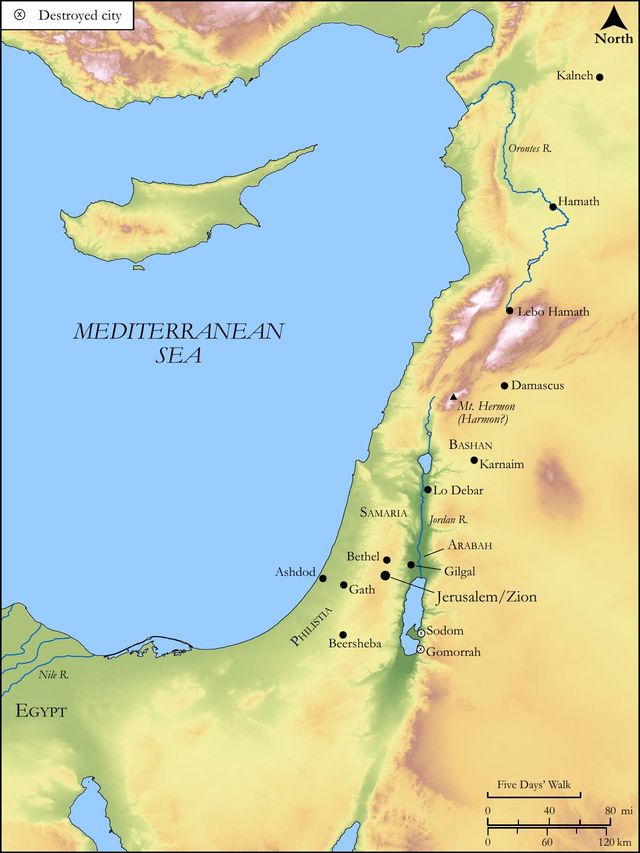
See on the biblical-era map
Study this verse
Public-domain commentary
Matthew Henry
From his Commentary on the Whole Bible. Henry comments on passages, not single verses — this entry covers Amos 5:16–20. His three-level outline is real structure in the source text, so it is rendered as structure.
Here is, I. A very terrible threatening of destruction approaching, Amo 5:16, Amo 5:17. Since they would not take the right course to obtain the favour of God, God would take an effectual course to make them feel the weight of his displeasure. The threatening is introduced with more than ordinary solemnity, to strike an awe upon them; it is not the word of the prophet only (if so, it might be made light of) but it is the Lord Jehovah, who has an infinite eternal being; it is the God of hosts, who has a boundless irresistible power, and it is Adonai - the Lord, who has an absolute incontestable sovereignty, and a universal dominion; it is he who says it, who can and will make his words good, and he has said, 1. That the land of Israel shall be put in mourning, true mourning, that all places shall be filled with lamentation for the calamities coming upon them. Look into the cities, and wailing shall be in all streets, in the great streets, in the by-streets. Look into the country, and they shall say in all the highways, Alas! alas! we are all undone! The lamentation shall be so great as not to be confined within doors, nor kept within the bounds of decency, but it shall be proclaimed in the streets and highways, and shall run wild. The husbandman shall be called from the plough by the calamities of his country to the natural expressions of mourning; and, because those who will come short of the merits of the cause, such as are skilful of lamentation shall be called to artificial mourning, to put accents upon the lamentations of the real mourners with their Ahone, ahone. Even in all vineyards, where there used to be nothing but mirth and pleasure, there shall be general wailing, when a foreign force invades the country, lays all waste, and there is no making any head against it, no weapons left but prayers and tears. 2. That the land of Israel shall be brought to ruin, and the advances of that ruin are the occasion of all this wailing: I will pass through thee, as the destroying angel passed through the land of Egypt to destroy the first-born, but then passed over the houses of the Israelites. God's judgments had often passed by them, but now they shall pass through them, shall run them through.
II.A just and severe reproof to those who made light of these threatenings, and impudently bade defiance to the justice of God and his judgments, Amo 5:18. Woe unto you that desire the day of the Lord, that really wish for times of war and confusion, as some do who have restless spirits, and long for changes, or who choose to fish in troubled waters, hoping to raise their families, as some had done, upon the ruins of their country; but the prophet tells them that this should be so great a desolation that nobody could get by it. Or it is spoken to those who, in their wailings and lamentations for the calamities they were in, wished they might die, and be delivered out of their misery, as Job did, with passion. The prophet shows them the folly of this. Do they know what death is to those who are unprepared for it, and how much more terrible it will be than any thing that can befal them in this life? Or, rather, it is spoken to those who speak jestingly of that day of the Lord which the prophet spoke so seriously of; they desired it, that is, they challenged it; they said, Let him do his worst; let him make speed, and hasten his work, Isa 5:19. Where is the promise of his coming? Pe2 3:4. It intimates,
1.That they do not believe it. They say that they wish it would come because they do not believe it will ever come; nor will they believe it unless they see it.
2.That they do not fear it; though they may have some belief of it, yet they had so little consideration of it, and their mind is so intent upon other things, that they are under no apprehension at all of peril from it; instead of having the conscience to dread it, they have the curiosity to desire it. In answer to this,
(1.)He shows the folly of those who impudently wished for any of God's judgments, and made a jest of any of the terrors of the Lord: "To what end is it for you that the day of the Lord should come? You will find it both certain and sad; not a thing to be bantered, for it is neither a thing to be questioned whether it will come or no nor a thing to be turned off with a slight when it does come. The day of the Lord is darkness, and not light, Amo 5:18. Shall it not be so? Amo 5:20. Do not your own consciences tell you that it will be so, that it will be very dark, and no brightness in it?" Note, The day of the Lord will be a dark, dismal, gloomy day to all impenitent sinners; the day of judgment will be so; and sometimes the day of their present trouble. And, when God makes a day dark, all the world cannot make it light.
(2.)He shows the folly of those who impatiently wished for a change of God's judgment, in hopes that the next would be better and more tolerable. They desire the day of the Lord, in hopes to better themselves (though their hearts and lives be not amended), or, at least, to know the worst. But the prophet tells them that they know not what they ask, Amo 5:19. It is as if a man did flee from a lion and a bear met him, a beast of prey more cruel and ravenous than a lion, or as if a man, to escape all dangers abroad, went into the house for security, and leaned his hand on the wall to rest himself, and there a serpent bit him. Note, Those who are not reformed by the judgments of God will be pursued by them; and, if they escape one, another stands ready to seize them; fear and the pit and snare surround them, Isa 24:17, Isa 24:18. It is madness therefore to defy the day of the Lord.
Historical interpretation
Historical reception
1 surviving comment on this verse from the historical church.
(Verse 16, 17.) Therefore, thus says the Lord God of hosts, the ruler: In all the streets there will be lamentation, and in all the public squares people will say, ‘Alas! Alas!’ They will summon the farmer to mourning and those skilled in lamentation to lament. And in all the vineyards there will be lamentation, for I will pass through your midst, says the Lord. LXX: Therefore, thus says the Lord God Almighty: In all the streets there will be lamentation, and in all the roads people will say, ‘Alas! Alas!’ The farmer will be called to mourning, and those who know lamentation to lament, and in all the streets there will be lamentation: for I will pass through the midst of you, says the Lord. I have commanded you to seek good, and not evil, so that you may live, and the Lord God of hosts will be with you. And again I say (lest you say you were only warned once): Hate evil, and love good, and restore justice in the gates; those who hated the one who rebuked in the gate, let the Lord have mercy on the rest of Joseph; and because you refused to do so, trampling on my commandments and turning against me, a turning away shoulder: therefore the Lord God Almighty, who is the Lord of hosts, says this: everywhere there is lamentation, everywhere there is mourning. The farmers will be called to mourn, and those who know the customs of the province will be called to incite tears, so that there will be mourning and lamentation not in all the streets, as was said above, but in the vineyards; where once there was material for joy, let it be the origin of tears. And all these things will happen, because I will pass through, says the Lord. The Hebrew word, 'I will pass through', which in their language is called Evor (), whenever it is used in the Holy Scriptures in the person of God, is to be understood as punishment, so that it may not remain among them; but let it pass through and leave. And in other places according to the interpretation of Aquila, when God is angry, He calls His fury and wrath 'ἀνυπερθεσία', which can all be applied to heretics, because they have refused to do both what is right and what is just, so there will be mourning in all their streets. For the wide and spacious road leads to destruction (Matthew 7); and each heretic and gentile has their own streets in their sand and fantasies, to which it is subsequently added: 'Woe, woe' will be said about everything that is outside. For those who are in the Church do not listen, which is the ultimate punishment; but if perhaps they have sinned, lamentation will be taken upon them. Therefore, however, it will be said outside or in all ways, woe, woe: because they do not have one way that leads to life, and which is the royal way, but crooked and perverse, and deviating to the right and to the left, while they do not hear the Lord saying: Do not be too righteous. And: The ways that are on the left are perverse. And they encounter a twofold woe, of the flesh and of the spirit, of the present age and of the future. When, on the other hand, ecclesiastics hear: Rejoice, I say again, rejoice (Philip. IV, 4). But even the farmer is called to mourning (for heretics indeed have their farmers, in whose fields thistles and thorns grow), and those who know how to lament are called to mourn, either for their own sins or for the sins of others; although we can take these things in a good sense, so that the man of the Church, powerful to provoke penance, may imitate his Lord saying: We have lamented, and you have not mourned (Luc. VII, 32), and let him mourn for the heretics, as King Saul of Israel once mourned for Samuel (I Reg. XV). And the Apostle says that he mourns over those who have not repented (II Cor. XII). And in all vineyards there will be lamentation, because the vineyards of Sodom are their vineyards. And for the wine of joy, which gladdens the heart of man, they have brought the wine of dragons and the incurable rage of asps. And all these things they will suffer; for the Lord will pass through their midst, so that he does not dwell among them, nor say: I will dwell in them, and walk among them. And behold, I am with you all days even to the consummation of the age. (Matthew 28:20)
Continue studying Amos 5:17 across the web’s major study libraries — every link below opens this exact verse, chapter, or book on the destination site.
Read & Compare
 BibleGatewayThis verse in more than 200 translations and 70 languages.
 Bible.comThe YouVersion reader — hundreds of translations, reading plans, and highlights.
 ESV.orgCrossway's official English Standard Version reader.
 NET BibleThe NET translation with 60,000+ translators' notes on every rendering decision.
 STEP BibleTyndale House's free study tool — original text, vocabulary, and scholarly resources.
 BibliaLogos Bible Software's free web reader.
 USCCBThe New American Bible (Revised Edition) with the U.S. bishops' study notes.
Commentaries
 BibleHub CommentariesDozens of classic commentaries on this verse, gathered on one page.
 StudyLightMore than 100 commentary sets — the largest collection on the web.
 BibleRefPlain-English commentary on what this verse means, verse by verse.
 Enduring WordDavid Guzik's free commentary on this chapter, widely used by Bible teachers.
 Bible Study ToolsVerse commentary alongside Greek and Hebrew study aids.
Original Language & Research
- BibleHub InterlinearThe verse word by word — original language, transliteration, and English.
- BibleHub LexiconEvery word's original-language definition and Strong's entry.
 Blue Letter BibleDeep-study tools — Strong's numbers, concordance, and word studies.
 SefariaThe Hebrew text with Rashi and centuries of Jewish commentary.
Sermons, Hymns & Audio


TrulyRandomVerse is not affiliated with these sites and doesn’t control their content. They’re linked because they’re genuinely useful.
Summary
Amos 5:17 delivers a stark prophecy of widespread divine judgment upon Israel, declaring that even their places of joy and abundance, the vineyards, will become scenes of intense wailing. This lamentation is presented as a direct consequence of God's personal and punitive "passing through" the nation, underscoring His active role in executing justice for their persistent unrighteousness and spiritual rebellion.
Context
ShowHideLiterary Context
Amos 5:17 intensifies the somber tone established earlier in the chapter, which opens with a funeral lament over Israel's spiritual demise (Amos 5:1-3). While the prophet offers a glimmer of hope with the repeated call to "seek the LORD, and ye shall live" (Amos 5:4, 6), the subsequent verses detail Israel's profound moral corruption, including their oppression of the poor and perversion of justice (Amos 5:7-13). Verse 16 describes a general mourning in the streets and highways, and verse 17 specifically extends this lamentation to the vineyards, places typically associated with joy and celebration. This progression underscores the comprehensive and inescapable nature of the coming judgment, leaving no sphere of life untouched.
Historical & Cultural Context
The prophet Amos ministered to the Northern Kingdom of Israel during the reigns of Uzziah of Judah and Jeroboam II of Israel (circa 760-750 BC). This was a period of significant economic prosperity and political stability for Israel, yet it was coupled with severe oppression, moral decay, and syncretistic religious practices. Vineyards (kerem) were not merely agricultural sites but deeply symbolic places in ancient Israelite culture, representing blessing, prosperity, and joy (e.g., Psalm 104:15). The prophecy that "in all vineyards shall be wailing" would have been particularly shocking and potent, signifying a complete reversal of their expected fortunes and a profound disruption of their cultural fabric. The concept of God "passing through" (ʻâbar) carried strong historical echoes, most notably the Lord's punitive passage through Egypt during the Passover judgment (Exodus 12:12), which would have evoked a sense of terrifying divine intervention.
Key Themes
ShowHideAmos 5:17 contributes significantly to several overarching themes in the book of Amos. Foremost is the theme of Divine Judgment, emphasizing God's unwavering commitment to justice and His readiness to punish persistent sin. The widespread wailing highlights the theme of Inescapable Consequences, demonstrating that no aspect of life, even those traditionally associated with joy, will be immune to the effects of divine wrath. It also reinforces the theme of God's Sovereignty and Active Intervention, as the Lord Himself declares, "I will pass through thee," asserting His direct agency in the coming calamity. This verse stands as a stark warning within the broader call for Repentance and Righteousness that permeates Amos, underscoring that without a genuine turn from injustice and idolatry, judgment is inevitable, as seen in the repeated exhortations to "seek good, and not evil" and "let justice roll down like waters".
Exposition and Analysis
ShowHideKey Word Analysis
ShowHideFrom an unused root of uncertain meaning, this word refers to a garden or vineyard, specifically vines or the produce of a vineyard. In ancient Israel, vineyards were places of cultivation, hard work, and ultimately, joy and celebration during harvest. Their transformation into places of wailing in Amos 5:17 signifies a complete reversal of blessing and a profound desolation.
Derived from a root meaning "to lament," miçpêd denotes a loud, public lamentation, often associated with mourning the dead or expressing profound national grief and disaster. The use of this term emphasizes the depth and universality of the sorrow that will engulf Israel, contrasting sharply with the customary sounds of joy (hedad) associated with vineyards.
A primitive root meaning "to cross over," this verb is used widely to describe any transition. In this context, especially with "saith the LORD," it carries the weight of a punitive, destructive passage, indicating a direct, active, and devastating intervention of God's wrath, bringing desolation and judgment upon the nation. This echoes the Lord's act of judgment in the Passover narrative.
From the root hâyâh (to be), this is the self-existent or eternal name of God, Jehovah, the Jewish national name of God. The use of this covenant name here emphasizes that the judgment is not arbitrary but comes from the covenant-keeping God who is just and holy, holding His people accountable to the terms of their relationship.
Verse Breakdown
ShowHide"And in all vineyards shall be wailing"
This clause paints a vivid picture of universal sorrow. Vineyards, symbols of prosperity, joy, and the fruit of labor, will instead be filled with the sounds of deep lamentation. This signifies that the judgment will be comprehensive, affecting every aspect of Israelite life and turning their sources of happiness into scenes of grief. It underscores the severity and pervasiveness of the coming calamity.
"for I will pass through thee"
This phrase reveals the divine agency behind the impending disaster. The "I" refers directly to the LORD, indicating that this is not a natural catastrophe or a mere consequence of human actions, but a direct, intentional act of God's judgment. The verb "pass through" (Hebrew ʻâbar) echoes the devastating judgment of the firstborn in Egypt during the Passover, implying a destructive and punitive visitation upon Israel.
"saith the LORD."
This concluding declaration authenticates the prophecy as a direct, authoritative utterance from God Himself. It leaves no doubt about the source or certainty of the judgment. The use of the divine name, YHWH (the LORD), reinforces God's sovereignty, holiness, and His covenant faithfulness in holding His people accountable for their unrighteousness.
Literary Devices
ShowHideAmos 5:17 employs several potent literary devices to convey its message of impending judgment. Symbolism is prominent, with "vineyards" serving as a powerful symbol. Traditionally representing joy, prosperity, and the blessings of God, their transformation into places of "wailing" creates a stark Irony, highlighting the complete reversal of Israel's fortunes due to their sin. The expected sounds of harvest celebration (hedad) are replaced by sounds of mourning (miçpêd), creating a jarring auditory contrast. Furthermore, the phrase "I will pass through thee, saith the LORD" utilizes Anthropomorphism, attributing human-like action (passing through) to God, emphasizing His direct and personal involvement in executing judgment. This also serves as an Allusion to the Passover narrative (Exodus 12:12), where God "passed through" Egypt to bring judgment, thereby invoking a sense of terrifying divine power and historical precedent for punitive action.
Theological and Thematic Connections
ShowHideAmos 5:17 profoundly articulates the biblical truth of God's unwavering justice and holiness. It demonstrates that divine judgment is not arbitrary but a righteous response to persistent sin, particularly oppression and spiritual apostasy. The verse underscores God's sovereignty, revealing Him as an active, intervening deity who holds His covenant people accountable. It serves as a powerful reminder that prosperity without righteousness is fleeting and ultimately invites divine reckoning, turning expected joy into widespread lamentation. This passage reinforces the Old Testament principle that God's character demands a response of obedience and justice from His people, and failure to do so results in severe consequences.
Reflection and Application
ShowHideAmos 5:17 offers a sobering reflection for believers today, reminding us that God's character encompasses both boundless love and unwavering justice. It challenges us to examine our own lives and societies, asking whether our prosperity or comfort has led to complacency, injustice, or spiritual compromise. The image of wailing in vineyards, places meant for joy, serves as a powerful metaphor for how sin can corrupt and reverse our blessings. This verse calls us to a deep humility before a holy God, urging us to actively pursue righteousness and justice in all our dealings, particularly caring for the vulnerable and overlooked. It is a timeless warning that divine judgment is a reality for those who persistently reject God's ways, yet it also implicitly points to the mercy available through repentance and seeking the Lord.
Questions for Reflection
ShowHideFAQ
ShowHideWhy are "vineyards" specifically mentioned as places of wailing?
ShowHideVineyards in ancient Israel were deeply symbolic of joy, prosperity, and the blessings of God's covenant. They were places of hard work but also of celebratory harvest festivals (e.g., Judges 9:27). By prophesying "wailing" in all vineyards, Amos underscores the comprehensive and devastating nature of God's judgment. It means that even the sources of their greatest joy and prosperity will be turned into scenes of profound sorrow, signifying a complete reversal of their fortunes and a national catastrophe that leaves no aspect of life untouched. It highlights the irony that what was meant for blessing will become a source of lamentation due to their sin.
What does it mean for God to "pass through" the nation?
ShowHideThe phrase "I will pass through thee, saith the LORD" signifies a direct, personal, and punitive act of divine judgment. This language carries strong echoes of the Passover narrative in Exodus 12:12, where the Lord "passed through" Egypt to execute judgment on the firstborn. In Amos 5:17, the same powerful imagery is invoked, but this time, the judgment is directed at Israel itself. It means God will actively intervene to bring desolation and calamity upon them, not merely allowing consequences to unfold, but personally orchestrating their downfall as a righteous response to their persistent unrighteousness and rebellion.
Christ-Centered Fulfillment
ShowHideAmos 5:17, with its pronouncement of divine judgment and widespread lamentation, finds its ultimate Christ-centered fulfillment not in a future earthly desolation for believers, but in the person and work of Jesus Christ. The "passing through" of the LORD, bringing judgment, is ultimately absorbed by Christ on the cross. He became the Lamb of God who takes away the sin of the world (John 1:29), bearing the full weight of God's righteous wrath against sin, so that those who believe in Him might be spared from the wailing of eternal judgment. The sorrow and wailing prophesied for Israel due to their unrighteousness are transformed for believers into the joy of salvation and peace with God, purchased by Christ's sacrifice. While judgment remains a reality for the unrepentant, Christ offers an escape from this ultimate "passing through" of divine wrath (Romans 5:9). Furthermore, the lamentation over sin that Amos calls for is fulfilled in the New Covenant through the Holy Spirit, who convicts hearts of sin and leads to true repentance and mourning that leads to salvation (2 Corinthians 7:10). Ultimately, for those in Christ, the wailing of judgment is replaced by the eternal joy and celebration of God's presence, where every tear will be wiped away (Revelation 21:4).