


2 Kings 8:27
Bible text: King James Version (1769 Blayney text) · Public domain
Bible text: King James Version with Strong's numbers · Public domain
Bible text: Berean Standard Bible · Public domain
Bible text: American Standard Version (1901) · Public domain
Bible text: World English Bible, Messianic edition · Public domain
Bible text: Geneva Bible (1599) · Public domain
Bible text: Young's Literal Translation · Public domain
- וַיֵּלֶךְvai·Ye·lekhand he walkedH1980Conj-w ¦ V-Qal-ConsecImperf-3msVerb Qal Consecutive Imperfect 3rd Singular Masculineוַandיֵּלֶךְhe walked
- בְּדֶרֶךְbe·De·rekhin [the] way ofH1870Prep-b ¦ N-cscNoun Singular common gender Constructבְּinדֶרֶךְ[the] way of
- בֵּיתbeit[the] house ofH1004N-mscNoun Singular Masculine Construct
- אַחְאָב'ach·'AvAhabH256N-proper-mNoun Proper Masculine
- וַיַּעַשׂvai·Ya·'asand he didH6213Conj-w ¦ V-Qal-ConsecImperf-3msVerb Qal Consecutive Imperfect 3rd Singular Masculineוַandיַּעַשׂhe did
- הָרַעha·Ra'the evilH7451Art ¦ Adj-msAdjective Singular Masculine Absoluteהָtheרַעevil
- בְּעֵינֵיbe·'ei·Neiin [the] eyes ofH5869Prep-b ¦ N-fdcNoun Dual Feminine Constructבְּinעֵינֵי[the] eyes of
- יְהוָהYah·wehYahwehH3068N-properNoun Proper Title
- כְּבֵיתke·Veitlike [the] house ofH1004Prep-k ¦ N-mscNoun Singular Masculine Constructכְּlikeבֵית[the] house of
- אַחְאָב'ach·'AvAhabH256N-proper-mNoun Proper Masculine
- כִּיkiforH3588PrtParticle Conditional
- חֲתַןcha·Tan[was] [the] son-in-law ofH2860N-mscNoun Singular Masculine Construct
- בֵּיתbeit[the] house ofH1004N-mscNoun Singular Masculine Construct
- אַחְאָב'ach·'AvAhabH256N-proper-mNoun Proper Masculine
- הוּאHu'heH1931Pro-3msPronoun Personal 3rd Singular Masculine
English is a literal word-by-word gloss of the Hebrew, not the KJV's wording. Why?
This is the original text the KJV's translators worked from — each Hebrew word with its own literal English meaning in this verse, prepared by scholars at Tyndale House, Cambridge. The KJV translates whole sentences, not word by word, so its wording differs: one Hebrew word can become several English words, and the KJV may choose “the LORD” where the gloss reads “Yahweh”. Both are faithful — they answer different questions. For the KJV's own rendering, switch to the KJV text.
Details
See on the biblical-era maps
Study this verse
Public-domain commentary
Matthew Henry
From his Commentary on the Whole Bible. Henry comments on passages, not single verses — this entry covers 2 Kings 8:25–29.
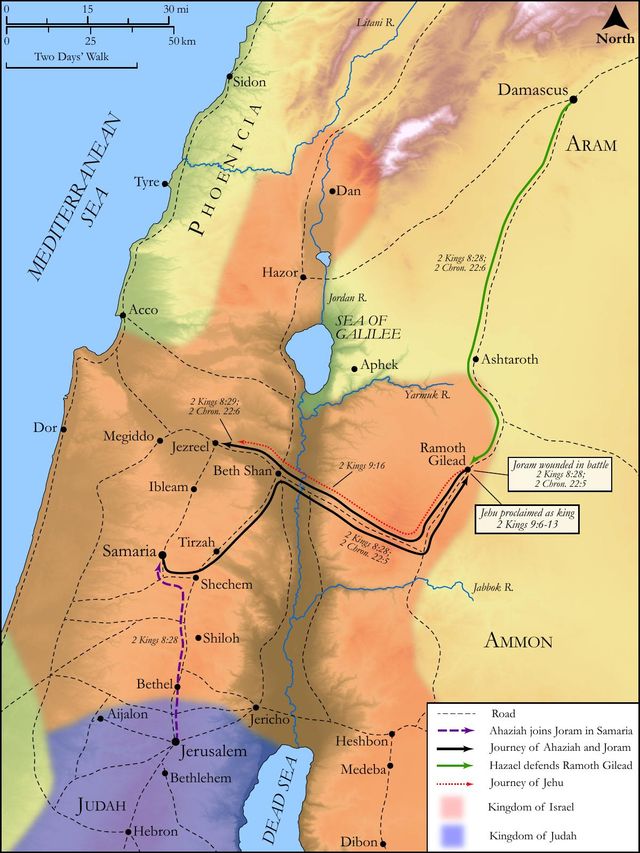
As among common persons there are some that we call little men, who make no figure, are little regarded, as less valued, so among kings there are some whom, in comparison with others, we may call little kings. This Ahaziah was one of these; he looks mean in the history, and in God's account vile, because wicked. It is too plain an evidence of the affinity between Jehoshaphat and Ahab that they had the same names in their families at the same time, in which, we may suppose, they designed to compliment one another. Ahab had two sons, Ahaziah and Jehoram, who reigned successively; Jehoshaphat had a son and grandson names Jehoshaphat had a son and grandson names Jehoram and Ahaziah, who, in like manner, reigned successively. Names indeed do not make natures, but it was a bad omen to Jehoshaphat's family to borrow names from Ahab's; or, if he lent the names to that wretched family, he could not communicate with them the devotion of their significations, Ahaziah - Taking hold of the Lord, and Jehoram - The Lord exalted. Ahaziah king of Israel had reigned but two years, Ahaziah king of Judah reigned but one. We are here told that his relation to Ahab's family was the occasion, 1. Of his wickedness (Kg2 8:27): He walked in the way of the house of Ahab, that idolatrous bloody house; for his mother was Ahab's daughter (Kg2 8:26), so that he sucked in wickedness with his milk. Partus sequitur ventrem - The child may be expected to resemble the mother. When men choose wives for themselves they must remember they are choosing mothers for their children, and are concerned to choose accordingly. 2. Of his fall. Joram, his mother's brother, courted him to join with him for the recovery of Ramoth-Gilead, an attempt fatal to Ahab; so it was to Joram his son, for in that expedition he was wounded (Kg2 8:28), and returned to Jezreel to be cured, leaving his army there in possession of the place. Ahaziah likewise returned, but went to Jezreel to see how Jehoram did, Kg2 8:29. Providence so ordered it, that he who had been debauched by the house of Ahab might be cut off with them, when the measure of their iniquity was full, as we shall find in the next chapter. Those who partake with sinners in their sins must expect to partake with them in their plagues.
Continue studying 2 Kings 8:27 across the web’s major study libraries — every link below opens this exact verse, chapter, or book on the destination site.
Read & Compare
 BibleGatewayThis verse in more than 200 translations and 70 languages.
 Bible.comThe YouVersion reader — hundreds of translations, reading plans, and highlights.
 ESV.orgCrossway's official English Standard Version reader.
 NET BibleThe NET translation with 60,000+ translators' notes on every rendering decision.
 STEP BibleTyndale House's free study tool — original text, vocabulary, and scholarly resources.
 BibliaLogos Bible Software's free web reader.
 USCCBThe New American Bible (Revised Edition) with the U.S. bishops' study notes.
Commentaries
 BibleHub CommentariesDozens of classic commentaries on this verse, gathered on one page.
 StudyLightMore than 100 commentary sets — the largest collection on the web.
 BibleRefPlain-English commentary on what this verse means, verse by verse.
 Enduring WordDavid Guzik's free commentary on this chapter, widely used by Bible teachers.
 Bible Study ToolsVerse commentary alongside Greek and Hebrew study aids.
Original Language & Research
- BibleHub InterlinearThe verse word by word — original language, transliteration, and English.
- BibleHub LexiconEvery word's original-language definition and Strong's entry.
 Blue Letter BibleDeep-study tools — Strong's numbers, concordance, and word studies.
 SefariaThe Hebrew text with Rashi and centuries of Jewish commentary.
Sermons, Hymns & Audio


TrulyRandomVerse is not affiliated with these sites and doesn’t control their content. They’re linked because they’re genuinely useful.
Summary
This verse delivers a concise yet profound indictment of Ahaziah, King of Judah, highlighting the corrupting influence of his familial ties and his deviation from the righteous path. It meticulously explains why Ahaziah, despite ruling the southern kingdom, adopted the wicked practices of the Northern Kingdom's most infamous royal family, directly attributing his apostasy to his deep connection with the notorious House of Ahab. His brief reign is thus characterized from its very beginning as a profound spiritual compromise and a tragic departure from the covenant faithfulness expected of a Davidic king.
Context
ShowHideLiterary Context
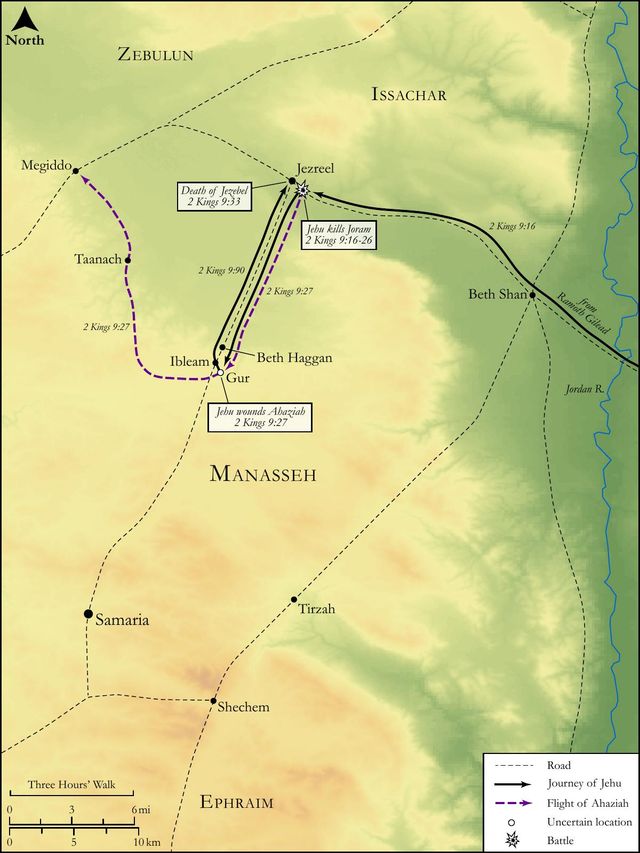
This verse immediately follows the introduction of Ahaziah's reign in 2 Kings 8:25-26. The preceding verses establish his age (22 years), the brevity of his reign (a mere one year), and crucially, the identity of his mother, Athaliah, who is explicitly stated to be the granddaughter of Omri and, by extension, the daughter of Ahab and Jezebel. Therefore, 2 Kings 8:27 serves as the narrative's immediate theological assessment of Ahaziah's character and reign, providing the explicit reason for his ungodly behavior. It functions as a summary statement, setting the moral and spiritual tone for his kingship before the details of his brief and ultimately tragic demise are recounted in 2 Kings 9:27. The placement emphasizes that his wickedness was not an isolated incident but a defining characteristic rooted in his lineage.
Historical & Cultural Context
The "house of Ahab" refers to the Omride dynasty, specifically King Ahab and his notorious Phoenician wife, Jezebel, who reigned in the Northern Kingdom of Israel. This dynasty was infamous for its aggressive promotion of Baal worship, the establishment of idolatrous altars, and the persecution of the prophets of the LORD, representing the nadir of Israel's spiritual apostasy (1 Kings 16:30-33). Ahaziah's mother, Athaliah, was a direct marital link to this corrupt lineage, having married Jehoram, king of Judah. Royal intermarriage was a common political strategy among the kings of that day to forge alliances and secure peace, as when Solomon made affinity with Pharaoh king of Egypt. However, for a king of Judah, whose lineage was tied to the covenant promises made to David and whose people were bound by the Mosaic Law, such a marriage (especially with a family as deeply idolatrous as Ahab's) represented a profound spiritual compromise and a dangerous deviation from God's commands, which warned against alliances with pagan nations and their gods (Deuteronomy 7:3-4). Ahaziah's actions reflect the pervasive and destructive influence of this ungodly alliance and the spiritual decay it introduced into the Davidic line.
Key Themes
ShowHideThis verse powerfully underscores several key themes within the Deuteronomistic history. First, it highlights the corrupting influence of association and ungodly alliances, demonstrating how Ahaziah's familial ties to the house of Ahab directly shaped his spiritual and moral trajectory. His choices were not made in a vacuum but were a direct consequence of his environment and relationships, particularly the dominant influence of his mother, Athaliah, who later attempted to destroy the Davidic line (2 Kings 11:1). Second, it emphasizes spiritual compromise and apostasy. As king of Judah, Ahaziah was expected to uphold the worship of the LORD and the Mosaic Law, yet he adopted the idolatrous ways of his mother's family, demonstrating a severe spiritual betrayal of the covenant. This illustrates the danger of allowing political expediency or even family connections to lead one away from faithfulness to God. Third, the verse points to the consequences of disobedience and divine judgment. The recurring phrase "did evil in the sight of the LORD" is a standard biblical judgment against kings who failed to follow God's commands. Ahaziah's short reign and violent end serve as a stark reminder of the divine judgment that follows rejection of God's ways and embrace of idolatry, echoing the fate of many kings in both Israel and Judah who strayed from the covenant.
Exposition and Analysis
ShowHideKey Word Analysis
ShowHideThis idiomatic expression, combining H3212 (yâlak, "to walk" or "to go") and H1870 (derek, "way" or "course of life"), is a common biblical metaphor signifying the adoption of a lifestyle, following a pattern of behavior, or adhering to a particular moral or spiritual path. It implies a comprehensive commitment and not merely superficial similarities. In this context, it clearly indicates Ahaziah's full adoption of the corrupt and idolatrous practices characteristic of Ahab's family, rather than isolated acts of sin. It suggests a deliberate alignment of his entire conduct with their ungodly example, indicating a profound spiritual orientation.
This formulaic phrase, employing H6213 (ʻâśâh, "to do" or "to make"), H7451 (raʻ, "bad" or "evil"), H5869 (ʻayin, "eye" or "sight"), and H3068 (Yᵉhôvâh, "the LORD"), is a theological judgment frequently used in the books of Kings and Chronicles to evaluate the reign of Israelite and Judean monarchs. It signifies a king's failure to adhere to the covenant stipulations and the exclusive worship of Yahweh, often involving the promotion of idolatry or other covenant breaches. It is a divine verdict, not merely a human opinion, indicating that Ahaziah's actions were a direct offense against God's holiness and His established covenant with Israel.
This phrase, combining H1004 (bayith, "house" or "family") and H256 (ʼAchʼâb, "Ahab"), refers to the entire dynastic lineage and pervasive influence of King Ahab, characterized by its extreme apostasy, Baal worship, and persecution of God's prophets. By repeating this phrase three times in a single verse, the text powerfully emphasizes the pervasive and determinative influence of this wicked family on Ahaziah. It serves as a shorthand for all the spiritual corruption and rebellion against God that Ahab's reign represented, highlighting the source of Ahaziah's moral and spiritual depravity.
Verse Breakdown
ShowHide"And he walked in the way of the house of Ahab"
This clause immediately establishes the character of Ahaziah's reign. "Walking in the way" denotes a lifestyle, a pattern of behavior, indicating that Ahaziah adopted the ungodly practices and spiritual orientation of the notorious Northern Kingdom dynasty. This implies a comprehensive embrace of their idolatry and wickedness, rather than isolated acts, signifying a deliberate choice to emulate their conduct.
"and did evil in the sight of the LORD, as [did] the house of Ahab"
This is the divine judgment on Ahaziah's conduct. "Did evil in the sight of the LORD" is a standard biblical condemnation, signifying a king's failure to uphold the covenant and lead his people in faithfulness to Yahweh. The explicit comparison "as did the house of Ahab" underscores the profound spiritual deviation, equating Ahaziah's sin with the most egregious apostasy in Israel's history and highlighting the severity of his rebellion against God.
"for he [was] the son in law of the house of Ahab"
This causal clause provides the explicit reason for Ahaziah's wicked behavior. His familial connection through his mother, Athaliah (daughter of Ahab and Jezebel), is presented as the direct source of his corrupt spiritual trajectory. This highlights the powerful and destructive influence of ungodly alliances and family ties, especially when they lead to a compromise of one's commitment to God and a departure from divine commands.
Literary Devices
ShowHideThe verse employs several potent literary devices to convey its message with striking clarity and emphasis. Repetition is prominent, with the phrase "house of Ahab" appearing three times, emphatically underscoring the pervasive and determinative influence of this corrupt lineage on Ahaziah's reign. This repetition serves to link Ahaziah's personal failure directly to the notorious spiritual apostasy of his in-laws, making the source of his wickedness undeniable. Formulaic Language is also evident in "walked in the way of" and "did evil in the sight of the LORD," which are standard expressions used by the Deuteronomistic historian to evaluate the kings of Israel and Judah. These phrases provide a concise, divinely informed assessment of the king's moral and spiritual standing, aligning Ahaziah's reign with a long line of disobedient monarchs. Furthermore, the verse utilizes a Causal Clause ("for he was the son in law of the house of Ahab") to explicitly state the reason for Ahaziah's wickedness, providing immediate clarity and theological insight into the source of his corruption. Finally, there is a profound Irony in a king of Judah, from the sacred line of David, adopting the ways of the condemned Northern Kingdom, whose kings were consistently judged for their idolatry and ultimately overthrown. This highlights the tragic spiritual decline within the Southern Kingdom due to unholy alliances and the devastating consequences of forsaking God's covenant.
Theological and Thematic Connections
ShowHideThis verse serves as a profound theological statement on the nature of influence and the enduring battle against idolatry and spiritual compromise. It underscores the biblical truth that associations profoundly shape character and destiny, particularly in matters of faith and leadership. Ahaziah's brief and wicked reign is directly attributed to his entanglement with the "house of Ahab," a family synonymous with spiritual depravity, Baal worship, and rebellion against God. This highlights the ever-present danger of spiritual compromise, even for those in positions of leadership within God's covenant people. Despite the divine promises to the Davidic dynasty, human choices, especially those involving ungodly alliances and familial pressures, can lead to devastating spiritual consequences and a deviation from God's intended path. The verse implicitly warns against the allure of worldly power or political expediency when it comes at the cost of spiritual purity and unwavering faithfulness to the Lord. It emphasizes that true leadership, especially among God's people, requires an uncompromising commitment to divine standards, regardless of external pressures.
Reflection and Application
ShowHideThe tragic account of Ahaziah offers a timeless and sobering warning about the powerful and often subtle impact of our relationships and influences. His downfall underscores the critical importance of spiritual discernment in choosing our companions and maintaining unwavering commitment to God's ways, even when faced with pressure from family, friends, or societal norms. This verse calls believers to a rigorous examination of their own associations, ensuring that they do not lead to spiritual compromise or deviation from God's commands. It challenges us to consider whether our closest relationships are drawing us nearer to Christ, encouraging righteousness, and upholding biblical truth, or subtly pulling us away from our convictions. Just as Ahaziah's ungodly alliances corrupted his reign and led him to embrace idolatry, our own spiritual integrity can be eroded by associations that do not honor God or align with His purposes. We are called to actively cultivate relationships that strengthen our faith, encourage godliness, and uphold biblical truth, recognizing that our spiritual trajectory is deeply intertwined with those we choose to walk with and whose "way" we adopt.
Questions for Reflection
ShowHideFAQ
ShowHideWhy is the "house of Ahab" so significant in this context?
ShowHideThe "house of Ahab" represents the epitome of apostasy and wickedness in the Northern Kingdom of Israel. King Ahab and Queen Jezebel were notorious for actively promoting the worship of Baal, establishing pagan altars, persecuting the prophets of the LORD, and committing grave injustices, such as the murder of Naboth to seize his vineyard (1 Kings 21:1-16). Their dynasty was marked by profound spiritual corruption and defiance of God's covenant. For Ahaziah, a king of Judah from the Davidic line, to "walk in the way of" such a house signifies a profound and shocking spiritual betrayal, importing the worst forms of idolatry and ungodliness into the Southern Kingdom, which was meant to preserve the pure worship of Yahweh and the Davidic covenant.
Did Ahaziah have a choice, given his family connections?
ShowHideWhile the influence of family, especially a powerful mother like Athaliah, was undoubtedly strong, biblical narrative consistently holds individuals accountable for their choices and actions. Ahaziah, as king, held the ultimate responsibility to lead Judah in faithfulness to the LORD, as many of his predecessors (e.g., his father Jehoshaphat, who sought the LORD and removed idolatry from Judah, as seen in 2 Chronicles 17:3-6) had done. The text's explicit statement that "he walked in the way of" implies a volitional act, a deliberate adoption of their practices. While external pressures and inherited tendencies exist, the Bible emphasizes that true faithfulness comes from an internal commitment to God, regardless of one's environment or lineage. His choice to align with the house of Ahab was a conscious rejection of the covenant responsibilities inherent in being a Davidic king.
What was the ultimate fate of the house of Ahab?
ShowHideThe house of Ahab met a violent and complete end, as prophesied by Elijah and Elisha, fulfilling divine judgment against their pervasive idolatry and wickedness. God raised up Jehu, a military commander, whom He anointed to utterly destroy the entire house of Ahab. This dramatic purge included the assassination of King Joram (Ahab's son), the gruesome death of Jezebel, and the systematic execution of all of Ahab's seventy sons, his officials, and priests of Baal, effectively wiping out their dynasty as a direct consequence of their egregious sins against the LORD. This dramatic and sweeping judgment is recounted in detail in 2 Kings 9-10.
Christ-Centered Fulfillment
ShowHideAhaziah's tragic story, marked by his adoption of the "way of the house of Ahab" due to corrupting familial influence and ungodly alliances, stands in stark contrast to the perfect life and reign of Jesus Christ. While Ahaziah succumbed to the spiritual depravity of his lineage, Jesus, the true Son of David, though born into a fallen world and facing immense temptation, never "walked in the way" of sin or compromise. He perfectly embodied righteousness and unwavering obedience to God, even to the point of sacrificial death on a cross (Philippians 2:8). Unlike Ahaziah, whose "house" is defined by idolatry and evil, Jesus' "house" is the new covenant community, the church, built not on human alliances but on the foundation of the apostles and prophets, with Christ Himself as the cornerstone (Ephesians 2:19-22). Through Christ, believers are not influenced by the corrupting "ways" of the world but are transformed by the renewing of their minds (Romans 12:2) and empowered by the Holy Spirit to walk in newness of life (Romans 6:4). He is the ultimate "Way, the Truth, and the Life" (John 14:6), inviting all to walk in His path of perfect obedience, spiritual purity, and eternal life, a path utterly distinct from the destructive "way of the house of Ahab" and all worldly compromises.