


2 Chronicles 22:3
- גַּםgamalsoH1571AdvAdverb
- הוּאhu'heH1931Pro-3msPronoun Personal 3rd Singular Masculine
- הָלַךְha·Lakhhe walkedH1980V-Qal-Perf-3msVerb Qal Perfect 3rd Singular Masculine
- בְּדַרְכֵיbe·dar·Kheiin [the] ways ofH1870Prep-b ¦ N-cpcNoun Plural common gender Constructבְּinדַרְכֵי[the] ways of
- בֵּיתbeit[the] house ofH1004N-mscNoun Singular Masculine Construct
- אַחְאָב'ach·'AvAhabH256N-proper-mNoun Proper Masculine
- כִּיkiforH3588PrtParticle Conditional
- אִמּוֹ'i·Mohis motherH517N-fsc ¦ 3msNoun Singular Feminine Constructאִמּmotherוֹhis
- הָיְתָהha·ye·Tahshe wasH1961V-Qal-Perf-3fsVerb Qal Perfect 3rd Singular Feminine
- יוֹעַצְתּוֹyo·'atz·To[female] his counselorH3289V-Qal-Prtcpl-fs ¦ 3msVerb Qal Participle Singular Feminine Constructיוֹעַצְתּ[female] counselorוֹhis
- לְהַרְשִׁיעַle·har·Shi·a'to act wickedlyH7561Prep-l ¦ V-Hiphil-InfVerb Hiphil Infinitive Constructלְtoהַרְשִׁיעַact wickedly
English is a literal word-by-word gloss of the Hebrew, not the KJV's wording. Why?
This is the original text the KJV's translators worked from — each Hebrew word with its own literal English meaning in this verse, prepared by scholars at Tyndale House, Cambridge. The KJV translates whole sentences, not word by word, so its wording differs: one Hebrew word can become several English words, and the KJV may choose “the LORD” where the gloss reads “Yahweh”. Both are faithful — they answer different questions. For the KJV's own rendering, switch to the KJV text.
Details
See on the biblical-era maps
Study this verse
Public-domain commentary
Matthew Henry
From his Commentary on the Whole Bible. Henry comments on passages, not single verses — this entry covers 2 Chronicles 22:1–9. His two-level outline is real structure in the source text, so it is rendered as structure.
We have here an account of the reign of Ahaziah, a short reign (of one year only), yet long enough, unless it had been better. He was called Jeho-ahaz (Ch2 21:17); here he is called Ahaz-iah, which is the same name and of the same signification, only the words of which it is compounded are transposed. He is here said to be forty-two years old when he began to reign (Ch2 22:2), which could not be, for his father, his immediate predecessor, was but forty when he died, and it is said (Kg2 8:26) that he was twenty-two years old when he began to reign. Some make this forty-two to be the age of his mother Athaliah, for in the original it is, he was the son of forty-two years, that is, the son of a mother that was of that age; and justly is her age put for his, in reproach to him, because she managed him, and did what she would - she, in effect, reigned, and he had little more than the title of king. Many good expositors are ready to allow that this, with some few more such difficulties, arise from the mistake of some transcriber, who put forty-two for twenty-two, and the copies by which the error should have been corrected might be lost. Many ancient translations read it here twenty-two. Few books are now printed without some errata, yet the authors do not therefore disown them, nor are the errors of the press imputed to the author, but the candid reader amends them by the sense, or by comparing them with some other part of the work, as we may easily do this.
The history of Ahaziah's reign is briefly summed up in two clauses, Ch2 22:3, Ch2 22:4. His mother and her relations were his counselors to do wickedly, and it was to his destruction.
I.He did wickedly.
Though by a special providence of God he was preserved alive, when all his brethren were slain, and reserved for the crown, notwithstanding he was the youngest of them - though the inhabitants of Jerusalem, when they had buried his father ingloriously, made him king, in hopes he would take warning by that not to tread in his steps, but would do better for himself and his kingdom - yet he was not influenced by the favours either of God or man, but walked in the way of the house of Ahab, did evil in the sight of the Lord like them (Ch2 22:3, Ch2 22:4), that is, he worshipped, Baalim and Ashtaroth, supposing (as the learned bishop Patrick thinks) that by these demons, as mediators, they might have easier access to the supreme Numen, the God of Israel, or that these they might resort to at all times and for all matters, as being nearer at hand, and not of so high a dignity, but of a middle nature between the immortal God and mortal men - deified heroes; so they worshipped them as the church of Rome does saints and angels. That was sufficiently bad; but I wish there was no reason to suspect worse. I am apprehensive that they looked upon Jehovah, the God of their fathers, to be altogether such a one as these Baalim, and them to be as great and as good as he, nay, upon one account, more eligible inasmuch as these Baalim encouraged in their worshippers all manner of lewdness and sensuality, which the God of Israel strictly forbade.
II.He was counselled by his mother and her relations to do so.
She was his counsellor (Ch2 22:3) and so were they, after the death of his father, Ch2 22:4. While his father lived he took care to keep him to idolatry; but, when he was dead, the house of Ahab feared lest his father's miserable end should deter him from it, and therefore they were very industrious to keep him closely to it, and to make him seven times more a child of hell than themselves. The counsel of the ungodly is the ruin of many young persons when they are setting out in the world. This young prince might have had better advice if he had pleased from the princes and the judges, the priests and the Levites, that had been famous in his good grandfather's time for teaching in the knowledge of God; but the house of Ahab humoured him, and he walked after their counsel, gave himself up to be led by them, and did just as they would have him. Thus do those debase and destroy themselves that forsake the divine guidance.
III.He was counselled by them to his destruction.
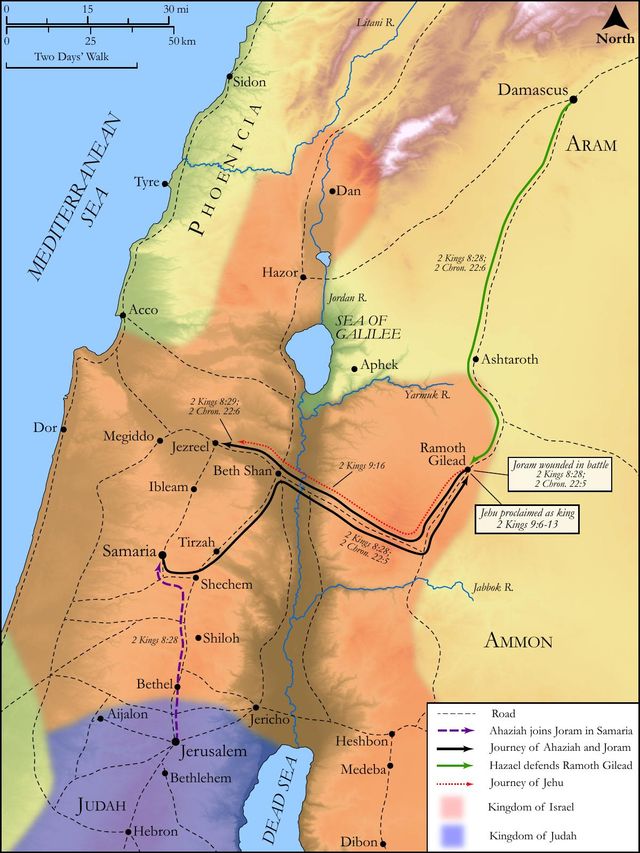
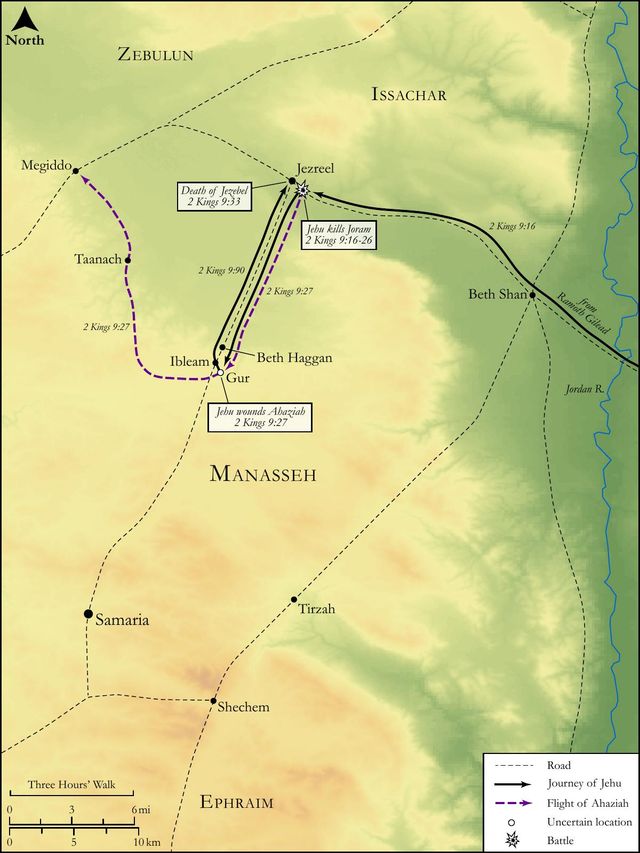
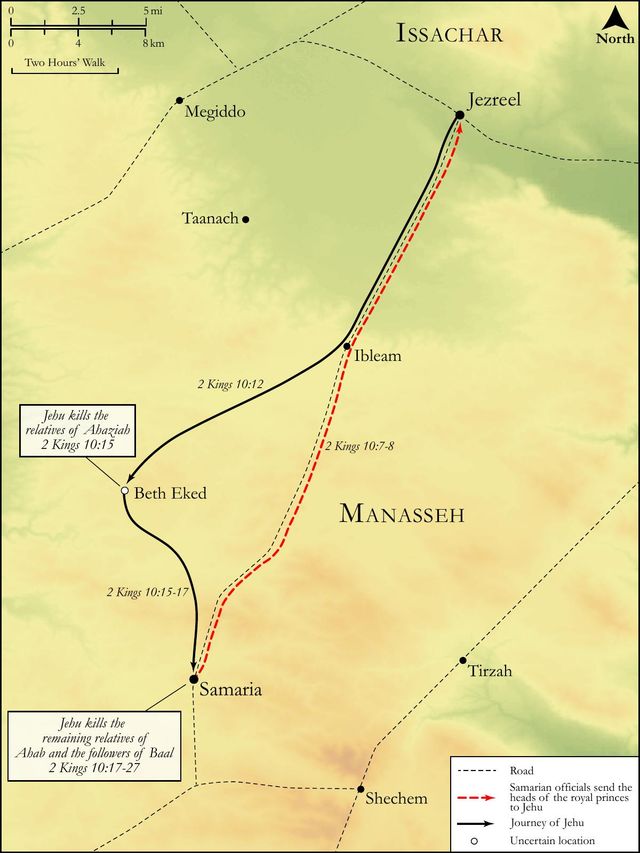
So it proved. Those that counsel us to do wickedly counsel us to our destruction; while they fawn, and flatter, and pretend friendship, they are really our worst enemies. Those that debauch young men destroy them. It was bad enough that they exposed him to the sword of the Syrians, drawing him in to join with Joram king of Israel in an expedition to Ramoth-Gilead, where Joram was wounded, an expedition that was not for his honour. Those that give us bad counsel in the affairs of religion, if regarded by us, may justly be made of God our counsellors to do foolishly in our own affairs. But that was not all: by engaging him in an intimacy with Joram king of Israel, they involved him in the common ruin of the house of Ahab. He came on a visit to Joram (Ch2 22:6) just at the time that Jehu was executing the judgment of God upon that idolatrous family, and so was cut off with them, Ch2 22:7-9. Here,
1.See and dread the mischief of bad company - of joining in with sinners. If not the infection, yet let the destruction be feared. Come out from Babylon, that falling house, Rev 18:4.
2.See and acknowledge the justice of God. His providence brought Ahaziah, just at this fatal juncture, to see Joram, that he might fall with him and be taken as in a snare. This we had an account of before, Kg2 9:27, Kg2 9:28. It is here added that he was decently buried (not as Jehoram, whose dead body was cast into Naboth's vineyard, Kg2 9:26), and the reason given is because he was the son (that is, the grandson) of good Jehoshaphat, who sought the Lord with his heart. Thus is he remembered with honour long after his death, and some respect shown even to his degenerate unworthy seed for his sake. The memory of the just is blessed, but the name of the wicked shall rot.
Continue studying 2 Chronicles 22:3 across the web’s major study libraries — every link below opens this exact verse, chapter, or book on the destination site.
Read & Compare
 BibleGatewayThis verse in more than 200 translations and 70 languages.
 Bible.comThe YouVersion reader — hundreds of translations, reading plans, and highlights.
 ESV.orgCrossway's official English Standard Version reader.
 NET BibleThe NET translation with 60,000+ translators' notes on every rendering decision.
 STEP BibleTyndale House's free study tool — original text, vocabulary, and scholarly resources.
 BibliaLogos Bible Software's free web reader.
 USCCBThe New American Bible (Revised Edition) with the U.S. bishops' study notes.
Commentaries
 BibleHub CommentariesDozens of classic commentaries on this verse, gathered on one page.
 StudyLightMore than 100 commentary sets — the largest collection on the web.
 BibleRefPlain-English commentary on what this verse means, verse by verse.
 Enduring WordDavid Guzik's free commentary on this chapter, widely used by Bible teachers.
 Bible Study ToolsVerse commentary alongside Greek and Hebrew study aids.
Original Language & Research
- BibleHub InterlinearThe verse word by word — original language, transliteration, and English.
- BibleHub LexiconEvery word's original-language definition and Strong's entry.
 Blue Letter BibleDeep-study tools — Strong's numbers, concordance, and word studies.
 SefariaThe Hebrew text with Rashi and centuries of Jewish commentary.
Sermons, Hymns & Audio


TrulyRandomVerse is not affiliated with these sites and doesn’t control their content. They’re linked because they’re genuinely useful.
Summary
King Ahaziah's brief and tragic reign in Judah is starkly summarized in a verse that encapsulates his profound spiritual declension. It attributes his wicked conduct directly to the corrupting influence of his mother, Athaliah, who actively counseled him towards ungodly practices, aligning him with the notorious idolatry and evil associated with the house of Ahab from the northern kingdom of Israel. This concise yet powerful statement underscores the devastating impact of ungodly counsel, the perils of compromising spiritual integrity, and the tragic continuation of a generational pattern of apostasy within the Davidic line.
Context
ShowHideLiterary Context
This verse is strategically placed by the Chronicler immediately following the ignominious death of King Jehoram, Ahaziah's father, as described in 2 Chronicles 21:19-20. Ahaziah, being the youngest surviving son, ascends the throne because all his older brothers had been tragically killed by a raiding party, as noted in 2 Chronicles 21:16-17. The Chronicler's overarching narrative consistently evaluates Judah's kings based on their faithfulness to Yahweh, attributing their success or failure to their adherence to or deviation from God's covenant. Ahaziah's reign, though remarkably short (only one year), is presented not as a new beginning but as a direct continuation and even intensification of the wickedness introduced by his father, Jehoram, who had married Athaliah, the daughter of the notoriously wicked King Ahab and Queen Jezebel of Israel. Thus, 2 Chronicles 22:3 serves as a pivotal explanatory statement, revealing the deep-seated spiritual corruption that defined Ahaziah's rule and setting the stage for the swift divine judgment that follows.
Historical & Cultural Context
Ahaziah's reign (c. 841 BC) occurred during a period of significant political and religious turmoil in both the northern kingdom of Israel and the southern kingdom of Judah. The Omride dynasty in Israel, particularly under Ahab and Jezebel, had aggressively promoted Baal worship and other idolatrous practices, directly challenging the exclusive worship of Yahweh. The marriage alliance between Jehoram of Judah and Athaliah, Ahab and Jezebel's daughter, was likely a calculated political move aimed at securing stability or influence between the two kingdoms. However, this alliance came at an immense spiritual cost, as Athaliah brought with her the deeply entrenched idolatry, ruthless political machinations, and moral depravity characteristic of her parents. In ancient Near Eastern monarchies, the queen mother frequently held a position of considerable power and influence, often serving as a key advisor to the king, especially if he was young or inexperienced. Athaliah's role as "counsellor" to Ahaziah, therefore, was culturally understandable in its function but devastating in its effect, as she actively promoted the very wickedness that God had condemned. This historical backdrop highlights the pervasive nature of idolatry and the grave dangers of compromising divine covenant principles for perceived political expediency.
Key Themes
ShowHide2 Chronicles 22:3 powerfully illustrates several recurring themes foundational to the books of Chronicles. Firstly, it underscores the corrupting influence of ungodly counsel, particularly when it emanates from those in positions of authority or intimate relationship. Athaliah's active role in advising Ahaziah "to do wickedly" vividly demonstrates how destructive negative influences can be, echoing the wisdom found in passages like Proverbs 13:20. Secondly, the verse highlights the severe consequences of ungodly alliances. The marriage between Jehoram and Athaliah, likely intended for political stability, directly introduced the spiritual depravity of the house of Ahab into the sacred Davidic line, leading to a profound decline in Judah's spiritual health. This theme resonates with warnings against intermarriage and foreign alliances found elsewhere in Scripture, such as in Nehemiah 13:23-27. Finally, it touches upon the theme of hereditary patterns of sin and divine judgment. While individual accountability remains paramount, the narrative clearly shows how patterns of sin can be perpetuated through generations, especially in the absence of righteous leadership, ultimately leading to severe consequences, a pervasive theme throughout the broader narrative of 2 Chronicles.
Exposition and Analysis
ShowHideKey Word Analysis
ShowHideThe Hebrew verb הָלַךְ (hâlak) is a primitive root meaning "to walk," but it is used in a great variety of applications, both literally and figuratively. In this context, "walked" is a common biblical idiom signifying a manner of life, a course of conduct, or adherence to a particular set of principles. Ahaziah's "walking" in the ways of Ahab indicates his adoption of their lifestyle, their religious practices, and their moral standards, rather than merely a physical journey. It emphasizes a deliberate and sustained pattern of behavior.
The Hebrew verb יָעַץ (yâʻats) means "to advise, consult, deliberate, or resolve." Here, it describes Athaliah's active, deliberate, and influential role in Ahaziah's life. She was not a passive figure but an intentional guide, steering his decisions and actions towards wickedness. This word underscores the direct and forceful nature of her negative influence, implying a malicious intent behind her guidance that led to Ahaziah's moral and spiritual downfall.
The Hebrew root רָשַׁע (râshaʻ), used here as an adverb, means "to be (causatively, do or declare) wrong; by implication, to disturb, violate." It describes actions that are contrary to God's law and righteous standards, implying moral depravity, criminality, and a state of rebellion against divine will. When applied to a king, it signifies a ruler who leads his people away from God and into idolatry and injustice, thereby incurring divine judgment.
Verse Breakdown
ShowHide"He also walked in the ways of the house of Ahab"
This opening clause immediately establishes King Ahaziah's spiritual and moral alignment. The phrase "walked in the ways" is a well-established biblical idiom for adopting a lifestyle, following a pattern of behavior, or adhering to a set of principles. The "house of Ahab" refers to the royal dynasty of the northern kingdom of Israel, infamous for its pervasive idolatry (particularly Baal worship), its persecution of Yahweh's prophets, and its profound moral corruption, largely instigated by King Ahab and Queen Jezebel (1 Kings 16:30-33). By choosing to "walk in their ways," Ahaziah explicitly rejected the covenant fidelity expected of a Davidic king in Judah and instead embraced the abominable practices of his pagan relatives, demonstrating a complete departure from the righteous path.
"for his mother was his counsellor to do wickedly"
This second clause provides the direct explanation and primary cause for Ahaziah's wicked conduct, establishing a clear causal link. His mother, Athaliah, who was the daughter of King Ahab and Queen Jezebel, actively and intentionally advised him to engage in ungodly practices. The term "counsellor" highlights her influential position, especially as a queen mother in an ancient monarchy, and the phrase "to do wickedly" underscores the deliberate and malicious nature of the evil she promoted. This reveals a tragic failure of parental guidance, where the one who should have nurtured righteousness instead cultivated depravity, leading Ahaziah down a path of rebellion against God and setting the stage for his swift demise.
Literary Devices
ShowHideThe verse employs several potent literary devices to convey its concise yet profound message. Metonymy is clearly evident in the phrase "the house of Ahab," where "house" (referring to the royal dynasty or lineage) stands for the entire system of idolatry, moral corruption, and rebellion against God that characterized Ahab's infamous reign. This allows the Chronicler to succinctly evoke a vast and well-known history of wickedness without needing to detail it. The phrase "walked in the ways" functions as a powerful metaphor for adopting a lifestyle or pattern of behavior, vividly illustrating Ahaziah's willing embrace of Ahab's ungodly path and departure from the ways of Yahweh. Furthermore, the verse presents a clear cause-and-effect relationship, explicitly stating that Ahaziah's wickedness was because his mother was his wicked counselor. This direct causal link serves as a strong didactic element, emphasizing the profound and often destructive impact of influence and counsel, particularly within family and leadership structures. The concise and direct nature of the statement also contributes to its epigrammatic quality, making it a memorable and impactful summary of Ahaziah's brief and lamentable reign.
Theological and Thematic Connections
ShowHide2 Chronicles 22:3 serves as a stark theological warning about the insidious power of corrupting influence, particularly within leadership and family structures. It underscores the biblical principle that bad company corrupts good character, a truth echoed throughout Scripture. Ahaziah's tragic trajectory demonstrates how even those in positions of immense authority can be led astray by ungodly counsel, leading to personal ruin and national apostasy. The verse implicitly contrasts Ahaziah's choices with the ideal of righteous leadership, where kings were meant to uphold God's law and guide their people in covenant faithfulness. It highlights the profound responsibility of those who advise and influence others, especially parents, to ensure their counsel aligns with divine wisdom and promotes righteousness, not wickedness. This passage also speaks to the persistent struggle against idolatry and the importance of maintaining spiritual purity within God's chosen people, a constant tension throughout the Old Testament narrative.
Reflection and Application
ShowHideThe account of King Ahaziah's brief and wicked reign, significantly shaped by his mother's destructive counsel, offers profound and enduring lessons for contemporary believers. It compels us to critically examine the sources of counsel we permit into our lives, whether they originate from family, friends, media, cultural trends, or even our own internal thoughts and desires. Are these influences drawing us closer to God's truth and righteousness, fostering spiritual growth and conformity to Christ, or are they subtly, or even overtly, leading us astray into compromise or outright sin? This verse challenges us to cultivate deep spiritual discernment, grounding ourselves so thoroughly in God's infallible Word that we can test all counsel against its unchanging standard. It also places a weighty responsibility on those in positions of influence—parents, mentors, teachers, spiritual leaders—to ensure their guidance is consistently godly, recognizing the profound and lasting impact their words and actions have on others, especially the young and impressionable. Ultimately, while external influences are undeniably powerful, we are each individually accountable before God for the choices we make, and we are called to actively choose paths of righteousness, even when contrary pressures or ungodly counsel abound.
Questions for Reflection
ShowHideFAQ
ShowHideWas Athaliah's influence on Ahaziah unique, or was it common for queen mothers to advise kings?
ShowHideWhile Athaliah's wicked influence on Ahaziah was tragically unique in its outcome and severity, the role of the queen mother as an advisor to the king was quite common and often highly influential in ancient Near Eastern monarchies, including Judah. The queen mother, known as the Gebirah in Judah, frequently held a prominent and powerful position within the royal court, sometimes even acting as a regent if the king was young or incapacitated. Examples such as Bathsheba advising Solomon (1 Kings 2:19) or Maacah, the mother of King Asa (1 Kings 15:13), demonstrate their significant roles and potential for both positive and negative influence. What made Athaliah's case so devastating was not her position, but the content of her counsel, which actively promoted the idolatry and wickedness of the house of Ahab, leading her son to abandon the Lord and ultimately contributing to the near-extinction of the Davidic line.
Christ-Centered Fulfillment
ShowHideWhile 2 Chronicles 22:3 vividly portrays the devastating consequences of ungodly counsel and the tragic trajectory of a king who "walked in the ways of wickedness," it ultimately points to the ultimate King, Jesus Christ, who perfectly embodies righteous counsel and offers complete deliverance from the dominion of sin. Unlike Ahaziah, who was led astray by his mother's wicked advice, Jesus always perfectly obeyed His Father's will, declaring, "I do nothing on my own authority, but speak just as the Father taught me" and "I always do what pleases him". He is the "Wonderful Counselor" prophesied by Isaiah, whose counsel always leads to life, truth, and righteousness, never to wickedness or destruction. Where human leaders like Ahaziah failed and led their people into spiritual ruin, Christ is the faithful Shepherd who lays down His life for His sheep (John 10:11) and guides them into paths of righteousness (Psalm 23:3). His perfect life of obedience, culminating in His atoning sacrifice on the cross, breaks the hereditary patterns of sin and the power of corrupting influences, offering forgiveness and profound transformation to all who trust in Him, enabling them to "walk in newness of life" rather than in the ways of wickedness. He is the true King whose reign is characterized by justice and righteousness, establishing an eternal kingdom that will never be corrupted or overthrown by evil counsel.