


2 Kings 9:26
- אִם'imifH518PrtParticle Conditional
- לֹאlo'notH3808NegParticle Negative
- אֶת'et<obj.>H853DirObjMParticle Object Indicator
- דְּמֵיde·Mei[the] blood<s> ofH1818N-mpcNoun Plural Masculine Construct
- נָבוֹתna·VotNabothH5022N-proper-mNoun Proper Masculine
- וְאֶתve·'Etand <obj.>H853Conj-w ¦ DirObjMParticle Object Indicatorוְandאֶת<obj.>
- דְּמֵיde·Mei[the] blood<s> ofH1818N-mpcNoun Plural Masculine Construct
- בָנָיוva·Navhis sonsH1121N-mpc ¦ 3msNoun Plural Masculine Constructבָנָיsonsוhis
- רָאִיתִיra·'I·tiI sawH7200V-Qal-Perf-1csVerb Qal Perfect 1st Singular common gender
- אֶמֶשׁ'e·meshyesterdayH570N-msNoun Singular Masculine Absolute
- נְאֻםne·'um[the] utterance ofH5002N-mscNoun Singular Masculine Construct
- יְהוָהYah·wehYahwehH3068N-properNoun Proper Title
- וְשִׁלַּמְתִּיve·shi·lam·Tiand I will repayH7999Conj-w ¦ V-Piel-ConsecPerf-1csVerb Piel Consecutive Perfect 1st Singular common genderוְandשִׁלַּמְתִּיI will repay
- לְךָle·Khato youPrep-l ¦ 2msSuffix Personal 2nd Singular Masculineלְtoךָyou
- בַּחֶלְקָהba·chel·Kahon the portion of landH2513Prep-b ¦ N-fsNoun Singular Feminine Absoluteבַּon theחֶלְקָהportion of land
- הַזֹּאתha·Zot<the> thisH2063Art ¦ PrtParticle Demonstrativeהַ<the>זֹּאתthis
- נְאֻםne·'um[the] utterance ofH5002N-mscNoun Singular Masculine Construct
- יְהוָהYah·wehYahwehH3068N-properNoun Proper Title
- וְעַתָּהve·'a·Tahand thereforeH6258Conj-w ¦ AdvAdverbוְandעַתָּהtherefore
- שָׂאsa'pick [him] upH5375V-Qal-Imp-2msVerb Qal Imperative 2nd Singular Masculine
- הַשְׁלִכֵהוּhash·li·Khe·huthrow himH7993V-Hiphil-Imp-2ms ¦ 3msVerb Hiphil Imperative 2nd Singular Masculineהַשְׁלִכֵthrowהוּhim
- בַּחֶלְקָהba·chel·Kahon the portion of landH2513Prep-b ¦ N-fsNoun Singular Feminine Absoluteבַּon theחֶלְקָהportion of land
- כִּדְבַרkid·Varaccording to [the] word ofH1697Prep-k ¦ N-mscNoun Singular Masculine Constructכִּaccording toדְבַר[the] word of
- יְהוָהYah·wehYahwehH3068N-properNoun Proper Title
English is a literal word-by-word gloss of the Hebrew, not the KJV's wording. Why?
This is the original text the KJV's translators worked from — each Hebrew word with its own literal English meaning in this verse, prepared by scholars at Tyndale House, Cambridge. The KJV translates whole sentences, not word by word, so its wording differs: one Hebrew word can become several English words, and the KJV may choose “the LORD” where the gloss reads “Yahweh”. Both are faithful — they answer different questions. For the KJV's own rendering, switch to the KJV text.
Details
See on the biblical-era map
Study this verse
Public-domain commentary
Matthew Henry
From his Commentary on the Whole Bible. Henry comments on passages, not single verses — this entry covers 2 Kings 9:16–29. His four-level outline is real structure in the source text, so it is rendered as structure.
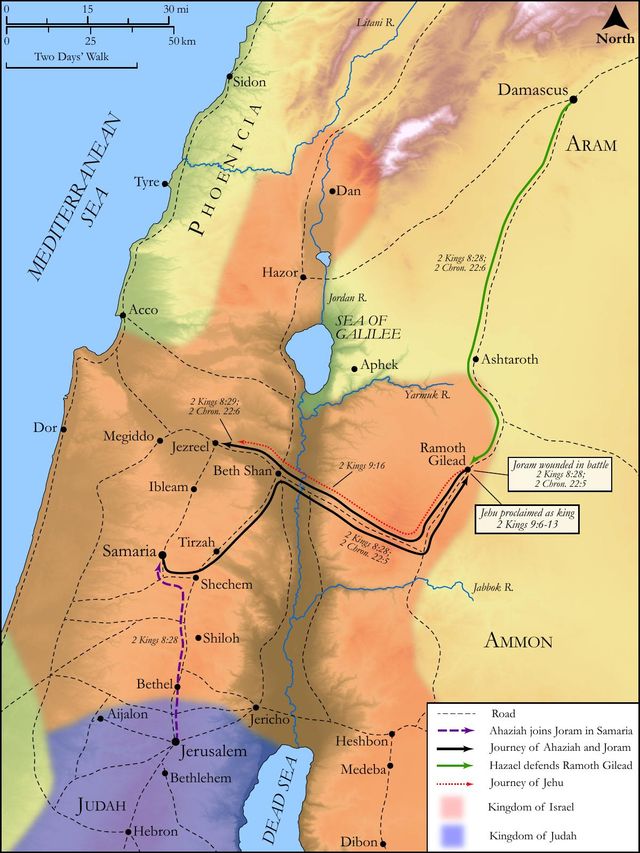
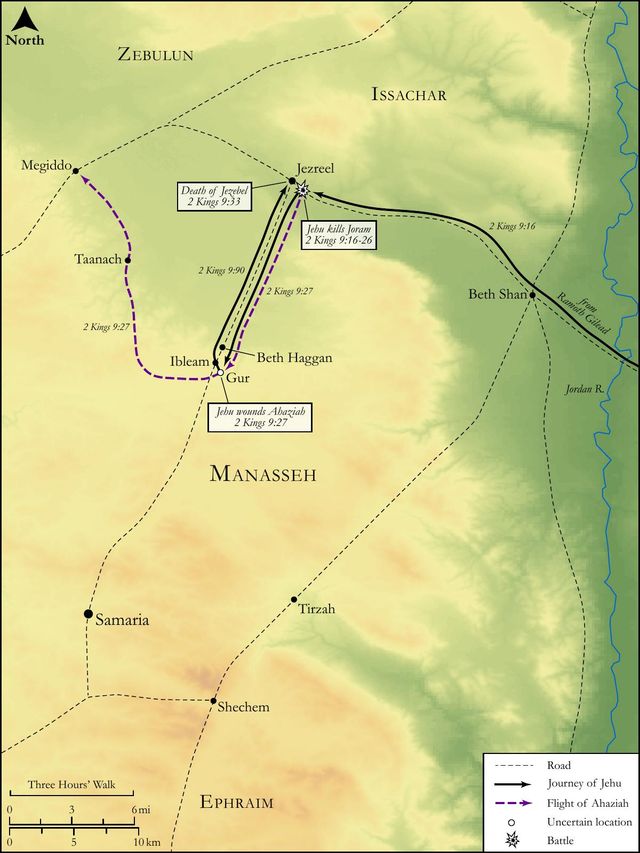
From Ramoth-Gilead to Jezreel was more than one day's march; about the mid-way between them the river Jordan must be crossed. We may suppose Jehu to have marched with all possible expedition, and to have taken the utmost precaution to prevent the tidings from getting to Jezreel before him; and, at length, we have him within sight first, and then within reach, of the devoted king.
I.Joram's watchman discovers him first at a distance, him and his retinue, and gives notice to the king of the approach of a company, whether of friends or foes he cannot tell. But the king (impatient to know what is the matter, and perhaps jealous that the Syrians, who had wounded him, had traced him by the blood to his own palace, and were coming to seize him) sent first one messenger, and then another, to bring him intelligence, Kg2 9:17-19. He had scarcely recovered from the fright he was put into in the battle, and his guilty conscience put him into a continual terror. Each messenger asked the same question: "Is it peace? are you for us or for our adversaries? Do you bring good tidings or bad?" Each had the same answer: What hast thou to do with peace? Turn thee behind me, Kg2 9:18. 19. As if he had said, "It is not to thee, but to him that sent thee, that I will give answer; for thy part, if thou consult thy own safety, turn thee behind me, and enlist thyself among my followers." The watchman gave notice that the messengers were taken prisoners, and at length observed that the leader of this troop drove like Jehu, who it seems was noted for driving furiously, thereby discovering himself to be a man of a hot eager spirit, intent upon his business, and pushing forward with all his might. A man of such a violent temper was fittest for the service to which Jehu was designated. The wisdom of God is seen in the choice of proper instruments to be employed in his work. But it is not much for any man's reputation to be known by his fury. He that has rule over his own spirit is better than the mighty. The Chaldee paraphrase gives this a contrary sense: The leading is like that of Jehu, for he leads quietly. And, it should seem, he did not come up very fast, for then there would not have been time for all this that passed. And some think he chose to march slowly, that he might give Joram time to come out to him, and so dispatch him before he entered the city.
II.Joram himself goes out to meet him, and takes Ahaziah king of Judah along with him, neither of them equipped for war, as not expecting an enemy, but in haste to have their curiosity satisfied. How strangely has Providence sometimes ordered it, that men have been in haste to meet their ruin when their day has come to fall.
1.The place where Joram met Jehu was ominous: In the portion of Naboth the Jezreelite, Kg2 9:21. The very sight of that ground was enough to make Joram tremble and Jehu triumph; for Joram had the guilt of Naboth's blood fighting against him and Jehu had the force of Elijah's curse fighting for him. The circumstances of events are sometimes so ordered by divine Providence as to make the punishment answer to the sin as face answers to face in a glass.
2.Joram's demand was still the same: "Is it peace, Jehu? Is all well? Dost thou come home thus flying from the Syrians or more than a conqueror over them?" It seems, he looked for peace, and could not entertain any other thought. Note, It is very common for great sinners, even when they are upon the brink of ruin, to flatter themselves with an opinion that all is well with them, and to cry peace to themselves.
3.Jehu's reply was very startling. He answered him with a question: What peace canst thou expect, so long as the whoredoms of thy mother Jezebel (who, though queen dowager, was in effect queen regent) and her witchcrafts are so many? See how plainly Jehu deals with him. Formerly he durst not do so, but now he had another spirit. Note, Sinners will not always be flattered; one time or other, they will have their own given them, Psa 36:2. Observe,
(1.)He charges upon him his mother's wickedness, because he had at first learned it and then with his kingly power protected it. She stands impeached for whoredom, corporal and spiritual (serving idols and serving them with the very acts of lewdness), for witchcraft likewise, enchantments and divinations, used in honour of her idols; and these multiplied, the whoredoms and the witchcrafts many; for those that abandon themselves to wicked courses know not where they will stop. One sin begets another.
(2.)Upon that account he throws him off from all pretensions to peace: "What peace can come to that house in which there is so much wickedness unrepented of?" Note, The way of sin can never be the way of peace, Isa 57:21. What peace can sinners have with God, what peace with their own consciences, what good, what comfort, can they expect in life, in death, or after death, who go on still in their trespasses? No peace so long as sin is persisted in; but, as soon as it is repented of and forsaken, there is peace.
4.The execution was done immediately. When Joram heard of his mother's crimes his heart failed him; he presently concluded the long-threatened day of reckoning had now come, and cried out, "There is treachery, O Ahaziah! Jehu is our enemy, and it is time for us to shift for our safety." Both fled, and,
(1.)Joram king of Israel was slain presently, Kg2 9:24. Jehu dispatched him with his own hands. The bow was not drawn at a venture, as that which sent the fatal arrow through the joints of his father's harness, but Jehu directed the arrow between his shoulders as he fled (it was one of God's arrows which he has ordained against the persecutor, Psa 7:13), and it reached to his heart, so that he died upon the spot. He was now the top branch of Ahab's house, and therefore was first cut off. He died a criminal, under the sentence of the law, which Jehu, the executioner, pursues in the disposal of the dead body. Naboth's vineyard was hard by, which put him in mind of that circumstance of the doom Elijah passed upon Ahab, "I will requite thee in this plat, said the Lord (Kg2 9:25, Kg2 9:26), for the blood of Naboth himself, and for the blood of his sons," who were either put to death with him as partners in his crime, or secretly murdered afterwards, lest they should bring an appeal, or find some way to avenge their father's death, or break their hearts for the loss of him, or (his whole estate being confiscated, as well as his vineyard) lose their livelihoods, which was in effect to lose their lives. For this the house of Ahab must be reckoned with; and that very piece of ground which he, with so much pride and pleasure, had made himself master of at the expense of the guilt of innocent blood, now became the theatre on which his son's dead body lay exposed a spectacle to the world. Thus the Lord is known by the judgment which he executeth. Higgaion. Selah.
(2.)Ahaziah king of Judah was pursued, and slain in a little time, and not far off, Kg2 9:27, Kg2 9:28.
[1.]Though he was now in Joram's company, he would not have been slain but that he was joined with the house of Ahab both in affinity and in iniquity. He was one of them (so he had made himself by his sins) and therefore he must fare as they fared. Jehu justly construed his commission as extending to them. Yet,
[2.]Perhaps he would not at this time have fallen with them if he had not been found in company with them. It is a dangerous thing to associate with evil-doers; we may be entangled both in guilt and misery by it.
Historical interpretation
Historical reception
1 surviving comment on this verse from the historical church.
“Then the prophet Elisha called a member of the company of prophets and said to him, ‘Gird up your loins; take this flask of oil in your hand, and go to Ramoth-gilead.’ ” Here the Scripture reports the just sentence that befalls the house of Ahab. Immediately it speaks about the choice of the judge and executor of the judgment. And this was Jehu, the son of Nimshi, who, on the word of the Lord, anointed one of the prophets for the royalty. And this was the disciple of Elisha who was sent by his master to the city of Ramoth-gilead, which was under the siege of the Israelites. He entered their camp and went to the tent where the commanders of the army gathered and standing before them, he naively said, “I have a message for you, commander.” Jehu said in reply, “For which one of us?” The servant realized that he was the one indicated by Elisha. In fact, he did not know his name, but even though the son of the prophet did not know him nor had ever seen him, he saw the importance of this situation, and his mind was troubled, so that he said, “For you, commander.” He showed that through the revelation of God he had realized that he was the one chosen by God. And immediately he took him into an inner chamber, according to the order of his master. And two things were also hidden: Jehu understood that that affair had to remain secret and that the news [of the anointing] should not be divulged at that time among the people. Therefore he anointed him and ordered him to take revenge against the house of Ahab. Then the prophet fled at once from the camp, and shortly later the entire assembly was in an admirable unanimity before king Jehu against Israel.So he went out with a group of select men. But he met Joram, king of Israel, in the course of his journey, and little later Ahaziah, king of Judah. He was able to defeat them after the first attack and killed them both. Jehu said to Bidkar, “ ‘Lift him out, and throw him on the plot of ground belonging to Naboth the Jezreelite,’ because last night I saw the blood of Naboth and the blood of his children.” He is thinking here about what had been said to him at night, or maybe he believes that this vengeance and the fact that he would kill Joram had been predicted to him at night through a vision. Jehu had also indicated to Bidkar another reason for killing Joram in his place and for ordering him to throw him on the plot of Naboth, saying, “When you and I rode side by side behind his father Ahab how the Lord uttered this oracle against him: ‘For the blood of Naboth and for the blood of his children that I saw yesterday, says the Lord, I swear I will repay you on this very plot of ground,’ ” that is, outside the walls of Jezreel where the goods of Naboth were. After this action accomplished outside the gates of Jezreel, he entered the city to complete what he had successfully begun.
Continue studying 2 Kings 9:26 across the web’s major study libraries — every link below opens this exact verse, chapter, or book on the destination site.
Read & Compare
 BibleGatewayThis verse in more than 200 translations and 70 languages.
 Bible.comThe YouVersion reader — hundreds of translations, reading plans, and highlights.
 ESV.orgCrossway's official English Standard Version reader.
 NET BibleThe NET translation with 60,000+ translators' notes on every rendering decision.
 STEP BibleTyndale House's free study tool — original text, vocabulary, and scholarly resources.
 BibliaLogos Bible Software's free web reader.
 USCCBThe New American Bible (Revised Edition) with the U.S. bishops' study notes.
Commentaries
 BibleHub CommentariesDozens of classic commentaries on this verse, gathered on one page.
 StudyLightMore than 100 commentary sets — the largest collection on the web.
 BibleRefPlain-English commentary on what this verse means, verse by verse.
 Enduring WordDavid Guzik's free commentary on this chapter, widely used by Bible teachers.
 Bible Study ToolsVerse commentary alongside Greek and Hebrew study aids.
Original Language & Research
- BibleHub InterlinearThe verse word by word — original language, transliteration, and English.
- BibleHub LexiconEvery word's original-language definition and Strong's entry.
 Blue Letter BibleDeep-study tools — Strong's numbers, concordance, and word studies.
 SefariaThe Hebrew text with Rashi and centuries of Jewish commentary.
Sermons, Hymns & Audio


TrulyRandomVerse is not affiliated with these sites and doesn’t control their content. They’re linked because they’re genuinely useful.
Summary
Second Kings 9:26 records the LORD's solemn declaration of judgment against the house of Ahab, delivered through Jehu, immediately following the execution of King Joram, Ahab's son. This verse directly links Joram's demise to the unpunished murder of Naboth and his sons, prophesied decades earlier by Elijah. It powerfully underscores God's unwavering commitment to justice, demonstrating His omniscience and perfect memory of all wrongdoing, and His certainty in bringing about righteous requital, often in a manner that precisely mirrors the original transgression.
Context
ShowHideLiterary Context
This verse serves as the pivotal moment in the execution of Jehu's divinely appointed mission to eradicate the corrupt Omride dynasty. The narrative begins with Jehu's anointing by a prophet of Elisha, who explicitly commissions him to "strike down the house of Ahab" as divine retribution for their idolatry and the bloodshed of God's prophets and Naboth (2 Kings 9:7-10). Jehu swiftly mobilizes, encountering King Joram of Israel and King Ahaziah of Judah at the very vineyard of Naboth (2 Kings 9:21). Following a brief, tense exchange, Jehu shoots Joram through the heart, fulfilling a portion of the prophecy (2 Kings 9:24). It is immediately after Joram falls that Jehu turns to Bidkar, his captain, and utters the command found in this verse, explicitly recalling Elijah's prophecy. The act of casting Joram's body into Naboth's field is the physical manifestation of this divine judgment, setting the stage for the subsequent, comprehensive eradication of Jezebel and the remaining descendants of Ahab.
Historical & Cultural Context
The Omride dynasty, particularly King Ahab and Queen Jezebel, were infamous for their aggressive promotion of Baal worship in Israel, leading to widespread idolatry and severe persecution of Yahweh's prophets. The incident of Naboth's vineyard, detailed in 1 Kings 21, stands as the foundational injustice that precipitates the judgment described in 2 Kings 9. Ahab coveted Naboth's ancestral inheritance, and when Naboth righteously refused to sell, Jezebel orchestrated a malicious scheme involving false witnesses and a rigged trial to have Naboth and his sons stoned to death for blasphemy, thereby allowing Ahab to seize the vineyard. This act was a profound violation of fundamental Israelite law and covenant principles, particularly the sanctity of ancestral land, the prohibition against covetousness, and the sanctity of life. The concept of "requital" or divine retribution was a powerful theological principle in ancient Israel, often manifesting as a "measure for measure" justice, where the punishment mirrored the crime, sometimes even occurring in the same geographical location.
Key Themes
ShowHideThis verse powerfully encapsulates several overarching themes prevalent within the Deuteronomistic History and the prophetic literature. Foremost is the theme of Divine Justice and Retribution, asserting God's active involvement in human affairs and His unwavering commitment to judging injustice. The phrase "I will requite thee in this plat" highlights the principle of poetic justice, where the punishment directly relates to the crime and its specific location. Secondly, it demonstrates the Fulfillment of Prophecy, specifically Elijah's pronouncement against Ahab's house in 1 Kings 21:19-24, proving that God's word is certain and will not return void, regardless of the passage of time. Thirdly, it underscores the Consequences of Unrepentant Sin, particularly those involving covetousness, murder, and idolatry, showing that the effects of sin can extend across generations and lead to severe, even generational, judgment. Finally, it illustrates God's Sovereignty, as He uses human agents like Jehu to execute His righteous decrees and bring about His purposes in history, ensuring that His will is accomplished.
Exposition and Analysis
ShowHideKey Word Analysis
ShowHideThis noun refers to "blood (as that which when shed causes death) of man or an animal." In ancient Israelite thought, blood was synonymous with life, and the shedding of innocent blood was a heinous crime that "cried out" for justice, as seen in Genesis 4:10. The repeated mention of "the blood of Naboth, and the blood of his sons" highlights the severity of the original sin, emphasizing the complete destruction of Naboth's lineage and the profound guilt incurred by Ahab and Jezebel. It signifies the life unjustly taken and the lasting stain of that injustice in God's sight, demanding divine retribution.
This feminine noun refers to "a portion; field, flattering(-ry), ground, parcel, part, piece of land (ground), plat, portion, slippery place, smooth (thing)." Its specificity here is crucial. It is not just any field, but the very "plat" of Naboth's vineyard, the scene of the original crime. This precise geographical detail emphasizes the "measure for measure" nature of God's justice, where the place of transgression becomes the place of retribution, making the judgment undeniably clear and symbolically potent.
This primitive root means "to be safe (in mind, body or estate); figuratively, to be (causatively, make) completed; by implication, to be friendly; by extension, to reciprocate (in various applications)." In this context, it signifies divine recompense, vengeance, or just repayment for the evil committed by Ahab and Jezebel. It implies God's active intervention to settle accounts and ensure justice is served, representing not merely a passive observation but an active, decisive act of judgment that brings completion to the matter.
Verse Breakdown
ShowHide"Surely I have seen yesterday the blood of Naboth, and the blood of his sons, saith the LORD"
This opening clause is a powerful divine declaration, emphasizing God's omniscience and perfect memory. The phrase "yesterday" from God's perspective does not imply a recent event in human time, but rather that the injustice is perpetually fresh and present in God's eternal memory; no crime goes unseen, and no injustice is forgotten. The specific mention of "Naboth, and the blood of his sons" underscores the comprehensive nature of the original crime—not just Naboth, but his entire lineage was wiped out to seize his inheritance, intensifying the guilt and the subsequent divine wrath. This is God's direct testimony, affirming His knowledge and righteous indignation.
"and I will requite thee in this plat, saith the LORD"
This is the core of the divine judgment and the declaration of impending retribution. "Requite" signifies God's active repayment or vengeance, bringing the matter to completion. The pronoun "thee" refers to Joram, representing the house of Ahab, indicating that the judgment for the grievous sins of the parents is now falling upon the offspring, a common biblical theme for corporate sin. The critical phrase "in this plat" directly links the punishment to the scene of the original crime, Naboth's vineyard. This is a vivid demonstration of poetic justice, where the very ground defiled by injustice becomes the ground of retribution, ensuring a clear and undeniable connection between sin and its consequence.
"Now therefore take [and] cast him into the plat [of ground], according to the word of the LORD."
This is Jehu's direct command to Bidkar, his captain, to execute the divine judgment. The imperative "take and cast him" emphasizes the immediate and physical fulfillment of the prophecy. Joram's body, representing the culmination of Ahab's wicked lineage, is to be desecrated by being left unburied in the very field that was unjustly acquired. The phrase "according to the word of the LORD" explicitly states that Jehu is merely an instrument in God's hands, carrying out a preordained divine decree, underscoring God's sovereignty and the certainty of His prophetic word.
Literary Devices
ShowHideThe passage is rich with Poetic Justice, as the punishment for Ahab's house occurs precisely in the location of their heinous crime. Joram's body is cast into Naboth's vineyard, where Naboth's blood was shed, creating a powerful and undeniable link between the sin and its consequence. This serves as a stark Fulfillment of Elijah's prophecy against Ahab in 1 Kings 21:19. The narrative demonstrates Irony in that the very land Ahab coveted and acquired through murder now becomes the site of his son's ignominious end. The "plat" itself functions as potent Symbolism, representing not only the specific location of the crime but also the enduring memory of injustice in God's sight and the certainty of His impending judgment. The recurring mention of "blood" also serves as Symbolism, representing life unjustly taken and the indelible guilt that cries out for divine retribution.
Theological and Thematic Connections
ShowHideSecond Kings 9:26 profoundly illustrates the biblical principle of divine justice, demonstrating that God is not indifferent to human suffering or wrongdoing. He is a righteous judge who sees, remembers, and will ultimately bring about recompense for every injustice. This passage reminds us that while God may be patient, His word is sure, and His judgments are certain, even if they are delayed across generations. It underscores the gravity of sin, particularly those involving covetousness, violence, and the oppression of the innocent, showing that such actions have severe and lasting consequences that extend beyond the immediate perpetrators. For the believer, this truth provides both comfort—knowing that God will ultimately right all wrongs—and a sober warning about accountability, motivating a pursuit of righteousness and justice in our own lives and in society.
Reflection and Application
ShowHideThis ancient narrative of divine retribution holds profound relevance for believers today. It calls us to a deep trust in God's sovereign justice, even when the world around us seems rife with unpunished evil and the scales of justice appear imbalanced. We are reminded that God sees every hidden injustice, hears every cry of the oppressed, and will, in His perfect timing, bring about His righteous judgment. This truth should stir within us a renewed commitment to personal holiness, understanding the serious and far-reaching consequences of sin, and to actively pursuing justice and mercy in our communities, reflecting the very character of God. While we are not called to take vengeance into our own hands, we are called to be agents of righteousness, pleading the cause of the vulnerable, rebuking the powerful, and standing against oppression, knowing that our God is ultimately the one who "requites" and will make all things right.
Questions for Reflection
ShowHideFAQ
ShowHideWhy did God wait so long to bring judgment upon Ahab's house for Naboth's murder?
ShowHideGod's timing is often not our timing, but it is always perfect and purposeful. While the immediate prophecy against Ahab for Naboth's murder was given in 1 Kings 21:19, Ahab's temporary and superficial repentance led God to defer the full judgment until his son's generation 1 Kings 21:29. This demonstrates God's patience and long-suffering, offering opportunity for repentance even to the most wicked. However, it also underscores the certainty of His word; though delayed, the judgment was not denied. God's justice is unwavering, and His promises, both of blessing and judgment, will ultimately be fulfilled in His sovereign plan.
Was Jehu justified in his brutal actions, or was he merely a ruthless opportunist?
ShowHideThe biblical narrative presents Jehu as God's chosen instrument to execute a specific divine judgment against the house of Ahab. He was anointed by a prophet of Elisha with the explicit commission to "strike down the house of Ahab your master, that I may avenge on Jezebel the blood of my servants the prophets and the blood of all the servants of the Lord" 2 Kings 9:7. While his methods were indeed brutal and shocking to modern sensibilities, they were carried out "according to the word of the LORD" 2 Kings 9:26. The text does not primarily portray him as acting out of personal ambition, but as fulfilling a divine mandate. However, it's also noted that later in his reign, Jehu himself fell short of fully following the Lord, indicating that even divine instruments can have their own moral failings 2 Kings 10:31.
Christ-Centered Fulfillment
ShowHideWhile 2 Kings 9:26 depicts a severe act of Old Testament judgment and retribution, it powerfully foreshadows the ultimate fulfillment of divine justice and God's righteous requital in Jesus Christ. The "blood of Naboth and his sons" crying out for justice finds its ultimate answer not merely in human vengeance, but in the innocent blood of the Lamb of God who takes away the sin of the world. On the cross, Jesus, the perfectly righteous one, bore the full weight of God's righteous wrath against sin, becoming the ultimate "requital" for humanity's rebellion 2 Corinthians 5:21. He did not come into the world to condemn the world, but that the world through Him might be saved John 3:17. Yet, He is also the one appointed by God to be the final judge of the living and the dead Acts 17:31. Thus, the certainty of God's justice, so vividly displayed in Jehu's actions, finds its perfect expression in Christ's atoning sacrifice for those who believe, and in His future return to execute righteous judgment upon all unrighteousness, ensuring that every injustice will ultimately be addressed and every wrong made right in His perfect timing Revelation 20:11-15.