


2 Chronicles 22:6
Bible text: King James Version (1769 Blayney text) · Public domain
Bible text: King James Version with Strong's numbers · Public domain
Bible text: Berean Standard Bible · Public domain
Bible text: American Standard Version (1901) · Public domain
Bible text: World English Bible, Messianic edition · Public domain
Bible text: Geneva Bible (1599) · Public domain
Bible text: Young's Literal Translation · Public domain
- וַיָּשָׁבvai·Ya·shovand he returnedH7725Conj-w ¦ V-Qal-ConsecImperf-3msVerb Qal Consecutive Imperfect 3rd Singular Masculineוַandיָּשָׁבhe returned
- לְהִתְרַפֵּאle·hit·ra·Pe'to get himself healedH7495Prep-l ¦ V-Hithpael-InfVerb Hithpael Infinitive Constructלְtoהִתְרַפֵּאget himself healed
- בְיִזְרְעֶאלve·yiz·re·'Elin JezreelH3157Prep-b ¦ N-properNoun Proper LocationבְinיִזְרְעֶאלJezreel
- כִּיkiforH3588PrtParticle Conditional
- הַמַּכִּיםha·ma·Kimthe woundsH4347Art ¦ N-mpNoun Plural Masculine Absoluteהַtheמַּכִּיםwounds
- אֲשֶׁר'a·SherwhichH834RelParticle Relative
- הִכֻּהוּhi·Ku·huthey had wounded himH5221V-Hiphil-Perf-3cp ¦ 3msVerb Hiphil Perfect 3rd Plural common genderהִכֻּthey had woundedהוּhim
- בָרָמָהva·ra·Mahat <the> RamahH7414Prep-b ¦ N-properNoun Proper Locationבָat <the>רָמָהRamah
- בְּהִלָּחֲמוֹbe·hi·La·cha·Mowhen he foughtH3898Prep-b ¦ V-Niphal-Inf ¦ 3msVerb Niphal Infinitive Constructבְּwhenהִלָּחֲמfoughtוֹhe
- אֶת'etwithH854PrepPreposition
- חֲזָהאֵלcha·za·h·'ElHazaelH2371N-proper-mNoun Proper Masculine
- מֶלֶךְMe·lekh[the] king ofH4428N-mscNoun Singular Masculine Construct
- אֲרָם'a·RamAramH758N-properNoun Proper Location
- וַעֲזַרְיָהוּva·'a·zar·Ya·huand AzariahH5838Conj-w ¦ N-proper-mNoun Proper MasculineוַandעֲזַרְיָהוּAzariah
- בֶןven[the] son ofH1121N-mscNoun Singular Masculine Construct
- יְהוֹרָםye·ho·RamJehoramH3088N-proper-mNoun Proper Masculine
- מֶלֶךְMe·lekh[the] king ofH4428N-mscNoun Singular Masculine Construct
- יְהוּדָהye·hu·DahJudahH3063N-properNoun Proper Location
- יָרַדya·Radhe went downH3381V-Qal-Perf-3msVerb Qal Perfect 3rd Singular Masculine
- לִרְאוֹתlir·'otto seeH7200Prep-l ¦ V-Qal-InfVerb Qal Infinitive Constructלִtoרְאוֹתsee
- אֶת'et<obj.>H853DirObjMParticle Object Indicator
- יְהוֹרָםye·ho·RamJehoramH3088N-proper-mNoun Proper Masculine
- בֶּןben[the] son ofH1121N-mscNoun Singular Masculine Construct
- אַחְאָב'ach·'AvAhabH256N-proper-mNoun Proper Masculine
- בְּיִזְרְעֶאלbe·yiz·re·'Elin JezreelH3157Prep-b ¦ N-properNoun Proper LocationבְּinיִזְרְעֶאלJezreel
- כִּיkiforH3588PrtParticle Conditional
- חֹלֶהcho·Leh[was] being illH2470V-Qal-Prtcpl-msVerb Qal Participle Singular Masculine Absolute
- הוּאHu'heH1931Pro-3msPronoun Personal 3rd Singular Masculine
English is a literal word-by-word gloss of the Hebrew, not the KJV's wording. Why?
This is the original text the KJV's translators worked from — each Hebrew word with its own literal English meaning in this verse, prepared by scholars at Tyndale House, Cambridge. The KJV translates whole sentences, not word by word, so its wording differs: one Hebrew word can become several English words, and the KJV may choose “the LORD” where the gloss reads “Yahweh”. Both are faithful — they answer different questions. For the KJV's own rendering, switch to the KJV text.
Details
See on the biblical-era maps
Study this verse
Public-domain commentary
Matthew Henry
From his Commentary on the Whole Bible. Henry comments on passages, not single verses — this entry covers 2 Chronicles 22:1–9. His two-level outline is real structure in the source text, so it is rendered as structure.
We have here an account of the reign of Ahaziah, a short reign (of one year only), yet long enough, unless it had been better. He was called Jeho-ahaz (Ch2 21:17); here he is called Ahaz-iah, which is the same name and of the same signification, only the words of which it is compounded are transposed. He is here said to be forty-two years old when he began to reign (Ch2 22:2), which could not be, for his father, his immediate predecessor, was but forty when he died, and it is said (Kg2 8:26) that he was twenty-two years old when he began to reign. Some make this forty-two to be the age of his mother Athaliah, for in the original it is, he was the son of forty-two years, that is, the son of a mother that was of that age; and justly is her age put for his, in reproach to him, because she managed him, and did what she would - she, in effect, reigned, and he had little more than the title of king. Many good expositors are ready to allow that this, with some few more such difficulties, arise from the mistake of some transcriber, who put forty-two for twenty-two, and the copies by which the error should have been corrected might be lost. Many ancient translations read it here twenty-two. Few books are now printed without some errata, yet the authors do not therefore disown them, nor are the errors of the press imputed to the author, but the candid reader amends them by the sense, or by comparing them with some other part of the work, as we may easily do this.
The history of Ahaziah's reign is briefly summed up in two clauses, Ch2 22:3, Ch2 22:4. His mother and her relations were his counselors to do wickedly, and it was to his destruction.
I.He did wickedly.
Though by a special providence of God he was preserved alive, when all his brethren were slain, and reserved for the crown, notwithstanding he was the youngest of them - though the inhabitants of Jerusalem, when they had buried his father ingloriously, made him king, in hopes he would take warning by that not to tread in his steps, but would do better for himself and his kingdom - yet he was not influenced by the favours either of God or man, but walked in the way of the house of Ahab, did evil in the sight of the Lord like them (Ch2 22:3, Ch2 22:4), that is, he worshipped, Baalim and Ashtaroth, supposing (as the learned bishop Patrick thinks) that by these demons, as mediators, they might have easier access to the supreme Numen, the God of Israel, or that these they might resort to at all times and for all matters, as being nearer at hand, and not of so high a dignity, but of a middle nature between the immortal God and mortal men - deified heroes; so they worshipped them as the church of Rome does saints and angels. That was sufficiently bad; but I wish there was no reason to suspect worse. I am apprehensive that they looked upon Jehovah, the God of their fathers, to be altogether such a one as these Baalim, and them to be as great and as good as he, nay, upon one account, more eligible inasmuch as these Baalim encouraged in their worshippers all manner of lewdness and sensuality, which the God of Israel strictly forbade.
II.He was counselled by his mother and her relations to do so.
She was his counsellor (Ch2 22:3) and so were they, after the death of his father, Ch2 22:4. While his father lived he took care to keep him to idolatry; but, when he was dead, the house of Ahab feared lest his father's miserable end should deter him from it, and therefore they were very industrious to keep him closely to it, and to make him seven times more a child of hell than themselves. The counsel of the ungodly is the ruin of many young persons when they are setting out in the world. This young prince might have had better advice if he had pleased from the princes and the judges, the priests and the Levites, that had been famous in his good grandfather's time for teaching in the knowledge of God; but the house of Ahab humoured him, and he walked after their counsel, gave himself up to be led by them, and did just as they would have him. Thus do those debase and destroy themselves that forsake the divine guidance.
III.He was counselled by them to his destruction.
So it proved. Those that counsel us to do wickedly counsel us to our destruction; while they fawn, and flatter, and pretend friendship, they are really our worst enemies. Those that debauch young men destroy them. It was bad enough that they exposed him to the sword of the Syrians, drawing him in to join with Joram king of Israel in an expedition to Ramoth-Gilead, where Joram was wounded, an expedition that was not for his honour. Those that give us bad counsel in the affairs of religion, if regarded by us, may justly be made of God our counsellors to do foolishly in our own affairs. But that was not all: by engaging him in an intimacy with Joram king of Israel, they involved him in the common ruin of the house of Ahab. He came on a visit to Joram (Ch2 22:6) just at the time that Jehu was executing the judgment of God upon that idolatrous family, and so was cut off with them, Ch2 22:7-9. Here,
1.See and dread the mischief of bad company - of joining in with sinners. If not the infection, yet let the destruction be feared. Come out from Babylon, that falling house, Rev 18:4.
2.See and acknowledge the justice of God. His providence brought Ahaziah, just at this fatal juncture, to see Joram, that he might fall with him and be taken as in a snare. This we had an account of before, Kg2 9:27, Kg2 9:28. It is here added that he was decently buried (not as Jehoram, whose dead body was cast into Naboth's vineyard, Kg2 9:26), and the reason given is because he was the son (that is, the grandson) of good Jehoshaphat, who sought the Lord with his heart. Thus is he remembered with honour long after his death, and some respect shown even to his degenerate unworthy seed for his sake. The memory of the just is blessed, but the name of the wicked shall rot.
Continue studying 2 Chronicles 22:6 across the web’s major study libraries — every link below opens this exact verse, chapter, or book on the destination site.
Read & Compare
 BibleGatewayThis verse in more than 200 translations and 70 languages.
 Bible.comThe YouVersion reader — hundreds of translations, reading plans, and highlights.
 ESV.orgCrossway's official English Standard Version reader.
 NET BibleThe NET translation with 60,000+ translators' notes on every rendering decision.
 STEP BibleTyndale House's free study tool — original text, vocabulary, and scholarly resources.
 BibliaLogos Bible Software's free web reader.
 USCCBThe New American Bible (Revised Edition) with the U.S. bishops' study notes.
Commentaries
 BibleHub CommentariesDozens of classic commentaries on this verse, gathered on one page.
 StudyLightMore than 100 commentary sets — the largest collection on the web.
 BibleRefPlain-English commentary on what this verse means, verse by verse.
 Enduring WordDavid Guzik's free commentary on this chapter, widely used by Bible teachers.
 Bible Study ToolsVerse commentary alongside Greek and Hebrew study aids.
Original Language & Research
- BibleHub InterlinearThe verse word by word — original language, transliteration, and English.
- BibleHub LexiconEvery word's original-language definition and Strong's entry.
 Blue Letter BibleDeep-study tools — Strong's numbers, concordance, and word studies.
 SefariaThe Hebrew text with Rashi and centuries of Jewish commentary.
Sermons, Hymns & Audio


TrulyRandomVerse is not affiliated with these sites and doesn’t control their content. They’re linked because they’re genuinely useful.
Summary
2 Chronicles 22:6 vividly portrays the immediate aftermath of a significant military engagement, detailing King Joram of Israel's return to Jezreel to recover from severe wounds inflicted during a battle with Hazael, king of Syria. This verse also records the pivotal visit of King Ahaziah (also known as Azariah) of Judah to his ailing uncle, Joram, in Jezreel. This seemingly ordinary familial visit, however, serves as a critical narrative pivot, setting the stage for the dramatic and divinely orchestrated purge of the Omride dynasty and tragically underscoring the perilous consequences of ungodly alliances and the unfolding of God's sovereign plan.
Context
ShowHideLiterary Context
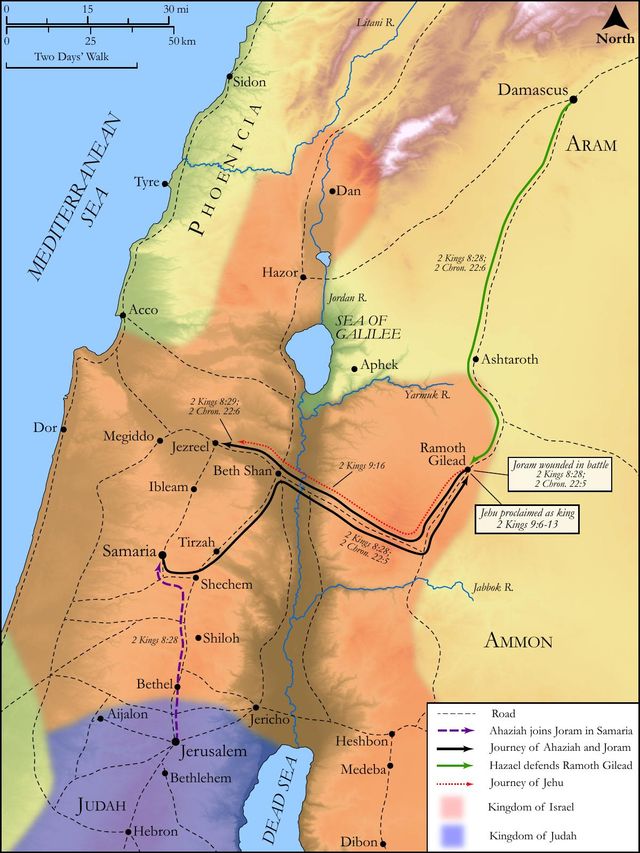
This verse is intricately woven into a broader narrative that consistently highlights the perilous and ultimately destructive alliance between the kingdom of Judah and the wicked Omride dynasty of Israel. Immediately preceding this account, 2 Chronicles 22:5 describes Ahaziah, King of Judah, joining Joram, King of Israel, in battle against Hazael, King of Syria, at Ramoth-gilead. This military cooperation is a direct continuation of the unholy alliances forged earlier between the two kingdoms, notably between Jehoshaphat and Ahab, as detailed in 2 Chronicles 18:1. Joram's injury and subsequent retreat to Jezreel for healing, as presented in 2 Chronicles 22:6, directly precipitates the dramatic events of 2 Chronicles 22:7-9, where Ahaziah's ill-fated visit leads to his own demise at the hands of Jehu, fulfilling prophetic judgment against the house of Ahab. The parallel account found in 2 Kings 8:28-29 corroborates this sequence of events, emphasizing the interconnectedness of these royal narratives across biblical books.
Historical & Cultural Context
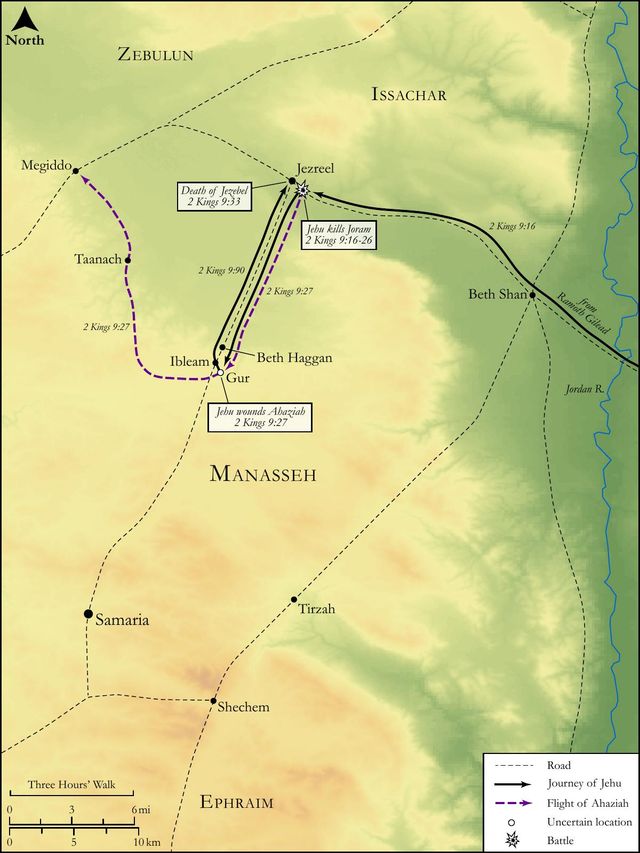
The battle at Ramoth-gilead (referred to as Ramah in this verse) was a frequently contested strategic point in the ongoing conflicts between Israel/Judah and Aram (Syria), a vital city in Transjordan. Jezreel, situated in the fertile Jezreel Valley, served as a significant royal residence for the northern kingdom of Israel, particularly under Ahab and his successors. It was famously the site of Ahab's palace and Naboth's vineyard, making it a location deeply associated with Omride wickedness and the pronouncements of divine judgment against them, as recounted in 1 Kings 21. The close familial ties between the royal houses—Ahaziah's mother, Athaliah, was the daughter of Ahab and Jezebel—explain the continued political and military alliances, despite their devastating spiritual consequences for Judah. In ancient warfare, it was a common practice for kings to retreat to secure, well-provisioned cities like Jezreel for recovery from severe battle wounds. Ahaziah's visit, while seemingly a customary act of familial concern, inadvertently placed him directly in the path of God's impending judgment on the Omride dynasty.
Key Themes
ShowHideThis verse powerfully contributes to several overarching themes within the book of Chronicles and the broader biblical narrative. Firstly, it starkly illustrates the consequences of unholy alliances, particularly the spiritual and physical dangers inherent in associating with those who disregard God's ways. Judah's repeated entanglement with the idolatrous house of Ahab consistently led to moral compromise, spiritual decline, and ultimately, divine judgment, culminating in Ahaziah's tragic end. Secondly, the verse highlights human vulnerability and frailty, even for powerful kings. Joram's "wounds" and subsequent "sickness" demonstrate that no earthly power or status can ultimately shield an individual from the realities of physical suffering, illness, and mortality. Finally, and perhaps most profoundly, the events of this verse are deeply intertwined with the theme of divine sovereignty and judgment. Though presented as a series of human actions—a battle, an injury, a visit—these occurrences are meticulously orchestrated by God to bring about the prophesied destruction of the house of Ahab, as foretold in 1 Kings 21:21-24. Ahaziah's ill-fated visit to Jezreel is thus a pivotal moment in this divine plan, setting the stage for Jehu's anointing and the subsequent comprehensive purge detailed in 2 Kings 9 and 2 Kings 10.
Exposition and Analysis
ShowHideKey Word Analysis
ShowHideThe Hebrew term מַכָּה (makkâh, H4347) refers to a blow, a strike, or a wound. It can also imply a plague or a severe beating. In this context, it signifies not superficial injuries but deep, debilitating wounds sustained in battle, indicating that Joram was critically injured and incapacitated. This word emphasizes the severity of his physical condition, necessitating his retreat for recovery and highlighting the brutal reality of ancient warfare.
The Hebrew verb חָלָה (châlâh, H2470) means "to be weak," "to be ill," "to be grieved," or "to be severely injured." Here, it complements the description of "wounds," indicating that Joram's injuries had led to a state of general illness, extreme weakness, or a critical decline in health. This reinforces the gravity of his condition, making him vulnerable and prompting Ahaziah's visit out of genuine concern for his ailing relative.
While the King of Judah is more commonly known as Ahaziah in other biblical texts (e.g., 2 Kings 8:24), the name Azariah (עֲזַרְיָהוּ, ʻĂzaryâh, H5838) means "Yahweh has helped" or "Yahweh is my help." The use of this variant name in 2 Chronicles 22:6 is profoundly ironic. Despite bearing a name that proclaims divine assistance, Ahaziah's actions—specifically his alliance with and visit to the wicked Omride house—lead him directly into a situation where he faces divine judgment, not help. This highlights the tragic disconnect between his name and his ultimate destiny, underscoring the spiritual consequences of his choices.
Verse Breakdown
ShowHide"And he returned to be healed in Jezreel because of the wounds which were given him at Ramah, when he fought with Hazael king of Syria."
This initial clause identifies the injured party as Joram, King of Israel (implied from the preceding narrative), and specifies his destination for recovery: Jezreel. The cause of his injuries is clearly stated as severe "wounds" sustained in battle at Ramah (Ramoth-gilead) against Hazael, King of Syria. This establishes Joram's weakened and vulnerable state and the immediate context of his retreat, setting the grim scene for the subsequent events.
"And Azariah the son of Jehoram king of Judah went down to see Jehoram the son of Ahab at Jezreel, because he was sick."
This second clause introduces King Azariah (Ahaziah) of Judah, identifying him by his lineage as "the son of Jehoram king of Judah." It describes his journey "down" (a common directional term for traveling from the Judean highlands to the Jezreel Valley) to Jezreel specifically to visit Joram, who is explicitly identified as "the son of Ahab" and "sick." This visit, born of familial concern for an ailing relative, is presented as the direct catalyst for Ahaziah's entry into the sphere of divine judgment that was about to fall decisively upon the house of Ahab.
Literary Devices
ShowHideThe verse employs several potent literary devices to convey its meaning and foreshadow future events. Irony is particularly prominent in the Chronicler's choice to refer to King Ahaziah as "Azariah," a name meaning "Yahweh has helped." This stands in stark contrast to the king's actual fate, as his visit to Joram leads directly to his own death and the swift end of his brief reign, a clear manifestation of divine judgment rather than divine aid. This ironic naming serves to underscore the tragic consequences of his unholy alliance with the Omride dynasty. Furthermore, the verse masterfully utilizes foreshadowing, as Joram's injury and retreat, coupled with Ahaziah's seemingly innocuous visit, create the precise conditions for Jehu's divinely appointed purge of the Omride dynasty, which immediately unfolds in the subsequent narrative. The seemingly mundane act of a king visiting a sick relative is thus imbued with profound theological significance, serving as a critical setup for the fulfillment of prophecy. The narrative also employs parallelism with the account in 2 Kings 8:28-29, reinforcing the historical veracity of the events while the Chronicler's version subtly emphasizes the moral and theological implications for Judah.
Theological and Thematic Connections
ShowHide2 Chronicles 22:6 serves as a profound and sobering reminder of the far-reaching consequences of spiritual compromise and unholy alliances. Ahaziah's decision to align with and visit the wicked house of Ahab, despite his own lineage as King of Judah, placed him directly in the path of divine judgment. This narrative powerfully illustrates God's unwavering commitment to His covenant and His readiness to execute righteous judgment upon those who persistently defy Him, even if it means the demise of kings and the disruption of royal lines. It highlights that God's sovereignty extends over human conflicts, personal relationships, and seemingly random events, orchestrating them to fulfill His prophetic word and bring about His righteous purposes. The vulnerability of Joram, laid low by "wounds" and "sickness," also reminds us of the universal human condition, subject to physical suffering and mortality, irrespective of status. Yet, even within this frailty, God's greater redemptive and judgmental plan unfolds with precision.
Reflection and Application
ShowHideThis verse, though presented as a historical account, offers profound and timeless lessons for contemporary believers. Ahaziah's fatal association with the house of Ahab underscores the critical importance of discernment in our relationships, partnerships, and alliances. Just as Judah was led astray and suffered judgment due to its ties with wickedness, believers today are called to exercise profound wisdom in choosing their companions, business partners, and even the spiritual affiliations they embrace. Our choices regarding whom we align ourselves with can have far-reaching spiritual and practical consequences, either drawing us closer to God's purposes and holiness or leading us into compromise, spiritual danger, and even judgment. Furthermore, the narrative reminds us that God's sovereign hand is actively at work even amidst human suffering, conflict, and chaos. Joram's wounds and Ahaziah's visit were not random occurrences but integral parts of a larger divine plan to bring about justice and fulfill ancient prophecy. This encourages us to cultivate a deep trust in God's overarching control, even when circumstances seem chaotic, unjust, or beyond our comprehension, recognizing that He is always working for His glory and the ultimate good of His people.
Questions for Reflection
ShowHideFAQ
ShowHideWhy is Joram, King of Israel, referred to as "Jehoram" in some biblical texts?
ShowHideThe names Joram and Jehoram are often used interchangeably in biblical texts to refer to the same individual. Both names are derived from the same Hebrew root, meaning "Yahweh is exalted" or "Yahweh has raised up." It was common in ancient Israel for individuals, especially kings, to have variant forms of their names or even multiple names. The Chronicler, like the author of Kings, uses these names to refer to the son of Ahab who reigned over Israel. This linguistic fluidity can sometimes cause confusion for modern readers but refers to the same historical figure.
Why is Ahaziah, King of Judah, called "Azariah" in this specific verse?
ShowHideSimilar to the interchangeability of Joram and Jehoram, Ahaziah and Azariah are variant names for the same King of Judah. Ahaziah means "Yahweh has grasped" or "Yahweh has sustained," while Azariah means "Yahweh has helped." The interchangeability of these names is a known scribal phenomenon in the Hebrew Bible, reflecting different textual traditions or simply alternative forms of the same name. While Ahaziah is the more common designation for this king (e.g., 2 Kings 8:24), the use of Azariah here does not refer to a different person but rather highlights a specific aspect or tradition associated with him, perhaps ironically given his ultimate fate.
What was the significance of Jezreel as a location in this narrative?
ShowHideJezreel was a highly significant royal city for the northern kingdom of Israel, particularly under the Omride dynasty. It was the site of Ahab's infamous palace and Naboth's vineyard, as recounted in 1 Kings 21, making it a place deeply associated with the wickedness, idolatry, and divine judgment against Ahab and Jezebel. Joram's return to Jezreel for healing, followed by Ahaziah's visit, strategically positions them both in the very location prophesied to be the site of divine judgment against the house of Ahab. Indeed, it is in Jezreel that Jehu will later execute God's judgment upon Joram, Jezebel, and many of Ahab's descendants (2 Kings 9:14-37), making this verse a crucial setup for the fulfillment of prophecy.
Christ-Centered Fulfillment
ShowHideWhile 2 Chronicles 22:6 details the physical wounds and ultimate demise of earthly kings entangled in unholy alliances, it powerfully foreshadows the coming of a King whose wounds would bring ultimate healing and whose reign would be established not by human alliances but by divine power and righteousness. Joram's physical "wounds" and "sickness" highlight the fragility of human life and the inherent limitations of even the most powerful earthly rulers. In stark contrast, Jesus Christ, the true and eternal King, willingly bore spiritual and physical wounds—not from an earthly battle for territory or power, but through His sacrificial death on the cross (Isaiah 53:5). His wounds bring ultimate healing and salvation to all who believe, transcending mere physical recovery to offer eternal life and spiritual restoration (1 Peter 2:24). Furthermore, the Old Testament narrative's emphasis on the devastating consequences of unholy alliances finds its ultimate resolution and reversal in Christ. While Old Testament kings suffered for their sinful partnerships, Christ establishes a new covenant where believers are called into a pure, holy, and unbreakable alliance with God Himself, through the indwelling of His Spirit (2 Corinthians 6:14-18). His kingdom is not of this world, and His reign is not subject to the vulnerabilities, judgments, or fleeting power struggles that plagued the kings of Israel and Judah (John 18:36). In Christ, the divine sovereignty that orchestrated judgment upon wicked dynasties now offers grace, redemption, and a secure, eternal relationship to all who trust in the King who conquered death and sin through His own suffering and resurrection.