


2 Kings 9:15
Bible text: King James Version (1769 Blayney text) · Public domain
Bible text: King James Version with Strong's numbers · Public domain
Bible text: Berean Standard Bible · Public domain
Bible text: American Standard Version (1901) · Public domain
Bible text: World English Bible, Messianic edition · Public domain
Bible text: Geneva Bible (1599) · Public domain
Bible text: Young's Literal Translation · Public domain
- וַיָּשָׁבvai·ya·Shavand he had returnedH7725Conj-w ¦ V-Qal-ConsecImperf-3msVerb Qal Consecutive Imperfect 3rd Singular Masculineוַandיָּשָׁבhe had returned
- יְהוֹרָםye·ho·RamJehoramH3088N-proper-mNoun Proper Masculine
- הַמֶּלֶךְha·Me·lekhthe kingH4428Art ¦ N-msNoun Singular Masculine Absoluteהַtheמֶּלֶךְking
- לְהִתְרַפֵּאle·hit·ra·Pe'to get himself healedH7495Prep-l ¦ V-Hithpael-InfVerb Hithpael Infinitive Constructלְtoהִתְרַפֵּאget himself healed
- בִיְזְרְעֶאלviy·ze·re·'Elin JezreelH3157Prep-b ¦ N-properNoun Proper LocationבִinיְזְרְעֶאלJezreel
- מִןminfromH4480PrepPreposition
- הַמַּכִּיםha·ma·Kimthe woundsH4347Art ¦ N-mpNoun Plural Masculine Absoluteהַtheמַּכִּיםwounds
- אֲשֶׁר'a·SherwhichH834RelParticle Relative
- יַכֻּהוּya·Ku·huthey wounded himH5221V-Hiphil-Imperf-3mp ¦ 3msVerb Hiphil Imperfect 3rd Plural Masculineיַכֻּthey woundedהוּhim
- אֲרַמִּים'a·ra·Mim[the] ArameansH761N-mpNoun Gentilic Plural Masculine Absolute
- בְּהִלָּחֲמוֹbe·hi·La·cha·Mowhen he foughtH3898Prep-b ¦ V-Niphal-Inf ¦ 3msVerb Niphal Infinitive Constructבְּwhenהִלָּחֲמfoughtוֹhe
- אֶת'etwithH854PrepPreposition
- חֲזָאֵלcha·za·'ElHazaelH2371N-proper-mNoun Proper Masculine
- מֶלֶךְMe·lekh[the] king ofH4428N-mscNoun Singular Masculine Construct
- אֲרָם'a·RamAramH758N-properNoun Proper Location
- וַיֹּאמֶרvai·Yo·merand he saidH559Conj-w ¦ V-Qal-ConsecImperf-3msVerb Qal Consecutive Imperfect 3rd Singular Masculineוַandיֹּאמֶרhe said
- יֵהוּאye·Hu'JehuH3058N-proper-mNoun Proper Masculine
- אִם'imifH518PrtParticle Conditional
- יֵשׁyeshthereH3426Adj-cscAdjective Numerical Singular common gender Construct
- נַפְשְׁכֶםnaf·she·Khem[is] your mindH5315N-fsc ¦ 2mpNoun Singular Feminine Constructנַפְשְׁ[is] mindכֶםyour
- אַל'almay notH408NegParticle Negative
- יֵצֵאye·Tze'he go outH3318V-Qal-Imperf-3msVerb Qal Imperfect 3rd Singular Masculine
- פָלִיטfa·Litan escapeeH6412N-msNoun Singular Masculine Absolute
- מִןminfromH4480PrepPreposition
- הָעִירha·'Irthe cityH5892Art ¦ N-fsNoun Singular Feminine Absoluteהָtheעִירcity
- לָלֶכֶתla·Le·khetto goH1980Prep-l ¦ V-Qal-InfVerb Qal Infinitive Constructלָtoלֶכֶתgo
- לְהַגִּידle·gidto tellH5046Prep-l ¦ V-Hiphil-InfVerb Hiphil Infinitive Constructלְtoהַגִּידtell
- בְּיִזְרְעֶאלbe·yiz·re·'Elin JezreelH3157Prep-b ¦ N-properNoun Proper LocationבְּinיִזְרְעֶאלJezreel
English is a literal word-by-word gloss of the Hebrew, not the KJV's wording. Why?
This is the original text the KJV's translators worked from — each Hebrew word with its own literal English meaning in this verse, prepared by scholars at Tyndale House, Cambridge. The KJV translates whole sentences, not word by word, so its wording differs: one Hebrew word can become several English words, and the KJV may choose “the LORD” where the gloss reads “Yahweh”. Both are faithful — they answer different questions. For the KJV's own rendering, switch to the KJV text.
Details
See on the biblical-era maps

Study this verse
Public-domain commentary
Matthew Henry
From his Commentary on the Whole Bible. Henry comments on passages, not single verses — this entry covers 2 Kings 9:11–15.
Jehu, after some pause, returned to his place at the board, taking no notice of what had passed, but, as it should seem, designing, for the present, to keep it to himself, if they had not urged him to disclose it. Let us therefore see what passed between him and the captains.
I.With what contempt the captains speak of the young prophet (Kg2 9:11):
"Wherefore came this mad fellow to thee? What business had he with thee? And why wouldst thou humour him so far as to retire for conversation with him? Are prophets company for captains?" They are called him a mad fellow, because he was one of those that would not run with them to an excess of riot (Pe1 4:4), but lived a life of self-denial, mortification, and contempt of the world, and spent their time in devotion; for these things they thought the prophets were fools and the spiritual men were mad, Hos 9:7. Note, Those that have no religion commonly speak with disdain of those that are religious, and look upon them as mad. They said of our Saviour, He is beside himself, of John Baptist, He has a devil (is a poor melancholy man), of St. Paul, Much learning has made him mad. The highest wisdom is thus represented as folly, and those that best understand themselves are looked upon as beside themselves. Perhaps Jehu intended it for a rebuke to his friends when he said, "You know the man to be a prophet, why then do you call him a mad fellow? You know the way of his communication to be not from madness, but inspiration." Or, "Being a prophet, you may guess what his business is, to tell me of my faults, and to teach me my duty; I need not inform you concerning it." Thus he thought to put them off, but they urged him to tell them. "It is false," say they, "we cannot conjecture what was his errand, and therefore tell us." Being thus pressed to it, he told them that the prophet had anointed him king, and it is probable showed them the oil upon his head, Kg2 9:12. He knew not but some of them either out of loyalty to Joram or envy of him, might oppose him, and go near to crush his interest in its infancy; but he relied on the divine appointment, and was not afraid to own it, knowing whom he had trusted: he that raised him would stand by him.
II.With what respect they compliment the new king upon the first notice of his advancement, Kg2 9:13.
How meanly soever they thought of the prophet that anointed him, and of his office, they expressed a grat veneration for the royal dignity of him that was anointed, and were very forward to proclaim him and sound of trumpet. In token of their subjection and allegiance to him, their affection to his person and government, and their desire to see him high and easy in it, they put their garments under him, that he might stand or sit upon them on the top of the stairs, in sight of the soldiers, who, upon the first intimation, came together to grace the solemnity. God put it into their hearts thus readily to own him, for he turns the hearts of people as well as kings, like the rivers of water, into what channel he pleases. Perhaps they were disquieted at Joram's government or had a particular affection for Jehu; or, however this might be, things it seems were ripe for the revolution, and they all came into Jehu's interest and conspired against Joram, Kg2 9:14.
III.With what caution Jehu proceeded.
He had advantages against Joram, and he knew how to improve them. He had the army with him. Joram had left it, and had gone home badly wounded. Jehu's good conduct appears in two things: - 1. That he complimented the captains, and would do nothing without their advice and consent ("If it be your minds, we will do so and so, else not"), thereby intimating the deference he paid to their judgment and the confidence he had in their fidelity, both which tended to please and fix them. It is the wisdom of those that would rise fast, and stand firm, to take their friends along with them. 2. That he contrived to surprise Joram; and, in order thereto, to come upon him with speed, and to prevent his having notice of what was now done: "Let none go forth to tell it in Jezereel, that, as a snare, the ruin may come on him and his house." The suddenness of an attack sometimes turns to as good an account as the force of it.
Historical interpretation
Historical reception
1 surviving comment on this verse from the historical church.
“Then the prophet Elisha called a member of the company of prophets and said to him, ‘Gird up your loins; take this flask of oil in your hand, and go to Ramoth-gilead.’ ” Here the Scripture reports the just sentence that befalls the house of Ahab. Immediately it speaks about the choice of the judge and executor of the judgment. And this was Jehu, the son of Nimshi, who, on the word of the Lord, anointed one of the prophets for the royalty. And this was the disciple of Elisha who was sent by his master to the city of Ramoth-gilead, which was under the siege of the Israelites. He entered their camp and went to the tent where the commanders of the army gathered and standing before them, he naively said, “I have a message for you, commander.” Jehu said in reply, “For which one of us?” The servant realized that he was the one indicated by Elisha. In fact, he did not know his name, but even though the son of the prophet did not know him nor had ever seen him, he saw the importance of this situation, and his mind was troubled, so that he said, “For you, commander.” He showed that through the revelation of God he had realized that he was the one chosen by God. And immediately he took him into an inner chamber, according to the order of his master. And two things were also hidden: Jehu understood that that affair had to remain secret and that the news [of the anointing] should not be divulged at that time among the people. Therefore he anointed him and ordered him to take revenge against the house of Ahab. Then the prophet fled at once from the camp, and shortly later the entire assembly was in an admirable unanimity before king Jehu against Israel.So he went out with a group of select men. But he met Joram, king of Israel, in the course of his journey, and little later Ahaziah, king of Judah. He was able to defeat them after the first attack and killed them both. Jehu said to Bidkar, “ ‘Lift him out, and throw him on the plot of ground belonging to Naboth the Jezreelite,’ because last night I saw the blood of Naboth and the blood of his children.” He is thinking here about what had been said to him at night, or maybe he believes that this vengeance and the fact that he would kill Joram had been predicted to him at night through a vision. Jehu had also indicated to Bidkar another reason for killing Joram in his place and for ordering him to throw him on the plot of Naboth, saying, “When you and I rode side by side behind his father Ahab how the Lord uttered this oracle against him: ‘For the blood of Naboth and for the blood of his children that I saw yesterday, says the Lord, I swear I will repay you on this very plot of ground,’ ” that is, outside the walls of Jezreel where the goods of Naboth were. After this action accomplished outside the gates of Jezreel, he entered the city to complete what he had successfully begun.
Continue studying 2 Kings 9:15 across the web’s major study libraries — every link below opens this exact verse, chapter, or book on the destination site.
Read & Compare
 BibleGatewayThis verse in more than 200 translations and 70 languages.
 Bible.comThe YouVersion reader — hundreds of translations, reading plans, and highlights.
 ESV.orgCrossway's official English Standard Version reader.
 NET BibleThe NET translation with 60,000+ translators' notes on every rendering decision.
 STEP BibleTyndale House's free study tool — original text, vocabulary, and scholarly resources.
 BibliaLogos Bible Software's free web reader.
 USCCBThe New American Bible (Revised Edition) with the U.S. bishops' study notes.
Commentaries
 BibleHub CommentariesDozens of classic commentaries on this verse, gathered on one page.
 StudyLightMore than 100 commentary sets — the largest collection on the web.
 BibleRefPlain-English commentary on what this verse means, verse by verse.
 Enduring WordDavid Guzik's free commentary on this chapter, widely used by Bible teachers.
 Bible Study ToolsVerse commentary alongside Greek and Hebrew study aids.
Original Language & Research
- BibleHub InterlinearThe verse word by word — original language, transliteration, and English.
- BibleHub LexiconEvery word's original-language definition and Strong's entry.
 Blue Letter BibleDeep-study tools — Strong's numbers, concordance, and word studies.
 SefariaThe Hebrew text with Rashi and centuries of Jewish commentary.
Sermons, Hymns & Audio


TrulyRandomVerse is not affiliated with these sites and doesn’t control their content. They’re linked because they’re genuinely useful.
Summary
Second Kings 9:15 marks a pivotal moment in Jehu's divinely appointed mission to overthrow the Omride dynasty. Having just been secretly anointed king, Jehu immediately issues a critical command to his officers: prevent any messenger from leaving their location at Ramoth-gilead to carry news of his anointing and impending coup to King Joram, who is recuperating from battle wounds in Jezreel. This swift, strategic move underscores Jehu's resolve and the paramount importance of surprise in executing God's judgment against the house of Ahab.
Context
ShowHideLiterary Context
This verse immediately follows the dramatic and clandestine anointing of Jehu by a young prophet, sent by Elisha, in the midst of the military camp at Ramoth-gilead. The prophet delivered a specific and urgent divine mandate for Jehu to "strike down the house of Ahab" and avenge the blood of the prophets and servants of the Lord 2 Kings 9:7. Having just been proclaimed king by his fellow officers, Jehu's first recorded words are this imperative command, signaling his immediate shift from a military commander to a conspirator-king intent on fulfilling the prophetic word. The narrative swiftly transitions from this strategic secrecy to Jehu's rapid journey to Jezreel and the subsequent, bloody execution of Joram and Jezebel, highlighting the critical importance of this initial command to seal off information.
Historical & Cultural Context
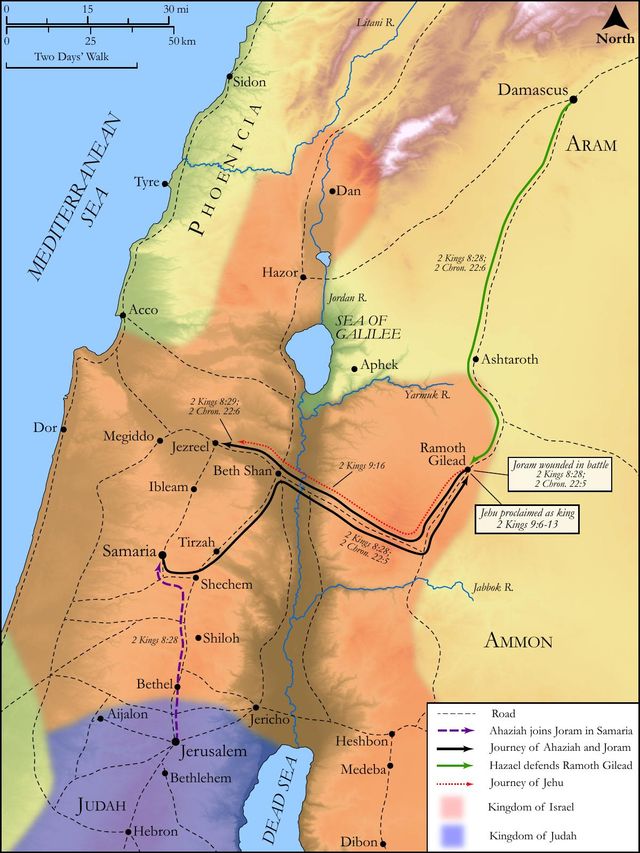
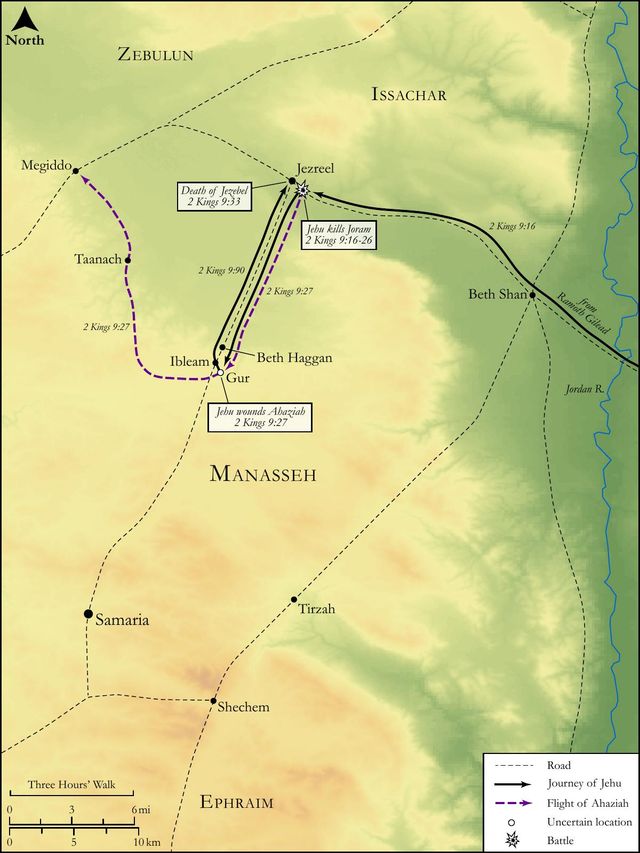
At this historical juncture, the northern kingdom of Israel, under King Joram (also known as Jehoram), was embroiled in ongoing conflict with Aram (Syria), led by King Hazael. This conflict, particularly the battle at Ramoth-gilead, a strategic frontier city, was part of God's broader judgment against both nations. King Joram had been wounded in this battle and had retreated to Jezreel, a significant royal residence and military base distinct from the capital Samaria, to recover. The anointing of Jehu by Elisha's prophet was a direct fulfillment of Elijah's earlier prophetic commission, which included the anointing of Hazael as king over Aram and Jehu as king over Israel, both as instruments of God's judgment 1 Kings 19:15-17. Jehu's immediate concern, as reflected in this verse, was to prevent any news of his anointing from preceding him to Jezreel, which would allow Joram to prepare defenses, flee, or otherwise thwart the divinely ordained coup.
Key Themes
ShowHideJehu's actions in this verse powerfully illuminate several key themes. Firstly, Decisive Action is paramount; Jehu, having received his divine mandate, immediately seizes control and issues a non-negotiable command, demonstrating his unwavering resolve to execute the prophetic word. Secondly, Secrecy and Strategic Planning are critical to his success; Jehu understands that surprise is the essential element for a successful coup, recognizing that forewarning Joram would jeopardize the entire operation. Thirdly, the underlying theme of Divine Sovereignty and Judgment permeates Jehu's every move; his immediate and forceful strategy is a direct response to the prophetic anointing he just received, underscoring God's active hand in orchestrating leadership changes and executing justice against wickedness, as seen throughout the broader narrative of 2 Kings 9. Finally, the Vulnerability of Earthly Leadership is starkly portrayed through Joram's absence from the front and his wounded state, creating the precise opportune moment for his overthrow and illustrating how even powerful rulers can be exposed in times of weakness.
Exposition and Analysis
ShowHideKey Word Analysis
ShowHideThe phrase "If it be your minds" translates the Hebrew im yesh et-nafshachem (אם יש את־נפשכם), which literally means "if it is in your soul" or "if it is your desire/will." This is not a casual inquiry about their intellectual agreement or preference, but a profound and urgent appeal to their shared commitment, intention, and absolute solidarity. Jehu is not seeking permission but demanding their unwavering loyalty and complicity in the impending, divinely sanctioned act. It implies a call for their complete alignment with his purpose, ensuring no one would betray his confidence or the mission.
This primitive root verb means "to go out," "to come forth," or "to issue out." In this context, it refers to the act of any person leaving the city of Ramoth-gilead. Jehu's command is a strict embargo on any movement out of the military camp, highlighting the critical role of secrecy and surprise in military and political coups. The prevention of anyone "going forth" is essential to maintain the element of surprise.
This noun, derived from a root meaning "to slip away" or "to deliver oneself," refers to a refugee or one who has escaped. In the KJV, "nor escape" functions as a verb here, emphasizing the absolute necessity of preventing any messenger or individual from slipping away unnoticed from Ramoth-gilead. Any "escape" of information, even by a single person, would jeopardize the entire operation, allowing King Joram to prepare or flee, thus thwarting the divine decree.
Verse Breakdown
ShowHide"But king Joram was returned to be healed in Jezreel of the wounds which the Syrians had given him, when he fought with Hazael king of Syria.)"
This parenthetical clause serves as crucial background information, explaining King Joram's absence from the front lines and his vulnerable state. It establishes the precise window of opportunity for Jehu's coup. Joram's retreat to Jezreel, a royal city and military hub, for recovery from battle wounds sustained against Hazael of Syria, underscores the ongoing conflict and the king's physical incapacitation, making him an easier and unsuspecting target for Jehu's swift action.
"And Jehu said, If it be your minds, [then] let none go forth [nor] escape out of the city"
This is Jehu's immediate and direct command to his fellow officers, who had just acclaimed him king. The phrase "If it be your minds" is a powerful rhetorical appeal for their absolute commitment, loyalty, and silence, rather than a genuine question of their preference. It signifies Jehu's immediate assertion of authority and the critical importance of maintaining secrecy. The command "let none go forth [nor] escape" is an imperative to seal off the city, preventing any communication that could alert Joram to the unfolding events.
"to go to tell [it] in Jezreel."
This final clause explicitly clarifies the purpose of Jehu's stringent command: to prevent any news of his anointing and the impending coup from reaching King Joram in Jezreel. The success of Jehu's divinely mandated mission hinged entirely on surprise, ensuring Joram would be caught unaware and unable to mount a defense or flee. This highlights Jehu's strategic foresight and his understanding of the high stakes involved in fulfilling his prophetic commission.
Literary Devices
ShowHideThe passage masterfully employs several literary devices to heighten the drama and underscore the strategic nature of Jehu's actions. Foreshadowing is prominently featured, as Joram's wounded state and retreat to Jezreel, ostensibly for healing, ironically set the stage for his imminent and violent demise at Jehu's hand. His physical vulnerability directly precedes and enables the swift execution of divine judgment. There is also a strong element of Dramatic Irony, where the reader is fully privy to Jehu's anointing and his decisive intentions, while King Joram remains completely oblivious in Jezreel, recovering from one battle only to be ambushed by another, far more personal and lethal conflict. Furthermore, Jehu's command itself functions as a Strategic Imperative, a concise and forceful directive that immediately establishes the absolute necessity of secrecy and control. This "strategic silence" is a powerful narrative tool, emphasizing the high stakes and the calculated, divinely sanctioned nature of Jehu's coup.
Theological and Thematic Connections
ShowHideThis verse, while appearing to be a simple tactical command, is deeply embedded in the overarching theological narrative of divine judgment and the fulfillment of prophecy. Jehu's immediate and decisive action to secure secrecy is not merely a military strategy but a direct, resolute response to his anointing, demonstrating his commitment to executing God's will. It underscores the profound theme that God sovereignly uses human agents, sometimes through violent and dramatic means, to bring about His purposes, particularly in the realm of national leadership and the execution of justice against persistent wickedness and idolatry. The swift and brutal fall of the Omride dynasty, initiated by this strategic move, serves as a stark reminder of the inevitable consequences of prolonged disobedience to God's covenant.
Reflection and Application
ShowHideJehu's immediate and strategic command in 2 Kings 9:15 offers a powerful, albeit complex, glimpse into the nature of decisive action when confronted with a clear mandate. While Jehu's context is one of a divinely ordained coup against a corrupt regime, for believers today, this passage can prompt profound reflection on the importance of focus, unwavering commitment, and strategic wisdom in pursuing God's revealed will in our lives. When we discern a clear call or direction from God, are we prepared to act with the necessary resolve and prudence, identifying and diligently removing obstacles that might hinder its fulfillment? This principle, when applied spiritually, does not endorse violence or deceit, but rather highlights the necessity of intentionality and the wise safeguarding of critical information or resources, not for personal gain, but for the successful execution of a greater, God-given purpose. It reminds us that sometimes, effective action requires careful planning and the protection of nascent endeavors from premature exposure or opposition that could derail them.
Questions for Reflection
ShowHideFAQ
ShowHideWhy was King Joram in Jezreel instead of with his army at Ramoth-gilead?
ShowHideKing Joram was in Jezreel because he had been wounded in a significant battle against Hazael, the king of Syria, at Ramoth-gilead. He had returned to Jezreel to recuperate from his injuries. Jezreel served as a royal residence and a strategic military base for the Omride dynasty, making it a natural and secure place for the king to recover. This absence from the front lines and his physically vulnerable state created the opportune moment for Jehu to execute the divinely mandated coup, as vividly described in 2 Kings 9.
What was the significance of Jehu's command to prevent anyone from escaping to Jezreel?
ShowHideJehu's command to prevent any escape was strategically vital for the success of his coup. If news of his anointing and the impending rebellion reached King Joram in Jezreel, Joram would have had ample time to prepare his defenses, rally loyal troops, or flee, thereby severely complicating or even thwarting Jehu's mission. The element of surprise was absolutely paramount for Jehu to swiftly and decisively execute the divine judgment against the corrupt house of Ahab, a judgment that had been prophesied by Elijah and confirmed by Elisha's prophet 1 Kings 19:16; 2 Kings 9:6-10.
Did Jehu have the full support of his officers when he issued this command?
ShowHideYes, the preceding verses clearly indicate that Jehu had the immediate and full support of his officers. After the prophet anointed Jehu and delivered the divine message concerning the overthrow of Ahab's house, Jehu initially downplayed what had transpired. However, when pressed by his officers, he revealed the prophet's words. In response, "they quickly took every man his garment, and put it under him on the top of the stairs, and blew with trumpets, saying, Jehu is king" 2 Kings 9:13. This act of immediate acclamation and symbolic enthronement demonstrates their solidarity, loyalty, and readiness to follow him, making his subsequent command for secrecy an accepted and obeyed directive among his newly declared followers.
Christ-Centered Fulfillment
ShowHideWhile Jehu's anointing and subsequent actions involve violence and political intrigue, they serve as a historical type, albeit imperfect and limited, of a divinely appointed king bringing judgment and establishing a new order. Jehu was anointed by God through His prophet to carry out a specific, temporal judgment against a corrupt and idolatrous dynasty, thereby fulfilling ancient prophecies. This historical event foreshadows the ultimate King, Jesus Christ, who was divinely anointed by the Holy Spirit, not with oil for a temporal earthly kingdom, but for an eternal, spiritual reign. Christ's mission, though not executed through a military coup, was equally decisive and strategically perfect: to confront and utterly defeat the spiritual powers of darkness, sin, and death. His "secrecy" or strategic timing was often manifested in His parables, His deliberate steps towards Jerusalem, and His understanding that His ultimate "coup" would be through the cross, where He disarmed principalities and powers and made a public spectacle of them Colossians 2:15. Unlike Jehu, whose reign was marked by bloodshed and ultimately led to further decline in Israel, Christ's reign brings eternal peace, righteousness, and salvation, establishing a spiritual kingdom that endures forever Isaiah 9:6-7; Luke 1:32-33. He is the true Lamb of God who decisively takes away the sin of the world John 1:29, and the Lion of Judah who conquers evil, not by preventing news, but by commissioning His followers to proclaim the good news of His victory to all the world Matthew 28:19-20; Revelation 5:5.