


2 Kings 8:25
Bible text: King James Version (1769 Blayney text) · Public domain
Bible text: Berean Standard Bible · Public domain
Bible text: American Standard Version (1901) · Public domain
Bible text: World English Bible, Messianic edition · Public domain
Bible text: Geneva Bible (1599) · Public domain
Bible text: Young's Literal Translation · Public domain
- בִּשְׁנַתbish·Natin yearH8141Prep-b ¦ N-fscNoun Singular Feminine Constructבִּinשְׁנַתyear
- שְׁתֵּיםshe·teimtwo [plus]H8147N-fdNoun Dual Feminine Absolute
- עֶשְׂרֵה'es·RehtenH6240N-csNoun Singular common gender Absolute
- שָׁנָהsha·NahyearH8141N-fsNoun Singular Feminine Absolute
- לְיוֹרָםle·yo·Ramof JoramH3141Prep-l ¦ N-proper-mNoun Proper MasculineלְofיוֹרָםJoram
- בֶּןben[the] son ofH1121N-mscNoun Singular Masculine Construct
- אַחְאָב'ach·'AvAhabH256N-proper-mNoun Proper Masculine
- מֶלֶךְMe·lekh[the] king ofH4428N-mscNoun Singular Masculine Construct
- יִשְׂרָאֵלYis·ra·'ElIsraelH3478N-properNoun Proper Location
- מָלַךְma·Lakhhe became kingH4427V-Qal-Perf-3msVerb Qal Perfect 3rd Singular Masculine
- אֲחַזְיָהוּ'a·chaz·Ya·huAhaziahH274N-proper-mNoun Proper Masculine
- בֶןven[the] son ofH1121N-mscNoun Singular Masculine Construct
- יְהוֹרָםye·ho·RamJehoramH3088N-proper-mNoun Proper Masculine
- מֶלֶךְMe·lekh[the] king ofH4428N-mscNoun Singular Masculine Construct
- יְהוּדָהye·hu·DahJudahH3063N-properNoun Proper Location
English is a literal word-by-word gloss of the Hebrew, not the KJV's wording. Why?
This is the original text the KJV's translators worked from — each Hebrew word with its own literal English meaning in this verse, prepared by scholars at Tyndale House, Cambridge. The KJV translates whole sentences, not word by word, so its wording differs: one Hebrew word can become several English words, and the KJV may choose “the LORD” where the gloss reads “Yahweh”. Both are faithful — they answer different questions. For the KJV's own rendering, switch to the KJV text.
Details
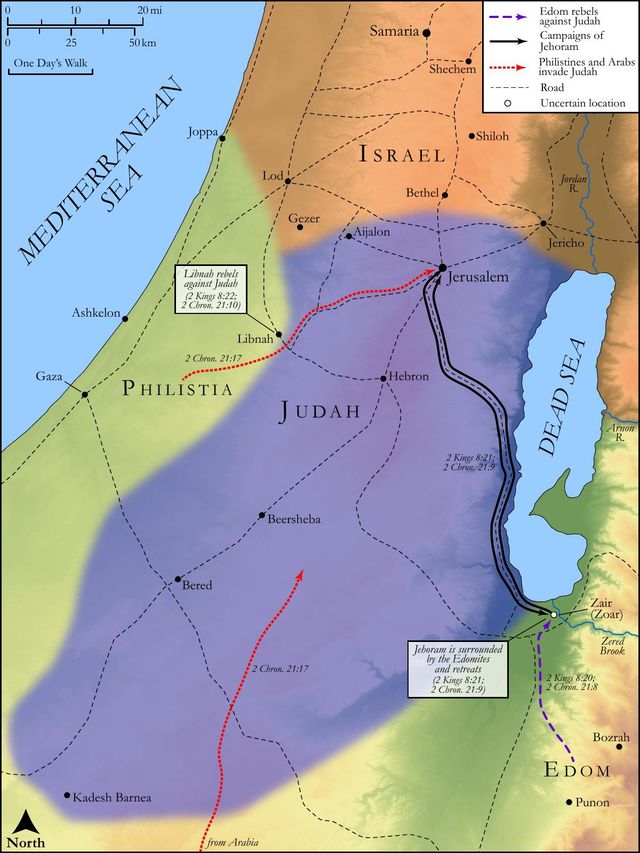
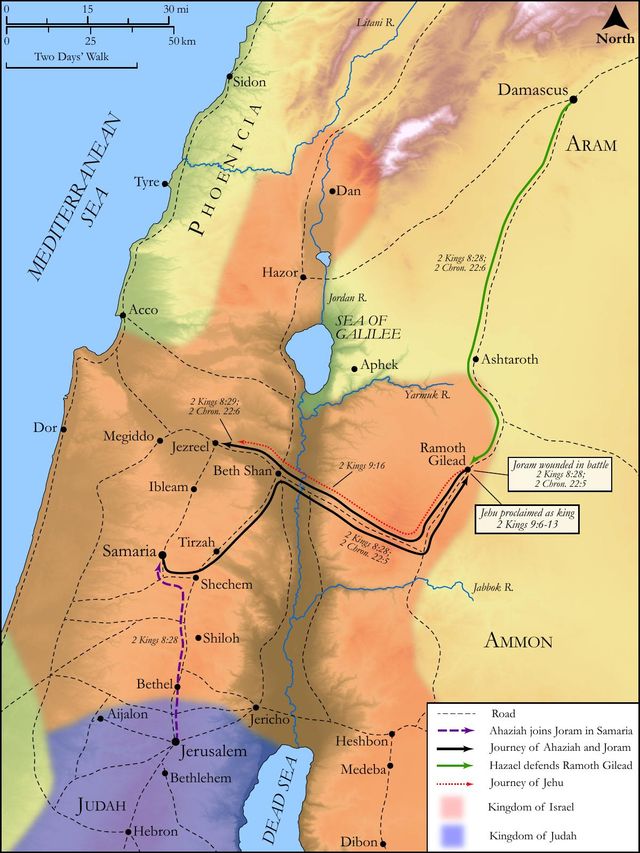
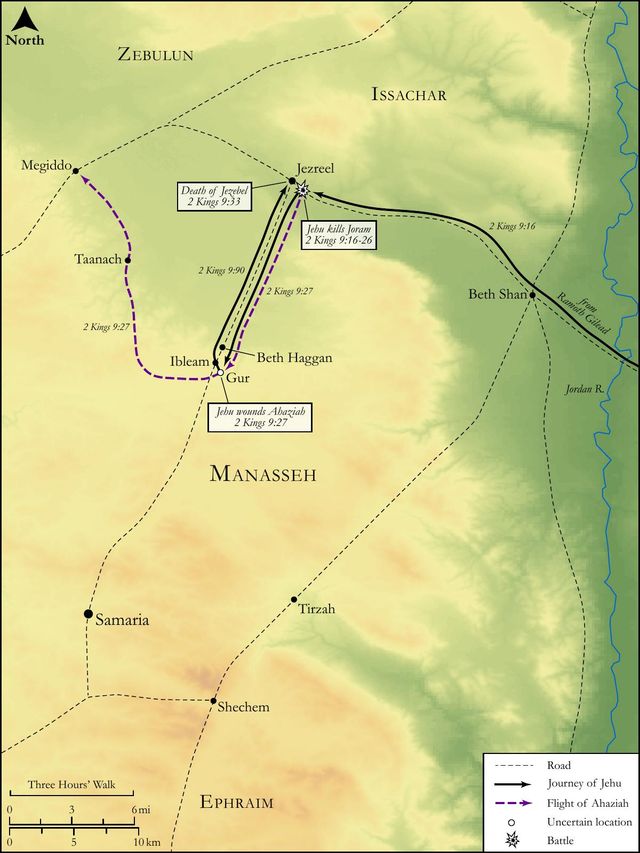
See on the biblical-era maps
Study this verse
Public-domain commentary
Matthew Henry
From his Commentary on the Whole Bible. Henry comments on passages, not single verses — this entry covers 2 Kings 8:25–29.
As among common persons there are some that we call little men, who make no figure, are little regarded, as less valued, so among kings there are some whom, in comparison with others, we may call little kings. This Ahaziah was one of these; he looks mean in the history, and in God's account vile, because wicked. It is too plain an evidence of the affinity between Jehoshaphat and Ahab that they had the same names in their families at the same time, in which, we may suppose, they designed to compliment one another. Ahab had two sons, Ahaziah and Jehoram, who reigned successively; Jehoshaphat had a son and grandson names Jehoshaphat had a son and grandson names Jehoram and Ahaziah, who, in like manner, reigned successively. Names indeed do not make natures, but it was a bad omen to Jehoshaphat's family to borrow names from Ahab's; or, if he lent the names to that wretched family, he could not communicate with them the devotion of their significations, Ahaziah - Taking hold of the Lord, and Jehoram - The Lord exalted. Ahaziah king of Israel had reigned but two years, Ahaziah king of Judah reigned but one. We are here told that his relation to Ahab's family was the occasion, 1. Of his wickedness (Kg2 8:27): He walked in the way of the house of Ahab, that idolatrous bloody house; for his mother was Ahab's daughter (Kg2 8:26), so that he sucked in wickedness with his milk. Partus sequitur ventrem - The child may be expected to resemble the mother. When men choose wives for themselves they must remember they are choosing mothers for their children, and are concerned to choose accordingly. 2. Of his fall. Joram, his mother's brother, courted him to join with him for the recovery of Ramoth-Gilead, an attempt fatal to Ahab; so it was to Joram his son, for in that expedition he was wounded (Kg2 8:28), and returned to Jezreel to be cured, leaving his army there in possession of the place. Ahaziah likewise returned, but went to Jezreel to see how Jehoram did, Kg2 8:29. Providence so ordered it, that he who had been debauched by the house of Ahab might be cut off with them, when the measure of their iniquity was full, as we shall find in the next chapter. Those who partake with sinners in their sins must expect to partake with them in their plagues.
Continue studying 2 Kings 8:25 across the web’s major study libraries — every link below opens this exact verse, chapter, or book on the destination site.
Read & Compare
 BibleGatewayThis verse in more than 200 translations and 70 languages.
 Bible.comThe YouVersion reader — hundreds of translations, reading plans, and highlights.
 ESV.orgCrossway's official English Standard Version reader.
 NET BibleThe NET translation with 60,000+ translators' notes on every rendering decision.
 STEP BibleTyndale House's free study tool — original text, vocabulary, and scholarly resources.
 BibliaLogos Bible Software's free web reader.
 USCCBThe New American Bible (Revised Edition) with the U.S. bishops' study notes.
Commentaries
 BibleHub CommentariesDozens of classic commentaries on this verse, gathered on one page.
 StudyLightMore than 100 commentary sets — the largest collection on the web.
 BibleRefPlain-English commentary on what this verse means, verse by verse.
 Enduring WordDavid Guzik's free commentary on this chapter, widely used by Bible teachers.
 Bible Study ToolsVerse commentary alongside Greek and Hebrew study aids.
Original Language & Research
- BibleHub InterlinearThe verse word by word — original language, transliteration, and English.
- BibleHub LexiconEvery word's original-language definition and Strong's entry.
 Blue Letter BibleDeep-study tools — Strong's numbers, concordance, and word studies.
 SefariaThe Hebrew text with Rashi and centuries of Jewish commentary.
Sermons, Hymns & Audio


TrulyRandomVerse is not affiliated with these sites and doesn’t control their content. They’re linked because they’re genuinely useful.
Summary
This verse serves as a precise chronological anchor within the biblical narrative, marking the commencement of Ahaziah's brief and ill-fated reign as king of Judah. By synchronizing his ascent to the throne with the twelfth year of Joram, king of Israel, the text meticulously interweaves the histories of the northern and southern kingdoms, highlighting their interconnected destinies and the unfolding of God's sovereign plan amidst human kingship and political alliances.
Context
ShowHideLiterary Context
This verse immediately follows a section detailing Jehoram of Judah's wicked reign and his alliance with the house of Ahab through marriage to Athaliah, as described in 2 Kings 8:16-24. It sets the stage for Ahaziah's short tenure, which is quickly detailed in the subsequent verses, specifically 2 Kings 8:26-29. The narrative then swiftly transitions to the dramatic anointing of Jehu and the comprehensive purge of the Omride dynasty, which tragically includes the deaths of both Joram of Israel and Ahaziah of Judah, as recounted in 2 Kings 9. Thus, 2 Kings 8:25 functions as a crucial temporal bridge, connecting the end of one king's reign to the beginning of another, and ominously foreshadowing the violent end of both the Omride and the corrupted Davidic lines.
Historical & Cultural Context
The period of the divided monarchy was characterized by fluctuating alliances, frequent conflicts, and significant spiritual decline. The synchronistic dating, which reckons one kingdom's reigns by the other's as this verse does, was essential for chronicling the parallel reigns of kings in Israel and Judah, providing a framework for understanding their intertwined histories. The marriage between Jehoram of Judah and Athaliah, daughter of Ahab and Jezebel, was a politically motivated alliance that had devastating spiritual consequences for Judah, introducing the pervasive influence of Baal worship directly into the Davidic line. This verse highlights a moment when the two kingdoms, though distinct, were closely intertwined through royal lineage and shared political fortunes, particularly in their ongoing struggle against Aram (Syria), as seen in the subsequent verses describing their joint military campaign in 2 Kings 8:28-29.
Key Themes
ShowHideThe verse underscores several key themes prevalent in the Books of Kings. Firstly, Chronological Precision is paramount, demonstrating the meticulous nature of biblical history and God's oversight of time. Secondly, the Interconnectedness of the Kingdoms is evident, as the fates of Israel and Judah are shown to be deeply intertwined, often through strategic (but spiritually detrimental) royal marriages and military cooperation. Thirdly, the Legacy of Ahab's House casts a long, dark shadow; Ahaziah's direct lineage through his mother, Athaliah, links him to the deeply idolatrous Omride dynasty, which profoundly influenced his wicked reign and foreshadowed the divine judgment that would soon fall upon both royal houses. This connection underscores the theme of Consequences of Unholy Alliances, particularly for the Davidic line, which was meant to uphold God's covenant, as detailed throughout 2 Kings.
Exposition and Analysis
ShowHideKey Word Analysis
ShowHideMeaning "Jah has seized" or "Yahweh has grasped." This name is tragically ironic, as Ahaziah's reign was brief, ungodly, and marked by his adherence to the idolatry of the house of Ahab, rather than being "grasped" or upheld by Yahweh in righteousness. His life and reign stand in stark contrast to the divine meaning embedded in his name.
This name, a shortened form of Jehoram (H3088), means "Jehovah-raised" or "Yahweh is exalted." While the king of Israel bore a name that invoked Yahweh, his actions, like those of his father Ahab, largely deviated from the worship of the true God, highlighting the spiritual apostasy prevalent even among those whose very names pointed to the Lord.
This verb signifies the act of becoming king, assuming royal power, and exercising sovereignty. In the biblical narrative, the commencement of a king's reign is a pivotal moment, not merely for political succession but for marking a new era under God's appointed (or permitted) leadership, with all the spiritual implications that follow concerning divine favor or judgment.
Verse Breakdown
ShowHide"In the twelfth year of Joram the son of Ahab king of Israel"
This opening clause provides the crucial synchronistic date, anchoring Ahaziah's accession to the reign of the northern kingdom's king. Joram, son of the notorious Ahab, represents the continuation of the Omride dynasty's influence, which was largely characterized by idolatry and opposition to Yahweh. The precision of "the twelfth year" emphasizes the meticulous nature of the biblical record, serving as a historical marker for cross-referencing events between the two kingdoms.
"did Ahaziah the son of Jehoram king of Judah"
This identifies the new monarch of the southern kingdom. Ahaziah's lineage is explicitly stated, connecting him to Jehoram of Judah, whose reign was marked by wickedness and the introduction of Baal worship due to his marriage to Athaliah, daughter of Ahab and Jezebel, as noted in 2 Kings 8:18. This parentage immediately signals the spiritual trajectory of Ahaziah's own reign, indicating a continuation of the apostasy that had infiltrated the Davidic line.
"begin to reign."
This simple phrase signifies the formal commencement of Ahaziah's rule. For the biblical historian, this moment is not just a political transition but a theological one, as the character of the new king would directly impact the spiritual health and divine favor (or judgment) upon the people of Judah. Ahaziah's reign would prove to be brief and disastrous, a direct consequence of his ungodly choices, heavily influenced by his Omride mother.
Literary Devices
ShowHideThe primary literary device employed in 2 Kings 8:25 is Synchronism, a common and vital feature throughout the Books of Kings. This technique of dating events in one kingdom by reference to the reign of a king in the other kingdom provides a precise chronological framework, enabling the reader to understand the parallel and often intertwined histories of Israel and Judah. Beyond mere chronology, this synchronism also serves as a form of Juxtaposition, placing the reigns of two distinct kings from two different kingdoms side-by-side, implicitly inviting comparison and highlighting the shared political and spiritual climate. There is also an element of Foreshadowing in this verse; the mention of Ahaziah's lineage through Jehoram and his connection to the house of Ahab (via Athaliah, though not named here, is known from the immediate context) subtly hints at the brevity and wickedness of his reign, which will be detailed in the subsequent verses and culminate in his violent death alongside Joram of Israel. Finally, the Irony of Ahaziah's name ("Yahweh has grasped") contrasts sharply with his ungodly actions and swift demise, underscoring the tragic disconnect between his divine heritage and his personal apostasy.
Theological and Thematic Connections
ShowHideThis seemingly straightforward chronological note carries profound theological weight. It underscores God's meticulous sovereignty over human history, demonstrating that even the rise and fall of kings, the formation of alliances, and the precise timing of reigns are all within His divine purview. The synchronization of the two kingdoms' histories reveals the interconnectedness of God's covenant people, even in their divided state. More critically, Ahaziah's accession, deeply influenced by his Omride mother Athaliah, highlights the devastating spiritual consequences of unholy alliances and the infiltration of idolatry into the Davidic line. Despite the wickedness of these kings and the spiritual decline of the nations, God's plan for the preservation of the Davidic covenant, from which the Messiah would come, remained steadfast, even through periods of intense apostasy and near-extinction.
Reflection and Application
ShowHideThe detailed chronological markers in Scripture, such as 2 Kings 8:25, serve as a powerful reminder that God is the ultimate historian and sovereign over all time and human events. Even in the midst of political intrigue, ungodly alliances, and spiritual decline, His overarching purposes are being meticulously unfolded. For us today, this means we can trust in God's perfect timing and His control over circumstances, even when they appear chaotic or contrary to His will. Ahaziah's reign, shaped by his mother's idolatrous heritage, also underscores the profound impact of family and cultural influences on an individual's spiritual trajectory. It challenges us to critically examine the influences in our own lives—familial, social, and cultural—and to actively choose to align ourselves with God's truth, rather than succumbing to corrupting pressures. We are called to be discerning in our alliances and vigilant in guarding our hearts and homes against anything that would lead us away from faithful devotion to God, recognizing that our choices have far-reaching consequences, not just for ourselves but for those who come after us.
Questions for Reflection
ShowHideFAQ
ShowHideWhy does the Bible provide such precise chronological details for these kings?
ShowHideThe precise chronological details, like the synchronism in 2 Kings 8:25, serve several crucial purposes. Firstly, they establish the historical veracity and accuracy of the biblical narrative, allowing for cross-referencing with other historical records (where available) and demonstrating the meticulous care taken by the biblical authors. Secondly, they highlight God's sovereignty over history, showing that the rise and fall of nations and kings occur within His ordained timeline and according to His purposes. Thirdly, these details help to interweave the parallel histories of the divided kingdoms of Israel and Judah, providing a coherent narrative flow and illustrating how their destinies were often intertwined, particularly through alliances and conflicts, as seen in the joint campaign of Joram and Ahaziah against Hazael of Aram in 2 Kings 8:28-29.
What was the significance of Ahaziah's mother, Athaliah, in his reign?
ShowHideAlthough Athaliah is not explicitly named in 2 Kings 8:25, her influence is paramount and is detailed in the very next verse, 2 Kings 8:26. As the daughter of King Ahab and Queen Jezebel of Israel, Athaliah brought the pervasive idolatry and wickedness of the Omride dynasty directly into the Davidic royal house of Judah. Her marriage to Jehoram of Judah and her subsequent influence on Ahaziah meant that the Baal worship and ungodly practices of the northern kingdom were deeply embedded in the southern kingdom's leadership. Ahaziah "walked in the way of the house of Ahab" (2 Kings 8:27), a direct result of his mother's influence, leading to his brief, wicked reign and ultimately, his violent death. Her subsequent attempt to usurp the throne and destroy the Davidic line further underscores her destructive impact, as recorded in 2 Kings 11:1-3.
How does this verse relate to the broader narrative of the Books of Kings?
ShowHideThis verse is a microcosm of the larger narrative in the Books of Kings, which chronicles the decline of both the northern kingdom of Israel and the southern kingdom of Judah due to their persistent idolatry and disobedience to God's covenant. It exemplifies the recurring pattern of wicked kings, the consequences of unholy alliances, and the unfolding of divine judgment. The synchronistic dating underscores the parallel trajectories of the two kingdoms towards their respective exiles. Furthermore, it sets the immediate stage for the dramatic anointing of Jehu and the violent purge of the Omride dynasty, which includes the death of both Joram of Israel and Ahaziah of Judah, as detailed in 2 Kings 9, marking a significant turning point in the history of both nations and demonstrating God's active intervention in human affairs to bring about His justice.
Christ-Centered Fulfillment
ShowHideWhile 2 Kings 8:25 appears to be a mere chronological entry, it subtly participates in the grand narrative of God's redemptive plan culminating in Christ. Ahaziah, though a wicked king and a descendant of David, represents a critical link in the unbroken, albeit often corrupted, Davidic lineage. The preservation of this line, despite the constant threats of idolatry, internal strife, and external enemies (including Athaliah's later attempt to annihilate the royal seed in 2 Kings 11:1), is paramount to God's covenant promise to David that his throne would be established forever, as recorded in 2 Samuel 7:12-16. This verse, therefore, quietly affirms God's faithfulness to His covenant, ensuring that the lineage from which the Messiah would come remained intact, even through the reigns of ungodly kings like Ahaziah. Ultimately, Jesus Christ is the true and eternal King, the righteous Son of David, whose reign is not brief and wicked like Ahaziah's, but everlasting and perfectly just, as proclaimed in Luke 1:32-33. His kingdom will never end, fulfilling the promises that no earthly king, however wicked or short-lived their reign, could ever truly embody.